Not in Love by Ali Hazelwood Summary, Characters and Themes
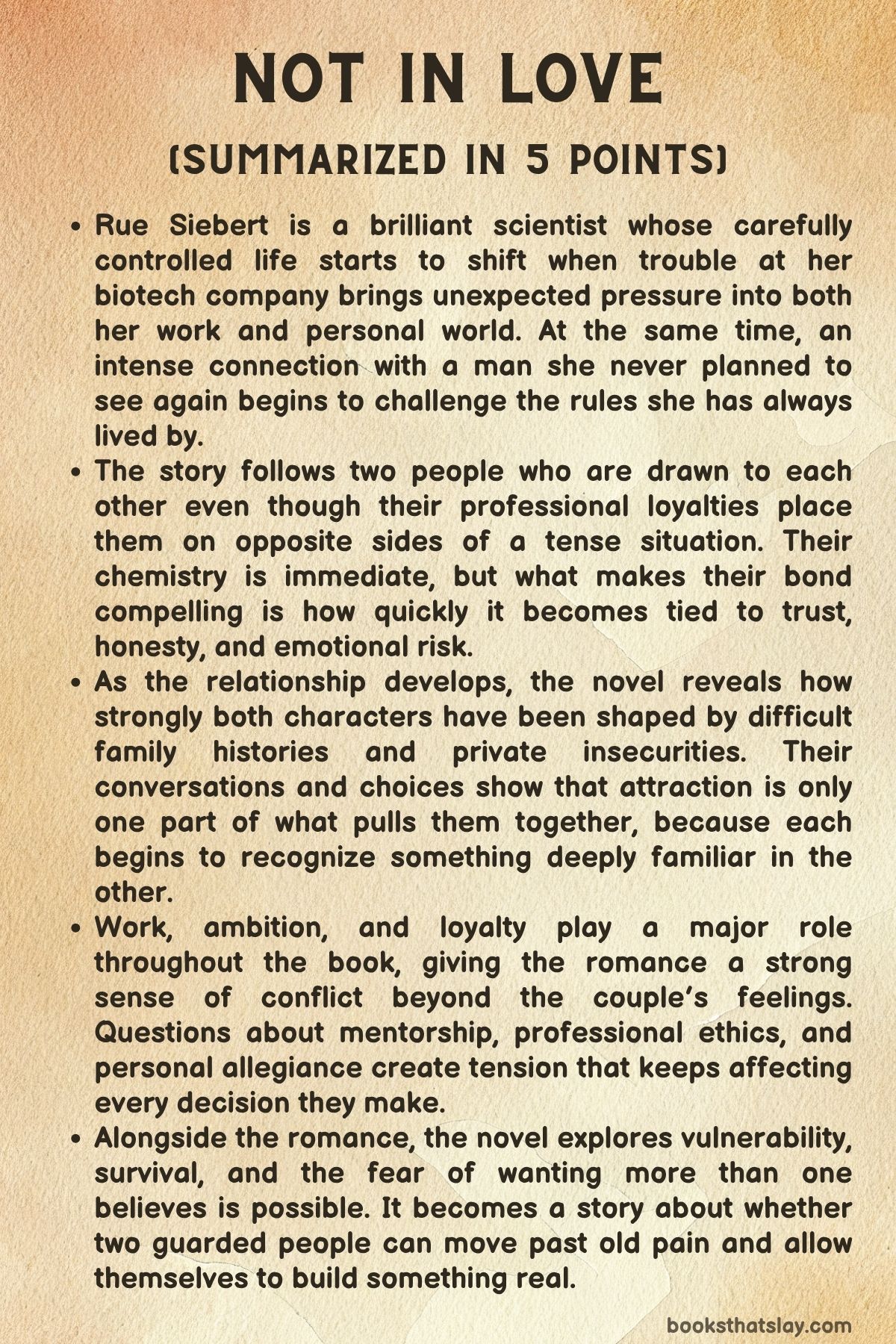
Not in Love by Ali Hazelwood is a contemporary romance that pairs sharp science-world tension with a deeply personal love story. Set around a biotech company under financial pressure, the novel follows Rue Siebert, a brilliant but guarded engineer, and Eli Killgore, a private equity partner whose business goals put him in direct conflict with her world.
What begins as raw attraction turns into something far more complicated as trust, loyalty, old betrayals, and long-buried pain come to the surface. The book balances desire and vulnerability with questions about ambition, ethics, friendship, and what it takes to let another person truly know you. It’s the first book in the Not in Love series.
Summary
Rue Siebert is a scientist at Kline, a biotech startup where she works closely with her best friend, Tisha, and the company’s founder, Florence Kline. Rue is fiercely loyal to Florence, who mentored her and helped shape her career.
When Rue learns that Kline’s loan has been reassigned to a private equity firm called the Harkness Group, she and her coworkers immediately fear for the future of the company. Their unease deepens when the Harkness team arrives in person to examine Kline’s operations.
Rue is stunned to see that one of the representatives is Eli Killgore, the same man she nearly slept with the night before after meeting him through an app for casual encounters.
Their first meeting had left a strong impression on both of them. Eli had been drawn to Rue at once, and when her brother Vincent showed up drunk and hostile, Eli stepped in to make sure she got home safely.
During the drive, they shared flashes of honesty, quick wit, and mutual attraction. Rue gave him her number at the end of the night, and both left thinking about what might have happened if they had not been interrupted.
Seeing each other again in a professional setting changes everything. Rue now views Eli as part of a threat to Florence and Kline, while Eli insists that his firm is simply protecting its investment.
Despite their distrust, they cannot ignore the force pulling them together. Eli seeks her out at work, offering help in her lab and showing that he understands more science than his finance role suggests.
Rue learns that he is intelligent, capable, and attentive in ways she did not expect. Their conversations begin to include not only technical work but also private confessions, with each revealing painful truths they rarely share with anyone.
This pattern becomes central to their connection: sex and emotional honesty arrive side by side, and both feel safer with each other than either wants to admit.
Rue’s loyalty to Florence remains a major barrier. Florence is not just her boss but a friend and protector.
Rue has built much of her identity around work, and Florence’s approval matters deeply to her. Tisha, practical and blunt, recognizes the danger in Rue’s involvement with Eli and worries that it could damage both Rue’s career and Florence’s position.
At the same time, Tisha also suspects that Eli may know more about Harkness’s plans than he lets on. Rue tries to keep her distance, but after a charged encounter at a party, she and Eli finally give in and begin a sexual relationship.
Their intimacy quickly becomes more serious than either intended. Rue has always avoided emotional entanglement and treated sex as something separate from love.
She does not date, does not build romantic expectations, and does not believe herself suited for the kind of attachment other people seem to want. Eli, however, starts wanting more almost at once.
He is patient with her boundaries, deeply attentive to her comfort, and increasingly open about his own life. Rue meets his sister Maya, learns about his past engagement, and begins spending time at his home.
He cooks for her, shares quiet routines with her, and slowly becomes a source of safety.
At the same time, the conflict around Kline grows more serious. Harkness is looking for proof that Florence violated the terms of the company’s loan, because if she did, they could gain control over Kline and its valuable technology.
Eli’s partners, especially Hark and Minami, are focused on uncovering the truth. It becomes clear that their interest in Florence is not only financial.
There is personal history here, one Florence has concealed. Rue begins noticing odd details, including evidence that Florence knew members of Harkness years ago despite denying it.
Her trust in Florence starts to crack.
The strain in Rue’s life is worsened by Vincent, with whom she shares ownership of their late father’s cabin in Indiana. Their childhood was marked by abandonment, poverty, hunger, and instability after their father left and their mother proved unable to care for them consistently.
Rue carries lasting scars from that upbringing. Food insecurity has shaped the way she eats and the way she sees herself.
She still feels guilty for leaving Vincent behind when she went to college, even though that escape was the start of her survival. Vincent’s anger over the cabin and his aggressive behavior keep reopening old wounds.
As Rue and Eli become closer, they begin telling each other the truths beneath their polished adult selves. Eli explains that he effectively became responsible for Maya after their parents failed them.
Rue finally tells him the full story of her childhood, including the hunger, fear, and shame she has carried for years. Instead of recoiling, Eli responds with compassion.
He does not judge her for surviving in the only ways she could. His acceptance gives Rue a kind of relief she has never known.
The central revelation arrives when Rue learns the truth about Florence’s past. Long ago, Florence was the academic advisor of Eli, Hark, and Minami.
She stole Minami’s scientific work, claimed the breakthrough as her own, and used it as the basis for the technology that eventually became the foundation of Kline. She later defended herself in ways that hid Minami’s role and protected her own career.
Harkness was founded partly out of the damage caused by that betrayal and the desire to reclaim what had been taken. For Rue, this revelation is devastating.
Florence has not only lied to her but has repeated the same pattern of manipulation with Rue’s own invention.
Rue discovers that Florence never properly secured Rue’s rights to her microbial food-coating technology, even though she led Rue to believe otherwise. In legal terms, the invention is vulnerable and could be sold off as part of Kline’s assets.
Rue feels humiliated and betrayed. She realizes that the same mentor she trusted completely has treated her as a tool, much as she once treated Minami.
Eli now faces his own impossible choice. Harkness can finally get the outcome it has wanted for years by taking fuller control of Kline, but saving Rue’s patent may require compromise.
Hark is furious that Eli is willing to put Rue ahead of the firm’s original mission. Even so, Eli chooses Rue.
He negotiates a deal in which Harkness gains a controlling share of Kline, Florence keeps a smaller role, and Rue’s patent is formally protected through a board-ratified contract. He also helps arrange a solution to Rue’s cabin dispute with Vincent.
Eli makes these choices knowing they may cost him his standing with Hark and leave him heartbroken if Rue still cannot return his feelings.
Rue, meanwhile, resigns from Kline after confronting Florence and refusing to excuse what she has done. Florence tries to justify her actions as necessary for survival in a difficult system, but Rue no longer accepts that logic.
She sees clearly that Florence’s ambition repeatedly came at the expense of people who trusted her.
Although Eli has done everything he can for Rue, he believes she still does not love him. Rue has spent so long thinking of herself as someone unsuited for love that she struggles to say what she feels.
With encouragement from Minami and after recognizing that fear is the real thing holding her back, she decides to act. She arranges to meet Eli at a skating rink, a place connected to both their pasts.
There, she tells him the truth: he has changed how she understands love, and she wants to be with him despite her fears. Eli accepts her without hesitation.
A year later, they are together at Rue’s cabin in Indiana, building a life that once seemed impossible to her. Rue is more at ease with love, friendship, and hope.
Surrounded by the place that once symbolized loss, she now has a future. During a walk in the woods with Eli and his dog, Tiny, Eli proposes, and Rue says yes, embracing the happiness she once believed she could never have.
Characters
Rue Siebert
Rue is the emotional center of the story, and her character is built around contradiction: she is brilliant yet guarded, deeply feeling yet outwardly detached, hungry for connection yet convinced she is not made for love. Her intelligence is obvious in her scientific work, where she is precise, disciplined, and original, but her emotional life is much harder for her to navigate.
She prefers rules, distance, and control because those things feel safer than vulnerability. Casual sex has long suited her because it allows physical closeness without the terrifying uncertainty of emotional dependence.
What makes her such a strong protagonist is that this detachment is not coldness for its own sake; it is a survival strategy shaped by abandonment, food insecurity, instability, and years of carrying guilt about leaving her younger brother behind. Her habits, her reserve, and even the way she approaches meals all reveal how thoroughly childhood deprivation still lives inside her.
Rue’s loyalty is one of her defining strengths, but it is also one of the traits that leaves her vulnerable to betrayal. She loves very few people, yet when she does, she commits completely.
That is why Florence’s deception wounds her so deeply. Rue does not simply admire Florence professionally; she has built part of her identity around Florence’s mentorship and approval.
When that foundation cracks, Rue is forced into one of the most painful recognitions of the novel: that trust can be sincere on one side and still be exploited on the other. Her relationship with Eli becomes meaningful partly because he sees her without trying to reshape her.
He recognizes both her competence and her pain, and he does not ask her to become easier, softer, or simpler in order to be loved. Rue’s growth lies not in becoming a different person, but in allowing herself to believe that the person she already is can be chosen fully.
By the end, she does not lose her seriousness or caution; she simply stops confusing self-protection with destiny.
Eli Killgore
Eli is presented at first as a threat, then as a romantic lead, and finally as a man whose emotional depth runs far deeper than his controlled exterior suggests. He enters the story as one of the people examining Kline from the outside, which immediately places him in opposition to Rue.
Yet even in those early scenes, he is marked by restraint, protectiveness, and attentiveness. He is not written as reckless or predatory; instead, he is careful with consent, observant about discomfort, and unusually willing to let Rue set the terms of their interactions.
This gives his character a quiet steadiness that separates him from the role he appears to occupy at first glance. Though he works in finance, his scientific background matters because it signals a split in his life: he is someone who once belonged more directly to the world Rue inhabits, and that helps explain why he can understand both the emotional and intellectual stakes of the conflict.
What gives Eli real weight as a character is the degree to which he is shaped by responsibility. Much of his life has been defined by having to step up when the adults around him failed.
His care for Maya is not presented as a symbolic gesture but as a lived burden that altered the course of his adulthood. He knows what it means to build stability out of chaos, and that history is one reason he responds to Rue with such instinctive empathy.
He understands damage without sentimentalizing it. He also understands anger, especially the kind that lasts for years, which is why the old wound involving Florence matters so much to him.
Still, what ultimately defines him is not revenge but choice. When forced to decide between the founding purpose of Harkness and the woman he loves, he chooses love without becoming weak or passive.
That choice does not erase his ambition or his loyalty to his friends, but it reveals his moral center. He is compelling because he combines strength with tenderness, desire with patience, and competence with emotional risk.
Florence Kline
Florence is one of the most complex figures in the story because she is neither a simple villain nor a misunderstood innocent. She is charismatic, accomplished, and capable of inspiring deep loyalty, which explains why Rue and Tisha trust her so completely.
As a mentor, she has clearly changed lives. She has opened doors for younger women in science, offered guidance, and built a company that gives talented people meaningful work.
That surface truth is important, because it prevents her from feeling flat or purely malicious. She is the kind of person who can be generous and exploitative at once, and that duality is central to her role.
She represents the danger of charisma when paired with self-justification. People around her are not foolish for believing in her; rather, she is genuinely skilled at making her ambition look like necessity and her betrayals look like hard choices.
Her most revealing trait is her ability to rationalize harm. She tells herself that the system is unfair, that she had limited options, and that her theft of Minami’s work must be understood in the context of sexism, professional pressure, and personal unhappiness.
There is truth in some of what she says about structural inequality, but the novel does not let that truth excuse what she did. Florence’s tragedy is that she has become someone who cannot admit the full moral cost of her actions without threatening the image of herself that she needs in order to keep going.
She repeats the same pattern with Rue, allowing a younger woman to believe her work is protected when it is not. In that sense, Florence is not only a betrayer of individuals but also a betrayer of the very mentorship she appears to embody.
She is effective as a character because she forces the story to ask difficult questions about power, survival, and whether suffering within a broken system gives anyone the right to harm others.
Tisha
Tisha serves as Rue’s closest friend, emotional anchor, and reality check. Her importance goes beyond friendship because she often voices the truths Rue is unwilling to face.
Where Rue is tightly controlled and inward, Tisha is more direct, expressive, and socially agile. This contrast makes their bond feel balanced and durable.
Tisha knows Rue well enough to recognize when she is in danger of fooling herself, and she does not hesitate to push when necessary. At times she treats Rue’s connection with Eli with irreverent humor, and at other times she warns her bluntly that she may be stepping into something genuinely risky.
That flexibility shows emotional intelligence. She can joke, provoke, protect, and comfort, often in the same conversation.
Tisha also matters because she broadens the emotional world of the novel. Through her, Rue is shown not as a solitary figure but as someone capable of sustaining long-term, meaningful attachment.
Tisha’s loyalty to both Rue and Florence places her in a difficult position once the truth starts to emerge, and her shock at Florence’s actions helps underline how thoroughly Florence had earned the trust of those around her. Tisha is not merely a sidekick who reacts; she participates in problem-solving, pushes Rue toward clarity, and remains present through the collapse of Rue’s faith in her mentor.
Her role demonstrates that friendship in Not in Love is not decorative. It is one of the structures that keeps Rue standing when romance, work, and family all become unstable.
Minami
Minami is one of the most important supporting characters because she embodies the original injustice that set much of the plot in motion. She is the person whose work was taken, whose future was altered, and whose talent was erased in favor of someone more powerful.
Yet she is not defined solely by victimhood. She is accomplished, perceptive, and emotionally self-possessed, and her presence adds a moral seriousness to the story.
She has every reason to be bitter, yet she is not written as consumed by bitterness. Instead, she comes across as someone who has learned to live with injury without letting it erase her intelligence or her capacity for connection.
That restraint makes her especially powerful.
Minami also functions as a mirror for Rue. Both are brilliant women whose work becomes vulnerable under Florence’s influence, but Minami is the earlier version of a fate Rue nearly repeats.
This parallel helps Rue understand that Florence’s betrayals are not isolated mistakes but part of a pattern. Minami’s conversations and warnings carry weight because she has already lived through the damage Rue is only beginning to grasp.
At the same time, she is not reduced to a moral lesson for Rue’s benefit. Her marriage to Sul, her friendship with Eli, and even the quiet revelation of her pregnancy all give her an interior life beyond the central conflict.
She represents endurance, competence, and the possibility of moving forward without forgetting what was taken.
Conor Harkness
Hark is driven, wounded, and often abrasive, but he is also one of the clearest embodiments of long memory in the story. The firm he helped build was born partly out of anger, and he carries that original grievance more openly than Eli does.
His investment in taking control of Kline is not just strategic. For him, it is tied to humiliation, betrayal, and a desire to finally reverse a past wrong.
That intensity gives him force, but it also makes him rigid. He is less able than Eli to separate justice from vengeance, which is why he reacts so strongly when Eli starts making choices shaped by love rather than by the founding mission of their group.
Hark’s emotional life is marked by unfinished attachments. His history with Minami and his inability to move past it suggest someone who does not recover easily once he has loved or committed.
That trait parallels Eli in an interesting way, but where Eli becomes gentler through love, Hark becomes more brittle through loss. His drinking, his sharpness at dinner, and his frustration with Eli all reveal a man struggling to maintain control over wounds that never properly healed.
He is not meant to be especially warm, but he is understandable. He stands for the seductive logic of making your entire future answer an old injury.
In that sense, he is both a foil to Eli and a warning about what unresolved pain can harden into.
Maya Killgore
In Not in Love, Maya plays a smaller role on the page, but she is crucial to understanding Eli. Through her, the reader sees how much of his identity is tied to caregiving, sacrifice, and loyalty.
Maya’s presence in his home and in his daily life is evidence of a history that has required him to become dependable long before he might have chosen that path for himself. Their sibling relationship has humor, irritation, and affection, which gives it a lived-in credibility.
She is not idealized, and that helps. She teases him, embarrasses him, and moves through his life with the casual familiarity of someone who belongs there completely.
Maya also helps reveal another side of Rue. Rue’s interactions with her show awkwardness, curiosity, and a tentative willingness to step closer to a fuller kind of intimacy.
Meeting a lover’s family often implies emotional seriousness, and Rue’s surprise at her own interest in Maya’s life signals how deeply involved she is becoming. Maya therefore serves as more than background; she is part of the world Eli offers Rue, a world that includes continuity, memory, and ordinary domestic connection.
She helps make love look less abstract and more inhabitable.
Vincent
Vincent is one of the story’s most painful characters because he represents both danger and damage. He is aggressive, unstable, and often frightening in his behavior toward Rue, especially when drunk, yet the novel makes clear that he is also a product of the same deprivation that shaped Rue.
The difference is that Rue found a way out, while Vincent remained trapped much longer inside the emotional and material wreckage of their childhood. This does not excuse his behavior, but it does make him tragic.
He is a living reminder of what survival can look like when it curdles into anger rather than discipline.
For Rue, Vincent carries layered meaning. He is her brother, a source of guilt, a threat, and a symbol of the part of her past she has never managed to resolve.
Their conflict over the cabin is not only financial; it is about memory, abandonment, and inheritance in a deeper sense. The cabin becomes a physical object onto which both siblings project unresolved grief about their father and their childhood.
Vincent’s presence keeps Rue tied to shame she has never fully released, especially her belief that she failed him by leaving. His role in the story is therefore emotionally significant even when he is not physically present.
He is one of the forces that make Rue believe she is fundamentally flawed, which is why Eli’s refusal to condemn her for that history matters so much.
Nyota
Nyota plays a practical role in the plot, but she also contributes a great deal to the story’s emotional architecture. As Tisha’s younger sister and a legal mind, she often becomes the person who translates confusing or threatening situations into something manageable.
Her intelligence is useful in concrete ways, especially when questions of contracts, patents, and property arise, but her deeper function is to bring structure to moments that might otherwise feel overwhelming. She helps Rue with both the cabin dispute and the patent problem, placing her at the intersection of Rue’s personal and professional crises.
What makes Nyota effective is that she never feels like a mere exposition device. Her presence suggests a wider support network around Rue, one built not through sentimentality but through trust and competence.
She belongs to a cluster of women in the story who help each other think, plan, and endure. In a narrative full of secrecy and betrayal, Nyota offers clarity.
She is one of the people who helps turn Rue’s confusion into action.
Jay
Jay may seem secondary, but he plays an important role in establishing Rue’s workplace environment and in highlighting the tension surrounding Eli’s presence at Kline. As Rue’s lab assistant, Jay reflects the ordinary professional world that exists before private equity pressure and romantic entanglement start distorting everything.
His worries about job security and his participation in the rhythm of lab life show what is at stake beyond the main romance. Kline is not just an abstract company in trouble; it is a workplace full of real people whose futures depend on decisions being made above them.
Jay also helps emphasize Rue’s competence. In scenes involving the lab, Rue is clearly in command of her scientific space, and Jay’s dynamic with her reinforces that authority.
When Eli steps into that environment and proves surprisingly capable, the disruption is heightened because the reader has already seen the normal working order. Jay is a useful grounding presence, someone who helps keep the scientific and professional dimension of the narrative visible.
Sul
Sul is quieter than Hark or Minami, but his role matters because he adds stability to the Harkness circle. His marriage to Minami, his friendship with the others, and his participation in the firm all contribute to the sense that this group has a long, tangled history.
Unlike Hark, Sul is less dominated by visible old wounds, and unlike Eli, he is not caught between love and corporate purpose in the same immediate way. This gives him a balancing function.
He helps the group feel less like a collection of dramatic opposites and more like an actual shared community with layered ties.
His relationship with Minami also deepens the emotional landscape around Hark. By simply existing as her chosen partner, Sul becomes part of the unresolved tension in that group’s history.
Yet he is not turned into a rival caricature. Instead, he appears solid, mature, and integrated into the friendships around him.
That steadiness helps underline the idea that not every relationship in the novel is built on crisis. Some are built on mutual trust and time.
Dave and Alec
In Not in Love, Dave and Alec are minor figures, but together they represent care that arrives without possession or control. In both Rue’s and Eli’s earlier lives, the skating rink and the adults connected to it offered something their homes often did not: safety, routine, nourishment, and encouragement.
This matters enormously in a story where childhood instability leaves such lasting marks. Dave and Alec are among the few adults from the past associated with kindness rather than abandonment or exploitation.
Their influence helps explain why both Rue and Eli respond so strongly to places and people linked with steadiness.
They also serve an important structural purpose in bringing Rue and Eli together in spaces outside work and conflict. Around them, the lovers are connected not through secrecy or corporate battle but through shared history and vulnerability.
The rink becomes a place where old selves and present selves can meet. Because of that, Dave and Alec quietly help shift the story from hidden desire toward emotional recognition.
Tiny
Tiny, Eli’s huge dog, may not be a human character, but the dog has a meaningful presence in the emotional world of the novel. Tiny softens Eli’s household, adds humor, and creates moments of instinctive warmth that contrast with Rue’s guardedness.
Rue’s reaction to Tiny also reveals something important about her past. Her childhood jealousy of a friend’s dog is one of the most striking details about her deprivation, because it shows how deeply she associated ordinary care with something available to others but not to her.
That memory turns Tiny into more than comic relief. The dog becomes part of the process by which Rue enters a home that feels abundant, affectionate, and safe.
Tiny also symbolizes the domestic ease Rue never imagined for herself. In scenes at Eli’s house, the dog is part of a world of meals, teasing, conversation, and rest.
That atmosphere helps Rue begin to imagine a future that includes comfort rather than mere endurance. Tiny’s presence is small in plot terms but large in emotional implication.
Themes
Love as Risk, Trust, and Relearning the Self
What gives the central relationship its force is not simple attraction but the fact that both Rue and Eli come to each other with lives already shaped by disappointment, obligation, and emotional self-defense. Rue does not enter romance hoping to be transformed by it.
She has built a functioning life around limits, distance, and control. Sex, for her, has long been easier than emotional dependence because physical desire can be contained, while love threatens exposure.
Eli unsettles that system because he does not treat intimacy as a game of pressure or performance. He listens, notices, and remembers.
He understands that trust is not created through declarations alone but through consistency, patience, and the willingness to remain present when another person reveals something ugly, painful, or shameful. Because of this, the relationship develops not through grand speeches at first but through repeated moments in which both characters choose honesty over self-protection.
This theme matters because the novel does not treat love as a magical cure. Rue’s fear does not disappear just because she meets the right person.
Her childhood deprivation, guilt over Vincent, and belief that she is somehow built wrong continue to shape her choices even after she begins to care for Eli deeply. She still pulls away, mistrusts what she wants, and struggles to believe that emotional safety can last.
Eli has his own history of burden and disappointment, and that history makes him serious about what it means to commit to someone. Love, then, becomes a process of relearning the self rather than escaping the self.
Rue has to confront the idea that she may have mistaken emotional caution for identity. She has to ask whether her belief that she cannot love is actually truth or merely an old conclusion drawn from pain.
Eli, meanwhile, has to accept that loving someone does not guarantee immediacy or certainty in return.
By the end, the novel argues that love is not valuable because it removes fear, but because it creates the possibility of moving through fear with another person. The emotional resolution feels earned because it grows out of difficult self-recognition.
Rue does not become romantic in a generic way, and Eli does not save her by force of devotion alone. Instead, both arrive at a relationship that is meaningful precisely because it asks for vulnerability from people who have spent years surviving without it.
In Not in Love, love becomes an act of courage that requires trust, confession, and a willingness to imagine that one’s future does not have to be governed entirely by one’s past.
Betrayal, Mentorship, and the Abuse of Power
One of the most unsettling ideas in the story is that betrayal is most damaging when it comes wrapped in guidance, care, and professional opportunity. Florence occupies a powerful role in Rue’s life not only as a boss but as a mentor, advocate, and friend.
She is someone who helped shape Rue’s career and gave her a place to belong in a demanding scientific environment. That is exactly why her deception cuts so deeply.
The novel is interested in the specific kind of harm that occurs when authority is mixed with intimacy, when a person who has nurtured talent also claims ownership over it, manipulates loyalty, and expects gratitude to survive even after trust has been broken. Florence is not a stranger exploiting Rue from a distance.
She is someone whose approval has emotional value, and that makes her actions harder to confront and more painful to name.
This theme extends beyond Rue’s situation and is rooted most powerfully in Minami’s past. Florence once occupied the role of academic advisor to Minami, Eli, and Hark, and she used that position to take Minami’s work for herself.
The betrayal is not only intellectual theft; it is also the corruption of what mentorship is supposed to mean. A mentor should protect, challenge, and elevate.
Florence instead treats the vulnerability of younger scientists as an opportunity. The novel is sharp in showing how power can justify itself through narrative.
Florence frames her choices as necessary responses to sexism, institutional barriers, and personal unhappiness. Some of those pressures are real, but the story does not allow structural unfairness to excuse private exploitation.
It insists that being harmed by a system does not give someone moral permission to harm those beneath them.
The repetition of Florence’s behavior with Rue makes the theme even stronger. She again creates a situation in which a younger woman believes her work is protected, only to reveal that the security was never real.
This pattern shows that betrayal here is not accidental or isolated; it is built into how Florence relates to ambition and control. Her tragedy is not that she is misunderstood but that she can still see herself as justified while standing on the damage done to others.
The novel therefore presents mentorship as something ethically serious. It can build futures, but when corrupted by ego, fear, or career hunger, it can also become a deeply personal form of theft.
In Not in Love, power is most dangerous when it borrows the language of care.
Survival, Scarcity, and the Long Afterlife of Childhood
Rue’s childhood is not treated as backstory that merely explains a few personality traits. It is an active force in the present, shaping how she eats, how she trusts, how she relates to pleasure, and how she understands guilt.
The scarcity she grew up with does not end simply because she is now educated, employed, and professionally respected. Hunger has remained inside her as memory, habit, and bodily knowledge.
Her need to sit down and eat slowly, her distress around rushed meals, and the shame she still carries about food all show that deprivation continues to govern her long after the original crisis has passed. This gives the novel an unusually grounded understanding of trauma.
It does not describe survival as a heroic upward arc in which pain is neatly left behind. Instead, it shows that childhood instability can become part of a person’s internal architecture, affecting even the most ordinary acts.
Vincent’s presence deepens this theme by showing that siblings can emerge from the same damaged home carrying radically different forms of ruin. Rue’s guilt over leaving him behind is central to how she sees herself.
She interprets her own escape through college and science not only as survival but also as a possible abandonment. Vincent, meanwhile, becomes a reminder of the life she could not control and the suffering she could not prevent.
Their conflict over the cabin is emotionally powerful because the property stands for far more than inheritance. It carries unresolved grief about their father, their fractured family, and the impossible choices forced on children who had too little.
Rue wants to hold on to the cabin partly because it is one of the few tangible links to a history she has never fully made peace with. Vincent wants resolution through aggression and urgency, reflecting his own unprocessed anger.
Eli’s history with Maya creates an important parallel. He too was shaped by parental failure and by the need to take responsibility too early.
This shared background is one reason he can understand Rue without reducing her to damage. Their connection suggests that being marked by scarcity does not guarantee similarity in behavior, but it can create a language of recognition between people who know what instability costs.
The novel does not romanticize hardship, nor does it suggest that suffering automatically produces wisdom. What it does suggest is that deprivation leaves patterns that must be named before they can loosen.
Rue’s movement toward a healthier future depends in part on her willingness to stop treating her survival responses as evidence of brokenness. In Not in Love, childhood scarcity is not a closed chapter.
It is a living inheritance, and healing begins when its effects are faced without shame.
Ambition, Ethics, and the Cost of Success
Professional success in the novel is never presented as a neutral achievement. Scientific innovation, startup growth, patents, loans, and corporate takeovers all exist inside a moral landscape where every advancement raises questions about ownership, loyalty, and the stories people tell to justify what they want.
Florence stands at the center of this theme because she represents what ambition can become when ethics are treated as flexible. She is talented and hardworking, but those qualities are not enough for the novel to view her sympathetically on professional grounds.
Her career is built in part on taking work that did not belong to her, and her company’s future is protected through concealment, manipulation, and the exploitation of trust. What makes her compelling is that she does not see herself as wicked.
She sees herself as someone who made harsh choices in a hostile world. That self-understanding is what makes the ethical tension so sharp.
The novel is interested in how often success is defended as necessity, especially in competitive institutions where recognition and resources are scarce.
The Harkness Group adds another layer to this theme by complicating the idea of justice. On one level, their pursuit of Kline is a response to a real wrong.
They are not inventing Florence’s betrayal. They want accountability, control, and access to what was stolen.
Yet the firm also operates through the logic of acquisition, leverage, and strategic pressure. Even when their cause has legitimacy, their methods are shaped by money and power.
This prevents the conflict from collapsing into a simple battle between innocence and corruption. Instead, the story asks what happens when ethical injury is pursued through systems that are themselves hard, transactional, and self-interested.
Eli becomes the key figure here because he lives at the crossroads of those tensions. He understands Harkness’s goal, shares its history, and respects what is owed to Minami, but he is also forced to face the possibility that justice without mercy can become another form of harm.
Rue’s patent crisis sharpens the theme further. She has done the intellectual labor, created valuable work, and trusted the wrong authority to protect it.
The legal vulnerability of her invention shows how easily a person’s brilliance can be converted into an asset for someone else when structures of ownership are not transparent. Science in the novel is full of possibility, but it is also vulnerable to careerism, institutional gamesmanship, and economic predation.
The final negotiated outcome matters because it does not claim that ambition itself is corrupt. People still build companies, file patents, and pursue influence.
What changes is the insistence that success without integrity is hollow, and that professional achievement gained through theft or deception carries a moral cost that cannot be disguised forever. In Not in Love, ambition is not condemned, but it is placed under pressure until the reader must ask what kind of success is worth wanting and what kind leaves too much damage behind.