Well Versed by Jen DeLuca Summary, Characters and Themes
Well Versed by Jen DeLuca is a contemporary second-chance romance about Caitlin Parker, a woman whose reluctant return to the Willow Creek Renaissance Faire forces her to confront an old heartbreak and reconsider the future she has planned for herself.
When Alexander Wright, the man who broke her heart seven years earlier, unexpectedly reappears, Caitlin discovers that neither of them has entirely escaped their past. Set against a lively world of Shakespearean performances, sword fights, royal ceremonies, and close friendships, the novel explores forgiveness, emotional vulnerability, personal growth, and the possibility of finding happiness in a life that looks nothing like the one originally imagined. It’s the 5th book of the Well Met series.
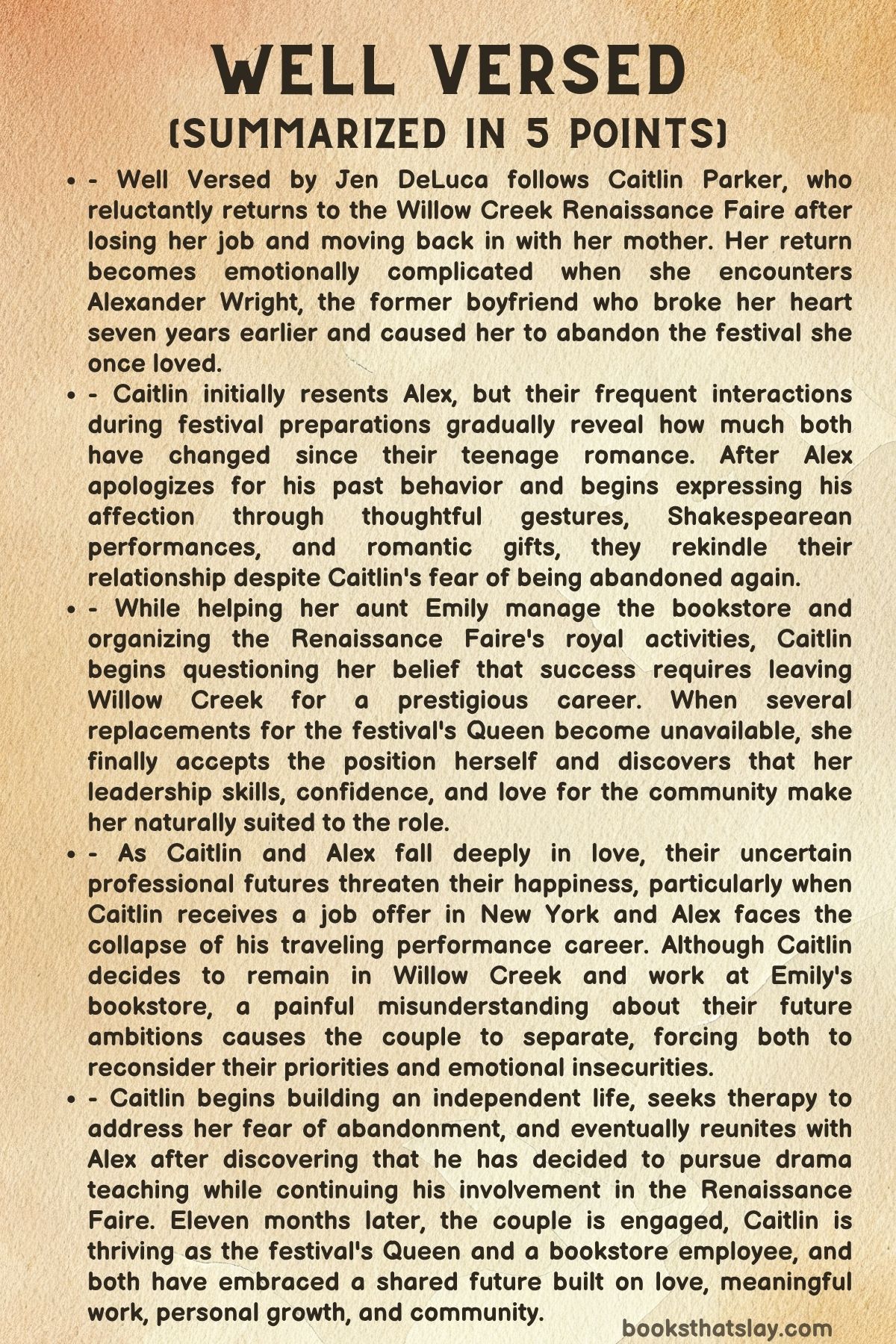
Summary
Caitlin Parker returns to Willow Creek after losing her job, moving back into her mother’s house and reluctantly agreeing to help at the town’s Renaissance Faire. Her aunt Emily has unexpectedly become the festival’s new Queen, and Caitlin promises to serve as her lady-in-waiting for one weekend, despite having avoided the event for seven years.
The Faire was once the center of Caitlin’s summers, a place where she developed lasting friendships and discovered her love of Shakespeare and performing. However, it also reminds her of Alexander Wright, a young sword fighter who became her first serious love before ending their relationship through increasingly distant messages and a final text.
Caitlin believes she can safely return because Alex’s former performing group, the Sword Bros, has disbanded. Unfortunately, during Emily’s first royal appearance, she discovers Alex participating in a new attraction called Shakespeare on Demand, and the unexpected reunion immediately revives her resentment.
Overwhelmed, Caitlin attempts to abandon her duties, but Stacey MacLean, an old friend and former singing mentor, encourages her to reconsider. Watching the familiar human combat chess match reminds Caitlin how much happiness she sacrificed by allowing her heartbreak to drive her away from a place she loved.
When Alex approaches her, Caitlin refuses to pretend that their history was insignificant. She eventually admits that his rejection was the reason she stopped attending the Faire, leaving him to confront the consequences of his youthful behavior.
An accident during the chess match brings them into closer contact when Mitch Malone, Caitlin’s mother’s partner, injures his ankle. Alex and Caitlin work together to help Mitch backstage, and his injury ultimately requires Alex to replace him in the festival’s sword-fighting performances.
The arrangement means Alex must regularly rehearse with Simon, Emily’s husband, in Caitlin’s backyard. Unable to escape him, Caitlin begins noticing that the man before her seems more thoughtful and responsible than the charming teenager she remembers.
Meanwhile, Caitlin helps Emily organize Read It & Weep, the bookstore her aunt recently purchased. Although she continues searching for a technology job elsewhere, the work provides unexpected satisfaction and allows Emily to explain how her own unplanned return to Willow Creek eventually led her toward a rewarding career and marriage.
Caitlin remains skeptical that abandoning carefully constructed plans could lead to happiness. Nevertheless, the bookstore, her family, and her renewed involvement in the Faire gradually challenge her certainty that leaving town is necessary for professional and personal success.
A significant change occurs when Alex visits the bookstore to collect Shakespeare books. Their conversation moves from literature and music to the painful circumstances of their separation, and Alex finally admits that he mishandled their relationship because he was too young and emotionally inexperienced to understand his feelings.
He explains that what began as a casual summer romance became unexpectedly serious, frightening him into withdrawing instead of communicating honestly. Caitlin also reveals how his rejection, combined with her father’s abandonment, left her terrified of trusting romantic partners.
When Caitlin notices that Alex still wears the silver ring decorated with asters that she gave him years earlier, she realizes their relationship mattered deeply to him. Alex explains that he kept it as a reminder to treat other people’s feelings with greater care, and his admission makes forgiveness seem possible.
Determined to help Caitlin rediscover the festival’s magic, Alex takes her to a secluded woodland clearing and later presents her with a handcrafted green leather rose. Declaring himself her champion before the chess match, he revives the courtly traditions that once made their relationship special.
Caitlin’s emotional defenses weaken as Alex repeatedly demonstrates his affection through thoughtful gestures rather than empty promises. During the closing festivities, their mutual attraction becomes impossible to ignore, and they share their first kiss in seven years.
Although the kiss awakens powerful feelings, Caitlin convinces herself that she can pursue a temporary relationship without risking another heartbreak. Her fear of emotional dependence remains strong, especially because she expects to leave Willow Creek once she secures another job.
At the same time, the Faire struggles to find a permanent Queen when Stacey, who temporarily replaces Emily, discovers that the responsibilities conflict with her traveling musical career and marriage. Caitlin eventually recruits Lulu Malone, a confident lawyer connected to the festival community, and helps prepare her for the demanding role.
As Caitlin and Alex spend more time together, their relationship becomes increasingly intimate. Alex expresses genuine interest in the woman she has become, while Caitlin begins realizing that their connection extends beyond nostalgia and physical attraction.
Her mother, April, offers an important perspective by explaining how her own marriage failed partly because she and Caitlin’s father never developed a shared understanding of their future. April contrasts that experience with her relationship with Mitch, which succeeds because they communicate and accept one another’s needs.
After Alex surprises Caitlin with white roses, they spend an intimate evening together that strengthens their emotional connection. Later, they enjoy ordinary dates, visit an ice-cream shop, and relax in the park, allowing Caitlin to experience the comfortable companionship she has avoided for years.
Lulu initially performs well as Queen, although an episode of heat exhaustion exposes the physical demands of the role. Her relationship with Dex also gives Caitlin a valuable example of how two people with different careers can sustain a partnership through compromise and flexible arrangements.
Caitlin begins wondering whether she and Alex might eventually build something similar. Before she can fully explore that possibility, she receives an invitation to interview for an assistant IT manager position in New York, placing her original career ambitions directly against her growing attachment to Willow Creek.
Alex soon reveals that his own future is equally uncertain. His traveling performance career has become financially unsustainable following the collapse of the Sword Bros, and his parents expect him to return home and pursue a conventional job in his father’s insurance business.
Caitlin recognizes his disappointment because she has also struggled with the loss of her intended career path. However, she begins realizing that both of them might need to reconsider their definitions of success if they want to remain together.
When Lulu must unexpectedly return to Virginia for an urgent legal matter, the Faire once again finds itself without a Queen. After months of preparing and supporting other women in the position, Caitlin finally agrees to accept the crown herself.
Despite her initial anxiety, she excels at the opening ceremonies and confidently manages the festival’s complicated activities. Her natural leadership and extensive knowledge of its traditions convince her that she belongs at the center of the community she once rejected.
Alex celebrates her achievement by presenting her with a blue rose and arranging a private evening together at a hotel. Away from their families and festival responsibilities, they confess their love, although neither knows how to reconcile their approaching separation with their desire to remain together.
The Faire’s final day arrives with a mixture of celebration and sadness. Caitlin receives praise from the performers and vendors for her abilities as Queen, strengthening her realization that the festival has once again become an essential part of her identity.
During the closing performances, Alex joins Dex to present a musical adaptation of a Shakespearean sonnet. Caitlin recognizes the romantic meaning behind the roses Alex has given her throughout the season, understanding that the performance is an expression of his love.
Their farewell afterward is painful because their feelings have become undeniable, yet their futures appear incompatible. Alex prepares to abandon professional performing, while Caitlin continues pursuing employment outside Willow Creek.
Following the festival, Caitlin successfully interviews for the New York position, but Emily offers her an alternative: a full-time job helping manage Read It & Weep. The opportunity would allow her to remain close to her family, establish a stable career, and continue serving as Queen.
Caitlin and Alex subsequently visit the larger Maryland Renaissance Festival, where they spend a joyful day watching performances and exploring attractions. Inspired by everything she sees, Caitlin finally realizes that she wants to remain in Willow Creek and contribute to the future of its Faire.
She decides to accept Emily’s offer rather than the New York position. Unfortunately, when she attempts to discuss a possible future with Alex, his distress about abandoning professional performing prevents him from listening to her suggestions about combining theater education with festival performances.
Alex dismisses the prospect of conventional employment, unintentionally making Caitlin feel that he considers her chosen lifestyle uninteresting. Believing their differences are impossible to overcome, she ends their relationship despite still loving him.
Devastated, Caitlin turns to April, who encourages her to stop measuring her worth through other people’s acceptance. Caitlin recognizes that her fear of abandonment has influenced her reactions for years and decides to seek professional counseling while building an independent life in Willow Creek.
She begins working full-time at the bookstore and searches for an apartment near her workplace. During a viewing at a renovated historic hotel, she unexpectedly encounters Alex, who reveals that he has rented the neighboring apartment and never actually left town.
Alex explains that he has been pursuing the qualifications necessary to teach drama at the local high school. He also intends to direct the Faire’s human combat chess match, allowing him to combine a stable profession with his passion for theatrical performance.
He apologizes for allowing his fear and disappointment to control their earlier conversation, while Caitlin reveals that she had been attempting to suggest almost exactly the same solution. They finally communicate openly about their desires, recognize that their futures can complement one another, and reconcile.
Eleven months later, Caitlin is flourishing in Willow Creek as a bookstore employee and the Faire’s official Queen. Alex has found a satisfying professional direction, and the two are engaged after a romantic proposal involving roses and an emerald ring decorated with asters.
Caitlin continues attending therapy, while both contribute new ideas to the Renaissance Faire and prepare for their wedding. Having abandoned the belief that security requires emotional isolation or rigid plans, Caitlin embraces a future built around love, meaningful work, family, and the community where she has finally found her place.
Characters
Caitlin Parker
Caitlin Parker is the central protagonist of Well Versed, and her development reflects the difficult process of rebuilding confidence after disappointment. At the beginning of the novel, she is unemployed, living with her mother, and convinced that returning to Willow Creek represents a personal failure.
Her outward independence conceals a profound fear of emotional abandonment. Having experienced her father’s withdrawal and Alex’s painful rejection, she approaches romantic relationships with the expectation that people she loves will eventually leave.
Consequently, Caitlin protects herself by ending relationships before they become serious. Although she presents this behavior as practical self-preservation, it prevents her from experiencing the trust and companionship she secretly desires.
Her relationship with the Renaissance Faire reflects this defensive personality. She abandons something she genuinely loves because it reminds her of Alex, demonstrating how thoroughly her past experiences have influenced her decisions.
As she returns to the Faire, Caitlin gradually rediscovers abilities and interests she previously dismissed. Her intelligence, organizational skills, understanding of Shakespeare, and capacity to support others become increasingly apparent as she guides successive women through the responsibilities of being Queen.
Her professional uncertainty also reveals how strongly she associates personal success with following a predetermined career path. Working at Emily’s bookstore challenges that assumption because the position offers meaningful responsibilities and satisfaction despite differing from her original ambitions.
Caitlin’s transformation becomes particularly evident when she accepts the role of Queen. Rather than remaining behind the scenes, she publicly embraces her competence and discovers that she can lead with authority, confidence, and genuine enjoyment.
Her reconciliation with Alex represents another important achievement, but her development extends beyond finding romantic happiness. By seeking therapy, choosing a career that suits her, and creating an independent home, she learns that a fulfilling relationship should complement her identity rather than determine her worth.
Alexander Wright
Alexander Wright, commonly called Alex, serves as the romantic male lead and a central figure in Caitlin’s emotional journey. His development in Well Versed focuses on accountability, maturity, professional identity, and the difficulty of accepting change.
As a teenager, Alex enjoyed the attention and excitement associated with performing as a sword fighter. He initially regarded his relationship with Caitlin as a temporary summer romance, only to discover that his feelings were more serious than he understood.
Unable to handle the emotional responsibility of a committed relationship, he withdrew and ultimately ended things through a text message. Although his behavior caused Caitlin lasting pain, his decision to keep her silver ring reveals that he never regarded their relationship as meaningless.
When the novel brings them together again, Alex demonstrates greater awareness of his earlier failures. Rather than dismissing Caitlin’s anger, he apologizes, acknowledges his responsibility, and attempts to establish a connection based on honesty.
His romantic gestures reflect his understanding of what matters to Caitlin. By introducing her to a woodland clearing, presenting handcrafted roses, and performing Shakespearean poetry, he reconnects with the interests and experiences that originally brought them together.
Nevertheless, Alex has his own insecurities. The collapse of his performing career leaves him frightened that accepting conventional employment will mean surrendering the identity he has spent years creating.
This fear contributes to the misunderstanding that temporarily destroys his renewed relationship with Caitlin. His inability to listen during their disagreement reveals that emotional maturity requires more than regret over past mistakes.
Alex ultimately demonstrates genuine growth by pursuing teaching qualifications and accepting responsibility for the Faire’s theatrical performances. He discovers that stability and creativity can coexist, allowing him to build a future with Caitlin without entirely abandoning his artistic ambitions.
Emily
Emily is Caitlin’s aunt, Simon’s wife, and the owner of Read It & Weep. Her importance in Well Versed extends beyond family support because her personal history offers Caitlin an alternative understanding of success and fulfillment.
Having arrived in Willow Creek after unexpected changes in her own life, Emily knows that meaningful opportunities do not always emerge from carefully constructed plans. Her experiences with family responsibilities, marriage, the Renaissance Faire, and bookstore ownership demonstrate how unpredictable circumstances can produce rewarding outcomes.
Emily’s temporary position as Queen also establishes the story’s central organizational challenge. Her difficulty balancing the festival with the bookstore creates opportunities for other characters to discover their abilities, especially Caitlin.
Although Emily occasionally contributes to Caitlin’s discomfort, particularly by unintentionally bringing her into contact with Alex, her intentions remain supportive. She apologizes when necessary and continues encouraging her niece to reconsider the assumptions that limit her happiness.
Her offer of full-time employment becomes a turning point in Caitlin’s professional development. Rather than treating Caitlin’s return as a setback, Emily recognizes her abilities and provides a practical way for her to build a satisfying life in Willow Creek.
Emily represents the value of adaptability and demonstrates that personal fulfillment can develop from choices that initially seem like deviations from an intended future.
April Parker
April Parker is Caitlin’s mother and one of the most influential figures in her emotional development. Her role in the novel is particularly significant because her history with Caitlin’s father provides context for the protagonist’s fear of failed relationships.
April understands the consequences of entering a marriage without establishing compatible expectations. When discussing her previous relationship, she explains that emotional attachment alone cannot guarantee a successful partnership if two people want fundamentally different futures.
Her relationship with Mitch provides a contrasting example of stability and mutual understanding. Through this partnership, April demonstrates that finding love after disappointment is possible without sacrificing personal identity.
Although Caitlin initially conceals her romantic life from her mother, April eventually becomes an important source of guidance. She recognizes her daughter’s distress after the separation from Alex and encourages her to consider whether she has been defining herself through other people’s decisions.
April’s importance in Well Versed is also evident in her willingness to support Caitlin’s decision to remain in Willow Creek. She does not pressure her daughter to pursue an externally impressive career but instead encourages her to choose a future that reflects her own priorities.
Through April, the novel emphasizes the difference between protecting a loved one and controlling their choices. Her guidance helps Caitlin understand that emotional security must begin with self-respect rather than dependence on another person’s approval.
Mitch Malone
Mitch Malone is April’s partner and an important source of stability within Caitlin’s family. His presence in Well Versed provides a positive contrast to Caitlin’s absent father, showing how reliability, affection, and shared responsibilities can strengthen relationships.
Mitch is actively involved in the Renaissance Faire, where he performs in the human combat chess match alongside Simon. His enthusiasm for sword fighting and theatrical entertainment makes him a valued member of the festival community.
When he injures his ankle during a performance, his temporary inability to participate creates an important change in the story. Alex replaces him, bringing the former lovers into regular contact through the backyard rehearsals.
Mitch’s injury also exposes his initial reluctance to acknowledge vulnerability. He tries to conceal his discomfort before accepting assistance, demonstrating that even dependable people sometimes struggle to admit they need support.
His encouragement becomes particularly important when Caitlin considers assuming the Queen’s responsibilities. By reminding her that she has successfully guided several other women through the position, he helps her recognize qualifications she has overlooked in herself.
Mitch represents supportive family relationships built through everyday actions rather than biological connections. His acceptance of Caitlin and willingness to encourage her independence reinforce the stability she gradually learns to appreciate.
Simon
Simon is Emily’s husband and a central participant in the Willow Creek Renaissance Faire. His involvement in the human combat chess match makes him especially important to the festival’s theatrical traditions and ongoing organization.
As an experienced performer, Simon understands the demands of staging entertaining sword fights while maintaining the event’s established customs. When Mitch is injured, Simon works with Alex to redesign the performance and prepare a suitable replacement.
His willingness to collaborate demonstrates the cooperative spirit that allows the festival to function despite unexpected difficulties. Rather than treating changes as insurmountable problems, Simon approaches them as practical challenges that can be resolved through creativity and teamwork.
Simon also provides Alex with a connection to Willow Creek after the festival season ends. His conversations about the future and willingness to offer support contribute to Alex’s eventual decision to pursue a more stable career.
Through his marriage to Emily, Simon represents a partnership in which personal ambitions and community responsibilities can exist together. His character helps establish the Faire as a place sustained by relationships extending beyond its public performances.
Stacey MacLean
Stacey MacLean is a longtime friend of Emily and a former singing mentor to Caitlin. Her lively personality, musical background, and strong connection to the Renaissance Faire make her an important supporting character.
When Caitlin becomes overwhelmed after unexpectedly encountering Alex, Stacey intervenes and encourages her to remain at the festival. By helping her recover emotionally and reconnect with familiar performances, Stacey prevents Caitlin from allowing an old disappointment to dictate another important decision.
Stacey later agrees to serve as Queen when Emily becomes increasingly occupied with the bookstore. Her enthusiasm and theatrical experience initially make her appear well suited to the role, but the demanding schedule eventually conflicts with her existing responsibilities.
Her decision to resign is not presented as a personal failure. Instead, it demonstrates that recognizing one’s limitations and priorities can be a responsible expression of self-awareness.
Stacey’s marriage to Daniel and their traveling musical work also introduce Caitlin to a lifestyle centered on movement, performance, and shared professional interests. Through conversations with Stacey, Caitlin begins reconsidering her assumption that successful relationships must follow predetermined patterns.
Stacey encourages Caitlin to embrace opportunities for enjoyment while remaining attentive to her own needs. Her character combines generosity, humor, practicality, and an understanding that happiness requires more than simply fulfilling other people’s expectations.
Nina Pritchard
Nina Pritchard is one of Caitlin’s closest childhood friends and a dependable source of emotional support throughout the novel. Their friendship survives Caitlin’s long absence from the Renaissance Faire, giving her a familiar connection when she returns to Willow Creek.
Nina understands that Caitlin’s reluctance to become romantically involved is connected to earlier experiences of abandonment. Rather than accepting her friend’s claims of complete emotional independence, she questions whether repeatedly ending relationships has actually made her happier.
Her conversations with Caitlin provide an outside perspective on the renewed attraction between Caitlin and Alex. Nina recognizes the difference between a genuinely casual relationship and one in which emotional attachment is growing despite deliberate attempts to deny it.
Nina also supports Caitlin during important transitions unrelated to romance. When Caitlin begins searching for an apartment, Nina accompanies her and helps her imagine an independent future within the community.
Her greatest contribution comes through her willingness to listen without controlling Caitlin’s decisions. Nina represents mature friendship as a combination of loyalty, honesty, companionship, and the courage to challenge someone when their behavior is preventing personal growth.
Toby Patterson
Toby Patterson is another of Caitlin’s longtime friends from the Renaissance Faire community. His continued presence at the festival provides Caitlin with a reminder that some relationships can remain dependable despite years of separation.
Toby participates in the practical work surrounding the Faire and helps maintain the smooth operation of its activities. His familiarity with festival routines makes him a useful presence during the repeated changes involving the Queen’s responsibilities.
When Lulu becomes overheated while serving as Queen, Toby assists Caitlin in helping her recover. His response demonstrates the cooperation and concern that characterize the community behind the public performances.
Toby also forms part of Caitlin’s trusted social circle alongside Nina. Their conversations and shared experiences give Caitlin opportunities to discuss her relationship with Alex without being overwhelmed by the emotional complications of the romance itself.
Although Toby does not undergo the dramatic personal changes experienced by the protagonists, his consistency is essential to the story’s social environment. He represents the lasting friendships that Caitlin discovers are still available to her when she stops distancing herself from Willow Creek.
Lulu Malone
Lulu Malone is Mitch’s cousin, Dex’s partner, and a successful lawyer whose confidence initially makes her an attractive candidate for the Renaissance Faire’s vacant royal position. Her participation in the story explores the relationship between professional identity, personal commitments, and adaptability.
Lulu first offers to help Caitlin with her employment search by reviewing her résumé and identifying potential opportunities. This practical generosity establishes her as someone who recognizes other people’s abilities and is willing to use her experience to support them.
When Caitlin asks her to become Queen, Lulu discovers that professional confidence does not automatically translate into comfort with theatrical performance. Despite her experience speaking in demanding professional environments, she initially feels intimidated by the speeches, costumes, and expectations attached to the royal position.
With Caitlin’s guidance, Lulu gradually becomes more comfortable and successfully performs her public duties. Her temporary difficulty demonstrates that competence in one setting does not eliminate the uncertainty associated with unfamiliar responsibilities.
Lulu’s relationship with Dex becomes especially important because they successfully accommodate different professional lifestyles. She maintains her legal career while spending portions of the year traveling with his musical performances, demonstrating that a relationship can be designed around the needs of both partners.
Her experiences encourage Caitlin to imagine a future with Alex that does not require one person to abandon their ambitions entirely. Lulu ultimately leaves the royal position because of an urgent legal obligation, reinforcing the importance of balancing responsibilities rather than attempting to fulfill every expectation simultaneously.
Dex
Dex is a musician, Lulu’s partner, and a member of the wider Renaissance Faire community. Although he occupies a comparatively limited role in the central romance, his relationship and creative abilities contribute meaningfully to Caitlin’s changing understanding of commitment.
His performing career involves travel, making his lifestyle substantially different from Lulu’s professional responsibilities as a lawyer. Rather than allowing these differences to separate them, the couple develops arrangements that accommodate both careers.
Their relationship offers Caitlin an example of how independence and emotional commitment can reinforce one another. Dex’s partnership with Lulu suggests that compatibility does not require identical occupations, schedules, or ambitions.
Dex also contributes to the novel’s romantic resolution through music. During the Faire’s closing celebrations, he performs alongside Alex in a Shakespeare-inspired song that becomes an important expression of Alex’s feelings for Caitlin.
His character connects the artistic world of the festival with the broader idea that relationships succeed when people are willing to adapt without abandoning what makes their individual lives meaningful.
Daniel
Daniel is Stacey’s husband and part of the traveling musical life she maintains outside her temporary responsibilities as Queen. Although he is not extensively developed as an independent character, his presence helps explain the practical commitments influencing Stacey’s decisions.
Stacey’s desire to preserve time for her marriage and musical work contributes to her realization that serving as Queen is incompatible with her existing schedule. Daniel therefore represents the personal responsibilities that must be considered when accepting new opportunities.
The relationship between Stacey and Daniel also adds another example of a partnership organized around shared interests and professional circumstances. Their traveling lifestyle differs from the more settled domestic arrangements of April and Mitch or Emily and Simon.
Daniel’s narrative significance lies primarily in demonstrating that romantic relationships can take different forms while still depending on consideration, cooperation, and mutual priorities.
Caitlin’s Father
Caitlin’s father is an important figure despite his physical absence from most of the story. His withdrawal from Caitlin’s life establishes an emotional injury that continues influencing her behavior long after their family relationships have changed.
His absence contributes to Caitlin’s belief that people who claim to love her may eventually decide that maintaining the relationship is no longer worthwhile. When Alex ends their teenage romance, the rejection reinforces feelings of abandonment that already existed.
As an adult, Caitlin attempts to avoid similar experiences by limiting emotional intimacy. She convinces herself that ending relationships before they become serious allows her to retain control over circumstances that might otherwise cause pain.
Her father’s influence becomes especially apparent when Alex’s uncertainty about their future triggers another intense fear of rejection. Caitlin interprets his emotional distress as evidence that he does not value the life she wants, partly because she expects important people to leave rather than negotiate differences.
The novel does not depend on a reconciliation between Caitlin and her father. Instead, Caitlin’s decision to seek therapy emphasizes that healing may require understanding the consequences of someone’s behavior without receiving an apology or restoration of the original relationship.
The Leatherworker
The leatherworker is a recurring minor character whose handcrafted merchandise becomes associated with Caitlin and Alex’s developing relationship. The vendor’s booth forms part of the distinctive atmosphere that makes the Renaissance Faire meaningful to the protagonists.
Alex’s decision to give Caitlin a green leather rose transforms an ordinary festival purchase into a symbol of renewed courtship. Subsequent roses continue this romantic tradition, connecting his changing feelings with the Shakespearean language and theatrical customs they both enjoy.
The leatherworker also provides an outside assessment of the various women serving as Queen. The vendor’s observations about Stacey’s performance suggest that enthusiasm and friendliness are not always sufficient for a role requiring authority and commanding presence.
When Caitlin eventually assumes the position, the leatherworker recognizes her as the rightful Queen. This acknowledgment carries particular significance because it comes from someone familiar with the Faire’s traditions and expectations.
Through these brief appearances, the character helps connect the story’s romantic symbolism with Caitlin’s growing acceptance of her place within the community.
Themes
1. Fear of Abandonment and the Difficulty of Trust
Caitlin’s fear of abandonment shapes how she understands love, relationships, and personal security. In Well Versed, her father’s absence and Alex’s rejection during adolescence create an emotional pattern in which affection becomes associated with the possibility of eventual loss.
Rather than allowing herself to experience relationships freely, Caitlin attempts to protect herself by controlling how deeply she becomes attached. She often ends romantic connections before they develop into serious commitments because she believes that choosing separation herself will hurt less than being rejected.
This protective behavior creates a contradiction between what Caitlin wants and what she allows herself to experience. Although she desires companionship, emotional intimacy, and stability, she repeatedly avoids the vulnerability required to establish those things.
Her reunion with Alex challenges this approach because she cannot entirely dismiss the attachment that survived their separation. His apologies and thoughtful actions gradually make her reconsider her belief that trusting someone necessarily means surrendering control over her happiness.
However, the novel does not suggest that trust can be restored simply through romantic gestures. When Alex reacts poorly to their conversation about the future, Caitlin’s old fears immediately return, demonstrating how deeply established emotional defenses can influence interpretations of new experiences.
April’s advice encourages Caitlin to separate her self-worth from the choices of people who have disappointed her. This becomes especially important when Caitlin decides to seek professional counseling and examine the experiences that have influenced her romantic behavior.
The theme ultimately presents trust as an active process requiring emotional honesty, personal responsibility, and a willingness to tolerate uncertainty. Caitlin’s development shows that genuine security does not come from eliminating every possibility of rejection but from recognizing that her identity and value remain intact regardless of another person’s decisions.
2. Second Chances, Forgiveness, and Emotional Maturity
The reunion between Caitlin and Alex demonstrates that receiving a second chance does not automatically erase the consequences of earlier mistakes. Seven years have passed since their teenage relationship ended, but both still carry memories that influence how they respond to one another.
Alex’s youthful inability to communicate becomes one of the central obstacles in their relationship. Although he genuinely cared for Caitlin, he handled his growing attachment by withdrawing, leaving her to interpret his behavior as evidence that their romance had never mattered.
His apology represents the beginning of reconciliation because he accepts responsibility without dismissing Caitlin’s pain. By explaining his fear and acknowledging that he behaved badly, Alex gives Caitlin information she never possessed when their original relationship ended.
Forgiveness nevertheless requires more than an explanation. Caitlin must decide whether the adult Alex has demonstrated enough growth to deserve renewed trust, while Alex must consistently behave in ways that support his claims of greater emotional responsibility.
The silver ring decorated with asters becomes an important representation of this process. Alex’s decision to preserve it suggests that he has reflected on the past and recognizes the emotional significance of the relationship he once mishandled.
Their later separation demonstrates that personal growth is not necessarily permanent or complete. Alex again struggles to communicate when confronted with an uncertain future, while Caitlin quickly assumes that their disagreement proves they are incompatible.
The reconciliation becomes convincing because both characters recognize their contributions to the misunderstanding. Alex begins developing a practical future that accommodates his artistic identity, while Caitlin becomes more willing to express her needs without assuming rejection is inevitable.
Through their experiences, the novel suggests that second chances become meaningful when people change their behavior rather than merely repeat promises. Forgiveness allows the past to be acknowledged without requiring it to determine every future decision.
3. Redefining Success and Accepting Unexpected Futures
Caitlin begins the novel convinced that professional success depends on obtaining a desirable technology position and establishing an independent life away from Willow Creek. Losing her job and returning to her mother’s home therefore feel like evidence that she has failed to achieve the future she expected.
Her experiences at the Renaissance Faire gradually challenge this interpretation. Although she initially regards her responsibilities as temporary inconveniences, she discovers that organizing festival activities and assisting others provide genuine satisfaction.
Working at Read It & Weep creates a similar change in perspective. Caitlin realizes that her abilities can be valuable in an environment completely different from the professional career she originally intended to pursue.
Emily becomes an important example of this alternative approach to success. Her own life developed through unexpected responsibilities, professional changes, and relationships that ultimately produced a rewarding existence she had never carefully planned.
Alex faces a related challenge because he associates his identity with professional performance and life on the Renaissance Faire circuit. When financial difficulties threaten that lifestyle, he initially views conventional employment as an admission that his artistic ambitions have failed.
His eventual pursuit of drama teaching demonstrates that changing a career does not necessarily mean abandoning a passion. By combining education with continued involvement in the Faire, he develops a future that provides both practical stability and creative fulfillment.
Caitlin’s decision to reject the New York opportunity similarly reflects a growing ability to determine success through personal satisfaction rather than external expectations. Remaining in Willow Creek allows her to pursue meaningful employment while strengthening relationships that have become important to her.
The novel therefore challenges the assumption that a successful life must resemble the future imagined during youth. Both protagonists discover that maturity sometimes requires abandoning rigid expectations so that their abilities, relationships, and interests can develop in more rewarding directions.
4. Community, Belonging, and Rediscovering Personal Identity
The Renaissance Faire functions as more than the setting for Caitlin and Alex’s romance. It represents a community where friendships, shared responsibilities, creative expression, and longstanding traditions allow individuals to experience a sense of belonging.
Caitlin’s decision to abandon the festival after her teenage breakup demonstrates how emotional pain can separate people from important parts of their identities. By associating the entire Faire with Alex’s rejection, she loses contact with experiences and relationships that once brought her considerable happiness.
Her return gradually reveals that the community has remained meaningful even during her absence. Reconnecting with Nina, Toby, Stacey, Emily, and the other performers reminds her that her relationship with Alex was only one part of her earlier life.
The repeated changes in the Queen’s position become an important demonstration of collective responsibility. Whenever a participant cannot continue, others contribute their time, knowledge, and abilities to ensure that the festival remains successful.
Caitlin initially participates by supporting others, but her eventual acceptance of the crown transforms her relationship with the community. She moves from regarding herself as a temporary visitor to recognizing that she possesses the experience and authority necessary to become one of its central figures.
In Well Versed, this transformation also represents the recovery of a personal identity Caitlin had abandoned. Her knowledge of Shakespeare, enthusiasm for festival traditions, and confidence in organizing performances reveal abilities that remain valuable regardless of her previous career plans.
The community also creates opportunities for Alex to reconsider his own future. Through Simon, Mitch, Emily, and the other performers, he discovers that his artistic interests can remain part of his life even if professional touring is no longer sustainable.
By the conclusion, Caitlin and Alex are not simply reunited as romantic partners but established as active contributors to the place they love. Their bookstore activities, theatrical responsibilities, and shared preparations for future festival seasons show that belonging develops through participation, mutual support, and the willingness to invest in a community.
The theme ultimately emphasizes that rediscovering one’s identity can involve returning to familiar places with a different understanding of their significance. Caitlin finds happiness not by escaping her past, but by reclaiming the interests, friendships, and opportunities that her earlier disappointment had persuaded her to abandon.