White Raven by Stacey Marie Brown Summary, Characters and Themes
White Raven by Stacey Marie Brown is a dark fantasy romance that explores destiny, political manipulation, forbidden attraction, and the destruction of deeply rooted beliefs. The novel follows Wrennlyn Stallard, a young princess raised to believe she is the chosen savior of a divided world.
When she is kidnapped by a dangerous warrior from an enemy kingdom, everything she understands about her family, her identity, and her supposed destiny begins to collapse. As she encounters the consequences of an ancient curse and the cruelty of competing rulers, Wren must confront uncomfortable truths about power, loyalty, and freedom. The story combines supernatural mythology, political conflict, psychological struggles, and a complicated relationship between two sworn enemies. It’s the 1st book in the Messengers of the Realm series.
Summary
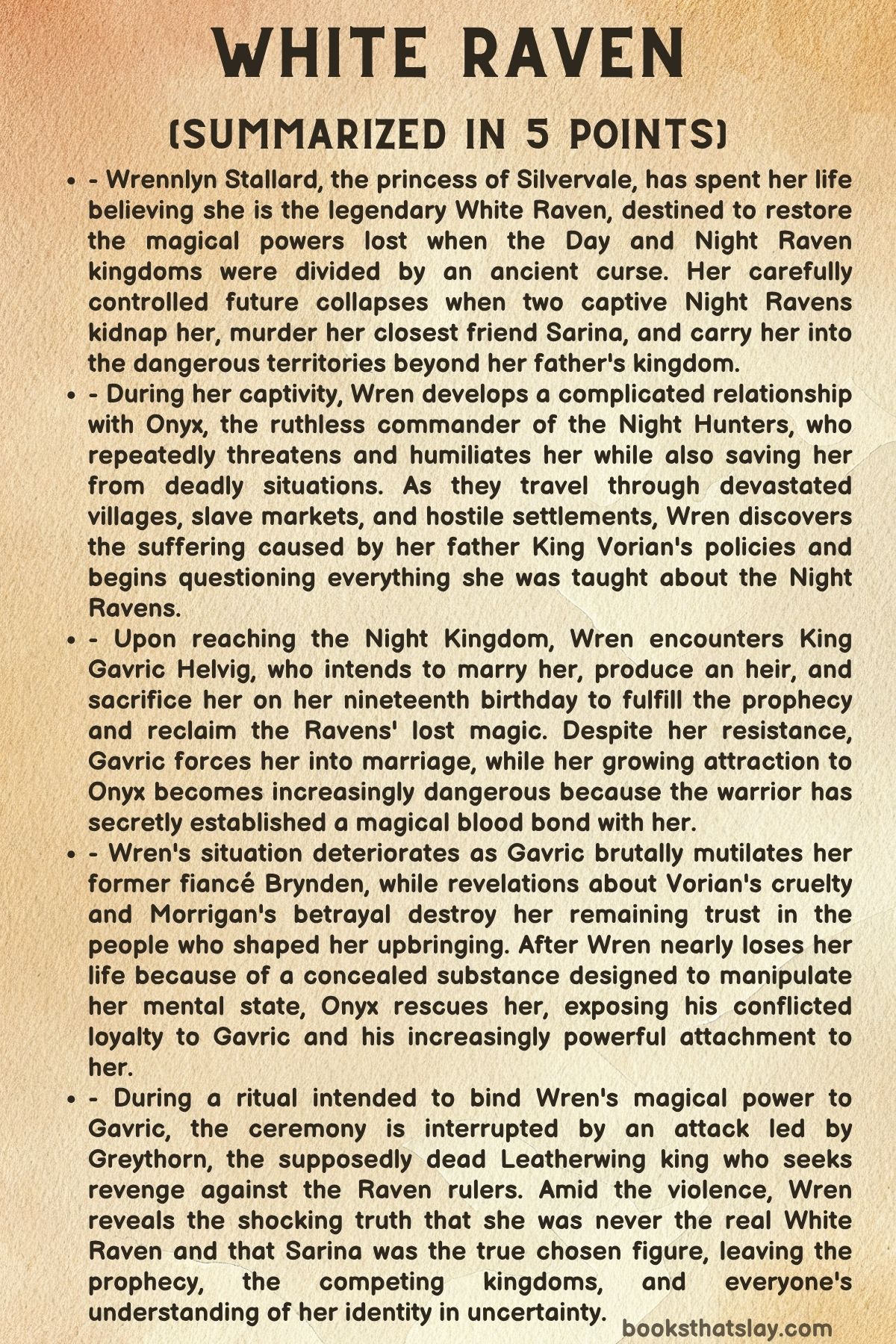
Wrennlyn Stallard, commonly known as Wren, is the eighteen-year-old princess of Silvervale and the only daughter of King Vorian Stallard, ruler of the Day Ravens. Since childhood, she has been raised to believe that she is the White Raven, a figure whose nineteenth birthday will fulfill an ancient prophecy and restore the magical powers lost when the raven kingdoms were divided.
Her existence carries enormous political and religious significance because the Day and Night Ravens have lived under a supernatural curse for generations. Once united as powerful beings associated with the gods Huginn and Muninn, the Ravens became enemies following a devastating conflict involving the Leatherwings, leaving their territories separated into regions of permanent daylight, darkness, and twilight.
Wren’s life has consequently been dictated by expectations rather than personal desires. Although she receives rigorous combat training from Yanric and enjoys a close friendship with her handmaiden Sarina, she has little control over her future and remains largely sheltered from the hardships experienced beyond the royal castle.
Shortly before her nineteenth birthday, King Vorian unexpectedly announces that she must marry Brynden Blaxhall, the son of an influential noble family. He insists that the arrangement will protect her from growing threats along the kingdom’s borders, but Wren suspects that his concern extends beyond her personal safety.
Despite her reluctance, she participates in the engagement ceremonies, where she witnesses animal sacrifices and the elaborate traditions associated with Raven society. During these celebrations, the royal seeress Morrigan repeatedly casts runes that mysteriously land blank, creating uncertainty about the destiny everyone believes Wren will fulfill.
Wren’s dissatisfaction grows when she realizes that Brynden seems more impressed by her legendary status than interested in understanding her as a person. An intimate encounter with him leaves her emotionally disconnected, but the discovery of confidential documents in her father’s office becomes much more significant.
The documents reveal worsening conditions in the borderlands, extensive military preparations, and a lucrative weapons agreement involving the Blaxhall family. Wren begins to understand that her marriage is also a political transaction designed to strengthen her father’s military position.
Before she can investigate further, two captive Night Ravens who have been working inside the castle enter the office while searching for important information. They seize Wren, and when Sarina unexpectedly appears, one of the prisoners murders her in front of the princess.
The killing destroys Wren’s remaining sense of security. Overpowered and taken hostage, she loses consciousness knowing that her closest friend is dead and that the enemies she has feared throughout her life are carrying her away from everything familiar.
Wren awakens during a dangerous escape across the snowy countryside, where her captors are being pursued by royal guards. One of the Night Ravens, Raelis, is struck by an arrow and apparently killed, leaving the other warrior to continue the journey with Wren as his prisoner.
The surviving captor is physically intimidating, ruthless, and determined to deliver her to the Night Kingdom. Wren repeatedly attempts to escape, relying on the combat techniques Yanric taught her, but her captor consistently overpowers her and threatens increasingly severe consequences for disobedience.
Their journey becomes a struggle against exhaustion, freezing temperatures, dangerous terrain, and mutual hatred. After Wren nearly drowns while attempting to flee through a violent river, the warrior rescues her, demonstrating that he is willing to preserve her life even though he treats her with hostility.
As they approach the Shadow Rift, Wren begins noticing that the world outside Silvervale is far more damaged than she imagined. Abandoned farmland, desperate settlements, and communities struggling with starvation suggest that the expanding curse has devastated ordinary people while the royal court has concealed the extent of their suffering.
At an isolated farmhouse, Wren briefly believes that a stranger might help her escape, only to discover that the man is a cannibal who exploits the region’s widespread hunger. Her captor saves her from being murdered, and their subsequent escape from violent riders associated with a group called the Jackals forces them into an increasingly uneasy partnership.
The pair eventually reaches Beggar’s Hole, a settlement where impoverished inhabitants openly resent the Day Ravens. Wren learns that her father allegedly ordered brutal attacks against families formed through relationships between the divided kingdoms, leaving innocent people dead, displaced, or enslaved.
These revelations challenge Wren’s loyalty to her father, although she initially refuses to believe the accusations. Her captor continually confronts her privileged assumptions, insisting that the prosperous kingdom she remembers exists alongside suffering that its rulers have deliberately ignored.
During another escape attempt, Wren is attacked by dangerous men, forcing her and her captor to fight together. Their cooperation introduces a complicated emotional dynamic because Wren begins recognizing that the man she considers her enemy can also be the person most capable of keeping her alive.
At a crowded inn, Wren finally discovers that her captor’s name is Onyx. Although his brutal methods and controlling behavior continue, their arguments increasingly reveal mutual curiosity, psychological vulnerability, and an unwanted physical attraction.
Onyx eventually tattoos Wren with symbols identifying her as his property, explaining that the mark will discourage others from harming or claiming her. The experience devastates Wren because her former identity as a sacred princess has been replaced by the humiliating status of an enslaved woman.
Her growing awareness of slavery becomes more personal when she is captured by traders who intend to sell her. Onyx rescues her, and with the assistance of a strange little creature she names Munch, Wren helps free other prisoners, including a man named Ansgar whose family suffered under the political violence of the borderlands.
The journey also brings changes to Wren’s understanding of herself. She cuts her long silver hair, learns practical survival skills, and gradually recognizes that royal training and ceremonial knowledge have left her unprepared for the world outside the palace.
When Onyx reunites with his companions, Wren discovers that he is the feared Black Wing, commander of the elite Night Hunters. His fellow warriors, including Bjørn, Brynn, Renyx, and Sven, reveal that the seemingly merciless soldier belongs to a close military community shaped by loyalty, grief, and shared experiences of war.
Through their interactions, Wren learns that Onyx witnessed the murders of his mother and siblings and has endured severe psychological suffering. She also discovers that his dead companion Raelis was Renyx’s twin brother, giving her a clearer understanding of the losses caused by her kidnapping.
Entering the Night Kingdom challenges another of Wren’s fundamental beliefs because she finds the night beautiful rather than terrifying. Its prosperous cities, vibrant social life, and ordinary citizens contradict the image of a cursed and barbaric civilization promoted by her father.
However, her arrival in Ravenshadow introduces a threat more disturbing than her captivity under Onyx. King Gavric Helvig, the charming but unpredictable ruler of the Night Ravens, announces that he intends to marry Wren and use her legendary status to unite the kingdoms under his authority.
Gavric reveals that the prophecy contains a terrible secret: Wren must supposedly be sacrificed on her nineteenth birthday at the site of the Battle of Blood. Her blood is believed to possess the power to restore Raven magic, and Gavric intends to produce an heir with her before arranging her death.
Wren is horrified to learn that her father concealed the sacrificial nature of her destiny and that Onyx knew about Gavric’s intentions. When the king discovers Onyx’s possessive tattoo, he publicly whips his commander, exposing the dangerous consequences of the connection between the warrior and his prisoner.
Wren is subsequently confined to luxurious chambers and prepared for a grand royal celebration that Gavric unexpectedly transforms into their wedding. Intoxicating flowers compromise her ability to resist, and Morrigan, who is revealed to have secretly worked for the Night King while maintaining a relationship with Vorian, performs the ceremony.
The marriage leaves Wren trapped in another political arrangement without meaningful consent. During the celebrations, she and Onyx surrender to their attraction, but their intimate encounter intensifies their emotional confusion because Onyx insists that their relationship cannot continue.
Gavric further demonstrates his cruelty when Brynden unexpectedly arrives in Ravenshadow, hoping to rescue Wren and restore their original engagement. The young nobleman’s courage is overshadowed by his lack of preparation, and Gavric mutilates him by cutting out one of his eyes before sending him back as a warning to Vorian.
Overwhelmed by guilt, grief, and hopelessness, Wren subsequently experiences a severe emotional collapse and nearly drowns herself. Onyx rescues her and discovers that a concealed object containing morning glory has been placed in her room, apparently to induce depression and suicidal behavior.
This discovery confirms that someone is deliberately manipulating Wren’s psychological state, potentially attempting to eliminate her without creating the appearance of murder. Onyx also reveals that Vorian personally tortured him and Raelis during their imprisonment, further damaging Wren’s remaining faith in her father.
The situation reaches a crisis during a forest ritual intended to establish a magical blood bond between Wren and Gavric. Morrigan’s rune casting again produces blank results, and when Gavric attempts to claim Wren’s future power, she discovers that Onyx secretly created a genuine blood bond through their matching tattoos.
Gavric reacts with fury, realizing that another man has already established a magical claim over the woman he intends to sacrifice. His attempt to assert control becomes violent, but Onyx intervenes before the situation can escalate further.
Before the confrontation can be resolved, mysterious warriors wearing skull-like masks attack the ceremony. Their leader is revealed as Greythorn, the Leatherwing king believed to have died nearly two centuries earlier, who now seeks revenge against the Raven rulers for the destruction of his people.
As battle erupts, several factions attempt to seize Wren because of the extraordinary power everyone believes she represents. Onyx and Bjørn struggle to protect her, while Wren becomes increasingly weakened by the violence and the substances affecting her body.
In the final moments, Wren confesses a secret that overturns the foundations of the entire political conflict: she is not the real White Raven. The true chosen figure was Sarina, the friend murdered during the kidnapping that began Wren’s ordeal.
This revelation transforms the significance of Sarina’s death, the prophecy, and the opposing kings’ attempts to control Wren. The novel ends with Wren losing consciousness, leaving the consequences of her confession, the supernatural curse, and the competing claims to power unresolved.
Characters
Wrennlyn Stallard (Wren)
Wrennlyn Stallard is the central protagonist of White Raven, whose journey transforms her from a protected princess into a young woman forced to confront the cruelty underlying her privileged existence. Raised to believe she possesses a divine destiny, she initially understands herself through her father’s expectations and the prophecy that has controlled nearly every aspect of her life.
Wren possesses considerable courage, stubbornness, and determination, but these qualities coexist with arrogance and a limited understanding of the world. Her behavior toward captive Night Ravens illustrates how completely she has accepted the prejudices surrounding her upbringing.
Her kidnapping strips away the social protections that previously defined her identity. Experiencing hunger, captivity, physical danger, and humiliation forces her to understand the suffering of people she once considered inferior.
Her relationship with Onyx complicates her emotional development because she becomes attracted to someone responsible for imprisoning and degrading her. Their connection reveals her longing for protection and understanding while also exposing the dangerous confusion between dependence, attraction, and genuine freedom.
Wren’s growing willingness to question authority represents a significant change in her personality. She begins to distinguish her father’s image from his actions, recognizing that loyalty to family does not require unquestioning acceptance of cruelty.
The final revelation concerning Sarina creates the strongest challenge to her identity. Having spent her entire life believing she was a chosen savior, Wren must now confront the possibility that the role defining her existence was never hers.
Onyx (Svart Vinge / Black Wing)
Onyx is one of the most morally complicated characters in White Raven, functioning simultaneously as Wren’s captor, protector, romantic interest, and a powerful military commander. Known as the Black Wing, he leads the Night Hunters and possesses a reputation for violence that makes even hardened criminals fear him.
His personality is characterized by aggression, secrecy, emotional restraint, and a fierce commitment to his companions. He frequently uses intimidation and humiliation to establish authority, revealing a willingness to exercise power over those unable to resist him.
Nevertheless, his behavior cannot be understood solely through brutality. He repeatedly protects Wren from threats, risks his own safety to rescue her, and demonstrates genuine alarm when her psychological suffering becomes life-threatening.
Onyx’s childhood trauma offers important context for his emotional instability. Witnessing the murders of his mother and siblings has left him with recurring nightmares, unresolved grief, and a tendency to respond to perceived threats with overwhelming violence.
His loyalty to Gavric creates a major internal conflict. Although he owes much of his position and upbringing to the king, his developing attachment to Wren increasingly places him in opposition to Gavric’s intentions.
The secret blood bond demonstrates that Onyx has acted independently of his ruler, but it also raises serious questions about his respect for Wren’s autonomy. His character is therefore shaped by the unresolved tension between affection and possession, making his capacity for genuine change a central uncertainty in the story.
Sarina
Sarina is one of the most consequential characters in White Raven, despite her death occurring early in the narrative. As Wren’s handmaiden and closest friend, she provides the companionship, warmth, and familiarity missing from the princess’s largely ceremonial existence.
Unlike the nobles who admire Wren because of her expected destiny, Sarina shares an affectionate personal relationship with her. Their friendship allows Wren moments of ordinary happiness in a life dominated by political expectations and royal obligations.
Sarina’s murder becomes a defining psychological wound for Wren. The inability to save her friend produces recurring nightmares, survivor’s guilt, anger, and a desperate desire for revenge.
Her importance changes dramatically with the final revelation that she was the true White Raven. This confession suggests that the apparent secondary figure in Wren’s life possessed the identity upon which the entire political and religious conflict depends.
The novel does not establish the full circumstances surrounding Sarina’s true identity or why Wren was raised in her place. Consequently, her death becomes more than a personal tragedy, representing an enormous unresolved mystery concerning prophecy, deception, and the fate of the divided kingdoms.
King Vorian Stallard
King Vorian Stallard, ruler of Silvervale and father of Wren, represents the corruption that can develop when political authority is treated as morally unquestionable. In White Raven, he initially appears to be a strict but concerned father determined to protect his daughter until she fulfills her destiny.
His decision to arrange Wren’s marriage to Brynden exposes the extent to which he treats her as an instrument of political strategy. The weapons agreement with the Blaxhall family suggests that strengthening his military position matters more than allowing his daughter to choose her future.
As Wren travels through the borderlands, accounts of Vorian’s policies reveal a much darker ruler. The persecution of mixed communities, confiscation of essential resources, and suffering of ordinary inhabitants suggest that his government maintains power through fear and systematic oppression.
The revelation that he tortured Onyx and Raelis further undermines his image as a righteous monarch. His secret relationship with Morrigan also indicates that personal ambition, hidden alliances, and deception have shaped decisions Wren once believed were motivated by duty.
Vorian’s concealment of the sacrificial prophecy is particularly significant because it demonstrates his willingness to deny his daughter information about her own life and possible death. Even without complete knowledge of his ultimate plans, his actions establish him as a central figure in the exploitation of Wren’s supposed destiny.
King Gavric Helvig
King Gavric Helvig serves as the most openly threatening royal antagonist in White Raven, combining outward charm with unpredictable cruelty. His theatrical personality, affectionate treatment of favored followers, and apparent enthusiasm initially distinguish him from the emotionally distant Vorian.
Beneath this engaging surface, Gavric exhibits extreme possessiveness and an obsession with controlling the power associated with the White Raven. His decision to marry Wren and sacrifice her after producing an heir demonstrates that he values her primarily as a means of securing political and magical authority.
His treatment of Onyx reveals how quickly affection can become punishment when personal loyalty conflicts with royal ownership. By publicly whipping the commander he helped raise, Gavric makes it clear that obedience matters more to him than emotional attachment.
Gavric’s mutilation of Brynden further establishes his willingness to inflict suffering for intimidation and entertainment. The brutality of this act is especially disturbing because Brynden poses little genuine threat to his military power.
His attempts to impose marriage and a magical bond on Wren expose his fundamental disregard for consent. Gavric represents a form of tyranny in which charm and generosity remain conditional, disappearing whenever another person’s independence challenges the ruler’s desires.
Morrigan
Morrigan is a powerful seeress whose apparent religious authority conceals a complicated network of political loyalties. Initially introduced as a trusted figure within Vorian’s court, she later emerges as an agent of Gavric who has maintained an intimate relationship with the Day King.
Her ability to conduct rune castings and perform sacred rituals places her at the center of the supernatural traditions governing Raven society. However, the repeated appearance of blank runes demonstrates that even her considerable knowledge cannot fully explain the forces surrounding Wren.
Morrigan’s involvement in the operation that allowed Onyx to enter Vorian’s office reveals her willingness to manipulate events from behind the scenes. She uses the trust attached to her position to gather information and influence powerful people without exposing her true allegiance.
Her role becomes particularly important during Gavric’s attempt to create a blood bond with Wren. Discovering that another bond already exists, she understands that the king’s plans are threatened by magical circumstances he cannot simply command away.
Morrigan represents the dangerous combination of supernatural knowledge and political secrecy. Her actions suggest that religious authority can become another instrument through which powerful individuals manipulate the lives of others.
Brynden Blaxhall
Brynden Blaxhall is Wren’s original intended husband and the son of an influential noble family whose resources make him politically valuable to King Vorian. Although he initially appears pleasant and enthusiastic, his immaturity prevents him from fully understanding the consequences of becoming involved in royal affairs.
Brynden admires Wren’s beauty and legendary status, but their relationship lacks emotional depth. His eagerness to marry her contrasts sharply with her reluctance, emphasizing the difference between his romantic expectations and her experience of an arranged marriage.
Despite these shortcomings, Brynden demonstrates genuine concern for Wren when he travels alone into the Night Kingdom to rescue her. His decision reveals a capacity for courage and loyalty, although he lacks the experience and preparation necessary to confront Gavric.
His disastrous confrontation with the Night King illustrates how innocence can become a weakness in a world dominated by calculated cruelty. By losing an eye and being sent back as a warning, Brynden becomes a victim of a political struggle he barely understands.
His character represents the tragic consequences of approaching dangerous power structures with honorable intentions but insufficient knowledge.
Bjørn
Bjørn is a member of the Night Hunters whose humor, friendliness, and relatively compassionate behavior provide an important contrast to the hostility surrounding Wren. Unlike several of his companions, he does not automatically treat her as deserving punishment because she belongs to the Day Ravens.
His approachable personality helps Wren become more comfortable among people she was raised to fear. Through conversations with him, she gains insight into the relationships, rivalries, and personal histories of the Hunters.
Bjørn also demonstrates considerable loyalty to Onyx, recognizing the importance of protecting his commander even when Onyx’s decisions create problems. His efforts to keep Gavric intoxicated during the wedding celebrations suggest that he is willing to participate in quiet acts of resistance when circumstances demand it.
Although his humor provides relief from the novel’s darker events, Bjørn is also a capable warrior who assists in defending Wren during the final attack. He represents companionship and practical loyalty within a group otherwise defined by violence and military discipline.
Brynn
Brynn is a female member of the Night Hunters whose hostility toward Wren reflects the deep resentment separating the Raven kingdoms. She refuses to overlook Wren’s royal heritage and consistently questions whether an enemy princess can be trusted.
Her suspicion also reveals the importance of loyalty within the Hunters. From her perspective, Wren represents a potential danger to Onyx and the companions who have already suffered losses during the mission.
Brynn’s personal relationships further complicate her position. The revelation that Renyx loved her while Raelis deliberately pursued her indicates that she occupies an emotionally sensitive place within the group.
Although the details of these relationships remain incomplete, they suggest that Brynn’s guarded behavior exists within a community affected by rivalry, grief, and unresolved romantic attachments.
Her character provides a reminder that Wren’s growing connection with Onyx does not automatically erase the hostility of his companions.
Renyx
Renyx is a Night Hunter struggling with the death of his twin brother, Raelis, during the escape from Silvervale. His grief shapes his behavior and contributes to his resentment toward Wren, whom he associates with the disastrous mission.
The emotional consequences of his brother’s death are intensified by their complicated history involving Brynn. Raelis’s decision to pursue the woman Renyx loved created unresolved tensions that cannot be settled after his death.
Renyx frequently expresses his distress through anger, drinking, and physical confrontation. These reactions suggest that he has difficulty processing grief in an environment where emotional vulnerability is often concealed behind aggression.
Despite his personal struggles, Renyx remains deeply connected to his companions. His intervention during Onyx’s violent confrontation with Stigr demonstrates his understanding of his commander’s dangerous psychological state.
Renyx represents the lasting damage caused by war, particularly when grief becomes entangled with guilt, rivalry, and unfinished personal conflicts.
Raelis (Rey)
Raelis, also referred to as Rey, is the Night Hunter who accompanies Onyx during the mission to infiltrate Silvervale and abduct Wren. His murder of Sarina makes him directly responsible for the tragedy that becomes Wren’s strongest emotional motivation.
Although his participation in the story is brief, his actions have lasting consequences. His willingness to kill Sarina demonstrates the violence associated with the Hunters’ mission and the disregard for innocent lives that can accompany military objectives.
Raelis is apparently killed by an arrow during the escape, creating another source of grief for Onyx. The loss also devastates his twin brother Renyx, whose emotional struggles continue throughout the journey.
His earlier pursuit of Brynn adds an additional dimension to his relationship with Renyx. Their rivalry suggests that the brothers experienced personal conflicts even while sharing their dangerous military profession.
Raelis functions as a reminder that death does not resolve the damage caused by a person’s choices. His actions continue influencing Wren, Onyx, and Renyx long after he disappears from the narrative.
Sven
Sven is a young member of the Night Hunters whose age and hesitant personality distinguish him from his more intimidating companions. At only eighteen, he has already developed exceptional archery skills and secured a position among experienced warriors.
His presence challenges Wren’s assumption that the Night Hunters consist entirely of older, hardened killers. He demonstrates that military expectations affect young people on both sides of the divided kingdoms.
Sven’s conversations with Wren suggest that he carries responsibilities connected to his family and position, although the complete nature of these burdens remains unexplored. His behavior shows a comparatively restrained side of the Hunters’ social structure.
By providing Wren with clothing and food, Sven also participates in moments of ordinary consideration that contradict her expectations of Night Raven cruelty. His character contributes to the gradual humanization of the people Wren previously understood only as enemies.
Yanric
Yanric is Wren’s combat instructor and an important influence on her development before the kidnapping. His training provides her with discipline, physical confidence, and the ability to defend herself under dangerous circumstances.
Although he does not accompany Wren on her journey, his lessons repeatedly influence her decisions. She recalls his instructions while resisting Onyx, escaping captivity, and fighting attackers who underestimate her abilities.
Yanric’s importance lies partly in the difference between Wren’s ceremonial upbringing and her practical combat education. While the royal court teaches her obedience and political expectations, his instruction gives her skills that become essential when those protections disappear.
However, the limitations of her training also become evident. Wren can fight effectively but lacks knowledge of survival, ordinary labor, and the hardships faced by common people.
Yanric therefore represents both the strengths and shortcomings of the education provided to someone raised for an extraordinary destiny.
Frida
Frida is a woman working at an inn who recognizes Onyx and greets him with considerable familiarity and affection. Her reaction suggests that they share a personal history extending beyond the events directly depicted in the novel.
She becomes an important figure in Wren’s growing emotional confusion because her obvious attraction to Onyx provokes jealousy. Wren finds herself reacting possessively despite continuing to insist that she hates the man holding her captive.
Frida’s presence also reveals that Onyx possesses a life outside his military identity. He has established relationships and connections within ordinary communities, making him more socially complicated than the isolated enemy warrior Wren initially imagined.
Although Frida’s role remains relatively limited, she helps expose Wren’s increasingly contradictory feelings. Her character contributes to the romantic tension by challenging Wren’s assumption that she can remain emotionally detached from Onyx.
Greythorn
Greythorn is the legendary Leatherwing king believed to have been killed nearly two centuries before the events of the story. His supposed death is closely associated with the ancient conflict that resulted in the division and magical punishment of the Raven kingdoms.
His unexpected appearance during Gavric’s blood-bonding ritual introduces a powerful new faction into the political struggle. Accompanied by highly trained warriors wearing skull-like masks, he demonstrates that the Leatherwings remain capable of challenging the Raven rulers.
Greythorn openly expresses his desire for revenge against both Raven kings for the suffering inflicted upon his people. His motives suggest that the historical conflict may contain grievances and injustices that the accepted accounts have failed to explain.
His attempt to capture Wren introduces further uncertainty about the prophecy and the value of the power attributed to her. The novel does not fully explain his survival, the circumstances of his return, or his ultimate intentions.
Greythorn represents the return of unresolved historical violence, demonstrating that a conflict believed to have ended can continue shaping the lives of later generations.
Munch
Munch is a tiny animated creature resembling a living twig who becomes Wren’s unexpected companion during her captivity. Although physically insignificant compared with the powerful warriors surrounding her, he repeatedly demonstrates remarkable usefulness.
His ability to chew through restraints helps Wren escape dangerous situations, including her imprisonment by slave traders. These interventions make him a practical ally rather than merely an amusing addition to the story.
Wren’s decision to name and keep Munch demonstrates her continuing capacity for affection despite the trauma surrounding her. Their companionship gives her something she can protect and care for without the political complications governing her human relationships.
Munch also provides moments of humor through his interactions with Fluffy. His character emphasizes that assistance and loyalty can appear in unexpected forms, even within a world dominated by physical strength and supernatural power.
Fluffy
Fluffy is the intimidating draugrhest associated with Onyx and Wren’s journey through the dangerous borderlands. Despite the innocent-sounding name, the horse possesses an unnatural appearance, including fanglike teeth, which initially frightens Wren.
Its exceptional speed and unusual nature make it valuable during escapes from violent pursuers. The creature reflects the strange supernatural environment that Wren encounters after leaving Silvervale.
Fluffy’s interactions with Munch provide comic relief and introduce a lighter quality into otherwise threatening circumstances. The contrast between its frightening appearance and its ordinary function as a traveling companion also reflects Wren’s changing perception of unfamiliar creatures.
Through Fluffy, the novel reinforces the idea that appearances do not always provide reliable evidence of danger or character.
Ansgar
Ansgar is a prisoner Wren meets after being captured by slave traders. His experiences reveal the personal consequences of Vorian’s policies, particularly the persecution of families whose relationships crossed territorial boundaries.
His family has been torn apart, leaving him struggling with separation, uncertainty, and the possibility that his loved ones may never be reunited. His suffering gives Wren a personal example of the political injustices she previously dismissed.
Unlike abstract accusations against her father, Ansgar’s testimony comes from someone directly affected by the violence. His story therefore plays an important role in Wren’s developing moral awareness.
When Wren helps free the prisoners and gives Ansgar a weapon, she demonstrates an emerging willingness to assist people outside her social class. Ansgar represents the ordinary victims whose lives are damaged by decisions made in distant royal courts.
Hvit
Hvit is a hostile slave trader who participates in Wren’s capture and demonstrates intense resentment toward the Day Ravens. His hatred is especially significant because he shares their heritage but despises the persecution carried out under Vorian’s authority.
His character complicates the assumption that political loyalty naturally follows ancestry. Instead, his experiences and grievances have produced hostility toward the kingdom associated with his own identity.
Hvit’s cruelty toward Wren also demonstrates how legitimate resentment can develop into violence against individuals who were not personally responsible for the original injustice. His suffering or anger does not justify his participation in slavery.
He escapes during Onyx’s attack on the trading camp, leaving his future role unresolved. Hvit represents the cycle through which persecution can generate further hatred and exploitation.
Stigr
Stigr is a former royal guard whose aggressive behavior reveals the darker elements within the Night Kingdom’s military establishment. Having previously been expelled from royal service by Onyx, he carries resentment toward the commander responsible for his removal.
His confrontation with Wren exposes his hostility toward Day Ravens and his willingness to intimidate someone in a vulnerable position. He treats her identity as sufficient justification for humiliation and threats.
The resulting fight with Onyx becomes significant because it reveals the commander’s capacity for nearly uncontrollable violence. Stigr therefore functions as both an immediate antagonist and a trigger for exposing a dangerous aspect of Onyx’s personality.
His history with Onyx also indicates that military institutions contain internal conflicts and individuals whose behavior violates even their own group’s standards.
Sölvi
Sölvi is a servant who appears during the ceremonial preparations for Gavric’s attempt to establish a blood bond with Wren. Although his role is brief, he demonstrates quiet compassion when he intervenes to limit the king’s mistreatment of her.
His assistance is important because openly challenging Gavric would carry considerable danger. Rather than confronting the king directly, Sölvi acts discreetly within the limited authority available to him.
His behavior provides a contrast to the royal followers who participate in Wren’s humiliation or remain indifferent to her suffering. Sölvi represents the possibility of moral resistance through small acts of protection.
Meya
Meya is one of the handmaidens assigned to Wren after her arrival at Gavric’s court. Her position places her within the complicated environment of royal service, where obedience and personal survival often determine behavior.
As part of Wren’s new household, Meya contributes to the atmosphere of isolation surrounding the princess. Wren receives luxurious accommodations and attendants, but these privileges do not provide genuine independence.
The available events do not establish a detailed individual history for Meya. Her significance rests primarily in illustrating how servants participate in the daily operation of a royal institution built around unequal power.
Kara
Kara is another of the handmaidens introduced during Wren’s confinement in the Night Kingdom. Like the other attendants, she belongs to a court where status, loyalty, and proximity to powerful individuals shape relationships.
Her presence contributes to Wren’s growing awareness that a luxurious position can still be deeply restrictive. Although Wren is treated as a queen, her attendants serve within a system that leaves her without control over her own future.
Kara is not given an extensive independent storyline in the provided events. Nevertheless, her role helps establish the social environment surrounding Gavric’s household and Wren’s position within it.
Sassa
Sassa serves among the handmaidens assigned to Wren following her arrival at Ravenshadow. Her inclusion in the royal household reinforces the contrast between Wren’s outward elevation in status and the reality of her captivity.
Like Meya and Kara, Sassa exists within a hierarchy where the king’s wishes determine the boundaries of acceptable behavior. The attendants’ reactions to Wren and Onyx also reveal the significance attached to his personal mark.
Although Sassa’s individual motivations remain largely unexplored, her presence contributes to the uneasy atmosphere of a court where servants must navigate dangerous political relationships.
Miika Blaxhall
Miika Blaxhall is Brynden’s father and a member of the influential noble family whose military resources make them valuable allies to King Vorian. His family becomes central to the political arrangement through which Wren is promised in marriage.
During the engagement ceremonies, Miika participates in the traditional animal sacrifices by killing a rabbit. The ritual emphasizes his adherence to the customs and religious expectations of Raven aristocracy.
His importance is primarily political because the proposed marriage connects the Blaxhall family’s resources with Vorian’s growing military ambitions. Through Miika, the novel illustrates how noble households use marriages to strengthen alliances and consolidate influence.
The Cannibal Farmer
The unnamed farmer encountered in the Shadow Rift represents the extreme consequences of hunger, isolation, and social collapse. Initially presenting himself as hospitable and harmless, he offers shelter and food before revealing that he has drugged his guests.
His hidden basement, filled with restraints, butcher’s equipment, and human remains, exposes the horrifying reality beneath his friendly behavior. He intends to murder and consume Wren, transforming an apparent opportunity for escape into a life-threatening ordeal.
Although he attributes such desperate behavior to worsening starvation and the spreading curse, his cruelty cannot be reduced to environmental hardship alone. His enjoyment of Wren’s terror reveals a deliberate willingness to exploit vulnerability.
The farmer symbolizes a society in which ordinary protections have broken down, allowing predatory individuals to thrive amid desperation.
The Jackals and Their Leader
The Jackals are a violent organization operating within the unstable border regions. Their involvement in kidnapping, pursuit, and intimidation demonstrates how criminal groups exploit the absence of effective law and protection.
Their unnamed leader takes a particular interest in Wren after the encounter near the cannibal’s farmhouse. This attention suggests that her unusual appearance or identity has made her valuable beyond her immediate political importance.
The group’s possession of a terrifying draugrhest further establishes its connection to the dangerous environment of the Shadow Rift. Although their wider organization and ultimate objectives remain unclear, their actions show how civilians and travelers become vulnerable when centralized authority collapses.
The Jackals function as an additional example of the widespread violence created by the division of the kingdoms.
Themes
Identity, Destiny, and the Search for Personal Freedom
The conflict between inherited identity and personal choice shapes Wren’s development throughout White Raven. From childhood, she has been told that she possesses a supernatural purpose, and nearly every important decision in her life has been made according to that supposed destiny.
Her status as the White Raven gives her enormous symbolic importance while denying her the freedom ordinarily associated with personal identity. She is admired, protected, and celebrated, but these privileges depend upon her willingness to accept a role she never chose.
Wren’s forced engagement to Brynden demonstrates that even her marriage is considered a matter of political necessity rather than emotional preference. Her subsequent captivity intensifies this loss of autonomy because Onyx and Gavric openly treat her as something that can be possessed, exchanged, or controlled.
The physical changes Wren experiences during her journey reflect the transformation of her identity. Cutting her silver hair symbolizes the gradual separation between the obedient princess she was raised to become and the more independent person emerging through hardship.
Her discovery that she may not be the true White Raven creates the theme’s greatest complication. If Sarina was the chosen figure, Wren’s entire upbringing has been organized around an identity that does not belong to her.
This revelation raises questions about whether personal worth depends on destiny, social recognition, or individual actions. Wren has spent her life believing that her importance comes from a prophecy, yet her courage and moral growth develop through choices unrelated to supernatural power.
The story ultimately suggests that discovering one’s identity requires challenging the expectations imposed by others. Although Wren has not yet achieved genuine freedom, her increasing awareness creates the possibility that she may eventually define herself independently of the roles assigned by kings, seers, and ancient predictions.
Power, Corruption, and Political Manipulation
Political power operates through fear, religious authority, military strength, and the control of information. Both Raven kings claim to act for the future of their people, yet their methods reveal a willingness to sacrifice individual lives for the preservation or expansion of their authority.
Vorian maintains the appearance of a protective father and legitimate monarch while concealing worsening conditions in his territories. The suffering of border communities suggests that his government prioritizes political control over the welfare of ordinary citizens.
His treatment of Wren demonstrates how rulers can exploit even their closest family members. Rather than allowing his daughter to understand the prophecy or make meaningful decisions, he controls her education, marriage, and access to information.
Gavric exercises power through a more openly theatrical form of intimidation. His apparent generosity and affection quickly disappear when others challenge his authority, as demonstrated by his punishment of Onyx and the mutilation of Brynden.
His intention to marry Wren, produce an heir, and sacrifice her reveals how completely he has reduced human relationships to instruments of political advantage. Even supernatural destiny becomes something he believes can be claimed through marriage, blood rituals, and physical domination.
Morrigan’s involvement introduces another dimension of corruption through the manipulation of religious knowledge. Her secret loyalties demonstrate that individuals trusted to interpret divine intentions can influence political events while concealing their own motivations.
The repeated failure of her rune castings undermines the certainty upon which these systems depend. Although kings attempt to control prophecy, the supernatural forces they invoke do not consistently validate their ambitions.
By presenting two rulers who differ in personality but share an obsession with possession and control, the novel questions whether political legitimacy has any moral value without accountability. Authority becomes dangerous when rulers believe that their ambitions justify deception, violence, and the destruction of individual freedom.
Prejudice, Propaganda, and the Human Cost of War
Wren’s understanding of the Night Ravens is initially shaped almost entirely by the teachings of her father and the royal court. She believes that the people living beyond Silvervale are dangerous, morally inferior, and responsible for much of the suffering dividing the kingdoms.
Her first encounters with captive Night Ravens demonstrate how deeply these beliefs influence her behavior. She treats them with contempt because their identity has already established their supposed guilt in her mind.
The journey through the Shadow Rift gradually dismantles these assumptions. Wren encounters ruined communities, displaced families, starvation, slavery, and evidence of persecution that contradict the prosperous image of her father’s kingdom.
The accusations against Vorian are particularly disturbing because they expose the violence committed in the name of protecting the Day Ravens. Families formed across political and cultural boundaries have allegedly been punished as traitors, demonstrating how prejudice can justify cruelty against people whose relationships challenge established divisions.
Wren’s encounter with Ansgar gives these injustices a personal dimension. His separation from his family forces her to recognize that government policies are not abstract political decisions but events that permanently alter individual lives.
Her arrival in the Night Kingdom offers another powerful challenge to propaganda. Instead of discovering a miserable and uncivilized population, she finds flourishing settlements, beautiful surroundings, and people capable of kindness, loyalty, humor, and ordinary happiness.
However, the novel avoids presenting the Night Ravens as entirely innocent. Slavery, violence, and Gavric’s cruelty reveal that injustice exists on both sides of the conflict.
The appearance of Greythorn further complicates the history of the kingdoms by introducing the perspective of the Leatherwings. His desire for revenge suggests that the original conflict may contain suppressed grievances whose consequences continue across generations.
Through these experiences, the story demonstrates that prejudice survives when communities accept inherited narratives without examining reality. Genuine understanding begins when individuals encounter those they have been taught to hate and recognize their shared humanity.
Love, Possession, and the Struggle for Emotional Trust
The relationship between Wren and Onyx examines the unstable boundary between attraction, dependency, protection, and control. Their connection develops under circumstances marked by captivity, violence, and profound inequality, making it impossible to interpret their romantic feelings separately from the power dynamics surrounding them.
In White Raven, Onyx initially treats Wren as an enemy prisoner whose survival matters because she possesses political value. His threats, restrictions, and attempts to establish ownership leave Wren struggling to maintain control over her body and choices.
Yet Onyx also becomes the person who repeatedly rescues her from immediate danger. His intervention against the cannibal, slave traders, and violent attackers gradually complicates Wren’s perception of him.
These contradictory experiences create an emotionally difficult relationship. Wren recognizes that Onyx has harmed and humiliated her, but she also begins associating his presence with safety in situations where almost everyone else poses a threat.
The revelation of Onyx’s childhood trauma deepens their connection by showing that his aggression exists alongside profound suffering. Their shared experiences of loss create moments of understanding that neither character can easily express.
However, suffering does not erase responsibility for harmful behavior. Onyx’s decision to establish a secret blood bond without Wren’s informed consent demonstrates that his desire to protect her remains closely connected to his impulse to control her.
Gavric provides an even more extreme example of possession disguised as legitimate authority. His insistence that marriage gives him control over Wren’s body, magical power, and future exposes the violence underlying relationships built entirely on ownership.
The contrast between these forms of attachment raises important questions about the meaning of love. Protection becomes morally complicated when the person offering safety also limits the other person’s independence.
Wren’s emotional development therefore depends not simply on acknowledging her attraction to Onyx but on discovering whether trust can exist without coercion. The novel leaves this question unresolved, suggesting that genuine intimacy requires more than desire, shared pain, or supernatural connection; it also requires respect for another person’s freedom.