Wildwood by Ashley Woo Summary, Characters and Themes
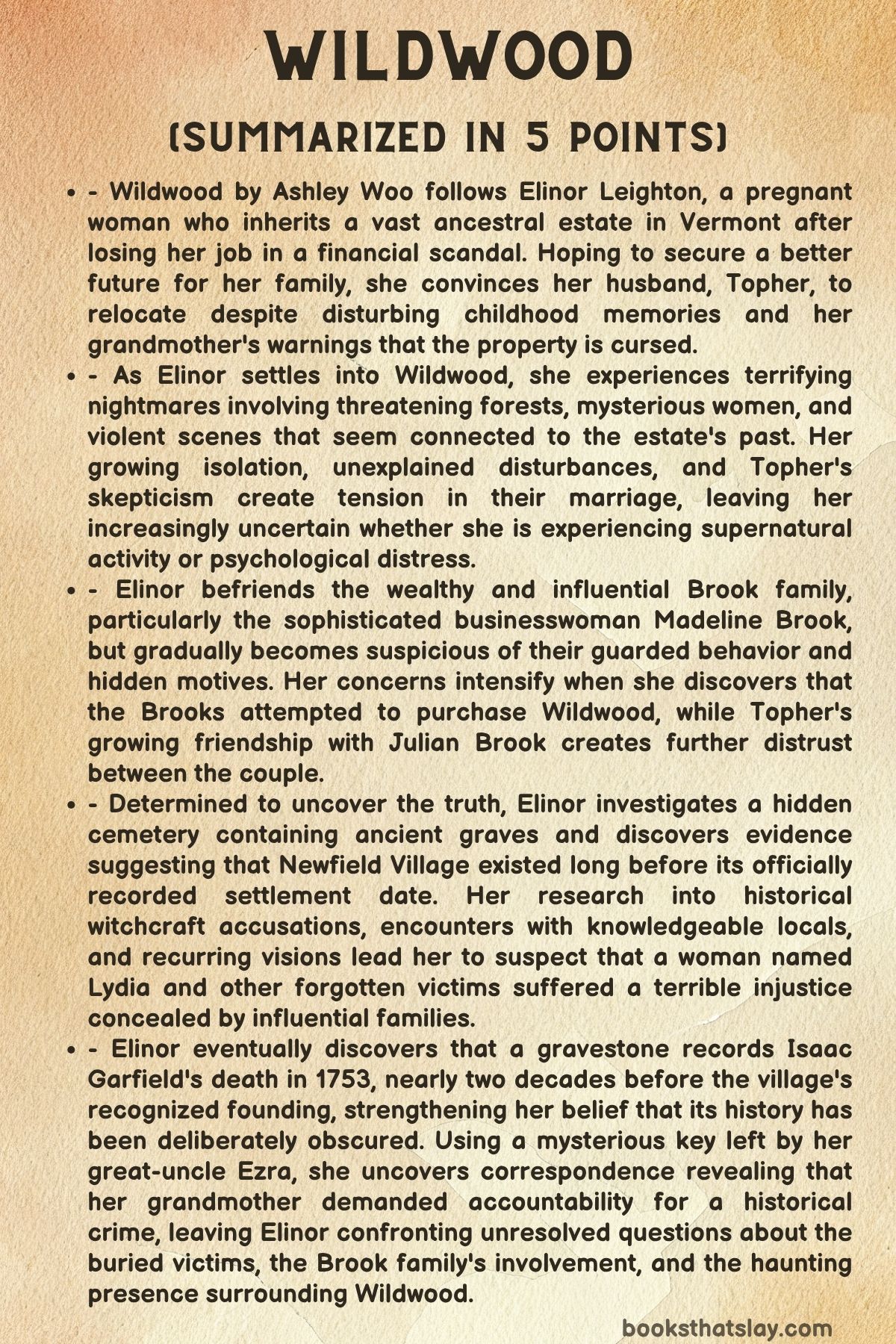
Wildwood by Ashley Woo is a gothic mystery novel that combines family secrets, psychological suspense, historical injustice, and supernatural uncertainty. The story follows Elinor Leighton, a pregnant woman who inherits an ancestral estate in rural Vermont after her great-uncle’s death.
What initially appears to be an opportunity for financial security and a peaceful new beginning gradually becomes a disturbing confrontation with unexplained visions, buried graves, and a powerful neighboring family. As Elinor investigates the property’s history, she discovers troubling connections between her childhood, her family’s estrangement, and an apparent historical crime. The novel examines how inherited privilege, suppressed memories, and unresolved suffering can influence generations.
Summary
Elinor Leighton’s life undergoes an unexpected transformation when she loses her job at FiPlan, a financial technology company whose collapse follows a major fraud scandal. Nine weeks pregnant and facing mounting financial uncertainty, she struggles to imagine how she and her husband, Topher, will maintain their Cambridge home while managing his medical career and their considerable debts.
Her circumstances change when Matthew Warnick, an estate attorney from Vermont, contacts her with surprising news. Her great-uncle Ezra Bishop has died of cancer and left her his ancestral property, Wildwood, along with substantial investments, provided that she lives on the estate for at least one year.
Elinor remembers spending childhood summers at the enormous farmhouse, exploring its orchards and forests alongside her cousins Tom and Anna. Those pleasant memories are complicated by her grandmother Mathilde’s insistence that the property was cursed and by an unexplained family disagreement that ended their visits when Elinor was eight.
Topher initially questions the practicality of relocating because his professional future lies in Massachusetts and maintaining an enormous historic estate would be expensive. Elinor argues that the inheritance could provide financial stability, a healthier environment for their child, and an opportunity to escape the professional disappointment she has recently experienced.
When the couple visits Newfield, Vermont, they encounter a prosperous community surrounded by attractive countryside and historic buildings. Their destination is a magnificent eighteenth-century house containing spacious rooms, aging furnishings, deteriorating infrastructure, and a disturbing bedroom mural depicting a sinister woodland scene that Elinor remembers calling the Forest of the Dead.
Warnick explains that the estate includes approximately two hundred acres and could be worth five million dollars. Although the house requires extensive restoration, Elinor becomes increasingly determined to preserve it rather than risk its eventual sale or development.
Her desire to return also has a personal dimension because Mathilde, now suffering from Alzheimer’s disease, can no longer explain the family’s estrangement from Ezra. Elinor remembers fragments of arguments suggesting that her great-uncle failed to intervene in something serious, and she hopes that living at the estate will allow her to uncover the truth.
After further discussion, Topher agrees to attempt the required year in Vermont and secures employment as an emergency physician at Green Mountain Medical. Elinor imagines a quieter existence devoted to her pregnancy, gardening, domestic projects, and the exploration of her family’s history.
Their arrival exposes the practical difficulties of rural life, including unreliable mobile reception, extensive repairs, and the unsettling darkness surrounding the isolated property. The couple settles into the principal bedroom despite Elinor’s discomfort with its enormous mural, while the discovery of Ezra’s elaborate security system raises questions about why he considered such precautions necessary.
Elinor begins investigating the house and its grounds, discovering old journals, abandoned outbuildings, familiar childhood landmarks, and a mysterious key that Ezra instructed Warnick to deliver after his death. Although her great-uncle’s journals initially contain little beyond ordinary observations, she suspects that the key provides access to information he deliberately concealed.
Meanwhile, she becomes acquainted with the wealthy Brook family, whose ancestors settled the region alongside the Bishops. Madeline Brook, a sophisticated businesswoman who transformed the family’s traditional wool enterprise into a successful luxury cashmere company, welcomes Elinor and invites the couple into her family’s social circle.
At a lavish dinner, Elinor meets Madeline’s husband John, the confident Julian Brook, his withdrawn wife Joan, and other relatives whose interactions reveal tensions beneath their privileged appearances. Julian’s competitive personality, Joan’s evident unhappiness, and Stuart Brook’s insulting treatment of her suggest that family membership and inherited status remain important sources of conflict.
Elinor grows closer to Madeline but becomes suspicious of the family’s guarded discussions about its history and ambitions. Her concerns intensify when Topher develops an independent friendship with Julian, including private meetings and hunting expeditions that he does not always mention to his wife.
As Topher’s demanding hospital schedule leaves Elinor increasingly isolated, she begins experiencing terrifying nightmares involving the surrounding forest. In these visions, trees move unnaturally, branches attack her body, a serpentine presence appears, and a mysterious woman communicates overwhelming fear, anger, and suffering.
The experiences revive memories of a childhood incident involving a Ouija board, followed by an episode of paralysis and the sensation of pressure around her throat. Elinor begins wondering whether the house is awakening memories that have remained buried since her grandmother abruptly ended the family’s visits.
Her fears intensify when the mysterious experiences seem to occur outside ordinary sleep. She encounters unexplained noises, shadowy figures, moving branches, and apparent physical sensations that disappear without leaving evidence, making it difficult to determine whether she is witnessing supernatural activity, sleepwalking, or psychological disturbances.
During an exploration of the woods, Elinor discovers a concealed burial ground containing ancient gravestones and four smaller, unmarked graves. The inscriptions appear inconsistent with Newfield Village’s officially recognized founding in 1771, leading her to suspect that an earlier settlement existed and that its history may have been deliberately suppressed.
Her efforts to investigate encounter resistance from the local historical society, where Jean dismisses her observations and discourages further examination. Patty, another employee, privately directs her toward Alice Clark, an elderly resident whose knowledge of local history may extend beyond the official record.
Elinor also researches witchcraft accusations in early New England and begins associating the woman in her visions with someone named Lydia. She develops a theory that the mysterious graves may belong to victims of religious persecution and that the Brook and Bishop families could have been involved in concealing their deaths.
Alice eventually reveals that Ezra deeply disliked the Brooks and that they attempted to purchase the estate after his death. This information changes Elinor’s interpretation of Madeline’s friendliness, particularly because Alice suggests that the wealthy family has always pursued opportunities to expand its land and influence.
The more Elinor investigates, the more strained her marriage becomes. Topher interprets her worsening insomnia, anxiety, and unusual experiences through a medical framework, while Elinor increasingly believes that his skepticism prevents him from recognizing a genuine danger.
A prenatal appointment confirms that their baby is a girl, briefly renewing their shared happiness, but Dr. Kahn expresses concern about Elinor’s mental health and recommends psychiatric evaluation. Elinor feels humiliated by the suggestion because she believes her distress is a response to actual events rather than evidence that she is becoming psychologically unstable.
Seeking independent expertise, Elinor secretly travels to Salem, Massachusetts, where she studies the historical persecution of alleged witches and meets Dr. Deborah Walker. The scholar does not endorse Elinor’s supernatural interpretation but acknowledges that the ancient graves deserve investigation and that historical communities sometimes concealed serious wrongdoing.
During the visit, Elinor reconnects with her friend Mia and receives a tarot reading warning of a profound betrayal, without establishing whether she will be its victim or perpetrator. She also discovers religious material preserved by Mathilde, whose handwritten criticism of its severe teachings suggests that her grandmother understood something important about the family’s past.
Returning to Vermont, Elinor experiences further disturbances, including unexplained basement lights, a hooded figure outside the conservatory, and an episode so frightening that she hides inside a wardrobe until morning. Topher becomes increasingly concerned about her safety, while her disappointing psychiatric consultation leaves her feeling that professional treatment offers little understanding of her experiences.
On Halloween, Elinor encounters teenagers who have entered the property searching for a legendary witch. Their familiarity with the local story convinces her that the haunting is not merely a creation of her imagination, although the legend itself provides no proof of the historical events she suspects.
Further visions eventually drive Elinor back to the hidden cemetery, where she uncovers the inscription on a fallen gravestone. The name Isaac Garfield and the death date of November 12, 1753, establish that the burial ground contains evidence predating Newfield Village’s officially accepted settlement by nearly two decades.
Armed with this discovery, Elinor returns to Ezra’s library and notices a concealed keyhole in his desk. The mysterious key opens a hidden compartment containing correspondence between Ezra and Mathilde, including a letter referring to the frightening incident involving Elinor in 2004 and demanding public acknowledgment of a terrible historical injustice.
Ezra’s own message insists that proving the crime is impossible without recovering the bodies. The correspondence provides Elinor with her strongest evidence that her relatives knew of a concealed atrocity and that their estrangement arose from disagreements about exposing it.
The available narrative ends with Elinor recognizing that the buried history of the estate may connect her childhood trauma, her grandmother’s warnings, the hidden cemetery, and the powerful families of Newfield. Although she has uncovered important evidence, the identities of the alleged victims, the precise circumstances of their deaths, the nature of Lydia’s presence, and the full extent of the Brooks’ involvement remain unresolved.
Characters
Elinor Leighton
Elinor Leighton is the central character of Wildwood, a woman whose attempt to rebuild her life becomes an increasingly consuming investigation into her family’s history. Her experiences form the emotional and psychological foundation of the novel, creating uncertainty about the relationship between memory, perception, and supernatural reality.
At the beginning of the story, Elinor is confronting several significant changes, including unemployment, pregnancy, and financial insecurity. Her unexpected inheritance offers an opportunity to establish a different future, but it also exposes her longstanding desire to understand the unexplained rupture within her family.
Elinor is intelligent, observant, and determined, qualities that make her unwilling to accept convenient explanations for the mysteries surrounding her ancestral home. She notices inconsistencies in local history, recognizes tensions within the Brook family, and investigates evidence that others dismiss as insignificant.
However, these strengths are complicated by anxiety, insecurity, and a growing inability to distinguish reliable observations from frightening experiences. Her nightmares and visions gradually dominate her thinking, affecting her marriage and making her increasingly suspicious of people who might otherwise support her.
Her pregnancy adds another dimension to her character because she must balance her determination to uncover the truth with responsibility for her unborn daughter. She wants to protect her child from danger, yet the investigation repeatedly draws her toward potentially threatening places and experiences.
Elinor’s most significant development occurs when her search shifts from understanding her family’s estrangement to seeking justice for people who may have been deliberately erased from history. By uncovering the old cemetery and Ezra’s hidden correspondence, she begins transforming personal fear into a more substantial pursuit of historical truth.
Topher Leighton
Topher Leighton, Elinor’s husband, represents a practical and scientifically oriented approach to the strange events occurring around their new home. As an emergency physician, he is accustomed to evaluating situations through evidence, medical knowledge, and identifiable causes.
Initially, Topher is reluctant to relocate because he understands the financial and professional complications associated with inheriting an enormous rural estate. Nevertheless, his eventual agreement demonstrates his willingness to support Elinor’s ambitions and provide their growing family with greater stability.
Once they move, Topher becomes increasingly comfortable with their circumstances. He establishes himself professionally, develops friendships with the wealthy Brook family, and enjoys activities such as hunting that allow him to participate in the community.
His enthusiasm contrasts sharply with Elinor’s growing uneasiness, creating a fundamental disagreement about their environment. While she interprets unusual experiences as warnings of hidden danger, he attributes them to stress, pregnancy, disrupted sleep, or psychological difficulties.
Topher’s concern for his wife is genuine, but his reliance on medical explanations sometimes prevents him from appreciating how dismissed and isolated she feels. His private conversations about her condition also damage her trust, even when his intentions appear protective.
The novel presents him as neither an obvious antagonist nor an entirely reassuring partner. His character illustrates how differences in perception, communication, and emotional needs can create distance within a marriage, particularly when one person feels that their experiences are being questioned.
Ezra Bishop
Ezra Bishop is an absent but enormously influential character in Wildwood, whose decisions shape the events long after his death. As the former owner of the ancestral estate, he provides Elinor with both her unexpected inheritance and the opportunity to investigate a history that he apparently struggled to confront.
Ezra appears to have been a reserved, methodical man who valued family possessions, historical records, and the preservation of his property. His carefully organized journals and documents suggest a personality inclined toward observation and order.
However, the unusual security arrangements, mysterious key, and concealed correspondence indicate that he also carried significant secrets. His instruction that Elinor should receive the key after his death suggests deliberate planning, although his exact intentions remain uncertain.
Ezra’s relationship with Mathilde is particularly significant because their disagreement appears to concern an unresolved historical crime. While Mathilde demanded accountability, Ezra insisted that proving the wrongdoing required recovering the bodies of its victims.
Alice Clark’s revelation that Ezra hated the Brooks further complicates his character. He was evidently aware of troubling aspects of the neighboring family’s history, yet he either could not or did not succeed in exposing them.
Ezra therefore represents the burden of inherited knowledge and the difficulty of acting against powerful institutions. His legacy consists not merely of property and wealth but also of unresolved obligations that Elinor must decide whether to pursue.
Mathilde
Mathilde, Elinor’s grandmother, is one of the most important figures connecting the present-day mystery with the family’s troubled past in Wildwood. Although Alzheimer’s disease has deprived her of much of her ability to communicate, her earlier decisions continue to influence Elinor’s understanding of the estate.
During Elinor’s childhood, Mathilde was an intelligent, financially cautious, and outspoken woman who apparently held strong moral convictions. Her declaration that the ancestral property was cursed led to the family’s abrupt departure and created a lasting division between her and Ezra.
Mathilde’s behavior initially appears connected to superstition or a personal disagreement over family wealth. However, her preserved correspondence reveals that her anger concerned a historical injustice she believed powerful people should publicly acknowledge.
Her reaction to the religious sermons Elinor discovers also suggests a critical attitude toward rigid beliefs and punitive moral judgments. This becomes particularly meaningful when Elinor begins investigating possible witchcraft accusations and religious persecution.
Mathilde’s inability to explain herself in the present gives her character a tragic dimension. She may possess essential knowledge, but illness has prevented her from sharing it with the granddaughter who desperately needs answers.
Through Mathilde, the novel explores how moral resistance can survive through warnings, letters, and family memories even when the person who originally expressed that resistance can no longer speak.
Madeline Brook
Madeline Brook is one of the most influential and ambiguous figures in Wildwood, embodying wealth, social sophistication, ambition, and the possibility of concealed wrongdoing. Her polished appearance and extraordinary professional success initially make her someone Elinor admires and hopes to befriend.
As the executive responsible for transforming the Brook family’s traditional wool business into a luxury cashmere enterprise, Madeline demonstrates intelligence, leadership, and commercial imagination. Her achievements establish her as a powerful figure within both her family and the wider Newfield community.
Madeline’s gracious treatment of Elinor seems generous, especially when she offers companionship during an unfamiliar and isolating period. However, her friendliness becomes increasingly questionable as Elinor discovers the family’s interest in purchasing the Bishop estate.
Her carefully controlled responses to questions about historical events suggest that she may know more than she is willing to reveal. When Elinor discusses her visions and possible witchcraft-related crimes, Madeline’s sudden defensiveness disrupts her normally composed manner.
Madeline’s ambition also introduces an important moral question about the lengths to which powerful families might go to protect their reputation and prosperity. Her insistence that nothing should interfere with the company’s development implies that preserving the Brook legacy is an overriding concern.
Nevertheless, the available narrative does not establish Madeline’s direct responsibility for any crime or supernatural disturbance. Much of her apparent menace develops through Elinor’s suspicions, allowing the character to remain both socially compelling and potentially dangerous.
Julian Brook
Julian Brook represents inherited privilege, masculine competitiveness, and the protective social world surrounding the Brook family’s wealth. His confidence and familiarity with the countryside make him appear entirely comfortable within an environment that Elinor initially finds intimidating.
Julian enjoys hunting and possesses expensive equipment that reflects the family’s considerable resources. His willingness to include Topher in these activities helps establish a friendship that gradually becomes a source of tension within the Leighton marriage.
Although Julian appears sociable and capable of generosity, Elinor perceives arrogance beneath his outward confidence. She also suspects that he resents Madeline’s professional prominence and the authority she exercises over the family enterprise.
His marriage to Joan reveals further complications, particularly when he minimizes insulting remarks directed toward her instead of firmly defending her position. His behavior suggests that family loyalty and established hierarchies may take precedence over his wife’s emotional needs.
Julian’s increasing influence over Topher becomes especially troubling to Elinor because she already distrusts the Brooks. However, the novel leaves open whether he is deliberately undermining her marriage or simply forming an ordinary friendship with someone who shares his interests.
Joan Brook
Joan Brook is a reserved and visibly unhappy member of the wealthy family whose presence exposes the difference between material privilege and emotional belonging. Although she possesses professional accomplishments of her own, she appears uncomfortable within the social environment surrounding her husband’s relatives.
Elinor initially interprets Joan’s withdrawn behavior as hostility, particularly because Joan makes little effort to establish a friendship. However, subsequent revelations suggest that her discomfort may arise from loneliness, displacement, and dissatisfaction with life in Vermont.
Joan owns an architecture firm, demonstrating that she has an independent professional identity beyond her marriage. The awkward assumption that Julian must be the business owner illustrates how easily her achievements are overshadowed by the family’s masculine and financial authority.
Stuart Brook’s suggestion that Joan is not truly a member of the family because she entered it through marriage is especially revealing. Her angry reaction demonstrates how deeply such exclusion affects her, particularly when Julian fails to address the insult adequately.
Joan functions as a contrast to Madeline, who appears completely integrated into the family’s power structure. Her unhappiness suggests that access to wealth and status does not necessarily provide security, respect, or genuine acceptance.
John Windsor Brook
John Windsor Brook is Madeline’s husband and a comparatively understated member of the extended family. His decision to adopt the Brook surname after marriage illustrates the unusual importance of preserving the family’s established identity.
John appears affectionate toward Madeline and supportive of her professional achievements. He participates comfortably in the family’s polished social environment, helping reinforce its public image of stability and prosperity.
However, the suggestion that his marriage may contain unresolved complications prevents him from being understood entirely through this reassuring appearance. The available material offers limited access to his private thoughts, leaving questions about his independence and knowledge of family secrets unanswered.
His character demonstrates how the Brook identity can extend beyond blood relationships and become a social institution that individuals are expected to preserve.
Stuart Brook
Stuart Brook is a relatively minor character whose behavior exposes the arrogance and exclusivity underlying the family’s privileged position. His insulting remark about Joan’s status reveals an attitude that measures belonging through lineage rather than personal commitment.
The incident is significant because it interrupts an otherwise carefully managed social gathering. It demonstrates that the family’s outward sophistication does not necessarily correspond to generosity or respect within its private relationships.
Stuart also reveals how inherited privilege can encourage entitlement, particularly when someone considers themselves more legitimate than a relative who entered through marriage.
Although the story provides limited information about his personal circumstances, his conduct helps establish the rigid hierarchy that shapes relationships among the Brooks.
Isabelle Brook
Isabelle Brook is an older, influential family member who introduces Elinor to the agricultural and social traditions of Newfield. Her presence connects the Brooks’ contemporary prosperity with their longstanding position in the community.
During their visit to the farmers’ market, Isabelle presents the family as generous local benefactors who provide assistance to struggling farmers. Her comments help explain why the Brooks enjoy widespread respect and why challenging their reputation might prove difficult.
Isabelle also provides Elinor with unexpected information about Topher’s private meetings with Julian. Although she mentions these encounters casually, the revelation contributes to Elinor’s increasing mistrust of her husband.
Her unfinished comments about Madeline and John suggest that she may understand complexities within the family that outsiders rarely see. Nevertheless, she remains closely associated with the family’s respectable public identity.
Alice Clark
Alice Clark is one of the most significant sources of alternative historical knowledge in the novel. An elderly woman who lives near the estate and keeps goats, she contrasts sharply with the wealthy, carefully presented members of the Brook family.
During childhood, Elinor and her cousins mockingly called her the Goat Lady, reflecting their limited understanding of someone they considered unusual. When Elinor returns as an adult, Alice becomes a person whose knowledge and independence deserve serious attention.
Alice’s guarded manner suggests that she has learned to distrust people connected with the influential local families. Rather than immediately offering explanations, she challenges Elinor to consider who controls historical narratives and whose interests are served by accepted versions of the past.
Her revelation that Ezra hated the Brooks and resisted their efforts to acquire his property changes the direction of Elinor’s investigation. It provides a concrete reason to question Madeline’s motives and suggests that the families’ relationship was considerably more hostile than Elinor understood.
Alice also offers an unfamiliar mushroom remedy for Elinor’s migraines, demonstrating a practical connection with traditional knowledge and the natural environment. Although her comments hint at deeper secrets, she remains cautious about explaining what she knows.
Through Alice, the novel presents an outsider whose limited social power may allow her to preserve truths that respectable institutions prefer to ignore.
Lydia
Lydia is the mysterious female presence whom Elinor increasingly associates with her nightmares and apparent supernatural experiences in Wildwood. Although her historical identity is not established in the available material, she becomes central to Elinor’s belief that a terrible injustice occurred in the surrounding forest.
The visions associated with Lydia contain images of strangulation, confinement, pursuit, and execution. These experiences communicate overwhelming suffering and anger, encouraging Elinor to interpret the presence as someone whose death may have involved violence or persecution.
Lydia’s possible connection to witchcraft accusations becomes especially significant after Elinor discovers the hidden cemetery and begins researching New England’s history. The recurring images of hanging and religious punishment support Elinor’s theory, although they do not independently prove it.
The character remains difficult to classify because Elinor cannot determine whether she is encountering a ghost, experiencing inherited memories, or projecting her fears onto unexplained sensations. This uncertainty gives Lydia considerable power despite her lack of an established physical presence.
Lydia also transforms the emotional meaning of the haunting. What initially appears to be a threatening force gradually becomes, in Elinor’s interpretation, a possible demand for recognition and justice.
Matthew Warnick
Matthew Warnick is the estate attorney responsible for informing Elinor of Ezra’s death and explaining the conditions attached to her inheritance. His professional role makes him the person who formally connects Elinor’s previous life with her ancestral family’s property.
Warnick provides practical information about the estate’s value, history, boundaries, and maintenance requirements. His explanations establish the considerable financial significance of the inheritance while drawing attention to the responsibilities associated with preserving the property.
He also delivers the mysterious key that Ezra specifically intended Elinor to receive. Although Warnick claims not to know what the key opens, his involvement ensures that an important piece of evidence reaches her.
Warnick primarily functions as a professional intermediary rather than an active participant in the mystery. His measured explanations contrast with Elinor’s emotional response to the property and its increasingly disturbing history.
Mia
Mia is Elinor’s close friend and an important source of emotional familiarity during a period of increasing isolation. Her presence allows Elinor to reconnect with someone who knew her before the strange events at the inherited estate began dominating her life.
When Elinor travels to Salem, Mia accompanies her during the investigation and encourages her to consider different ways of understanding the nightmares. Although she does not provide definite supernatural explanations, she listens without dismissing Elinor’s distress.
Their shared meals, laughter, and conversations temporarily restore a sense of ordinary friendship that Elinor has been missing in Vermont. Mia’s kindness demonstrates the importance of relationships that are not complicated by local wealth, family history, or competing loyalties.
However, Mia also reveals that Topher has expressed private concern about Elinor’s condition. This makes her position more complicated because she becomes connected to the conflict between Elinor’s need to be believed and her husband’s desire to obtain help.
Dr. Deborah Walker
Dr. Deborah Walker is a scholar specializing in historical witchcraft accusations and the Salem trials. Her role is particularly important because she provides Elinor with the first substantial acknowledgment that the hidden cemetery may represent a legitimate historical mystery.
Unlike characters who either dismiss Elinor’s concerns or appear to conceal information, Dr. Walker approaches the evidence through careful scholarly reasoning. She does not confirm that Elinor is experiencing supernatural communication, but she recognizes that undocumented settlements and suppressed historical events are plausible subjects for investigation.
Her suggestion that the gravestones should be dated gives Elinor a practical method of testing her theory. She also raises questions about why the local historical society seems unwilling to examine potentially important evidence.
Dr. Walker represents intellectual openness combined with methodological caution. Her contribution helps separate the legitimate historical questions from interpretations that remain unproven.
Dr. Kahn
Dr. Kahn is Elinor’s prenatal physician and one of the characters most directly concerned with her immediate physical and psychological well-being. She monitors the pregnancy and provides reassuring information about the unborn baby’s development.
As Elinor becomes increasingly exhausted and distressed, Dr. Kahn recognizes symptoms that may require additional attention. Her concern about possible perinatal depression leads her to recommend psychiatric evaluation.
Elinor interprets these questions as threatening because she fears that medical professionals will dismiss her experiences as evidence of instability. Nevertheless, the physician’s recommendations arise from observable concerns about her patient’s health.
Dr. Kahn represents the responsibility of medical professionals to identify risks even when patients are reluctant to discuss their symptoms openly.
Dr. Prescott
Dr. Prescott is the psychiatrist Elinor consults after concerns arise about her worsening psychological condition. His appointment becomes another source of frustration because his approach does not address the questions she considers most important.
He focuses on medical history, medications, symptoms, and immediate safety rather than treating her supernatural interpretation as a subject for investigation. From Elinor’s perspective, this makes the consultation feel restrictive and unproductive.
Her disappointment contributes to her decision to conceal the truth about the appointment from Topher. Although the available narrative does not establish that Dr. Prescott’s assessment is inappropriate, the interaction demonstrates how a patient can become disengaged when they feel misunderstood.
Jean and Patty
Jean and Patty work at the Newfield Historical Society, but their responses to Elinor’s investigation reveal contrasting attitudes toward the town’s established history. Together, they demonstrate how access to historical knowledge can depend on institutional authority and individual willingness to question accepted narratives.
Jean dismisses Elinor’s concerns about the old cemetery and refuses to pursue further investigation. Her insistence that Newfield’s settlement history is already established makes her appear more interested in protecting the official account than examining contradictory evidence.
Patty behaves more cautiously and privately directs Elinor toward Alice Clark. Although she does not openly challenge Jean, her intervention suggests that she recognizes the possible importance of Elinor’s discovery.
Their contrasting actions illustrate the difference between institutional resistance and individual curiosity.
Gina
Gina is the tarot reader Elinor visits during her trip to Salem. Her appearance introduces another perspective on the relationship between uncertainty, symbolic interpretation, and the possibility of future betrayal.
During the reading, Gina explains that apparently frightening tarot cards do not necessarily predict literal supernatural danger. This suggests a more nuanced approach than Elinor initially expects from someone working in a psychic establishment.
Her interpretation of the Ten of Swords as a warning of profound betrayal strongly affects Elinor because she already suspects that people close to her are concealing information. Gina’s additional suggestion that Elinor herself might become the betrayer makes the prediction more unsettling.
Although the reading provides no verified knowledge of future events, it intensifies the novel’s atmosphere of uncertainty and mistrust.
Tom and Anna
Tom and Anna are Elinor’s cousins, whose shared childhood experiences are important to her recollection of the ancestral estate. Their adventures among the abandoned buildings, orchards, and woods initially represent the freedom and excitement she associates with family summers.
The three children also participated in a frightening Ouija board session that becomes increasingly significant as Elinor experiences similar sensations in adulthood. Their inability to explain the apparent movement of the planchette contributes to her belief that something unusual happened during those years.
Although Tom and Anna do not play active roles in the present-day events covered by the narrative, their importance lies in the memories they share with Elinor. They connect her adult investigation to a period when the family’s secrets were already influencing her experiences.
Elinor’s Mother and Father
Elinor’s deceased parents remain emotionally important despite their absence from the present-day action. Her memories of them help explain the sense of belonging she associates with the ancestral home and her desire to recover the family’s lost history.
Her mother is particularly significant because of the fairy tale she told Elinor about a child taken into an enchanted forest by a beautiful queen. The mother’s unexpected silence when Elinor questions the villagers’ fear suggests that she may have understood a darker meaning beneath the apparently innocent story.
Elinor also remembers her mother questioning Mathilde about Ezra’s exclusion from a family gathering. This recollection provides an early indication that the estrangement involved an obligation Ezra had failed to fulfill.
Her father is remembered through ordinary experiences of comfort, practical work, and family companionship. These memories create an emotional contrast with the threatening atmosphere Elinor encounters after returning to the house.
Together, her parents represent a period of security that has been lost through death and unanswered questions.
Vera
Vera appears in Elinor’s childhood recollection of the Ouija board incident. When Mathilde angrily objects to the children’s use of the board, Vera dismisses the concern by describing it as an ordinary game.
Her reaction contrasts with Mathilde’s apparent belief that the object could expose the children to danger. Although the available narrative provides little further information about Vera, this disagreement establishes that the adults surrounding Elinor interpreted unusual experiences very differently.
Vera’s role also illustrates how seemingly minor childhood incidents can acquire new significance when later events cause familiar memories to be reconsidered.
Alex Bromley
Alex Bromley is the founder of FiPlan, the financial technology company where Elinor worked before losing her job. His involvement in the company’s fraud scandal establishes the economic instability that makes her unexpected inheritance so attractive.
The substantial settlement he reaches without admitting wrongdoing contrasts with the unemployment and financial uncertainty experienced by ordinary workers. This difference exposes the unequal consequences that powerful executives and employees may face following corporate misconduct.
Although Alex is not actively involved in the estate mystery, his position helps establish Elinor’s early dissatisfaction with corporate life. His character also introduces the broader question of whether influential people can avoid accountability while others bear the consequences of their decisions.
Hank Chester and Lucy Acton
Hank Chester is a journalist associated with regional folklore and Vermont history. Elinor attempts to contact him while investigating possible witchcraft accusations, and Dr. Walker later identifies him as someone who may be able to assist with her research.
Although Hank does not directly participate in the events covered by the available material, his potential involvement represents a possible connection between Elinor’s private discoveries and a broader historical investigation.
Lucy Acton is a retired sociology professor whom Elinor encounters during the Brook family’s autumn harvest festival. Elinor attempts to direct their conversation toward historical wrongdoing and the treatment of women accused of unacceptable behavior.
Lucy’s presence offers another potential source of intellectual knowledge, although their interaction does not produce a decisive revelation. Both characters demonstrate Elinor’s increasing determination to find people capable of evaluating the historical questions that local authorities have dismissed.
The Historical Figures Associated with the Graves
Isaac Garfield, Lavinia Brown, Amias Smith, and Hester Proctor are among the names connected with the hidden burial ground. Although they are not developed as active characters, their graves provide evidence that challenges Newfield Village’s officially recognized history.
Isaac Garfield becomes particularly important because his gravestone records his death in 1753. This date establishes that the burial ground predates the settlement date accepted by local historical institutions.
Josiah Bishop and Nathaniel Brook, whose gravestones record matching death dates, introduce another unexplained connection between the families. Their circumstances are not established, but the coincidence attracts Elinor’s attention because she already suspects that the families share a concealed history.
Edward Brook, whose grave Elinor also encounters, further illustrates the extended family history preserved in local cemeteries.
The people occupying the four unmarked graves remain unidentified, making them especially significant to Elinor’s investigation. Their possible connection to historical persecution gives the mystery a moral dimension, transforming forgotten burial sites into potential evidence of lives erased from public memory.
Elinor and Topher’s Unborn Daughter
Although Elinor’s unborn daughter does not participate directly in the action, her presence influences many of the novel’s most important decisions. The pregnancy initially makes financial security urgent and helps persuade Elinor that accepting the inheritance could provide a better future.
As Elinor’s experiences become more frightening, the baby also represents vulnerability and responsibility. Elinor’s determination to uncover the estate’s secrets exists alongside the need to protect herself and her child from possible danger.
The discovery that the baby is a girl strengthens Elinor’s emotional connection to the women in her family, particularly Mathilde. She imagines preserving that relationship through her daughter’s name, giving the unborn child symbolic importance as a representative of the next generation.
The baby therefore represents both hope and the question of whether unresolved family history will continue affecting those who come afterward.
Themes
The Burden of Family Secrets and Inherited Trauma
Family history becomes an active force shaping Elinor’s present rather than a collection of memories belonging safely to the past. Her inheritance brings material wealth, but it also carries unanswered questions, emotional obligations, and warnings that earlier generations were unable to resolve.
In Wildwood, the breakdown of communication between family members creates consequences that extend across decades. Mathilde’s decision to end the family’s visits, Ezra’s apparent failure to expose a historical wrongdoing, and Elinor’s incomplete childhood memories all contribute to a mystery sustained by silence.
The contrast between the estate’s financial value and its emotional burden is particularly important. What initially appears to be an extraordinary opportunity gradually reveals itself as a responsibility involving events that previous generations could not confront.
Mathilde’s Alzheimer’s disease intensifies this problem by making direct explanations impossible. Her condition demonstrates the fragility of family knowledge when stories, disagreements, and experiences depend on individuals who eventually lose the ability to communicate them.
Ezra’s concealed correspondence suggests that silence may arise from several different motives, including fear, uncertainty, lack of evidence, and an inability to challenge powerful people. His behavior complicates the assumption that withholding information necessarily reflects indifference.
Elinor’s investigation consequently becomes an attempt to recover not only historical facts but also the emotional experiences that shaped her family’s relationships. Understanding the past may allow her to interpret her own childhood and reconsider the judgments she has inherited.
The novel also raises questions about what responsibilities individuals owe to their ancestors and descendants. By choosing to investigate instead of ignoring the warnings, Elinor attempts to interrupt a pattern in which unresolved suffering passes from one generation to another.
The Conflict Between Rationality and Supernatural Belief
Elinor’s experiences repeatedly challenge the distinction between events that can be explained scientifically and those that seem to exist beyond ordinary understanding. Her nightmares, apparent hallucinations, mysterious sounds, and physical sensations create an atmosphere in which neither explanation feels entirely satisfactory.
Her initial response is to search for rational causes. She considers the effects of stress, pregnancy, poor sleep, and the disturbing mural, demonstrating that her belief in supernatural forces develops gradually rather than emerging from unquestioning superstition.
Topher represents a contrasting perspective because his medical training encourages him to interpret unusual experiences through identifiable psychological and physiological processes. His explanations are plausible, particularly given Elinor’s exhaustion and increasingly distressed behavior.
However, his certainty sometimes becomes a barrier to meaningful communication. Elinor’s frustration arises not simply because he disagrees with her conclusions but because she feels that he refuses to appreciate the seriousness of her observations.
The hidden cemetery complicates this conflict by introducing material evidence that can be investigated independently of supernatural claims. Isaac Garfield’s gravestone establishes a genuine historical inconsistency even though it cannot prove that a ghost is communicating with Elinor.
Dr. Walker’s approach offers an important alternative to both unquestioning belief and complete dismissal. She acknowledges uncertainty while identifying practical methods for investigating the historical evidence.
The novel therefore explores the difference between evidence, interpretation, and personal conviction. Elinor’s experiences may contain meaningful information, but their frightening intensity does not automatically establish the accuracy of every conclusion she draws.
By maintaining uncertainty, the story encourages readers to consider how people should respond when genuine distress and potentially important discoveries coexist with experiences that remain impossible to verify.
Wealth, Social Power, and the Control of History
The Brook family’s extraordinary prosperity demonstrates how wealth can extend beyond financial comfort into social authority, institutional influence, and control over communal identity. Their business success, extensive property holdings, and prominent role in Newfield establish them as people whose interests are closely connected with the town’s reputation.
In Wildwood, this influence becomes especially troubling when Elinor begins questioning the officially recognized history of the settlement. The local historical society’s unwillingness to examine her discovery raises the possibility that established institutions may be protecting narratives that benefit influential families.
The Brooks’ public generosity complicates their portrayal because their assistance to struggling farmers appears to provide genuine community benefits. At the same time, such philanthropy strengthens their social position and may discourage others from challenging their authority.
Madeline embodies this contradiction through her considerable professional achievements and guarded attitude toward potentially damaging information. Her ambition is admirable in some respects, but her intense commitment to preserving the family’s enterprise raises questions about what might be sacrificed to maintain success.
Alice Clark provides an alternative perspective by suggesting that accepted historical accounts reflect the interests of those with the power to preserve them. Her position outside the town’s privileged circles allows her to question claims that others appear reluctant to examine.
The estate’s ownership also introduces questions about the historical acquisition of land. Elinor’s awareness of the Abenaki people’s earlier connection to the region challenges the assumption that colonial family histories provide a complete account of belonging and ownership.
Through these conflicts, the novel examines how economic privilege can shape collective memory. The possibility of concealed violence suggests that protecting a respected family name may sometimes involve denying recognition to people whose suffering threatens established reputations.
The Persecution of Women, Silenced Voices, and the Search for Justice
The recurring images of a frightened woman pursued through the forest and threatened with hanging establish a connection between Elinor’s experiences and the historical persecution of vulnerable people. Her investigation into witchcraft accusations gradually changes the meaning of these visions from personal nightmares into possible expressions of collective suffering.
The historical examples Elinor encounters demonstrate how fear, religious extremism, and social suspicion could be used to justify cruelty. Women accused of violating accepted expectations were particularly vulnerable in communities where established authorities controlled definitions of morality and acceptable behavior.
The mysterious figure Elinor calls Lydia becomes a possible representative of those who were denied justice or whose suffering was deliberately excluded from historical records. Although Lydia’s identity and circumstances remain uncertain, the visions communicate a powerful demand that the past should not remain concealed.
This theme also operates through the novel’s contemporary relationships. Elinor repeatedly encounters situations in which her observations are questioned, her emotional responses are medicalized, and her attempts to investigate are treated as signs of irrationality.
The story does not establish that every concern expressed by Topher or the medical professionals is unjustified. Instead, it explores the difficult relationship between legitimate concern for someone’s well-being and the danger of dismissing their testimony because their experiences seem implausible.
Joan’s treatment within the Brook family provides another example of how women can be excluded from positions of respect despite their accomplishments. Her professional independence does not protect her from a family hierarchy that questions her belonging.
Elinor’s growing concern for the unidentified people buried in the forest expands the theme beyond her personal circumstances. By constructing a small memorial and promising that the forgotten dead will not remain forgotten, she recognizes remembrance as a basic form of justice.
The search for historical truth ultimately becomes an ethical obligation rather than merely an attempt to explain frightening experiences. The novel suggests that acknowledging suffering, questioning inherited authority, and preserving the memory of those denied recognition are necessary steps toward confronting the consequences of past injustice.