Winterveil by Ava Reid Summary, Characters and Themes
Winterveil by Ava Reid is a speculative political thriller that combines espionage, psychological suspense, advanced technology, and complicated relationships in an alternate version of American history.
Set during a prolonged Cold War, the novel follows four exceptionally talented teenagers whose personal troubles lead them to Valeran Academy, a secretive institution that trains young people for intelligence operations. What initially appears to be an opportunity for redemption gradually becomes an experience of manipulation, surveillance, and dangerous experimentation. Through its central characters, the story examines power, trauma, ambition, loyalty, and the struggle to preserve personal freedom within institutions that demand absolute obedience.
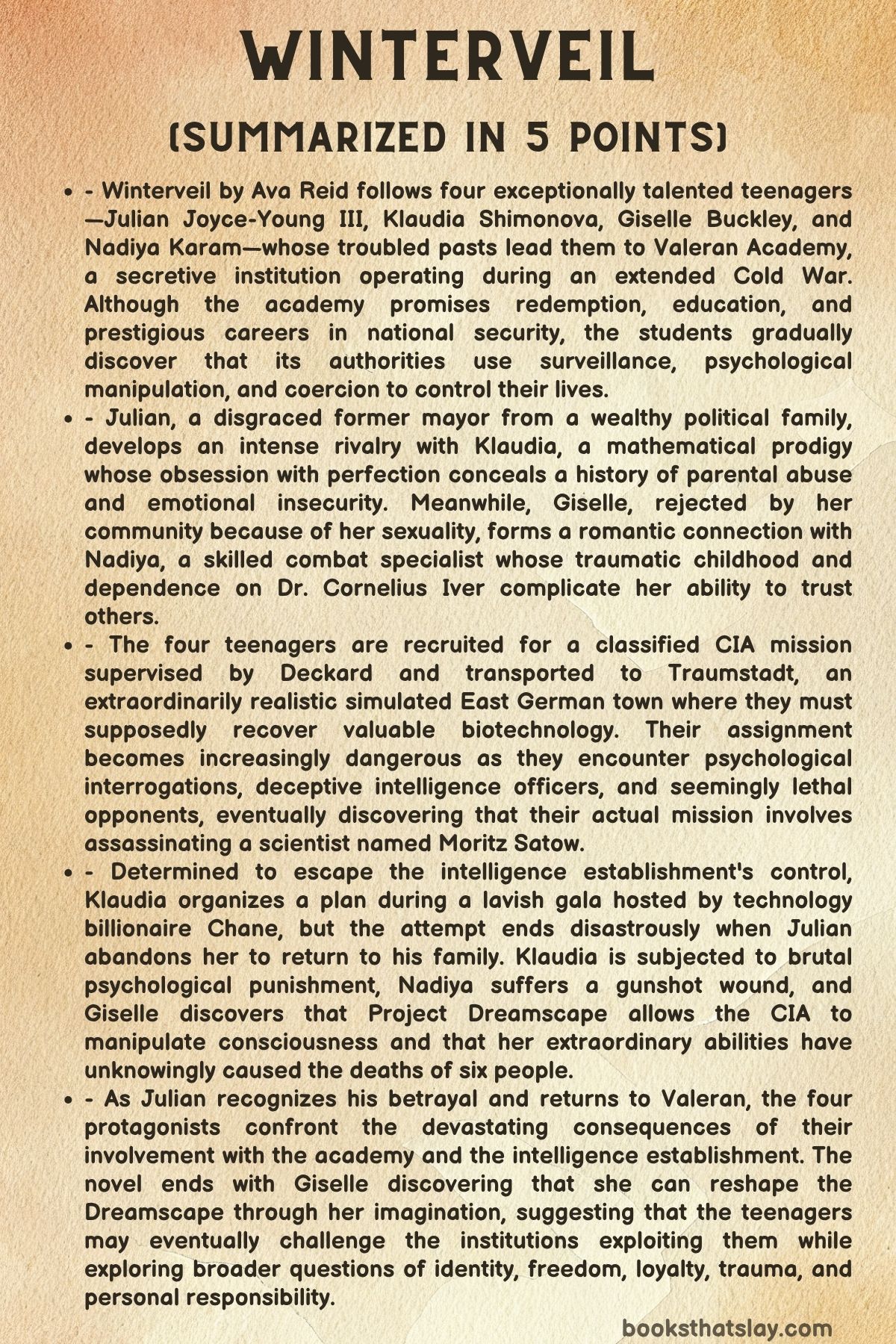
Summary
In an alternate America where the Cold War has continued into the 2030s, four teenagers find their lives transformed by criminal scandals, family conflicts, and extraordinary intellectual abilities. Their separate circumstances eventually bring them to Valeran Academy, a secretive institution hidden in Virginia’s Blue Ridge Mountains, where the government recruits exceptionally talented young people for national security work.
Julian Joyce-Young III, an eighteen-year-old from a wealthy and politically influential Boston family, has become the city’s youngest mayor after accepting a challenge to accomplish something unprecedented among his distinguished relatives. However, his political career collapses when he becomes implicated in bribery and embezzlement, prompting a public scandal that even his family’s connections cannot resolve.
His father refuses to intervene, leaving Julian to face arrest and the humiliation of losing his privileged position. When Dr. Cornelius Iver offers him admission to Valeran in exchange for the dismissal of his criminal charges, Julian accepts, believing that the academy might provide a path toward restoring his reputation.
Meanwhile, fifteen-year-old Klaudia Shimonova faces prosecution in New York after forging her father’s signatures to access financial accounts and earning approximately ten million dollars through stock trading. Her extraordinary mathematical abilities attract public attention, but her Russian heritage and America’s continuing hostility toward the Soviet Union make her an especially controversial defendant.
Klaudia’s relationship with her father, Ivan Shimonov, is deeply troubled by his cruelty and impossible expectations. When Iver intervenes in her legal predicament, she enters Valeran, where her exceptional strategic intelligence soon establishes her as the academy’s highest-ranked student.
Giselle Buckley, a former beauty pageant champion from West Virginia, experiences a different kind of disgrace when a photograph reveals her romantic relationship with Bonnie Nash. Rejected by her family and betrayed by her former boyfriend, Sutton Reeve, Giselle is arrested for financial crimes involving stolen credit card information.
Iver recognizes Giselle’s remarkable photographic memory and offers her a place at Valeran, sending a mysterious young woman named Nadiya Karam to help recruit her. Giselle accepts because she has almost nowhere else to go, although she quickly discovers that the academy’s promises of opportunity conceal severe restrictions on personal freedom.
Nadiya occupies an unusual position within Valeran because Iver has raised her since the murder of her parents when she was nine. An exceptional combat specialist, she remains fiercely loyal to her guardian while depending on neurological devices to suppress the traumatic nightmares associated with her childhood.
At Valeran, students study espionage, military strategy, political theory, and advanced technology while competing through elaborate simulations. Klaudia dominates the rankings, but Julian’s rapid advancement threatens her position, creating an intense intellectual rivalry complicated by their growing attraction.
Julian initially wants to defeat Klaudia to prove himself worthy of his family’s respect. Yet his feelings change after he discovers Carter Egan and several accomplices assaulting her, an incident that exposes the fear and vulnerability hidden beneath her controlled exterior.
Their rivalry reaches a crisis during a tournament involving Thymos, a sophisticated strategic game developed by Julian’s roommate, Mikhail Karchenko. Julian gains a winning position but deliberately allows Klaudia to prevail after witnessing her terrified reaction to the possibility of defeat.
Klaudia immediately recognizes his surrender and interprets it as an act of condescending pity rather than compassion. Furious that Julian has denied her the opportunity to compete honestly, she publicly confronts him, leaving their developing relationship badly damaged.
While Julian and Klaudia struggle with competition and emotional vulnerability, Giselle and Nadiya become increasingly close. Initially instructed by Iver to befriend Giselle, Nadiya discovers that her attachment has developed into genuine affection.
Professor Blanchard, a neuroscience specialist, begins conducting experiments on Giselle’s extraordinary memory using neurological devices called nodes. His research progresses from testing visual recall to extracting autobiographical memories, eventually involving Nadiya in procedures that expose the disturbing circumstances of her parents’ deaths.
Giselle discovers that she can transfer memories into Nadiya’s consciousness, interrupting traumatic recollections and influencing what another person experiences. When the girls begin wearing their devices during sleep, they unexpectedly enter shared dreams, allowing them to explore memories and emotionally intimate experiences together.
Their growing romance becomes a source of happiness within the oppressive academy, but Nadiya’s fear of vulnerability repeatedly complicates their relationship. Her distrust intensifies after a combat exhibition in which Blanchard uses advanced neurological technology to create a disturbing replica of her, triggering a public psychological breakdown.
Shortly afterward, Iver summons Julian, Klaudia, Giselle, and Nadiya to meet a mysterious CIA officer known as Deckard. The four are selected for a classified operation supposedly offering early release from Valeran and prestigious government appointments.
At Camp Peary, the CIA’s training facility, Deckard introduces them to Traumstadt, an extraordinarily realistic reconstruction of an East German town. Their assigned mission involves locating biotechnology associated with Moritz Satow, a scientist whose disappearance has heightened tensions between the United States and the Soviet Union.
The town appears populated by advanced holographic inhabitants, while a mysterious young man named Crispin serves as the students’ liaison. Klaudia quickly suspects that their handlers are withholding information, and she persuades the others to cooperate even if the authorities attempt to turn them against one another.
As they investigate Traumstadt, the students discover that its inhabitants possess an unsettling physical reality. Nadiya and Giselle also experience a painful confrontation when Nadiya admits that their friendship began as an assignment from Iver, leaving Giselle uncertain whether their relationship has ever been genuine.
The mission becomes increasingly brutal when armed men abduct Julian and Nadiya and subject them to psychological interrogation. Deckard presents each captive with an opportunity to betray the other in exchange for freedom, but both refuse, demonstrating the solidarity their captors intended to test.
Meanwhile, Klaudia and Giselle decode cryptic references to Shakespeare and discover a hidden route leading toward the prisoners. Their rescue succeeds, revealing that the abduction was another deliberately constructed examination designed to test loyalty, resourcefulness, and psychological endurance.
Afterward, Nadiya finally acknowledges her attraction to Giselle, and the girls share their first kiss. Their relationship provides a rare experience of mutual acceptance, while Julian and Klaudia gradually begin rebuilding trust through their shared experiences.
Further investigation connects Traumstadt to Moritz Satow and exposes inconsistencies in Deckard’s explanations. The students eventually recognize that their mission may involve assassinating the scientist rather than simply recovering technology.
During the concluding simulation, they face armed opponents carrying apparently genuine weapons. Giselle unexpectedly discovers that she can alter the environment through thought, causing several attackers to disappear and demonstrating abilities beyond anything Blanchard had previously described.
When the exercise ends, Deckard reveals that the students have been evaluated for a real assassination mission against Satow. Their objections are dismissed, and he threatens to treat refusal as treason, making clear that their supposed opportunities for freedom were always conditional.
The group travels to New York, where Deckard requires assistance from Chane, the billionaire head of the powerful technology company Auric. Chane’s extravagant gala creates an opportunity for Klaudia to organize an escape by attracting public attention and attempting to obtain protection through Julian’s influential family.
At the gala, Julian and Klaudia experience a moment of emotional closeness that almost develops into a romantic confession. Meanwhile, Nadiya and Giselle create a violent distraction, allowing their companions to attempt an escape through the hotel.
However, Julian unexpectedly encounters his father, who offers to take him home. Overwhelmed by his longing for family acceptance, Julian abandons Klaudia, allowing security personnel to capture her while he leaves with his father.
Nadiya and Giselle attempt to escape by helicopter but are pursued onto the roof. Nadiya suffers a serious gunshot wound, and Giselle confesses her love while desperately trying to keep her conscious before security forces capture them.
Back at Valeran, Klaudia experiences a particularly cruel punishment for her disobedience. Iver subjects her to psychologically devastating experiences through neurological technology and wounds her wrists to fabricate evidence of a suicide attempt, intending to discredit anything she might reveal about the academy.
Julian initially returns to his family’s Boston home, but he realizes that his former privileges cannot erase his guilt. Memories of his younger brother Aurelian’s death and his growing affection for Klaudia compel him to reject his father’s expectations and return voluntarily to Valeran.
Giselle, meanwhile, learns the truth about Project Dreamscape, the CIA’s immersive neurological system developed through research connected to Satow. Traumstadt was never simply a conventional holographic training facility; the students experienced it through interconnected virtual consciousness while their physical bodies remained elsewhere.
Even more devastatingly, Blanchard reveals that the six men Giselle made disappear during the mission were actual CIA employees who died as a consequence of her actions. Horrified by her unwitting involvement in their deaths, Giselle begins understanding how thoroughly the institution has exploited her extraordinary abilities.
After being subjected to further abuse and coercion, Giselle cuts off her long hair, rejecting the decorative and submissive identity others have repeatedly imposed upon her. Nadiya eventually returns to Valeran after recovering from surgery, believing Iver’s assurance that Giselle remains safe there.
The girls reunite, but their relief is temporary because Iver and Blanchard intend to use them again in the Dreamscape. Julian and Klaudia are also drawn back into the operation, leaving all four teenagers trapped within the institution they had attempted to escape.
In the final moments, Giselle discovers that she possesses extraordinary control over the Dreamscape itself. As buildings and landscapes transform according to her imagination, she takes Nadiya’s hand and begins creating a new reality, suggesting that the power intended to make her an obedient instrument may ultimately allow her to challenge those who control her life.
Characters
Julian Joyce-Young III
Julian Joyce-Young III is one of the central protagonists of Winterveil, representing the conflict between inherited privilege and genuine personal responsibility. His journey begins with the collapse of his political career, exposing the emptiness of an identity constructed around family prestige, public admiration, and the desire to accomplish something extraordinary.
Although Julian possesses considerable intelligence, charm, and strategic ability, he initially approaches most situations with the expectation that his privileged background will protect him. His decision to become Boston’s youngest mayor emerges from a reckless challenge rather than a commitment to public service, revealing how little he understands about responsibility when the novel begins.
His arrival at Valeran places him in an environment where family status offers fewer advantages than exceptional ability. Determined to reclaim his father’s approval, he directs his ambition toward defeating Klaudia, whose intellectual accomplishments both intimidate and fascinate him.
Their relationship becomes the catalyst for much of Julian’s emotional development. He gradually recognizes that Klaudia’s achievements are not simply expressions of intellectual pride but essential defenses against discrimination, violence, and deeply rooted insecurity.
Julian’s decision to surrender during their Thymos competition reveals his growing compassion while exposing his tendency to make choices on another person’s behalf. Although he intends to spare Klaudia humiliation, he fails to recognize that genuine respect requires allowing her to determine the meaning of her own victories and defeats.
His emotional struggles are also connected to the death of his younger brother, Aurelian. Julian carries unresolved grief and guilt, and his desperate pursuit of family approval reflects his inability to accept that achievement cannot restore what his family has lost.
His betrayal of Klaudia during the gala represents his most serious moral failure because he abandons someone who has gradually learned to trust him. However, his eventual decision to return to Valeran demonstrates that his character is capable of change, particularly when he chooses accountability over security.
By the novel’s conclusion, Julian has begun separating his identity from the expectations of his family. His transformation remains incomplete, but his willingness to sacrifice privilege for someone else’s well-being suggests the emergence of a more mature understanding of loyalty and love.
Klaudia Shimonova
Klaudia Shimonova is among the most intellectually accomplished and psychologically complex characters in Winterveil. A mathematical prodigy whose extraordinary abilities have brought her both wealth and criminal prosecution, she approaches the world through logic, probability, and an uncompromising commitment to excellence.
Her academic dominance at Valeran conceals a profound fear of failure. Having endured an abusive upbringing under her demanding father, Ivan Shimonov, Klaudia has learned to associate vulnerability with danger and intellectual superiority with personal survival.
Her Russian heritage intensifies her insecurity because she lives in an American society where anti-Soviet suspicion shapes public attitudes. She recognizes that her gender and background make her achievements more vulnerable to dismissal, encouraging her to pursue a standard of perfection that becomes increasingly destructive.
Klaudia’s rivalry with Julian exposes these tensions. She resents his wealth, charm, and inherited advantages because he appears capable of acquiring the recognition she has struggled to earn without experiencing comparable hardships.
Nevertheless, their intellectual compatibility creates an attraction that neither character initially understands. Julian challenges her strategically while gradually offering the possibility of recognition that does not depend entirely on academic superiority.
Her response to his deliberate defeat during the Thymos tournament reveals the extent of her psychological wounds. What Julian considers compassion, Klaudia experiences as the denial of her autonomy, reinforcing her fear that others regard her as incapable of confronting failure.
Carter’s assault further demonstrates that her exceptional abilities cannot fully protect her from gendered intimidation and violence. Her subsequent hypervigilance and emotional withdrawal reveal the lasting influence of trauma upon her behavior.
Klaudia’s strategic brilliance becomes especially valuable during the Dreamscape mission, where she questions authority, identifies concealed information, and helps rescue her companions. These experiences reveal her capacity for leadership based on cooperation rather than individual achievement.
Her punishment by Iver represents an assault on the independence she has spent her life constructing. By manufacturing evidence of psychological instability, he attempts to undermine the credibility of a young woman whose greatest source of security has always been her intellect.
Ultimately, Klaudia embodies both the power and limitations of rational intelligence. Her development suggests that genuine strength requires not only exceptional ability but also the willingness to trust others without surrendering personal dignity.
Giselle Buckley
Giselle Buckley provides one of the novel’s clearest examinations of identity, social exclusion, and the discovery of personal power. In Winterveil, her experiences reveal how someone accustomed to being underestimated can possess abilities that fundamentally challenge the institutions attempting to control her.
Raised in a conservative West Virginia community, Giselle builds her early identity around beauty pageants, social approval, and the expectation that she should fulfill a conventional feminine role. Her relationship with Bonnie Nash exposes the difference between the public identity she has been taught to maintain and her private emotional reality.
When her sexuality becomes public, Giselle experiences abandonment from nearly everyone she considers important. Her family’s rejection and Sutton’s betrayal leave her vulnerable to Iver’s recruitment, which promises opportunity while concealing another system of control.
At Valeran, Giselle feels inferior to students with advanced academic training and prestigious backgrounds. Although her photographic memory is exceptional, she initially believes that memorization cannot compensate for her perceived lack of intellectual sophistication.
Her developing relationship with Nadiya becomes central to her transformation. Through their shared dreams and growing affection, Giselle experiences the possibility of being valued for her personality and emotional sincerity rather than her appearance or ability to satisfy social expectations.
Giselle’s compassion is one of her defining qualities, but the novel also demonstrates how easily others can exploit it. Blanchard uses her history of rejection to persuade her that developing extraordinary power will protect her from abandonment, manipulating her desire for independence.
Her neurological abilities gradually evolve beyond exceptional memory, allowing her to influence consciousness and ultimately reshape the Dreamscape. The revelation that her actions have caused the deaths of real people confronts her with a devastating moral responsibility she never knowingly accepted.
The decision to cut off her hair symbolizes her rejection of the identity that has confined her since childhood. By altering an important feature of her former pageant persona, she asserts ownership over her body and future.
Giselle’s final transformation is particularly significant because she discovers that the very ability others intended to exploit may enable her to challenge their authority. Her character ultimately represents the movement from externally imposed definitions of worth toward an identity grounded in self-determination, emotional courage, and genuine agency.
Nadiya Karam
Nadiya Karam is a highly skilled combat specialist whose personal history exposes the psychological consequences of trauma and institutional manipulation. Within Winterveil, she embodies the contradiction between extraordinary physical competence and profound emotional vulnerability.
The murder of her parents during childhood fundamentally shapes her understanding of safety and attachment. Taken into Iver’s care after the tragedy, she grows up believing that discipline, obedience, and exceptional combat ability are necessary for survival.
Nadiya regards Iver as her closest remaining family member, making her particularly susceptible to his manipulation. His apparent affection encourages her to interpret dangerous assignments as evidence of trust, even when his actions place her physical and psychological well-being at risk.
Her use of neurological nodes to suppress nightmares further illustrates the extent to which her emotional life has been controlled. The devices provide relief from traumatic memories but also prevent her from confronting experiences essential to understanding her own identity.
Her relationship with Giselle challenges the emotional detachment she has cultivated. Although their friendship begins as an assignment, Nadiya gradually recognizes that her affection exists independently of Iver’s instructions.
She struggles to express these feelings because intimacy requires a degree of vulnerability she has been trained to consider dangerous. Her cruel reaction when Giselle attempts to comfort her after the combat exhibition reveals how thoroughly she associates public emotional exposure with humiliation.
The Dreamscape mission forces Nadiya to confront the consequences of her upbringing. Her repeated experiences of psychological manipulation undermine her faith in Iver, while her growing loyalty to her companions provides an alternative foundation for her identity.
Nadiya’s unusual physical responses to injury and the hidden circumstances of her father’s research introduce further uncertainty about her past. These mysteries suggest that her extraordinary abilities may be connected to scientific experimentation conducted long before she understood its significance.
By choosing Giselle and questioning Iver’s authority, Nadiya begins rejecting the idea that her value depends exclusively on obedience or combat performance. Her journey demonstrates that courage can involve accepting affection, acknowledging fear, and refusing to allow trauma to determine every future decision.
Dr. Cornelius Iver
Dr. Cornelius Iver serves as one of the principal antagonistic forces in Winterveil, exercising control through intellectual authority, emotional manipulation, and institutional power. As Valeran Academy’s headmaster, he presents himself as a visionary educator capable of transforming exceptional but troubled teenagers into valuable national security professionals.
His recruitment methods reveal the coercive foundations of his institution. By approaching young people facing criminal prosecution or social abandonment, he offers them opportunities that appear voluntary but are structured around the absence of meaningful alternatives.
Iver’s relationship with Nadiya demonstrates his particular skill at combining affection with manipulation. Although he assumes the role of her guardian, his willingness to exploit her trauma suggests that his professional objectives repeatedly outweigh his paternal responsibilities.
His interactions with Klaudia expose an even more disturbing aspect of his character. When she challenges his authority, he authorizes psychological torture and fabricates evidence of a suicide attempt, demonstrating his determination to preserve institutional control regardless of the suffering involved.
Iver understands that authority depends upon the belief that resistance carries consequences. His philosophy transforms education into coercion, loyalty into submission, and scientific research into a means of controlling vulnerable individuals.
He is especially dangerous because he frequently presents harmful decisions as necessary sacrifices for a greater national purpose. Rather than behaving as an openly hostile figure at every moment, he uses reassurance, admiration, and selective kindness to keep his students dependent on him.
His character raises questions about whether any claimed commitment to national security can justify the systematic violation of personal freedom. The contrast between his language of protection and his willingness to inflict suffering makes him a representation of institutional corruption disguised as benevolent leadership.
Deckard
Deckard is a mysterious CIA officer whose involvement transforms the students’ experiences from competitive academic training into direct confrontation with the intelligence establishment. His detached professionalism conceals a willingness to expose teenagers to severe psychological distress in the name of operational readiness.
As the supervisor of the Traumstadt mission, Deckard deliberately withholds information about the nature of the simulated environment and the objectives of the operation. He treats uncertainty as an essential feature of intelligence training, even when it prevents the students from understanding the dangers they face.
His orchestration of Julian and Nadiya’s abduction demonstrates his belief that loyalty must be tested through extreme pressure. By offering each prisoner freedom in exchange for betraying the other, he attempts to reduce human relationships to strategic calculations.
Deckard’s final threat that refusal constitutes treason reveals the fundamental dishonesty of the mission’s promised rewards. He represents a bureaucracy that demands personal sacrifice while refusing to acknowledge the moral rights of those it recruits.
Professor Blanchard
Professor Blanchard is a neuroscience specialist responsible for much of the experimentation conducted at Valeran. His scientific brilliance is accompanied by a disturbing lack of concern for consent, emotional suffering, and the consequences of his research.
He initially approaches Giselle’s abilities as an intellectual problem, testing her memory through carefully monitored neurological procedures. However, his experiments become increasingly invasive as he discovers that she can influence other people’s memories and experiences.
His treatment of Nadiya is especially cruel because he deliberately exposes traumatic childhood recollections without adequately explaining the procedures or providing psychological protection. The public demonstration that causes her breakdown reveals his willingness to sacrifice a student’s well-being to impress influential observers.
Blanchard also manipulates Giselle by presenting extraordinary neurological power as a solution to her history of rejection. His later sexual violation of her boundaries further exposes his disregard for the autonomy of those under his control.
His character illustrates the danger of scientific advancement when researchers treat human beings as experimental resources rather than individuals deserving dignity and protection.
Crispin
Crispin is an enigmatic young man assigned to accompany the students during their simulated mission in Traumstadt. His strangely impassive manner, unexplained knowledge, and close association with Deckard immediately raise questions about his true purpose.
He appears to function as a liaison and possible surveillance instrument, making Klaudia suspicious that their conversations and decisions are being monitored. Nevertheless, Crispin occasionally exhibits curiosity and emotional vulnerability that complicate the impression that he is merely an obedient agent.
His intimate encounter with Julian introduces another dimension to the novel’s exploration of personal autonomy. Julian’s confusion afterward, combined with Crispin’s ambiguous circumstances, raises questions about consent, emotional needs, and the exploitation of young people within controlled environments.
Crispin remains one of the more mysterious characters because the full nature of his relationship with the intelligence establishment is not explained. His uncertain identity reinforces the novel’s broader concern with the distinction between independent human action and behavior shaped by external control.
Mikhail Karchenko
Mikhail Karchenko is Julian’s roommate at Valeran and an exceptionally talented hacker whose creativity contributes significantly to the academy’s competitive environment. His friendly and approachable personality provides Julian with an important connection during his difficult adjustment to institutional life.
Mikhail’s development of Thymos demonstrates his unusual ability to combine programming, strategy, and artificial intelligence. When Iver incorporates the game into the official curriculum, Mikhail receives recognition that elevates his academic standing.
Although the game initially appears to be a recreational achievement, it becomes a major instrument through which the academy measures student performance. Mikhail therefore indirectly contributes to the escalating rivalry between Julian and Klaudia, even though his own motivations are less aggressively competitive.
His developing relationship with Jane Lin also provides a contrast to the emotionally guarded behavior of the central protagonists. He represents friendship, technical ingenuity, and the possibility of ordinary companionship within an environment increasingly dominated by manipulation.
Jane Lin
Jane Lin is one of Klaudia’s closest friends and an important source of emotional stability at Valeran. Unlike students whose crimes primarily arise from ambition or personal gain, Jane is recruited after hacking a health insurance corporation to prevent patients from being denied treatment.
Her actions demonstrate a strong commitment to compassion and social responsibility. Although technically unlawful, her interference with the insurance system emerges from a desire to protect vulnerable people rather than exploit them.
Jane’s optimism contrasts with Klaudia’s intensely analytical worldview. She encourages Klaudia to participate in ordinary social experiences and recognize that intellectual accomplishment does not require complete emotional isolation.
Her romantic feelings for Mikhail further emphasize her willingness to form personal attachments despite the academy’s competitive culture. Through Jane, the novel presents kindness as a meaningful form of strength that does not depend on domination or superiority.
Matteo Alemu Sorensen
Matteo Alemu Sorensen is a charming former model whose theft of a valuable painting leads to his recruitment into Valeran. His background illustrates the academy’s willingness to identify extraordinary potential in young people whose talents have previously been expressed through criminal behavior.
He maintains a close friendship with Nadiya and provides moments of humor and normality within her disciplined life. His teasing and conversational ease contrast with the emotional restraint she displays toward most other students.
Matteo also demonstrates concern when Nadiya’s behavior begins changing after her unusual experiences with Giselle. Although he does not fully understand the neurological experiments, his attention to her distress reveals the importance of relationships that exist outside Iver’s authority.
His character helps establish the academy as a functioning social environment rather than merely a collection of exceptionally talented individuals.
Carter Egan
Carter Egan is a highly ranked Valeran student whose resentment toward Klaudia becomes increasingly aggressive as his competitive position deteriorates. Initially occupying second place, he regards her continued dominance as a challenge to his own identity and sense of superiority.
His hostility intensifies when Julian begins advancing through the rankings, threatening the status Carter previously enjoyed. Rather than responding through legitimate intellectual competition, Carter resorts to intimidation and humiliation.
His assault on Klaudia reveals the extent to which entitlement and misogyny influence his behavior. Unable to defeat her through academic achievement, he attempts to establish physical and psychological power over her.
Carter’s character exposes the violent assumptions that can exist beneath apparently respectable systems of merit. His actions demonstrate that exceptional intelligence does not necessarily produce ethical maturity or respect for others.
Chane
Chane is an eccentric billionaire whose corporation, Auric, plays a significant role in developing technology associated with the American intelligence establishment. His influence extends across business, politics, military innovation, and elite social networks.
He regards technological supremacy as essential to defeating the Soviet Union, enthusiastically supporting ambitious scientific projects without demonstrating comparable concern for their human consequences. His wealth allows him to influence decisions that place others in danger while he remains personally insulated from the risks.
Chane’s gala becomes an important setting because it exposes the close relationships between private wealth and government power. His inappropriate interest in Klaudia also reveals a willingness to exploit unequal social positions.
His reaction to the students’ attempted escape demonstrates how quickly his apparent hospitality can transform into hostility. Chane embodies the dangers of concentrated private power when commercial ambition operates alongside coercive state institutions.
Ivan Shimonov
Ivan Shimonov is Klaudia’s father and one of the central figures responsible for her psychological development. His demanding and abusive behavior teaches her that affection and personal worth depend upon exceptional performance.
He repeatedly emphasizes the disadvantages associated with her gender and Russian background, encouraging her to believe that even minor failures can destroy her opportunities. His treatment produces a young woman who possesses extraordinary discipline but struggles to experience genuine security.
Memories of his cruelty continue to affect Klaudia long after she enters Valeran. Her reactions to Carter’s assault, Julian’s apparent pity, and the possibility of losing her academic position all reflect the influence of her father’s expectations.
Ivan represents the damaging consequences of treating a child’s accomplishments as more important than their emotional well-being. His eventual reappearance as an invited guest at Chane’s gala reminds Klaudia that institutional power and family trauma remain closely connected.
Aurelian Joyce-Young
Aurelian Joyce-Young is Julian’s younger brother, whose death by suicide profoundly affects the surviving members of his family. Although he appears primarily through Julian’s recollections, his presence is essential to understanding Julian’s grief, ambition, and desire for parental approval.
Aurelian is remembered as sensitive and emotionally vulnerable, qualities that contrast with the expectations associated with the Joyce-Young family’s public standing. His death exposes emotional suffering that wealth and prestige cannot resolve.
Julian’s memories of discovering his brother’s body remain intensely painful. His pursuit of extraordinary achievement partly reflects an attempt to compensate for feelings of helplessness and restore meaning to a family damaged by loss.
Aurelian’s role demonstrates that absence can be as influential as physical presence. His memory shapes Julian’s relationships and ultimately contributes to his recognition that love and personal responsibility matter more than public success.
Julian’s Parents
Julian’s father represents the rigid expectations associated with inherited wealth and political influence. Although he possesses considerable power, he refuses to rescue Julian from his corruption scandal, expressing anger at the embarrassment his son’s behavior has brought upon the family.
His emotional distance contributes to Julian’s insecurity and persistent desire to prove himself. When he offers to take Julian home during Chane’s gala, the promise becomes powerful enough to override Julian’s commitment to Klaudia.
Julian’s mother displays greater warmth, welcoming her son home with obvious relief after his disappearance into the intelligence establishment. Nevertheless, the family’s apparent return to normality cannot resolve the grief and emotional alienation surrounding Aurelian’s death.
Together, Julian’s parents represent the difference between material security and emotional understanding. Their household offers comfort and status but lacks the openness necessary for Julian to confront his grief and develop an independent identity.
Sutton Reeve
Sutton Reeve is Giselle’s former boyfriend and an important figure in the destruction of her life in Belle. As the son of the local sheriff, he possesses social connections that reinforce the authority he assumes over others.
After Giselle’s relationship with Bonnie becomes public, Sutton responds with hostility and exposes her involvement in financial crimes. His actions reveal how personal resentment can become particularly destructive when supported by social prejudice and institutional influence.
Sutton’s condemnation of Giselle’s sexuality demonstrates his inability to accept an identity that challenges his expectations of her. His confrontation with Nadiya, who easily overpowers him, exposes the limitations of the authority he has relied upon.
He represents the judgmental environment Giselle must leave behind to begin discovering a more authentic understanding of herself.
Bonnie Nash
Bonnie Nash is Giselle’s former romantic partner and a significant figure in her early experiences of love, secrecy, and rejection. Their relationship provides Giselle with an opportunity to express desires that conflict with the expectations of her family and community.
However, the exposure of their relationship brings serious consequences, and Bonnie’s refusal to shelter Giselle contributes to her emotional isolation. Giselle is left confronting not only public condemnation but also disappointment in someone she had trusted.
Bonnie’s importance lies partly in the contrast between her relationship with Giselle and the later development of Giselle’s romance with Nadiya. While the earlier relationship becomes associated with secrecy and abandonment, the later one gradually offers mutual protection and the possibility of a shared future.
Professor Narendra
Professor Narendra is a mathematics and strategy instructor at Valeran who plays an important role in Klaudia’s academic development. He recognizes her extraordinary intelligence and provides advanced instruction that supports her continued dominance of the academy’s rankings.
Unlike Iver and Blanchard, Narendra occasionally demonstrates awareness of the emotional pressures placed upon students. Following Klaudia’s public breakdown during the Thymos tournament, he acknowledges that the academy has neglected her psychological well-being.
Nevertheless, his sympathy cannot fully overcome the institutional environment in which he operates. Klaudia experiences his concern as another threat to her independence because she has learned to associate vulnerability with diminished respect.
Narendra represents the possibility of a more humane approach to education, while also illustrating how individual concern may remain inadequate within a fundamentally coercive institution.
Alexander Karam
Alexander Karam is Nadiya’s deceased father, whose involvement in classified neurological research becomes increasingly significant as the story develops. His murder leaves Nadiya with traumatic memories and a lasting sense of guilt connected to her childhood escape.
The silver cross she inherits from him preserves a connection to the family life that existed before Iver became her guardian. It also serves as a reminder of the religious and cultural traditions she has been discouraged from exploring.
Evidence connecting Alexander to experimental neuroscience raises questions about whether his death and Nadiya’s subsequent upbringing are linked to the intelligence establishment’s research. Although the complete circumstances remain unresolved, his past suggests that Nadiya’s recruitment may involve more than the recognition of her combat abilities.
Alexander’s character therefore functions as both an emotional presence and a central element of the novel’s scientific mystery.
Moritz Satow
Moritz Satow is an East German scientist whose disappearance becomes a central concern in the escalating conflict between American and Soviet intelligence services. His research is associated with advanced neurological technology, making him valuable to governments seeking strategic advantages.
Although he has limited direct involvement in the events shown, the uncertainty surrounding his whereabouts drives the operation involving the four protagonists. Deckard initially presents the mission as an effort to recover sensitive biotechnology, concealing the intention to assassinate Satow.
His role becomes particularly important when the existence of Project Dreamscape is revealed. The technology’s connection to Soviet research suggests that the struggle over his knowledge has consequences extending far beyond conventional military intelligence.
Satow represents the vulnerability of scientific expertise within political conflicts, where discoveries can become instruments of coercion and their creators targets of competing governments.
Landon Downing
Landon Downing is one of Julian’s longtime acquaintances from his privileged social circle. His deteriorating circumstances, including expulsion from school and impending rehabilitation, reveal that wealth does not protect young people from destructive personal choices.
During Julian’s return to Boston, Landon exposes him to photographs from Chane’s gala, including an image of Julian and Klaudia dancing together. His degrading comments about Klaudia provoke an unexpectedly forceful response from Julian.
The confrontation reveals how much Julian’s values have changed during his time at Valeran. Landon functions as a reminder of the shallow social attitudes Julian once tolerated and increasingly rejects.
Christabel Cabot
Christabel Cabot is Julian’s former girlfriend and another representative of his life before Valeran. Their relationship belongs to the world of inherited status, familiar social obligations, and emotional expectations that Julian once accepted without serious examination.
When Christabel announces that she is dating someone else, Julian becomes aware of the distance that has developed between his former identity and his present feelings. Their subsequent intimate encounter does not restore the emotional connection he once associated with their relationship.
Her character helps clarify Julian’s growing attachment to Klaudia. Through his interactions with Christabel, he recognizes that returning to a familiar relationship cannot reverse the personal changes he has experienced.
Dr. Li
Dr. Li is a physician who treats Nadiya after she suffers a serious gunshot wound during the failed escape from Chane’s gala. His professional concern contrasts with the secrecy and manipulation practiced by the scientists controlling her life.
He notices unusual findings in Nadiya’s blood tests and extensive abdominal scarring that appear relevant to her medical history. His attempts to investigate these abnormalities are interrupted when Iver arrives and uses his authority to remove him from the situation.
Although his appearance is relatively brief, Dr. Li introduces evidence suggesting that Nadiya’s physical condition may conceal important information. His role also emphasizes the difference between medical care intended to protect a patient and experimentation designed to serve institutional interests.
Themes
Power, Surveillance, and the Struggle for Freedom
Power in Winterveil operates through institutions that present control as protection, education, or patriotic responsibility. Valeran Academy embodies this contradiction because its administrators promise talented teenagers opportunities for personal advancement while systematically depriving them of meaningful independence.
The students enter the institution after encountering circumstances that leave them vulnerable to prosecution or social abandonment. Their supposed freedom to accept Valeran’s offer is therefore questionable because rejection often means returning to punishment, disgrace, or uncertain futures.
Dr. Iver demonstrates how authority can become especially effective when combined with emotional dependence. His relationship with Nadiya illustrates this process because he uses his position as her guardian to secure obedience even when his decisions expose her to severe psychological harm.
The neurological experiments introduce an additional dimension of institutional control. Surveillance no longer involves merely observing physical actions or monitoring communication; it extends into private memories, dreams, and the structure of consciousness itself.
Project Dreamscape represents the ultimate expression of this ambition. By constructing environments that appear indistinguishable from reality, the intelligence establishment can manipulate what individuals experience, believe, and remember.
Deckard’s training exercises similarly challenge the distinction between voluntary cooperation and coercion. His willingness to threaten the students with accusations of treason reveals that their participation has never depended upon genuine consent.
The conflict becomes particularly significant when Giselle discovers that she can influence the Dreamscape independently. Her abilities create the possibility that a system designed to eliminate individual autonomy might be transformed into an instrument of resistance.
Ultimately, the novel portrays freedom as something more demanding than physical escape. Genuine independence requires the ability to question authority, reject imposed identities, and make moral decisions without surrendering personal judgment to institutions claiming superior knowledge or power.
Memory, Trauma, and the Construction of Reality
Memory functions as both a source of personal identity and an instrument of psychological vulnerability throughout the story. The characters’ experiences demonstrate that the past does not remain confined to recollection but continues influencing their relationships, decisions, and understanding of themselves.
Nadiya’s childhood trauma provides a particularly powerful example of this relationship. Her memories of her parents’ murder have been suppressed through neurological technology, allowing her to function as a highly disciplined combat specialist while remaining separated from essential parts of her emotional history.
Klaudia’s memories of her father’s abuse similarly shape her behavior long after the immediate danger has passed. Her pursuit of perfection, fear of humiliation, and resistance to emotional intimacy all emerge from experiences that taught her to associate weakness with punishment.
Julian’s grief over Aurelian reveals another consequence of unresolved trauma. His obsession with accomplishment and paternal recognition becomes understandable when viewed alongside his inability to reconcile himself with his brother’s death.
The Dreamscape technology transforms these psychological experiences into physical-seeming environments that can be manipulated by outside observers. This development makes memory especially dangerous because private suffering becomes material that powerful institutions can exploit.
Blanchard’s experiments illustrate the ethical consequences of treating consciousness as an accessible scientific resource. His willingness to expose traumatic memories without consent demonstrates how technological advancement can create new forms of psychological violence.
At the same time, shared dreaming allows Giselle and Nadiya to experience memories through intimacy rather than coercion. Their encounters suggest that revisiting painful experiences can support understanding when participants possess mutual trust and the freedom to establish boundaries.
The novel ultimately challenges the assumption that reality consists only of externally observable events. By revealing that constructed experiences can produce genuine emotional and physical consequences, it suggests that memory and consciousness are essential dimensions of human existence deserving protection from exploitation.
Trust, Love, and Betrayal
Trust develops under unusually difficult circumstances because the central characters inhabit an environment structured around competition, secrecy, and psychological manipulation. Their relationships become meaningful precisely because emotional openness carries consequences that neither intelligence nor physical strength can reliably prevent.
Julian and Klaudia initially understand their relationship through rivalry. Each regards the other as a threat to personal security, making their gradual attraction inseparable from questions about recognition, fairness, and vulnerability.
Julian’s deliberate surrender during the Thymos tournament reveals how compassionate intentions can damage trust when they deny another person’s independence. His later abandonment of Klaudia during the gala demonstrates an even more serious failure because he prioritizes his desire for family acceptance over an established commitment.
Nevertheless, his eventual return to Valeran suggests that betrayal need not permanently determine a person’s moral identity. By choosing to face the consequences of his actions, Julian begins demonstrating that trust requires accountability rather than merely affection.
Giselle and Nadiya’s relationship develops through a different set of difficulties. Giselle approaches intimacy with a history of rejection, while Nadiya fears emotional attachment because her upbringing has taught her that vulnerability invites suffering.
Their shared dreams create opportunities for honesty that ordinary interactions rarely provide. However, Nadiya’s admission that she originally befriended Giselle under Iver’s instructions threatens the authenticity of everything they have experienced together.
Their eventual reconciliation becomes possible because both begin distinguishing genuine affection from the manipulation surrounding their initial meeting. Love provides a means of recognizing one another as individuals rather than as instruments serving somebody else’s purpose.
The growing solidarity among all four protagonists expands this theme beyond romance. Their refusal to betray one another during Deckard’s exercises reveals that loyalty can become a form of resistance when institutions attempt to exploit isolation and fear.
Identity, Ambition, and Social Inequality
The pursuit of personal achievement in Winterveil is inseparable from questions of class, gender, sexuality, ethnicity, and social expectations. Although Valeran claims to reward exceptional talent, the experiences of its students reveal that individuals do not enter competition with equal advantages or comparable opportunities for recognition.
Julian possesses inherited wealth, political connections, and social confidence that initially protect him from consequences experienced more severely by others. His desire for achievement emerges partly from the pressure to distinguish himself within an already influential family.
Klaudia approaches ambition from a fundamentally different position. Her Russian background and experiences of gender discrimination encourage her to believe that maintaining exceptional performance is necessary to secure opportunities others receive more easily.
Their rivalry therefore represents more than a competition between equally talented individuals. It exposes the tension between merit and privilege, demonstrating that intellectual achievement cannot be understood independently of the social structures surrounding it.
Giselle’s experiences reveal another form of inequality rooted in sexuality, class, and conventional expectations of femininity. Her community celebrates her beauty and pageant accomplishments while rejecting her when her private identity becomes inconsistent with its moral standards.
At Valeran, Giselle encounters intellectual elitism that reinforces her sense of inadequacy. Yet her extraordinary abilities eventually challenge assumptions about intelligence and demonstrate the limitations of systems that recognize only particular forms of achievement.
Nadiya’s identity has been shaped by a different structure of expectations. Her combat abilities earn admiration, but the institution’s emphasis on discipline discourages her from expressing emotional needs or exploring her family’s history.
The novel also questions whether ambition remains desirable when success requires surrendering personal values. Julian’s political career, Klaudia’s obsession with rankings, and Nadiya’s pursuit of Iver’s approval all demonstrate how externally defined achievement can obscure deeper emotional needs.
By the conclusion, the protagonists have begun recognizing that their worth cannot be measured exclusively through status, obedience, academic rankings, or usefulness to powerful institutions. Their developing independence suggests that genuine personal growth requires the freedom to define success according to individual values rather than inherited expectations or institutional demands.