With All My Haunted Heart Summary, Characters and Themes
With All My Haunted Heart by Isabel Sterling is a paranormal romance that combines witchcraft, supernatural mysteries, emotional healing, and an unexpected love story. The novel follows Pippa Ainsley, a gifted witch whose unconventional approach to magic leads her to an extraordinary project involving a genuinely haunted bed-and-breakfast.
As she works to create a safe environment for ghosts and living guests, she develops feelings for Eloise Thompson, a woman whose personal circumstances make their relationship complicated. Through magical discoveries, family conflicts, romantic uncertainty, and the experience of loss, the story explores unconditional love, personal identity, grief, and the importance of finding a place where one truly belongs.
Summary
Pippa Ainsley is a talented witch living in Windsfell, where she operates a small business specializing in unusual magical problems. Despite her considerable abilities, her financial situation has become increasingly difficult because a competing establishment, Coffee, Charms, and Crystals, offers cheaper magical services.
Her professional struggles are illustrated when she successfully removes a complicated hex from wealthy businessman Callum Anders. Although Pippa demonstrates exceptional skill and identifies evidence suggesting that the curse originated from a business rival, Callum declines her additional services, leaving her frustrated by the difficulty of attracting reliable customers.
Pippa’s financial worries are temporarily interrupted when her close friend Xander Owens arrives with an unusual proposition. Following the collapse of his engagement to Barrett, who betrayed him through infidelity, Xander has purchased an impressive manor in Oak Spires with his childhood friend Eloise Thompson, whom he calls Louie.
The two intend to convert the property into a bed-and-breakfast called Midnight Manor, and Xander asks Pippa to investigate its supernatural condition before the business opens. Pippa agrees, partly because Xander supported her when her influential witch family rejected her unconventional magical interests.
At the manor, Pippa encounters Elle, an attractive but guarded woman whose sharp remarks initially make their interactions uncomfortable. Despite their awkward introduction, Pippa immediately feels drawn to her, especially as their conversations reveal glimpses of humor and intelligence beneath Elle’s defensive attitude.
Pippa discovers that the building has already been cleared of its ghosts, although some lingering spiritual energy requires cleansing. Once she completes the work, Elle reveals that they actually want the property to contain genuine ghosts, believing an authentic haunting will distinguish their establishment from ordinary accommodations.
Pippa objects because deliberately keeping spirits in the mortal world raises serious ethical questions. She believes ghosts should be free to cross into the afterlife rather than being confined for human entertainment, and she worries about possession, injuries, and the exploitation of deceased individuals.
Initially, the disagreement causes her to abandon the project. However, worsening business problems and a subsequent conversation with Elle persuade her to reconsider, particularly after she learns that the investor, Sloane McKinley, hopes to use the manor for educational retreats involving communication with spirits.
Pippa agrees to undertake the assignment on the condition that every ghost participates voluntarily and retains the freedom to leave. She moves into Midnight Manor with her magical equipment, determined to establish protective systems and recruit suitable supernatural residents before its Halloween opening.
Working closely with Elle gradually changes their relationship. Their disagreements continue, but Pippa begins appreciating Elle’s intelligence, determination, and occasional tenderness, while Elle becomes increasingly fascinated by Pippa’s creativity and extraordinary magical abilities.
Pippa first concentrates on developing barriers that prevent spirits from entering guest bedrooms or possessing visitors. She also investigates ways to attract ghosts, communicate with them, and allow ordinary people to experience supernatural phenomena safely.
One early experiment nearly ends in disaster when Pippa captures an aggressive poltergeist from a frightened couple’s home and transports it to the manor. Elle accidentally breaks the crystal containing the spirit, allowing it to possess Pippa, who must instruct Elle to use an emergency Taser to destroy the ghost.
Although Pippa survives, the incident forces both women to confront the dangers of their undertaking. Elle’s concern during Pippa’s recovery reveals her growing affection, while conversations about their previous relationships and difficult childhood experiences begin establishing genuine emotional trust.
Pippa explains that her mother, Nanette Erikson, valued conventional healing magic and regarded her daughter’s unconventional abilities as shameful. Her family ultimately disowned her after a public scandal exposed her magical experiments, leaving Pippa convinced that love and acceptance were conditional upon meeting other people’s expectations.
Elle also discusses her painful relationship with her former girlfriend Kinsley, whose constant criticism damaged her confidence. Recognizing that their personal histories make them sensitive to rejection, the women agree to communicate more openly and stop assuming the worst about each other’s intentions.
Their search for appropriate ghosts proves unexpectedly complicated. Although numerous spirits respond to Pippa’s summoning rituals, many are unsuitable because of aggressive behavior, inappropriate attitudes, or incompatibility with the manor’s intended visitors.
Pippa eventually encounters Laney, a friendly young ghost who seems ideal for the property, but Elle initially rejects them because they are uncomfortable around children. This disagreement creates further tension, as Pippa cannot understand why Elle has established such uncompromising requirements for the manor’s supernatural residents.
After further discussion, Elle agrees to reconsider Laney, and Pippa successfully persuades them to relocate. She also creates enchanted goggles that allow people without magical abilities to see ghosts, an invention that transforms the practical possibilities of the entire business.
The successful experiment leads to an unexpected romantic breakthrough when Elle kisses Pippa. Although their attraction is undeniable, Elle becomes hesitant afterward, worrying that a relationship between Xander’s two closest friends might complicate his recovery from Barrett’s betrayal.
After confronting their feelings, the women agree to pursue a discreet romantic relationship without making promises about the future. Their physical intimacy grows alongside their emotional attachment, even as Pippa repeatedly reminds herself that the arrangement is supposed to end when her assignment is complete.
Meanwhile, Pippa recruits additional ghosts, including Colton and Harry, and develops enchanted mirrors that allow spirits to communicate through written messages. Her experimental work attracts admiration from the household, although the pressure to satisfy Sloane’s demanding expectations continues increasing.
As the Halloween deadline approaches, Pippa also confronts uncertainty about her professional future. Her rival’s planned expansion into Oak Spires threatens her business, while the memory of her family’s rejection continues influencing her belief that her worth depends on extraordinary achievements.
A visit to bless the newborn son of Jackie and Marisol provides an unexpected emotional turning point. While performing the ceremony, Pippa experiences visions of the child’s future surrounded by unconditional parental love, reminding her of the affection she rarely experienced growing up.
Soon afterward, Pippa unexpectedly encounters Elle at the hospital and discovers that she has been concealing a devastating family crisis.
Elle’s niece Willa is dying from an aggressive brain tumor, and no medical treatment or magical healing has been able to save her. Pippa learns that Elle and Xander developed Midnight Manor partly to create a place where Willa’s spirit might remain after death, allowing her family to maintain contact with her.
The revelation transforms Pippa’s understanding of the entire project. Although hurt that Elle concealed something so significant, she agrees to help Willa if the child wishes to remain and her parents consent.
Pippa visits Willa and uses her celebration magic to provide moments of happiness during the child’s final days. She also comforts Elle, whose overwhelming grief and exhaustion reveal how deeply the approaching loss has affected her.
Meanwhile, Pippa successfully develops an enchanted room where ghosts can become visible without special equipment. Unfortunately, an accidental magical surge sends four resident ghosts permanently across the veil, threatening Sloane’s investment and devastating Pippa’s confidence.
Believing that she must repair everything herself, Pippa undertakes an exhausting search for replacement spirits. She eventually recruits Betty, Noah, Imani, and Keith, but returns to the manor dangerously weakened by magical overexertion and inadequate rest.
Xander and Elle reassure her that their affection does not depend on her achievements. Their concern begins challenging Pippa’s belief that mistakes inevitably lead to rejection, and she gradually allows herself to accept their support.
With the project restored, Pippa and Elle acknowledge that their relationship has become far more meaningful than either expected. They agree to remain together beyond the Halloween opening, and Pippa realizes that she has fallen in love.
Midnight Manor opens successfully, attracting guests eager to experience its supernatural attractions. However, the celebration is complicated by the unexpected appearance of Barrett, now engaged to another man, and Pippa intervenes to protect Xander from further humiliation.
The evening ends when Elle receives news that Willa is approaching death. Pippa accompanies her to the family home and establishes a magical circle that will allow Willa’s spirit to communicate with her loved ones after her passing.
When Willa dies, her spirit emerges free from the limitations of her illness. Although Elle eagerly describes the welcoming home prepared for her at Midnight Manor, Willa chooses to cross into the afterlife, where she senses her deceased great-grandfather waiting.
Pippa honors Willa’s wishes, allowing her to depart after a final goodbye with her family. Elle, overwhelmed by grief, lashes out at Pippa for not keeping Willa’s spirit at the manor and ends their romantic relationship.
Heartbroken, Pippa returns to Windsfell, where further changes await her. Deanna announces that she has accepted another job, prompting Pippa to reconsider her struggling business and eventually close its physical office in favor of a more flexible operation.
With encouragement from Xander and Deanna, Pippa begins rebuilding her independence, adopts two kittens named Cocoa and Waffles, and meets Teagan Keller, the competitor she previously resented. Their conversation reveals that Teagan admires her work and hopes to collaborate, creating an unexpected professional opportunity.
A regulatory investigation into Midnight Manor’s magical inventions subsequently leads Pippa to confront her estranged sister, Flora. Their reunion exposes years of misunderstanding and reveals that Flora had quietly supported Pippa despite their separation.
After Flora approves the manor’s magical systems, the sisters begin repairing their relationship. Pippa’s renewed confidence encourages her to reconsider her future with Elle, but before she can initiate a reconciliation, Elle arrives at her apartment.
Elle apologizes for blaming Pippa after Willa’s death and acknowledges that respecting the child’s wishes was an act of compassion. She confesses her love and offers Pippa a place at Midnight Manor without attaching romantic conditions.
Pippa accepts the possibility of rebuilding their relationship, and they eventually reunite. She moves back to Oak Spires, bringing her kittens and beginning a new chapter surrounded by the people who have become her chosen family.
One year later, Midnight Manor is thriving, and Pippa and Elle are preparing to establish a home together. During Halloween, Pippa uses the unusually thin boundary between the living world and the afterlife to arrange a brief reunion between Willa and her family.
The occasion brings happiness, reassurance, and a renewed understanding that love can endure without preventing those who have died from moving forward. With professional success, restored family connections, and a lasting romantic relationship, Pippa finally experiences the security and belonging she had spent years searching for.
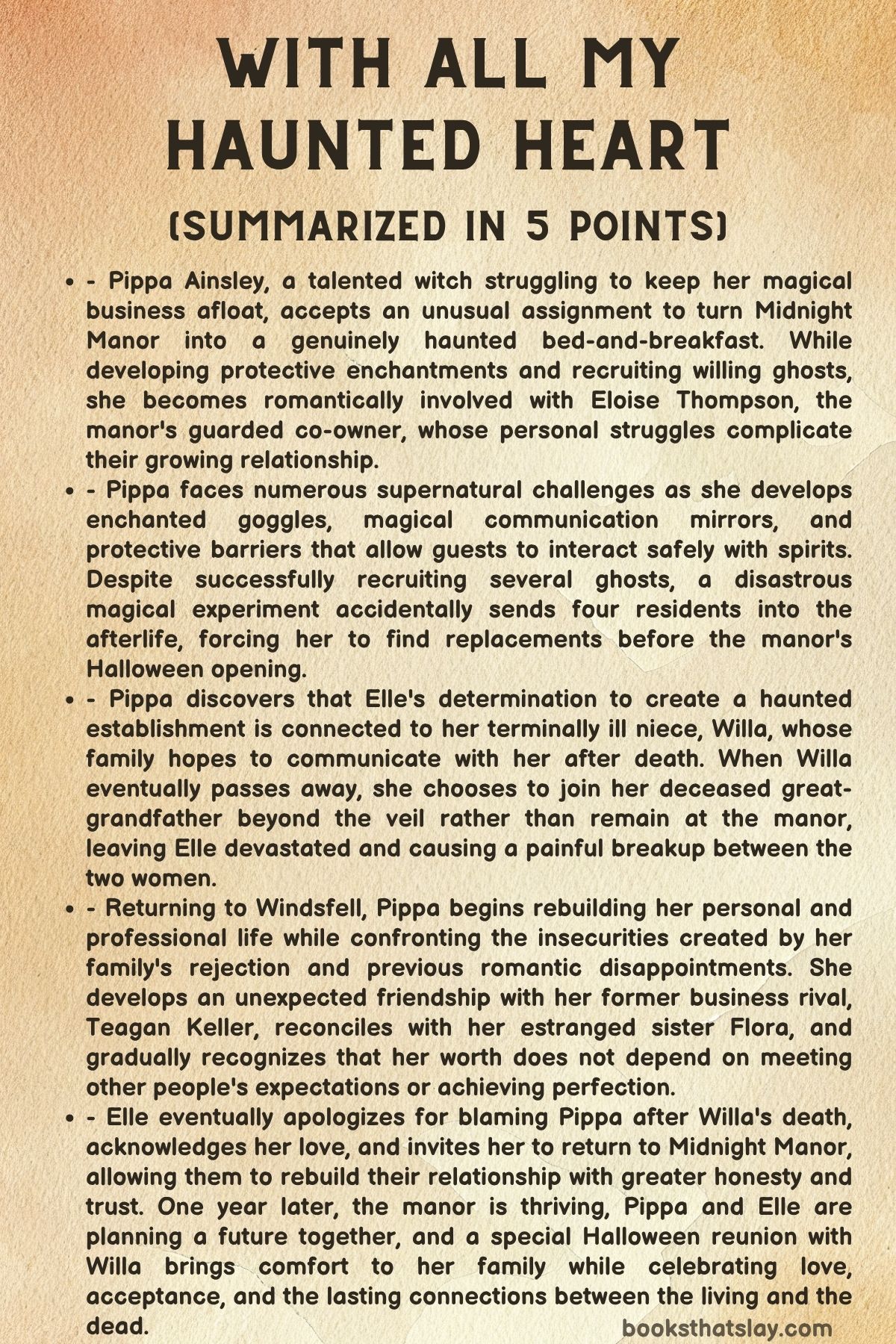
Characters
Pippa Ainsley
Pippa Ainsley is the protagonist of With All My Haunted Heart, a resourceful and exceptionally skilled witch whose unconventional magical abilities distinguish her from the traditional practitioners surrounding her. Her creativity, intelligence, and professional integrity make her capable of solving problems that other witches cannot easily address.
Despite her remarkable abilities, Pippa suffers from deep insecurity caused by her family’s rejection. Growing up under the control of a demanding mother taught her to associate love with achievement, and this belief continues influencing her professional decisions and personal relationships.
Her commitment to ethical witchcraft becomes especially significant during the Midnight Manor project. Even when financial desperation makes the commission attractive, she refuses to exploit ghosts, insisting that supernatural residents must participate voluntarily and retain control over their existence.
Pippa’s romantic relationship with Elle forces her to confront the vulnerability she has avoided since previous experiences of abandonment. Although she initially accepts a temporary arrangement to protect herself from disappointment, she gradually recognizes that genuine intimacy requires emotional honesty and the willingness to risk rejection.
Her accidental destruction of four resident ghosts exposes the destructive side of her perfectionism. Instead of accepting support, she exhausts herself attempting to repair the mistake, revealing how strongly she believes that personal failures threaten her right to be loved.
By the conclusion, Pippa has developed a healthier understanding of her abilities and personal worth. Reconciliation with Flora, professional collaboration with Teagan, and her renewed relationship with Elle demonstrate that she can build a fulfilling life without sacrificing her individuality or constantly proving herself deserving of affection.
Eloise “Elle” Thompson
Eloise Thompson, commonly known as Elle or Louie, is the principal romantic interest in With All My Haunted Heart and one of the owners of Midnight Manor. She is intelligent, fiercely protective, emotionally guarded, and deeply committed to the people she considers family.
Her occasionally abrasive behavior initially makes her appear unnecessarily critical of Pippa’s methods. However, her defensiveness reflects experiences of emotional mistreatment, abandonment, and prolonged anxiety rather than an inability to appreciate other people’s contributions.
Elle’s former relationship with Kinsley damaged her confidence and taught her to anticipate criticism. Consequently, she often withdraws when conversations become emotionally uncomfortable, even when openness would improve her relationships.
Her dedication to Willa reveals the compassionate foundation beneath her difficult exterior. The approaching death of her niece motivates much of the Midnight Manor project, transforming what initially appears to be a commercial supernatural venture into an attempt to preserve a beloved family connection.
Elle’s grief also exposes a troubling tendency to seek control over circumstances that cannot be controlled. Her strict requirements for the manor’s ghosts and her anger after Willa chooses the afterlife demonstrate how fear of loss can interfere with her ability to respect other people’s choices.
Her relationship with Pippa becomes a process of learning emotional responsibility. By apologizing for her hurtful accusations, acknowledging her fears, and offering Pippa a home without conditions, Elle proves capable of growth and becomes a loving partner who respects both independence and commitment.
Xander Owens
Xander Owens is a central supporting character in With All My Haunted Heart, serving as Pippa’s closest friend and Elle’s longtime companion. His warmth, humor, loyalty, and emotional generosity provide stability throughout a story shaped by abandonment and uncertainty.
Following Barrett’s infidelity and the collapse of their engagement, Xander attempts to rebuild his life by investing in Midnight Manor. The business represents financial independence and emotional renewal, offering him a meaningful alternative to the future he had imagined with his former partner.
Despite his own suffering, Xander consistently supports Pippa and Elle through their difficulties. He encourages Pippa to recognize her worth beyond her magical achievements, reassures her after professional setbacks, and respects the complicated emotions surrounding Elle’s family.
His humorous behavior, including his playful interactions with the manor’s ghosts, contributes moments of relief during otherwise painful situations. Nevertheless, his cheerful personality does not erase the vulnerability he experiences when reminded of Barrett’s betrayal.
Xander also challenges the assumption that friendship and romantic attachment must compete for importance. When he discovers Pippa and Elle’s relationship, he responds with happiness rather than jealousy, demonstrating that genuine affection makes room for the happiness of others.
By the end of the novel, his emotional growth is evident in his ability to create a successful business and maintain meaningful connections without defining himself through his failed engagement.
Deanna Hallowell
Deanna Hallowell is Pippa’s close friend and office manager, combining practical intelligence with loyalty and emotional insight. She plays an essential role in maintaining Pippa’s struggling business, handling financial arrangements, scheduling, and administrative responsibilities.
Unlike Pippa, who often becomes absorbed in complicated magical challenges, Deanna recognizes the practical limitations of their financial situation. Her willingness to discuss uncomfortable business realities makes her an important counterbalance to Pippa’s idealism.
Deanna also encourages Pippa to consider opportunities she might otherwise reject. Her advice helps Pippa reconsider the Midnight Manor commission, while her arrangements with Teagan eventually transform a perceived competitor into a potential collaborator.
Her decision to accept a position with a nonprofit organization initially devastates Pippa, who interprets the departure through her existing fear of abandonment. However, Deanna makes it clear that pursuing her professional ambitions does not diminish their friendship.
Before leaving, she establishes systems that allow Pippa to operate independently, demonstrating her concern for her friend’s future. Deanna represents the possibility of maintaining loving relationships even when circumstances, careers, and daily routines change.
Laney
Laney is one of the most memorable supernatural characters in With All My Haunted Heart, a friendly young ghost whose personality helps redefine the meaning of the manor’s haunting. Their humor, openness, and enthusiasm distinguish them from the threatening or unsuitable spirits Pippa encounters during her initial investigations.
Although Laney is uncomfortable around children, their willingness to communicate makes them an excellent candidate for Midnight Manor. Their eventual acceptance demonstrates the importance of negotiation and accommodation rather than demanding that everyone satisfy rigid expectations.
Laney becomes instrumental in testing Pippa’s enchanted goggles, supernatural mirrors, and other communication devices. Their participation helps establish that ghosts can be active collaborators in magical experiments rather than passive objects of human curiosity.
Their companionship with Xander, particularly during his emotional difficulties, shows how relationships between living and deceased individuals can provide comfort without being exploitative.
After several other ghosts accidentally cross the veil, Laney remains at the manor and forgives Pippa for the incident. Their response reinforces the distinction between an honest mistake and deliberate harm, offering Pippa an opportunity to accept compassion without first achieving perfection.
Willa
Willa is the terminally ill child whose circumstances provide the emotional foundation of With All My Haunted Heart. As Elle’s niece, she becomes the reason the manor’s supernatural purpose carries significance far beyond commercial success.
Diagnosed with an aggressive brain tumor shortly after her tenth birthday, Willa experiences a devastating decline in physical independence. Her illness transforms the lives of her family members, who struggle to reconcile their memories of her lively personality with her worsening condition.
Although her direct presence in the novel is relatively limited, her influence extends across the central narrative. Elle’s decisions, Xander’s commitment to the business, and Pippa’s eventual understanding of the project’s deeper purpose all emerge from the family’s desire to remain connected with her.
Willa’s most significant moment occurs after her death, when she declines the opportunity to remain at Midnight Manor. Rather than accepting the future imagined by her grieving relatives, she chooses to join her deceased great-grandfather beyond the veil.
Her decision establishes her autonomy and challenges the assumption that love requires permanent physical or spiritual proximity. Willa represents the importance of respecting another person’s peace, even when doing so involves accepting an unbearable separation.
Florentia “Flora” Erikson
Flora Erikson is Pippa’s younger sister and an influential member of NACOW, the organization responsible for regulating magical practices. Her relationship with Pippa illustrates how family estrangement can emerge from misunderstanding, silence, and conflicting assumptions rather than a complete absence of affection.
During their childhood, Flora possessed the healing abilities that their mother considered respectable. However, she also secretly used those abilities to help Pippa, demonstrating compassion that contrasted with their parents’ harsh expectations.
After Pippa was disowned, the sisters spent five years apart, each believing that the other had deliberately abandoned their relationship. Their reunion reveals that Flora had actually continued supporting Pippa indirectly, including referring potential clients to her business.
Flora’s willingness to reconsider their shared history allows both women to recognize how their parents’ behavior shaped their perceptions. She also demonstrates professional integrity by evaluating Pippa’s supernatural inventions according to legitimate safety requirements rather than family prejudices.
Their reconciliation becomes an important part of Pippa’s emotional recovery. Through Flora, the novel shows that damaged family relationships can sometimes be repaired when individuals abandon assumptions and communicate honestly.
Nanette Erikson
Nanette Erikson is Pippa and Flora’s mother, an influential traditional witch whose rigid beliefs about magical respectability deeply affect her daughters. She represents the destructive consequences of placing social reputation, family prestige, and professional achievement above emotional acceptance.
Nanette regards healing magic as the highest expression of witchcraft and dismisses Pippa’s experimental abilities as inappropriate. Her punishment of Pippa, including destroying her experimental grimoire and withholding care after a childhood injury, reveals a troubling willingness to use parental authority as a form of control.
Her eventual decision to disown Pippa follows the public exposure of her daughter’s unconventional experiments, which damages Nanette’s political ambitions. This response demonstrates that preserving her reputation matters more to her than maintaining a relationship with her child.
Although Nanette does not undergo a meaningful transformation within the novel, her influence remains central to Pippa’s psychological struggles. She symbolizes conditional love and the emotional harm caused when children are taught that acceptance must be earned through obedience.
Sloane McKinley
Sloane McKinley is a respected witch, influential investor, and supporter of unconventional magical education. Their financial involvement makes Midnight Manor possible while establishing demanding expectations for Pippa and the manor’s owners.
Sloane approaches the project with considerable professional ambition, intending to use the property for retreats that teach communication between living people and supernatural beings. Their interest in genuine ghosts rather than artificial illusions creates the unusual challenge that brings Pippa and Elle together.
Although Sloane appreciates Pippa’s creativity, their insistence on demonstrable results generates significant pressure. Following the accident that sends four ghosts across the veil, Sloane demands immediate replacements, illustrating the tension between commercial expectations and experimental magical work.
Sloane is not presented simply as an antagonist, however, because their appreciation of innovative witchcraft creates opportunities that traditional institutions have often denied Pippa. Their character represents both the possibilities and pressures associated with professional recognition.
Teagan Keller
Teagan Keller owns Coffee, Charms, and Crystals, the successful magical business that Pippa initially considers her greatest professional threat. For much of the novel, Pippa views Teagan through resentment, assuming that her lower prices and commercial success reflect inferior magical expertise.
Their eventual meeting overturns these assumptions. Teagan proves to be an intelligent, inventive witch whose techniques complement Pippa’s abilities, and she offers valuable suggestions for improving the enchanted devices created for Midnight Manor.
More importantly, Teagan reveals that Pippa’s unconventional experiments inspired her own professional journey. The public controversy that destroyed Pippa’s relationship with her family encouraged Teagan to pursue magical interests that traditional practitioners might reject.
Their developing friendship demonstrates the value of collaboration over unnecessary competition. Teagan becomes evidence that Pippa’s work has influenced others positively, even during periods when she believed her professional reputation had been permanently damaged.
Barrett
Barrett is Xander’s former fiancé, whose infidelity and abandonment leave a lasting emotional impact on him. Although Barrett appears only briefly in the central events, his decisions influence Xander’s motivations and the creation of Midnight Manor.
His betrayal destroys the future Xander expected to share with him, forcing Xander to establish a new source of purpose and stability. Barrett’s apparent ability to move forward quickly contrasts with the difficulty Xander experiences while recovering from their separation.
His unexpected arrival at the manor’s opening with a new fiancé demonstrates considerable insensitivity toward Xander’s circumstances. The incident also allows Pippa to demonstrate her loyalty by protecting her friend from further humiliation.
Barrett represents romantic betrayal and the emotional consequences of treating commitment carelessly. His presence underscores the importance of trust and respect in the healthier relationships developing elsewhere in the story.
Kinsley
Kinsley is Elle’s former girlfriend, whose emotionally damaging behavior influences Elle’s guarded personality and reluctance to trust romantic partners. Their relationship was characterized by criticism, misunderstanding, and a gradual erosion of Elle’s confidence.
When a career opportunity required Kinsley to relocate, she ultimately rejected their relationship rather than working toward a shared solution. This experience reinforced Elle’s fear that emotional commitment could leave her vulnerable to humiliation or abandonment.
Although Kinsley does not play an active role in the principal storyline, her influence helps explain Elle’s defensive reactions toward Pippa. Her character provides a contrast to the healthier partnership that eventually develops through honest communication and mutual acceptance.
Rose
Rose is Pippa’s former girlfriend, whose departure during Pippa’s family crisis contributes to her fear of romantic rejection. At a time when Pippa desperately needed emotional support, Rose’s abandonment reinforced the belief that affection could disappear when life became difficult.
The experience contributes to Pippa’s reluctance to pursue serious relationships. Rather than risk another devastating rejection, she attempts to maintain emotional distance even when she develops strong feelings for Elle.
Rose’s importance lies primarily in the lasting effect of her absence. She helps establish why Pippa initially regards temporary intimacy as safer than committed love.
Grayson
Grayson is a man Pippa briefly dated who secretly worked as a reporter. By gaining access to information about her unconventional magical experiments, he ultimately contributed to the public scandal that destroyed her relationship with her family.
His deception represents a serious betrayal of personal and professional trust. Unlike individuals who openly criticize Pippa’s abilities, Grayson exploits an apparently intimate connection to expose information that she believed was private.
The consequences of his actions extend beyond the original controversy, influencing Pippa’s fear of vulnerability and her suspicion that affection may conceal ulterior motives. His character demonstrates how dishonesty can create emotional injuries that persist long after a relationship ends.
Jackie
Jackie is one of the women whose home becomes occupied by a dangerous poltergeist. Alongside her wife, Marisol, she seeks Pippa’s assistance when the spirit’s increasingly aggressive behavior threatens their household.
Jackie’s experiences demonstrate the practical importance of Pippa’s magical work beyond commercial ventures. By accepting help, she also contributes indirectly to Pippa’s investigation of spirit containment and supernatural safety.
Her family later invites Pippa to perform a protective blessing for their newborn son, establishing a connection that extends beyond a single professional transaction. Jackie represents the supportive family environment that Pippa gradually learns to recognize and appreciate.
Marisol
Marisol is Jackie’s wife and the mother of their newborn son, Rykelan. Her pregnancy makes the dangerous haunting of their home particularly concerning, emphasizing the responsibility Pippa carries when confronting aggressive supernatural forces.
After the poltergeist is removed, Marisol and Jackie welcome Pippa into their lives with warmth and gratitude. Their invitation to bless Rykelan leads to one of Pippa’s most meaningful emotional experiences.
The magical visions accompanying the blessing show the child growing up surrounded by unconditional affection. Through Marisol and her family, Pippa encounters a model of parenthood that contrasts sharply with her own upbringing.
Rykelan
Rykelan is the infant son of Jackie and Marisol, whose protective blessing becomes an important moment in Pippa’s emotional development. Although he is too young to participate actively in the story, his presence reveals the happiness and security that loving parents can provide.
When Pippa performs his blessing, she experiences intuitive visions of his future. These images reveal the affection surrounding his childhood and bring Pippa face-to-face with the painful differences between his family and her own.
Rykelan represents new beginnings, innocence, and the possibility of growing up without having to earn parental love.
Vivian
Vivian is Elle’s sister and Willa’s mother, whose family experiences the devastating consequences of Willa’s terminal illness. Her situation reveals the emotional exhaustion and helplessness that can accompany caring for a seriously ill child.
Despite the family’s attempts to pursue medical treatment and magical healing, Vivian must eventually confront the reality that her daughter cannot be saved. Her willingness to consent to Pippa’s supernatural intervention reflects both desperation and a desire to give Willa an opportunity for one final connection.
Vivian’s relationship with her daughter emphasizes that parental love cannot always prevent suffering. Her experience becomes especially significant when Willa chooses to cross the veil, requiring her family to accept a decision that contradicts their deepest wishes.
Ted
Ted is Willa’s father and Vivian’s partner, sharing the responsibility of supporting their daughter through her terminal illness. Although his individual experiences receive less attention than Elle’s, his presence contributes to the portrayal of a family confronting extraordinary grief.
He participates in the difficult decisions surrounding Willa’s final days and the possibility of communicating with her spirit after death. His consent to Pippa’s magical intervention reflects the family’s collective desire to preserve meaningful contact with their daughter.
Ted represents the quiet endurance required when love cannot change an unavoidable outcome. His character reinforces the novel’s emphasis on family solidarity during experiences of profound loss.
Holly
Holly is one of Willa’s younger siblings, whose presence helps establish the broader family consequences of Willa’s illness. Through her, the novel suggests that serious childhood illness affects every member of a household, including children who may struggle to understand the approaching loss.
Although Holly is not extensively developed as an independent character, she contributes to the emotional context surrounding Elle’s decisions. Her existence also influences the family’s hope that Midnight Manor might provide a continuing connection with Willa.
Parker
Parker is another of Willa’s younger siblings and an important part of the family Elle hopes to comfort through the supernatural project. Like Holly, Parker represents the younger family members whose lives are changed by Willa’s declining health.
The character helps explain why Elle considers the manor’s haunting so important. She wants Willa’s siblings, along with the adults, to have the possibility of maintaining a relationship with her after death.
Betty
Betty is one of the ghosts Pippa recruits after the magical accident removes several spirits from Midnight Manor. Her grandmotherly personality makes her particularly suitable for a property intended to welcome families and visitors of different ages.
Unlike some earlier candidates, Betty is comfortable around children and willing to participate in the manor’s unusual household. Her acceptance helps Pippa restore the business without compromising the requirement that its supernatural residents be cooperative and considerate.
Betty contributes to the reassuring atmosphere that Pippa ultimately hopes the manor will provide.
Noah
Noah is another of the replacement ghosts recruited during Pippa’s desperate attempt to repair the consequences of her magical accident. His warm personality makes him a valuable addition to Midnight Manor’s supernatural community.
The possibility that Noah’s surviving relatives may eventually visit him introduces a meaningful dimension to the business. His presence suggests that communication with ghosts can provide opportunities for connection and remembrance rather than existing solely for entertainment.
Noah demonstrates that the manor can become a place where the living and deceased interact respectfully.
Imani
Imani is one of the four spirits Pippa recruits during the emergency effort to restore Midnight Manor’s resident ghosts. Although the character receives limited individual development, Imani’s arrival contributes to the survival of the project.
As a willing supernatural resident, Imani also reinforces the importance of Pippa’s ethical approach to ghost recruitment. The character helps establish that the manor can welcome spirits without relying on confinement or coercion.
Keith
Keith joins Midnight Manor alongside Betty, Noah, and Imani after Pippa’s magical accident threatens the establishment’s future. His arrival demonstrates Pippa’s determination to fulfill her obligations despite overwhelming personal and professional pressure.
Although Keith’s personality is not explored extensively, his acceptance into the manor contributes to its growing supernatural community. His presence becomes part of the successful recovery that allows the business to open as planned.
Harry
Harry is one of the original ghosts recruited to reside at Midnight Manor. His participation helps demonstrate that Pippa can persuade supernatural beings to voluntarily become part of a commercial establishment.
Harry also becomes involved in the disastrous magical experiment that accidentally sends several spirits beyond the veil. His departure reveals the limits of Pippa’s control over supernatural forces and contributes to her intense feelings of guilt.
Colton
Colton is another resident ghost who joins the manor during Pippa’s initial recruitment efforts. His presence helps establish the property as a genuinely haunted destination and contributes to testing Pippa’s magical systems.
Like Harry, Colton crosses into the afterlife when Pippa loses control of the experimental ghost room. His disappearance emphasizes that even carefully intended magical innovations can have irreversible consequences.
The Two Jennifers
The two ghosts known as the Jennifers are among the supernatural residents accidentally sent beyond the veil during Pippa’s failed experiment. Their presence contributes to the manor’s initial success, while their unexpected departure creates a serious threat to the business.
Although their individual personalities receive limited attention, their fate is important to Pippa’s development. The accident forces her to confront the consequences of magical mistakes and eventually recognize that guilt does not require self-destruction.
Sebastian
Sebastian is Sloane McKinley’s assistant and a representative of the professional oversight surrounding Midnight Manor. His involvement establishes that the property’s magical innovations must satisfy institutional requirements rather than relying entirely on their inventor’s confidence.
He reminds Pippa that her inventions require registration with NACOW and later participates in the approval of the replacement ghosts. His character connects the experimental world of Pippa’s witchcraft with the formal structures governing magical practice.
Sebastian represents the administrative responsibilities that accompany professional innovation and commercial success.
Callum Anders
Callum Anders is a wealthy real estate executive who hires Pippa to remove an elaborate hex. His affliction gives readers an early demonstration of Pippa’s extraordinary technical abilities and attention to magical detail.
Despite receiving effective treatment, Callum shows little interest in Pippa’s additional recommendations or more specialized services. His behavior illustrates the difficulty she faces in attracting customers who recognize the value of sophisticated magical work.
Callum functions primarily as a representation of the demanding clientele and competitive marketplace challenging Pippa’s independence.
Zack Ryan
Zack Ryan is an established client whose decision to cancel his agreement with Pippa significantly worsens her financial situation. His departure in favor of cheaper competing services demonstrates the vulnerability of her business model.
Although Zack receives little personal development, his decision becomes an important practical influence on Pippa’s willingness to consider the Midnight Manor assignment. He represents the financial pressures that force her to reevaluate how she markets and sustains her talents.
Kai
Kai is a friendly employee at an antiques shop who shows romantic interest in Xander during an outing with Pippa. Their brief interaction provides a glimpse of the possibility that Xander might eventually develop a new romantic connection.
However, the encounter also reminds Xander of Barrett and demonstrates that he has not fully recovered from their failed engagement. Kai’s role is therefore less about establishing a new romance than revealing the emotional vulnerability Xander continues to carry.
Mark Duval
Mark Duval is Barrett’s new fiancé, who arrives at Midnight Manor’s grand opening without apparently understanding the painful history between Barrett and Xander. His presence transforms an important professional celebration into an emotionally uncomfortable situation.
Although Mark does not knowingly participate in Barrett’s earlier betrayal, his arrival exposes how abruptly Xander’s former partner has moved into another relationship. The incident allows Pippa to demonstrate her protective loyalty toward Xander while avoiding a public confrontation.
Willa’s Great-Grandfather
Willa’s deceased great-grandfather appears as a significant spiritual presence when Willa crosses into the afterlife. Although he does not participate extensively in the events of the novel, his presence reassures Willa that someone familiar is waiting beyond the veil.
He becomes central to her decision not to remain at Midnight Manor. His existence suggests that death does not necessarily represent isolation, helping Willa approach her transition with peace rather than fear.
Themes
Unconditional Love and the Search for Belonging
Pippa’s emotional struggles emerge from growing up in a family where affection depended heavily on obedience, reputation, and the possession of socially acceptable magical abilities. Her inability to satisfy her mother’s expectations convinced her that personal worth must be demonstrated through achievement, leaving her vulnerable to interpreting ordinary difficulties as evidence that others might abandon her.
In With All My Haunted Heart, this understanding of love is gradually challenged by relationships that operate according to different principles. Xander supports Pippa during financial instability and professional mistakes, while Deanna remains committed to their friendship even after deciding to pursue another career.
Flora’s reconciliation with Pippa provides another important example of affection that survived separation and misunderstanding. Their renewed relationship reveals that family bonds need not be permanently determined by the judgments of controlling parents.
Elle’s eventual transformation becomes especially meaningful because she learns to offer love without demanding that Pippa meet particular emotional or professional conditions. By inviting Pippa to return to Midnight Manor without making the offer dependent on their romance, she demonstrates that genuine acceptance respects another person’s independence.
The creation of a chosen family also extends beyond human relationships. The manor’s ghosts become companions, friends, and valued members of a community where belonging is based on mutual consideration rather than biological connections or conventional expectations.
Through these relationships, the novel suggests that home is defined less by geography or ancestry than by emotional safety. Pippa’s eventual happiness comes from discovering that she does not need to become a different person to deserve enduring love.
Grief, Death, and the Necessity of Letting Go
Willa’s terminal illness establishes a painful conflict between the desire to preserve meaningful relationships and the reality that some separations cannot be prevented. Her family responds to her approaching death by creating an extraordinary opportunity for continued contact, hoping that supernatural abilities can provide a solution unavailable through conventional medicine.
Elle’s determination to establish Midnight Manor reflects both profound affection and an understandable inability to accept losing her niece. By imagining a future in which Willa remains spiritually present, she attempts to create a sense of control over an experience characterized by helplessness.
However, Willa’s decision to cross the veil reveals the limitations of this approach. Although her family hopes she will remain, she experiences her transition differently and chooses the peace of the afterlife over continued existence among the living.
Pippa’s insistence on respecting this decision establishes an essential distinction between loving someone and possessing them. Preventing Willa from leaving would serve the emotional needs of her grieving relatives rather than honoring the child’s wishes.
Elle’s anger afterward demonstrates how grief can temporarily distort judgment, causing people to blame those who cannot reverse an unbearable loss. Her eventual apology reflects the difficult process of accepting that compassion sometimes requires relinquishing control.
The later Halloween reunion offers reassurance without invalidating Willa’s earlier decision. Her family receives another opportunity for connection while understanding that she remains at peace beyond the mortal world.
The novel therefore presents acceptance not as the disappearance of grief but as the ability to continue loving someone without demanding that they remain physically or spiritually accessible. It recognizes that meaningful relationships can endure through memory, remembrance, and occasional connection even after permanent separation.
Individuality, Creativity, and Challenging Traditional Expectations
Pippa’s conflict with conventional witchcraft reflects the broader struggle of individuals whose abilities do not conform to established social expectations. Her family values traditional healing magic and regards experimental magical applications as embarrassing, despite the creativity and intelligence required to produce them.
In With All My Haunted Heart, this conflict becomes both professional and deeply personal. Pippa’s rejection demonstrates how institutions and influential families can discourage innovation by treating unfamiliar approaches as evidence of incompetence rather than recognizing their potential.
The Midnight Manor project offers Pippa an opportunity to challenge these assumptions through practical achievement. Her enchanted goggles, supernatural communication mirrors, protective barriers, and experimental ghost room reveal possibilities that conventional practitioners might never have considered.
However, the novel does not suggest that creativity automatically excuses recklessness. The accident that sends several spirits beyond the veil demonstrates that innovation carries responsibilities, particularly when experimental methods can affect the well-being of others.
Pippa’s growing professional confidence therefore involves balancing imagination with ethical safeguards and accountability. She learns that protecting people and spirits is not an obstacle to creativity but an essential part of using her abilities responsibly.
Teagan’s admiration provides another important perspective on unconventional talent. The very experiments that caused Pippa’s family to reject her inspired another witch to pursue her own interests, demonstrating that socially criticized achievements can have positive consequences beyond their creator’s immediate awareness.
Flora’s eventual approval of Pippa’s inventions further distinguishes reasonable professional regulation from prejudice. Through this reconciliation, the novel argues that progress becomes possible when institutions evaluate unfamiliar ideas according to their effectiveness, safety, and ethical consequences rather than inherited assumptions about respectability.
Vulnerability, Trust, and Emotional Healing
Both Pippa and Elle enter their relationship carrying the consequences of earlier emotional injuries. Pippa associates intimacy with eventual abandonment, while Elle has learned to anticipate criticism and rejection because of her previous romantic experiences and difficult family history.
Their early disagreements reveal how easily these fears interfere with communication. Pippa interprets Elle’s caution as disapproval, while Elle sometimes responds defensively to Pippa’s confidence, causing relatively ordinary professional disputes to become emotionally charged.
As their relationship develops, they begin recognizing the importance of explaining their feelings rather than assuming that the other person intends harm. Their agreement to approach disagreements with more generous interpretations marks an essential shift from self-protection toward mutual understanding.
Nevertheless, emotional progress does not eliminate their difficulties immediately. Elle’s secrecy concerning Willa creates uncertainty, while Pippa’s expectation of abandonment makes her especially vulnerable when their relationship becomes more serious.
Their separation after Willa’s death exposes these unresolved patterns. Elle attempts to escape overwhelming grief by withdrawing from the relationship, while Pippa interprets the rejection as confirmation that affection inevitably disappears when circumstances become difficult.
Their eventual reconciliation becomes possible only when both women accept greater emotional responsibility. Elle acknowledges the damage caused by her accusations, and Pippa recognizes that protecting herself from every possibility of rejection would also prevent her from experiencing lasting happiness.
The restoration of their relationship does not require either woman to erase her past or become entirely free from fear. Instead, they develop a partnership grounded in honesty, patience, independence, and the willingness to confront painful emotions together.
Through their experiences, the novel presents emotional healing as a continuing process rather than a sudden transformation. Trust grows when people repeatedly demonstrate that vulnerability will be met with respect, even during disagreement, uncertainty, and personal hardship.