We’re Not Safe Here Summary, Characters and Themes
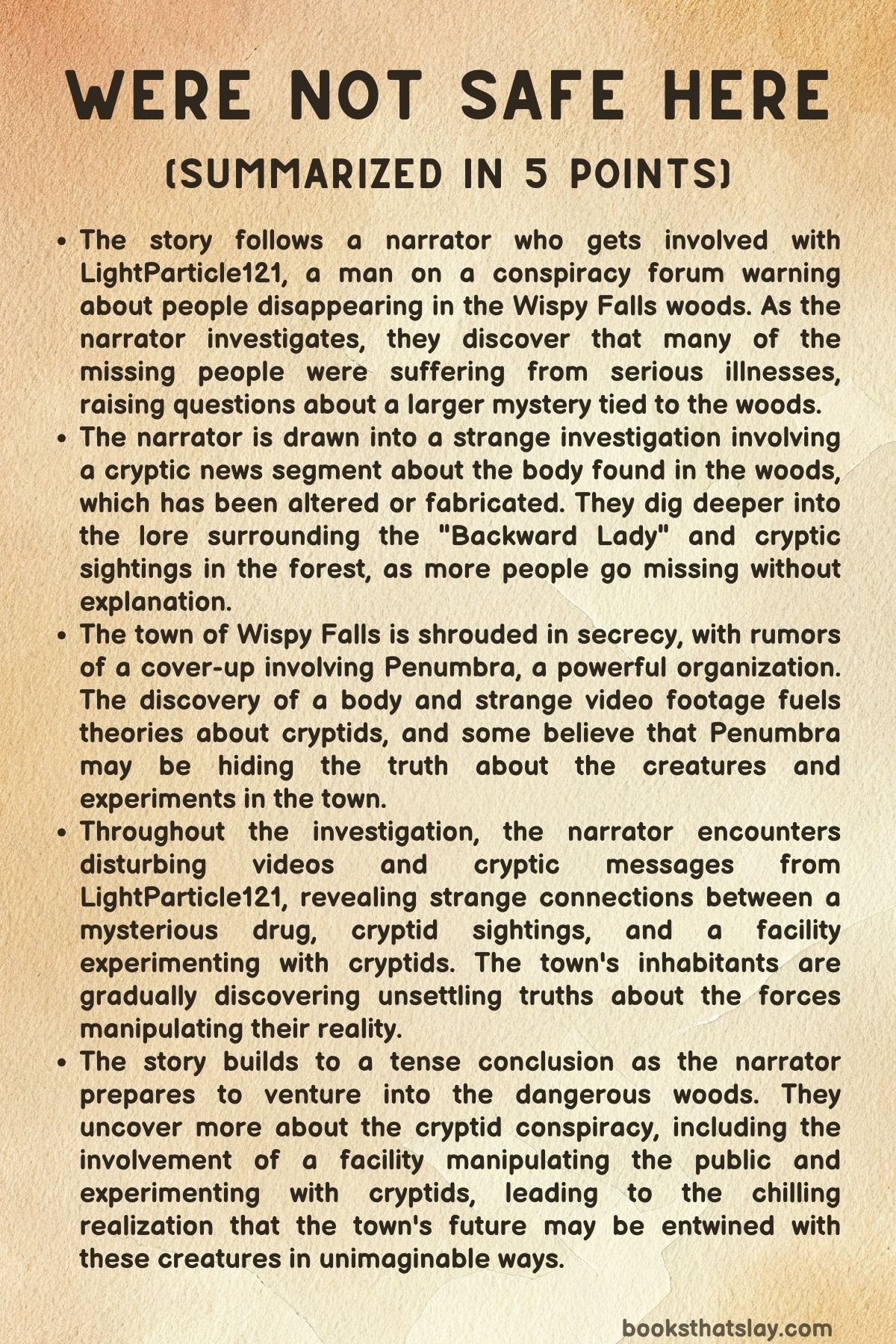
We’re Not Safe Here by Rin Chupeco is a chilling tale that blurs the lines between conspiracy, cryptids, and the unsettling events occurring in the seemingly quiet town of Wispy Falls. The book follows the narrator’s investigation into mysterious disappearances in the nearby Wispy Falls woods, where people with severe illnesses have gone missing.
As they uncover cryptic messages from a user named LightParticle121 and explore conspiracy theories, the narrator begins to unravel a horrifying secret about the town, a deadly disease, cryptid creatures, and a powerful organization. The book delves into the darker elements of human nature, the unknown, and how far one will go for survival, all while leaving readers questioning the true extent of the dangers lurking in the woods.
Summary
The story begins with the narrator engaging with LightParticle121, a user on a conspiracy forum known for posting bizarre theories. Initially dismissed as eccentric, LightParticle121 begins to share disturbing warnings about people who have gone missing in the nearby Wispy Falls woods.
The victims, all of whom were suffering from severe illnesses like cancer and Alzheimer’s, seem to vanish without a trace. The narrator, personally affected by the loss of a brother to cancer, becomes intrigued and begins a conversation with LightParticle121.
The interaction leads to a cryptic email exchange, where LightParticle121 refuses to offer clear answers but sends a strange video. This video contains a news segment from a local anchor, Trinity Vanderlust, who reports on the “Bloodmoon,” an annual event where the moon turns crimson.
The segment warns viewers to avoid the woods during this time after a body was found there, advising everyone to stay indoors. However, when the narrator looks up the original broadcast, they notice that the footage in the video differs from the actual news segment, suggesting that parts of the broadcast have been altered or fabricated.
Determined to find out more, the narrator continues to dig deeper. They visit Wispy Falls forums and come across stories about the “Backward Lady,” a mythical figure believed to haunt the woods.
These stories detail strange sightings of a woman with twisted, unnatural movements, which only adds to the growing mystery of the woods. The narrator learns of other missing persons, whose bodies were never recovered.
This raises the stakes of the body recently found, as it’s the first known case where the remains of a missing person have been discovered.
The body’s discovery sparks further conspiracy theories, especially after a user named UsernameGoesBrr live-streams his encounter in the woods, where he discovers a decayed and disfigured corpse. The situation becomes more disturbing when the body seems to vanish and reappear as a puppet-like figure, only to be followed by a monstrous cryptid resembling a marionette.
UsernameGoesBrr films the creature, but shortly after, he disappears, leaving the town with more questions than answers.
As the narrator digs deeper, they begin to suspect that the authorities in Wispy Falls may be hiding something. Many locals have strange beliefs about the cryptids that inhabit the woods, and some even speculate that these creatures have ties to a powerful corporation called Penumbra.
Penumbra is rumored to be hiding the truth about cryptid research and potential government experiments. The town, under Penumbra’s protection, is reportedly safe from cryptids due to mysterious relics known as “Stones” that are believed to repel these creatures.
There are also tales of bloodmoon rituals, but their true purpose remains unclear.
Meanwhile, the town continues to be gripped by fear, as the discovery of the body and the bizarre footage from UsernameGoesBrr spark growing tension. The local authorities remain tight-lipped, fueling further conspiracy theories.
Some believe that Penumbra’s involvement in the town’s protection may be a cover for something darker—experiments on humans and cryptids alike. As the narrator’s investigation progresses, they are confronted with a strange connection between the cryptids and the disease that seems to be spreading across the town.
A new, unsettling layer is added to the mystery when JellyBeanFish, a young girl who has been investigating the strange events in the town, uncovers more videos that shed light on the role of a facility involved in the mysterious happenings. JellyBeanFish learns that this facility, known as The Facility, is deeply involved in controlling the town’s narrative, suppressing information about cryptids, and possibly conducting experiments on the residents.
She discovers the existence of a disturbing children’s program called Mr. Happy, which mixes cheerful puppetry with cryptid lore and indirectly teaches children how to kill themselves to avoid being taken by cryptids. This unsettling realization opens up a new layer of horror as JellyBeanFish digs deeper into the Facility’s activities.
Her investigation leads to more disturbing revelations. She uncovers a link between the mysterious drug Somnium, which the residents take to cope with the loss of loved ones, and the cryptids that terrorize the town.
The drug appears to have a numbing effect, dulling emotions and memories, potentially to protect the residents from the horrors lurking in the woods. As JellyBeanFish uncovers the truth, she realizes that the Facility has been manipulating the residents’ understanding of cryptids, transforming them into something beyond human comprehension.
Meanwhile, Storymancer, a key figure in the investigation, begins to fall ill after coming into contact with items belonging to Ivy Delgado, a person involved in the mystery. His younger brother Lee explains that the illness is part of a larger experiment, one that uses cryptid creatures and moon rituals to protect the town from a deadly disease.
The disease, however, appears to have a far darker and more sinister purpose: it is linked to a transformation that slowly turns the infected individuals into beings connected to the cryptids.
As Storymancer’s condition worsens, he is taken to a secret location where he discovers that the transformation involves a process of becoming something other than human. His body is altered, and his identity is gradually erased in favor of something more monstrous.
The truth about the Facility’s experiments becomes clear—people who are “healed” by the facility are not truly saved; they are changed into something else entirely.
JellyBeanFish continues to investigate, uncovering more truths about the Facility’s dark experiments. She learns that the goal is to create a new existence by merging human traits with cryptids, offering immortality at the cost of losing humanity.
As she ventures deeper into the heart of the conspiracy, she uncovers horrifying secrets about the residents of Wispy Falls and the horrifying experiments being conducted by the Facility. Ultimately, she finds herself trapped in this web of deception, unsure of what her future holds in a world that is no longer entirely human.
The narrative concludes with the uncertainty of what will happen next, as the town’s secrets continue to unfold.
Characters
LightParticle121
LightParticle121 is a key figure in the narrative who serves as both a mysterious informant and a cryptic guide for the narrator. His presence is largely felt through his cryptic online exchanges, where he provides the narrator with fragmented pieces of information, often leaving more questions than answers.
Initially, LightParticle121 comes across as an eccentric conspiracy theorist, known for his bizarre and often unsubstantiated claims. However, as the narrator begins to dig deeper into the strange events surrounding the Wispy Falls woods, LightParticle121’s warnings seem more credible, especially when the body in the woods and the peculiarities of the Bloodmoon ritual are brought to light.
His ultimate role in the story is one of ambiguity; while he seems to possess valuable knowledge, he is also reluctant to share it directly, instead offering cryptic insights that force the narrator to piece together the truth on their own. This creates an air of distrust, as LightParticle121 is neither fully a hero nor an antagonist but rather a harbinger of strange and unsettling truths.
Trinity Vanderlust
Trinity Vanderlust is a local news anchor who becomes a key player in the unfolding mystery. She reports on the Bloodmoon event, which has peculiar significance to the story, warning the public about the dangers of the woods during this time.
Her role is initially that of a typical news reporter, offering information about a local phenomenon. However, when the narrator examines the news segment more closely, they discover discrepancies in her report, specifically regarding the body found in the woods.
This inconsistency suggests that the segment has been altered or fabricated. Vanderlust’s character remains somewhat elusive, with her exact motivations and role in the larger conspiracy unclear.
Nonetheless, her broadcast serves as a catalyst for the narrator’s investigation, revealing that the authorities, including those within the media, may be involved in covering up crucial information about the events in Wispy Falls.
UsernameGoesBrr
UsernameGoesBrr is a well-known streamer who ventures into the Wispy Falls woods to investigate the body discovered there. His live-streamed footage provides the audience, and ultimately the narrator, with an unsettling glimpse of the disturbing and cryptic events occurring in the forest.
UsernameGoesBrr’s encounter with the disfigured corpse and his subsequent discovery of the monstrous, marionette-like creature, later identified as the Puppetmaster, leaves a lasting impression on both him and the viewers. His video adds fuel to the growing conspiracy theories, but it also sparks controversy, as some believe his footage was fabricated for sensationalistic views.
UsernameGoesBrr’s character is defined by his role as a modern-day explorer, seeking answers through technology, but he ultimately becomes a victim of the very forces he sought to expose. His disappearance following the video only deepens the mystery surrounding the events in Wispy Falls, making his character a tragic figure whose curiosity leads to his undoing.
Storymancer
Storymancer is a central figure in the narrative whose journey mirrors that of the narrator in many ways, as he seeks to uncover the truth behind the cryptid phenomena and the facility’s role in the events. He is initially involved in an investigation alongside JellyBeanFish, but his trajectory takes a darker turn as he becomes infected with a mysterious disease tied to the cryptid experiments.
Storymancer’s illness is a key part of his character arc, as it highlights the sinister nature of the experiments being conducted by the authorities. He becomes increasingly isolated, both physically and emotionally, as he grapples with his impending transformation into something less than human.
His brother, Lee, reveals that the illness Storymancer contracts is part of a larger plan to control the disease using cryptids and moon-related rituals. Storymancer’s ultimate acceptance of his fate, realizing that he is being transformed into a cryptid-like being, is a heartbreaking moment in the story.
His character represents the human cost of the experiments and the blurred lines between humanity and monstrosity.
JellyBeanFish
JellyBeanFish is a young girl who takes on the mantle of investigator after Storymancer’s disappearance. Her character is marked by her determination and her gradual discovery of the horrifying truths about the facility and the cryptid experiments.
JellyBeanFish’s journey is one of personal growth, as she moves from a curious individual to someone who must confront terrifying realities about the town’s conspiracy and the fate of those involved. Her role as a truth-seeker makes her the emotional heart of the story, as she faces the darkness head-on and uncovers disturbing secrets about the facility’s control over the town and its inhabitants.
She is particularly affected by the discovery of her own mother’s involvement in the facility’s plans, leading her to question her place in this new, monstrous world. JellyBeanFish’s perseverance in uncovering the truth, even in the face of immense danger, marks her as a central figure in the investigation and a symbol of resistance against the sinister forces at play.
Lee
Lee, Storymancer’s younger brother, plays a pivotal role in revealing the darker truths behind the experiments being conducted on the townspeople. As the story progresses, Lee serves as a guide to Storymancer, explaining the nature of the disease that is slowly overtaking him and revealing the authorities’ use of cryptid creatures to protect the population.
His character is complex, as he initially appears to be a caring sibling, but his involvement in the experiments reveals a more unsettling side. Lee reveals that the “healed” individuals, including Storymancer, are not truly human anymore but are instead becoming part of the cryptid-infused existence created by the facility.
His character arc is tragic, as he is caught between familial love and the harsh reality of the experiments, ultimately leading Storymancer into a fate he cannot escape.
ThrowAway2745
ThrowAway2745 is a former employee of the facility who plays a critical role in revealing the truth about the facility’s practices. Through messages and leaks, they provide Storymancer and JellyBeanFish with crucial information about the facility’s involvement in cryptid research and its manipulation of public perception.
ThrowAway2745’s role is that of a whistleblower, exposing the dark underbelly of the institution that has been controlling the town’s narrative. They help to piece together the larger conspiracy that surrounds the cryptids, the transformation of people into new creatures, and the facility’s overarching goals.
Despite the danger they face by leaking information, ThrowAway2745 remains a shadowy, behind-the-scenes figure whose revelations are instrumental in unraveling the mystery.
Themes
Conspiracy and Secrecy
At the heart of We’re Not Safe Here is a pervasive sense of conspiracy and secrecy. From the outset, the narrator is drawn into an enigmatic world of cryptic messages and altered truths.
The mysterious disappearance of people in Wispy Falls, especially those with serious illnesses, serves as a catalyst for an investigation that unveils a far-reaching web of hidden agendas. As the story progresses, it becomes evident that the authorities, local organizations like Penumbra, and even corporations play a crucial role in concealing the truth about the eerie events in the woods.
The town of Wispy Falls, under the influence of Penumbra, is characterized by a deep sense of fear and suppression, where public knowledge is carefully controlled and manipulated. The video segments, such as the altered news broadcast about the body in the woods, further emphasize the theme of secrecy—information is selectively shared, often distorted to serve a hidden purpose.
The continuous questioning of reality, the cryptic nature of LightParticle121’s warnings, and the deliberate withholding of key information about the cryptids and the sinister events in the woods contribute to a growing sense of distrust and unease. As the narrator digs deeper, they encounter increasingly bizarre and unsettling information, with the suggestion that the truth behind the disappearances and the cryptid sightings is being deliberately suppressed to maintain control over the town and its residents.
The conspiracy theme is not just about hidden knowledge; it’s about the manipulation of perceptions, the creation of false narratives, and the exploitation of people’s fears to enforce compliance and maintain power.
The Human Condition and Transformation
The theme of transformation in We’re Not Safe Here is one that explores the fragility of the human condition and the extent to which individuals are willing to sacrifice their humanity in the face of survival. The transformation process in the story—through the cryptid experiments and the use of Somnium, a drug that numbs emotions—serves as a grim commentary on the lengths people will go to in order to prolong life or escape suffering.
The characters, such as Storymancer, are forced to confront the idea that survival comes at a high cost, often resulting in a loss of identity and selfhood. Storymancer’s journey of sickness and eventual acceptance of his transformation into a being connected to cryptids illustrates the dehumanizing nature of these experiments.
The eerie moon-shaped objects and the desiccated body in the hidden room represent the death of the individual as they knew it, replaced by something else—a new form of existence that is both a curse and a form of survival. The people in Wispy Falls are caught in a cycle where the preservation of life requires their submission to a process that alters their very nature.
The question of whether it is better to remain human and succumb to illness or to accept the grotesque transformations offered by the facility reflects the broader existential dilemma of how far one can go to preserve life without sacrificing their humanity. This theme delves into the nature of existence, the price of immortality, and the emotional and psychological toll of living in a world where survival often means losing what makes us human.
Fear of the Unknown
A central aspect of the story is the exploration of the unknown and the fear it generates. The cryptids lurking in the woods of Wispy Falls are not merely physical threats but also symbols of the unknown—entities whose origins and purposes are shrouded in mystery.
The inhabitants of Wispy Falls live in constant fear of these creatures, driven by legends and rumors that have evolved over time. The creature known as the Puppetmaster, a cryptid capable of mimicking human forms, is an example of how the unknown feeds into paranoia and fear.
The idea that these creatures might be using human remains to create false human-like figures is unsettling, suggesting that there is something deeply wrong with the world around them. Furthermore, the strange occurrences that follow the discovery of the decaying body in the woods—the body that disappears, only to reappear as something unrecognizable—adds to the growing sense of unease.
The unknown is not just a physical threat, but also a psychological one, as the characters grapple with the uncertainty of what is real and what is being manipulated. This fear is compounded by the town’s reluctance to provide answers, with authorities covering up the true nature of these creatures and the cryptid phenomena.
The fear of the unknown is not just about creatures in the woods but extends to the terrifying realization that the world around them may not be what it seems, and the answers they seek may only lead to more confusion and horror. The sense of the unknown permeates every corner of the narrative, driving the characters to question the nature of their reality and the dangers lurking just beyond their comprehension.
Manipulation and Control
In We’re Not Safe Here, manipulation and control emerge as significant forces that shape the lives of the townspeople. The Facility, a powerful organization in Wispy Falls, plays a key role in shaping the town’s reality, using its influence to dictate the narrative surrounding the cryptid phenomenon.
The Facility’s involvement in the creation of disturbing children’s programs like Mr. Happy, which contains cryptic messages and disturbing content, highlights their ability to manipulate public perception, particularly the vulnerable minds of children. The deliberate spreading of misinformation, such as the use of Somnium to numb the emotional pain of families affected by disappearances, is another example of how the Facility uses psychological tactics to control the population.
The very existence of cryptids like the Burrowers and the Puppetmaster is weaponized by the Facility to maintain power and keep people in line. The residents of Wispy Falls, while living under the protection of Penumbra, are unaware of the larger manipulations at play.
The town’s rituals, including the Bloodmoon event, are used as a means to control the population, keeping them indoors and preventing them from questioning the narratives that the authorities have set in place. Even when the characters, such as Storymancer and JellyBeanFish, begin to uncover the truth, they find themselves caught in a larger web of deception that extends far beyond the cryptids and into the very fabric of society.
The theme of manipulation and control is not limited to the overt actions of the Facility and Penumbra but is also embedded in the way people’s perceptions are shaped, their fears exploited, and their ability to think independently stifled. The narrative portrays a society where free will is compromised, and the truth is twisted to ensure compliance with a larger, more sinister agenda.
The Dangers of Escapism
Escapism is a recurring theme throughout We’re Not Safe Here, with characters often seeking refuge in distractions to avoid confronting harsh realities. The use of substances like Somnium, a drug prescribed to help people cope with the emotional trauma of losing loved ones, is a form of escapism that numbs the pain but also distances individuals from their emotions and true selves.
The characters’ reliance on these substances is indicative of a society in which facing the truth has become too overwhelming. The disturbing videos, such as the one featuring a yoga session that turns into something far more sinister, serve as a metaphor for how society often masks the uncomfortable truths with surface-level calmness or positivity.
The unsettling videos and advertisements, like the Wasp-away commercial that masks the real purpose of the product, reflect how society seeks to obscure its darker elements by presenting them in a more palatable way. The characters, particularly JellyBeanFish, are faced with the challenge of confronting these illusions and the uncomfortable truths they represent.
As they peel back the layers of deception, they find themselves in a situation where escape is no longer possible, and the consequences of ignoring reality become all too clear.
The story ultimately asks whether it is better to live in ignorance, sheltered by false realities, or to face the terrifying truths that lie beneath the surface, knowing that doing so may lead to a darker understanding of the world around them.