What Remains of You Summary, Characters and Themes
What Remains of You by Kimberly Hensle Lowrance is a domestic drama about grief, marriage, secrecy, and the difficult question of how well one person can ever know another.
At its center is Diana Morgan, a widowed mother who has spent eighteen months trying to rebuild life after her husband Tom’s death, only to discover a confession he deliberately left behind. What begins as an attempt to understand one hidden event gradually forces Diana to reconsider her marriage, her family, and even her own identity. The novel asks whether love survives the discovery of betrayal and whether a person can move forward without simplifying the dead into either heroes or villains.
Summary
Eighteen months after Tom Morgan’s death from cancer, Diana Morgan is still struggling to function as a single mother to twelve-year-old Duncan and nine-year-old Phoebe. Her family believes she is recovering because she exercises, works, cares for the children, and participates in family gatherings, but much of that apparent recovery is performance intended to keep everyone from worrying about her.
Everything changes when Phoebe discovers a family time capsule that was created several years earlier. Inside are photographs, drawings, keepsakes, and an envelope addressed to Diana in Tom’s handwriting, and Diana initially expects it to contain a loving message from her dead husband.
Instead, Tom confesses that when he was eighteen he committed a terrible crime in which people died. He says that he never accepted responsibility and warns Diana that people who know what happened may eventually enter her life, specifically telling her to protect Duncan and Phoebe from them.
The letter immediately destabilizes Diana’s understanding of her marriage. She realizes Tom secretly added it to the time capsule after learning that he was terminally ill, meaning the confession was not an impulsive message but something he deliberately prepared for her to find after his death.
Diana initially tries to hide the truth from Duncan, but he eventually finds and reads the letter himself. Devastated by the possibility that his father may have been responsible for someone’s death, Duncan demands answers Diana cannot provide, forcing her to promise that she will investigate Tom’s past while he focuses on school and basketball.
With the help of her neighbor and closest friend Lakshmi, Diana begins examining Tom’s life before they met. She identifies Hamilton, Vermont, where Tom grew up, as the most likely location of the mysterious crime and starts contacting relatives, searching old newspapers, and reconsidering memories that once seemed harmless.
The investigation also causes Diana to reevaluate her marriage. She remembers occasions when Tom redirected conversations whenever she asked about Hamilton, instances when he dismissed her wishes, and moments when she accommodated him simply because resisting seemed more difficult, leaving her increasingly uncertain about how much of their relationship depended on what Tom chose not to reveal.
Her anxiety increases when she discovers repeated hang-up calls on an old answering machine and later learns that someone has entered her house using a hidden spare key. Nothing valuable is taken, but Tom’s old mug is moved and a photograph of Tom with Duncan and Phoebe disappears, convincing Diana that someone connected to his secret has begun watching the family.
Tom’s former law partner and close friend, Jonathan Hobart, provides another disturbing discovery. He reveals that Tom made unexplained financial withdrawals over several years and that more than sixty thousand dollars remains unaccounted for, suggesting that whatever Tom concealed was not limited to one event from adolescence.
Diana eventually travels to Hamilton and searches old newspaper archives. She finds reports of a 1982 fire at the farm of Grace and William O’Connor, where a young man named Carson Roy died inside a burning barn, William later died from his injuries, and Grace survived with severe burns.
Officially, investigators concluded that Carson entered the barn to steal and accidentally caused the fire. Yet Diana discovers that Carson was Tom’s friend, Tom worked for the O’Connors, and William had been both Tom’s teacher and an important mentor, making the tragedy closely connected to the people surrounding Tom when he was eighteen.
An even more personal discovery follows when Diana learns William O’Connor’s full name was William Duncan O’Connor. Her own son is Duncan William Morgan, and Diana realizes Tom secretly gave their child the names of a man who died after the fire without ever explaining the connection.
Tom’s relatives Teresa and Chris clearly know more than they initially admit. Chris finally tells Diana that Tom had been at the O’Connor farm on the night of the fire and later convinced his mother Martha to give him an alibi, while Martha helped him leave Hamilton early after becoming frightened that investigators might connect him to the blaze.
During Diana’s stay, her emotional closeness with Chris becomes physical. Sleeping with him marks an important psychological change because Diana recognizes that she has made a decision based entirely on her own needs rather than on what Tom, her children, or her family might expect from her.
Diana eventually tells Duncan that Tom may have been involved in a fire that killed two men and injured a woman. Duncan is devastated but insists that his mother continue investigating, making Diana understand that discovering the truth is no longer solely about satisfying her own doubts.
Her search increasingly focuses on Jessica O’Connor, Grace’s niece, who spent the summer of the fire at the farm and had a relationship with Tom. Diana learns that Tom later represented Jessica when she faced drug charges, that he remained connected to her for years, and that the unexplained money may have been directed toward helping her.
At the same time, Diana begins confronting other forms of secrecy within her own family. Her mother Vivian reveals that she once struggled with alcohol, endangered Diana and Andrea as children, and concealed the episode for decades, showing Diana that shame can cause people to hide serious mistakes without making every later act of love false.
Jonathan finally reveals an even larger financial secret. When Tom sold his share of the law firm, he quietly transferred $250,000 into a trust for Jessica, proving that their connection continued long after adolescence and strengthening Diana’s determination to locate her.
Jessica eventually agrees to meet Diana and immediately admits that she was the mysterious woman watching the family, the person who entered Diana’s house, and the caller responsible for the repeated silence on the answering machine. She explains that after Tom died she visited the places he had described to her because she wanted to feel close to the life he had built without her.
Jessica then begins revealing what happened in 1982. She and Tom had been romantically involved at the O’Connor farm, and Tom had carelessly left a cigarette in the barn, contributing to the fire, but Diana senses that Jessica is still withholding the most damaging part of the story.
Pressed to tell everything, Jessica finally admits that Tom encountered Carson stealing saddles from the barn. The two fought, and after Carson put him in a headlock, Tom escaped, grabbed a shovel, struck Carson in the head, and left him unconscious before going to Jessica.
When Tom and Jessica returned, the barn was burning. Rather than seek immediate help or confess to the authorities, they fled, and Tom later decided that the fire could conceal the circumstances of Carson’s death, convincing his mother to provide him with a false alibi while Jessica repeated the same story to police.
Jessica’s revelations do not end there. She and Tom resumed an intermittent sexual relationship years later, Jessica became pregnant with Tom’s child, and their daughter Ava was eventually raised primarily by Jessica’s parents while Jessica struggled with addiction.
Tom secretly sent Jessica approximately sixty thousand dollars over the years and later established the much larger trust to fund rehabilitation and therapy. His money ultimately helped Jessica become sober, but the assistance also represented years of deception against Diana and explained the unexplained withdrawals Jonathan had discovered.
Diana finally understands Tom’s warning about keeping certain people away from Duncan and Phoebe. He was not merely protecting his family from dangerous outsiders; he was attempting to prevent Jessica from exposing Carson’s death, their affair, Ava’s existence, and the full extent of the life he had concealed.
The truth leaves Diana furious and deeply wounded, yet it also ends the uncertainty that has dominated her life since finding the confession. She remembers Tom attempting to ask forgiveness while dying and realizes that some of his final words were probably indirect efforts to admit what he had done.
Diana chooses not to report the decades-old case to police or expose Jessica’s role in providing a false alibi. She also decides that Duncan is not ready to know about Carson’s exact death or Ava, though she intends eventually to tell her children that they have a half sister.
Instead of allowing Tom’s crimes to determine every memory of their marriage, Diana begins separating the man she loved from the terrible choices he made. She reconciles with Andrea, starts clearing Tom’s clothes from the house, accepts that she may pursue the library director position, and allows herself to imagine a future that does not require permanent loyalty to the life she once expected.
Diana gives Duncan a repaired photograph of him with Tom and explains an edited version of what happened. Duncan responds that he still loves and misses his father, confirming that knowledge of wrongdoing does not automatically erase affection, memory, or grief.
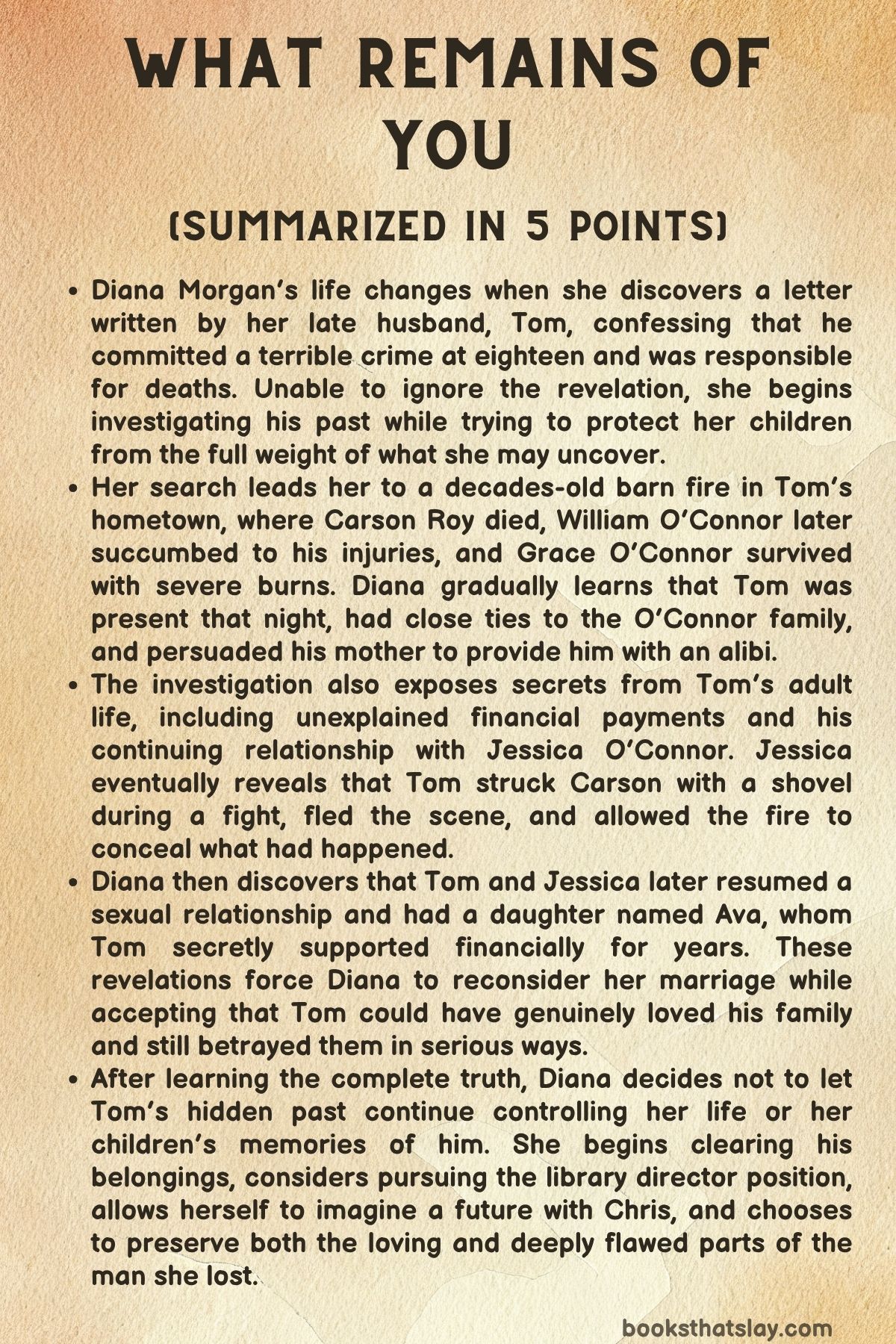
Finally, Diana burns Tom’s confession and the documents from her investigation and buries the ashes beneath the stone she brought home from the ruins of the O’Connor farm. She takes Duncan and Phoebe to the beach, decides to tell them more stories about their father rather than allowing silence to define him, considers a future connection with Chris, and turns toward a life in which Tom remains important without continuing to control her choices.
Characters
Diana Morgan
Diana is the emotional and psychological center of What Remains of You, and much of her development depends on the conflict between the version of herself she presents to others and the uncertainty she carries privately. Eighteen months after Tom’s death, she has learned to appear functional largely because her family’s concern makes her feel responsible for reassuring them, so even her recovery begins as something shaped by other people’s expectations.
Tom’s letter forces Diana to stop maintaining that performance because it creates questions that cannot be answered through routine. Her investigation initially appears to be about discovering Tom’s crime, but it gradually becomes an examination of her own marriage and of the ways she surrendered decisions, desires, and professional ambitions without always recognizing that she was doing so.
Diana is neither completely trusting nor instantly suspicious, which makes her response to Tom convincing. She remains capable of remembering his affection, generosity, companionship, and love for the children even while evidence of his dishonesty becomes increasingly impossible to deny.
Her relationship with Duncan adds another layer to her decisions because she cannot investigate only for herself. She must constantly decide how much truth a twelve-year-old can handle, and her decision to conceal some of Tom’s worst actions is less about protecting Tom than about protecting Duncan from knowledge that cannot yet serve him.
Sleeping with Chris marks an important step in Diana’s recovery because it is one of the first significant choices she makes without filtering it through Tom’s memory or her family’s judgment. Later, considering the library directorship extends that development beyond romance and shows that she is recovering ambitions she previously subordinated to her husband.
By the end of the story, Diana does not achieve peace by forgiving everything Tom did. She moves forward by accepting contradictory truths simultaneously: Tom loved her, Tom deceived her, their marriage contained genuine happiness, and some of its foundations were compromised by secrets.
Tom Morgan
Tom is physically absent from most of What Remains of You, yet his decisions shape nearly every major conflict. The version of Tom initially remembered by Diana is a loving husband, successful lawyer, devoted father, and charismatic partner whose death left an enormous emotional absence, but the investigation gradually exposes a far more complicated history.
As a teenager, Tom reacts catastrophically after striking Carson during their fight. His greatest moral failure is not simply the violent act itself but the chain of decisions afterward: fleeing the scene, allowing the fire to conceal what happened, persuading his mother to lie, and accepting a public explanation that blamed Carson.
That decision becomes the foundation of decades of secrecy. Tom appears unable to confess openly, yet he also never truly leaves the event behind, which is suggested by his avoidance of Hamilton, his decision to incorporate William Duncan O’Connor’s names into his son’s name, his continued relationship with Jessica, and the money he later provides for her rehabilitation.
His relationship with Jessica makes his moral position still more difficult. Helping her financially and paying for treatment can be interpreted as guilt, responsibility, affection, or an attempt at restitution, but his later sexual relationship with her and the existence of Ava mean that these actions also coexist with betrayal of Diana.
Tom’s final confession shows both conscience and cowardice. He wants Diana to know that he has done something terrible, but he leaves the details vague and warns her away from the people who could reveal the complete story, effectively placing the emotional labor of discovering his past on the woman he has already deceived.
The book therefore refuses to reduce Tom to either the husband Diana loved or the man responsible for devastating harm. His complexity lies in the uncomfortable fact that both identities belong to the same person.
Duncan Morgan
Duncan is old enough to understand that Tom’s confession may change how his father should be remembered but young enough to desperately need the security of the father he already knew. His discovery of the letter turns an adult moral crisis into a deeply personal childhood question: how can he continue loving someone who may have done something terrible?
Basketball symbolizes Duncan’s connection to Tom because it was one of the strongest bonds between father and son. When Duncan struggles with schoolwork and practice after learning about the confession, his behavior shows how thoroughly the uncertainty about Tom has invaded something that once gave him comfort.
Duncan also becomes one of the reasons Diana cannot abandon the investigation. He needs answers not because he demands punishment but because uncertainty is damaging his memories and creating fear that the father he misses may never have existed in the way he remembers.
His eventual response is one of the novel’s clearest statements about complicated grief. After receiving a limited version of the truth, Duncan says he still loves and misses Tom, showing that affection does not disappear simply because the person being mourned was morally flawed.
Phoebe Morgan
Phoebe experiences Tom’s absence differently because her younger age allows her to retain a simpler relationship with his memory. She does not become directly involved in the investigation, and Diana deliberately protects her from information that would be impossible for her to process constructively.
Her collection of pennies is especially revealing. Because Vivian once told her that dead loved ones may send signs, Phoebe gathers pennies and places them inside Bear Bear, interpreting each one as evidence that Tom continues to love her.
Phoebe therefore represents memory before moral complication. While Diana and Duncan struggle to reconcile Tom’s hidden life with the father and husband they knew, Phoebe continues to relate to him through affection, objects, photographs, and stories.
Her presence also reminds Diana why truth requires judgment rather than simple disclosure. Diana ultimately understands that honesty does not mean telling every person everything immediately; sometimes responsibility means considering what knowledge a child is prepared to carry.
Jessica O’Connor
Jessica first exists as a mysterious figure connected to Tom’s past, but her eventual appearance radically changes the meaning of nearly every clue Diana has discovered. Her teenage relationship with Tom connects her directly to the fire, while her adult history of addiction and relapse explains part of Tom’s continued involvement in her life.
Jessica shares responsibility for the concealment of Carson’s death because she helps Tom decide what to do after the fire and later repeats the false alibi. Her actions are serious, yet the story also presents her as someone whose adolescence, addiction, guilt, and dependency shape a life that remains tied to one catastrophic night.
Her later relationship with Tom is equally complicated. She loves him, resumes an intermittent sexual relationship with him, becomes the mother of his daughter, and accepts significant financial assistance, placing her simultaneously in the roles of former lover, affair partner, co-conspirator, beneficiary, and keeper of his greatest secrets.
Jessica’s behavior after Tom’s death shows how powerful that attachment remains. Entering Diana’s home, stealing a photograph, watching the family, and repeatedly calling the answering machine are violations of Diana’s privacy, but they are motivated less by hostility than by Jessica’s desperate desire to remain connected to Tom.
Most importantly, Jessica gives Diana what Tom never could: the complete truth. Her confession is painful and damaging, but it finally allows Diana to stop living inside possibilities and begin responding to facts.
Chris
Chris functions as both a connection to Tom’s childhood and a possible path toward Diana’s future. As Tom’s cousin, he carries information about the Morgan family and knows that Tom’s mother provided a false alibi, but his instinct is initially to protect the dead rather than reopen events that have been buried for decades.
His reluctance frustrates Diana because it mirrors the secrecy she is already encountering everywhere else. Yet Chris is not simply obstructive; he genuinely seems to believe that exposing Tom’s past may cause more pain than understanding.
The romantic connection between Chris and Diana becomes significant because it is not presented as a replacement for Tom. Diana’s decision to sleep with him represents her recognition that she can experience desire, intimacy, and independent choice without betraying her deceased husband.
Chris therefore occupies an unusual position. He belongs to Tom’s history but also helps Diana imagine a life that is no longer organized entirely around Tom’s absence.
Lakshmi
Lakshmi is Diana’s most reliable source of practical and emotional support because she offers concern without trying to control Diana’s decisions. Unlike Vivian and Andrea, who sometimes respond to Diana’s grief by managing her life, Lakshmi usually gives Diana room to admit fear, anger, confusion, and uncertainty.
Her involvement in the investigation demonstrates this balance. She helps organize Diana’s early search, accompanies her when finding Jessica may be dangerous, insists on basic safety precautions, and encourages her to think critically without dictating what conclusion she should reach.
Lakshmi also challenges Diana’s instinct to interpret every secret as proof that an entire relationship was false. By acknowledging that most people protect private areas of themselves while still recognizing that Tom’s deception was unusually serious, she helps Diana maintain a more balanced understanding of human complexity.
Her friendship represents one of Diana’s healthiest relationships because honesty does not require performance. With Lakshmi, Diana does not have to appear recovered, strong, or certain.
Vivian
Vivian initially appears as an overprotective mother whose constant involvement in Diana’s household has become both useful and irritating. She brings food, manages family gatherings, helps with the children, and watches Diana closely because she remembers how badly Diana deteriorated after Tom’s death.
Her controlling tendencies are therefore rooted in fear rather than simple interference. Vivian nearly watched her daughter collapse under grief, and her attempts to manage Diana’s life are an imperfect response to that experience.
Her confession about her own past significantly changes her role. By admitting that she once abused alcohol, endangered her daughters, hid the incident, and eventually rebuilt her life, Vivian gives Diana a personal example of how a terrible action can remain part of someone without becoming the total definition of that person.
Vivian also grows by recognizing that Diana must decide for herself whether to continue investigating. Her eventual willingness to stop directing her daughter and respect Diana’s choices parallels Diana’s larger movement toward autonomy.
Andrea
Andrea embodies the frustration experienced by relatives who have spent months organizing themselves around someone else’s grief. Her confrontation with Diana is harsh because she argues that the entire family has been adjusting its behavior around Diana since Tom’s death and that Tom continues controlling Diana even from beyond the grave.
Although Andrea expresses herself cruelly, some of what she says forces Diana to confront uncomfortable patterns. Tom’s ambitions often came before Diana’s, and the investigation has indeed consumed much of Diana’s emotional life.
Andrea therefore serves as a necessary counterweight to the romanticized version of Tom that other people sometimes preserve. She is more willing to identify his selfishness and to question whether his confession was itself another act that forced Diana to carry consequences he avoided.
Their reconciliation matters because Diana does not simply dismiss Andrea’s criticism. She absorbs what is useful, rejects what is unfair, and rebuilds the relationship on more equal emotional ground.
Grace O’Connor
Grace transforms the decades-old fire from an abstract mystery into a human tragedy. Her scars, memories, and attachment to the farm give Diana direct access to the damage created by the night Tom spent years refusing to discuss.
Grace lost William, suffered severe burns, lost horses, and lived for decades with an official explanation that blamed Carson. Because she does not initially know Tom’s full role, her life also demonstrates how concealed wrongdoing affects people who never receive enough information to understand what happened to them.
Her willingness to speak with Diana is therefore generous. She has no obligation to reopen painful memories, yet she provides information about Tom, Jessica, William, and the farm because Diana approaches her as another person harmed by secrets.
Grace also complicates Diana’s feelings about whether disclosure is always morally necessary. Once Diana learns everything, telling Grace the complete truth could offer knowledge but might also destroy an old understanding without producing meaningful justice.
Jonathan Hobart
Jonathan represents loyalty taken to a morally questionable extreme. As Tom’s law partner and close friend, he continues protecting Tom’s confidences even after Tom’s death, despite seeing how urgently Diana needs information.
His discoveries about the missing money and the trust for Jessica prove that he possesses crucial pieces of the mystery. Yet he repeatedly encourages Diana to abandon her investigation, partly because he wants to preserve the version of Tom he knew and partly because he feels bound by promises made to his friend.
Jonathan is not portrayed as malicious, but his choices demonstrate how loyalty to the dead can become unfair to the living. By withholding information, he effectively participates in maintaining Tom’s deception and leaves Diana to uncover facts that he might have helped her understand much earlier.
His eventual confession about the $250,000 trust is important because it breaks that loyalty, though Diana correctly recognizes that revealing the truth late does not erase the harm caused by withholding it.
Camille Taylor
Camille plays a smaller role in the mystery but an important role in Diana’s personal growth. As the library director, she sees professional ability in Diana that Diana herself has neglected while organizing much of her adult life around Tom’s legal career and then around surviving his death.
Her suggestion that Diana consider becoming library director opens a future Diana had previously been unwilling to imagine. Before Tom died, she automatically assumed his work would take priority, whereas Camille encourages her to reconsider what she might want when no husband’s ambition is placed ahead of hers.
Camille therefore represents opportunity rather than investigation. Her presence reminds Diana that rebuilding a life cannot consist only of understanding the past; eventually she must decide what she wants the future to contain.
Themes
Grief, Memory, and the Changing Image of the Dead
Grief in What Remains of You is not presented as a steady movement from pain toward acceptance. Diana’s mourning repeatedly changes shape as new information forces her to grieve not only Tom’s death but also the version of her marriage she believed was complete.
Before finding the letter, Diana’s central difficulty is absence: Tom will not attend graduations, weddings, family dinners, or future milestones. After discovering his confession, absence becomes more complicated because she can no longer ask him questions, challenge his explanations, or determine whether the man she remembers matches the person he understood himself to be.
Duncan experiences a related crisis when he fears that discovering Tom’s wrongdoing might invalidate his memories. His question is not simply whether his father was good or bad but whether affection remains legitimate once a loved person is revealed to have caused serious harm.
The story ultimately rejects the idea that memory must deliver a single verdict. Diana can remember Tom as loving and selfish, generous and deceptive, devoted to his children and capable of betraying his wife.
Her final choice to tell Duncan and Phoebe stories about their father shows that moving forward does not require either idealizing Tom or erasing him. Grief becomes manageable when Diana accepts that memory can preserve contradiction without demanding that one version cancel all the others.
Secrecy, Shame, and the Consequences of Silence
Nearly every major relationship is shaped by information that someone chooses not to reveal. Tom’s secrecy is the most damaging, but the story repeatedly places his behavior beside smaller examples to examine why people hide actions that threaten the identities they have built.
Tom’s original violence against Carson becomes catastrophic partly because he refuses responsibility afterward. Once his mother provides an alibi and Jessica supports the false account, secrecy creates its own momentum, requiring more avoidance, more lies, and eventually an entire adult life constructed around information that cannot safely be acknowledged.
His later relationship with Jessica creates another layer of concealment involving adultery, Ava, secret payments, legal assistance, and the financial trust. Each attempt to manage an old secret produces additional secrets, showing how concealment rarely remains confined to the event that first created it.
Vivian’s confession offers an important contrast. She also hides a shameful episode from her daughters, but she admitted her behavior to Francis, stopped drinking, changed her life, and accepted responsibility within the relationship most directly affected.
The difference between Vivian and Tom suggests that shame itself is not the central problem. The deeper danger lies in allowing shame to replace accountability and forcing other people to live inside consequences they do not understand.
Marriage, Intimacy, and the Limits of Knowing Another Person
Diana’s investigation raises an unsettling question about intimacy: if someone can conceal something enormous for decades, what does it mean to claim that another person is truly known? Her first reaction is to reinterpret nearly every memory, wondering whether ordinary moments of affection were actually calculated distractions from subjects Tom wanted to avoid.
This uncertainty threatens the entire meaning of her marriage. If Tom concealed Carson’s death, Jessica, Ava, and substantial financial payments, Diana begins to wonder whether the love between them was equally false.
Gradually, however, she rejects the assumption that deception automatically erases every genuine emotion surrounding it. Tom’s hidden life was real, but so were his years of companionship with Diana, his relationship with the children, his fear of dying, and the affection preserved in countless ordinary memories.
The theme becomes more complex because Diana also recognizes her own forms of concealment. She hides the investigation from her family, keeps her encounter with Chris from Lakshmi, and decides that Duncan and Phoebe should not immediately know everything she learns.
These comparisons do not excuse Tom, because the scale and consequences of his deception are fundamentally different. They instead reveal that intimacy does not provide complete access to another consciousness, and mature love may require accepting that knowing someone deeply is not identical to knowing everything.
Autonomy, Identity, and Choosing a Future
Diana begins the story living according to roles that other people have partly defined for her. She is Tom’s widow, Duncan and Phoebe’s mother, Vivian and Francis’s daughter, Andrea’s grieving sister, and the woman everyone watches for signs that she is finally recovering.
Even before Tom’s death, she often placed his preferences and career ahead of her own. Looking backward allows her to recognize how frequently she adjusted herself around him and how easily accommodation became a permanent habit.
The investigation initially appears to keep Diana trapped in Tom’s life, but it eventually gives her a reason to question those patterns. She begins choosing what information to seek, refusing her family’s attempts to manage her, sleeping with Chris because she wants intimacy, and seriously considering professional advancement that she once would have rejected automatically.
Moving her wedding rings to a necklace is an especially clear expression of that transition. Diana does not discard Tom or deny the marriage, but she changes the physical symbol of their relationship because she no longer wants widowhood to be the single identity through which she understands herself.
Her final decisions complete that movement toward autonomy. Clearing Tom’s closet, pursuing the library directorship, allowing the possibility of seeing Chris again, and taking her children toward new experiences show that survival is not simply continuing after loss but recovering the authority to choose what comes next.