When They Burned The Butterfly Summary, Characters and Themes
When They Burned The Butterfly by Wen-Yi Lee is a historical fantasy set in 1970s Singapore, where secret societies and street power sit beside school uniforms and new suburban dreams. Sixteen-year-old Adeline Siow has a hidden talent: she can call fire into her hands, the same gift her mother once had but now forbids and fears.
When Adeline’s mother dies in a suspicious blaze, Adeline is pulled into the underworld her mother kept locked away—an all-female gang called Red Butterfly, a hungry goddess behind their magic, and a coming war with rivals who want to steal divine power for profit.
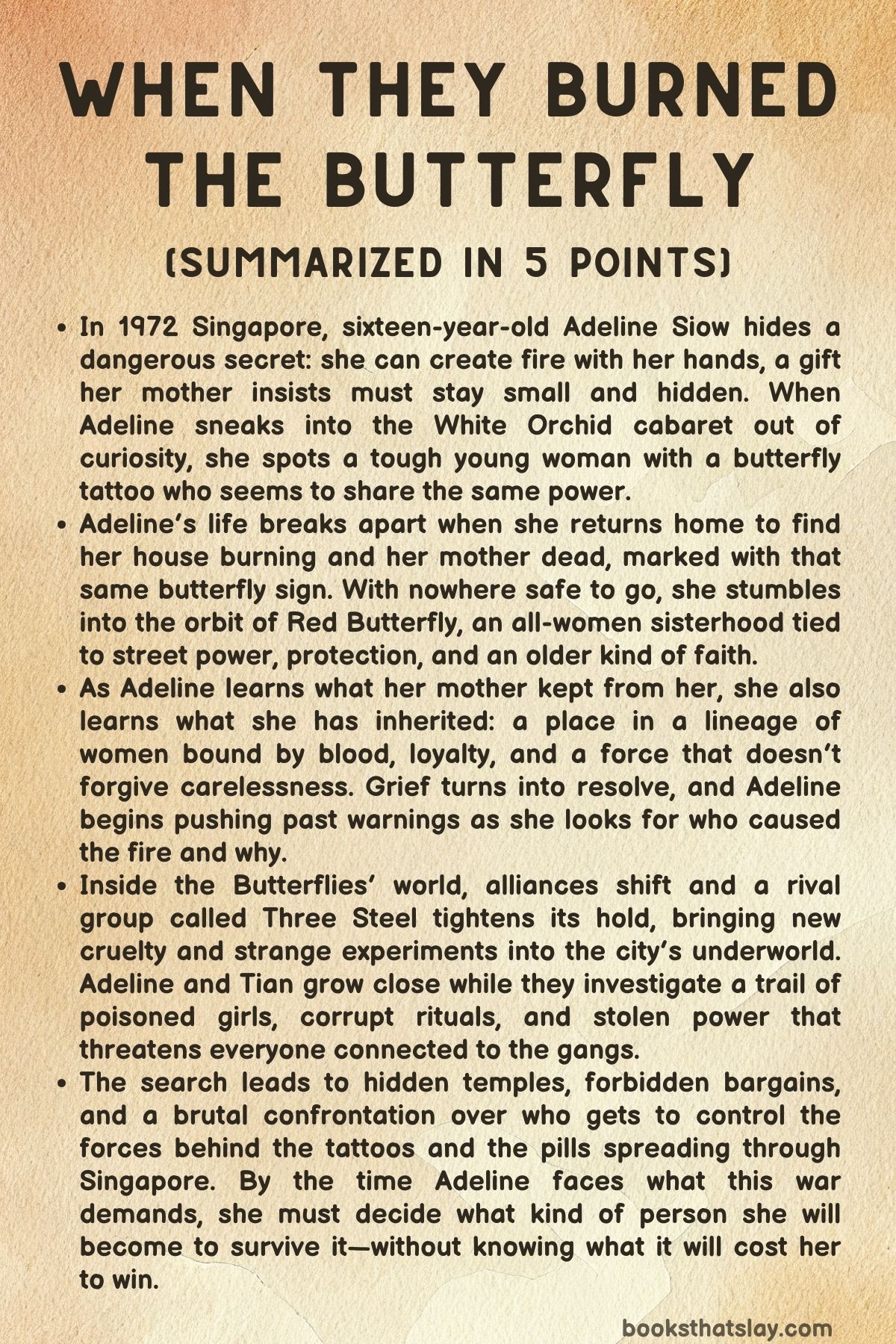
Summary
In 1972 Singapore, Adeline Siow is a restless student at St. Mary’s Girls’ School, locked in a long, ugly rivalry with Elaine Chew and her clique. Adeline keeps one secret above all others: she can create fire with her bare hands.
Her mother has warned her for years to keep the gift small and hidden, insisting it is shameful and dangerous. Adeline obeys in public, but when boredom and anger build, she sneaks away to release a quick flare in private, thrilled by the heat and the control.
After school, Adeline heads to Jenny’s, the department store her mother built from a small Chinatown shop into a glossy symbol of new wealth and Western fashion. Adeline drifts through the aisles and steals jewelry and cash from customers for sport, treating it like proof she can take what she wants without being seen.
She targets a rude socialite and pockets a silver bracelet, then overhears her mother discussing something called the White Orchid, switching languages as she arranges a private meeting with someone named Ah Poh. The secrecy irritates Adeline.
She feels her mother is always managing appearances—Adeline’s grades, her weight, her future—while guarding a locked part of her own life.
That night, Adeline notices something that unsettles her: her mother lights a cigarette with a lighter instead of using her own hands, as she used to do. It’s another sign her mother has cut herself off from the thing they share.
When her mother disappears into her office, Adeline searches the phone directory and finds the White Orchid listed as a bar on Neil Road. A late-night radio show spreads rumors of crimes and strange attacks nearby.
Convinced her mother is mixed up in something real and dangerous, Adeline dresses up to look older, wears the stolen bracelet, and sneaks out.
The White Orchid turns out to be a smoky cabaret where men drink and leer at singers. Adeline notices a striking young woman with short hair and a butterfly tattoo—confident, masculine, and quick to violence when men cross the line.
When a customer harasses a performer, the tattooed girl steps in, breaks his dominance with a spiked ring, and threatens him with a flicker of flame in her hand. Adeline blurts out what she saw.
The girl dismisses her, telling her to go home, and the man retreats calling her “Butterfly.” Adeline leaves shaken, unable to stop thinking about the impossible: someone else has the same power.
On the ride back, Adeline sees her own house burning. She runs into the fire and finds her mother stumbling out, hands blazing, clutching her stomach before collapsing dead.
On her mother’s skin is a butterfly mark like the girl’s. When Adeline touches her, her own fire reacts and the mark burns away, as if transferring or erasing something.
Adeline flees into the night as neighbors and sirens close in, carrying shock, grief, and a hardening certainty that this was not an accident.
Wandering the city, Adeline hears from two sex workers that Red Butterfly is not one person but an all-female gang. They guide her to a coffee shop where she meets members of Red Butterfly, including Pek Mun, a cautious older woman, and Ang Tian, the tattooed girl from the club.
Adeline attacks Tian, accusing her of killing her mother, but Tian restrains her and denies it. When Tian demonstrates her fire, Adeline reveals her own, stunning them all.
The moment Adeline says her mother’s name—Siow Kim Yenn—the room shifts. Tian tells her the truth: her mother was Madam Butterfly, their leader.
Tian explains Red Butterfly’s origins as a sisterhood of women—bar girls, servants, outcasts—who protected each other with fire through a conduit marked by the butterfly tattoo. The power comes from Lady Butterfly, a hungry presence tied to pain, desire, and heat.
No Butterfly would have killed Madam Butterfly, Tian insists; the likely enemy is Three Steel, a violent rival group expanding across the city. Pek Mun urges Adeline to disappear for her own safety.
Adeline instead goes to Genevieve Hwang, her mother’s old friend and business partner, and learns Genevieve has known about Red Butterfly for years. The betrayal stings: everyone seems to have had a version of her mother that Adeline was denied.
At the funeral, Red Butterfly women arrive to help, while underworld figures—including Fan Ge of Three Steel—pay respects in a tense show of power. The police call the death accidental, but Adeline refuses that story.
Back at school, she feels alien among classmates’ pity. When Elaine confronts her, their hostility erupts into a brutal fight that ends with a fire breaking out nearby, exposing how unstable Adeline’s control becomes when her emotions spike.
After Genevieve tries to manage the fallout and move Adeline into a quieter life, Adeline runs away. She returns to Jenny’s at night and finds Tian searching the office, investigating another Butterfly death linked to a new fire.
Suddenly Tian is overtaken by a strange burning trance—eyes turning unnatural, heat rising out of control—like the force that killed Adeline’s mother. Adeline manages to extinguish it with her bare hands.
The shared danger binds them, and Tian brings Adeline to Red Butterfly’s shophouse, where Adeline begins to feel, for the first time, that she belongs somewhere.
Adeline witnesses the gang’s rituals, learns their rules, and joins their retaliation against a Three Steel killer. Her connection with Tian deepens into desire, and they cross a line into intimacy that becomes both comfort and complication.
Then Pek Mun vanishes without warning, leaving the gang shaken. Meanwhile, evidence surfaces that dangerous pills are circulating among girls—drugs that twist bodies and heat in unnatural ways.
Tian is formally raised as the new Madam Butterfly in a blood ceremony that brings Lady Butterfly fully into her, revealing the goddess’s beauty and menace.
Fan Ge arrives and gives Tian an ultimatum: surrender in ten days or be destroyed. He calls the goddess an abomination, and his threat forces the Butterflies toward war.
Adeline is drawn into a separate bargain when Elaine is struck by a burning fever traced to counterfeit sacramental wine at a revival led by a disgraced former Steel. With help from a Needle healer, Adeline recognizes the sickness as magical heat contamination and risks herself to draw it down inside Elaine and others.
In exchange, Elaine’s father provides intelligence: Three Steel is experimenting with hybrid magic, mixing Butterfly power with White Bone transformation.
When Tian tries to sever her link to Lady Butterfly to protect the gang, the backlash nearly kills her, and Adeline forces the power back into place to keep her alive. The Butterflies strike first, assassinating Three Steel’s tattooist, Iron Eye, to cripple their magic.
But the wider conspiracy points to something worse: a hidden laboratory where blood and divine oaths are being harvested to manufacture “Fire” and “Bone” pills.
Adeline, Tian, and allies travel to Pulau Ubin and petition the ancient White Bone goddess for knowledge, paying in blood and gold. A traitor, Su Han, reveals the lab’s location under a construction site and exposes how Tian’s sister’s blood and other girls’ blood have been used as ingredients.
The Butterflies storm the bunker and discover records of experiments, vials marked with names, and rows of pills. They capture the Needle, Ruyi, but the confrontation turns violent.
Ruyi injects Tian with an unstable serum that mutates her beyond saving, and she dies in Adeline’s arms.
In raw grief and rage, Adeline drinks Tian’s blood and becomes the new vessel for Lady Butterfly. The goddess floods her fully, and Adeline unleashes overwhelming fire, destroying the lab and collapsing the site into an inferno.
Afterward, Adeline refuses to let the power go. She binds the goddess permanently within herself through tattoo and ritual, becoming something no longer fully human.
With the old underworld burning away, Adeline wages a final campaign against Three Steel, hunting Fan Ge and ending him with fire that melts even his protection. By the time the smoke clears, Adeline stands as the new Madam Butterfly—victorious, transformed, and claimed by the same force that took everyone she loved.
Characters
Adeline Siow
Adeline begins When They Burned The Butterfly as a sixteen-year-old caught between enforced obedience and an almost feral hunger for sensation—she steals, lies, skips chapel, and treats danger like a dare because ordinary life feels like suffocation. Her fire is more than a supernatural talent; it externalizes everything she cannot safely say: rage at control, grief she can’t name, and longing for a life that belongs to her.
The shock of her mother’s death shatters the fantasy that secrecy can keep her safe, and her arc becomes a fast, brutal education in power—how it protects, how it corrupts, and how it demands a price. What makes Adeline compelling is that her evolution isn’t a clean “hero’s journey”; she grows more capable, but also more willing to harm.
Each step toward truth and belonging pulls her further from the version of herself that could have returned to school, passed exams, and stayed a “good daughter.” By the end, when she binds the goddess into herself, Adeline is no longer simply inheriting a legacy—she is choosing to become the legacy, even if it costs her humanity.
Siow Kim Yenn
Siow Kim Yenn is the story’s central absence: a mother whose death detonates the plot, but whose life explains nearly every fault line in it. As a parent, she is strict, image-conscious, and obsessive about restraint, insisting Adeline be small, careful, and academically “respectable.” As Madam Butterfly, she is something far more dangerous—an underworld leader who shelters women and wields divine fire as both weapon and promise.
That contradiction is the point: her love is real, but it is expressed through control; her protection is sincere, but it requires lies. Keeping Adeline hidden from the gang suggests fear not only of enemies, but of what the goddess’s inheritance might do to her daughter.
Her death—marked by the butterfly brand—turns her into a myth Adeline must interpret: was she a martyr, a tyrant, a protector, or all of these at once? In the end, Kim Yenn’s greatest narrative function is to show how survival can demand a double life until even a mother can’t tell where the mask ends.
Ang Tian
Tian enters as a flash of defiance—tattooed, fearless, and visibly unlike the world Adeline knows—then becomes the emotional hinge of the book: the person who offers Adeline a home that isn’t built on pretending. Tian’s confidence is real, but so is her exhaustion; she carries leadership like a wound, especially once she is forced into becoming Madam Butterfly.
Her relationship with Adeline is charged because it mixes tenderness with self-protective violence: Tian wants closeness, yet repeatedly pushes Adeline away when closeness becomes a liability. As a conduit, Tian embodies the terror of being “chosen” by something divine that does not care whether you want the job.
Her attempt to block the goddess reads as both rebellion and self-preservation—proof that even the strongest believer might panic when faith becomes possession. Tian’s death is not only tragic; it is structurally catalytic, because it transfers the story’s spiritual center of gravity into Adeline and makes vengeance feel inevitable rather than optional.
Pek Mun
Pek Mun is the voice of caution inside Red Butterfly, and her seriousness functions as a moral counterweight to Adeline’s impulsiveness and Tian’s intensity. She understands that survival in the underworld is often about invisibility—covering identifiers, avoiding spectacle, refusing drama—and she treats Adeline less like a romantic heir and more like a liability who could get everyone killed.
Her eventual disappearance is chilling precisely because she is the character most associated with order; when someone like Pek Mun can be “erased,” the book signals that the rules have changed and that even competence cannot guarantee safety. The tension between Pek Mun and Tian also frames leadership as a relationship problem, not just a power problem: two people can love the same community and still disagree on what sacrifices are acceptable to save it.
Genevieve Hwang
Genevieve is a caretaker with sharp edges, a woman whose generosity is inseparable from history and obligation. She offers Adeline shelter, food, and logistical competence, but she also represents a different kind of control—the respectable version, delivered through calm voices, “practical” plans, and polite pity that feels like dismissal.
Her backstory with Kim Yenn makes her essential: she links the boutique’s legitimate success to underworld leverage and exposes that the adult world Adeline thought she understood has always been transactional. Genevieve’s “betrayal” is complicated because it isn’t malicious; she kept secrets partly to protect Kim Yenn and partly to preserve the stability that made her own life possible.
For Adeline, Genevieve becomes a mirror of her mother: another adult woman who loves through management, and who cannot give Adeline the one thing she wants most—an unfiltered truth that doesn’t come with strings.
Elaine Chew
Elaine is not just a school bully; she is an embodiment of institutional cruelty—piety as performance, authority as humiliation, popularity as permission to harm. Her rivalry with Adeline is fueled by history, betrayal, and the intoxicating power of being believed over someone labeled “crazy.” Yet Elaine’s later infection by “Butterfly fire” reframes her as a casualty of the same adult underworld she once benefited from at school: her father’s connections and the city’s hidden magic finally reach into her body.
That turn doesn’t absolve her; it complicates her. Elaine becomes proof that social dominance is fragile and that sanctimony does not protect you from contamination—literal or moral.
In narrative terms, she also forces Adeline to confront what power means when used on an enemy: saving Elaine is an act of control as much as mercy, and it shows Adeline beginning to decide who lives and who doesn’t.
Ma Fan Tai Tai
Ma Fan Tai Tai is a brief but sharp symbol of class entitlement: rude, demanding, and convinced that money should bend other people into shape. For Adeline, stealing from her isn’t only thrill-seeking—it is a private revenge against a world that measures worth through wealth and “good breeding.” The bracelet becomes more than loot; it becomes a portable piece of Adeline’s defiance, and later a point of suspicion that reveals how closely crime and respectability are entwined.
Ah Wang
Ah Wang’s coffee shop provides a rare kind of refuge—public, ordinary, and quietly compassionate—where the underworld can pass as daily life. His willingness to shelter Adeline without turning her into a commodity highlights a recurring theme: survival often depends not on grand heroes, but on small mercies offered by people who understand when not to ask questions.
Ah Poh
Ah Poh appears as a shadowy associate connected to “White Orchid” and Kim Yenn’s secret dealings, representing the web of intermediaries that makes underworld power possible. Characters like Ah Poh matter because they show that leadership is never solitary; it relies on networks of favors, errands, and quiet enforcement that keep the machine running.
Christina
Christina, the tattooist, is both artisan and gatekeeper: her work literally inscribes identity, belonging, and divine access onto the body. In a story where magic is tied to marks and conduits, Christina’s craft becomes a form of authorship—she writes the gang’s history in ink and pain.
Her presence during rites and war planning also emphasizes that creation and destruction are linked; the same hands that make someone a Butterfly can also prepare them for violence. When she tattoos Adeline with sigils to bind the goddess permanently, Christina becomes the midwife of transformation, helping Adeline cross a threshold from human grief into something more fearsome.
Mavis
Mavis represents experimentation—the impulse to test limits even when the cost is unknown. Her mutated rat and her discovery of heat manipulation turn curiosity into horror, showing how quickly “new power” becomes “new cruelty” when the environment rewards lethality.
Within the Butterflies, she also signals the spread of agency: the goddess’s fire is no longer restricted to the official conduit, which destabilizes the gang’s hierarchy and foreshadows how divine gifts can fracture communities as easily as they protect them.
Bee Hwa
Bee Hwa’s death is a grim reminder that membership in a sisterhood does not guarantee safety in a world escalating toward war. She becomes a vessel for communal mourning and communal rage, and her cremation—watched by Adeline—deepens Adeline’s sense that fire remembers pain.
Bee Hwa matters because she makes the conflict personal to the whole gang; this is not only about Kim Yenn’s murder, but about an ongoing campaign to erase women who refuse to be disposable.
Skinny Steel Weng
Skinny Steel Weng functions as a low-level face of Three Steel’s violence: a killer who can be cornered, beaten, and punished, giving the Butterflies a moment of catharsis and control. His confession hints at larger instability—encounters with someone who “went mad,” chaotic magic, and forces that even foot soldiers do not understand.
He is a symptom more than a mastermind, and that is precisely what makes him frightening: the system keeps producing men like him.
Fan Ge
Fan Ge is the book’s concentrated embodiment of predatory power—charismatic, feared, and convinced that domination is moral order. His contempt for Lady Butterfly as an “abomination” reveals a worldview where any power not sanctioned by his structure must be destroyed, even if it is ancient and divine.
He also represents the fusion of criminal enterprise with ideological certainty: he isn’t simply expanding territory; he is trying to control the spiritual economy of the city by regulating which gods can be used and how. His eventual death at Adeline’s hands is framed as revenge, but it also reads as a brutal inversion of hierarchy: the “respectable” patriarchal underworld is undone by the very women it tried to harvest.
Iron Eye
Iron Eye, the Three Steel tattooist, mirrors Christina in a dark key: where Christina’s tattoos create kinship and survival, his tattoos enforce domination and magical infrastructure for exploitation. Killing him is strategically important because it attacks the mechanism that keeps Three Steel “protected,” but it is also thematically important because it targets the artisan behind the violence, not just the fists carrying it out.
The removal of his metal eye as proof turns his mystique into an object—symbolically stripping him of the aura that made him untouchable.
Mr. Chew
Mr. Chew represents respectable power that is not actually separate from the underworld. His influence makes Genevieve fear consequences, and his willingness to bargain using his daughter’s life shows how transactional his morality is: he will trade secrets for survival, even while his associations helped create the danger.
He is also a portrait of paternal control—protective in a way that is possessive—mirroring Kim Yenn’s maternal control, but with more social leverage and fewer restraints.
Master Gan
Master Gan functions as a bridge between old practices and new contamination. As a Needle healer, he treats magic like medicine—diagnosing fevers not as metaphor but as literal spiritual pollution—and he gives Adeline a structured way to understand what her fire can do beyond destruction.
His presence legitimizes the idea that this world has rules, lineages, and expertise, even if those rules are being violated by Three Steel’s experiments.
Charles Pereira
Charles is a practical connector—useful because he can move between spaces, provide access, and facilitate violence without the theatrical loyalties of the gangs. He highlights the ecosystem around underworld wars: not everyone is a believer in gods or sisterhoods; some people are simply operators who know which doors open for money, charm, or timing.
Brother White Skull
Brother White Skull embodies oath-bound power and the terror of spiritual debt. He is both guide and warning: he can lead others to the old temple and negotiate with White Bone, but he insists on the cost—blood, gold, and whatever is ripped out of you in the bargain.
His suffering during the ritual makes clear that magic here is not a parlor trick; it is contract law written into flesh. He also functions as a moral boundary marker for Tian and Adeline, reminding them that in trying to punish monsters, they may end up feeding older ones.
White Bone
White Bone is presented as grotesque divinity—ancient, bodily, and indifferent to human comfort. She treats people as materials for bargains, pulling threads of oath and identity as if unraveling cloth.
Her role in the story widens the spiritual landscape beyond Lady Butterfly and makes the conflict feel like a clash of ecosystems rather than gangs: gods have rivalries, appetites, and memories, and humans are both agents and offerings within those systems.
Su Han
Su Han is betrayal given a human face: once part of the White Bones, now an exploited weapon and informant shaped by survival and resentment. Her confrontation is charged because she does not arrive as a clean villain; she arrives bleeding, furious, and determined to make others feel what she felt.
The forced transfer of memories is her final act of violence and truth—she weaponizes intimacy, ensuring Tian and Adeline cannot look away from what Three Steel did. Even her motherhood complicates the moment: the presence of her son turns vengeance into something morally contaminated, because it creates a witness who will carry the cycle forward.
Ruyi
Ruyi, the Needle who runs the laboratory, represents the industrialization of sacred power: turning gods and girls into ingredients, labeling pills like products, and treating transformation as a research problem rather than a moral catastrophe. His philosophy—creating gods “free from oaths”—is not liberation; it is conquest, because it aims to sever the constraints that keep divine forces in balance and human communities intact.
His death at Adeline’s hands is both justice and escalation: it removes a mastermind, but it also marks Adeline’s willingness to kill not in self-defense alone, but in wrath.
Khaw
Khaw is a survivor-adapter, someone able to shift appearance and tactics as the city’s power structures collapse. He becomes valuable not because he is noble, but because he is flexible, and that flexibility is what war rewards.
His role alongside Adeline in the final phase underscores how the end of old kongsi orders requires new kinds of alliances—less sentimental, more strategic, and often morally murky.
Yang Sze Feng
Yang Sze Feng, associated with the Sons of the Death Houses, functions as the narrative’s hard limit. When Adeline begs for resurrection, his refusal asserts a rule the story will not break: some deaths are final, and desire cannot always reverse loss.
That boundary is crucial because it forces Adeline toward the darker substitute for resurrection—binding the goddess, remaking herself, and turning grief into annihilation.
Themes
Secrecy, Shame, and the Cost of Containment
Adeline’s fire is treated less like a gift and more like evidence of something improper, a force that must be hidden to keep a respectable life intact. That pressure starts inside the home, where her mother’s strict rules teach Adeline that safety is earned through self-erasure: make it small, keep it quiet, never let anyone see.
The story keeps returning to the idea that secrecy is not neutral. It becomes a habit of shrinking, then a method of control, and finally a kind of inheritance.
Adeline learns to split herself into versions that can survive different rooms: the obedient student at school, the bored daughter in a polished department store, the thrill-seeker who steals, the frightened girl who sneaks into a cabaret to chase a forbidden truth. Her mother’s refusal to use her own flame shows what long-term containment does to a person.
It is not simply restraint; it is a slow surrender of identity, replaced by performance, social climbing, and rigid expectations about propriety and achievement. The irony is that Adeline’s hidden fire does not prevent disaster; it delays it, and when the dam breaks, it breaks violently.
When Adeline discovers another flame-user and then returns home to find her world burning, secrecy is exposed as a fragile bargain: it protects until it doesn’t, and it always demands payment. In When They Burned The Butterfly, the demand to hide power operates like a social rule enforced by fear, gossip, class judgment, and patriarchy, but it is also internal, living inside Adeline as shame.
Once she enters the orbit of Red Butterfly, the question shifts from “Can I hide this?” to “What kind of person does hiding make me?” The story’s tension comes from how secrecy trains Adeline to lie not only to others but also to herself, and how liberation from that lie immediately brings danger, responsibility, and a new kind of captivity.
Motherhood, Inheritance, and the Violence of Unanswered Questions
Adeline’s mother is present even after death through contradictions: a strict parent who demanded discipline, a former conduit of fire who pretended that part of herself was gone, and a hidden gang leader whose absence leaves a vacuum that pulls Adeline into the underworld. Grief here is not gentle or clarifying; it is destabilizing, full of jealousy, suspicion, and rage.
Adeline’s loss is intensified by how little she truly knew about the woman she lived with. The funeral becomes a public display of private gaps: strangers mourn with a familiarity Adeline cannot access, and the police’s “accident” ruling feels like another theft, turning a personal catastrophe into a tidy narrative that protects the powerful and closes the case.
In Genevieve’s memories, Adeline’s mother appears as a poor teenage seamstress and later as a strategist who could bargain with gangs, build a store, and protect women who had nowhere else to go. Each new fragment exposes Adeline’s earlier view of her mother as incomplete, and that incompleteness becomes its own wound.
The story also asks what it means to inherit something you never consented to inherit. Adeline does not simply inherit grief; she inherits a role, a reputation, and enemies.
Even the butterfly mark functions like a brand that turns her body into proof of lineage. Her anger at being kept secret from the Butterflies is not just teenage resentment; it is the terror of realizing her life was managed as a liability, as if she was an inconvenient fact to be concealed from the very community that defined her mother’s deepest commitments.
When Adeline moves from wanting answers to becoming the next Madam Butterfly, inheritance becomes a trapdoor: the past does not stay behind you, it opens under you. The mother-daughter bond is therefore shown as intimate and adversarial at once, a relationship built on care but also on withholding.
By the time Adeline begins making irreversible choices, grief and identity are fused; her mother’s unanswered questions become the fuel for Adeline’s transformation, and love turns into something sharper—an obligation to finish what the dead could not.
Female Solidarity, Chosen Family, and the Price of Belonging
Red Butterfly offers Adeline what every “respectable” space in her life denies her: recognition without polite disbelief. The gang’s home is battered and tense, but it holds a logic of care that is practical rather than sentimental.
Women who have been discarded—bar girls, runaways, sex workers—are not treated as embarrassing problems to be fixed; they are treated as people worth defending. That shift matters because Adeline’s earlier world frames female relationships as competition and surveillance.
At school, Elaine and the Marias weaponize piety and popularity; cruelty becomes a social language that protects status. In the boutique and suburban house, femininity is measured through weight, clothes, and obedience.
Red Butterfly rejects that measurement, but it replaces it with a different set of demands: loyalty, secrecy, risk, and a shared willingness to meet violence with violence. The story does not romanticize sisterhood as automatically pure.
Pek Mun’s caution, Tian’s volatility, Christina’s role as tattooist, and Mavis’s dangerous experimentation show a group that argues, fractures, and makes brutal choices. Still, their solidarity is real because it is tested constantly.
They prepare altars, hide each other, patch wounds, share rumors, and enforce boundaries that keep them alive in a city where men and gangs feel entitled to their bodies. Adeline’s growing sense of home in the shophouse is built on this daily intimacy of survival.
Yet belonging comes with conditions: Adeline’s personal grief must become collective grief, and her private revenge must align with the gang’s larger war. The blood ceremony makes that explicit, turning unity into something bodily and binding.
Even the romance between Adeline and Tian sits inside the chosen-family structure, making desire both comforting and risky because it threatens leadership stability and exposes vulnerabilities enemies can exploit. In When They Burned The Butterfly, chosen family is not an escape from power; it is another arena of power that can be protective, consuming, and transformative.
Adeline gains sisters, but she also gains a cause that can swallow her individual self, especially once divine forces enter the equation and the gang’s identity is tied to gods, marks, and rites that outlast any single person.
Desire, Intimacy, and Agency Under Threat
Adeline’s desire is not limited to romance; it includes appetite for danger, freedom, attention, and control over her own narrative. Early on, she steals not out of necessity but because it makes her feel alive in a life designed to be obedient and predictable.
That thrill is a form of agency, but it is also a symptom of confinement—she has so few sanctioned ways to feel powerful that transgression becomes her private language of selfhood. When she meets Tian, the attraction carries the same charge: Tian represents a kind of person Adeline has not been allowed to imagine, someone who moves through male spaces without asking permission and who refuses to be softened for comfort.
Their intimacy grows out of shared wounds and shared risk, and the story treats sex as both refuge and defiance. It is not framed as a simple coming-of-age milestone; it is an assertion that tenderness can exist in a violent world, and that two girls can choose each other even when every surrounding structure tries to define them as property, targets, or tools.
At the same time, desire is shown as something that can be exploited. The goddess Lady Butterfly feeds on fire and desire, turning human longing into spiritual fuel.
That creates an unsettling overlap: what Adeline and Tian feel is real, but it happens inside a system where strong emotion strengthens a power that may not care about their well-being. The fever afflicting Elaine and other youths after contaminated sacramental wine also links desire, faith, and bodily vulnerability, suggesting that longing—whether for God, belonging, beauty, or love—can be manipulated by people seeking control.
Even beauty itself becomes a battlefield through the deadly pills that promise transformation while destroying bodies. Agency, then, is constantly negotiated: characters grab it where they can, lose it when institutions and gangs close in, and risk it when they invite divine forces into their veins.
Adeline’s ability to heal by channeling heat shows agency as caretaking power, but the later loss and return of her fire shows how unstable that autonomy is when it depends on rituals, conduits, and bargains. The theme ultimately asks a hard question: when your desire is one of the few things that feels truly yours, what happens when a god begins feeding on it?
Power, Exploitation, and the Body as a Site of War
The conflict between Red Butterfly and Three Steel is not only about territory; it is about who gets to control bodies, especially female bodies. The underworld economy in the story thrives on treating people as resources: sex workers as commodities, addicts as markets, and girls’ blood as raw material for experiments.
The pills that blend Butterfly fire with White Bone transformation magic are the clearest expression of this theme. They promise power and beauty, but the promise is bait, drawing vulnerable people into a cycle where their bodies become test sites for men chasing dominance beyond ordinary violence.
The lab’s records, vials of blood, and notes about transformed girls show exploitation as organized, bureaucratic, and methodical, not merely cruel in the moment. It is cruelty with paperwork.
Against that, Red Butterfly’s origin as a sisterhood of outcasts becomes a political act: women claiming collective force in a world that assumes they can be bought, discarded, or silenced. But the story also complicates resistance by showing how the same tools used for protection can become tools of coercion.
Tattoos are both armor and leash; the goddess’s mark grants power but also binds a leader to a role that can destroy her. Mavis’s discovery that heat can be weaponized pushes the gang toward becoming what they fear—people who can end life with a touch, and who may start seeing enemies as objects rather than humans.
When Tian kills, when Adeline kills, and when the gang burns a rival’s tattoo to strip protection, the body remains the main battlefield. Even betrayal is bodily: severed oaths, blood rituals, possession, mutation.
The story suggests that in a city where official authority is distant or compromised, control of bodies becomes the true currency of power. By the end, Adeline’s transformation into something half-divine literalizes the theme.
Her body stops being merely her own; it becomes a vessel, a weapon, and a symbol. The cost is that the fight against exploitation can consume the self, turning liberation into another form of captivity—only this time the cage is made of fire, devotion, and the expectations of an entire sisterhood.
Justice, Vengeance, and the Erosion of the Self
From the moment Adeline sees her house burning and her mother collapse, the story sets revenge beside grief as a force that shapes identity. The need to name a culprit becomes a way to survive the chaos of loss: if there is a murderer, then there is a reason, and if there is a reason, then there is something Adeline can do.
That logic drives her toward Red Butterfly, toward the underworld’s codes, and toward choices that steadily narrow her moral world. Justice in this story rarely looks like fairness or restoration; it looks like retaliation, deterrence, and control.
The police calling the death an accident is not just a plot obstacle—it is a moral vacuum that invites vigilante logic. When the gang punishes Skinny Steel Weng, it is framed as corrective violence, but it also initiates Adeline into a community where violence becomes normal, even bonding.
The quiet murder of Iron Eye is especially revealing. It is efficient and strategic, and the lack of spectacle makes it feel colder, suggesting how quickly outrage can turn into procedure.
The further Adeline goes, the more vengeance becomes a structure around her life: plans, targets, rituals, alliances. Divine involvement intensifies the danger, because revenge starts to look like fate.
The goddess’s possession offers a shortcut past fear and doubt, but it also strips away limits that keep a person human. When Adeline drinks Tian’s blood and rises with full power, the act is grief-driven and devotional, but it also signals a point where personal loss merges with a larger destructive force.
The later cleansing of the streets and Adeline’s slow killing of Fan Ge show vengeance reaching its end-state: the enemy is destroyed, but so is much of what made Adeline herself. Even her act of burning Tian’s treasured love letters is a kind of self-erasure, a rejection of softness because softness feels incompatible with survival and revenge.
The theme does not argue that vengeance is irrational; it shows why it is seductive, especially for people denied lawful protection. But it also tracks the erosion that follows: the narrowing of empathy, the reshaping of identity into an instrument, and the haunting possibility that the victor becomes what the war required.
In When They Burned The Butterfly, revenge is not merely an action taken; it is a transformation that remakes the inner life until the line between justice and annihilation is no longer easy to see.