When We Were Monsters Summary, Characters and Themes
When We Were Monsters by Jennifer Niven is a dark, claustrophobic campus thriller about art, ambition, and the ways adults can weaponize teenage vulnerability. Set during an exclusive winter term at an elite Massachusetts prep school, it follows seven high-achieving students brought to a secluded mansion in forbidden woods to study under celebrity author Meredith Graffam.
What begins as a prestigious, career-making opportunity turns into a psychological endurance contest. Old betrayals resurface, alliances shift, and the students realize they’re being manipulated for someone else’s narrative. The novel asks how far people will go to be seen, believed, and remembered—and what it costs to survive.
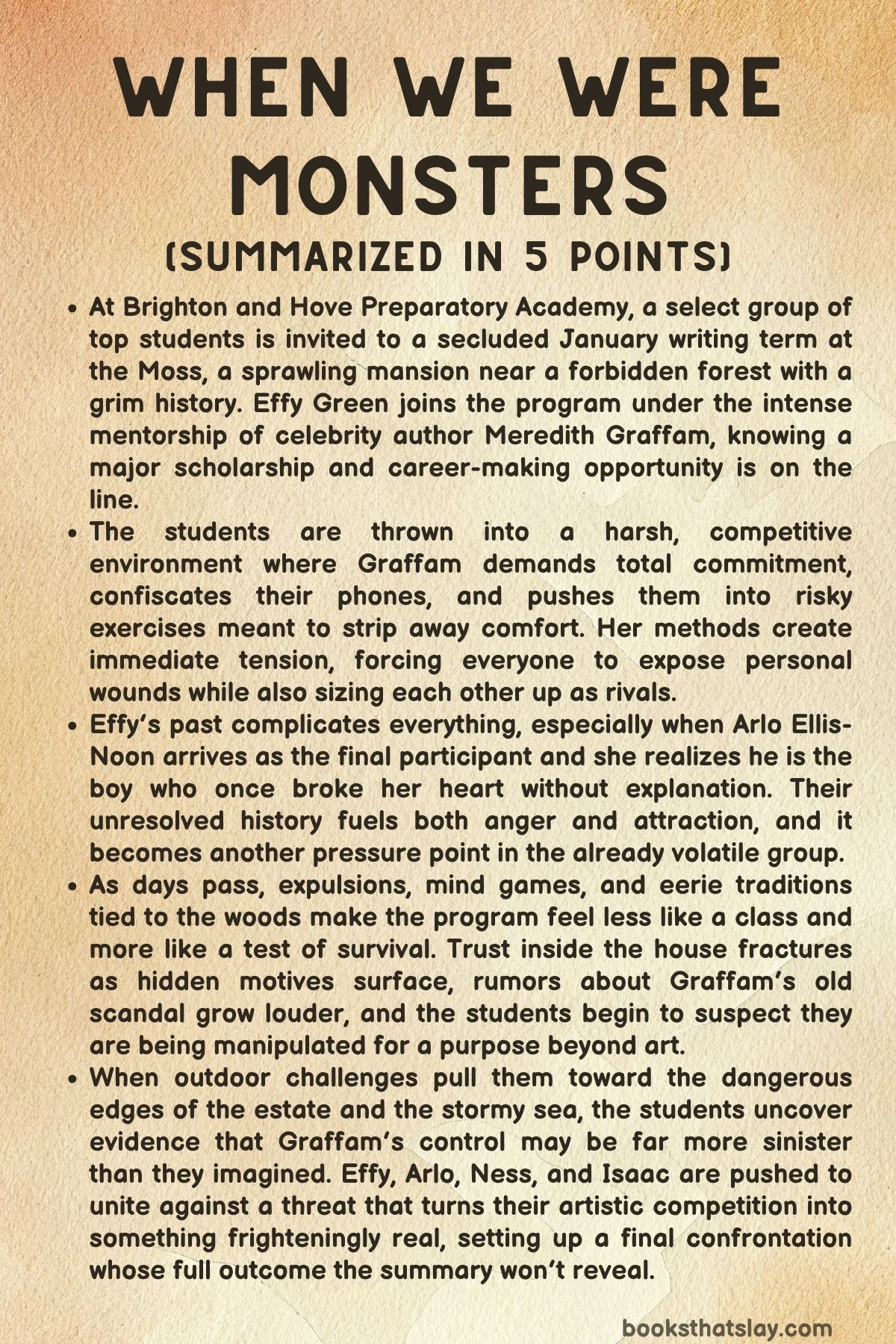
Summary
The story opens with a calm day that the narrator frames as the last peaceful moment before Meredith Graffam dies. Brighton and Hove Preparatory Academy sits on the Massachusetts coast, beautiful and wealthy on the surface, but shadowed by a long-forbidden forest called Murton Wood, or “Murder Wood,” where a student once died decades earlier.
Each January, the school selects eight top students for a sixteen-day Jan Term taught by a visiting artist at the Moss, the massive estate of the school’s founder, hidden deep in those woods. The narrator signals that four students—Effy Green, Arlo Ellis-Noon, Vanessa “Ness” Stone, and Isaac Williams—will be central to what leads to Graffam’s death.
Effy, a talented writer with a guarded streak, receives her selection letter and arrives at the Moss with six other students: Ness, Isaac, Ramon Santos, Joey Fiske, Peter Tobin, and Leela Kim. They are greeted by Dean Booker and Graffam’s assistant, Drea Garcia, and given strict rules: no leaving the house after dark, no entering the forest, doors locked at night, and obedience to the program.
The mansion feels like a labyrinth—grand, creaky, and isolating. Effy carries a letter from her estranged father, Clay Reynolds, recently released from prison after serving time for a drunk-driving crash that killed her mother.
Effy’s grandmother, her guardian, wants nothing to do with him, but Effy can’t throw the letter away.
The missing eighth student arrives late: Arlo, a former Brighton and Hove student forced to return after a long absence. Arlo is raw from witnessing the drowning of his best friend Jonah the previous summer, and he walks through the estate like someone half-awake.
Effy and Arlo also share a private past: they had a brief, intense relationship sophomore year before he vanished without warning. When they bump into each other, Arlo pretends not to recognize her, calling her “Elsie,” and Effy immediately shuts down any chance of warmth.
Graffam launches Jan Term with a test of loyalty and nerve. She takes the group to the icy ocean and demands they jump in; refusal means expulsion.
Effy goes first, not wanting to show fear. Most follow.
Ramon refuses fully, and Arlo is humiliated when another student dunks him under at Graffam’s command. The stunt sets the tone: this term is about obedience, risk, and competition.
Inside, Graffam has each student tell a deeply personal story as raw material for future work. Effy reveals her mother’s death and her father’s return; Ness speaks about adoption and desperation to be perfect; Isaac admits his parents want him molded into a corporate heir; Ramon recalls being outed and abandoned; Leela describes her identity and relationship with her twin; Peter talks about feeling unwanted; Arlo confesses he hurt a girl he cared about and still hates himself for who he was at fifteen.
Graffam praises Arlo’s storytelling in a way that needles Effy. She confiscates all their phones, gives them cameras for daily video journals, and pushes them to reshape truth into art, no matter how messy.
That first night, the group learns Graffam can erase a student at will when Joey is expelled after a private meeting. The rest are shaken.
During dinner, Peter fuels gossip about Graffam’s infamous past: she once wrote a bestselling true-crime memoir about a friend’s murder, publicly helped convict a man later exonerated, then returned years later with another memoir admitting her lies. The students argue over whether she was misguided or cruel, but their fascination with her power only grows.
In the small hours, an eerie folk song blares through the mansion. The students discover a hidden record player and a note from “MG” ordering them to vote someone out.
They protest but comply under pressure. By morning Peter is gone—the first of several forced eliminations.
Graffam then stages another spectacle, climbing onto the icy roof and threatening to jump unless each student screams their biggest fear. The exercise is less about honesty than about control.
Effy, already off-balance, begins to sense that Graffam’s lessons are closer to psychological games than teaching.
Effy and Arlo circle each other uneasily. Effy records a video journal about their sophomore-year romance: stargazing, secrecy, sleeping together, and then Arlo leaving for California without a word.
The hurt still lives in her body. Arlo tries again and again to bridge the gap, admitting he was selfish and terrified back then, but Effy won’t give him forgiveness on demand.
Still, a fragile truce forms when they both care for Ness during an illness, and Effy allows herself to feel something other than anger.
Midway through the term, Graffam takes four students to Brighton’s Woe, a rocky island off the estate, to lecture on setting and atmosphere. The return boat drifts away just as a storm rolls in.
Effy reacts instinctively, dives into the freezing water, and swims hard enough to haul the boat back with help from the others. The rescue leaves everyone shaken and sick.
Back at the Moss, the storm cuts power and isolates them further. Graffam speaks to Effy privately, urging her to write directly to her father and turn the letters into a book.
She also reveals a secret about her own career: she shaped her ex-husband’s confessional manuscript into her breakout work, taking real lives and bending them into a story that made her famous. Then she drops a new knife: Arlo once voted to send Effy away.
Effy doesn’t know whether to believe her, and the doubt corrodes what little trust she and Arlo have rebuilt.
After a tense night that includes a game of anonymous “fatal flaw” cards—some containing alarming confessions planted among the students—Ness breaks down over accidentally borrowing lines in her application poem. Effy discovers Ness has edited her own writing into something sharper, which feels like both help and theft.
Emotions stay jagged. Yet when Effy confronts Arlo about the alleged vote, he denies it, and she chooses to trust him over Graffam.
That choice leads to a renewed intimacy between them: they sleep together again, not as a tidy reunion, but as two people trying to be real in a place designed to distort them.
When the storm clears, Graffam sends the students into Murton Wood for a solo trek competition, each with private instructions and GPS trackers. Arlo’s directive is not to stop for anyone.
While separated, he receives a warning call from Ramon, who says Graffam lied about Ramon’s earlier challenge and left him lost in the woods for days. Ramon also claims Graffam framed an innocent man, Timothy Hugh Martin, for the murder of their friend Lara Leonard during a past Wild Hunt game, and that Graffam herself was involved.
The call drops, leaving Arlo rattled and certain something is seriously wrong.
Suspicion turns to proof when Effy, Arlo, Isaac, and Ness discover a hidden room full of cameras and footage showing Graffam secretly filming them and drugging their food. They try to escape but find the doors locked and keys missing.
A library deck collapses under Isaac, almost killing him, convincing them the traps are intentional. Wesley, a young staffer, admits Graffam has sent most staff away and taken all keys, trapping everyone inside.
They confront Graffam, but she coolly reminds them they signed waivers granting her ownership of all footage. With no exit and no phones, they plan to use the Wild Hunt that night to force her hand.
In the masked chase through the snowy woods, Graffam attacks Effy from behind with a rock, knocking her out. When Effy wakes, the four students realize Graffam is heading toward the cliffs.
They corner her and accuse her of drugging them, sabotaging the boat, and manipulating the term to create a film about their unraveling. Graffam admits she has been shaping them into a story and claims she was the true “Ruler of the Forest” years ago, jealous that Lara’s death made her a legend instead.
Drea arrives and confirms she has long known Graffam killed Lara to build her own survivor myth.
A violent storm crashes in, waves throwing everyone onto the rocks. In the chaos, Graffam drags Effy under the water, using her to stay afloat.
Effy breaks free, nearly drowning, and is hauled up by Ness. Graffam keeps coming, taunting them near Stray’s Chasm.
The students understand that if she survives, she will ruin them and repeat the pattern. Without a spoken agreement, they push Graffam into the chasm.
Her body is later found after the storm, and her death is ruled accidental.
Years pass. Effy, Arlo, Ness, Isaac, and Drea stay bound by what happened, and they channel the experience into a successful film loosely based on the term.
When Brighton and Hove invites them back to teach Jan Term, they return to the Moss older, accomplished, and carrying a secret no one else can name. Effy stands in the mansion again, watching her friends arrive, choosing to live forward with the truth they share and the cost they paid to survive.
Characters
Effy Green
Effy is the emotional and moral center of When We Were Monsters, a teenager shaped by grief, abandonment, and a relentless need to prove she can author her own life. Her mother’s death and her father Clay’s imprisonment created a core wound that shows up in everything she does: she distrusts promises, expects people to leave, and treats vulnerability like a trap.
Yet Effy is not brittle—she is fiercely alive. Her competitiveness at Jan Term isn’t just ambition; it’s survival instinct and a bid for control in a world that has repeatedly stolen it from her.
She is drawn to stories about sudden transformation because she is living one, trying to figure out whether catastrophe has to define her or can be reshaped into meaning. In her relationship with Arlo, we see her struggle between self-protection and desire for connection; she wants to forgive but won’t surrender her safety to do it.
Effy’s arc bends toward agency: she learns to look directly at horror, name it, and act, even when action makes her complicit. By the end, her forward motion is not innocence regained but adulthood earned—she carries the secret of Graffam’s death the way she carries her past, choosing to live anyway.
Arlo Ellis-Noon
Arlo is a character built out of absence—of a dead friend, a broken first love, and a self he no longer trusts. He returns to Jan Term hollowed out by Jonah’s drowning and by the guilt of witnessing it, and his grief expresses itself as insomnia, detachment, and a drifting sense of unreality.
Arlo’s early posture is defensive irony, but that mask is also a plea: if he can’t feel too much, maybe he won’t drown in it. His history with Effy exposes his adolescent cruelty—leaving without explanation—yet the narrative doesn’t let him hide behind “I was young.
” He knows he hurt her, and the shame of that harm sits beside his grief, making him both tender and volatile. Arlo’s growth is about choosing responsibility rather than fleeing from it.
He moves from passivity—being dragged through Graffam’s stunts—to leadership when the stakes become life and death. His love for Effy becomes meaningful not because it erases the past, but because it forces him to stay present, to act, and to accept that being a good person is something you do, not something you claim.
Meredith Graffam
Meredith Graffam is the novel’s most magnetic monster: brilliant, charismatic, and utterly predatory. She understands narrative the way a surgeon understands anatomy, and she uses that skill to cut people open.
Graffam’s public persona is forged out of scandal and reinvention; she has learned that confession can be a career move, and that control of the story equals control of reality. At Jan Term she frames cruelty as mentorship and risk as artistry, pushing students into humiliation, danger, and paranoia so their fear becomes consumable material.
Her obsession with ownership—of footage, of lives, of their truths—reveals a deep hunger to be the author of everyone’s meaning, not just her own. The revelation that she killed Lara Leonard years earlier places her current behavior in a continuum: Graffam is addicted to survivor narratives and to the power that comes from being the one who defines what “really happened.
” She isn’t chaotic; she is purposeful. Even her manipulative tenderness toward Effy is strategic—she sees Effy’s trauma as raw ore for her next masterpiece.
Graffam’s death, pushed by the students, lands as the bleak culmination of her worldview: she taught them that monsters are made by circumstance and choice, then forced them to become exactly that to survive her.
Vanessa “Ness” (Vanessa Graffam-adopted name)
Ness is a portrait of perfectionism as both armor and prison. Adopted into a family carrying grief for a lost baby, she grows up believing love is conditional on flawlessness.
That pressure becomes her defining trait at Jan Term: she is terrified of not being enough, terrified of being removed, and so eager to please that she starts measuring herself through Graffam’s eyes. Ness’s illness during the program reads not only as physical weakness but as the body’s rebellion against psychological strain.
Her plagiarism confession shows that her “perfection” is built on insecurity rather than arrogance; she doesn’t steal because she’s careless, she steals because she’s desperate to belong among the elite. Her conflict with Effy reveals another layer—Ness quietly resents Effy’s loud pain because Ness’s own suffering has been trained to stay invisible.
Yet she is also deeply empathetic; she risks herself for Effy on the island and later saves her from drowning. Ness’s journey is from performance toward selfhood.
She ends the story less haunted by the need to be chosen and more capable of choosing herself, even if that self is scarred and morally compromised.
Isaac Williams
Isaac is the novel’s embodiment of controlled volatility: outwardly polished, inwardly strangled by expectation. Raised as a legacy heir to a corporate dynasty, he has spent his life being groomed to become a role rather than a person.
His elegance in the ocean stunt and his confidence in class initially signal someone comfortable with risk, but that ease is partly rebellion—he wants to prove he can author a different future. Isaac’s fear of living someone else’s life is one of the most honest in the group, because it frames his privilege as a different kind of captivity.
After the boat incident and the storm, his anger becomes sharper; he is the first to push toward confrontation, and when the deck collapses under him, the story literalizes the trap of the Moss and of Graffam’s games. Isaac’s loyalty is complicated: he can be cutting and domineering, but he shows up when it counts, dragging himself into danger to pull others back.
In the climax he becomes part of the collective decision to kill Graffam, which underscores his thematic role: he is learning that freedom isn’t clean, and that sometimes survival means crossing lines you once believed defined you.
Ramon Santos
Ramon is the character most explicitly marked by social vulnerability, and his presence exposes the class and power dynamics humming beneath the academy’s privilege. His experience of being outed, bullied, and then abandoned by the boy he loved gives him a core terror of being left behind, which Graffam weaponizes.
His refusal to jump into the ocean is not cowardice but a clear-eyed rejection of performative cruelty; he sees the stunt as a manipulation, and that clarity makes him dangerous to Graffam’s control. When he is sent home and later calls Arlo to warn him, Ramon becomes a moral alarm bell in the narrative, the one who names the truth others are still hypnotized by.
His off-screen suffering in the woods, where no one searched for him, shows how easily institutions sacrifice the powerless to preserve their myth. Ramon’s role is smaller in page time but huge in consequence: he is the first proof that Graffam’s artistry is a cover for violence, and his empathy for others survives even after he’s been discarded, making him the story’s clearest example of integrity under pressure.
Leela Kim
Leela is bold, funny, and politically awake, using humor as both shield and weapon. Her feminist stand-up project positions her as someone who turns pain into performance on her own terms, and she has an instinct for seeing how power works in rooms like the Moss.
Leela’s fear of living safely is telling: she is addicted to intensity because intensity makes her feel alive and important, but it also makes her complicit in Graffam’s escalating games. She debates Graffam’s past with heat and principle, yet she still stays, still plays, still participates in the ritual of voting others out—showing how even the sharpest critic can be seduced by proximity to fame.
Leela’s elimination earlier than the final four is thematically consistent: Graffam removes people who keep their own narrative authority. Still, Leela leaves behind an imprint on the group as a voice of resistance and a reminder that cleverness alone doesn’t equal safety in a system built to devour you.
Peter Tobin
Peter is ambition without empathy, a student who treats Jan Term like a ladder and other people like rungs. He performs entitlement as charm and uses gossip as currency, constantly probing for scandal he can package into advantage.
His delight in Joey’s expulsion and his willingness to supply alcohol despite strict rules show his instinct to destabilize the group to make himself feel powerful. Peter’s interest in “online journalism” reads less like a calling and more like a desire to control stories the way Graffam does—by choosing what gets framed and what gets erased.
His early removal through the forced vote is structurally important: he is the canary indicating how quickly the group will turn predatory under Graffam’s influence. Even after he’s gone, his family’s media power becomes a threat the survivors later wield, making Peter a kind of lingering shadow of institutional privilege, useful even when morally suspect.
Joey Fiske
Joey appears briefly but functions as the first casualty of Graffam’s methodology. Coming from a background tied to animal testing and personal escape, Joey arrives already carrying complicated trauma and a desire to reinvent herself.
Her sudden expulsion after refusing or failing Graffam’s tests is meant to terrify the remaining students into obedience. Joey’s removal signals that Jan Term is not a meritocracy but a curated experiment in control, and her absence becomes a silent warning: anyone can be erased if they don’t feed the narrative Graffam wants.
She is less a fully explored character than a narrative wound that never closes for the group.
Drea Garcia
Drea is the quiet accomplice who forces the story’s hardest moral questions. As Graffam’s assistant she performs professionalism and care, but she is also complicit in captivity, drugging, and psychological warfare.
Her art project about women painted by women suggests genuine feminist intent, yet her loyalty to Graffam reveals how ideals can be bent into excuses for harm. The late revelation that Drea has long known about Lara’s murder reframes her as someone who chose career and proximity to genius over justice, perhaps convincing herself she was protecting a larger story.
Drea’s presence in the final circle of secret-keepers shows that survival doesn’t necessarily purify people; it binds them. Her later success and return to teach Jan Term implies a life built on compromise, and her character stands as the novel’s reminder that monsters are not only those who strike, but also those who stay silent.
Wesley
Wesley is the closest thing to an honest witness inside the Moss. As a young staffer he occupies a liminal class position—near the elite but not of it—and so he observes their world with wary distance.
His stories about Moss Hove, preserved birds, and the Wild Hunt connect the present to the estate’s mythic past, giving the students context they don’t yet understand. Wesley’s helplessness when Graffam takes the keys underscores the power imbalance: he sees danger, he wants to help, but he lacks authority.
Still, he tries to protect the students in small ways, making him a moral contrast to the adults who are actively exploiting them. Wesley represents the bystander who is decent but structurally constrained, and his fear echoes the larger theme that goodness without power can still fail.
Dean Booker
Dean Booker is the institutional face of Brighton and Hove Preparatory Academy, and his role highlights how systems enable predators. He sets the rules, delivers the students to the Moss, and then recedes, trusting Graffam’s prestige to justify the program.
His distance from the unfolding violence is not accidental; it’s the kind of cultivated oversight that protects an academy’s brand. By the end, the school’s decision to invite survivors back to teach signals that Dean Booker, and what he represents, values legacy and mystique over transparency.
He is not evil in a dramatic sense, but his passive complicity is a major engine of harm.
Clay Reynolds
Clay is Effy’s absent-present father, a man whose life is defined by one catastrophic choice: driving drunk and killing Effy’s mother. His letters are both apology and intrusion, reopening a wound Effy has spent years learning to live around.
Clay’s early release and desire for reconnection create the novel’s central question of free will versus fate, responsibility versus accident. Even without much direct page time, he is a constant psychological presence, shaping Effy’s writing, her distrust, and her hunger for truth.
The uncertainty about whether the crash was deliberate mirrors the story’s larger uncertainty about who chooses to become a monster and who is pushed there. Clay functions as Effy’s first encounter with the idea that love and harm can exist in the same person, preparing her, painfully, to recognize that complexity in herself.
Gran
Gran is Effy’s guardian and the embodiment of protective pragmatism. She tries to shred Clay’s letters and keep Effy sealed off from past trauma, not because she’s cruel but because she is terrified of seeing Effy hurt again.
Gran’s love is practical, rooted in safety and boundaries, and her conflict with Effy reflects a generational divide about healing: Gran believes survival means closing doors, Effy believes survival means opening them and staring into the dark. Gran’s role anchors Effy to a life outside the Moss, reminding us that Effy’s fight for agency began long before Jan Term.
Jonah
Jonah is Arlo’s dead best friend and the novel’s emotional ghost. Through Arlo’s memories, Jonah becomes a symbol of reckless joy, intimacy, and the unbearable fragility of youth.
His phrase “look up” is both literal and metaphorical, a reminder of wonder that Arlo can’t access after the drowning. Jonah’s death is the event that splits Arlo into before and after, and the guilt of witnessing it primes Arlo to accept punishment at Jan Term, almost as if suffering there might balance the ledger.
Jonah’s presence shapes Arlo’s tenderness toward Effy and his eventual refusal to let another person drown if he can stop it.
Moss Hove
Moss Hove is more legend than character, but his myth saturates the house and the program. As the founder who built the estate as refuge for outsiders, he represents an earlier, more romantic version of creative rebellion.
His preserved birds and bohemian circle suggest a desire to give discarded things new life, an ethos Graffam perverts into using living people as artifacts. Moss Hove’s drowning and the fact that his house remains a maze of secrets make him a kind of atmospheric ancestor, showing how places inherit and replay violence.
Zachary Brighton
Zachary Brighton, part of the Odds and tied to the estate’s folklore, functions as another spectral figure in the narrative’s background. His presence in the mythos of the Moss reinforces the theme that stories outlive people and can be weaponized.
Whether he “haunts” the island matters less than how the students use the idea of him to frame their fear, showing how easily imagination turns landscape into fate.
Lara Leonard
Lara is the girl who died during the Wild Hunt in the 1990s, and her death is the original sin of the Moss. She is remembered more as a narrative object than a person, which is exactly what Graffam wanted—Lara’s death became Graffam’s lifelong justification for cruelty and her template for crafting survivor mythology.
Lara’s role in the present story is to reveal the cyclical nature of violence: her death is not past, it is the pattern repeating in new bodies.
Timothy Hugh Martin
Timothy is the man Graffam framed for Lara’s murder and the clearest example of the collateral damage produced by Graffam’s ego. He never enters the plot directly, but his existence forces the reader to see that Graffam’s artistry has always relied on destroying other lives to polish her own.
He represents the unseen victims behind celebrated narratives and makes the students’ final decision feel less like random cruelty and more like a desperate attempt to stop a repeating history.
Paddy Eason
Paddy is Graffam’s ex-husband and the narrative’s illustration of literary predation in another form. Graffam’s confession that she reshaped his unfinished manuscript into her own breakout work shows her longstanding habit of mining intimate relationships for material and credit.
Paddy’s presence demonstrates that Graffam’s moral collapse did not begin at Jan Term; it is a career-long pattern of taking what isn’t hers, whether stories, reputations, or lives.
Themes
Art, Ambition, and the Cost of Winning
From the moment the students arrive at the Moss, creativity is framed less as exploration and more as a contest where survival and visibility are the real prizes. Meredith Graffam’s program is designed to make them believe that artistic success requires surrendering comfort, privacy, and even safety.
The ocean plunge, the forced confessions, the sudden expulsions, and the staged competitions all teach the same lesson: if you hesitate, you lose; if you obey, you might be chosen. Their ambition is not shallow—it is tied to scholarships, futures, and the hope that being “seen” by someone powerful will change their lives.
But the book shows how quickly ambition can be weaponized when a gatekeeper controls the rules. Graffam turns the students’ hunger into a lever, pushing them to reveal personal pain on command, to distrust each other, and to accept escalating cruelty as “part of the process.
What makes this theme unsettling is that the students are not simply victims of a tyrant; they also participate in the logic she sets up. Voting Peter out, continuing after Joey and Ramon vanish, chasing Graffam’s approval even when they suspect manipulation—these choices reflect how competition can erode empathy.
The promise of singular victory narrows their moral vision. Effy’s drive to win is intertwined with her desire to prove agency over a life shaped by tragedy.
Isaac’s ambition is partly rebellion against a prewritten corporate future. Ness wants legitimacy.
Arlo hopes for meaning after grief. In each case, winning becomes a way to rewrite the self.
Yet the program strips their autonomy instead, turning their stories into raw material for someone else’s film.
By the end, When We Were Monsters refuses a simple condemnation of ambition. The students do become artists, and their work matters.
But their success is stained with what they endured and what they did to survive. The theme ultimately questions whether art gained through coercion can ever be free, and whether a system that rewards only one voice out of many inevitably breeds harm.
Truth, Storytelling, and the Ethics of Using Real Lives
The book continually tests where truth ends and exploitation begins. Graffam is a living warning: her career is built on transforming murder into narrative, first by accusing an innocent man and later by confessing that lie as another bestselling story.
She embodies the dangerous idea that if a story is compelling enough, its moral cost can be forgiven. Her teaching amplifies this.
She tells students to use truth as material, even to twist it, and she models a worldview where the “real” event matters less than the version that sells. In her hands, truth is not sacred; it’s a tool for control and legacy.
Effy is positioned against that approach. Her writing obsession comes from wanting to capture the instant a life changes forever, which is also the instant her own world collapsed.
Her letters to her father are not just catharsis but acts of investigation: she wants the truth of the crash, of intent, of guilt, and of love. Yet Graffam pushes her to shape those letters into a marketable project.
The tension is not only about accuracy but about ownership. Who has the right to tell a story rooted in someone else’s pain?
Effy’s mother is dead, her father is trying to return, and Graffam is circling like a producer seeking a hit. Even Arlo’s grief for Jonah becomes potential footage.
The students sense, in fragments, that the program is less about their growth than about harvesting their lives.
The later revelation of hidden cameras and drugging makes the ethical stakes literal. Consent is a core boundary in storytelling, and Graffam erases it.
She believes her film will “immortalize” truth, but she defines truth as whatever she captures and edits. When the students fight back, they are also fighting for narrative control of their own lives.
Their final film, created years later, is an attempt to reclaim that power, though even that act is complicated by their silence about what truly happened.
In When We Were Monsters, storytelling is never neutral. Truth can heal, but it can also be reshaped into a weapon.
The theme asks readers to consider not only what stories are told, but who benefits from them, who is hurt, and what is lost when reality becomes currency.
Trauma, Grief, and the Search for Agency
Nearly every character carries a past that presses on the present, and the Jan Term environment forces those wounds into the open. Effy’s trauma is anchored in the violent loss of her mother and the long absence of her father, a man whose return threatens to reopen grief while also offering the possibility of repair.
Her need to decide whether the crash was accident or choice is about more than facts; it is about whether her life has been shaped by random tragedy or deliberate betrayal. That difference determines how she understands herself.
Her insistence on free will—her belief that she must have a say in her life—comes directly from living through a moment where she had none.
Arlo’s grief is more immediate and raw. He watched Jonah die, and his memories are filled with guilt, unfinished conversations, and the sense of being stuck at the edge of an event he cannot change.
His insomnia and isolation show how loss interrupts time, leaving a person present in body but stranded elsewhere in mind. Ness’s sickness mirrors her internal strain: perfectionism built on fear of abandonment, adoption shadowed by the dead child she replaced in someone else’s story.
Isaac’s pressure to become what his parents planned for him is a quieter trauma, yet still a kind of erasure. Even Ramon’s experience of being outed and bullied shapes his distrust of belonging.
Graffam claims fear makes writing dishonest, but her methods confuse healing with exposure. The students are pushed to “perform” their trauma publicly, before they are ready and without support.
This is part of why the house becomes a pressure cooker. The pain is already there; Jan Term simply removes the defenses that usually keep it manageable.
Yet trauma also becomes a route to agency. Effy swimming after the drifting boat is a physical replay of her core identity: she acts, she saves, she refuses to be helpless.
Arlo’s choice to love again, even without promises, is his way of stepping out of the frozen moment of Jonah’s death. Ness’s confrontation with her plagiarism fear is a test of whether she can exist without perfection.
The theme does not present recovery as clean or complete. Agency emerges through messy choices, including the final decision to kill Graffam to survive.
Healing in When We Were Monsters looks less like forgetting and more like learning how to live with memory without allowing it to dictate every future move.
Power, Control, and the Breakdown of Consent
The Moss is a controlled world where authority is both seductive and terrifying. Graffam is not merely a demanding teacher; she is a figure who systematically removes ordinary safeguards.
She confiscates phones, isolates the students from adults who might intervene, sends staff away, locks gates, and creates an atmosphere where her rules feel absolute. This is a classic pattern of coercive power: cut off escape, make the subject dependent, then define obedience as virtue.
The students sign waivers, but those waivers are meaningless in a real moral sense, because consent cannot be genuine under deception, surveillance, and drugging.
The book shows how power disguises itself as mentorship. Graffam flatters, singles out, and offers career promises to keep the students invested.
Her attention feels like opportunity, so they tolerate what would otherwise be unacceptable. Even the atmosphere of elite prestige at Brighton and Hove supports her dominance, because the students have internalized the belief that suffering is the price of greatness.
The Wild Hunt tradition also functions as cultural camouflage; what began as a bohemian game becomes a ritual through which violence can be framed as art or folklore.
Control is not only top-down. The competitive structure makes the students police each other.
Voting people out, suspecting each other’s confessions, and fearing expulsion keeps them from uniting early. This fractured trust benefits Graffam, because a divided group is easier to manage.
When they finally collaborate—hiding in Effy’s tower room, piecing together Ramon’s warning, planning to force Graffam to delete footage—the balance shifts. Their solidarity is the first true threat to her authority.
The collapsing deck trap and the locked doors underline that her control is willing to risk their lives. She treats their survival as secondary to her project.
At the cliffs, when she tries to use Effy as flotation, the theme reaches its clearest expression: people are objects to her, tools for her continuation. The students’ final shove is not framed as heroic, but as an act born from realizing that negotiation with such power is impossible.
In When We Were Monsters, consent is portrayed not as a single signature or spoken yes, but as an ongoing condition requiring freedom, knowledge, and the ability to refuse. Take those away, and art becomes captivity.
Moral Complicity, Friendship, and Living with a Shared Secret
The students’ journey is also a study in how decent people become capable of terrible actions when trapped together. At first, their relationships are shallow alliances shaped by competition.
They fear one another almost as much as they fear Graffam. Yet as danger increases, rivalry shifts into dependence.
Effy caring for sick Ness, Arlo and Effy rebuilding trust, Isaac’s anger giving way to protectiveness—these moments show friendship forming under pressure, not through comfort. The bonds are real, but they are also forged in an environment that distorts ethics.
Complicity begins early. Even before they know the worst, they accept Joey’s expulsion and Peter’s removal with shock but not rebellion.
They vote because they are told to. They keep playing the game because stopping seems impossible, and because each hopes they will be the one left standing.
The book does not excuse these choices, but it explains them: fear plus ambition plus isolation can make compliance feel like logic. Their later discoveries force them to confront not only Graffam’s crimes but their own earlier passivity.
The final act—the collective decision to push Graffam into the chasm—creates a shared moral wound. It is self-defense, yes, but also homicide carried out in silent agreement.
The lack of spoken consent in that moment matters; it shows how deeply they understand each other without words, but it also indicates how quickly a group can cross a line when all other exits vanish. Their survival depends on becoming what Graffam always claimed they were capable of: monsters.
The title gains weight here, not as a label for evil people, but as a description of what circumstances can pull out of anyone.
Years later, their success and reunion at the Moss reveal the afterlife of that choice. They live with a secret that binds them more tightly than friendship alone ever could.
Their careers flourish partly because they turned trauma into art, but also because they never fully faced the truth publicly. Returning to teach Jan Term suggests both healing and repetition.
They are older, wiser, and together, yet the institution that enabled Graffam still stands, still inviting young artists into the same seductive isolation.
When We Were Monsters argues that morality is not tested in abstract debates but in cramped rooms, locked houses, and storm-lit cliffs where every option is terrible. Friendship can save people, but it can also make them partners in a secret they will carry forever.