While It Was Snowing Summary, Characters and Themes
While It Was Snowing by Julia London is a holiday romance about a woman who finally claims a small pocket of time for herself—and the unexpected man who shows up in the middle of it. Amy Casey, newly divorced and stretched thin by work, family, and constant responsibility, retreats to a Christmas-drenched lake house in north Texas to paint for an important local art contest.
Harrison Neely, a famous golfer recovering from a serious injury, has rented the same house to heal and figure out his future. What begins as an awkward standoff turns into an offbeat, funny, and tender reset for them both.
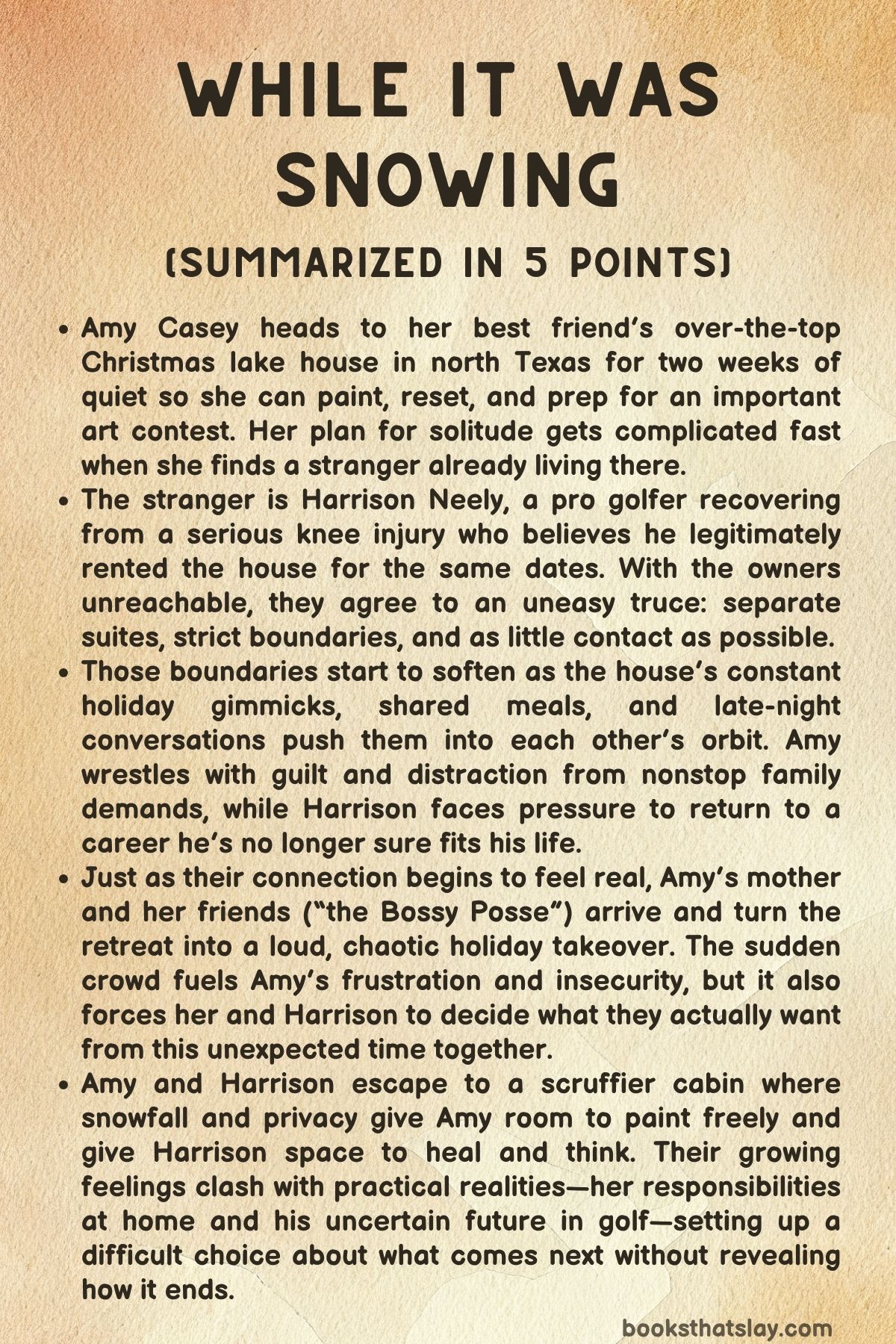
Summary
Amy Casey arrives at a massive, luxury lake house on Lake Texoma expecting two quiet weeks alone. The house is a Christmas spectacle: themed rooms, nutcrackers, wreaths, mistletoe, lights, and hidden speakers that launch holiday music on a schedule.
Amy is there for one reason—paint. She has an upcoming show and a shot at a Christmas festival art contest in Willow Valley that could change her confidence and her finances.
After years of being everyone’s fix-it person, she wants uninterrupted time to create. She brings her elderly, nearly blind dog, Duchess, expecting the dog to sleep most of the day.
Not long after settling in, Amy walks into the kitchen and finds a tall man making himself a sandwich. Both shout; both freeze.
He’s not a burglar—he’s Harrison Neely, a professional golfer. He assumes Amy is the housekeeper.
Amy, insulted and rattled, insists she belongs there. Harrison insists he does too: he rented the property through a vacation site, paid in full, and has a confirmation.
Amy realizes the booking must have come from Sam, her best friend Julie Kleinhoff’s sister, and that Sam has double-booked the house before its official rental date.
They try to call their contacts. Julie doesn’t answer at first, and Sam’s voicemail is full.
With no quick solution and neither willing to leave, they agree to a strict, temporary truce: separate primary suites, minimal contact, no shared food, and no expectations. Amy jokes that this is how people end up on true-crime podcasts, but Harrison’s limp and calm manner soften her suspicion.
The house itself keeps sabotaging peace—lights flare, music blasts unexpectedly, and Amy learns she can’t simply shut it off without disabling other systems. She crawls behind the Christmas tree more than once just to silence a surprise “Holly Jolly” moment.
Amy tries to settle into painting, but her life follows her through her phone. Texts and calls arrive from her teenage sons, Jonah and Ethan, and from her ex-husband, Ryan.
Jonah wants permission, snacks, and rides. Ethan struggles with intense anxiety and needs reassurance.
Amy’s brother Kevin is another ongoing concern, and at work she is an HR director stuck managing other people’s messes, including a boss who makes inappropriate comments. Even in a mansion meant for calm, Amy can’t switch off the constant demand for her attention.
She starts to wonder if she’s forgotten how to be an artist without apologizing for it.
Harrison has his own reasons for hiding out. He’s nearing fifty and recovering from a car accident that shattered his knee and damaged his leg badly enough to threaten his PGA future.
His manager, Clay, keeps calling with opportunities and pressure. Harrison is wealthy and well-known, but his life feels empty and unrooted: hotels, travel, obligations, and a lot of silence when the crowds go away.
He came to Texas to heal and make a decision about whether he can keep competing—or whether he even wants to.
Despite their “stay out of my way” rules, they keep crossing paths. Amy sees Harrison practicing on the deck, hitting balls into the lake, then stopping abruptly when pain or frustration catches him.
Later, during a clumsy attempt at yoga, Amy ends up flat on the deck in the rain. Harrison appears with a martini, checks if she’s okay, and offers the drink.
Amy insists she’s there to work, not relax—then takes the martini anyway. The small exchange breaks something open between them: they talk, tease each other, and share the first honest pieces of their real lives.
They have dinner together—steaks, salad, and more drinks—and the conversation turns easy in a way that surprises them both. Amy admits she once wanted art to be the center of her life, but responsibility crowded it out.
Harrison admits the mental strain of competition, including a period of debilitating performance anxiety that therapy helped him survive. Later, they sit by the fire, play a game, and share vulnerable truths about loneliness and dating after divorce.
A kiss nearly happens—until Amy’s phone rings with a crisis at home, pulling her straight back into motherhood. The moment passes, but it leaves a mark.
They both go to bed thinking about what almost happened and what they secretly want.
Their relationship turns physical and affectionate soon after, and Amy wakes with a rush of hope and confusion. She tells Julie, who immediately warns her not to get attached to a man whose life is built around travel and fame.
Amy tries to treat it like a short holiday romance, but her feelings keep growing. Harrison, too, is unsettled.
He didn’t plan to fall into companionship; he came for solitude. Yet Amy makes him feel seen in a way the golf world never does.
Then Amy’s retreat collapses. Her mother, Barb, arrives at the house with three friends—older women in blinking antlers and matching “Bossy Posse” sweatshirts—declaring it a girls’ trip and insisting the house is big enough for everyone.
Amy is horrified. Barb ignores protests, the friends take over common spaces, and the house becomes loud, opinionated, and full of snack plans.
Harrison’s physical therapist, Hillary, arrives for rehab sessions, and Amy’s insecurity flares when she sees Harrison being worked on by a younger woman. The Bossy Posse teases relentlessly, asks nosy questions, and turns Amy’s carefully protected time into chaos.
Amy confronts her mother and learns Barb isn’t just being intrusive—she’s unhappy at home and desperate to feel alive again. That confession hits Amy hard, because it mirrors her own fear: that she has been surviving instead of living.
Harrison, seeing Amy cornered and stressed, suggests they escape. They flee in Amy’s minivan with Duchess and head to a shabby lakeside cabin just as snow finally arrives.
The cabin is imperfect but peaceful. In that smaller space, Amy paints again with clarity.
She creates a whimsical series inspired by the Bossy Posse—comic, festive scenes that feel like her voice rather than tourist art. Harrison continues rehab and practice, testing his knee carefully, and the two settle into a simple rhythm: firelight, warm drinks, quiet mornings, and honest conversation.
The comfort makes their future question unavoidable. Harrison misses golf and isn’t ready to quit.
Amy misses her children and recognizes she can’t abandon them or her job to chase his schedule. They admit they love each other, but they also admit love alone doesn’t erase real life.
When they return, Amy’s family shows up with an apology banner and a genuine attempt to support her dream. Back in Willow Valley, Amy enters the contest with her new series, reconnects with her sons, and finds her family has built her a small backyard studio.
Harrison leaves for Scotland, but he stays present—messages, flowers, and encouragement. At the Christmas Eve show, Amy doesn’t win the top prize, but she feels proud because she made the work she wanted to make.
Afterward, Harrison appears in Willow Valley instead of boarding his flight. He chooses to spend Christmas with Amy, stepping into her loud, messy, loving family gathering like he belongs there.
They exchange meaningful gifts—a reminder of the cabin and the snow—and make it clear they’re no longer pretending this was temporary. Over time, Harrison returns to golf, finds a new balance, and eventually builds a life in Texas.
Amy keeps her job, keeps painting, and keeps choosing space for herself. Their relationship grows into something steady enough to hold both of their worlds, and they end the season planning a future together—one that includes family, art, and the kind of ordinary joy they both thought they’d lost.
Characters
Amy Casey
Amy Casey is the emotional and creative core of While It Was Snowing, a woman standing at the intersection of reinvention and exhaustion. Recently divorced and navigating life in her fifties, Amy arrives at Lake Texoma hoping for solitude and the chance to reconnect with her artistic identity.
She is a devoted mother, an overextended caretaker, and a woman burdened by years of putting others before herself. Her teenage sons, her brother, her ex-husband, and her intrusive job have all drawn from her reserves of patience and time, leaving little space for her own aspirations.
The retreat is both an escape and a declaration of independence—a test to see if she can still be more than the dependable problem-solver everyone expects her to be. Amy’s character unfolds through her interactions with Harrison and her struggle to reclaim her confidence as an artist.
Her vulnerability—whether through her frustration at constant interruptions or her self-consciousness about aging—makes her deeply human. Yet she possesses quiet resilience.
As she paints, battles creative block, and endures the comic chaos of her mother’s arrival, Amy learns that fulfillment lies not in isolation but in balance. By the end, she embraces love, motherhood, and art without sacrificing herself to any one of them.
Amy’s growth represents mature self-discovery—messy, funny, and utterly authentic.
Harrison Neely
Harrison Neely serves as both counterpart and catalyst to Amy’s transformation. A professional golfer in his late forties recovering from a career-threatening injury, Harrison arrives at the lake retreat in search of clarity.
Outwardly successful and self-assured, he conceals deep uncertainty about his future and his worth beyond the sport that has defined him. His initial insistence on staying in the house with Amy hints at stubbornness, but beneath it lies a quiet loneliness.
He is a man used to transient living—hotels, tournaments, sponsorships—and the silence of the lake house exposes the hollowness of that lifestyle. Through his growing bond with Amy, Harrison rediscovers emotional intimacy and purpose.
Their relationship begins with wary tension but evolves into companionship built on empathy and humor. Harrison’s nurturing side surfaces when he comforts Amy, plays host to her chaotic family, and encourages her art.
At the same time, his journey reflects the universal fear of obsolescence: what happens when the life you’ve built no longer fits? By the conclusion, Harrison’s decision to return to golf on his own terms, then later build a life in Texas with Amy, shows his evolution from a man defined by career to one defined by connection.
Julie Kleinhoff
Julie Kleinhoff, Amy’s best friend and the unseen architect of the story’s inciting situation, is the practical yet playful presence who anchors Amy’s emotional world. Though not physically present for much of the novel, her influence is constant.
Julie’s gesture of lending the lake house reflects her faith in Amy’s need for independence, even as her teasing about Harrison reveals a lighter, mischievous spirit. She functions as the voice of both support and caution—encouraging Amy’s creativity while reminding her to guard her heart.
Julie’s off-page energy embodies friendship at its truest: the one who nudges, provokes, and believes in you when you can’t.
Barb Casey
Barb Casey, Amy’s mother, is a whirlwind of energy, humor, and exasperation. Her sudden arrival with the “Bossy Posse” transforms Amy’s peaceful retreat into chaos, but it also exposes the generational echoes within the story.
Barb represents an older woman’s refusal to fade quietly into domestic invisibility. Her decision to leave Amy’s father for a time and to live vivaciously—even foolishly—suggests that self-reinvention isn’t limited to the young.
Yet her boundary-crossing and obliviousness also reflect the challenges of mother-daughter relationships: love entangled with control, care tangled with intrusion. Barb’s journey mirrors Amy’s own, each learning that autonomy and affection can coexist.
The Bossy Posse
The “Bossy Posse,” Barb’s spirited group of friends, injects comic relief and warmth into the narrative. They embody camaraderie, aging unapologetically, and the chaos of chosen family.
Though they disrupt Amy’s solitude, they indirectly inspire her art, becoming the whimsical subjects of her award-contending “Bossy Posse Christmas” series. Their collective presence contrasts with Amy’s initial isolation and ultimately teaches her that joy, community, and creative inspiration often come from the unpredictable.
Ryan Casey
Ryan Casey, Amy’s ex-husband, is both a source of frustration and nostalgia. His attempts at reconciliation reveal his dependence on Amy’s steadiness and his struggle to accept their new boundaries.
Through Ryan, Julia London examines the complexities of post-divorce dynamics—resentment intertwined with lingering affection, and the slow process of redefining family. While he often represents the domestic burdens Amy tries to escape, his later involvement in supporting their children and building her studio shows that growth is possible even after romantic endings.
Jonah and Ethan Casey
Jonah and Ethan, Amy’s teenage sons, embody the pull of motherhood that Amy can never fully leave behind. Jonah’s teenage apathy and Ethan’s anxiety represent the emotional demands that make Amy’s artistic escape feel impossible.
Yet they also ground her, reminding her that love and responsibility coexist with independence. Their presence at the end, celebrating Christmas with Amy and Harrison, symbolizes reconciliation between the roles of mother, lover, and artist that Amy finally learns to balance.
Duchess
Duchess, Amy’s nearly blind old dog, functions as more than a pet; she is a quiet metaphor for loyalty and endurance. Her vulnerability mirrors Amy’s at the novel’s start—aging, uncertain, yet still seeking comfort and companionship.
The tenderness both Amy and Harrison show toward Duchess softens their relationship, marking the first bridge between two guarded souls. In a story about rediscovering joy and connection, Duchess represents the steadfast love that persists even as life changes.
Clay and Hillary
Clay, Harrison’s persistent manager, and Hillary, his physical therapist, serve as contrasting reminders of the world Harrison left behind. Clay embodies professional pressure and the relentless pursuit of success, constantly pulling Harrison back toward competition.
Hillary, on the other hand, symbolizes healing—both physical and emotional. Her presence sparks Amy’s jealousy but also helps reveal Harrison’s vulnerability and need for grounding beyond ambition.
Together, they frame Harrison’s internal conflict between duty and desire, career and contentment.
Themes
Self-Discovery and Reinvention
Amy Casey’s journey in While It Was Snowing revolves around the rediscovery of her individuality after years of being defined by family roles, responsibilities, and social expectations. The novel captures the emotional exhaustion of a woman who has always been the caretaker—managing her children’s crises, her ex-husband’s indecision, her brother’s failures, and even her boss’s inappropriate behavior.
When she retreats to Lake Texoma, it is not merely to paint; it is an attempt to reclaim the space within herself that has long been neglected. Through her interactions with Harrison Neely, Amy begins confronting her own complacency and suppressed desires.
The isolation of the lake house becomes symbolic of solitude’s power to clear away accumulated noise, allowing her to reconnect with her creative impulses and personal dreams. Her art, initially hesitant and commercial, gradually transforms into genuine expression as she accepts that self-fulfillment is not selfish but necessary.
The transformation is not dramatic but deeply internal—a gradual acceptance that reinvention does not require abandoning family or responsibility but balancing them with self-respect and creativity. Julia London uses Amy’s art and her emotional awakening to underline how midlife reinvention is not a desperate attempt to start over, but a conscious reclamation of identity.
Healing and Emotional Connection
Harrison Neely’s presence in While It Was Snowing mirrors Amy’s emotional journey, providing a parallel exploration of healing—physical, emotional, and spiritual. Once a professional golfer, Harrison arrives at the lake with an injured knee and a fractured sense of purpose.
His career, which once gave him prestige and identity, now confines him in uncertainty. His relationship with Amy begins with irritation and misunderstanding but evolves into mutual empathy.
Both characters carry unhealed wounds—Amy’s tied to emotional overextension and self-doubt, and Harrison’s linked to aging, fear of obsolescence, and the emptiness of fame without intimacy. Their growing bond illustrates that healing often occurs through vulnerability rather than solitude.
Harrison’s gradual surrender of control, his willingness to cook, laugh, and share space, symbolizes his emotional rehabilitation. Likewise, Amy’s openness to affection after years of restraint allows her to rediscover emotional intimacy beyond the roles of mother and professional.
Their connection redefines strength—not as independence alone but as the courage to depend on another without losing oneself. Through shared humor, quiet companionship, and moments of genuine tenderness, the novel portrays love as a restorative force that helps both characters reimagine what fulfillment looks like beyond ambition and duty.
The Conflict Between Freedom and Responsibility
Throughout While It Was Snowing, Amy’s constant tug-of-war between her responsibilities and her yearning for independence forms one of the novel’s central emotional conflicts. Her time at the lake represents a fleeting liberation from the demands of motherhood, work, and familial caretaking.
Yet even there, her phone buzzes with messages, and her family’s needs infiltrate the sanctuary she has carved out. The arrival of her mother and the “Bossy Posse” epitomizes the inescapability of obligation—how women, in particular, are rarely granted unbroken solitude without guilt or intrusion.
Harrison, too, experiences a similar duality; his desire to escape the pressures of professional sports conflicts with his fear of irrelevance. The novel treats freedom not as an absolute state but as a dynamic negotiation.
Amy’s realization that true independence does not mean detachment but equilibrium marks a mature resolution. By the end, she chooses to return to her life not out of resignation but understanding—accepting that autonomy and belonging can coexist.
London’s portrayal of this balance challenges conventional romantic or career-centered resolutions, showing that fulfillment emerges when freedom is redefined as self-directed choice rather than escape from responsibility.
Love and Second Chances
The love story in While It Was Snowing stands as a meditation on rediscovery and renewal rather than idealized romance. Both Amy and Harrison enter the relationship burdened by their pasts and uncertain futures.
Their connection grows not through grand gestures but through quiet companionship and shared imperfections. The novel treats middle-aged love with sensitivity, emphasizing its authenticity rather than novelty.
For Amy, affection becomes an affirmation that she remains vibrant and desirable, while for Harrison, it represents the possibility of stability after years of transient relationships. Their separation near the end underscores the realism of adult relationships—love cannot erase logistical differences or personal ambitions.
Yet Harrison’s return on Christmas Eve transforms their story into one of reconciliation, where love is grounded in mutual growth rather than fantasy. Their eventual life together, built on balance and shared respect, reinforces the idea that second chances do not rewrite the past but build meaning upon it.
London crafts their reunion as a hopeful reminder that emotional courage and timing can align when individuals are ready to love without losing themselves.
Creativity and Artistic Identity
Art functions as both a metaphor and a narrative thread in While It Was Snowing, reflecting Amy’s internal evolution. When she arrives at the lake, her art is tentative, shaped by commercial considerations and self-doubt.
She paints to please, not to express. However, her experiences—ranging from frustration to joy—begin transforming her creative vision.
The “Bossy Posse Christmas” series becomes a turning point; it merges humor, affection, and authenticity, proving that creativity thrives when it draws from lived experience rather than idealized beauty. Amy’s art, like her emotional journey, evolves from mimicry to self-expression.
London situates painting as a process of self-understanding rather than mere productivity. Even when Amy loses the art contest, her satisfaction stems from creative honesty rather than external validation.
This evolution mirrors the broader theme of female artistry—how women’s creativity is often overshadowed by domestic roles or societal expectations. Through Amy’s renewed commitment to her art and her eventual balance between family and passion, the novel asserts that artistic fulfillment is not an indulgence but a vital dimension of identity.