Who Is the Liar Summary, Characters and Themes
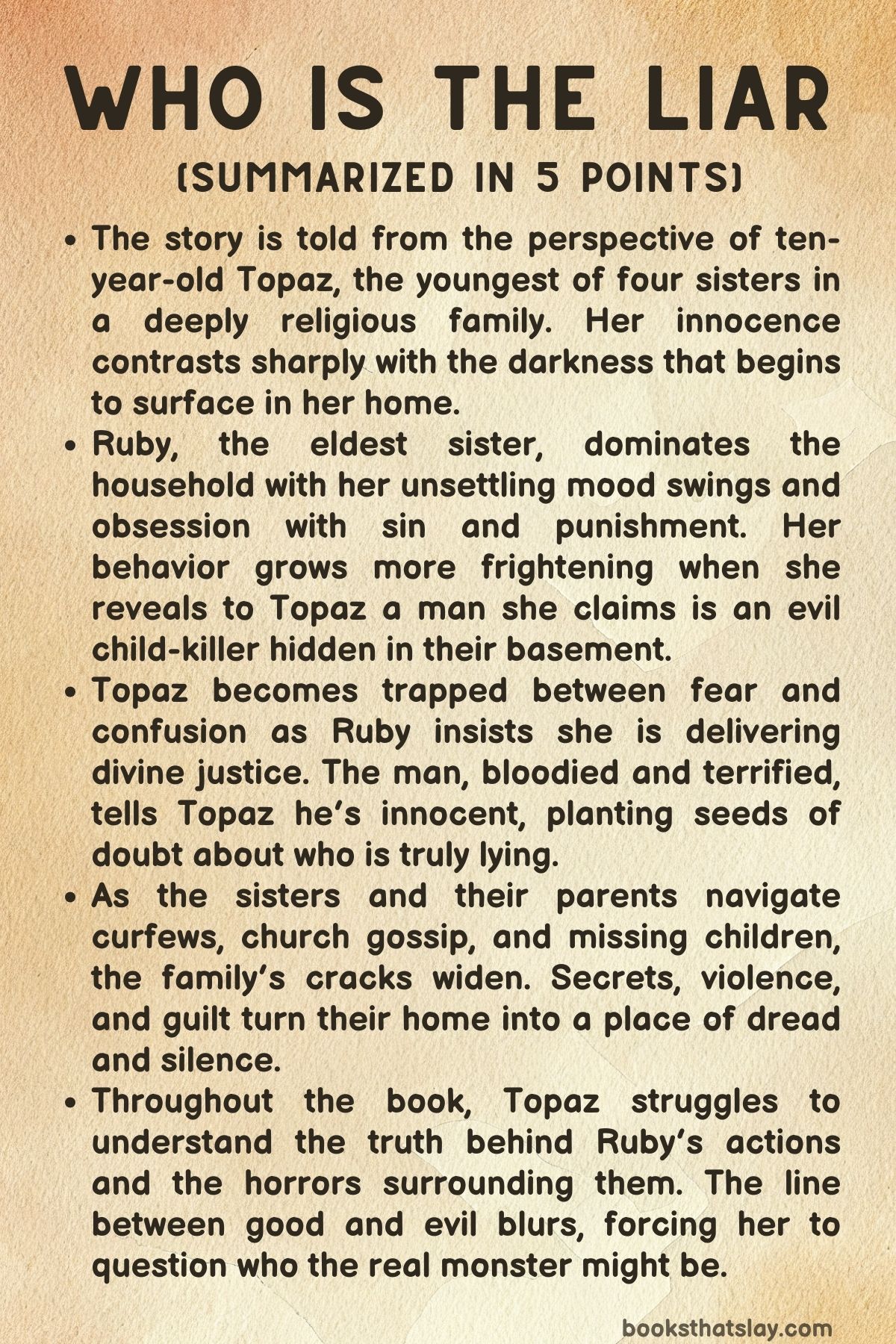
Who Is the Liar by Laura Lee Bahr is a haunting psychological novel that blurs the lines between truth, imagination, and trauma. Told through the eyes of ten-year-old Topaz, the youngest of four sisters in a deeply religious family, the story captures the confusion and fear of a child caught between innocence and horror.
As she tries to make sense of her sister Ruby’s disturbing behavior and the darkness lurking within their home, Topaz becomes an unwilling witness to violence, secrets, and manipulation. Through her fragmented understanding, the book explores how lies, abuse, and faith can twist perception, leaving the reader uncertain about who—or what—to believe.
Summary
The story begins in a devout household ruled by faith and fear. Ten-year-old Topaz sits at dinner with her family—her stern father, anxious mother, and three older sisters: Ruby, the eldest; and the twins, Lily and Lavender.
When their mother warns them about a child-killer loose in town, Ruby mocks the fear, her attitude defiant and unsettling. That night, she behaves oddly tender toward Topaz, brushing her hair and whispering that she knows who the murderer is.
She leads Topaz into the basement, revealing a bloodied man tied up in a secret cold space. Terrified, Topaz flees, realizing Ruby has imprisoned someone she claims is the killer.
At church the next day, Ruby appears pious, but Topaz is consumed with dread. Ruby later insists the captive is Brother Johnson, a trusted church member.
She claims God told her to punish him for his sins. Topaz’s fear and curiosity grow as Ruby’s story shifts—sometimes saying she saw an angel, other times admitting she lied.
When Topaz challenges her using a logic riddle taught by the prisoner, Ruby changes her story again, claiming Brother Johnson abused her. The contradictions confuse Topaz, who can’t distinguish truth from deceit.
At school, news spreads of another missing girl, Janie Potts, deepening Topaz’s panic. She suspects Ruby freed Brother Johnson and that he struck again.
The family’s tension heightens until Ruby reappears unharmed, cryptically saying the man will never hurt her again. The uncertainty about who is guilty—the captive, Ruby, or someone else—lingers like a shadow.
As fear consumes the household, Ruby’s behavior becomes volatile. She controls her sisters, locks doors, hides the phone, and brings her boyfriend Dale into the house.
Together they plan to kill the captive, whom Ruby insists is the Beast responsible for the town’s murders. When Aunt Jess arrives unexpectedly, the plan collapses, and Ruby reveals she was abused by Brother Johnson.
She says no one believed her then, so she took justice into her own hands. The next morning, Aunt Jess warns the girls about evil men and the dangers lurking even in families.
The twins later peek into the cold space and confirm the man is still there, alive but near death. The knowledge divides them—fear, loyalty, and disbelief battling within the sisters.
Mom returns from the hospital after an injury, announcing that Janie Potts has been found alive. Relief is short-lived, as it raises a new question: if Janie wasn’t kidnapped, who is the Beast?
The sisters now realize that Ruby might have tortured an innocent man. Still, they are too scared to tell their parents.
Meanwhile, Uncle Gerald, a policeman, drives them to school, unaware that a bound man lies beneath their home. At school, Topaz blurts out strange things, enjoying the attention her secrets bring even as guilt eats at her.
Back home, life goes on in eerie normalcy. When Topaz insists they feed the man, Lily reluctantly helps her bring food and water.
The captive, weak and bleeding, denies being Brother Johnson. He pleads for help, claiming Ruby is insane.
But his calm, manipulative tone unnerves the girls. When they confront Ruby later, she retells her abuse story, describing herself as a protector.
She demands silence from her sisters and commands them to stay away from the basement. The twins comply, but Topaz doubts everything.
The contradictions deepen when Heather Johnson, Brother Johnson’s daughter, visits and mentions her father is home from a business trip. Realizing the captive cannot be him, Topaz’s confusion intensifies.
Ruby, meanwhile, shows the girls her hideout in the woods filled with stolen trinkets. She spies on the real Brother Johnson’s house, claiming to have proof he’s guilty, but her sisters see only obsession.
When Ruby’s lies unravel, chaos breaks out, and soon police arrive at their door looking for her. Their mother learns Ruby has been sneaking out with Dale and might be connected to Satanic rumors sweeping the town.
Ruby is sent to a treatment school for troubled girls, leaving the others behind with their secrets and a possibly dead man in the basement.
As time passes, Topaz sneaks into the cold space again and finds the captive still alive but barely human—rambling, bleeding, and possibly dangerous. He manipulates her with affection, calling her special and coaxing her into helping him imagine escape.
When she hugs him, she notices a shard of glass hidden in his hand. Later that night, she hears noises, finds the phone line cut, and sees blood near the basement phone.
Their mother arms herself with a knife while sending the twins to the neighbors. Topaz cleans the blood to protect Ruby’s name, lying to her mother to prevent the police from coming.
The sisters argue afterward. Lavender admits she cleaned the cold space earlier and buried pieces of evidence—a tooth, ropes, and tape.
Lily hints at contacting a cousin of another missing girl to expose the truth, but fear keeps them silent. Their mother dreams of wolves and rocks, symbolic of buried guilt and danger.
When Ruby’s boyfriend is arrested, suspicion briefly lifts, but dread remains.
Soon, reality and delusion merge. Brother Johnson reappears at church, bruised but alive, having survived an “accident.
” He corners Topaz, forcing her into a game that feels both sinister and familiar. He hints at knowing her secrets and controlling her.
When Topaz visits his home later, she discovers a childhood photo of Ruby there, proving Ruby once knew him—perhaps confirming her accusations. In a horrifying turn, he assaults Topaz under the guise of play, ensuring her silence through manipulation and fear.
At Lily and Lavender’s slumber party, Heather joins the group. The girls gossip, unaware of the darkness about to return.
Heather, defending her father, insists he’s innocent, while Lily claims to have photos proving otherwise. That night, Heather awakens Topaz in terror—her first period has begun, which she interprets as punishment.
Topaz comforts her, but moments later, Brother Johnson appears, climbing the stairs. In a surge of courage, Topaz strikes him twice with a heavy piece of petrified wood.
He falls and lies still. The girls hide the body in the Johnsons’ cold cellar and cover it with sheets and bins.
Heather warns Topaz that if anyone finds out, she could face the electric chair. They swear never to tell.
Days blur together. Topaz becomes haunted by what she’s done, bringing rocks from her collection to the hidden corpse, whispering lessons about change.
Heather adjusts her father’s calendar to make it seem like he’s away, protecting their secret. When Ruby returns home from the treatment center, the house feels suffocating with buried guilt.
During dinner, Topaz, nauseous from the memory of Brother Johnson’s touch and death, vomits at the table. As her family looks on, she insists she’s fine, but she knows the truth: she killed him, hid his body, and must carry that silence forever.
Through the innocent yet fractured voice of Topaz, Who Is the Liar examines how truth, evil, and memory can be distorted within the confines of family, religion, and trauma. In the end, no one is entirely innocent—each character carries a secret, each lie breeding another, until even the reader is left uncertain about who the real monster is.
Characters
Topaz
Topaz, the ten-year-old narrator of Who Is the Liar, is both the innocent lens and the emotional core of the novel. Her childlike curiosity, naivety, and imagination filter every event, making the reader question what is real and what is fantasy.
Topaz’s narration captures the confusion of growing up in a world that mixes religious dogma, violence, and moral ambiguity. Her perception constantly shifts between awe and terror, revealing how deeply she internalizes fear and guilt.
Throughout the book, Topaz’s innocence becomes a tragic burden—she is manipulated by her sister Ruby, haunted by the thought of monsters, and finally implicated in an act of violence that blurs the line between victim and perpetrator. Her emotional development mirrors the loss of childhood purity; by the end, she is burdened with unbearable knowledge and silence, embodying the consequences of a corrupt and secretive family dynamic.
Ruby
Ruby is the novel’s most complex and magnetic character—a figure of menace, pain, and distorted justice. As the eldest sister, she wields authority over her siblings, yet her control stems from trauma and rage rather than love.
Ruby oscillates between protector and predator, embodying both victimhood and monstrosity. Her claim that Brother Johnson abused her shapes much of the novel’s moral tension, as it remains unclear whether she speaks truth or lies to justify her violent acts.
Ruby’s fixation on punishing evil exposes her fractured psyche; she channels her suffering into a self-styled crusade for purity and revenge. Yet beneath her cruelty lies a desperate need to be believed and to reclaim power from the men who have hurt her.
Ruby’s presence haunts every corner of the family home—she is both its dark heart and its reflection of suppressed truths.
Brother Johnson
Brother Johnson stands as the story’s embodiment of hypocrisy, religious manipulation, and concealed evil. To the community, he is a respected church leader and family man; to the girls, he becomes the living question of whether faith hides monstrosity.
His interactions with Topaz reveal his dual nature—gentle and persuasive at first, then predatory and controlling. When he returns from the hospital, his quiet menace underscores the theme of unseen corruption within the sanctified spaces of religion and authority.
Brother Johnson’s manipulation of Topaz and his abuse of power expose the novel’s central horror: evil disguised as goodness. His eventual death at Topaz’s hands symbolizes both revenge and contamination, as the violence he inflicted spreads through the next generation.
Lily and Lavender
The twins, Lily and Lavender, serve as a chorus of skepticism and conformity within the family dynamic. Though similar in appearance, their personalities diverge—Lily is more sensitive and questioning, while Lavender clings to order and denial.
Together they represent the pressure of conformity within a strict moral system, mocking Topaz’s fears even as they share them. Their participation in small cruelties and gossip shows how violence and disbelief trickle down through family culture.
As the story progresses, both twins become increasingly complicit in the household’s hidden crimes, their laughter and mockery turning into silence and avoidance. They are the embodiment of how childhood innocence can survive by looking away from truth.
The Mother
The mother is a tragic figure of repression and helplessness. Trapped in a rigid religious identity and domestic fragility, she channels her anxiety into controlling rules about morality and safety, yet fails to see the real dangers within her own home.
Her warnings about the “monster” who kidnaps children reflect both genuine fear and symbolic blindness—she cannot protect her daughters from the monster that lives among them. Her emotional withdrawal, physical injuries, and denial mark her as a woman crushed by faith, guilt, and exhaustion.
She represents the generational silence that enables abuse, unable to confront the chaos festering beneath her family’s surface.
The Father
The father embodies authority without understanding. He offers the illusion of stability through religion, work, and patriarchal control, but remains emotionally absent and oblivious to his family’s suffering.
His reliance on faith and police justice blinds him to the violence festering in his own house. The few times he acts decisively—sending Ruby away, dismissing accusations—he reinforces the pattern of denial that allows trauma to persist.
His tears at the end show a man who feels loss without grasping its cause, a symbol of male detachment in a world ruled by appearances.
Dale
Dale is Ruby’s volatile boyfriend, a reflection of her inner chaos. His presence brings real-world danger into the family’s secluded nightmare.
Dale’s influence deepens Ruby’s descent into violence, yet he also functions as a mirror—both are young, damaged, and trapped in cycles of power and defiance. His involvement with “Satanic rituals” and his eventual disappearance highlight the novel’s theme of moral panic and scapegoating.
Dale is less a fully developed villain than an instrument of atmosphere: the external embodiment of the corruption Ruby feels inside herself.
Aunt Jess
Aunt Jess, the authoritarian guardian figure, reinforces the oppressive control of religion and discipline. Her cruelty toward the children under the guise of righteousness echoes the novel’s critique of moral hypocrisy.
She represents an older generation’s approach to trauma—punishment and silence rather than understanding. By wielding physical and verbal violence, she continues the cycle of fear and submission that dominates the family.
Heather Johnson
Heather is both foil and parallel to Topaz. As Brother Johnson’s daughter, she stands on the opposite side of the moral divide yet becomes equally ensnared in secrets and denial.
Her innocence is eroded by loyalty to her father and the shame of his actions. Heather’s friendship with Topaz evolves into a dark alliance, culminating in their shared complicity in hiding her father’s corpse.
She symbolizes the blurred boundary between victim and accomplice, and how the inheritance of lies poisons even the purest bonds of friendship.
Cocoa Puff
Though a small presence, Cocoa Puff, Topaz’s hamster, symbolizes fragile innocence and comfort in a world of cruelty. The animal’s repeated endangerment and eventual survival mirror Topaz’s own struggle for safety and identity.
When Topaz finds Cocoa Puff safe after Ruby’s departure, it signifies a fleeting moment of reclaimed peace, a fragile reminder of what remains unbroken amid the devastation.
Themes
Guilt and Innocence
In Who Is the Liar, the blurred boundaries between guilt and innocence dominate the narrative, shaping the psychological tension that runs through every event. The story places a child, Topaz, in a world where moral clarity is constantly undermined.
Her older sister Ruby acts out of both vengeance and delusion, claiming to punish a supposed predator in the name of justice. Yet her actions—kidnapping, imprisonment, violence—mirror the very evil she believes she’s eradicating.
The uncertainty of whether Brother Johnson is a predator or an innocent victim further clouds the reader’s understanding, leaving both Topaz and the audience trapped in ambiguity. This confusion reflects the impossibility of moral certainty in a world ruled by secrets, religious dogma, and trauma.
Innocence in the novel is not merely a state of moral purity but a fragile illusion, vulnerable to manipulation by fear and authority. Topaz’s youthful perspective magnifies this distortion; her understanding of right and wrong shifts constantly, influenced by her sister’s righteousness, her parents’ repression, and the church’s rhetoric.
By the end, when Topaz kills Brother Johnson, the boundaries between guilt and innocence collapse entirely. She becomes both victim and perpetrator, inheriting the cycle of moral corruption that began long before her.
Through this unsettling moral tangle, the book exposes the consequences of a world that mistakes punishment for justice and faith for truth, revealing how innocence is destroyed not by evil alone, but by the human need to define and control it.
Religion and Hypocrisy
The novel presents religion not as a source of redemption but as a mask for hypocrisy and control. The family’s devout environment is steeped in sermons about sin, purity, and divine judgment, yet these same beliefs conceal abuse, violence, and silence.
Church gatherings and prayers serve as performances of holiness rather than expressions of compassion. Ruby’s claim that she acts on divine instruction mirrors the sanctimonious rhetoric of the adults around her—her father’s moral authority, her mother’s repression, and Brother Johnson’s predatory manipulation cloaked in faith.
The family’s church functions as a microcosm of religious hypocrisy, where piety is measured by outward appearance rather than moral integrity. Topaz observes these contradictions without understanding them fully, but her confusion underscores the damage inflicted by religious double standards.
Faith, in this world, becomes a language of fear—a system that demands obedience instead of empathy. The characters invoke God to justify cruelty or to conceal shame, showing how religion can become an accomplice to evil rather than its cure.
By portraying a community where prayer coexists with violence and where divine justice is indistinguishable from vengeance, Who Is the Liar dismantles the illusion of moral superiority often claimed by institutions of faith. It suggests that the true blasphemy lies not in disbelief but in using religion as a tool to sanctify human corruption.
Trauma and Repressed Memory
Trauma saturates every layer of the story, shaping both the family’s dysfunction and the fractured consciousness of its narrator. Ruby’s violent behavior emerges as a manifestation of unhealed wounds—her claims of sexual abuse by Brother Johnson blur the line between truth and psychosis.
Whether her memories are accurate or not, the trauma they express is undeniable, and it spreads like an infection through the household. Topaz absorbs this pain secondhand, internalizing fear and confusion before she has the emotional maturity to process them.
The adults, instead of acknowledging the family’s collective suffering, bury it beneath prayer and silence, teaching the children to suppress what cannot be explained. This repression becomes the novel’s most pervasive form of violence: what is unsaid haunts every room, every whispered conversation.
As the story progresses, trauma ceases to be a reaction to events and becomes the structure of reality itself—time distorts, truth collapses, and memory becomes unreliable. Topaz’s eventual act of killing Brother Johnson is less an assertion of power than a desperate attempt to restore order to a disordered mind.
Yet the final image of her vomiting at the dinner table shows that the body remembers what the mind tries to deny. Through its portrayal of trauma as both contagious and cyclical, Who Is the Liar reveals how silence perpetuates suffering and how repression transforms victims into perpetrators.
Family and Control
The family in Who Is the Liar is both sanctuary and prison, governed by the rigid rules of patriarchal and religious authority. The father’s dominance, the mother’s submission, and the daughters’ confinement within domestic rituals create a world where obedience is valued above truth.
This imbalance of power nurtures secrecy and resentment, turning the home into a stage for coercion and fear. Ruby’s rebellion is a distorted response to this control—her need to assert moral authority mimics the oppressive systems she despises.
She becomes a reflection of her father’s severity and her church’s absolutism, channeling their authoritarian energy through violence. Topaz, meanwhile, navigates the contradictory roles imposed on her: she must be loyal yet truthful, innocent yet complicit.
The family’s attempts to preserve order only tighten the grip of dysfunction, driving each member into deeper isolation. Even the moments of affection—a shared meal, a bedtime prayer—carry an undercurrent of tension, as if love itself has become conditional.
By the time the story concludes, the family’s structure has consumed its own moral foundation. Authority, meant to protect, becomes a mechanism of harm; unity, meant to comfort, becomes a trap.
Through this portrait of domestic control, the novel critiques the myth of the perfect family and exposes how hierarchy and silence can turn intimacy into imprisonment.
Truth and Deception
Truth, in Who Is the Liar, is never stable—it shifts with every confession, denial, and revelation. The title itself becomes a riddle that the reader, like Topaz, must continually solve.
The narrative is built on uncertainty: who is telling the truth about Brother Johnson, who is lying, and whether memory can ever be trusted. Ruby’s alternating claims—first divine justice, then revenge for abuse—illustrate how trauma fractures perception.
Brother Johnson’s duplicity as both a respected churchman and a possible predator deepens this confusion, showing how authority can disguise corruption. Topaz’s childish logic, molded by riddles and fear, mirrors the reader’s struggle to discern reality.
Every attempt to uncover truth leads to deeper ambiguity, until truth itself becomes another form of deception. The novel suggests that in a world shaped by manipulation—religious, familial, psychological—the concept of objective truth may not exist.
What matters instead is power: who controls the story, who is believed, and who is silenced. When Topaz kills Brother Johnson, she does so not out of certainty but out of desperation to end the lies consuming her family.
Yet even this act fails to resolve the question of truth; it only adds another layer of concealment. The closing scene, where Topaz insists she is fine despite her horror, completes the novel’s paradox—truth survives only as a lie we tell ourselves to endure what cannot be faced.