Willow Rose Summary, Characters and Themes
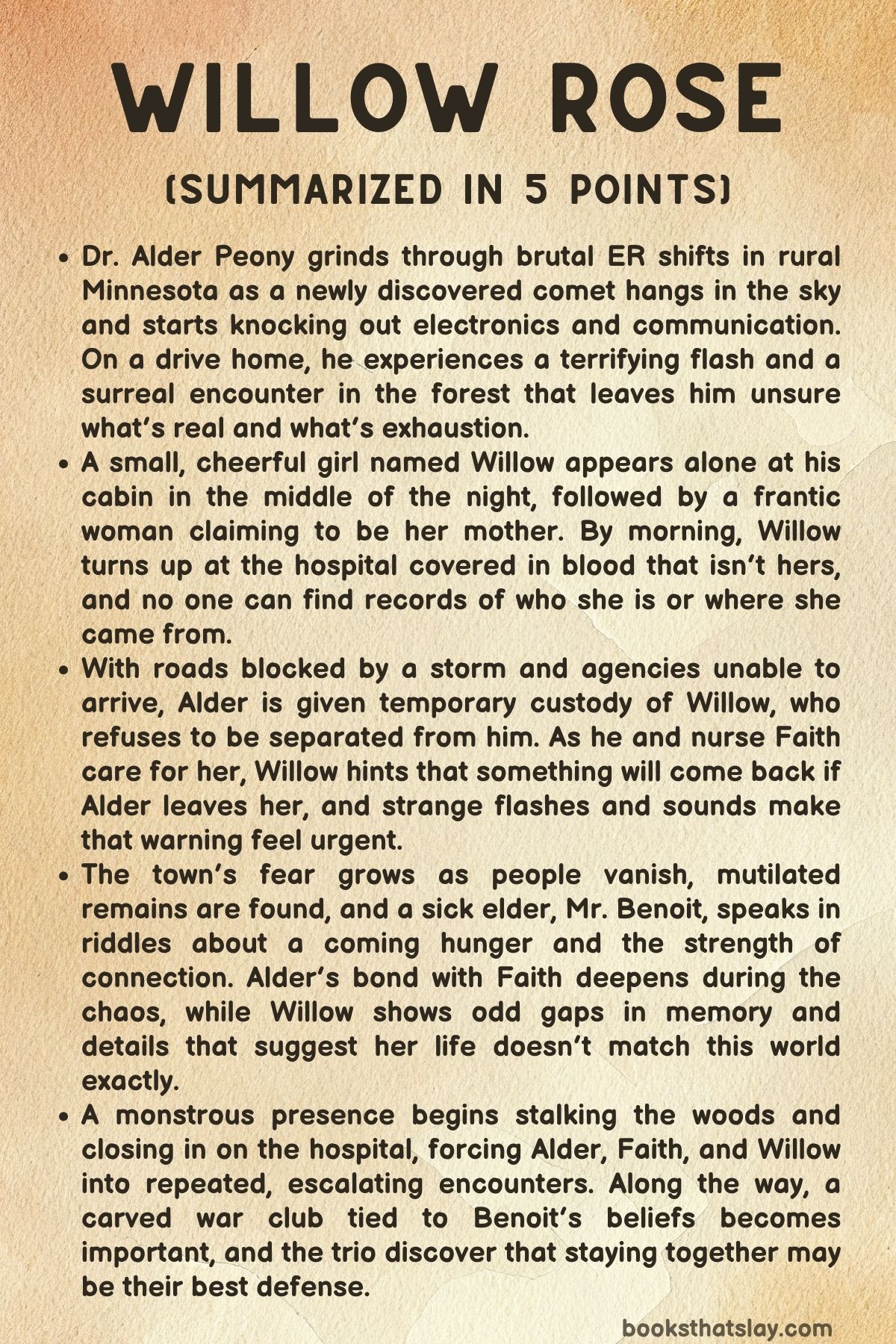
Willow Rose by M Kevin Hayden is a small-town supernatural thriller set in the frozen backroads of Minnesota. Dr. Alder Peony, an exhausted ER physician, is trying to survive punishing shifts at an understaffed rural hospital when an unexpected comet appears and the world’s electronics begin to fail.
Strange flashes, missing people, and a terrifying presence in the woods push Alder past anything he can explain with medicine. Then a cheerful little girl named Willow enters his life, and Alder realizes she may be the key to understanding what’s hunting the town—and what might be coming next.
Summary
Dr. Alder Peony is nearing the end of a brutal twenty-four-hour shift at Morningstar Falls Medical Center, a small rural hospital stretched thin by staffing shortages and harsh winter weather. With only Faith, a steady and capable nurse, beside him through the long night, Alder moves from one crisis to the next while fighting exhaustion and isolation.
In the early morning, a news report interrupts the routine: a massive new comet, C/2005 L3 (Goodwin), has suddenly appeared in the sky. It is visible day and night, and as it grows brighter, electronics and communications across the world begin to glitch or fail.
Alder watches the eerie green smear in the sky and feels a sour unease he can’t name.
After the shift changes, Alder drives home through the forest to his remote cabin. The roads are empty, the trees dark, and the comet seems to stain the snow with a sickly tint.
His radio collapses into static, followed by a strange tearing sound. Then a blinding white flash erupts ahead of him.
A bull elk stands motionless in the road, staring upward. A shockwave hits, his window shatters, and when the light fades the elk lies dead with a clean, bloodless hole in its side.
Seconds later, the animal disappears entirely. Alder’s car and phone die and then come back as if the moment never happened.
He tells himself it was a hallucination caused by fatigue, but the memory sticks like ice under the skin.
Not long after he crawls into bed, Alder wakes to knocking at his door in the deep night. When he looks out, a small blonde girl stands alone in the freezing darkness.
She smiles calmly and introduces herself as Willow. Before Alder can decide what to do, a frantic woman appears from the trees claiming to be Willow’s mother, Clara, and hustles the child away.
Alder lets them go, uneasy and angry with himself for not calling the sheriff, but the storm and the hour make everything feel unreal.
The next day, Alder brings his damaged car to a questionable mechanic, pays too much, and drives back to his cabin with the sense that the woods are listening. That night an inhuman, metallic howl rolls through the forest.
Alder locks himself inside, turns on every light, and tries to drown the silence with music. Even the Emergency Alert System on TV cuts out mid-message, leaving a frozen screen that makes the cabin feel smaller than ever.
At the hospital the following morning, Alder learns the sheriff has brought in a child found wandering in the woods, covered in dried blood. When Alder sees her, his stomach drops: it’s Willow, the same girl from his doorstep.
Willow appears physically fine, even cheerful, but there is no trace of her supposed mother, and deputies have located a cabin soaked in blood with no bodies. There are no records of Willow, no school registration, no report of a missing child that fits her description.
Faith bathes Willow gently while Alder examines her. The results are normal, but the girl’s calmness doesn’t match the horror around her.
Because the snowstorm prevents Child Protective Services from reaching Morningstar Falls, the sheriff grants temporary custody to Alder as the only stable option available. Alder resists, but Willow clings to him and insists she cannot be separated from him.
The hospital staff, including Russ and Vin, quickly warm to her as Willow charms them with her openness and appetite for pancakes. In a rare quiet moment, music plays in the empty ER and everyone briefly lets themselves breathe.
Then another blinding flash hits—Alder senses it even if others don’t—and Willow collapses shaking. When she wakes, she begs Alder not to leave her, warning that if they are apart, something will come back and hurt people.
Almost immediately, a blood-smeared woman staggers into the ER screaming that her husband is missing. When the staff rushes outside, they find only streaks of blood in the snow.
The metallic howl returns, closer, and Alder glimpses a glowing shape in the woods with cold blue points like eyes. He forces everyone back inside.
While he holds Willow, Alder feels an electric warmth flow through him, as if the child is grounding him against the fear outside.
During another stormbound night at the hospital, Alder and Faith talk in the quiet between emergencies, trading jokes and small truths. Their attraction becomes harder to ignore.
A sick Ojibwe elder, Mr. Benoit, arrives delirious with fever and speaks in fragments about trees connected beneath the ground and a dark hunger moving through the world. Once stabilized, he warns Alder that what’s coming feeds on weakness and separation.
His words sound like folklore wrapped in illness, yet they match the pattern Alder has already witnessed.
Alder, Faith, and Willow take shelter together as the town grows more isolated. At a diner run by Mama Curlie, warmth and food offer temporary relief, and Faith reveals parts of her past: a violent marriage, survival, and losses that still haunt her.
Alder begins to see Faith not only as a colleague but as someone who understands what it costs to keep going. Willow, meanwhile, hints that the woman she called “mom” wasn’t truly her mother, and she speaks as if she remembers details that don’t match the world around them.
Back at Alder’s cabin, communications fail further, and the sheriff visits with grim news: mutilated remains have been found near town, and Willow’s blood tests don’t match any known type. The conversation ends when the monster arrives.
It is massive and antlered with glowing blue eyes and a burning maw, and it moves with a force that feels older than reason. Gunshots do nothing.
The creature kills the sheriff and attacks Alder’s home, battering the walls as Alder grabs Willow and tries to protect her. Another flash floods the cabin, and the creature retreats, leaving destruction and silence behind.
Alder tries to flee with Willow, but the car crashes, trapping them in the snowbound woods. The creature returns, hunting them with the same metallic cry.
Alder fights it with bare desperation and is nearly killed, but Willow’s voice and presence seem to disrupt the creature long enough for them to escape to another cabin belonging to Frank Benoit, Mr. Benoit’s son. There, Mr. Benoit identifies the entity as a Windigo, a cursed spirit of hunger and corruption.
He shows Alder a carved war club made from a “twin tree” struck by lightning, a weapon he calls Sarah, and when Alder and Willow touch it they feel heat and power pulse through the wood.
The brief refuge collapses when the Windigo attacks again, killing Frank and Mr. Benoit. Alder and Willow race back toward the hospital to find Faith.
Inside, Alder’s injuries worsen, and a CT scan reveals bleeding in his brain. Before they can act, the Windigo smashes into the hospital, kills the technician, and drags Alder through the halls, forcing him to watch Faith suffer as it feeds on fear and despair.
Russ, still alive, strikes the creature with the glowing club and pulls Alder to safety, but the fight isn’t finished.
Faith takes the weapon and faces the Windigo head-on. Fueled by fury, love, and the refusal to lose more, she drives the club through the creature’s skull.
The Windigo collapses and disintegrates into black sand, as if its body cannot hold together without what it consumes. Faith falls from exhaustion, and Alder and Willow reach her just before everything goes dark.
Emergency crews eventually extract them and transport them to safety. Alder survives surgery and wakes to find Willow safe and Faith recovering.
In the months that follow, the three form something close to a family, bound not only by trauma but by the strange current Willow seems to carry. As they prepare to return to Chicago, news continues to report unsettling global disturbances linked to the comet.
At the airport, a familiar green flicker appears again, and Alder feels that same electric warmth—suggesting the threat may not be finished, and that staying connected might be the only real protection they have.
Characters
Dr. Alder Peony
Dr. Alder Peony stands as the emotional and thematic core of Willow Rose. A weary emergency physician stationed in the isolated town of Morningstar Falls, Alder is portrayed as a man crushed by fatigue and loneliness, yet anchored by an unyielding sense of duty.
His exhaustion reflects not only the physical toll of endless hospital shifts but also the existential weight of disconnection—from people, from faith, and from his own sense of belonging. At the novel’s beginning, Alder’s cynicism and emotional detachment serve as armor against a world that has left him hollow.
However, the arrival of the mysterious comet, the appearance of the supernatural child Willow, and his encounters with the monstrous Windigo force him into an internal reckoning. His rational, scientific worldview clashes with the inexplicable events surrounding him, pushing him to confront both his trauma and his suppressed spirituality.
As the story unfolds, Alder evolves from a detached observer to a compassionate protector, embodying a rediscovery of empathy, courage, and connection. His bond with Willow and Faith becomes his salvation, transforming him into a symbol of resilience and human warmth in the face of cosmic dread.
Faith
Faith, the nurse at Morningstar Falls Medical Center, represents endurance born from suffering. Beneath her calm, nurturing exterior lies a woman shaped by trauma—a survivor of domestic abuse, infertility, and loss.
Her backstory of violence and resilience infuses her with emotional depth, revealing a strength that is both tender and unbreakable. Faith’s kindness toward patients and her gentle humor mask the scars she carries, but her vulnerability becomes her greatest strength as she learns to trust again.
Her relationship with Alder unfolds with delicate pacing, grounded in mutual understanding rather than idealized romance. She functions as both a healer and a guardian, bridging the human and the spiritual realms when the Windigo threatens their world.
By the novel’s climax, Faith becomes the embodiment of empowerment: wielding the ancestral war club, she conquers the very embodiment of corruption and hunger. Through her transformation from victim to warrior, Faith symbolizes the reclamation of agency and the redemptive power of love and compassion.
Willow
Willow is the enigmatic heart of Willow Rose, both child and mystery. At first glance, she seems like an innocent seven-year-old girl—lost, bloodied, and frightened.
Yet her calm demeanor and otherworldly awareness hint at something beyond human understanding. Her inexplicable presence, untraceable origins, and cryptic knowledge connect her directly to the comet and the Windigo’s awakening.
Willow’s duality—half child, half celestial being—embodies the novel’s tension between innocence and cosmic power. Her bond with Alder is profound, reflecting a father-daughter dynamic infused with spiritual resonance.
She functions as a catalyst for his transformation, guiding him toward empathy and courage even as she struggles with her fragmented identity. Willow’s mysterious energy and connection to the “twin trees” prophecy position her as both protector and key to balance between worlds.
By the end, she becomes the symbol of renewal—a bridge between human frailty and the eternal cycle of nature, memory, and rebirth.
Sheriff Tom
Sheriff Tom represents the voice of grounded reason within the chaos engulfing Morningstar Falls. His pragmatic approach to the strange events contrasts sharply with Alder’s growing spiritual unease.
A man of quiet integrity and small-town decency, Tom is the kind of lawman who believes in the tangible—the blood, the tracks, the evidence. Yet his death at the claws of the Windigo marks the tragic collapse of human order before the incomprehensible.
His relationship with Alder is one of mutual respect, and his attempts to maintain control in a disintegrating reality underscore the futility of rationality against mythic forces. Tom’s brutal demise serves as both a narrative turning point and a thematic warning—that denial of the unseen can lead to destruction.
His courage and humanity, however, linger as echoes in Alder’s eventual acceptance of his own role as protector.
Mr. Benoit
Mr. Benoit, the Ojibwe elder, serves as the spiritual compass of the novel. His cryptic visions and teachings about the “twin trees” and the interconnectedness of all living things ground Willow Rose in Native cosmology and ecological wisdom.
Though dismissed initially as a delirious old man, Benoit’s insight into the Windigo’s nature reveals him as a bearer of ancient knowledge bridging myth and reality. His belief in balance, his reverence for ancestral spirits, and his symbolic gifting of the war club “Sarah” transform him into a messenger of unity.
Benoit’s death, though tragic, completes his role as a guide—his spirit lives on through the weapon and through the lessons he imparts to Alder and Faith. In many ways, he represents the conscience of the story, reminding the modern world of the costs of disconnection from the sacred rhythms of the earth.
Mama Curlie
Mama Curlie is the novel’s beacon of warmth and community. As the owner of the local diner, she nurtures Morningstar Falls with humor, food, and motherly care.
Her presence evokes a nostalgia for small-town solidarity, a safe haven against the chaos of the outside world. Beneath her jovial exterior lies quiet wisdom; her advice to Alder about deserving happiness is a turning point in his emotional journey.
Her tragic death during the Windigo’s attack shatters the illusion of safety, symbolizing the death of innocence within the community. Yet her influence endures through Faith, who carries forward her compassion and strength.
Mama Curlie’s legacy is one of unconditional love—the kind that nourishes even in the darkest of times.
Russ
Russ, the young orderly at the hospital, provides the story’s youthful optimism and moral courage. His easygoing demeanor and loyalty to Faith and Alder make him an emblem of hope amid despair.
Initially a secondary figure, Russ evolves into a quiet hero, surviving the Windigo’s attack and returning in the climax to strike the creature with the war club. His unexpected bravery reinforces the novel’s central theme: that courage often arises from ordinary hearts.
Through Russ, Willow Rose emphasizes that connection and solidarity—not strength or knowledge alone—are what truly vanquish darkness.
In Willow Rose, each character functions not merely as an individual but as part of a living system of interconnected souls. The weary doctor, the resilient nurse, the mystical child, the wise elder, and the everyday townsfolk all converge to form a tapestry of survival and redemption.
Through their intertwined fates, the novel asserts that the true miracle lies not in divine intervention but in human connection—the shared heartbeat that endures even beneath a comet-lit sky.
Themes
Cosmic disruption and the fear of a world losing its rules
A twenty-four-hour ER shift already puts life in a fragile state, but the arrival of Comet Goodwin shifts fragility into something larger and harder to name. The comet isn’t presented as a distant astronomical event; it behaves like a pressure on reality itself, showing up with no warning, dominating the sky day and night, and triggering breakdowns in electronics, travel, and communication.
That matters because modern life depends on those systems to create a sense of continuity. When phones die and signals collapse into static, it is not only inconvenient, it removes the reassuring idea that help is reachable, that explanations will be available, and that tomorrow will follow normal patterns.
Alder’s exhaustion initially offers a rational excuse for what he sees—white flashes, a bull elk that appears “frozen,” a bloodless wound, and then the elk vanishing—yet the story repeatedly undermines the comfort of calling it a hallucination. The same kind of flash returns at the hospital and affects Willow physically, even when no one else registers it.
That repetition creates a theme where the cosmos is not neutral background; it becomes an active force that changes what is possible. The dread Alder feels under the comet’s green tail is not just personal anxiety, it is a response to the sense that the world’s ordinary safeguards—science, routine, and even geography—are no longer dependable.
The snowstorm trapping CPS and cutting off access becomes an extension of that disruption: natural weather and cosmic disturbance combine to isolate a community until myths can operate like facts. In Willow Rose, terror grows from the idea that reality can be altered without warning, and that human preparedness—credentials, technology, institutional procedures—may not matter when the sky itself is the trigger.
Isolation versus connection as a survival requirement
Alder begins as someone who functions through endurance: long shifts, sparse staffing, a remote cabin, and an emotional life defined more by coping than belonging. That baseline isolation is not painted as dramatic loneliness; it is shown through small details—driving alone through a silent forest, eating and sleeping in a cabin that is safe mainly because it is far from people, and returning to work because work is structure.
The story then pushes him into forced connection through Willow’s arrival. Her insistence that staying together prevents “it” from coming back changes connection from a nice emotional goal into a survival rule.
The town’s conditions reinforce this: CPS cannot arrive, roads are buried, communications fail, and the usual systems that would separate personal responsibility from community responsibility stop functioning. Alder is compelled to hold a role that is not part of his job description—guardian, protector, emotional anchor—while still being a doctor expected to act decisively in crisis.
Faith’s presence strengthens this theme because her bond with Alder grows in the same space where trauma is treated. Their flirtation is not decorative romance; it becomes a test of whether two exhausted people can risk closeness without being swallowed by fear.
The book repeatedly frames connection as something that creates warmth—sometimes literally, when Alder feels an electric warmth flowing through him as he holds Willow close—and also as something that organizes courage. Mr. Benoit’s imagery of trees sharing roots gives language to this idea: strength exists underground, in shared systems that are unseen but real.
In practice, Alder’s survival depends on other people stepping in—Faith preparing clothes and a booster seat, Russ staying present even when danger escalates, and later Frank and Benoit providing shelter and knowledge. Even the final movement toward becoming a family suggests that connection is not a sentimental reward after horror; it is the antidote to a threat that feeds on isolation.
In Willow Rose, separation is treated as vulnerability, while chosen closeness becomes an active strategy against forces that want individuals cornered and alone.
Care as a moral burden in a collapsing system
Emergency medicine already carries an emotional cost, and Alder’s fatigue is not only physical. He is working inside an understaffed hospital where two people cover an entire night, and the first scenes establish how care can be both necessary and dehumanizing: a constipated patient’s gratitude becomes comic relief, but it also shows how thin the line is between meaningful healing and grinding routine.
When the comet disrupts travel, Alder’s medical decisions gain extra weight because standard options—air transport, reliable communications, quick transfers—are removed. This theme deepens when Willow enters the hospital as a found child covered in blood but physically unharmed.
Alder’s responsibility shifts from clinical care to ethical care: what does he owe a child with no records, no family verification, and signs that something is profoundly wrong? The sheriff granting temporary custody is not a neat bureaucratic solution; it is a system improvising under stress.
Alder’s earlier self-reproach for not calling the sheriff after Willow appeared at his door also highlights how moral judgment becomes harsher when people are tired and alone. Faith adds another layer because she represents care as both professional skill and personal repair.
Her story—abuse, infertility, a foster son taken away—shows care as something that can be punished by life even when it is done well. Her baking as therapy positions care as creation: producing comfort where pain existed, choosing to make something gentle in a world that was not gentle to her.
When violence arrives, the theme becomes sharper: treating wounds and calming victims is still required, but the caregivers themselves become targets. The hospital, usually a place of safety, turns into a hunting ground when the Windigo breaches its doors.
Alder being dragged through hallways and forced to watch Faith’s suffering turns care into helplessness, the nightmare version of a healer’s identity. Yet the story also suggests that care produces power, not in a simplistic sense, but as resilience built through repeated choices to protect others.
Faith’s decision to stand between the creature and the people she loves becomes the ultimate expression of the caregiver role: she does not stop being a nurse when the rules collapse; she expands what “care” means to include direct confrontation with harm. In Willow Rose, the moral burden of caregiving is that it never ends when disaster starts—it intensifies—and it demands both tenderness and ferocity from the same hands.
Trauma, guilt, and the way the past can be used against you
The characters do not enter the story as blank slates. Faith carries the lasting effects of an abusive marriage, infertility, and the loss of a foster child, and those losses shape how she approaches Willow—with preparation, compassion, and a quiet readiness for the child to cling elsewhere because Faith already knows what it feels like to lose a child you tried to protect.
Alder’s loneliness and the hints of his addictions and guilt over his mother’s death place him in a similar category: he is competent, but he is also haunted. The threat they face does not only attack bodies; it attacks emotional weak points.
The Windigo is described as a cursed spirit of hunger and corruption, and the story gives that concept psychological weight by showing how despair becomes food for the creature. When Alder is near death, his memories and shame surface, and the monster’s dominance is tied to that inward collapse.
This turns trauma into more than backstory. It becomes a battlefield inside the characters, where survival depends on not letting old pain define the present moment.
Willow’s trauma is different but equally destabilizing. She appears alone in the freezing night, cheerful in ways that feel wrong, and later reveals that the woman she called “mom” was not really her mother.
Her blood type being “unclassifiable” reinforces that she carries an unsolved history inside her body. The result is a theme where identity itself becomes uncertain under trauma: Willow’s memories come in fragments, and she suggests she might be from another reality where even small details differ.
That disorientation mirrors the cosmic disruption caused by the comet, but it lands personally—she cannot rely on her own past to explain who she is. Healing in the story happens when trauma is faced without denial.
Faith does not pretend her past never happened; she names it, describes it, and shows how she built coping mechanisms that do not erase pain but keep it from controlling her. Alder’s path is similar: he is forced to admit vulnerability, accept help, and recognize that protection cannot be performed purely through willpower.
The end-state—forming a family—does not erase trauma, but it reframes it as something survivable when shared. In Willow Rose, guilt and fear are not treated as private feelings; they are forces that can be exploited by evil, and the counterforce is honest connection that keeps the past from becoming a weapon.
Folklore and spirituality as practical knowledge, not decoration
The story places a modern physician at the center, which sets an expectation of rational explanations. That expectation is intentionally strained.
Alder encounters events that do not fit medical or scientific categories: an elk with a bloodless wound that vanishes, a child with an unclassifiable blood type, flashes of light that behave like triggers, and a creature that kills in ways that resemble predation but exceed biology. Into that gap enters Mr. Benoit’s language about trees sharing roots, warnings about a coming dark force, and the naming of the Windigo.
The theme here is not “science versus superstition” in an argumentative way; it is about which kind of knowledge helps you survive when the environment stops following normal rules. Benoit’s worldview is presented with specificity through objects and practices, not vague mysticism.
The war club carved from a “twin tree” struck by lightning, named Sarah, is tied to ancestry and breath, and when Alder and Willow touch it they feel warmth and power. This matters because it suggests spirituality is embodied—held in wood, memory, naming, and communal belief.
Frank’s explanations provide a bridge that makes these ideas intelligible to outsiders without flattening them into clichés. The hospital staff’s initial skepticism is also realistic: people trained in medicine resist attributing events to spirits.
Yet the story repeatedly shows that folklore is not merely storytelling; it is a category of warning, a framework for understanding patterns of harm, and eventually a guide for action. When Russ strikes the creature with the glowing club, and when Faith uses it to finish the fight, the myth becomes operational.
The weapon is not a magical shortcut; it is a tool that only matters because people choose to stand together and act. Even Alder’s near-death vision of nature and a maternal voice teaching connection suggests that the spiritual dimension of the story is less about spectacle and more about ethics: it points toward how to live, how to withstand fear, and how to align with something larger than personal survival.
In Willow Rose, folklore and spirituality function as an emergency language for crises that lie outside institutional training, offering meanings and methods when modern systems fail and when naming the threat is the first step toward resisting it.