World’s Okayest Oracle (Reluctantly) Seeks Demon Summary, Characters and Themes
World’s Okayest Oracle (Reluctantly) Seeks Demon by Olivia Dade is a paranormal romantic fantasy that combines supernatural politics, conspiracy, humor, and a second-chance love story.
At its center is Gwen Wexloff, an oracle who has spent twenty years believing she failed to live up to her calling, and Hugh Blacke, the half-demon councilor tied to the worst humiliation of her youth. When Gwen’s previously modest prophetic abilities suddenly reveal an approaching interspecies war, the two are forced back into each other’s lives. Their investigation challenges old assumptions about power, worth, family, social status, and the meaning of a useful life. It’s the 2nd book of the Supernatural Entanglements series.
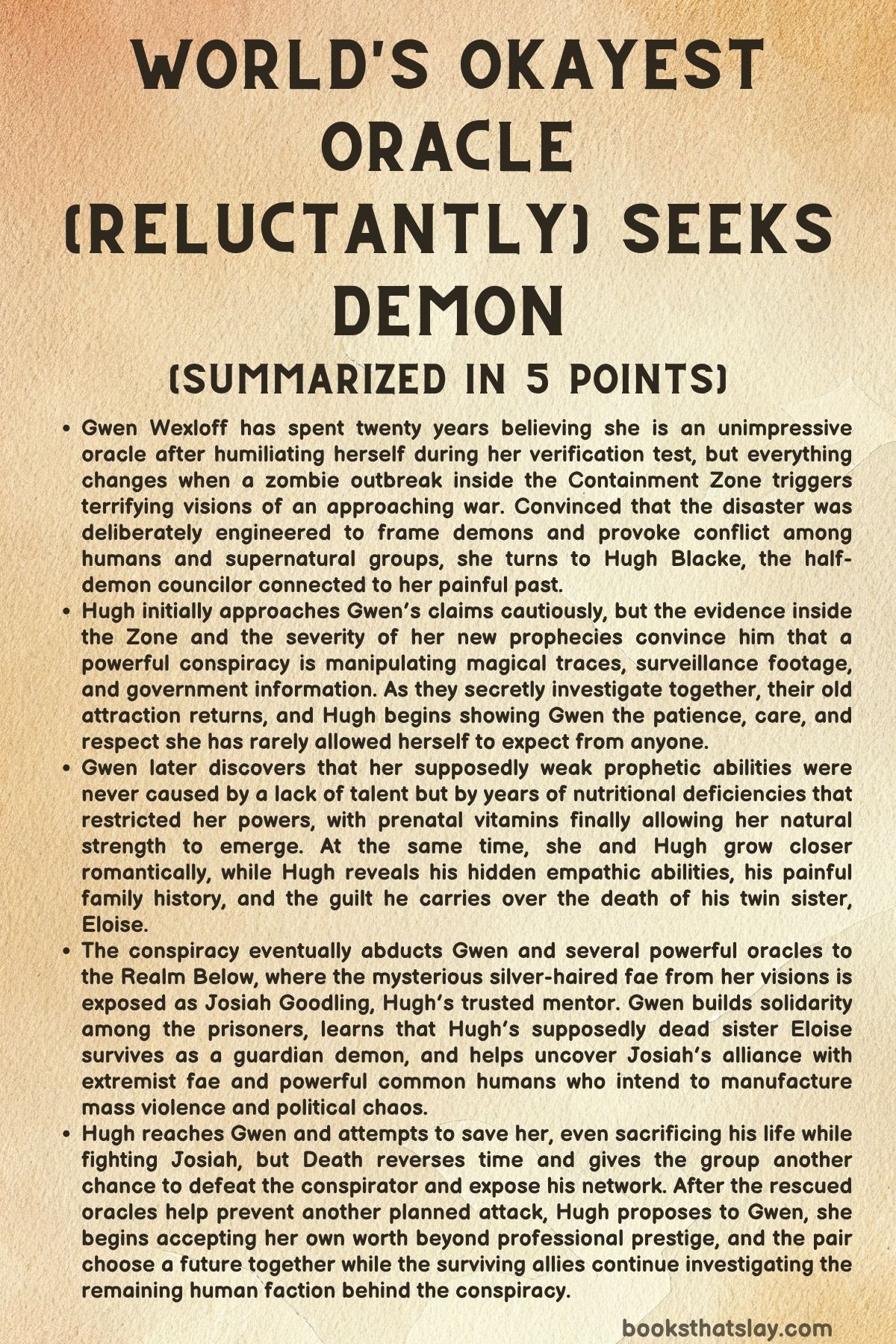
Summary
Twenty years before the central events of World’s Okayest Oracle (Reluctantly) Seeks Demon, eighteen-year-old Gwen Wexloff is waiting to undergo the test that will determine whether she can become a professional oracle. Her abilities have always seemed embarrassingly weak compared with those of her gifted classmates, and failure would feel especially devastating because her struggling family has sacrificed so much for her education.
While waiting, Gwen meets Hugh Blacke, a young man she assumes is connected to the organization supervising the test. She speaks openly with him about Delphi Academy’s cruel rules, her love of books and cheese, and her hopes for the future, even asking him on a date before discovering that he is actually one of the people evaluating her.
Gwen feels deliberately deceived and enters the examination shaken. When her abilities fail her under pressure, she desperately invents a spectacular prophecy based largely on Jurassic Park, humiliating herself before the panel and beginning two decades of professional insecurity.
In the present, Gwen lives inside the Containment Zone, a community populated largely by supernatural and Enhanced residents. A catastrophic zombie outbreak has just occurred there, and Gwen and her friends know the official story is false because the creatures were deliberately released while communications, electrical systems, and protective barriers were manipulated.
More disturbing than the sabotage itself is Gwen’s sudden experience of a massive spontaneous prophecy. After years of producing only small predictions, she sees widespread slaughter involving ordinary humans, Supernaturals, and Enhanced people, with powerful common humans and fae apparently cooperating to engineer a war.
Exhausted, pregnant, and wearing a ridiculous Guy Fieri disguise, Gwen leaves the Zone with the trolls Kip and Lorraine to find the one politically influential person she believes might take her seriously: Hugh Blacke. Hugh is now a respected SERC councilor famous for following procedures, yet Gwen also knows that he once kept his promise to improve Delphi’s treatment of students and families.
Their reunion is awkward but unexpectedly gentle. Hugh gives Gwen food, tea, warmth, and time to recover before questioning her, and when she explains the sabotage, the planted evidence implicating demons, and her terrifying prophecy, he eventually agrees to return secretly to the Zone and examine the situation himself.
Inside the Zone, Hugh sees evidence that the disaster could not have resulted from ordinary mechanical failures. The inner barriers were deliberately opened, communications were cut, and suspicious magical traces appear designed to make demons seem responsible, while other signs suggest fae involvement.
Gwen then suffers another violent vision in which common human military figures and fae leaders openly discuss creating mass bloodshed. The prophecy leaves her physically devastated, but it also convinces Hugh that her warnings must be treated seriously.
Knowing that official investigators could misread the planted brimstone as proof of demonic guilt, Hugh, Kip, and the others create an elaborate distraction. Kip deliberately provokes Hugh into genuine anger so that Hugh releases enough demonic heat and sulfur to contaminate the area, giving investigators an innocent explanation for the supernatural residue.
The deception becomes even more complicated when Hugh and Gwen pretend to be romantically involved. Their staged kiss, however, reveals that the attraction between them is far from artificial.
The group temporarily prevents demons from becoming the official suspects, but surveillance footage appears to show demons releasing the zombies. Max argues that glamours could easily falsify appearances, and the investigators eventually shift public suspicion toward common human agitators rather than supernatural conspirators.
Hugh takes leave from his official responsibilities and becomes the unofficial leader of a secret investigation. Because Gwen’s prophecies are central to identifying the conspiracy, he insists she stay close to him for protection.
As Gwen moves into Hugh’s penthouse, they gradually discover that each has misunderstood the other for years. Hugh sees that Gwen’s supposedly unsuccessful life actually consists of helping neighbors through modest prophecies and barter arrangements, while Gwen discovers that beneath Hugh’s wealth, intimidating reputation, and rigid self-control is a man who cooks, cleans, remembers tiny details about her, and has never forgotten their first meeting.
Their investigation widens when Hugh’s informant Thora reveals extremist activity among the fae. They also learn that several exceptionally powerful oracles have disappeared, suggesting someone may be kidnapping seers either to suppress their predictions or exploit their abilities.
Meanwhile, Gwen and Hugh become increasingly emotionally close. Hugh comforts her after nightmares without trying to control her feelings, remembers her favorite cheese and books from twenty years earlier, and repeatedly demonstrates that her safety matters more to him than appearances.
Their attraction eventually becomes physical, but Hugh remains cautious because Gwen depends on him for protection and shelter. Gwen makes clear that her consent and desire are freely given, allowing the relationship they once almost began as teenagers to develop into something real.
The danger soon reaches Hugh’s home. Gwen experiences a prophecy in which a mysterious silver-haired fae seems able to see her inside the vision and announces that he is coming for her.
Soon afterward, Hugh’s penthouse is deliberately set on fire while he is away. The alarms and sprinklers have been disabled, magical silence prevents others from hearing the danger, and Gwen barely survives after Haziq breaks in and rescues her.
At the hospital, a doctor finally discovers why Gwen’s powers have changed so dramatically. Her prophetic weakness was never proof that she lacked natural ability; years of poverty and poor nutrition had left her deficient in nutrients essential to using her powers, and prenatal vitamins taken during pregnancy have finally allowed her true strength to emerge.
The revelation changes how Gwen understands her entire life. The woman everyone dismissed as an inferior oracle may actually possess extraordinary natural power, while the systems responsible for training her never recognized that deprivation rather than incompetence was limiting her.
The fire also creates a new political problem when investigators suspect Hugh himself because traces of demonic activity were deliberately planted. The fact that Gwen is pregnant becomes public, and Hugh learns about the baby through an official investigation rather than directly from her.
Instead of rejecting Gwen, Hugh makes clear that her child is not an obstacle to their relationship. He begins researching pregnancy and parenting, purchasing items for the baby, and treating the unborn child as someone who already matters to him.
Gwen also discovers that Hugh is an empath. His human father and demon mother produced twins with both demonic traits and Enhanced human abilities, but Hugh’s wealthy family considered his empathy an embarrassing reminder of his human ancestry.
Hugh explains that his twin sister Eloise embraced her empathic abilities while he learned to suppress his own. Eloise eventually became furious with the exploitation protected by her family’s legal business, suffered personal betrayals, confronted powerful people responsible for human deaths, and died during the confrontation.
Hugh has carried enormous guilt ever since. Yet he also admits that he has always been able to sense Gwen emotionally, which means the connection he felt with her during their first meeting was genuine rather than part of the verification process.
Their growing bond strengthens Gwen’s confidence. Hugh repeatedly reminds her that even before her immense abilities emerged, her small predictions mattered because she used them to improve the lives of ordinary people rather than enrich powerful organizations.
Then the investigation turns personal again. A demon suddenly enters Max’s supposedly secure home, immobilizes Gwen, and abducts her.
Gwen awakens in the Realm Below and finally learns the identity of the silver-haired fae haunting her prophecies. The man is Josiah Goodling, Hugh’s trusted mentor, whose extraordinarily powerful glamour has concealed his real species for decades.
Josiah can detect strong oracles when they see him in visions, explaining both the disappearances and the attack on Gwen. His accomplice is Hugh’s mother, Marlee, who entered a binding agreement with Josiah years earlier to restore the Blacke family business after Eloise’s scandal.
Gwen is imprisoned with several abducted oracles, including her former classmate Matilda. Although the prisoners initially exist as frightened individuals, Gwen quickly turns them into a cooperative community that shares food, comfort, information, and plans for survival.
Their combined visions reveal that the conspirators are planning another mass-casualty event, this time at a parade, intending to frame witches and werewolves. Gwen is threatened with death when her prophetic strength fades in captivity, but an unexpected visitor changes everything.
Marlee enters the prison and reveals that she is actually Eloise using a glamour. Eloise survived death in another form and now serves as a guardian demon, and she has discovered Gwen’s location through her continuing empathic connection with Hugh and through her own investigation.
Josiah becomes suspicious and moves the prisoners before Eloise can organize a straightforward rescue. Gwen therefore prepares the oracles to escape on their own, but Hugh reaches their new prison first.
Hugh has entered the Realm Below after receiving information from Eloise through Dottie, the werewolf assigned to Eloise’s protection. His revived empathic abilities have become strong enough for him to locate Gwen emotionally even after the prisoners are moved.
As the group searches for an escape route, Hugh discovers Eloise’s sleeping physical body in a guardian-demon dormitory. Gwen tells him that his sister remembers him, loves him, and is happy in her new existence, giving Hugh the first genuine closure he has had since her death.
Hugh and Gwen also finally admit that they love each other. Their reunion remains dangerous, however, because Josiah has anticipated their escape and controls the demon who was supposed to teleport them to safety.
Josiah offers Hugh a cruel bargain: serve the conspiracy from within SERC, and Gwen and her baby will remain alive as prisoners. Gwen refuses to allow Hugh to sacrifice countless innocent people for her survival.
Hugh attempts to kill Josiah by using an enormous amount of demonic power to expose his heart. Eloise strikes the exposed heart with iron and kills Josiah, but the effort costs Hugh his own life.
Gwen tries desperately to revive him before Death and the Fates appear. Death, irritated by the disorder in his realm, reveals that Hugh once supported funding for an administrative project and therefore owes him a favor.
He reverses time.
Hugh returns to life, and Josiah is placed before Death’s court. After one of the Fates kills him in a legally acceptable manner, he is compelled to confess the full conspiracy.
An elite fae faction had allied itself with extremist members of the common human government to create a war against Supernaturals and Enhanced humans. The fae eventually intended to betray their human partners, rule those who survived, and extend their lives by consuming human lifespans.
Because the rescued oracles now know enough about the planned parade attack, authorities can prevent it. Josiah also identifies many supernatural and human conspirators, allowing Hugh and his allies to begin dismantling the network.
Hugh decides that his mother must face the consequences of her involvement and cuts himself free from the destructive expectations of the Blacke family. He also receives a proper farewell from Eloise, who assures him that their emotional connection will survive their physical separation.
Afterward, Hugh asks Gwen to marry him. Her first instinct is to believe that she cannot possibly be enough for someone with his money, status, and power, but Hugh refuses the standards by which she has spent her life judging herself.
He wants her love, her community, her honesty, her child, and the imperfect but meaningful life they can build together. Gwen finally accepts both his proposal and the larger truth that her value never depended on becoming the kind of oracle Delphi taught her to admire.
In the aftermath, the known fae conspirators and supernatural accomplices are arrested, while Gwen begins organizing the rescued seers into something resembling an oracle union. The extremist common human faction remains active, however, leading Hugh to send Thora and the unexpectedly clever Kip undercover to continue investigating the threat.
Characters
Gwen Wexloff
Gwen is the emotional and moral center of World’s Okayest Oracle (Reluctantly) Seeks Demon, and much of her development concerns the difference between being considered impressive and actually being valuable. For twenty years, she defines herself through the humiliation of her failed verification test, believing that her weak prophecies prove she has wasted her education and disappointed everyone who sacrificed for her.
Her life, however, repeatedly contradicts that judgment. Gwen uses modest predictions to help neighbors who cannot afford elite services, builds barter relationships inside the Containment Zone, cares for frightened people under pressure, and instinctively creates communities wherever she goes.
The discovery that nutritional deficiencies suppressed her powers is important because it exposes how deeply class and circumstance shaped what others interpreted as personal inadequacy. Yet Gwen’s growth does not depend solely on discovering that she is secretly powerful; she must also recognize that the life she built before that discovery already had meaning.
Her imprisonment in the Realm Below demonstrates her greatest strength. Surrounded by frightened oracles trained to compete and remain isolated, Gwen turns them into a cooperative group capable of caring for one another and planning resistance.
Romantically, Gwen learns to accept care without assuming that receiving it makes her weak or indebted. Her relationship with Hugh ultimately helps her understand that love does not require her to become richer, more prestigious, or more spectacular than she already is.
Hugh Blacke
Hugh is the disciplined, intimidating counterpart to Gwen in World’s Okayest Oracle (Reluctantly) Seeks Demon, but his controlled exterior hides a man shaped by emotional sensitivity, family shame, and years of suppressed grief. His devotion to rules initially makes him cautious about Gwen’s conspiracy claims, yet once he sees enough evidence, that same seriousness turns him into a determined investigator.
His empathic ability explains much of his personality. Growing up among people whose anger, greed, judgment, and social ambition he could constantly sense made emotional connection painful, so Hugh learned to close himself off instead of developing the talent openly.
The death of Eloise intensified this tendency. Hugh carries guilt for failing to stop his sister’s decline even though the forces that hurt her were far larger than anything he could control, and his parents reinforce that guilt rather than helping him process it.
Gwen gradually gives Hugh permission to exist outside his family’s standards. Around her, he can display his natural demonic features, acknowledge his empathy, choose love over reputation, and reject the Blacke family’s obsession with appearances.
His willingness to accept Gwen’s unborn child is also central to his character. He does not treat the baby as a complication to tolerate but begins caring about the child as part of the future he wants with Gwen.
Eloise Blacke
Eloise gives World’s Okayest Oracle (Reluctantly) Seeks Demon one of its most complicated examinations of anger, justice, and emotional sensitivity. Like Hugh, she is both half demon and empath, but instead of suppressing her ability, she actively embraced emotional connection.
That openness made Eloise unusually aware of suffering around her. Working within the Blacke family law firm exposed her to wealthy clients who could use contracts and influence to harm vulnerable people without meaningful consequences, gradually transforming frustration into fury.
Her personal relationships deepened that disillusionment. Relatives exploited her desire to reconnect with her human heritage, her husband betrayed her, and her family environment offered status without genuine emotional safety.
Her death therefore becomes both a tragedy and a warning about what happens when moral outrage is combined with isolation and despair. Hugh spends years fearing that her final actions defined her, only to discover that Eloise has continued growing after death as a guardian demon.
Her return gives Hugh the closure he was denied. Eloise also becomes decisive in rescuing the captive oracles and confronting Josiah, proving that her fierce refusal to ignore injustice survives without consuming her entire identity.
Josiah Goodling
Josiah is the central antagonist of World’s Okayest Oracle (Reluctantly) Seeks Demon, and his effectiveness comes from the enormous gap between the trustworthy identity he performs and the person he actually is. For years, he appears to Hugh as a respected mentor and political ally, using glamour, institutional credibility, and patience to conceal his true nature.
His conspiracy depends on controlling perception. Demons are framed for the zombie attack, surveillance footage is manipulated, supernatural traces are planted, government communications are falsified, and later attacks are designed to blame additional groups.
Josiah also treats prophetic ability as a resource to possess rather than a gift belonging to individual people. He kidnaps powerful oracles, isolates them, starves them of meaningful support, and forces them to produce information for his political project.
His ability to detect oracles through visions makes him unusually dangerous, but Gwen ultimately challenges the worldview behind that power. Josiah believes control flows downward from powerful individuals, while Gwen repeatedly proves that cooperation can make supposedly weaker people far harder to dominate.
His exposure also devastates Hugh because Josiah had occupied a role of trust after Eloise’s death. The betrayal demonstrates how successfully institutional respectability can conceal destructive ambition.
Kip
Kip supplies much of the comic energy in World’s Okayest Oracle (Reluctantly) Seeks Demon, but the story gradually reveals that humor and apparent foolishness are only part of his identity. His friendship with Gwen is loyal, practical, and fearless, particularly during the early attempt to protect the Zone from being blamed for the zombie disaster.
The staged confrontation with Hugh shows Kip’s willingness to look ridiculous if doing so protects others. He deliberately insults and provokes Hugh until genuine demonic anger creates enough sulfurous evidence to explain the suspicious traces at the crime scene.
The epilogue adds another dimension by revealing that trolls have intentionally allowed other species to underestimate their intelligence. Kip may behave chaotically and enjoy absurd bargains involving food, yet Hugh recognizes him as clever enough for a dangerous undercover assignment.
His character therefore fits the novel’s larger rejection of surface judgments. Just as Gwen is more capable than her professional reputation suggests, Kip is more intelligent and strategically useful than outsiders assume.
Lorraine
Lorraine is one of Gwen’s troll companions and represents the dependable social network Gwen has built inside the Containment Zone. She accompanies Gwen during the dangerous journey to reach Hugh and participates in the group’s efforts to protect both Gwen and the wider community.
Her presence also reinforces the warmth and irreverence surrounding Gwen’s friendships. Lorraine and Kip treat Hugh’s intimidating public reputation with very little reverence, which helps expose the difference between the feared councilor known to outsiders and the awkward, caring man Gwen gradually rediscovers.
Although Lorraine does not drive the central political investigation, she is part of the stable community that makes Gwen’s life meaningful. Characters such as Lorraine matter because they show that Gwen’s supposed professional failure has not left her isolated or useless; she has created durable relationships based on mutual loyalty.
Max
Max is one of the group’s most important practical allies. He provides a hidden underground home when Hugh’s penthouse is destroyed and when the investigation becomes dangerous enough that ordinary residences can no longer be trusted.
His protectiveness toward Edie parallels Hugh’s treatment of Gwen. Both men can become intensely focused on the safety of the people they love, although Max is already comfortable showing that devotion while Hugh is still learning how openly he can express emotional attachment.
Max also contributes important skepticism when surveillance footage appears to implicate demons. His recognition that glamours could falsify appearances helps prevent the conspiracy from controlling the official narrative.
His role demonstrates how the investigation succeeds because people with different forms of knowledge cooperate. Legal authority, prophecy, supernatural experience, community knowledge, and practical resources all become necessary.
Edie
Edie survives the zombie disaster with serious injuries, making her one of the clearest reminders that the conspiracy produces consequences long before its full political objective is understood. Her recovery also reveals Max’s devotion and the strength of the group’s personal bonds.
Gwen’s later decision to provide Edie and Max with a prophetic session is significant because the predictions are ordinary rather than world-changing. She sees problems involving soap making, furniture, appearance, and other domestic matters, then apologizes because she still believes small predictions are somehow inferior.
Through Edie, the story demonstrates why ordinary life matters. Preventing inconvenience, embarrassment, financial waste, or frustration may lack political grandeur, but those outcomes directly improve the experience of real people.
Thora Creekwood
Thora is a half-fae operative working secretly for Hugh inside extremist fae circles. Her controlled manner reflects the constant danger of living under cover, where one mistake could expose not only herself but the larger investigation.
She initially feels responsible for failing to uncover the zombie plot, revealing how seriously she takes her role. Gwen immediately rejects that self-blame, recognizing that no single operative could possibly learn every secret inside a large extremist network.
Thora’s continuing importance after Josiah’s defeat shows that destroying one conspiracy leader does not automatically destroy the ideology or political alliances surrounding him. Hugh therefore sends her toward the remaining common human faction, this time paired with Kip rather than forced to operate completely alone.
Marlee Blacke
Marlee is one of the novel’s clearest examples of what happens when family loyalty becomes indistinguishable from loyalty to status. She presents her cooperation with Josiah as something done to protect the Blacke family, but her choices repeatedly prioritize reputation, wealth, and institutional survival over the lives of others.
Her binding bargain places both herself and Timothy in danger, which gives her decisions a degree of understandable fear. Even so, she continues enabling kidnapping, attempted murder, and a conspiracy capable of producing enormous casualties.
Her relationship with Hugh becomes particularly revealing during the apartment scandal. Instead of focusing primarily on whether Gwen is safe or whether her son has been falsely accused, Marlee worries about the effect on the family name and business.
Hugh’s eventual decision to cut contact with her marks an important stage in his development. He stops allowing blood ties to excuse behavior that violates his own moral standards.
Haziq
Haziq begins as the cautious doorman protecting access to Hugh’s building, but he becomes a genuine hero when Gwen is trapped during the apartment fire. He enters a dangerous environment and saves her despite the magical protections and sabotage surrounding the attack.
His rescue also illustrates the value of Gwen’s community relationships. Gwen gains his trust partly through her connection to Farhanah, and those ordinary neighborhood ties ultimately help save her life.
Hugh’s response to Haziq further reveals Hugh’s priorities. He makes sure Haziq receives recognition and that his family knows he is safe, treating the doorman’s courage as something deserving real respect rather than as a service owed to wealthy residents.
Farhanah
Farhanah is Gwen’s neighbor and one of the people who make the Containment Zone feel like a genuine community rather than merely an inexpensive place to live. She understands Gwen through years of ordinary interaction rather than through institutional judgments about the quality of her prophetic powers.
She also contributes materially to the investigation when information from her daughter reveals suspicious purchases of abandoned Zone property by a secretive fae buyer. What seems at first like neighborhood gossip becomes a clue connecting political violence with economic opportunity.
Farhanah’s suspicion that Hugh might be ashamed of Gwen also forces him to state publicly that Gwen is his girlfriend. Her protectiveness reflects the social support Gwen has earned by consistently helping the people around her.
Sabrina and Starla
Sabrina is a witch whose magical abilities repeatedly assist the group, from treating injuries to removing misleading traces at the zombie scene. Her work makes her an important technical counterweight to a conspiracy that constantly relies on manipulated magical evidence.
Starla, Sabrina’s telepathic wife, contributes information and coordination when ordinary communication systems cannot be trusted. Their relationship also broadens the supernatural community surrounding Gwen and shows how many different abilities become necessary once powerful institutions themselves may be compromised.
Together, they represent cooperation across supernatural identities. The conspiracy wants species to mistrust one another, while Sabrina, Starla, Gwen, Hugh, trolls, demons, werewolves, and others repeatedly survive by sharing knowledge.
Matilda Tinley
Matilda is one of Gwen’s former classmates and one of the kidnapped oracles imprisoned in the Realm Below. Her presence gives Gwen a direct connection to the elite prophetic world that once made her feel inadequate.
Matilda’s visions repeatedly show possible versions of Gwen’s death, making her valuable to the group but also demonstrating the psychological burden carried by powerful seers. Prophecy does not guarantee control; knowing possible futures can produce fear without offering an obvious solution.
Her eventual cooperation with Gwen also challenges the competitive culture surrounding oracles. Captivity becomes the setting in which people trained to operate separately begin discovering the strength of collective action.
Death
Death appears late in the story but radically changes its direction. Rather than functioning as a solemn abstraction, he is portrayed as an irritated administrator dealing with supernatural chaos inside a realm governed by rules, obligations, and bureaucratic procedures.
His decision to reverse Hugh’s death is humorous on the surface, yet it also rewards a form of civic responsibility Hugh never expected to matter personally. Hugh’s previous support for funding the Realm Below’s digitization project becomes the unlikely reason Death is willing to intervene.
Death also forces Josiah into a system where concealment becomes impossible. Once the technical problem of jurisdiction is resolved, Josiah must answer questions truthfully, allowing the group to expose the conspiracy.
The Fates
The Fates operate alongside Death and embody the strange combination of cosmic power and procedural logic that governs the Realm Below. Their intervention ensures that Josiah can be brought legally under Death’s authority.
One Fate transforms Eloise’s weapon into iron scissors and kills Josiah, resolving the jurisdictional obstacle with a solution that is both brutal and absurd. Their presence reinforces the novel’s comic approach to supernatural institutions while still allowing those institutions to carry serious consequences.
General Blair Herka and Micah Cartwright
General Blair Herka represents the unsettling possibility that parts of the common human military establishment may be connected to the conspiracy. Her presence around the investigation and association with Josiah create suspicion, although the available evidence does not establish the full extent of her personal involvement.
Micah Cartwright becomes more directly significant when Gwen recognizes him from her apocalyptic visions. His disappearance before he can be located strengthens the group’s belief that powerful common humans are cooperating with supernatural extremists and receiving warnings from inside influential institutions.
Together, these figures expand the threat beyond one supernatural faction. The conflict is not simply humans against Supernaturals or fae against demons but a secret partnership among powerful actors willing to manufacture hatred for political purposes.
Themes
Self-Worth Beyond Achievement
World’s Okayest Oracle (Reluctantly) Seeks Demon repeatedly challenges the belief that a person’s worth can be measured by prestige, exceptional talent, wealth, or institutional approval. Gwen spends two decades convinced that she is a failed oracle because her prophecies lack the impressive scale expected by Delphi Academy and the professional world that trained her.
The discovery that malnutrition suppressed her natural abilities changes the facts of Gwen’s history, but it does not provide the complete emotional solution. If Gwen only learned to respect herself because she turned out to possess immense power, the story would simply replace one achievement-based hierarchy with another.
Hugh therefore emphasizes something more important: Gwen’s smaller prophecies had always mattered because she used them to help people who lacked money, influence, and access. She prevented ordinary problems, supported neighbors, traded predictions for necessities, and used what she had rather than waiting until she could become extraordinary by someone else’s standards.
Her final growth comes from accepting that usefulness is not the same as spectacle. She can be powerful without needing power to justify her existence, and she can receive love without first proving that she deserves it through exceptional achievement.
Community Versus Isolation
Isolation repeatedly makes characters vulnerable, while cooperation gives them forms of power that individual ability cannot provide. Gwen’s strongest talent may not actually be prophecy but her instinct for creating communities in places where people have been taught to function alone.
The captive oracles provide the clearest example. They enter imprisonment as frightened individuals but gradually begin sharing food, caring for the sick, discussing visions, comforting one another after nightmares, and planning escape collectively because Gwen creates the conditions for trust.
The same pattern already exists in Gwen’s ordinary life. Her neighborhood relationships, barter system, friendships with trolls, connections with witches, and willingness to help people without demanding status in return create a social network that repeatedly becomes practically valuable.
The conspirators operate through secrecy, compartmentalization, fear, manipulation, and mistrust between species. Gwen’s side succeeds through the opposite principles: demons, trolls, witches, werewolves, Enhanced humans, oracles, and ordinary people pool their abilities.
The theme also explains why the possibility of an oracle union matters at the end. Organizing seers collectively could prevent powerful institutions from isolating, exploiting, or controlling them in the future.
Family, Love, and Chosen Loyalty
Family in World’s Okayest Oracle (Reluctantly) Seeks Demon is presented as something far more complicated than biological connection. Hugh’s relatives possess wealth, influence, and social standing, yet much of his pain comes from a family structure that values reputation more consistently than emotional honesty.
Marlee hides the truth of her demonic identity from Timothy, disguises her children, pressures Hugh to conform, and eventually helps Josiah because she believes preserving the Blacke family’s status justifies terrible compromises. Hugh’s parents also allow him to carry disproportionate guilt for Eloise’s suffering instead of helping him mourn.
By contrast, Hugh’s bond with Gwen develops through freely chosen care. He remembers her preferences, protects her without treating her as helpless, respects her consent, values her community, and accepts her unborn child before being given any formal role in the baby’s life.
Eloise’s continuing empathic connection with Hugh provides another version of genuine family loyalty. Even after death, she searches for him, follows his life, assists Gwen, and eventually gives Hugh the chance to hear that their bond survived everything that separated them.
The novel therefore separates family from possession or obligation. The relationships that heal its characters are the ones in which love allows people to be fully themselves.
Prejudice, Manipulation, and Political Fear
The conspiracy depends on understanding how easily fear can be directed toward groups that society already views with suspicion. Rather than openly starting a war, Josiah and his allies manufacture evidence designed to make different supernatural communities appear responsible for atrocities.
Demons are framed through brimstone, glamour, and altered surveillance footage. When that attempt begins to fail, the conspirators prepare another attack meant to implicate witches and werewolves, demonstrating that the specific target matters less than the ability to produce public anger.
This strategy works because existing prejudice provides fertile ground for false narratives. Hugh’s demonic identity makes investigators willing to consider him capable of burning his own home, while social divisions make fabricated evidence against an entire species politically useful.
The alliance between extremist fae and powerful common humans adds another layer. The groups cooperate temporarily despite different ultimate goals because each believes fear and violence can increase its own power.
Against that strategy, the protagonists rely on evidence, cross-species cooperation, and personal trust. The story suggests that prejudice becomes most dangerous when institutions, political ambition, and manipulated information reinforce one another, while solidarity makes those divisions harder to exploit.