You Will Pay Summary, Characters and Themes
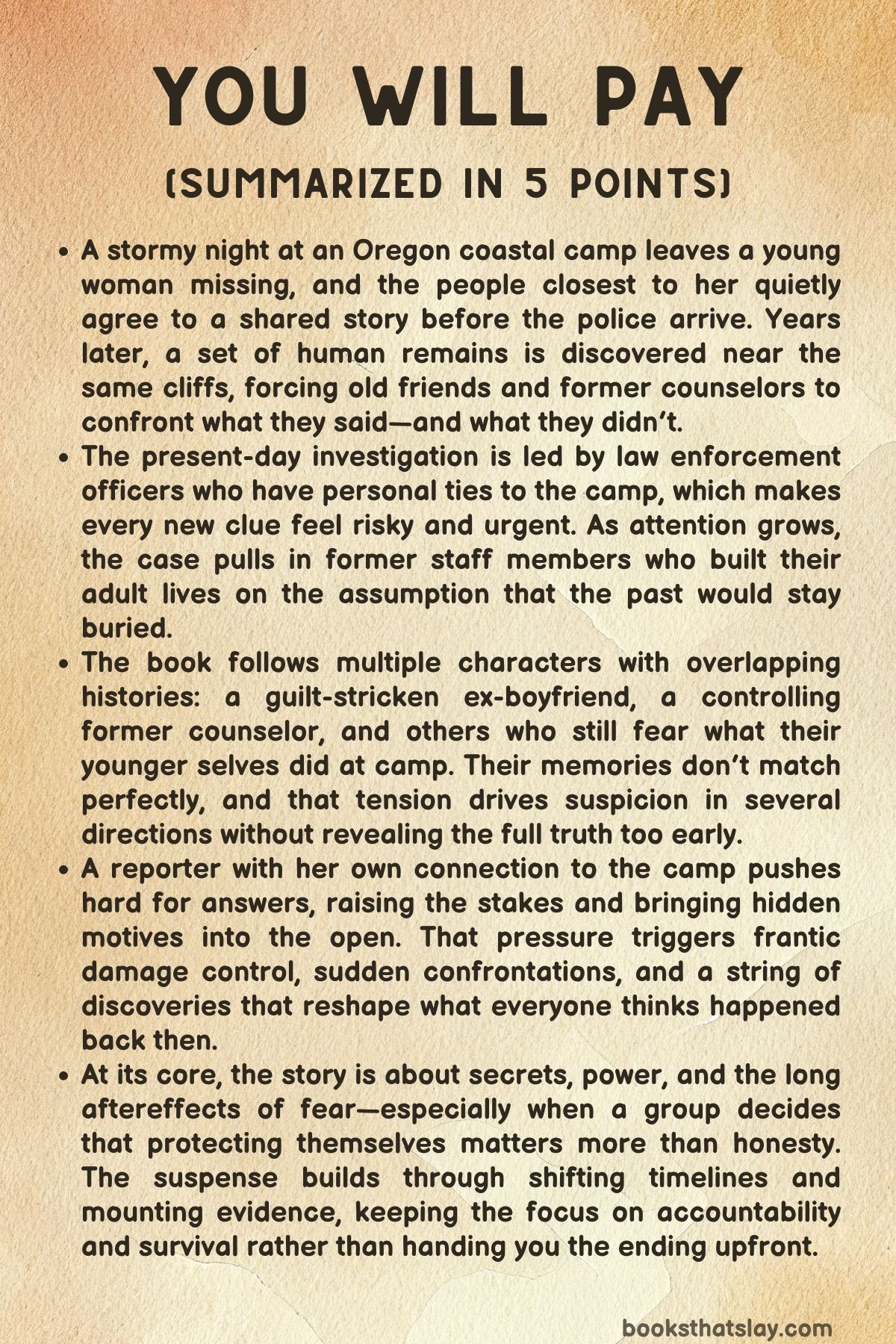
You Will Pay by Lisa Jackson is a twist-heavy suspense novel set on the stormy Oregon coast, where a long-buried summer tragedy refuses to stay buried. Twenty years after two young counselors vanished from Camp Horseshoe, human remains surface near the cliffs, forcing former campers and staff to face the lies they agreed to live with.
At the center is Lucas Dalton, now law enforcement, who thought he’d sealed the past away. As old relationships reignite and old grudges sharpen, the case pulls everyone back to the isolated camp—and toward the truth about who hunted whom, who survived, and who has been settling scores ever since.
Summary
On a brutal, rain-lashed night at Cape Horseshoe, nineteen-year-old Eleanor “Elle” Brady stands barefoot on a cliff edge, pregnant and frightened, convinced she has no way out. The summer at Camp Horseshoe was meant to reset her life before college, but it turned into humiliation and betrayal.
In the storm, she hears metal scraping rock and sees someone moving toward her through the rain. A lightning flash reveals the attacker clearly enough for Elle to recognize them, and that recognition fills her with panic.
The figure carries a knife and advances. Elle slips on the wet stone.
For a second, a gloved hand grabs her wrist—then releases. The attacker shoves, and Elle tumbles into the freezing Pacific while the figure watches from above to make sure she disappears.
That same night at camp, Monica O’Neal, also nineteen and a counselor, lies awake in her cabin, terrified and ashamed. She has been pregnant and is now bleeding and cramping, afraid she may be losing the baby.
Two weeks earlier she told Tyler Quade—handsome, popular, and the boy she wants—that he was going to be a father, hoping it would bind him to her. But Tyler is closely tied to Jo-Beth Chancellor, a wealthy, ambitious counselor Monica can’t stand.
Monica knows other counselors are meeting secretly to coordinate what they’ll say about Elle’s disappearance, and she wants to avoid them. She slips out to meet Tyler privately at an abandoned chapel in the woods.
As Monica moves through the dark camp, she overhears Jo-Beth and Reva Mercado. Jo-Beth is already managing the story they’ll tell authorities: Elle was unstable, devastated by a breakup, and likely took her own life at the cliff locals call Suicide Ledge.
Jo-Beth’s control is cold and practical—she’s determined that no one strays from the script. Then Monica hears Jo-Beth demand, “Where’s the knife?” Reva admits she forgot it and runs to retrieve it.
The knife becomes a symbol of how far the group has already crossed the line, and how desperate Jo-Beth is to tie off loose ends.
Monica reaches the ruined chapel and calls for Tyler. Instead, she stumbles over something in the aisle—Tyler’s bare foot.
Her flashlight reveals Tyler’s naked body sprawled among the pews, blood pooling beneath him. He is dead.
Monica’s first thought is Jo-Beth, and the knife. Before she can process it, she hears movement inside the chapel.
A voice from the darkness speaks her name, calm and certain: someone expected her to come.
In the aftermath, chaos spreads through the camp, but not everyone reacts the same way. The female counselors gather in a sea cave near the shoreline, arguing about how to explain being out after lights-out.
Jo-Beth takes charge, shaping a unified lie to protect their futures. She threatens to expose everyone’s rule-breaking—drug use, secret relationships, petty theft, the kinds of mistakes that could destroy reputations and careers—unless they follow her plan.
As the tide rises around them, urgency pushes them toward agreement. Annette Alsace admits she may have seen a girl in white running during the storm, but Jo-Beth shuts down anything that sounds supernatural or uncertain.
The final story is set: they were worried about Elle, met briefly, and returned to their bunks early. It’s a lie they will keep for decades.
The novel then jumps to the present. A poacher named Caleb Carter hikes down to a secluded cove beneath Cape Horseshoe to dig clams.
In a sea-carved cavern, he pulls up what he thinks is a large clam and instead finds a human jawbone with a dental filling. He delays reporting it, then contacts Lucas Dalton—now law enforcement in the area.
Lucas is furious about the delay, but even more unsettled because the discovery threatens to expose the secret he and others buried twenty years ago. When Lucas searches the cavern, he finds a skull in the sand, confirming the past is no longer safely hidden.
Sheriff Nina Locklear pulls Lucas and another former counselor, Ryan Tremaine, into her office and lays out the pattern: around the time an escaped prisoner named Waldo Grimes vanished into the region, a teen camp worker, Dustin “Dusty” Peters, disappeared. Soon after, two counselors vanished: Eleanor Brady and Monica O’Neal.
Locklear makes it clear that if the remains connect to Camp Horseshoe, Lucas and Ryan could be removed from the case due to conflict of interest. She also warns them that an online reporter, Kinley Marsh, is asking questions—and she has a personal reason to care because she was a camper at the camp during those disappearances.
Lucas works with Detective Maggie Dobbs, who pushes him to fill in what the old files don’t say. Search teams return to the beach and cavern, finding scattered bones and strange remnants like buried candles.
The evidence hints at more than one body and more than one crime. Lucas also faces pressure from his father, Reverend Jeremiah Dalton, who once ran Camp Horseshoe with strict religious authority and still acts like the land and the narrative belong to him.
Lucas’s memories of the camp include fear, control, and abuse, and the current investigation drags those feelings back into the open.
As former counselors learn about the remains, old alliances reform fast. Bernadette Alsace—now living in Seattle—gets contacted by Kinley, who hints she remembers Bernadette’s relationship with Lucas back then.
Bernadette panics, then reconnects with her sister Annette. Jo-Beth, now Jo-Beth Leroy, begins calling others, insisting they return to Averille to “set the record straight”—which really means keeping everyone under her thumb.
Meanwhile, flashbacks reveal how the knife moved through the camp that summer, passed around for what was supposed to be a “prank” against Monica, while anger and jealousy grew sharper by the hour.
In the present, Jo-Beth travels to Averille determined to manage damage control. Then she receives a call that turns her cold certainty into shock: Tyler Quade is alive.
His sudden reappearance cracks open the old story the counselors have protected for years.
Kinley, the reporter, escalates by secretly planting cameras and microphones in hotel rooms to catch the former counselors speaking freely. Bernadette, refusing to be controlled again, meets Lucas and admits a key detail she kept buried: Monica told her Tyler was the father of her baby, and Monica never showed up to the counselors’ late-night cave meeting.
Bernadette also believes Jo-Beth and Reva had their own agenda that night—one tied to jealousy and Tyler.
Then the present-day story explodes. Bernadette calls Lucas in a panic: Jo-Beth may be dead.
Kinley claims her illegal recordings captured Tyler entering Jo-Beth’s hotel room, drinking with her, having sex, and then being confronted about Monica’s death. On the recording, Tyler essentially admits he killed Monica.
When Jo-Beth reacts, Tyler panics and smothers her with a pillow. He flees, and a BOLO goes out.
Lucas arrives as the room becomes a crime scene. Then Tyler unexpectedly returns to the hotel parking lot as if nothing happened.
Maggie and Lucas confront him. Tyler attacks and tries to run.
Lucas tackles him, Maggie fights to restrain him, and Lucas’s dog helps stop him. Tyler is arrested for the murders of Monica O’Neal and Jo-Beth Leroy, but the case still isn’t complete—because the most haunting question remains: what really happened to Elle?
A threatening group text circulates among the former counselors showing a woman in a coffin with the message “YOU WILL PAY.” The image resembles Elle. Lucas studies it and senses something off, as if the person is close to Elle but not quite her.
Before dawn, Lucas watches the Brady house and sees movement in Elle’s old room. He follows a young woman on a motorcycle into the mountains to a remote cabin.
There he finds the impossible: Elle is alive, gravely ill, living under a new identity as Caroline Brown. The young woman is her daughter, Rebecca.
Elle tells Lucas what happened that stormy night: after she became pregnant, Reverend Jeremiah Dalton pushed her off the cliff as revenge against Elle’s mother, Naomi. Elle survived, escaped, and rebuilt her life in secrecy.
She returned only when illness left her desperate for help. Rebecca admits she helped stage the coffin photo and other “hauntings” for money—part of Naomi’s plan to torment Jeremiah by making the town believe Elle’s ghost had returned.
But Naomi’s “payback” doesn’t stop at tricks. She abducts Bernadette and Annette at gunpoint and drives them to the abandoned camp.
Naomi intends to kill them and frame Jeremiah, drenching a building in gasoline and locking the sisters inside before setting it on fire. Bernadette smashes a window and drags the wounded Annette through smoke and flames to escape.
As responders rush in, Jeremiah arrives and confronts Naomi. Naomi shoots him repeatedly, killing him.
A blast and collapsing debris pin Naomi as well, and she dies at the scene.
In the aftermath, Annette recovers in the hospital, scarred but alive. Authorities confirm Tyler Quade will be prosecuted, and Dustin Peters—who disappeared long ago—has been located under a rodeo name and is now giving a statement.
Waldo Grimes remains missing. The law decides not to pursue charges against Elle or Rebecca for the staged sightings, though consequences still ripple outward.
With Jeremiah and Naomi both gone, the camp’s hold finally breaks. Bernadette stays in Oregon, and she and Lucas choose to build a life together, no longer forced to live under the weight of the lie that started everything.
Characters
Eleanor “Elle” Brady / Caroline Brown
In You Will Pay, Elle begins as a nineteen-year-old on the brink—pregnant, terrified, and cornered into believing death is her only exit. Her seeming “suicide” is actually engineered violence, and the crucial detail that she recognizes her attacker instantly frames her as someone betrayed by a familiar authority rather than destroyed by vague despair.
What makes Elle especially layered is how her survival reshapes her into two people at once: the girl the town mythologizes into a tragic ghost story, and the woman who deliberately disappears into “Caroline Brown” to stay alive. Her reinvention is not glamorous escape but sustained self-erasure—years of carrying trauma, secrecy, and the cost of living while everyone else grieves.
When the truth surfaces, Elle is not positioned as a simple miracle return; she is gravely ill, exhausted, and practical about what happened, which recasts her earlier “victimhood” into something sharper: she has endured the long aftermath of attempted murder, reproductive coercion, and isolation, and she still becomes a chess piece in other people’s revenge. Even then, Elle retains agency by finally naming her attacker, exposing the hidden architecture of control that ruled Camp Horseshoe, and reclaiming her own story from the lies that trapped everyone for decades.
Lucas Dalton
Lucas functions as both witness and wound: a former counselor who helped build the original false narrative through silence, and a present-day lawman forced to excavate what he buried in himself. His guilt over Elle is deeply personal—he broke up with her, walked away, and then let the story harden into something “inevitable,” which becomes a quiet self-punishment that shapes his adult identity.
In the present timeline, Lucas is reactive in a way that feels earned; he is furious at delays, anxious about exposure, and constantly scanning for who is manipulating the truth. That intensity is not just professional diligence—it is trauma muscle memory from growing up under Reverend Jeremiah Dalton’s harsh, weaponized faith.
Lucas’s scenes with his father show a man trained to expect domination, now refusing it, and the investigation becomes an extension of that lifelong rebellion: naming what happened, resisting the urge to hide it, and refusing to let “reputation” outrank human lives. His relationship with Bernadette also reveals his development; the teenage triangle and his past choices could have stayed a sentimental thread, but it turns into a moral reckoning—he has to face what he did, what he didn’t do, and who benefited.
By the end, Lucas is not a spotless hero; he is someone who takes damage, makes mistakes, and still chooses to fight for accountability, even when the consequences scorch his own family.
Monica O’Neal
Monica is written as tragedy under pressure: young, frightened, and making desperate calculations with limited power. Her pregnancy is not simply plot fuel—it exposes how quickly the camp’s moral policing and social hierarchy can become lethal when sexuality is weaponized.
Monica’s longing for Tyler and her belief that a baby might force him to stay reveal a painful immaturity, but also a survival logic shaped by insecurity and the fear of being discarded. She is squeezed from all sides—by shame, by the possibility of miscarriage, by Jo-Beth’s hostility, and by the counselors’ collective anxiety about exposure.
When she finds Tyler’s murdered body, Monica becomes the story’s purest “truth-teller” in that moment because she reacts like someone outside the conspiracy: she tries to process what she sees rather than manage optics. Her subsequent abduction is especially grim because it shows how the camp’s closed ecosystem enables violence; the darkness, the woods, the sea, and the secrecy all conspire to erase her.
Monica’s role lingers even after her disappearance because her death becomes the pivot point that forces other characters into lifelong complicity—she is the person they all failed, and her absence becomes the glue holding their lies together until the present-day investigation starts dissolving it.
Tyler Quade
Tyler’s charm masks a core instinct for self-preservation that turns predatory when threatened. As a teen counselor, he benefits from being perceived as desirable and “golden,” and he uses that social capital to avoid responsibility—especially when Monica’s pregnancy jeopardizes his future.
The story makes him dangerous not because he is a stereotypical monster at first glance, but because he is ordinary in the way he seeks the easiest exit from consequences. His apparent death in the past functions like a narrative misdirection that mirrors how people wanted to believe a single villain was responsible; when Tyler reappears alive decades later, it reframes the old mysteries through a harsher lens—he didn’t vanish, he endured, and he kept the truth buried.
In the present-day hotel sequence, Tyler’s violence is intimate and panic-driven rather than theatrical: once confronted with the possibility of exposure, he tries to smother the problem—literally. His attempted flight and sudden aggression during arrest show the same pattern repeating: evade, overpower, escape.
Tyler’s arc ultimately embodies the book’s central engine of retribution—he harms others to preserve his future, and the past eventually returns with enough force to pin him down.
Jo-Beth Chancellor / Jo-Beth Leroy
Jo-Beth is control embodied: ambitious, socially dominant, and terrified of anything that could derail the life she believes she deserves. Her cruelty is strategic; she doesn’t simply dislike Monica—she sees Monica as a destabilizing variable that could expose Tyler, humiliate Jo-Beth, and fracture Jo-Beth’s grip on the camp’s social order.
What makes Jo-Beth compelling is that her power is not supernatural or institutional; it is interpersonal—she uses secrets like currency and fear like glue. In the cave scene, she manufactures a story in real time, adapting it when someone challenges it, leveraging other counselors’ rule-breaking to keep them obedient.
That is leadership, but corrupted: she organizes survival through deception, and she normalizes moral compromise as “necessary.” In adulthood, Jo-Beth returns to the same playbook, convinced she can still orchestrate people through intimidation and narrative control. Yet her downfall reveals the limits of that dominance: she cannot bully someone who is cornered and terrified of exposure, and she cannot negotiate with a truth she helped bury.
Her death is not just punishment; it is the collapse of the illusion that reputation management can permanently outpace reality.
Reva Mercado
Reva operates as the story’s uneasy accomplice—someone who participates in wrongdoing, but without Jo-Beth’s appetite for domination. She is the character who shows how coercion works in groups: she follows a stronger personality, compromises step by step, and then finds herself holding literal evidence like the knife.
Reva’s discomfort and hesitations matter because they prevent the conspiracy from feeling cartoonish; she is not a mastermind, she is a person trying to stay safe inside a toxic system. Her handling of the butcher knife and her awareness of who might have seen it highlight her as a practical operator—someone who understands consequences even if she lacks the courage to stop the chain of events.
Reva’s significance grows over time because she represents the many ways people become complicit: not by craving violence, but by prioritizing self-protection, accepting small lies, and letting the group’s logic rewrite their personal ethics. In that sense, Reva is one of the book’s clearest portraits of moral erosion.
Bernadette Alsace Warden
Bernadette is the character most shaped by the cost of silence. As a young counselor, she is cautious, observant, and uneasy about Jo-Beth’s manipulation, but she still stays within the group’s gravitational pull.
Her relationship with Lucas places her at the emotional center of the original summer—she is part of the romantic fracture that becomes a convenient explanation for Elle’s “instability,” yet she is also one of the first to challenge the official story’s neatness. In the present, Bernadette’s panic during Kinley’s call shows how the past still owns her; she has built an adult life that depends on the old narrative remaining sealed.
What elevates Bernadette is how she chooses, eventually, to stop being managed. She resists Jo-Beth’s attempt to reassert control, she shares the secret about Monica’s pregnancy and Tyler’s paternity, and she commits to giving an official statement even though it threatens her.
Her climax at Camp Horseshoe—surviving Naomi’s hostage situation, dragging Annette through fire, refusing to fold—turns her from cautious bystander into active survivor. Bernadette’s ending with Lucas feels less like romance reward and more like two people deciding to live honestly after decades of living around a lie.
Annette Alsace
Annette functions as the moral pressure point of the counselor group: she is the one most likely to say the quiet part out loud, to question the story, and to argue that telling the truth matters more than protecting themselves. That stance makes her both brave and vulnerable, because the group’s fear relies on everyone participating equally.
Her memory of seeing a girl in white in the rain becomes a symbol of how the truth survives in fragments—an image that could be dismissed as hysteria, yet keeps haunting the narrative. In the present, Annette’s willingness to admit they lied signals growth, but it also places her in danger because truth-tellers threaten revenge plots and cover-ups alike.
Her abduction by Naomi and subsequent shooting underline the cruel irony that Annette, the character most oriented toward honesty, becomes collateral damage in someone else’s “payback” fantasy. Annette’s survival matters thematically: the story does not let vengeance fully win; it leaves room for recovery and testimony, even when it comes at a brutal cost.
Maggie Dobbs
Maggie represents disciplined skepticism—the investigator who refuses easy narratives and keeps asking what doesn’t fit. She functions as Lucas’s professional mirror: where he is emotionally saturated by the past, she insists on evidence, procedure, and the uncomfortable possibility that the camp’s old explanations were convenient fiction.
Maggie’s pressure on Lucas to fill in gaps is not cruelty; it is an insistence that policing cannot be built on selective memory. Her presence also forces Lucas to confront conflict-of-interest realities and the fact that his personal guilt can distort an investigation.
Maggie’s near-fatal encounter with Tyler shows that she is not a detached observer; she pays for the truth with her body, and the story uses that to emphasize the danger of resurfacing buried violence. Even so, she remains focused on outcomes—charges, statements, timelines—grounding the narrative in the modern demand for accountability rather than the camp’s old culture of concealment.
Sheriff Nina Locklear
Sheriff Locklear acts as institutional friction: she is the authority who arrives with a wider lens and refuses to let local loyalties dictate the scope of the investigation. Her focus on the cluster of disappearances and her warnings about conflicts of interest reveal her as someone who anticipates obstruction—whether intentional or emotional—and tries to prevent the case from being quietly steered away from powerful people.
Locklear’s role is especially important because she treats the camp history as a pattern rather than isolated tragedies, which undercuts the long-standing scapegoat story that blamed everything on a single fugitive. She is not sentimental about Lucas’s past involvement; she is pragmatic, and that pragmatism becomes the mechanism that keeps the investigation from collapsing into personal drama.
Kinley Marsh
Kinley is a fascinating blend of victim memory and opportunistic ambition. As a former camper, she has a personal stake in what happened at Camp Horseshoe, and that connection gives her questions a sharper edge than ordinary journalism.
Yet her tactics—stealing a diary, planting illegal cameras and microphones—show a willingness to violate boundaries to get her story. Kinley embodies the modern hunger for narrative closure, especially in true-crime culture, where private trauma becomes public commodity.
She helps crack the case by capturing Tyler’s admissions, but she also contaminates the moral landscape by behaving like a vigilante reporter rather than a responsible one. The result is a character who is neither pure ally nor pure antagonist: she is a catalyst whose methods force outcomes, while also demonstrating how “truth” can be pursued for ego, leverage, and spectacle as much as for justice.
Caleb Carter
Caleb is the accidental messenger—the ordinary man whose poaching trip cracks open the grave the town forgot. His delay in reporting the jawbone and his later drunken behavior paint him as unreliable, but that unreliability is part of the point: major truths often surface through imperfect people.
Caleb’s claim of seeing Elle’s “ghost” also illustrates how the past has become folklore, how fear and myth substitute for facts when communities refuse to confront what they enabled. He is less a developed psychological portrait than a narrative instrument, but he still matters because his messy humanity keeps the discovery from feeling staged; the case reopens not through heroism but through chance and flawed judgment.
Reverend Jeremiah Dalton
Jeremiah is the story’s embodiment of sanctified control—someone who uses religion as both branding and bludgeon. As camp leader and Lucas’s father, he creates a moral environment where shame is constant, secrets are lethal, and punishment is framed as righteousness.
His hypocrisy is not incidental; it is structural, shaping everything from Lucas’s trauma to the counselors’ willingness to lie to protect the “good name” of the camp. Jeremiah’s later confession about paying Dusty to disappear reveals how power operates in his world: problems are not solved through justice, but through concealment and money, all while maintaining a public posture of virtue.
The most chilling aspect of Jeremiah is the way he treats people as obstacles—he tries to eliminate Elle when her pregnancy threatens him, and he expects Lucas to prioritize the camp’s sale and his own future over truth. His death at Naomi’s hands is narratively violent, but thematically fitting: the man who built a private kingdom of control is finally destroyed within the ruins of that kingdom.
Naomi Dalton
Naomi is vengeance without brakes, a character driven less by healing than by a craving to make others suffer as she has suffered. Her actions show how trauma can metastasize into obsession when it is fed by secrecy and years of suppressed rage.
Naomi is intelligent enough to orchestrate a “haunting,” recruit Rebecca, and target Jeremiah’s reputation, but she is also unstable in the way she escalates—kidnapping, shooting, arson—until her revenge becomes indiscriminate. Importantly, Naomi’s “payback” is not framed as justice; it is framed as annihilation, and that distinction matters because the book draws a line between exposure/accountability and revenge-as-fire.
Naomi’s end beside Jeremiah, pinned under debris, is symbolic: she becomes trapped in the very destruction she set, fused to the man she could not stop orbiting. Her story is a warning about how revenge can replicate the violence it claims to answer.
Rebecca
Rebecca is the inheritor of secrets she didn’t create and the performer recruited to weaponize them. Resembling Elle becomes her curse and her utility; it allows Naomi to turn her body into evidence, her face into threat, and her existence into a tool of psychological terror.
Rebecca’s confession that she posed for the coffin photo for money highlights her as less malicious than entangled—she is participating in a scheme shaped by older people’s wounds and agendas. At the same time, her involvement demonstrates how easily identity can be manipulated in a community primed for myth.
Rebecca is not ultimately punished by the legal system, which fits her role as a smaller cog in a larger machine, but the emotional consequences remain: she has been used as a symbol more than treated as a person, and she must live with having helped terrorize others even if she never committed the original crimes.
David Tremaine
David operates as one of the story’s quieter expressions of the camp’s damaged family ecosystem. His connection to Lucas through Jeremiah creates a constant undercurrent of rivalry, resentment, and the legacy of abuse.
The fight between Lucas and David in the aftermath of chaos suggests that violence at Camp Horseshoe is not only external; it is domestic, normalized, and ready to erupt under stress. David’s later relevance—possibly recognizing Dusty under a rodeo name—positions him as someone who, like Lucas, carries fragments of the truth yet did not assemble them into action.
He represents the people around power who may know pieces but lack either the moral clarity or the leverage to change outcomes.
Reva’s girlfriend Nell and counselor Sosi Gavin
Nell and Sosi function as a lens on the camp’s suffocating moral surveillance. Their relationship, treated as dangerous “evidence” by others, shows how Jo-Beth’s control relies on the threat of exposure in a culture that punishes sexuality and difference.
Sosi’s objection to using faith as a cover story reveals her limits—she will lie to protect herself, but she bristles at blasphemous manipulation—yet she still participates, which illustrates the trap: even those with conscience get pulled into the lie when the social penalties are too high. Their presence deepens the theme that Camp Horseshoe’s rule structure doesn’t create purity; it creates secrecy, leverage, and fear.
Dustin “Dusty” Peters / “Pete Denver”
Dusty is one of the clearest examples of how “disappearance” can be manufactured and tolerated when someone with authority decides it is convenient. Initially framed as another vanishing teen in a cluster of mysteries, Dusty later becomes proof that at least one disappearance was arranged rather than mysterious—money, intimidation, and a moral justification (“protecting Leah”) were enough to erase him from the story.
That twist complicates the book’s ethics: Jeremiah’s motive may sound protective, but his method is extrajudicial and corrupt, reflecting the same authoritarian instinct that drives his other crimes. Dusty’s later cooperation with authorities suggests a man who survived the consequences of someone else’s power play, and his existence under a new name underscores how easily truth can be hidden when the community prefers ignorance.
Waldo Grimes
Waldo Grimes is the convenient villain the town clings to because blaming a fugitive is emotionally efficient. His rumored presence offers a ready-made explanation for multiple disappearances, allowing the camp community to avoid confronting internal violence and complicity.
Whether or not he is truly involved, his narrative function is crucial: he is the scapegoat that keeps everyone else safe. The fact that he remains missing sustains the book’s sense that not every thread gets neatly tied, and it reinforces the idea that “unknown evil” is often more comfortable than known wrongdoing committed by familiar faces.
Jeanette Brady
Jeanette appears as the quiet anchor for Elle’s late return, representing the complicated love that remains when years of absence have rewritten a family’s life. Her presence underscores the human cost of disappearance beyond the sensational mystery: parents and families do not just lose a person, they lose time, certainty, and the ability to grieve cleanly.
Jeanette’s role also highlights how survival is rarely solitary; Elle returns because she is sick and needs help, and that need reopens old wounds while still offering a final chance at connection.
Isabelle Dalton
Though not present in active scenes, Isabelle’s death shapes Lucas’s internal landscape and his relationship with Jeremiah. She becomes part of the emotional evidence explaining why Lucas refuses to trust easy moral narratives from his father, and why the camp’s religiosity feels hollow to him.
Isabelle functions as a reminder that the story’s damage did not begin with the disappearances; the family system was already fractured, and the camp simply magnified those fractures into catastrophe.
Themes
Secrets, Silence, and the Cost of Self-Protection
From the first night of Elle’s disappearance, self-preservation becomes a group project, and the story shows how quickly private shame turns into public damage when people decide that the safest option is to say nothing. The counselors are not just hiding what they saw; they are hiding what they did, what they feared would be discovered, and what they believed would ruin them.
The lie they settle on is designed to be believable to authority and flattering to their own self-image, and that combination makes it powerful. Once they commit, truth becomes dangerous—not only because it might expose a crime, but because it might expose rule-breaking, relationships, substance use, theft, jealousy, and personal ambition.
The silence isn’t passive; it’s actively maintained, rehearsed, and enforced. Even when someone wavers, the group pressure pulls them back, and the people with the strongest need to control the narrative become the leaders.
The book keeps returning to how a secret doesn’t stay contained: it spreads into other decisions, warps memories, and forces everyone involved to keep paying interest on the original lie. Years later, the discovery of bones doesn’t just reopen a case; it reactivates a whole structure of denial that former counselors have built their adult lives upon.
The fear isn’t only legal punishment—it’s the collapse of the identities they constructed after that summer. The long delay between the original events and the present-day investigation highlights that silence can “work” in the short term, but it hardens into a prison.
People remain tied to each other through the shared risk of exposure, and that bond is corrosive because it is based on mutual vulnerability rather than loyalty. In You Will Pay, the consequences are both external—murders, investigations, public scrutiny—and internal, as guilt and anxiety keep resurfacing no matter how far the characters move away.
Control, Power, and the Manipulation of Truth
Control is treated as a practical weapon rather than an abstract idea. It shows up in who gets to define what happened, who gets believed, and who gets blamed.
Jo-Beth’s role in pushing a unified story demonstrates a specific kind of power: she doesn’t need physical force to dominate the group because she understands leverage. She collects everyone’s weaknesses and uses them as bargaining chips, turning personal secrets into a set of threats that make compliance feel “reasonable.” Her control is also social—she frames her demands as necessary for everyone’s future, which turns coercion into a kind of false teamwork.
That same instinct for narrative domination appears again in the present day through the scramble to manage interviews, calls, and public attention once the remains are found. The book also places institutional power alongside personal control.
Lucas’s father, Jeremiah, represents authority that presents itself as moral leadership while acting in self-interest. His religious status and ownership claims over the camp property create a shield that discourages questions, and his ability to intimidate—especially within a community that has been trained to respect him—makes him dangerous even without a visible weapon in his hand.
When the truth finally surfaces about what he did to Elle, the revelation reframes earlier “strictness” as something far darker: control used to erase consequences and protect a public image. The investigation itself becomes a contest over truth, with competing forces trying to steer outcomes—law enforcement seeking facts, former counselors seeking survival, and outsiders seeking stories.
The theme lands hardest in how easily “truth” can be shaped when the powerful control what information is available. By hiding evidence, choosing scapegoats, and pressuring witnesses, characters create a reality that others must accept because they lack an alternative.
You Will Pay presents control as something that can look like leadership, morality, or protection, but the results reveal it as domination that multiplies harm.
Guilt, Memory, and the Inability to Outrun the Past
Guilt in this story is not a single emotion; it becomes a long-term condition that changes how people think, remember, and react. Lucas’s adult life is marked by unresolved responsibility: he replays his breakup with Elle, his choices that night, and his later role in the story the camp told police.
The book illustrates how memory is both vivid and unreliable under pressure. People remember fragments—sounds in the rain, a flashlight beam, a knife, a foot in the aisle, a voice in the dark—and those fragments become the foundation for years of assumptions.
The more time passes, the easier it becomes to treat assumptions as facts, especially when doing so keeps guilt manageable. At the same time, guilt refuses to stay quiet.
It emerges through insomnia, anger, defensiveness, and sudden panic when the past threatens to become public again. The present-day discovery of remains works like a trigger: it doesn’t just start an investigation; it forces characters back into the emotional reality they tried to bury.
The book also shows guilt as contagious. When people keep a shared secret, each person’s anxiety increases the anxiety of the others, and the group becomes a closed system of suspicion.
That tension is why, decades later, even a reporter’s phone call can cause immediate fear. The past is not just remembered; it is anticipated—everyone is always waiting for the moment they will be confronted.
The theme becomes especially sharp in how guilt changes moral judgment. Characters justify cruel choices because they believe they are already “too far in.” They rationalize silence as protection, and they rationalize manipulation as necessity.
Yet their bodies and reactions tell a different story: the guilt remains present even when they refuse to name it. You Will Pay suggests that the past persists not because fate demands it, but because unresolved wrongdoing creates a psychological debt.
When the truth finally moves toward daylight, it doesn’t arrive as relief; it arrives as reckoning, forcing characters to face both what happened and what they allowed to happen.
Betrayal, Desire, and the Violence of Personal Rivalries
The story uses romantic tension and jealousy as more than drama; they become catalysts for decisions that escalate into catastrophe. Monica’s pregnancy, her hope that it will secure Tyler’s commitment, and Tyler’s attachment to Jo-Beth create a volatile triangle where love is mixed with status and fear.
The betrayals are layered. Tyler betrays Monica emotionally by refusing to commit.
Monica betrays Jo-Beth’s expectations by becoming a threat to her future. Jo-Beth experiences betrayal as humiliation and reacts with the kind of rage that seeks punishment, not closure.
These dynamics matter because they show how quickly people can treat another person as an obstacle rather than a human being. When rivalry becomes the lens, cruelty feels justified.
The book repeatedly places characters in situations where desire and insecurity distort their sense of proportion: a relationship conflict becomes a reason to plan intimidation, a plan becomes a reason to involve a weapon, a weapon becomes a reason to hide evidence, and hiding evidence becomes a reason to lie about someone’s death. What makes the theme unsettling is that the personal and the deadly sit close together.
The same people who trade insults, gossip, and power plays are also capable of decisions that permanently erase lives. The narrative also shows betrayal beyond romance.
Friends betray friends by withholding information and by agreeing to Jo-Beth’s coercion. Adults betray teenagers by failing to protect them or by using authority to silence them.
And the betrayals ripple forward: decades later, people who survived the summer still betray each other by trying to control what gets said, who gets blamed, and who gets sacrificed to protect reputations. In You Will Pay, desire is not portrayed as inherently destructive, but as dangerous when paired with entitlement—when someone believes they deserve a person, a future, or a public image, and will harm others to keep it intact.
The violence that follows is not random; it grows from personal rivalries that were never checked by empathy or accountability.
Moral Hypocrisy and the Weaponization of Faith
Camp Horseshoe is presented as a place claiming spiritual purpose while operating through control, shame, and concealment. That contradiction becomes a constant pressure on the characters, especially the teenagers who are taught that appearances matter and that obedience equals righteousness.
Jeremiah’s authority works because it is socially protected: challenging him is treated as challenging moral order itself. The story exposes how that environment makes it easier to hide wrongdoing.
If the camp’s identity depends on purity, then any scandal becomes an existential threat, and people will do extreme things to prevent it. The counselors’ choice to use a “spiritual” explanation as a cover story shows how faith can be reduced to a convenient costume.
Even those who object understand the risk: once religion is used to validate a lie, anyone who challenges the lie can be framed as disrespectful or immoral. That dynamic is powerful because it makes truth-telling feel like transgression.
Jeremiah’s private behavior sharpens the theme: he quotes scripture to justify harshness, demands control over property and people, and ultimately is revealed as capable of profound violence and exploitation. The book doesn’t argue that belief itself is corrupt; it argues that institutions and leaders can exploit belief to protect themselves.
When a community elevates a leader as morally untouchable, it becomes easier for harm to continue unchecked. The effect on the younger characters is long-lasting.
They learn that morality is something performed and enforced, not practiced with compassion. That lesson feeds directly into the larger culture of secrecy: it is safer to appear good than to do good.
Later, when the past resurfaces, the hypocrisy becomes impossible to maintain, and the spiritual language that once served as camouflage is exposed as part of the machinery that kept victims unprotected. You Will Pay uses this theme to show how moral branding can be used to silence doubts, discourage reporting, and convert community respect into a shield for abuse.
Revenge, Payback, and the Collapse of Restraint
Payback is treated as both motivation and poison, pushing characters past the point where they can still make rational, humane choices. The story shows revenge not as a single act but as a plan that expands.
It begins with the desire to punish, scare, or humiliate—often presented as “deserved”—and then becomes harder to contain. Naomi’s later actions embody revenge as identity: she frames what she does as balancing scales, but the scale she uses is personal pain rather than justice.
Her fixation turns into a willingness to harm whoever is convenient, including people who were not the original source of her suffering. The message “YOU WILL PAY” works on multiple levels because it is both threat and worldview.
It suggests that someone has decided consequences must be delivered by hand, outside law, outside proportion, outside empathy. The book also contrasts revenge with accountability.
Law enforcement represents the slower, imperfect method of consequences, while revenge is immediate and emotionally satisfying to the person who carries it out. The narrative shows the seductive nature of that immediacy, especially when characters believe systems failed them.
But it also shows revenge’s cost: it does not heal; it escalates. Instead of bringing clarity, it creates new victims and new trauma, widening the circle of harm.
Even the haunting scheme—staged sightings, the coffin photo—demonstrates how revenge can become theatrical, designed to terrorize and humiliate rather than reveal truth. It is punishment as performance.
The theme reaches its most devastating point when revenge becomes indistinguishable from self-destruction. Naomi’s end is not a triumph; it is the final stage of obsession.
The book suggests that revenge often consumes the person seeking it, leaving little room for rebuilding or peace. In You Will Pay, the desire for payback grows from real grievances, but it becomes morally unmoored, showing how easily righteous anger can turn into indiscriminate violence when it is not guided by restraint or a commitment to protecting the innocent.
Identity, Reinvention, and Survival Through Disappearance
Elle’s fate complicates the story’s assumptions about victimhood and survival. Her survival is not a clean victory; it is a life built around erasure.
By becoming Caroline Brown, she chooses disappearance as the only way to stay alive, which turns identity into a strategy rather than an expression of self. The book shows the emotional price of that choice: she loses her name, her relationships, her history, and any normal path back to her family.
Her reinvention also exposes another kind of violence—the way a person can be forced to abandon their life to escape someone else’s power. Survival requires not only enduring the original attack, but constructing an existence that can’t be traced.
That kind of survival is lonely, medically fragile, and haunted by the knowledge that the world believes you are dead. The story extends the theme through Rebecca, whose resemblance becomes a tool for deception and intimidation.
Rebecca’s participation in staged “hauntings” shows how identity can be used as a weapon by others: her face becomes evidence, threat, and spectacle depending on who is looking. The theme also applies to the other former counselors, though in a different way.
They reinvent themselves socially—careers, marriages, reputations—on top of an unresolved past. Their adult identities function like disguises, carefully maintained, because exposure would collapse them.
The discovery of remains threatens that reinvention by forcing their old selves back into view. You Will Pay treats identity as unstable under trauma: people change names, change stories, change cities, and still cannot fully control what follows them.
Reinvention can be a form of resilience, but the book emphasizes that it is also a symptom of fear—proof that the world was not safe enough for the original self to remain visible.