Zami: A New Spelling of My Name Summary and Analysis
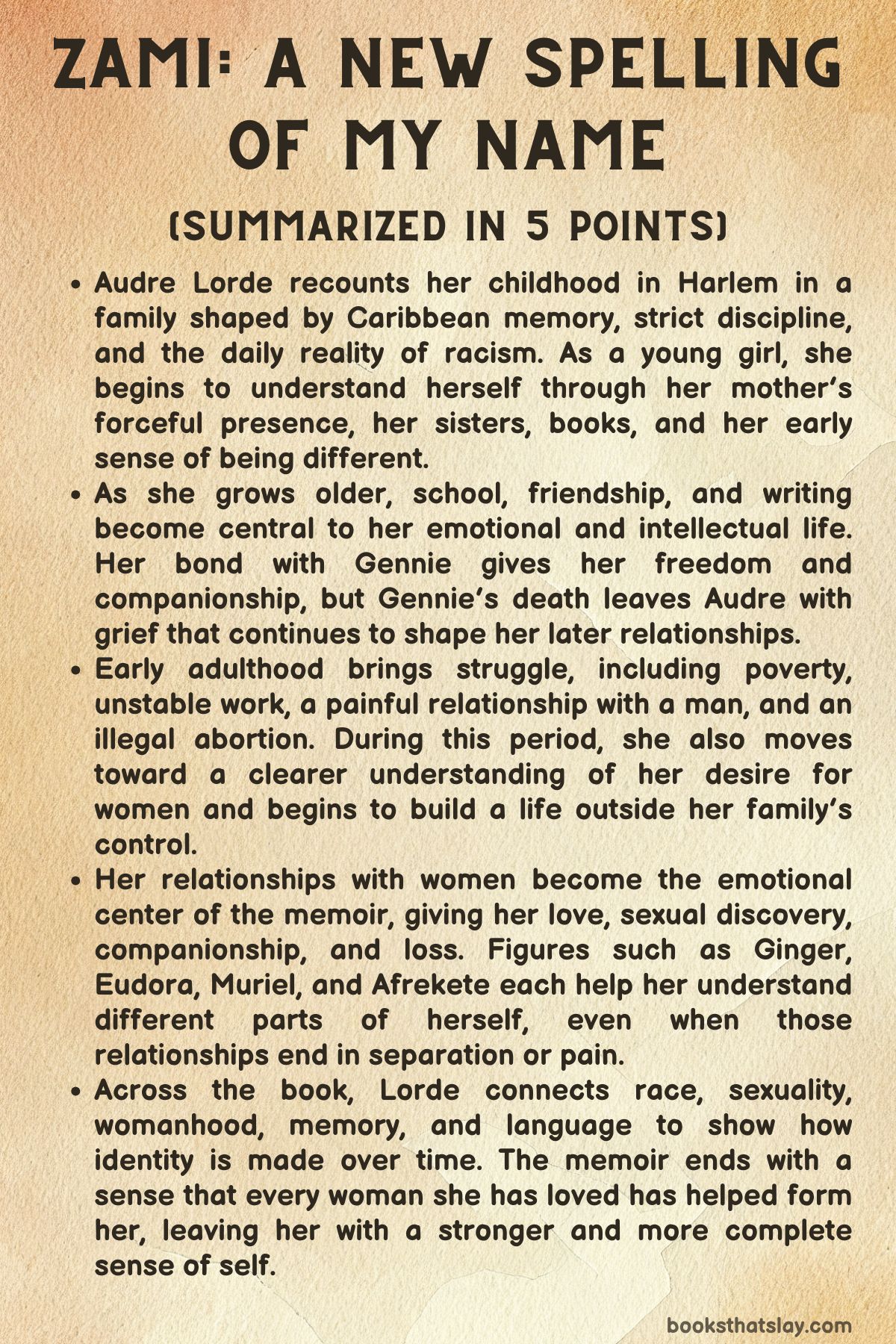
Zami: A New Spelling of My Name is Audre Lorde’s autobiographical work about growing up Black, nearly blind, female, and lesbian in mid-century America while learning how to claim language, desire, and selfhood on her own terms. It follows her from childhood in Harlem through adolescence, early love, grief, work, political awakening, and adult relationships with women.
What makes the book stand out is the way memory, history, sensual experience, family conflict, and identity all shape one another. Lorde presents the making of a self not as a straight line, but as a life formed through mothers, sisters, lovers, friendships, losses, and survival.
Summary
Audre begins by tracing her sense of self back to the women who surrounded her life. From the start, she understands strength, speech, and endurance through women’s presence.
Her mother, sisters, tenants, strangers, and later her lovers all become part of the story of how she came to know herself. She also carries an early sense that womanhood contains power, mystery, danger, and possibility, and this feeling stays with her throughout the book.
Her childhood is shaped by her parents’ Caribbean background, especially her mother’s memories of Grenada and Carriacou. Her mother is commanding, proud, protective, and often harsh, carrying old-world knowledge into a racist American city that has little use for it.
Audre grows up in Harlem during the Depression and war years in a household ruled by discipline, secrecy, ritual, and survival. Her mother teaches her prayers, language, manners, and caution, especially around white people, though much of that caution is expressed indirectly.
As a child, Audre does not fully understand racism, but she feels its force in stores, on the street, at school, and in the many silences her parents keep.
She is a difficult child to others because she does not easily accept instructions that make no sense to her. Nearly blind, intensely observant, and unusually verbal once she begins to speak, she enters school already shaped by books and by a private logic of her own.
Reading becomes one of the first ways she enters the world on her own terms. She discovers both the pleasure and the authority of language early, and writing grows from that same need to name things clearly.
Yet school is also where she learns humiliation, punishment, and the unfairness of institutions. Teachers misread her intelligence as stubbornness, and discipline often falls hardest on those who do not fit.
At home, she longs for closeness yet often feels apart. Her older sisters share a bond she envies, and she experiences herself as both deeply attached to her family and emotionally isolated within it.
She is curious about bodies, intimacy, and female beauty from an early age, though she has no language yet for these feelings. Small childhood encounters stay with her because they reveal desire, class difference, race, and exclusion before she can fully explain them.
As she grows older, racism becomes more direct and undeniable. In Catholic school and later in Washington Heights, white children mock her appearance and smell, and adults either excuse the cruelty or reinforce it.
She also begins to understand the limits of her mother’s strategy of endurance. Her parents present the world as manageable through discipline and excellence, but Audre sees that brilliance and obedience do not protect her from contempt.
She becomes increasingly angry at unfairness, especially when others tell her to endure it quietly.
Her bond with her father is quieter and more tender than her stormy relationship with her mother. Their connection lives in small routines rather than open conversation.
These moments matter because they give her a form of care that is understated but real. At the same time, her adolescence becomes marked by confusion about sex, the body, and secrecy.
Information about menstruation, pregnancy, and desire reaches her through fragments, warnings, rumors, and fear rather than honest instruction.
High school changes her life because it brings friendship, literary purpose, and a wider world. She finds some relief among bright girls and artistic circles, and poetry becomes central to how she understands experience.
Yet her closest emotional tie is with Gennie, whose friendship gives her companionship, rebellion, glamour, and risk. Together they roam the city, steal, dream, and test limits.
But Gennie’s life is full of instability and pain, especially around her father, and her repeated suicidal despair eventually leads to her death. This loss becomes one of the central wounds of Audre’s young life.
She is left with guilt, shock, unfinished feeling, and the knowledge that love does not always save the people one loves.
After high school, Audre leaves home and tries to build an adult life through work, temporary relationships, and independence. She has an affair with a young man, becomes pregnant, and undergoes an illegal abortion.
The experience is physically brutal and emotionally isolating. It confirms for her how exposed women are, how dangerous heterosexual expectations can be, and how survival often depends on other women’s underground forms of help.
Through loneliness, poverty, and depression, writing remains one of the few things that keeps her anchored.
She takes jobs where she can find them and lives in cheap rooms and small apartments, slowly making a life for herself outside her family’s control. During this period, her attraction to women becomes clearer to her, first in longing, fantasy, and tentative intimacy, then in fuller sexual and emotional relationships.
Her first deeply affirming sexual relationship with Ginger gives her a powerful sense of recognition. For the first time, desire feels natural, mutual, and revealing rather than forced or empty.
Yet even this relationship is limited by class, circumstance, and different expectations.
Her father’s illness and death draw her briefly back toward family responsibility, but she remains determined to make a life elsewhere. She works in factories under dangerous conditions, sees labor exploitation directly, and understands how Black women are pushed into the worst and least protected jobs.
She wants escape, and that desire takes shape as a journey to Mexico.
In Mexico, she experiences a new social feeling: moving among brown people without the same constant racial pressure she knew in the United States. The country offers her beauty, space, study, and a loosening of fear.
There she meets women living at the edges of politics, art, exile, and unconventional sexuality. Most important is Eudora, with whom she shares poetry, conversation, and a deeply important love affair.
Through Eudora, Mexico becomes not just a refuge but a place of erotic and intellectual expansion. Yet this relationship, too, is marked by absence, secrecy, and loss, ending without closure.
When she returns to New York, she enters lesbian life more fully, though not without conflict. She finds community, bars, friendships, and sexual freedom, but she also sees that white lesbian spaces often deny or minimize race.
She and other Black lesbians remain marginal even within supposedly liberated circles. She forms powerful friendships with women who understand some part of her reality, but she also continues to feel the loneliness of being different in several ways at once.
Her relationship with Muriel becomes one of the deepest and most formative in the book. Their love is passionate, creative, intellectual, and domestic.
They build a home together, share poems, friends, hunger, sex, and dreams. For a time, this shared life seems to promise lasting safety.
But Muriel’s mental illness, instability, and despair gradually strain the relationship. Audre tries to sustain them through devotion, work, and belief in love’s power.
Over time, betrayal, other lovers, financial strain, jealousy, silence, and emotional collapse wear them down. Their separation is painful and slow, not a single break but a long unraveling of a life they had made together.
By the end, Audre understands herself through the women who shaped her rather than through any single fixed category. Family, lovers, Black womanhood, Caribbean inheritance, grief, language, sexuality, and survival all become part of her naming of herself.
The meaning of Zami comes to hold this collective identity: a self made through memory, desire, ancestry, and women’s enduring marks upon one another.
Key People
In Zami, character is never separate from memory, history, race, gender, class, and desire. The people in Audre’s life matter not only because of what they do, but because each one leaves a lasting pressure on her mind, body, language, and emotional growth.
What emerges is not a flat cast arranged around a single protagonist, but a living network of family members, friends, lovers, and companions who help shape her sense of self.
Audre
Audre stands at the center of the narrative as both witness and maker of meaning. She is presented as fiercely observant from childhood, a girl who notices tone, gesture, silence, injustice, sensuality, and contradiction long before she has the vocabulary to explain them.
Her intelligence is not merely academic; it is emotional, bodily, and intuitive. She sees how adults hide pain behind manners, how race structures everyday life, and how difference can isolate a person even within family.
This gives her an unusual intensity as a narrator, because she is always trying to interpret the world rather than merely pass through it.
Her personality is marked by stubbornness, sensitivity, pride, and a refusal to accept false explanations. As a child, she often appears difficult to authority figures because she cannot easily submit to nonsense.
That refusal later becomes one of her strengths. It is tied to her development as a writer, because writing gives her a way to preserve what others deny, simplify, or silence.
Language becomes the place where she can hold complexity without apology. Her growing awareness of herself as Black, female, lesbian, working class, and intellectually ambitious does not come all at once, but through friction, injury, longing, and comparison.
She becomes herself through conflict as much as through love.
Audre’s emotional life is shaped by deep hunger for connection. She wants to be chosen, understood, protected, and answered.
This need appears in childhood through her attachment to women and later in her friendships and romances. Yet she is also afraid of dependence because dependence seems to expose her to abandonment and humiliation.
That tension helps explain many of her relationships: she seeks intimacy with force, but she also watches herself closely, as if preparing for loss. Grief, desire, creativity, and self-making are inseparable in her character.
Linda Lorde
Linda, Audre’s mother, is one of the most commanding presences in the narrative. She is disciplined, proud, practical, protective, and emotionally difficult to reach.
Much of her authority comes from her refusal to appear weak before the world. She carries with her the knowledge of the Caribbean, old healing practices, food, superstition, social codes, and a sense of female power that does not fit easily into American categories.
To Audre, she often seems larger than ordinary womanhood, almost beyond gender in the force of her will. She runs the household with severe standards and uses punishment freely, yet her harshness is tied to fear, racial vigilance, and the burden of survival.
Linda’s relationship with her daughters is full of contradiction. She protects them from racism while often refusing to name it plainly.
She teaches strength, caution, dignity, and endurance, but rarely offers softness. Her love is usually indirect, expressed through labor, food, instruction, and discipline rather than emotional openness.
This makes her both formative and painful for Audre. She becomes the first model of female power Audre knows, but also the first source of emotional withholding.
Because of this, Audre’s later relationships with women often carry traces of both longing and struggle shaped by her mother’s example.
Linda also represents the strain of migration and dislocation. Her wisdom belongs to one world, while she is forced to survive in another that devalues her knowledge and humiliates her because she is Black.
Part of her hardness comes from trying to maintain control in a place that constantly threatens it. She is therefore not simply an oppressive mother; she is also a woman under pressure, improvising dignity under hostile conditions.
Her complexity makes her unforgettable.
Byron Lorde
Byron, Audre’s father, is quieter and more remote than Linda, but his emotional significance is substantial. He exists in the household as a figure of steadiness, labor, and distance.
Unlike Linda, who dominates the daily emotional climate, Byron is marked by silence and routine. Much of his life appears to be organized around work, fatigue, and duty.
He is not a deeply expressive father, yet the moments Audre spends with him carry unusual tenderness because they are so restrained. Their connection is built less through conversation than through ritual acts of care, such as bringing him food and watching him eat in his office.
That quiet relation matters because it reveals another mode of attachment in Audre’s life, one not driven by argument, punishment, or volatility. Byron offers her a form of recognition that is muted but real.
She treasures his small gestures because they feel unforced and private. He is not idealized; he remains distant, shaped by his own disappointments, exhaustion, and patriarchal habits.
Yet he is also one of the few figures from whom Audre seems to receive uncomplicated moments of calm.
His death carries symbolic weight. It marks the end of one kind of family order and leaves the women to absorb both grief and practical responsibility.
Byron’s character is important not because he dominates the story, but because his reserve and fragility help define the emotional texture of Audre’s early life.
Helen
Helen, one of Audre’s older sisters, represents a world of older-girl intimacy from which Audre feels excluded. She shares stories, secrets, and a private language with Phyllis, and Audre sees that bond with a mix of admiration, jealousy, and frustration.
Helen often seems impatient with Audre’s interruptions and neediness, which is understandable but painful from Audre’s point of view. Through Helen, the narrative shows how childhood loneliness can exist even inside a crowded family.
Audre’s awareness that her sisters have each other sharpens her own sense of being set apart.
Helen is also part of the domestic hierarchy that defines childhood. Because she is older, she has privileges Audre lacks, and those privileges seem enormous to a younger child.
Yet Helen is not simply an antagonist in miniature. She is one of the people through whom Audre learns about storytelling, secrets, and the power of imagination.
Even when she excludes Audre, she helps create the atmosphere in which Audre begins to invent narrative for herself.
Later, Helen’s presence during family grief shows another side of her. She is marked by restraint and inwardness, especially around their father’s death.
Her character remains somewhat less developed than Linda or Audre, but this is fitting. In memory, siblings often appear less as fully explained selves than as emotional climates.
Helen is remembered as a figure of closeness withheld, story half-shared, and family feeling kept just out of reach.
Phyllis
Phyllis often appears as the more relaxed counterpart within the older-sister pair. Compared with Helen, she seems somewhat less protective of the boundary between the older girls and Audre.
She is part of the storytelling, joking, teasing, and informal education of childhood, and she helps create the world of sibling lore that Audre longs to join. Through Phyllis, Audre learns things about race, social categories, and daily life before she can fully interpret them.
Even brief exchanges with her can be revealing, because Phyllis often says things directly that adults surround with silence.
At the same time, Phyllis is still an older sister, still aligned with age, privacy, and power. Audre does not experience her as a simple comfort figure.
The older sisters’ ability to move in a shared orbit remains a source of envy. This makes Phyllis important not merely as an individual, but as part of a structure of belonging from which Audre is partly excluded.
She helps define Audre’s emotional position in the family.
Phyllis also reflects the layered social education of a Black family in mid-century America. She knows rules that Audre has not yet learned, especially around race and conduct.
Her presence helps show how children begin to absorb social reality long before they are able to analyze it.
Gennie
Gennie is one of the most important figures in Audre’s adolescence because she embodies friendship as intensity, rebellion, glamour, danger, and emotional dependence. With Gennie, Audre experiences a kind of chosen closeness that feels freer than family life.
They roam the city, share secrets, perform style, test rules, and build a world in which they matter to each other more than adult authority does. Gennie gives Audre companionship at a stage when companionship feels like survival.
Yet Gennie’s character is shadowed by instability, pain, and self-destruction. Her emotional life is tied to family damage, especially in relation to her father, and she moves between charisma and despair.
Audre cannot save her, though she wants to. That inability becomes central to how Gennie functions in the narrative.
She is not simply a doomed friend; she is the first person whose suffering forces Audre to confront the limits of love, loyalty, and witness. Gennie’s suicide leaves behind guilt, unfinished conversation, and a wound that echoes through later relationships.
Gennie also occupies a crucial place in Audre’s development as a feeling subject. Through her, Audre learns that intimacy can be ecstatic and unstable at once.
Gennie’s death becomes one of the emotional measures by which later love and loss are understood. She remains less a completed character than a brilliant, painful presence that never fully leaves the narrator’s inner life.
Maxine
Maxine occupies a quieter but meaningful place in Audre’s youth. She offers a different form of friendship from the charged, unstable bond Audre shares with Gennie.
With Maxine, there is introspection, awkwardness, conversation, and a mutual orientation toward feeling and thought rather than drama alone. She belongs to a separate emotional world, and Audre keeps her friend groups apart because each one reflects a different side of herself.
This compartmentalizing says as much about Audre as it does about Maxine, but it also shows Maxine’s role as someone associated with a more reflective, interior companionship.
Maxine helps reveal Audre’s ability to live several emotional lives at once. She is part of the adolescent process of trying on affiliations, discovering which kinds of closeness are possible, and learning that no single friendship can contain the whole self.
Her presence broadens the emotional map of Audre’s young life.
Though Maxine is not given the same dramatic weight as Gennie or Muriel, she matters because she shows that Audre’s development is not built only through crisis. It is also shaped by quieter ties that offer contrast, breathing room, and alternative ways of being known.
Peter
Peter is important less as a lasting emotional partner than as a figure through whom Audre confronts heterosexual expectation and bodily alienation. Their relationship takes place at a time when sex with men appears to be part of the expected path into adulthood, but Audre’s experience with him is marked by dissatisfaction and emotional disconnection.
She does not find in this relationship the affirmation or recognition that others promise she will eventually feel. Instead, the affair exposes how little conventional sexuality answers her deeper desires.
His significance grows because the relationship leads to pregnancy and an illegal abortion, one of the most physically and psychologically difficult experiences in Audre’s young adulthood. Peter’s inability to offer real support during this period exposes the gendered imbalance of sexual consequence.
He becomes part of a larger pattern in which women bear the pain, secrecy, risk, and aftermath of male-centered sexual arrangements.
Peter is therefore not drawn as a richly layered love interest, and that is precisely the point. He occupies a position in Audre’s life that reveals mismatch, social pressure, and vulnerability rather than fulfillment.
His character helps clarify what Audre does not want and what kind of intimacy cannot sustain her.
Ginger
Ginger marks a turning point in Audre’s erotic and emotional life because she is connected to Audre’s first fully affirming sexual relationship with a woman. Working-class, direct, flirtatious, and grounded in the rhythms of factory life, Ginger introduces Audre to a form of intimacy that feels embodied and real rather than abstract or furtive.
Through her, Audre experiences desire not as confusion or theory but as mutual physical discovery. Ginger gives her a sense of arrival in herself.
At the same time, Ginger is not reduced to a sexual awakening device. She is shaped by her local world, her mother, her class position, her habits, and her own expectations of life.
She is more socially rooted than Audre, less inclined toward fantasy, and more practical in certain ways. Their differences matter.
Audre senses from the beginning that the relationship is temporary because their futures point in different directions. Ginger’s attraction to men as well as women and her relation to ordinary local life contrast with Audre’s restless search for elsewhere.
Ginger’s greatest importance lies in the certainty she gives Audre. After this relationship, desire between women is no longer hypothetical.
It is knowledge. That makes Ginger one of the most formative figures in the emotional architecture of Zami, even though her place in Audre’s life is limited in duration.
Cora
Cora, Ginger’s mother, is a secondary figure, but she contributes to the domestic and emotional atmosphere surrounding Ginger. She is practical, observant, and somewhat resigned, the kind of woman who manages a household without unnecessary display.
Her presence gives structure to the home Audre enters during her affair with Ginger. She does not openly discuss everything she likely understands, but her behavior suggests the subtle negotiations adults often make around what can be acknowledged.
Cora matters because she represents a version of maternal presence different from Linda’s. She is not idealized, yet her house offers Audre a temporary experience of being folded into another family rhythm.
Food, routine, mild complaint, and tolerance create a sense of lived domesticity that helps define this phase of Audre’s life.
Her character also reinforces how important women’s homes are in the narrative. Homes are not merely settings; they are moral and emotional worlds.
Cora’s house becomes one of those worlds, carrying both comfort and limit.
Rhea
Rhea is one of the more intellectually and politically important figures in Audre’s early adult life. She is progressive, white, and active in left politics, and Audre lives with her during a period of activism, work, and emotional searching.
Rhea offers space, companionship, and access to circles shaped by public commitment and ideological language. Yet the relationship between them is marked by distance as well as care.
Audre feels no deep emotional bond with her, and that gap matters. Rhea represents a world of principle that does not necessarily understand all forms of lived experience.
Her attitude toward homosexuality reveals the limits of political liberalism when it is constrained by orthodoxy and respectability. She can participate in struggles for justice while still failing to understand the reality of Audre’s love for women.
Her eventual distress in the face of Audre and Muriel’s happiness shows how “correct” political belief does not guarantee emotional generosity or freedom from prejudice.
Rhea is therefore a useful and sharply drawn character because she exposes the gap between declared values and intimate understanding. She is neither demonized nor romanticized.
She is one of several white women in the narrative who offer real connection of some kind, while also embodying blindness that Audre cannot ignore forever.
Bea
Bea enters Audre’s life during a period of loneliness, and the relationship quickly reveals the limits of companionship built more on need than on true reciprocity. Bea is attractive, socially established, white, and emotionally unavailable in ways that leave Audre dissatisfied.
Their sexual relation lacks the vitality Audre craves, and Bea seems more comfortable with the idea of intimacy than with passionate surrender to it. This creates a repeated pattern in which Audre gives energy and attention while receiving little emotional or sensual completion in return.
Bea is useful as a character because she helps define Audre’s standards for love. The relationship shows that loneliness can produce attachment, but not necessarily fulfillment.
It also underscores class and cultural difference. Bea comes from privilege and ease that are alien to Audre’s experience, and that gap cannot be bridged by attraction alone.
Her persistence after Audre breaks with her adds another layer. Bea is not shallow, but she is not right for Audre.
In narrative terms, she represents a relationship that clarifies incompatibility and helps Audre move toward a more demanding understanding of desire.
Eudora
Eudora is one of the most compelling figures in Audre’s life because she offers both erotic fulfillment and intellectual companionship. In Mexico, where Audre already feels some release from American racial tension, Eudora becomes a guide into a richer emotional and cultural experience.
She is mature, self-possessed, scarred, knowledgeable, and deeply attractive. Their connection is built not only on sexual desire but on conversation, poetry, shared recognition, and a way of seeing the world that enlarges Audre’s own.
Her body, marked by mastectomy, becomes central to the tenderness of their intimacy. Eudora’s vulnerability and strength coexist, and Audre’s response to her scars makes this relationship one of the most emotionally generous in the narrative.
At the same time, Eudora is not fully available. She carries hidden grief, private habits, and destructive currents that Audre senses but cannot reach.
Her disappearances and eventual vanishing give the relationship a haunting quality.
Eudora matters because she teaches Audre that love can be nourishing, adult, and intellectually expansive while still remaining beyond one’s control. She is linked with Mexico itself as a place of beauty, possibility, and impermanence.
Her loss is painful precisely because the connection feels so real.
Muriel
Muriel is perhaps the most fully developed lover in the narrative and one of the great shaping forces of Audre’s early adulthood. Their bond includes poetry, sex, domestic life, friendship networks, emotional recognition, and the dream of shared permanence.
Muriel seems to answer some of Audre’s deepest needs: she is a fellow writer, a woman who understands lesbian life, and a partner with whom Audre can build an everyday world. Their relationship allows Audre to imagine that love might finally overcome loneliness, grief, and difference.
But Muriel is also fragile, unstable, and psychologically burdened in ways Audre does not fully grasp at first. Her history of mental illness, memory loss, depression, and erratic behavior eventually presses hard against the life they try to create together.
As their relationship deepens, it also frays under economic pressure, jealousy, infidelity, resentment, and emotional exhaustion. Audre wants love to heal what wounds them both, but the relationship gradually proves that love alone cannot repair everything.
Muriel’s complexity lies in the fact that she is neither simply beloved nor simply destructive. She is charismatic, wounded, gifted, needy, evasive, and unforgettable.
Through her, Audre confronts the painful truth that intimacy can be real and sustaining while still ending in ruin. Muriel becomes one of the key figures through whom Audre learns the limits of romantic idealism.
Flee
Flee is crucial because she gives Audre one of the few recognizably Black lesbian connections in a world where race is often minimized in white lesbian circles. Their relationship is not based on intense romance but on sisterhood, recognition, shared marginality, and mutual relief.
In Flee’s presence, Audre feels less singular. The simple fact of another Black lesbian existing nearby has emotional and political value.
Flee also helps reveal the pressures operating on Black lesbian life. Bars, roles, racial exclusion, economic precarity, and self-destructive paths all form part of the world both women move through.
Through Flee, Audre sees how difficult it is to build a stable sense of self when one is made peripheral in several spaces at once. Her later involvement with heroin gives this reality a tragic edge.
Even when she is not central to the plot, Flee matters symbolically and emotionally. She stands for kinship outside romance and for the importance of finding mirrors where one has long expected none.
Toni
Toni appears at different moments in Audre’s life and often represents a combination of competence, confidence, and practical adulthood that Audre notices with admiration. Unlike some of the more volatile figures in the narrative, Toni seems grounded in work, mobility, and self-possession.
When she reappears and Audre learns she is gay, Toni becomes part of the widening field of lesbian connection that no longer feels entirely impossible or hidden.
Her role in relation to Muriel is more complicated. Audre senses Muriel’s interest in Toni and has to face the emotional strain of watching her relationship become more porous and unstable.
Toni is not demonized for this; rather, she enters a painful triangle shaped by Muriel’s restlessness and Audre’s fear of losing what she cannot secure. Toni’s practical comment that Muriel is not worth the destruction she causes offers an outside perspective that Audre herself struggles to accept.
Toni therefore functions as both friend and mirror. She reflects a version of lesbian adulthood that is not entirely ruled by emotional chaos, and that contrast helps illuminate Audre’s own condition.
Afrekete / Kitty
Afrekete, also called Kitty, enters late but leaves a profound impression. She appears after much loss and emotional damage, and her presence carries a charge of beauty, sensual intelligence, Black female recognition, and spiritual force.
From the moment they meet, she is associated with bodily ease, style, movement, and a form of attraction that does not require explanation. Audre’s response to her feels immediate and deep, as though something old and unnamed has suddenly taken shape before her.
Afrekete is especially important because she joins erotic desire with cultural and ancestral resonance. With her, Audre experiences Black womanhood not only as struggle but as radiance, continuity, and sacred recognition.
She is linked with food, markets, music, moonlight, and rooftop intimacy, all of which give their brief relationship a symbolic richness. She helps Audre recognize the beauty and power of Black women in a fuller way than before.
Her disappearance does not diminish her importance. Some characters change a life through duration; others do so through intensity.
Afrekete belongs to the second category. She becomes one of those figures whose brief presence alters the meaning of desire and memory permanently.
Anne
Anne is a smaller but still meaningful figure in Audre’s early adult years. She is associated with dangerous experimentation, emotional ambiguity, and practical help.
Her flirtation with Audre and her perception that Audre may be gay place her among the people who help move Audre toward clearer self-recognition. More importantly, Anne connects Audre to the clandestine network that makes her abortion possible.
In that sense, she becomes part of the hidden female system of survival operating beneath official morality and law.
Her character may not occupy much narrative space, but her function is significant. She stands for the women who appear briefly at critical moments and change the course of a life.
In a book so deeply concerned with how women leave marks on one another, that is no small role.
Themes
Identity as Self-Invention Through Memory
Identity emerges here as something made rather than inherited whole. Audre does not simply discover a fixed self waiting intact beneath social pressure.
She builds that self through recollection, naming, desire, family history, racial experience, and contact with other women. Memory is therefore not decorative background; it is the method by which the self is assembled.
Childhood scenes, bodily sensations, shame, pleasure, hunger, and loss all become material out of which personhood is formed. This matters because identity is shown as layered and unstable rather than singular.
Blackness, girlhood, womanhood, queerness, class struggle, migration, and creativity do not sit neatly beside one another. They collide, reshape one another, and demand new language.
The act of remembering is also an act of refusing erasure. By telling her life this way, Audre claims authority over experiences that were often denied legitimacy by family, school, medicine, religion, and public culture.
Zami therefore presents selfhood as an active process of revision, one in which survival depends on finding words broad enough to hold contradiction without flattening it.
The Power and Limits of Women’s Love
Love between women is presented as sustaining, erotic, educational, and life-giving, but never as simple rescue. Audre’s life is shaped by mothers, sisters, friends, and lovers, and each relationship opens a different dimension of what female connection can mean.
Some bonds offer tenderness, some sexual discovery, some intellectual companionship, and some practical survival. These relationships give her forms of recognition unavailable elsewhere, especially in a world structured by racism, sexism, and compulsory heterosexuality.
Yet the text is equally clear that love does not remove damage already carried inside a person. Gennie cannot be saved by friendship.
Muriel cannot be healed by devotion alone. Eudora cannot be made fully present by desire.
This prevents the narrative from turning women’s love into fantasy. It is powerful because it allows truth, pleasure, and self-knowledge, but it does not erase grief, mental illness, addiction, fear, or social violence.
That tension gives the emotional life of the book its seriousness. Love matters deeply, but it is not magic.
It can enlarge a life, expose a life, nourish a life, and still fail to protect it from ruin.
Race as an Everyday Structure of Feeling
Race is not treated as an abstract issue or a set of public events alone. It appears as a daily structure that shapes movement, speech, punishment, beauty, danger, housing, schooling, work, desire, and belonging.
Audre learns racism through stores, classrooms, church spaces, travel, friendships, and the coded warnings of her mother long before she can fully theorize it. What makes this portrayal strong is the way race is shown as emotional atmosphere as much as social fact.
It creates vigilance, anger, confusion, silence, self-consciousness, and also defiance. The book also insists that racism does not disappear inside supposedly progressive or lesbian spaces.
White friends may be intimate and still remain blind. Shared outsider status does not produce automatic solidarity.
This is especially important in Audre’s adult life, where sexuality opens one kind of community while race continues to mark exclusion inside it. The search for belonging is therefore never simple.
To be Black is not just to endure prejudice from hostile institutions; it is also to confront the failures of understanding among allies, lovers, and friends who imagine themselves liberated while reproducing old hierarchies.
Language, Writing, and the Struggle for Authority
Language functions as more than expression; it is a means of survival, resistance, and self-creation. Audre’s development as a speaker, reader, and writer is tied to her need to make experience intelligible when institutions and intimate relationships fail to do so.
As a child, she senses that words are coded, withheld, or weaponized by adults. Euphemism, silence, racial caution, religious instruction, and school discipline all shape her awareness that language is never neutral.
Her turn toward reading and poetry becomes a way to break open those limits. Writing offers a place where she can preserve emotional truth even when it is inconvenient, shaming, or socially unspeakable.
This is especially important in relation to sexuality and race, where official language often distorts more than it reveals. Poems, remembered scenes, and the naming of women become acts of reclaiming authority over her own life.
At the same time, the book recognizes that language is always incomplete. Some losses resist explanation, and some forms of longing exceed neat statement.
Yet that incompleteness does not weaken the power of writing. It makes the effort to speak more urgent, because silence would mean surrendering reality to those who never lived it.