Zach’s Lie Summary, Characters and Themes
Zach’s Lie by Roland Smith is a suspense novel for young readers about identity, fear, family, and the cost of telling the truth too late. The story follows a 13-year-old boy whose life is overturned when he learns that his father has been involved with dangerous criminals.
Forced into witness protection with his mother and sister, he must leave behind his home, his name, and everyone he knows. In a new town, he tries to build a life while carrying secrets he cannot share. The book combines danger, emotional conflict, and a thoughtful look at how a young person handles loss, anger, and change. The book is the 1st book of the Zach’s Lie series by the author, the 2nd one being Jack’s Run.
Summary
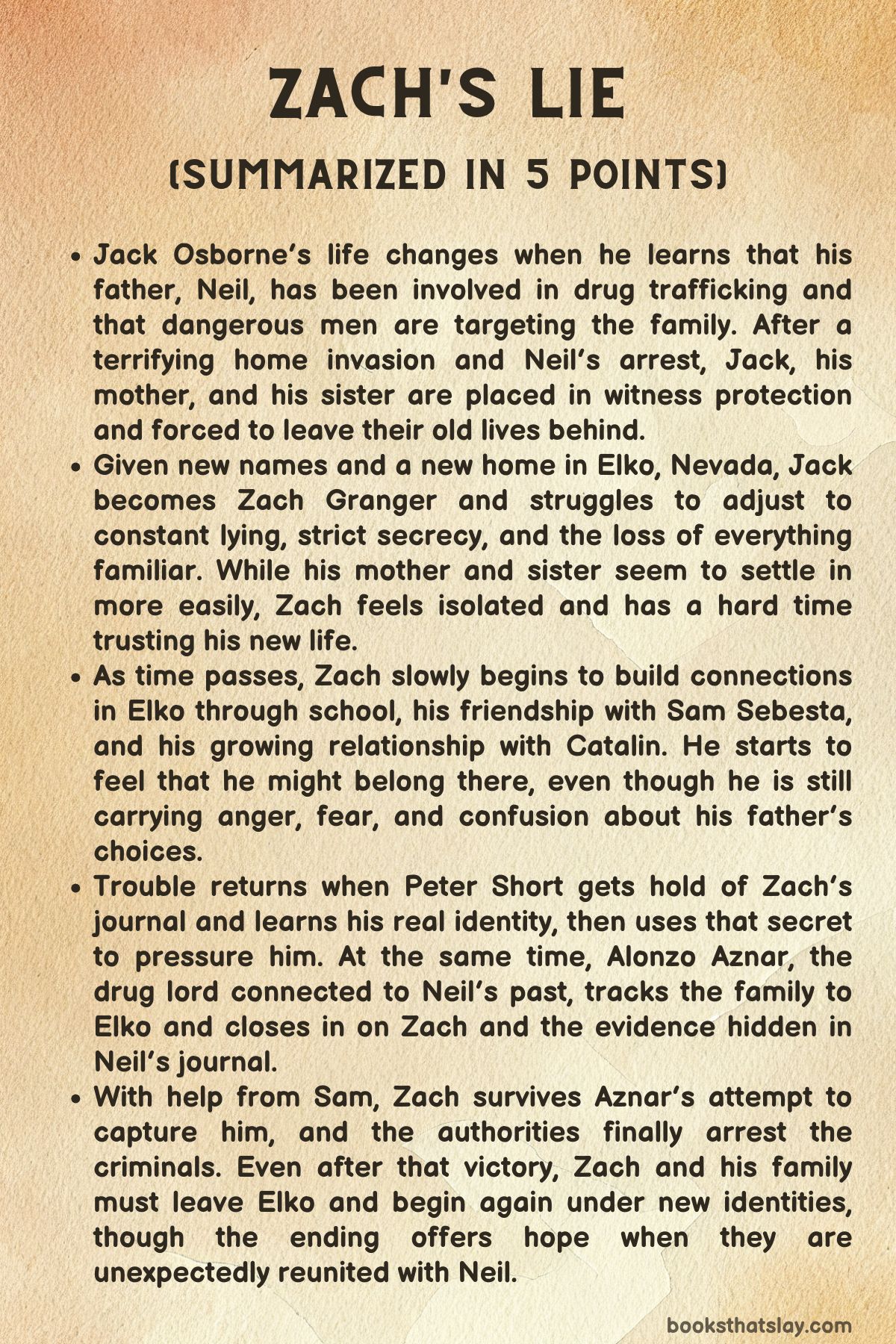
The story centers on Jack Osborne, a 13-year-old boy whose life changes without warning after his father’s criminal ties catch up with the family. At the beginning, Jack, his mother Patricia, and his older sister Joanne are being quietly escorted onto a flight under heavy security.
They are traveling under new identities because they are no longer safe as themselves. Jack is now Zach Granger, though he still feels like Jack and has trouble accepting the false name.
He records his thoughts in a journal, something he has done for years. Writing gives him stability, especially after earlier hardships in his life, including a childhood accident that left him badly injured and led him to rely on reading, writing, and an imaginary companion named Commander IF.
The reason for the family’s sudden disappearance is revealed through Jack’s memories. One night, masked men break into their house, tie up Jack, Joanne, and Patricia, and use them to threaten Jack’s father, Neil.
Soon after, federal agents raid the home and seize the family’s property. Neil has been arrested on drug trafficking charges.
The authorities believe he used his cargo airline business to move drugs across international routes. Patricia is shocked because she did not know the truth about her husband’s work.
Jack struggles to understand how his father, someone he admired deeply, could have placed the family in such danger.
As the pressure grows, Patricia is pushed to choose whom to trust. A smooth defense attorney connected to Neil urges her to stay silent, but Neil later reveals that the lawyer works for Alonzo Aznar, the powerful drug trafficker at the center of the case.
Neil tells Patricia that Aznar’s men are the ones who threatened the family and that the only real chance at survival is cooperation with the government. Neil has decided to help the DEA in exchange for protection for his wife and children.
Patricia, Joanne, and Jack must enter the Witness Security Program. Their home will be sold, their past will be erased, and they will begin again somewhere far away.
Before they leave, the family has one last painful visit with Neil in detention. He admits the truth.
After buying his airline company, he ran into financial trouble. Aznar stepped in with money, and Neil accepted the arrangement even though he knew what Aznar was doing.
At first he justified it to himself, but eventually he realized the damage he had done and turned against Aznar. His confession breaks what remains of Patricia’s trust, yet Jack still loves his father and cannot fully let go of him.
This conflict becomes one of the story’s emotional centers.
The family arrives in Elko, Nevada, where Patricia becomes Mary, Joanne becomes Wanda, and Jack becomes Zach. Their new town feels dry, small, and strange.
They move into a cramped house, and Patricia plans to open a bookstore. Zach feels cut off from his mother and sister, who seem to adjust more quickly than he does.
He misses his old life and continues to think about Neil. He also resents the endless lying required by witness protection.
Every answer about his past must be invented, and every casual conversation is a risk.
As Zach slowly explores Elko, he discovers places that interest him, including the local museum and school auditorium. There he meets Sam Sebesta, the school custodian, who is also a talented musician and stage craftsman.
Sam is perceptive, calm, and kind, and he becomes an important adult figure in Zach’s life. At school, Zach struggles at first.
He does not know how to act like someone with a made-up history, and his awkwardness makes him stand out. Still, he gradually begins to settle in.
A turning point comes when Zach defends a girl named Catalin from a bully named Peter Short. Zach punches Peter and releases a great deal of anger he has been carrying.
Sam helps him afterward by giving him space to work through his feelings rather than punishing him immediately. That moment leads to change.
Other students begin to notice Zach in a better way, and he starts making friends, especially with a boy named Darrell. He also grows close to Catalin, who is curious, thoughtful, and patient with him.
Their relationship becomes one of the few bright parts of his new life.
Zach also becomes involved in work around town. He helps Sam with repairs and spends time at the Nevada Hotel, where Catalin’s family works.
He visits Catalin’s grandfather Benat at a sheep camp in the Ruby Mountains and begins to love the landscape and rhythm of life there. For the first time since the move, Zach feels that Elko could become home.
Yet even as he grows happier, the danger around him is quietly getting closer. Aznar’s people continue searching for the family, and a blank postcard sent by Mary to signal their safety is intercepted.
Their location is discovered.
The central threat tightens because of Zach’s journals. He has kept detailed records of his thoughts and his old life, even though witness protection depends on secrecy.
Peter, already jealous and hostile, gets access to one of the journals and starts reading it. He leaves lines from Zach’s writing on classroom chalkboards to unsettle him.
Zach realizes that someone knows the truth. At home, he discovers one of Neil’s journals hidden in his special box of old notebooks.
Inside are notes, numbers, sketches, and information that appear to expose Aznar’s operation. This makes the danger far greater.
Zach’s missing journal means his identity can be uncovered, and Neil’s journal may be the evidence everyone is hunting.
Peter uses what he knows to blackmail Zach, demanding that he stop seeing Catalin. Zach feels trapped.
He cannot tell the authorities because he cannot reach them, and he cannot explain anything to Catalin without breaking the rules that are supposed to keep everyone safe. Peter, meanwhile, is also desperate in his own unhappy home life.
When Aznar, pretending to be a private investigator, questions him about new families in town, Peter eventually sees a chance to make money. He identifies Zach, and in doing so puts everyone in immediate danger.
As Mary and Wanda travel to Los Angeles for a book convention, Zach stays behind with Sam’s approval. Peter’s actions quickly lead Aznar to the truth.
Sam realizes what is happening after finding signs that dangerous men have entered the Grangers’ house. He also finds Neil’s journal and understands how serious the situation has become.
At last, Zach tells Sam everything. Sam then reveals a hidden history of his own: he once worked as a KGB colonel before defecting to the United States after personal tragedy and disillusionment.
He has lived quietly in Elko for years, hiding from his own past. Because of that history, he understands both secrecy and pursuit better than most people.
Sam takes charge. He moves Zach to Benat’s sheep camp for safety and tries to alert the proper authorities.
But Aznar reaches them anyway, taking Catalin and Benat hostage. He demands Neil’s journal in exchange for their lives.
Sam appears to cooperate, but he is actually setting a trap. He brings Aznar and his henchman to the school auditorium, where he has hidden Zach’s special box beneath the stage and rigged the area using his knowledge of the stage machinery.
When Aznar opens the box, expecting the journal, a heavy punching bag drops onto him through a trapdoor and knocks him out. Sam then overpowers the other criminal.
Federal marshals arrive in time to make the arrests, rescue Peter from Aznar’s plane, and secure the family.
Even after Aznar is captured, Zach cannot stay in Elko. The family must move again because the risk has not fully disappeared.
This is one of the book’s saddest outcomes. Just when Zach has built friendships, found purpose, and fallen in love, he has to leave it all behind.
Before going, he writes a final letter to Catalin. He explains as much as he is allowed to explain and sends her Commander IF, giving away the object that carried so much of his private inner life.
It is both a goodbye and a sign that he is trying to grow beyond the frightened, isolated boy he was.
In the final pages, the family boards another plane under yet another set of identities. Zach is now Mack Greene, and Joanne has become Christine.
Their mother has been helping the government case against Aznar. Then comes the last surprise: the pilot and co-pilot are introduced, and the co-pilot is revealed to be Neil, now under a new identity as well.
The family is reunited, suggesting that after fear, betrayal, and separation, they may finally have a chance to begin again together.
Characters
Zach Osborne / Jack Osborne / Mack Greene
In Zach’s Lie, Zach is the emotional center of the story and the character through whom the reader experiences fear, confusion, anger, and gradual growth. He begins as a boy whose inner life is richer than his outward confidence.
His journals, his attachment to Commander IF, and his habit of observing people closely all show a child who depends on imagination and reflection to make sense of the world. When his family is forced into witness protection, that inwardness becomes both a strength and a weakness.
It helps him endure loss, but it also keeps him isolated. He cannot freely explain himself, and that silence creates distance between him and almost everyone around him.
What makes Zach compelling is that his conflict is not only external. He is not simply hiding from criminals; he is also trying to understand what his father’s betrayal means and what remains of the family he trusted.
He loves Neil deeply, yet he is angry that Neil’s choices destroyed their lives. He wants safety, but he also wants the truth.
He wants to belong in Elko, yet his new identity is built on lies. This tension shapes almost every major decision he makes.
His journals symbolize that struggle. They preserve his past and help him cope, but they also put him in danger because they make it impossible to fully abandon who he was.
Zach’s growth is measured less by dramatic speeches than by his changing responses to other people. At first, he withdraws, mistrusts others, and reacts to events with private resentment.
Over time, he opens himself to friendship, work, responsibility, and affection. His bond with Catalin shows his longing to be known honestly, while his friendship with Darrell shows that he is capable of ordinary teenage connection even under pressure.
By the end, he is still uncertain and still wounded, but he is more self-aware. He understands that identity is not only a name assigned by others.
Even after becoming someone new again, he carries forward the emotional truth of who he has become.
Neil Osborne / Robert Greene
Neil is one of the most morally complex figures in the novel. He is not presented as a monster, yet he is clearly responsible for the chain of danger that engulfs his family.
His crime is not a momentary lapse but a sustained act of compromise. He knowingly enters business with a drug trafficker, accepts money that saves his company, and allows himself to believe he can manage the consequences.
That choice reveals ambition, pride, and a willingness to separate financial survival from moral responsibility. He tells himself that he is preserving his business and his way of life, but the story makes clear that he is also feeding the machinery that later threatens his wife and children.
At the same time, Neil is not written as a flat villain. His love for his family is genuine, and his eventual cooperation with the authorities is not empty self-protection.
He understands that he has made a terrible mistake and that the only decent action left is to help destroy the network he once served. His scenes with Zach are especially important because they show the painful split between fatherly tenderness and unforgivable error.
He is the same man who once built things for his son, encouraged his recovery, and shared family stories, but he is also the man whose choices force that son into a life built on fear and deception.
Neil’s role also raises the question of whether repentance can repair damage. He cannot restore the home his family loses, nor can he protect them from the emotional cost of his actions.
Even when he tries to do right, he does so from a jail cell while others bear the immediate burden. Yet the ending grants him partial redemption by allowing reunion rather than total destruction.
That ending does not erase his guilt. Instead, it suggests that moral failure and love can exist in the same person, and that forgiveness, if it comes, must exist alongside memory rather than instead of it.
Patricia Osborne / Mary Granger / Mrs. Greene
Patricia is the adult who must absorb the shock of betrayal and still keep the family functioning. Her role is especially demanding because she does not have the luxury of emotional collapse.
She has to decide whom to trust, protect her children, endure the truth about her husband, and rebuild a practical life in a new place. She moves from disbelief to action with impressive force.
At first she is stunned by the charges against Neil and by the idea that he kept such a major secret from her. But once she understands the danger, she becomes the person who keeps the family moving forward.
What defines Patricia is not emotional coldness but disciplined survival. She cuts ties, accepts new identities, studies the fabricated backstory required by witness protection, and starts planning a bookstore in a town she never chose.
She cannot afford to indulge nostalgia for long because her children depend on her steadiness. Even so, the story does not hide the cost of that strength.
She is frightened, exhausted, and still deeply hurt by Neil’s deception. Her caution sometimes makes Zach feel controlled, but that tension is realistic.
She is a mother whose terror has made vigilance feel inseparable from love.
Her character also represents the burden of rebuilding after a disaster created by someone else. Neil’s criminal choices force Patricia into a life of consequence even though she did not commit the crime.
She must carry both practical labor and emotional damage. Yet she is not passive or defeated.
By opening a bookstore, making decisions for the family, and eventually helping with testimony, she claims agency within a situation that initially strips it from her. She becomes a figure of endurance, showing that courage can look quiet, managerial, and unspectacular while still holding an entire family together.
Joanne Osborne / Wanda Granger / Christine Greene
Joanne, later Wanda and then Christine, is a striking contrast to Zach because she appears to adapt more quickly to witness protection. She takes to the new identity more easily, builds a social life, finds work, and throws herself into performance.
On the surface, she seems resilient in ways Zach is not. This difference creates tension between the siblings because Zach reads her adjustment as ease, even as a kind of escape.
He envies her confidence and her visible goals, especially since he feels stuck and uncertain while she seems capable of turning reinvention into opportunity.
Yet Joanne’s apparent confidence should not be mistaken for lack of pain. Her refusal to see Neil at one point reveals how deeply she has been hurt.
She processes betrayal through anger and distance rather than through journaling or inward reflection. Her interest in acting is especially meaningful because performance becomes both ambition and shield.
She is a girl forced to play false versions of herself in real life, and the stage gives her a space where performance is at least honest in its own terms. Winning the role in the school musical affirms her talent, but it also shows how much she longs for a future defined by choice rather than by relocation and secrecy.
Her relationship with Zach changes over the course of the story. They begin with a sense of distance, partly because they cope so differently, but later recover warmth and mutual understanding.
Joanne’s emotional confession after her audition is one of the moments that reveals the grief beneath her social ease. She misses her father too, despite her anger.
That complexity makes her more than the adaptable older sister figure. She becomes a portrait of someone who survives by staying in motion, only allowing her vulnerability to appear in rare and private moments.
Sam Sebesta
Sam is one of the most memorable characters because he combines wisdom, mystery, and moral steadiness. At first he appears to be an unusual but grounded local figure: a school custodian, a musician, a stage craftsman, and a man with unexpected knowledge.
His presence gives Zach something he badly needs, which is an adult who sees distress without demanding immediate confession. Sam’s methods are practical.
He gives Zach a punching bag when words are impossible. He offers work, food, and calm conversation.
He does not treat him like a fragile case, yet he also notices when something is wrong.
As the story progresses, Sam becomes much larger than a kindly mentor. His hidden past as a former KGB colonel transforms earlier details about him into signs of deep experience with danger, secrecy, and divided loyalty.
This revelation does not feel decorative; it explains his discipline, his emotional restraint, and his ability to act decisively when the crisis returns. He understands the psychology of hunted people because he has been one himself.
That shared history makes him uniquely capable of helping Zach not just physically but emotionally.
Sam also serves as a moral counterpoint to Neil. Both men have lived compromised lives tied to dangerous systems, but Sam chose to break away after profound loss and has spent years building a life of service rather than self-justification.
He protects children, supports his community, and refuses to disappear again even when threatened. His final actions show intelligence, courage, and self-possession, but his deeper significance lies in what he offers Zach: an example of manhood not built on power, money, or bravado, but on control, loyalty, and care.
Catalin Pasquale
Catalin brings warmth, curiosity, and emotional honesty into Zach’s life at a time when he is nearly suffocated by secrecy. She is not simply a romantic interest placed in the story to soften the tension.
Her role is much more important than that. She represents the possibility of being seen and accepted, which is exactly what Zach cannot allow himself to have fully.
Her attraction to him begins not because he performs confidence well, but because she senses complexity beneath his silence. She notices what he avoids, asks questions that matter, and recognizes that he is carrying more than he says.
Catalin is also a grounded presence in the life of Elko. Through her, Zach enters the world of the Nevada Hotel, her family’s history, and the mountain life connected to Benat.
She belongs deeply to place and family in a way that Zach, as a transplanted witness, cannot. This difference gives their relationship much of its emotional force.
He is drawn not only to her personality but to the stability and rootedness that seem to surround her. She offers a version of belonging that feels real rather than invented.
Her kindness never becomes naivety. She repairs Commander IF without mocking Zach, senses when he is upset, and presses gently against the false boundaries he tries to maintain.
Even when she does not know the truth, she responds to him with intelligence and patience. That makes the ending more painful, because Zach’s departure is not only the loss of a girlfriend but the loss of someone who might have understood him deeply under different circumstances.
Catalin stands for the life he might have built if safety had not required disappearance.
Peter Short
Peter begins as a school bully, but the novel gives him enough context to make him more than a simple antagonist. He is rude, jealous, and reckless, especially in the way he targets Catalin and fixates on Zach.
Yet his cruelty grows from neglect, humiliation, and desperation. His parents ignore him, gamble compulsively, and fail to provide either structure or attention.
He learns manipulation and waiting from that environment, and when he gains access to Zach’s journal, he treats it as leverage because leverage is the only form of power he trusts.
What makes Peter dangerous is not intelligence alone but wounded opportunism. Once he realizes Zach has a secret, he cannot resist using it.
His demand that Zach give up Catalin shows that his motives are personal as well as selfish. He wants to punish Zach for having what he lacks: affection, possibility, and a place within the community.
His cooperation with Aznar begins as greed, but it also reflects a child’s fantasy that one bold move can buy escape from a miserable life. In that sense, Peter is tragic.
He is clever enough to understand the value of information but too immature to understand the full danger of the forces he is inviting in.
Even so, the narrative does not excuse what he does. His actions place multiple lives at risk, and his resentment nearly destroys people who never truly harmed him.
Yet the fact that he ends up captured by Aznar shows how little control he actually had. Peter tries to act like a gambler holding a winning hand, but he is really a neglected boy playing with violence he cannot manage.
He functions as a warning about what emotional abandonment can turn into when it mixes with envy and the desire to matter.
Alonzo Aznar
Alonzo Aznar is the clearest embodiment of external danger in the story. He is powerful, patient, and ruthless, and his threat comes not from loud displays of evil but from his calm certainty that other people’s lives are expendable.
He runs a criminal network built on fear, and he understands how to use lawyers, spies, henchmen, and surveillance to maintain control. Even when Neil begins to cooperate with the authorities, Aznar behaves like a man accustomed to bending reality to his will.
He believes information can be found, witnesses can be silenced, and loyalty can be purchased or forced.
What makes Aznar effective as an antagonist is that he is not chaotic. He is strategic.
He follows emotional weak points, looks for patterns, and exploits carelessness. The family’s relocation does not end his reach because his system is larger than any one arrest.
He also understands vulnerability in others. He manipulates Peter with money, uses hostages efficiently, and treats delay as something to overcome rather than fear.
That cold competence gives the story much of its tension.
At the symbolic level, Aznar represents the long afterlife of immoral choices. Neil may repent, but Aznar remains the form that past guilt takes in the present.
He is the reason witness protection is necessary, the reason Zach cannot tell the truth, and the reason a new life never feels fully secure. His eventual capture matters, but the story is careful not to suggest that one arrest can erase the larger system of fear he stands for.
Even defeated, he leaves behind the fact that innocence, once threatened, cannot return unchanged.
Darrell Gill
Darrell plays a quieter role than some of the major figures, but he is important because he offers Zach a model of everyday friendship. In a story shaped by criminal pursuit and hidden identities, Darrell brings ordinary teenage life back into focus.
He invites Zach over, talks about local habits and gossip, and gives him social entry into Elko. His famous description of the town, that everyone knows everything about everybody, captures both the closeness and the danger of the community.
For Zach, who must survive by hiding, that truth is both funny and frightening.
Darrell’s value lies in his normalcy. He is not mysterious, heroic, or deeply conflicted in the way Sam or Neil are.
Instead, he gives Zach what relocation has taken from him: casual companionship. Through him, Zach is able to laugh, play games, and experience friendship without every interaction carrying heavy emotional stakes.
Darrell also helps normalize Zach’s influence in school, especially when reading becomes socially acceptable among other students.
At the same time, Darrell is not merely comic relief or filler. His openness highlights the contrast between a life lived plainly and one lived under a constructed identity.
Zach must constantly edit himself around him, which makes even friendly moments feel bittersweet. Darrell stands for the ordinary adolescence Zach wants but cannot fully inhabit.
That makes his presence small in scale but large in emotional meaning.
Benat Pasquale
Benat gives the story a sense of heritage, landscape, and continuity. He is tied to the mountain sheep camp, to Basque immigrant history, and to a way of life based on endurance and labor rather than speed or appearance.
To Zach, Benat and his camp represent a kind of freedom that feels honest. Away from school and false biographies, the mountain world offers a simpler rhythm in which Zach briefly imagines another future for himself.
Benat’s physical presence, humor, and competence make him feel rooted in a way that contrasts strongly with the instability of witness protection.
His importance also lies in what he reveals about belonging. Benat is part of a family and cultural tradition that extends across generations and geography.
That depth of connection is exactly what Zach has lost. Spending time with Benat gives Zach access to a world where identity is inherited, practiced, and visible rather than hidden behind invented names.
This helps explain why those scenes are so calming for him.
Benat also deepens the moral world of the story. He is generous without being sentimental, practical without being cold, and brave without spectacle.
When he is later taken hostage, the danger feels especially offensive because it invades not just Zach’s temporary refuge but a place associated with dignity and peace. Benat helps define what is worth protecting: family memory, work, place, and the possibility of a life not ruled by fear.
Themes
Identity as Performance and Survival
In Zach’s Lie, identity is presented as something both deeply personal and externally imposed. Zach, Patricia, and Joanne are given new names, new histories, and new appearances, but those changes do not automatically produce new selves.
The conflict comes from the gap between what they must say and what they actually feel. Every ordinary interaction becomes a performance.
A school introduction, a casual question, even eye color become part of a script meant to preserve life. This makes identity feel unstable and exhausting because survival depends on acting convincingly in a role no one truly chose.
The story also shows that invented identities do not erase emotional truth. Zach remains attached to his old journals because they preserve continuity between past and present.
He fears losing not only his home but the memory of who he was before the lies began. Joanne handles reinvention more smoothly on the surface, while Patricia treats it as practical necessity, but all three are shaped by the same pressure.
The novel suggests that identity cannot be reduced to a name on paper. At the same time, it acknowledges that identity can be reshaped by experience.
Zach does not remain the same boy he was at the start. He changes through fear, love, betrayal, and responsibility, showing that the self is both remembered and remade.
Family, Betrayal, and the Possibility of Repair
Family in the novel is both the source of greatest comfort and deepest wound. Neil’s choices place everyone in danger, so the family’s suffering begins inside the home rather than outside it.
This matters because the betrayal is not abstract. Patricia loses trust in her husband, Joanne responds with anger and distance, and Zach is forced to rethink a father he has admired.
The emotional damage comes not only from criminal threats but from the collapse of certainty. The person who was supposed to protect them is the reason protection is needed.
Yet the story refuses to treat family as permanently broken. Love survives even after trust has been damaged.
Zach remains emotionally tied to Neil despite knowing what he has done. Patricia cannot simply stop caring, even while she is furious and hurt.
Joanne’s anger itself shows how much the bond matters. The narrative treats family not as innocence but as a site of conflict, memory, obligation, and stubborn attachment.
Repair is possible, but it is neither simple nor complete. The ending offers reunion, but it does not erase what came before.
That balance gives the theme weight. Love is not shown as pure or easy.
It is shown as something that can endure guilt, disappointment, and separation while still carrying scars.
Secrecy, Truth, and the Cost of Silence
Secrecy operates on almost every level of the story. The family hides from criminals, the government hides them from the world, Zach hides his past from new friends, Sam hides his history, and Neil once hid the truth about his business from the people closest to him.
This creates a world where silence is often necessary, but never harmless. Secrets protect, yet they also isolate.
Zach cannot form honest relationships because every conversation is shaped by what must not be said. Even when people care for him, he must remain partly absent from their understanding.
The novel does not present truth as easy or automatically liberating either. Neil’s delayed honesty comes only after enormous damage has already been done.
Zach wants to tell Catalin the truth, but doing so could place her in danger. The moral challenge is therefore not simply choosing truth over lies.
It is deciding when truth helps, when silence protects, and when concealment becomes a form of harm. The journals sit at the center of this conflict.
They are records of honest feeling, but they also become dangerous objects because private truth can fall into the wrong hands. The book suggests that secrecy may sometimes be unavoidable, yet it always demands a price.
The hidden self becomes lonely, and the hidden fact always carries the risk of eventual exposure.
Courage as Endurance, Restraint, and Care
Courage in the story is not limited to action scenes or physical confrontation. It often appears as endurance under pressure, emotional restraint, and the willingness to keep caring despite danger.
Patricia shows courage by rebuilding a life while frightened and betrayed. Zach shows it by continuing to attend school, form relationships, and face uncertainty when he would rather retreat.
Sam shows it through calm intelligence and controlled action rather than forceful display. Even Joanne’s pursuit of performance in the middle of upheaval can be read as brave, because it asserts hope in a life disrupted by fear.
This broader idea of courage is important because it resists easy heroics. Zach punching Peter is a dramatic moment, but the deeper forms of bravery in the novel are quieter.
They involve choosing not to collapse, not to surrender moral judgment, and not to let fear define every decision. Sam’s example is especially powerful because he understands danger completely and still refuses to live as if fear should have the final word.
Courage here is not the absence of vulnerability. In fact, it is often inseparable from it.
Characters act bravely precisely because they know what can be lost. That gives the novel a mature moral center.
Heroism is not shown as dominance. It is shown as persistence, self-command, and loyalty to others when retreat would be easier.