The Zookeeper’s Wife: A War Story Summary and Analysis
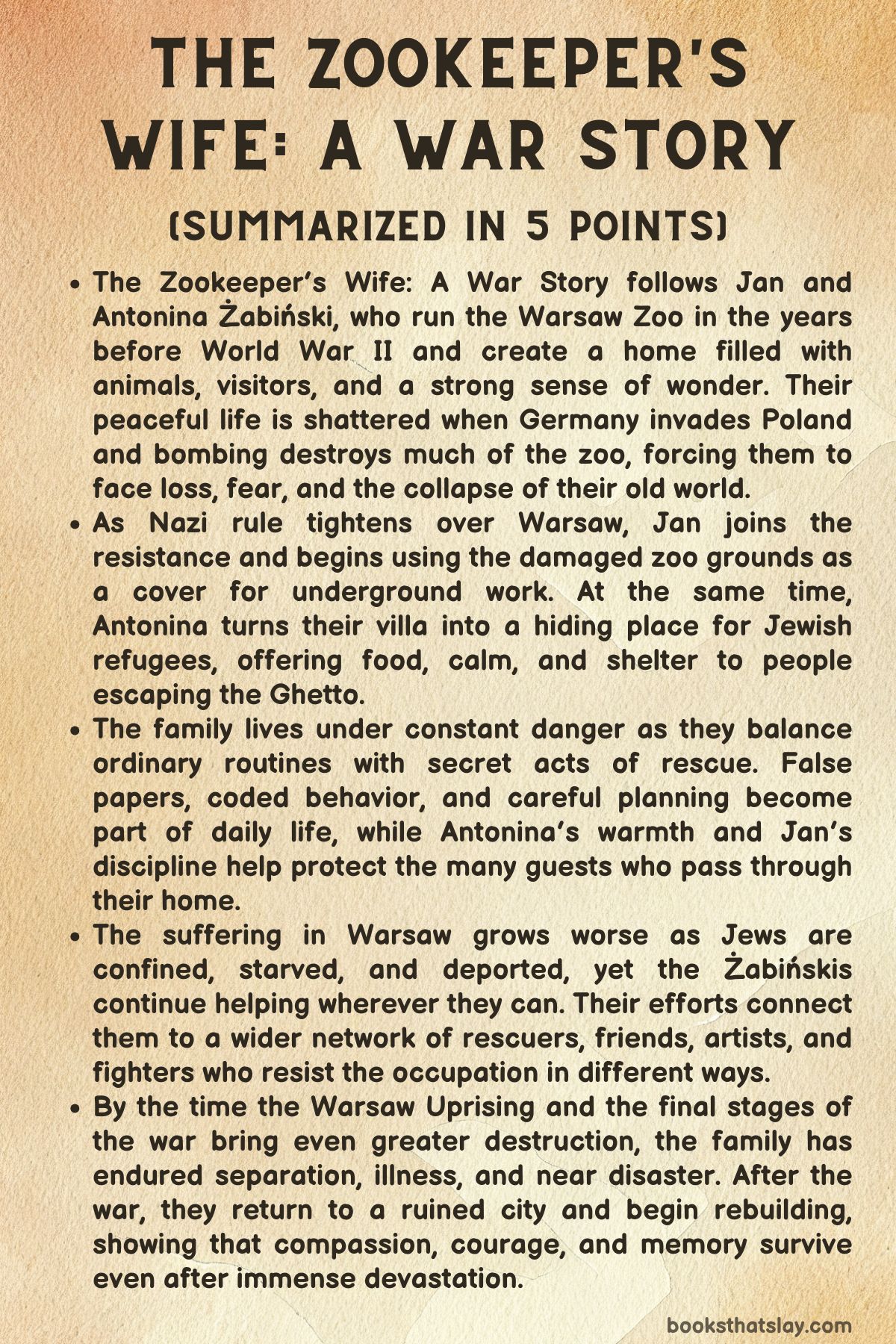
The Zookeeper’s Wife: A War Story is a nonfiction narrative by Diane Ackerman about Jan and Antonina Żabiński, the married couple who ran the Warsaw Zoo before and during World War II. Set against the destruction of Poland under Nazi occupation, the book shows how their home, once filled with animals and visitors, became a refuge for Jews escaping the Warsaw Ghetto.
Ackerman combines historical research with Antonina’s diaries to portray courage in ordinary daily life. The result is both a wartime account and a portrait of two people who used compassion, intelligence, and steady nerve to resist cruelty while protecting others.
Summary
Before the war, Jan and Antonina Żabiński build a lively life at the Warsaw Zoo. Jan, a zoologist with modern ideas, wants animals to live in surroundings that resemble their natural habitats rather than in harsh cages.
Antonina, warm, observant, and unusually gifted with animals, helps turn the zoo into a place that feels welcoming not just to visitors but to the creatures themselves. Their villa becomes a center of activity, filled with animals, artists, friends, and their young son, Ryś.
Warsaw around them is energetic and culturally rich, and the zoo reflects that spirit. It stands as a symbol of curiosity, beauty, and harmony between human and animal life.
That world collapses when Germany invades Poland in September 1939. Bombing strikes Warsaw, and because the zoo lies near military positions, it is heavily damaged.
Animals are killed, buildings are shattered, and the family is separated in the chaos. Jan joins the fighting, while Antonina tries to keep Ryś safe and later returns to face the wreckage.
The destruction of the zoo is one of the book’s defining shocks: a place devoted to care and life is transformed into a landscape of death. When Jan makes it back, he and Antonina realize that survival will now depend on improvisation, restraint, and moral clarity.
As the occupation tightens, the Nazis begin stripping Poland of its institutions, freedom, and leadership. Jews are increasingly isolated, degraded, and then forced into the Warsaw Ghetto under terrible conditions.
The Żabińskis, already facing hunger and uncertainty, begin making choices that place them in direct opposition to the occupation. Jan joins the underground resistance and uses the zoo grounds as a base for secret activity.
At the same time, the family must appear cooperative enough to avoid attracting fatal attention. Their dealings with German officials, including zoo experts linked to Nazi power, are tense and dangerous.
The remaining rare animals are taken away under false promises, another sign that their former life is being systematically erased.
To keep the grounds functioning and to create cover for resistance work, Jan starts a pig farm on the zoo property. This practical decision becomes part of a larger hidden mission.
The zoo, now outwardly reduced and altered, becomes useful precisely because it appears harmless and half-abandoned. Beneath that appearance, it develops into a shelter, meeting point, and passageway.
Jan uses his permits and work assignments to move around Warsaw, carry out sabotage tasks, and help Jews escape the Ghetto. His knowledge of behavior, timing, and risk makes him highly effective.
He knows how to act ordinary when carrying out extraordinary deeds.
Antonina’s role is different but no less central. If Jan opens routes to safety, Antonina makes survival possible once people arrive.
She receives those in hiding as “Guests,” offering food, rest, calm, and a sense of dignity in a world built to erase all three. She learns when to ask questions and when not to.
Silence itself becomes protective. The villa fills with people moving through under assumed names and false papers, along with a changing collection of animals that soften fear and help preserve an atmosphere of domestic normalcy.
Antonina’s instincts allow her to manage terror without spreading it. She can soothe suspicious visitors, calm frightened refugees, and maintain the household under constant strain.
The book also places the Żabińskis within a larger network of rescue. Helpers across Warsaw provide forged documents, hiding places, food, medicine, and routes beyond immediate danger.
The Żabińskis are not isolated heroes but part of a broader community of resistance, though the risks are personal and relentless. Some friends and guests become especially important, including the sculptor Magdalena Gross, whose friendship with Antonina reveals the emotional toll of living in concealment.
Art, music, prayer, and routine appear again and again as ways people preserve identity when everything around them pushes toward despair.
Conditions in the Ghetto worsen steadily. Starvation, disease, overcrowding, and deportations create a reality almost beyond description.
Jan, who had known many Jewish citizens since childhood, is driven by both outrage and loyalty. He uses unusual opportunities, including access gained through professional contacts, to enter the Ghetto and bring people out.
Some escape; many do not. The book never lets rescue become a simple story of victory.
Every success stands beside a larger catastrophe. Treblinka begins receiving deported Jews from Warsaw, and the scale of murder increases drastically.
The Żabińskis continue helping those who remain, including people hidden among the non-Jewish population after mass removals.
Throughout these years, Antonina’s physical weakness at times complicates the effort. During one period she is bedridden and pregnant, yet the work of refuge continues around her.
Those she has cared for begin caring for her in return. This reversal shows how the villa functions not just as a hiding place but as a fragile community.
Meanwhile, Ryś grows up inside this strange mixture of fear, secrecy, animals, and resistance. He befriends guests and underground fighters without always understanding the full weight of events.
His childhood is shaped by abrupt separations, coded behavior, and dangers that adults struggle to soften.
The Warsaw Ghetto Uprising marks a major turning point. Jews who remain fight back against German forces, and the people at the villa follow the news with shock, admiration, and grief.
The uprising does not save the Ghetto, but it stands as a declaration of human resistance against annihilation. Later, as German control weakens and the war shifts, conditions in Warsaw become even more unstable.
Searches intensify, informers threaten hidden Jews, and every contact carries risk. Yet the Żabińskis continue.
Antonina repeatedly shows an ability to steady tense situations, whether dealing with suspicious officers or covering for incidents that could expose the household.
By 1944, the approaching collapse of German power leads the Polish Home Army to launch the Warsaw Uprising. Jan leaves to join the fighting, while Antonina remains at the villa with children, helpers, and lingering uncertainty.
The city erupts into violence. For days and then weeks, she waits for news, trying to protect those around her while German and later Russian forces move through the ruins.
One of the most painful features of this period is helplessness: she cannot know whether Jan is alive, cannot trust any army that enters, and cannot protect her children from fear. Cruelty and absurdity sit side by side, as soldiers threaten lives one moment and demand music the next.
Eventually Antonina and the children are forced to flee. Warsaw is devastated, the uprising crushed, and Jan is missing, later revealed to be wounded and held in a prison camp.
The family survives in exile through the final months of war, suspended between loss and hope. A letter from Jan becomes a lifeline, proof that he is still alive.
When the occupation finally ends, Antonina returns to Warsaw and finds a city in ruins. The zoo compound is damaged, but the villa still stands.
That survival carries symbolic weight. It cannot restore the dead or rebuild the past, but it offers a starting point.
In the aftermath, the book traces what became of those who lived through the villa and of the Żabiński family themselves. Jan eventually returns and helps rebuild the zoo, which reopens with donated animals.
Political life under Soviet influence brings new difficulties, especially for someone linked to the wartime underground, yet he continues his work in zoology and public education. Antonina writes books for children and remains connected to many of the people they saved.
Their son and daughter grow into adulthood, carrying forward memories of a household shaped by danger and unusual courage.
By the end, the Warsaw Zoo stands for more than a place where animals once lived. During the war it became a disguised center of rescue, a home in which kindness had to operate with discipline, secrecy, and nerve.
Ackerman presents Jan and Antonina not as flawless legends but as people who used the tools they had, including professional knowledge, emotional intelligence, and moral resolve, to resist a system built on cruelty. Their story shows how shelter, food, false papers, conversation, and composure can become acts of defiance when the world has turned against human life.
Characters
Antonina Żabińska
Antonina stands at the emotional center of The Zookeeper’s Wife. She is not defined by loud heroism or dramatic declarations, but by steadiness, intuition, and an unusual sensitivity to both human beings and animals.
Before the war, that sensitivity gives the zoo’s home life its warmth and strangeness. She can calm animals, read moods, and create an atmosphere of trust, which makes her far more than the director’s wife.
Once the war begins, those same qualities become essential to survival. Her gift is not simply kindness.
It is the ability to make safety feel real for people who have forgotten what safety is. She receives frightened refugees into the villa, feeds them, shelters them, and preserves their dignity at a time when the outside world is designed to strip it away.
She also understands silence, concealment, and emotional control, all of which are necessary in a house constantly at risk.
Antonina is especially compelling because her strength does not erase her vulnerability. She experiences fear, exhaustion, illness, and despair, yet she continues to function as the moral and domestic anchor of the villa.
Her courage often appears in ordinary acts: setting a table, finding food, soothing a child, distracting a suspicious visitor, or carrying on a conversation as if nothing dangerous is happening. These actions reveal that resistance is not only military or public; it can also be private, domestic, and deeply relational.
She protects life through atmosphere, routine, and emotional intelligence. Her bond with animals also enriches her characterization, because it suggests that her way of seeing the world is based on care rather than domination.
In a time governed by brutality, Antonina preserves tenderness without becoming naïve, and that balance makes her one of the most memorable figures in the narrative.
Jan Żabiński
Jan is driven by action, discipline, and a strong moral instinct. As a zoologist and zoo director, he begins as a man of scientific purpose, ambition, and modern ideas about animal life.
He wants the zoo to reflect freedom and natural order rather than confinement and spectacle. That same practical intelligence shapes his wartime role.
Once the occupation begins, he becomes not only a caretaker of damaged grounds but an organizer, courier, saboteur, and rescuer. He is the figure most directly connected to underground resistance, and he uses every available position, permit, and official task to create opportunities for covert work.
What makes him so effective is his ability to operate in hostile systems without surrendering to them. He can deal with German officials, move through dangerous spaces, and take calculated risks while keeping larger goals in view.
Jan’s character is marked by control. He does not act recklessly, even when his work appears daring.
He studies behavior, plans contingencies, and understands how appearances can mislead. His years with animals seem to have sharpened his ability to read threat, hierarchy, and timing.
Yet he is not a cold strategist. His decision to help Jews is also rooted in loyalty, memory, and outrage at injustice.
He sees the people being persecuted not as abstractions but as neighbors, friends, and fellow citizens. At home, he can appear emotionally restrained, especially beside Antonina’s warmth, but this difference strengthens rather than weakens their partnership.
He creates routes, structures, and possibilities; she turns those possibilities into lived refuge. Jan represents the active, outward-facing side of resistance, the side that depends on nerve, mobility, and precision.
Through him, the narrative shows how courage can be methodical, intelligent, and inseparable from duty.
Ryś Żabiński
Ryś gives the wartime story a child’s perspective without reducing its seriousness. Through him, the reader sees how conflict reshapes childhood rather than simply interrupting it.
He begins as a lively boy who adores animals and participates in the zoo’s daily world with enthusiasm. He is curious, affectionate, and proud of his role among the creatures and routines of the grounds.
Because of this, the destruction of the zoo is also the destruction of his earliest sense of order. Yet Ryś does not become merely a symbol of innocence.
He adapts to danger with the half-understanding available to a child, absorbing secrets, sudden losses, coded behavior, and the unstable presence of hidden guests.
His character is important because he shows how resistance enters family life and education. He learns caution not through theory but through daily necessity.
He encounters refugees, underground fighters, false identities, and moments of fear that adults try but often fail to soften. At times he wants to act directly against the occupiers, revealing the way war can shape a child’s imagination toward violence and bravery at once.
His parents’ need to restrain him shows the tension between youthful impulse and the careful discipline survival requires. Ryś’s friendships, attachments to animals, and emotional reactions to disappearances or separations give the story a quieter sorrow.
He is growing up in a house where affection and secrecy exist side by side. His experiences also reveal the cost of courage to children, who may not carry out the main acts of rescue but must live inside the silence that makes rescue possible.
Magdalena Gross
Magdalena Gross represents the endurance of artistic identity under persecution. As a sculptor and close friend of the family, she is more than a secondary figure passing through a wartime shelter.
Her presence allows the narrative to explore what happens to creativity when a person is hunted, displaced, and forced to move from hiding place to hiding place. Magdalena’s friendship with Antonina is one of the richest emotional relationships in the book because it is based on recognition, trust, and shared endurance.
Antonina does not simply protect her body; she also tries to protect the conditions in which her mind and spirit can still function. Providing clay, conversation, and familiarity becomes a way of preserving her humanity.
Magdalena’s character shows that trauma does not only threaten life in a physical sense; it attacks continuity, concentration, memory, and the ability to imagine a future. She remains intelligent and gifted, but fear narrows existence and changes the meaning of ordinary sounds, habits, and songs.
Her emotional life carries the marks of repeated hiding, repeated escapes, and repeated uncertainty. At the same time, she does not disappear into victimhood.
Her creative practice, however strained, remains a sign of resistance against the attempt to reduce people to hunted bodies. She embodies both fragility and persistence.
Through her, the narrative argues that art is not a luxury separate from survival. In conditions of terror, it can become one of the final proofs that a self still exists beyond fear.
Her bond with Antonina also highlights the importance of female friendship as a form of shelter, loyalty, and moral companionship.
Maurycy Fraenkel
Maurycy Fraenkel is one of the figures through whom the narrative explores fear, adaptation, and the strange performances that survival demands. A musician by temperament and training, he appears as a deeply agreeable man, someone accustomed to order, civility, and compliance.
That disposition becomes dangerous under a regime built on annihilation, because obedience no longer offers protection. His movement from the Ghetto into the villa marks not only a physical escape but a psychological transformation.
He must learn how to improvise, deceive, and inhabit roles that once would have seemed alien to him. In this sense, he represents the ordinary cultivated person forced into acts of theater by a murderous political system.
Maurycy’s scenes often carry tension mixed with absurdity. He can move from panic to performance in an instant, as when he must pretend to be someone he is not in order to avoid discovery.
This ability is not presented as effortless confidence but as the product of necessity. He becomes part of the villa household, and his gradual incorporation into that improvised family shows how refuge changes both hosts and guests.
He also reveals the importance of paperwork, appearances, and social credibility during the occupation. Survival depends not only on hiding in cellars or behind walls, but on passing, speaking, dressing, and behaving in ways that will not attract suspicion.
Maurycy therefore embodies the precariousness of identity under occupation. His intelligence and adaptability become tools for life, but the reader never forgets how unnatural such constant performance is.
He stands for those whose survival required not only luck and help, but the ability to become convincing versions of themselves under impossible pressure.
Lutz Heck
Lutz Heck is one of the most revealing antagonistic figures because he does not appear as a crude monster alone. He is educated, cultivated, and interested in animals, yet fully implicated in the ideology and machinery of Nazism.
That combination matters. He shows how refinement, professional prestige, and scientific language can exist alongside moral corruption.
His interactions with Jan and Antonina are unsettling because he approaches them through the shared world of zoology while standing on the side of occupation, theft, and racial fantasy. He wants the zoo’s surviving animals under the guise of preservation, but his actions expose the predatory logic beneath polite language.
Heck’s fascination with breeding and recovering lost animal lines mirrors the racial obsessions of the regime he serves. Through him, ideas about conservation, species, and ancestry become distorted into fantasies of control and purity.
He is therefore not only a threatening official figure but also a symbolic one. He embodies the way Nazi thought absorbed nature into its own mythology, turning the language of biology into a justification for hierarchy and extermination.
Unlike Antonina and Jan, whose relationship with animals is rooted in care, curiosity, and coexistence, Heck’s relationship is tied to ownership, classification, and power. He helps the narrative show that love of animals does not automatically imply love of life in a wider ethical sense.
In his character, knowledge without conscience becomes dangerous. He is a reminder that culture and expertise can be bent toward inhuman ends when they are detached from moral responsibility.
Dr. Szymon Tenenbaum
Dr. Szymon Tenenbaum adds intellectual and moral gravity to the story through his devotion to knowledge and his tragic refusal to save himself. As an entomologist trapped in the Ghetto, he is linked to a world of close observation, patience, and scientific value.
His vast insect collection represents years of labor, curiosity, and discipline, all of which stand in painful contrast to the chaos and degradation around him. When he entrusts this collection to Jan, the act carries more than practical meaning.
It is an attempt to preserve a life’s work, a legacy of order and understanding, in a historical moment bent on obliteration.
Tenenbaum’s choice not to escape complicates the narrative’s treatment of rescue. Not everyone who might have been saved accepts rescue, and not every refusal can be explained simply.
His attachment to place, identity, scholarship, or inner exhaustion may all play a part. What matters is that he is not portrayed as weak, but as a person shaped by circumstances so brutal that survival itself becomes morally and psychologically complex.
His death, contrasted with the later preservation of part of his collection, creates a painful irony. The man is lost, but fragments of his work endure.
Through Tenenbaum, the narrative reflects on what war destroys besides bodies: it destroys archives, disciplines, habits of study, and systems of meaning built over decades. His character helps show that genocide is also an assault on memory, knowledge, and intellectual continuity.
Teresa Żabińska
Teresa enters the story late, but her significance is larger than the amount of narrative space she occupies. Born during war, she becomes a sign of continuity in a setting dominated by ruin, concealment, and uncertainty.
Her arrival does not erase danger or solve any practical problem, but it alters the emotional atmosphere around the family. In the middle of siege, loss, and exhaustion, a newborn child carries the force of renewal.
She represents time moving forward when history seems trapped in destruction.
Teresa also deepens Antonina’s characterization, because motherhood under occupation becomes even more demanding with an infant in the house. Caring for a baby while hiding guests, managing fear, and living under military threat makes domestic life seem both more fragile and more defiant.
Teresa’s presence asks the reader to consider what it means to raise children where even the future is under assault. She is not developed as a psychologically complex character in the same way as the adults, but symbolically and emotionally she matters.
She embodies survival without memory of the world before catastrophe, a generation that begins within damage rather than after it. Her existence also gives shape to the family’s belief that rebuilding, however difficult, remains possible.
In The Zookeeper’s Wife, even a brief infant presence can carry the meaning of persistence.
Themes
Moral Courage in Ordinary Life
Courage in this narrative is shown less as spectacle than as repetition. It appears in daily choices made under pressure, where the consequences are severe and the rewards uncertain.
The people who resist are not separated from ordinary life; they are cooks, parents, caretakers, scholars, artists, and workers who continue to perform common tasks while quietly opposing a murderous system. This is what gives the theme its force.
Heroism does not arrive in a single grand gesture and then end. It is sustained through routine acts such as offering shelter, carrying messages, producing false documents, baking bread, changing a child’s mood, or speaking calmly to an armed official.
The story insists that moral action can take a domestic form, and that such action may require as much bravery as open combat.
This understanding of courage also challenges romantic versions of resistance. The people involved are afraid, often exhausted, sometimes ill, and never guaranteed success.
They do not act because they feel invulnerable; they act because they decide that fear cannot become their governing principle. Their bravery includes caution, patience, and self-restraint.
It includes knowing when not to speak, when to lie convincingly, and when to appear harmless. That complexity matters because it reveals courage as an ethical discipline rather than a dramatic impulse.
In The Zookeeper’s Wife resistance grows out of the refusal to let brutality define what is normal. That refusal is sustained not by abstract ideals alone but by the stubborn protection of human dignity in the smallest spaces of daily life.
The Thin Line Between Civilization and Barbarity
The narrative repeatedly shows how quickly a cultured, lively city can be transformed into a place ruled by terror, hunger, and organized cruelty. Before the war, Warsaw is presented as energetic, artistic, and intellectually alive, and the zoo itself reflects ideas of beauty, order, and curiosity.
Once the occupation begins, those same social structures are turned inside out. Bureaucracy becomes an instrument of persecution.
Scientific language is used to support racist fantasies. Official decrees regulate starvation and segregation.
Educated men carry out acts of theft, humiliation, and extermination while maintaining the appearance of administrative order. The result is a sharp examination of how fragile civilization can be when ethics collapse.
What makes this theme especially unsettling is that barbarity does not always announce itself through chaos alone. It often arrives dressed in uniforms, documents, schedules, and polished speech.
This is why the book pays attention to the moral failures of cultivated people as well as the suffering of victims. A person may appreciate music, animals, scholarship, or elegance and still participate in atrocity.
The contrast between care and domination runs through the entire story. The zoo, once a place of observation and respect for living creatures, becomes a site of military utility, theft, and covert danger.
The city, once shared by neighbors, becomes divided by walls, passes, and categories of worth. The theme therefore asks a profound question: what prevents a society from turning technical skill and cultural refinement into tools of cruelty?
The answer offered is not confidence in progress, but the necessity of conscience.
Home as Shelter, Performance, and Resistance
Home in this story is never a simple private refuge. The villa at the zoo becomes a place where domestic life and political danger coexist so completely that one cannot be separated from the other.
Rooms that should signify rest become hiding places. Meals become logistical acts.
Furniture, animals, music, and family rituals all take on strategic value. Yet the home is not reduced to camouflage alone.
It remains emotionally real for the people inside it. This dual quality is what makes the theme so rich.
The house is a sanctuary, but it is also a stage on which safety must be performed convincingly. Everyone within it learns to participate in that performance, whether by keeping secrets, controlling expression, or behaving as if nothing unusual is happening.
The idea of home is also expanded beyond architecture. It becomes a set of conditions that allow a person to remain human: food, privacy, tenderness, routine, conversation, and the chance to sleep without immediate terror.
Antonina in particular creates these conditions for others, showing that home can be built through behavior as much as through walls. At the same time, the narrative never lets the reader forget how provisional such shelter is.
A suspicious glance, a wrong visitor, a paper check, or a rumor could turn sanctuary into a trap. This instability gives domestic life unusual intensity.
To set a table or comfort a guest is to resist the world outside, which seeks exposure, degradation, and fear. Home therefore becomes one of the central forms of opposition, a protected moral space sustained within a regime built to destroy such spaces.
Human Identity Under Pressure
One of the most striking concerns of the narrative is how identity changes when survival depends on concealment, improvisation, and constant alertness. People under occupation cannot remain socially legible in the usual ways.
Names are altered, papers forged, accents modified, clothes changed, and gestures monitored. Jewish refugees must often perform identities assigned to them for safety, while rescuers must act innocent, indifferent, or cooperative in front of authority.
This produces a world in which the self becomes both precious and unstable. The question is not only whether a person can survive physically, but whether a core sense of self can endure through endless disguise and fear.
The theme is developed through many kinds of characters. Artists struggle to maintain creativity when constantly uprooted.
Scholars try to preserve collections and intellectual work in a world committed to erasing them. Children absorb codes of secrecy before they can fully understand the reasons for them.
Even those doing the rescuing must divide themselves into public and private roles. Jan is one person at home and another in the streets or in contact with officials.
Antonina turns emotional calm into a form of protective labor, even when she herself is frightened. These shifts do not mean that identity disappears.
Rather, identity becomes something defended inwardly when outward expression is dangerous. The story suggests that personhood survives not through fixed social labels but through memory, loyalty, ethical choice, and attachment.
Under extreme pressure, the self may be forced into disguise, but it is not wholly surrendered unless fear or power succeeds in breaking moral continuity.