Zeitoun Summary and Analysis
Zeitoun is a nonfiction book by Dave Eggers that tells the story of Abdulrahman Zeitoun, a Syrian American contractor living in New Orleans, during and after Hurricane Katrina. It begins as a portrait of family life, work, faith, and routine, then gradually becomes a record of disaster, separation, and state failure.
Through Zeitoun, his wife Kathy, and their children, the book shows how quickly ordinary life can be overturned by a storm and by the systems meant to protect people. It is both a personal account of survival and a broader look at race, religion, power, and justice in the United States after Katrina.
Summary
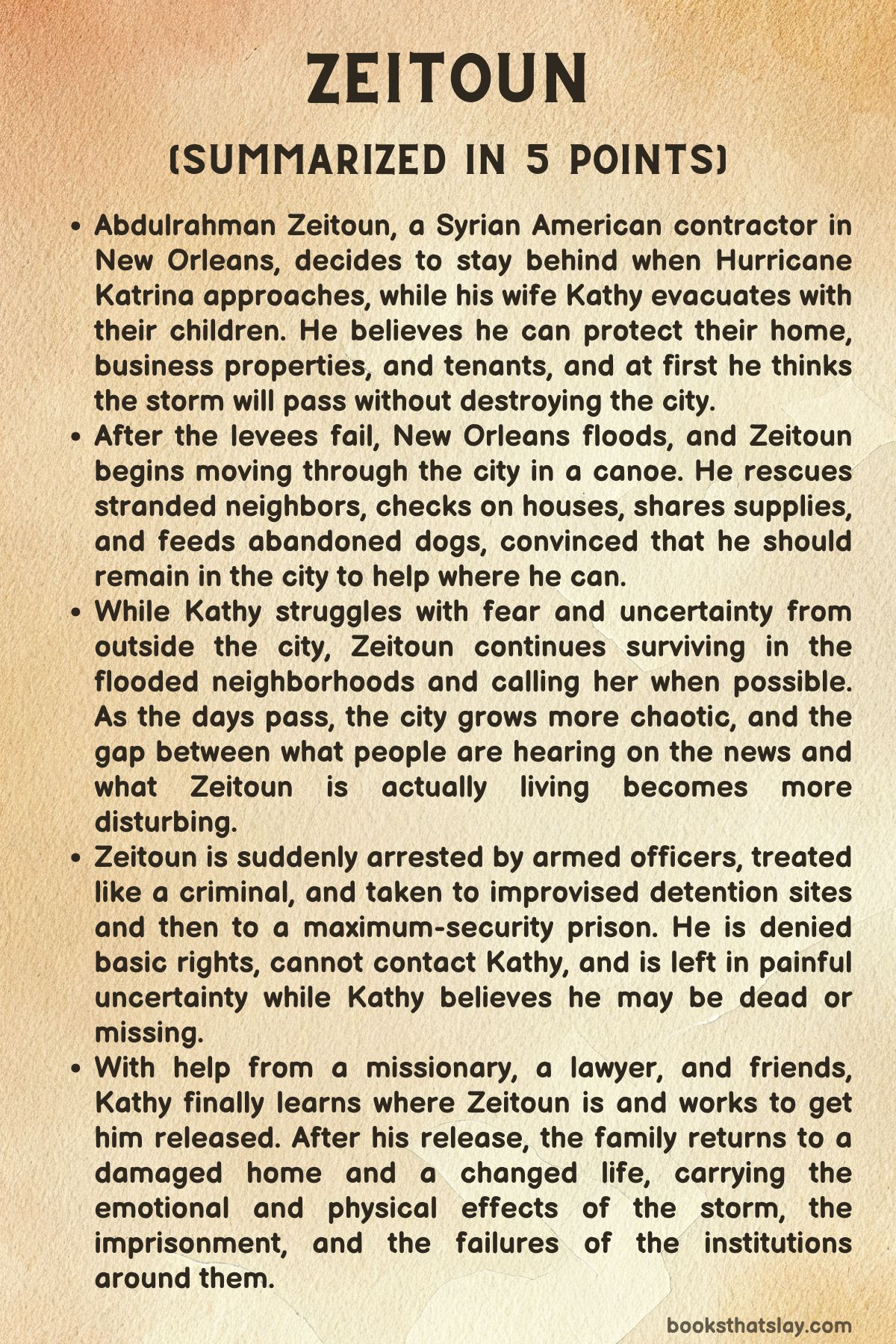
Zeitoun follows Abdulrahman Zeitoun and his wife Kathy in the days just before Hurricane Katrina strikes New Orleans. Their life at first appears steady and full: they run a painting and contracting business, raise four children, manage rental properties, and move through the rhythms of family, work, and faith.
Zeitoun is calm, practical, and used to storms. Kathy is more alert to danger and more easily shaken by the warnings on television and radio.
As Katrina grows stronger, their different instincts become more visible. Kathy wants the family to evacuate.
Zeitoun believes the storm will pass like others before it and feels responsible for protecting their homes, worksites, tools, and tenants.
Kathy eventually leaves New Orleans with the children and heads to Baton Rouge, expecting the separation to be brief. Zeitoun stays behind, convinced that he can manage whatever comes.
Their parting is tense but not dramatic. Both assume they will speak soon and reunite quickly.
Even after the hurricane hits, Zeitoun initially thinks the city has escaped the worst. He checks the damage, notices flooding in the streets, and believes the danger is already fading.
But when he wakes the next day and hears the sound of rushing water, he realizes something far worse has happened. The levees have failed, and water is pouring into the city.
As the flood rises, Zeitoun moves valuables to the second floor of his house and prepares to survive. He ties a canoe to the porch, watches the water swallow the lower level of the home, and begins living in a tent on the roof.
The neighborhood becomes almost unreal: silent, half-drowned, and abandoned, broken only by the cries of stranded people and animals. Rather than flee, Zeitoun takes to the water in his canoe and starts moving through the flooded streets.
He checks on neighbors, rental properties, and anyone who may need help.
What follows is a series of acts that define his role in the disaster. He finds elderly residents trapped in their homes, hears cries for help, and works to get stranded people rescued.
Sometimes officials ignore him. Sometimes volunteers in small boats help where formal authority does not.
He brings food and water to those he finds, checks on buildings for friends, and keeps paddling through a city that feels cut off from normal law and order. His builder’s eye notices structural damage everywhere, but his moral attention keeps turning toward human need.
Animals become an important part of what he sees. He hears dogs barking from upper floors and enters flooded houses to free and feed them.
These scenes matter because they show the scale of abandonment around him. The city is not only full of ruined houses and stranded people, but also of living creatures left to starve.
Zeitoun returns repeatedly to care for these dogs, bringing them food and water even when his own situation is precarious. These actions deepen the picture of him as someone who feels called to remain because help is needed.
Meanwhile, Kathy’s experience is one of distance, fear, and helplessness. From Baton Rouge she tries to follow the news, but the reports are chaotic and extreme.
Stories of violence, lawlessness, armed gangs, and rising death tolls fill the air. She struggles to decide what to believe.
She is also under strain from family tensions and from the difficulty of being displaced with children. Eventually she leaves Louisiana and heads west, trying to find safer and calmer shelter with people she trusts.
Even as she moves farther from New Orleans, her anxiety increases because Zeitoun remains there, and she cannot control what is happening to him.
The daily noon phone calls between husband and wife become one of the book’s anchors. Kathy waits for them with dread and relief.
Zeitoun speaks calmly, often downplaying the danger, and insists he is where he needs to be. He describes helping others, checking houses, and surviving.
Kathy urges him again and again to leave the city, but he refuses. He believes he still has work to do.
He also believes, with growing conviction, that his presence there has meaning. His endurance begins to feel to him like a test of purpose as much as a matter of stubbornness.
As the days pass, however, the city becomes darker and more unstable. Zeitoun sees armed men, encounters scenes of death, and realizes that the public story of order being restored is not matching what he experiences.
He finds dead animals, witnesses the neglect of whole groups of people, and becomes increasingly aware that ordinary protections have broken down. Still, he stays.
He shares food with other men who have remained behind, prays, remembers his childhood in Syria and his years at sea, and thinks often of his family.
Then the story takes a sharp turn. At one of the houses he is using, armed men suddenly enter.
They appear to be law enforcement, though their authority is murky and their behavior unsettling. Zeitoun, along with several others, is detained.
At first he assumes this is a forced evacuation and that any confusion will soon be cleared up. Instead, he is treated as a suspect.
Officers refer to the prisoners in terms that connect them to terrorism. Without any clear explanation of charges, he is searched, humiliated, and taken to a makeshift outdoor jail.
Inside the improvised prison, Zeitoun enters a world of cages, rough treatment, uncertainty, and fear. He is denied basic information and denied contact with Kathy.
Food is often inedible for him because it contains pork. His pain from injuries and illness is ignored.
Guards use force casually. Pepper spray, intimidation, and degradation become part of daily life.
He and another Syrian man, Nasser, begin to suspect they are being viewed with special suspicion because of their background. Zeitoun’s earlier confidence in the fairness of the system starts to collapse.
He is later transferred to a maximum-security prison, where the confinement continues. He remains cut off from his wife and children.
Kathy, having no idea where he is, begins to believe he may be dead. She contacts shelters, aid organizations, media outlets, and anyone who might help.
Friends and relatives call constantly. Her daughters absorb the fear around them, and the strain begins to affect them physically and emotionally.
Kathy’s panic grows as day after day passes with no word. The storm that first threatened the family becomes, in this period, something larger: a disappearance inside the machinery of the state.
Zeitoun in prison becomes increasingly reflective. He thinks about the choices that led him there, about pride, faith, race, and his belief that good actions would protect him.
He begins to see that his confidence in being judged fairly was misplaced. Yet he still searches for some opening, some decent person who will carry a message to Kathy.
Finally, a missionary agrees to take down his information. That small act becomes the first break in the silence.
Once Kathy learns that Zeitoun is alive and imprisoned, the story shifts toward legal struggle and release. Bureaucracy remains cold and obstructive.
Information is hard to obtain. Hearing dates move or disappear.
Offices refuse to answer basic questions. Kathy, with the help of a lawyer and friends, travels back to Louisiana and begins the exhausting process of getting him out.
Even when release seems close, delays and paperwork keep him inside longer. When they finally reunite, the emotional damage is obvious.
He is physically diminished and inwardly changed.
The final portion of Zeitoun looks at the years after Katrina. The family returns to a damaged city and a damaged home.
Much of what Zeitoun tried to protect has been lost anyway. The dogs he fed did not survive.
Their office is ruined. FEMA’s help is slow, mismanaged, and at times absurd.
Kathy begins suffering from post-traumatic stress, memory loss, and physical symptoms linked to what the family endured. The couple eventually pursues legal action and learns more about the misconduct and disorder behind Zeitoun’s arrest.
Even so, the book does not end only in defeat. The Zeitouns rebuild their house, continue working, expand their property holdings, and welcome another child into the family.
Yet the recovery is not simple or clean. The damage remains in memory, in health, and in trust.
Zeitoun closes as a story about survival after catastrophe, but also as an account of what happens when disaster exposes deeper failures already present in a society.
Key Figures and People
In Zeitoun, the figures are drawn with a strong sense of moral pressure, private memory, and lived experience. They are not arranged as simple heroes or villains.
Instead, each person is shaped by disaster, by institutions, by family history, and by the choices they make when ordinary life breaks apart.
Abdulrahman Zeitoun
Abdulrahman Zeitoun stands at the center of the narrative as a man defined by discipline, endurance, pride, and a deep sense of responsibility. Before the storm, he appears as a capable contractor, husband, father, and landlord who sees himself as a protector of what he has built.
His confidence comes not only from his practical skills but also from his life history. He has known hard labor, danger at sea, immigration, and the long effort of building a stable life in America.
That background gives him unusual calm in the face of Katrina’s early warnings. He does not think of himself as reckless.
He thinks of himself as experienced, useful, and prepared. This is one of the most important tensions in his character: the same qualities that make him admirable also lead him into danger.
His attachment to work is central to who he is. He does not treat houses, job sites, and rental properties as mere assets.
They represent labor, care, and identity. Staying behind in New Orleans is therefore not simply a practical decision; it is also a declaration of who he believes himself to be.
He is the kind of man who remains when others leave, who fixes what can be fixed, and who takes responsibility seriously. That self-image grows stronger once the city floods.
In the canoe, moving through ruined neighborhoods, rescuing stranded residents, feeding abandoned dogs, and checking on homes, he experiences himself as someone with a mission. He is useful in a world where official structures have failed.
His acts are often quiet and unannounced, which gives them moral weight. He does not help people for praise, though he does carry a private wish that his family, especially his accomplished siblings, will see his value clearly.
Zeitoun is also marked by faith, but his faith is not presented as loud or self-congratulatory. It shapes his habits, his endurance, his prayers, and his sense that human life has order beyond visible chaos.
At times, this faith steadies him. At other times, it feeds his conviction that he is meant to remain in the city, even when reason suggests he should leave.
His spiritual confidence is therefore double-edged. It gives him strength, but it can also make him overestimate his place in unfolding events.
Later, in prison, he begins to question whether he confused purpose with pride. That self-questioning adds depth to him.
He is not frozen in one moral pose. He becomes a man forced to examine his own motives under extreme pressure.
His imprisonment reveals the most painful dimension of his character. Until then, he has believed that if he behaves honorably, works hard, and does good, he will be treated fairly.
His arrest begins to destroy that belief. He is stripped not only of freedom but of social identity.
The contractor, husband, rescuer, and property owner is reduced to a body in a cage. Because he is Arab and Muslim, he becomes vulnerable to suspicion that has little to do with his actual conduct.
His dignity is attacked through humiliation, silence, and arbitrary authority. What makes this tragic is that he remains, even then, fundamentally reasonable.
He keeps expecting explanation, procedure, and correction. The system’s refusal to provide these things wounds him at a very deep level.
By the end, he is still strong, but he is changed. His faith in the moral logic of the country around him has been damaged, and his sorrow lingers in ways even medical tests cannot measure.
Kathy Zeitoun
Kathy is one of the most fully developed characters in the narrative because she carries both emotional intensity and intellectual clarity. She is not simply the anxious spouse waiting for news.
She is a woman with her own history, convictions, and strength, and the story gives serious attention to the experiences that formed her. Her conversion to Islam is one of the clearest examples of this.
It is not shown as impulsive or decorative. It comes out of deep dissatisfaction, spiritual searching, and disillusionment with religious hypocrisy.
That history matters because it helps explain why she is both deeply committed and fiercely independent. She has already made difficult choices against social expectation before Katrina arrives.
Kathy’s love for her family is active rather than sentimental. She is the emotional organizer of the household, the person who keeps the children moving, manages business responsibilities, handles practical details, and interprets threats quickly.
She recognizes danger earlier than Zeitoun does, and her instinct to evacuate reveals her realism. Where he trusts experience and self-reliance, she trusts warning signs and probability.
This difference does not make her fearful in any shallow sense. It shows her capacity to respond to risk without romanticizing endurance.
In this way, she becomes a counterweight to her husband’s stubbornness. She sees that devotion to property and duty can become self-destructive when conditions cross a certain line.
Her displacement after the storm becomes an ordeal of a different kind. She is physically safe compared to Zeitoun, but emotionally trapped in uncertainty.
What makes her suffering especially painful is the absence of reliable information. She is forced to imagine possibilities without knowing which are real.
News reports, rumors, official confusion, and family questions all crowd her mind. She tries to protect the children while she herself is breaking apart.
This produces one of the most human parts of her characterization: she is loving, but she becomes exhausted; she wants to reassure, but she cannot control her panic; she tries to stay composed, but grief and fear erupt in unexpected moments. The narrative allows her to be strong without pretending that strength cancels psychological cost.
Kathy also becomes a figure through whom the book studies Muslim identity in America, especially for women. Her memories of hostility toward her hijab, of casual public prejudice, and of religious misunderstanding prepare the reader to understand the larger climate in which Zeitoun’s arrest occurs.
She knows from experience that people project fantasies onto visible Muslim identity. Her concern for her husband is therefore not limited to floodwaters or violence in the streets.
She senses that state power itself may be dangerous to him. That intuition proves tragically accurate.
After the reunion, Kathy remains one of the clearest indicators of long-term trauma. She does not simply “move on.” Her memory loss, bodily symptoms, and emotional dislocation show that survival is not the same as recovery.
She is forced to carry administrative burdens, legal battles, rebuilding work, and family care while also processing terror and helplessness. This makes her one of the most resilient figures in the book, but also one of the most wounded.
In Zeitoun, she emerges as a character whose insight, devotion, and suffering are as central to the story’s meaning as her husband’s visible ordeal.
Nademah Zeitoun
Nademah, the eldest daughter, represents the way children absorb adult crisis even when adults try to shield them. She is old enough to notice news coverage, ask questions, and sense the seriousness of Katrina before younger children fully grasp it.
Her presence in the early domestic scenes helps establish the family’s ordinary tenderness, but as events grow darker, she becomes part of the emotional field through which the disaster is measured. She listens, worries, watches her mother’s reactions, and takes in far more than adults intend.
She also serves as a subtle bridge between the parents’ two emotional worlds. Her concern reflects Kathy’s alertness, while her trust in family routine reflects the secure home her parents have built.
Once Zeitoun disappears, the children’s confusion becomes a silent accusation against the adult world. Nademah’s prayers and questions show that the disaster is not only physical or political.
It reaches into a child’s developing understanding of safety, truth, and parental reliability.
Aisha Zeitoun
Aisha is portrayed with heartbreaking vulnerability. Her distress over her father’s disappearance becomes one of the clearest signs of how deeply catastrophe enters the body.
Her hair loss is especially significant because it makes emotional trauma visible. She cannot process events in the abstract language adults use.
Instead, fear appears physically and immediately. Through her, the story shows that children do not need full information to suffer the effects of uncertainty.
They read tone, absence, broken routine, and parental distress with extraordinary sensitivity.
At the same time, Aisha’s suffering also intensifies the moral stakes of the narrative. Zeitoun’s imprisonment is not only an injustice to one man.
It radiates outward through his family, touching children who have no role in the events but who must live with the consequences. Aisha’s pain turns private bureaucratic abuse into something intimate and irreversible.
Ahmad Zeitoun
Ahmad, Zeitoun’s brother, is an important presence even when he is physically distant. Living abroad and working as a ship captain, he represents family continuity, worldly experience, and protective loyalty.
He is one of the first people to understand the seriousness of the storm, and his repeated calls create a pattern of concern that contrasts with Zeitoun’s confidence. Ahmad is not merely a worried relative.
He often appears almost as a guardian figure, someone who sees the larger picture from outside and tries to intervene before disaster deepens.
His importance is also symbolic. The bond between the brothers connects New Orleans to Syria, the present to childhood, and the flooded city to the seafaring life that shaped Zeitoun.
Ahmad knows his brother’s strengths but also his blind spots. When he urges him to leave, the plea carries special force because it comes from someone formed by the same family history.
Later, when he works from afar to locate him, he becomes a model of familial persistence in the face of institutional indifference.
Mohammed Zeitoun
Mohammed, the dead brother, is a memory that continues to shape Abdulrahman’s inner life. His status as a celebrated ocean swimmer gives him an almost legendary stature in family memory.
He represents excellence, aspiration, and the idea that one person’s gifts can expand the horizon of an entire family. His death leaves a wound that never really closes, and his presence in photographs and recollections keeps grief active in the narrative.
What makes Mohammed significant is that he is not only mourned; he functions as a measure. Abdulrahman often thinks in relation to achievement, honor, and family standing.
Mohammed’s greatness helps explain why he wants his own acts of courage and service to matter. The memory of this brother adds emotional depth to Abdulrahman’s drive, pride, and longing for recognition.
Nasser Dayoob
Nasser is one of the clearest companions to Zeitoun during the flood, and his role helps reveal sides of Zeitoun that might otherwise remain hidden. Also Syrian, displaced by the flood, and surviving in improvised ways, Nasser shares both cultural familiarity and immediate practical need.
His presence relieves Zeitoun’s isolation. The two men pray together, travel together, assess damage together, and try to make sense of a collapsing city through shared experience.
Nasser’s character is quieter and less sharply individualized than Zeitoun’s, but that is part of his function. He stands as a mirror and witness.
Through him, the reader sees how solidarity can form quickly in crisis. At the same time, the fact that both men are later singled out and treated with suspicion underscores how ethnicity and religion shape vulnerability in the aftermath.
Nasser’s companionship makes the later imprisonment even more bitter, because the humane fellowship of the flooded city is replaced by the dehumanizing logic of detention.
Todd Gambino
Todd at first seems like a marginal figure, but he grows into an important example of how crisis can alter moral perception. Zeitoun initially sees him as somewhat unreliable, perhaps a drifter, not a man of particular consequence.
Yet in the flood Todd proves resourceful, brave, and generous. His small motorboat becomes essential in helping evacuate people whom the authorities fail to assist.
He acts where official systems stall.
Todd’s importance lies partly in how he changes Zeitoun’s judgment. Disaster strips away social assumptions and reveals character through action.
Todd’s decency is not polished or ceremonial; it is practical and immediate. He helps because help is needed.
Later, his arrest alongside the others shows that in the world of militarized confusion, real service offers no protection. His presence strengthens the argument that the authorities are not sorting guilty from innocent but sweeping up people without care or justice.
Frank Noland
Frank Noland enters the story as a neighbor whose losses are immediate and concrete. His ruined truck and submerged property show the ordinary personal devastation of the flood.
Yet he is more than a symbol of damage. By joining Zeitoun in the canoe, he becomes part of the improvised civilian response that emerges when institutions fail.
He helps search for stranded residents, shares information, and works in a spirit of cooperation.
Frank’s character is useful because he grounds the narrative in neighborhood reality. The flood is not only a media event or government failure; it is also a local crisis faced by people who know one another’s streets, houses, and habits.
His partnership with Zeitoun suggests a temporary civic community built from proximity, trust, and shared need.
Ronnie
Ronnie appears later and more briefly, but his role is telling. He uses the phone at the Claiborne house, benefiting from the small islands of functionality that remain in the broken city.
He is one of several figures who show how survival often depends on informal sharing rather than official aid. His presence complicates the idea of property and possession in disaster.
Zeitoun does not fully want to send him away because need has altered the normal rules of privacy and ownership.
Ronnie’s importance lies in that moral ambiguity. He is not a close friend, but neither is he a threat.
He is simply one more person trying to get through a situation in which all ordinary structures have fractured. His presence reminds the reader that disaster creates temporary communities of necessity.
Alvin and the Williamses
The elderly couple, especially Alvin with his wheelchair, embody the terrifying vulnerability of those who cannot self-evacuate. Their dependence on others makes visible the human cost of failed emergency planning.
They are not developed through extensive backstory, but they do not need to be. Their significance comes from the way they expose the limits of self-help rhetoric.
No amount of personal responsibility can solve the problem of immobility in a flooded city without functioning rescue systems.
Their treatment also reveals the gap between promise and action. Zeitoun secures assurances that they will be rescued, yet the rescue does not happen on time.
This failure deepens the book’s criticism of official response. The Williamses stand for those left waiting while bureaucratic authority performs competence without delivering it.
Yuko
Yuko is one of the most stabilizing figures in Kathy’s life. Her friendship reaches back before the storm and connects directly to Kathy’s religious journey.
Because of that history, Yuko represents trust that predates the catastrophe. She is not merely a helpful friend who offers shelter.
She is one of the few people who can speak to Kathy with authority, tenderness, and credibility. When Kathy begins spiraling under the pressure of news and uncertainty, Yuko provides practical intervention rather than empty comfort.
Her role also shows the value of chosen family. Blood relatives are present in the narrative, but support does not always come most fully from them.
Yuko offers a form of friendship rooted in long knowledge, moral seriousness, and action. She helps transform panic into survival, even if she cannot remove the pain.
Ahmaad
Ahmaad, Yuko’s husband, serves as a figure of steady assistance during displacement. He drives Kathy and the children across long distances and helps create physical safety when emotional safety is impossible.
His importance lies in his reliability. He does not dominate scenes or speeches, but he acts decisively.
In a narrative full of failing systems and absent answers, people like Ahmaad matter because they show what ordinary, competent care looks like.
Mary and Mary Ann
These two women illuminate different social pressures on Kathy. Mary, who offers refuge in Arizona, represents hospitality, understanding, and religious kinship.
She gives Kathy a place where she does not need to explain herself in the middle of crisis. Mary Ann, by contrast, reflects the painful persistence of family judgment.
Her criticism and refusal to help sharpen the sense that catastrophe does not erase older tensions; in some cases it intensifies them. Through these women, the narrative shows that displacement can expose both generosity and narrowness within one’s social world.
Adnan and Abeer
Adnan and Abeer appear as friends linked to mobility, shelter, and support during the scattered geography of the storm’s aftermath. Their importance grows later when Kathy needs help in Louisiana while trying to free her husband.
They are part of the network of practical care that makes survival possible. Abeer’s pregnancy adds another layer of fragility to the broader atmosphere of dislocation.
Together, they represent friendship under strain: not dramatic, but essential.
Raleigh
Raleigh, the lawyer, is one of the few figures who can confront the prison system with procedural tools. He is not idealized.
He can be difficult to reach, and his work unfolds within a deeply broken structure. Still, he represents the possibility that formal knowledge can be used against bureaucratic injustice rather than in service of it.
His role is especially important because he transforms Kathy’s desperation into action. He becomes a translator of a system designed to exclude ordinary people from understanding it.
Raleigh’s value lies less in heroic personality than in function. He helps reveal how inaccessible legal processes are to families in crisis.
Without someone like him, Zeitoun might have remained buried even longer within the machinery of detention.
The Missionary
The missionary is a brief but crucial figure because he embodies the power of a small moral choice. Many people in positions of authority ignore Zeitoun, dismiss him, or deny him the most basic human consideration.
The missionary, though hesitant at first, eventually listens and carries a message outward. That act breaks the sealed world of prison silence.
In narrative terms, he is the person who reconnects the disappeared man to the world of family and law.
His presence matters because he is not powerful in the institutional sense. He changes events through willingness rather than rank.
This makes him a reminder that human decency can survive inside corrupted systems, even if only in fragile, partial ways.
Donald Lima and Ralph Gonzales
These officers become important later because they reveal the moral confusion of the law-enforcement response. They are not drawn as grand masterminds but as men operating inside a system where legality, panic, and abuse have become mixed together.
Their actions and later admissions expose how easily authority can justify theft, vandalism, and arbitrary detention when wrapped in the language of emergency. They complicate the story by showing that corruption does not always announce itself as hatred.
It can also appear as routine opportunism and unexamined obedience.
Their significance lies in what they uncover about institutions. Even when prejudice is not the only motive, the result is still injustice.
Their conduct helps explain why the legal system in the aftermath feels less like a source of order and more like a force of chaos wearing official clothing.
The Guards, Soldiers, and Prison Officials
Though many remain unnamed, these figures function collectively as the face of impersonal power. They are not characterized through deep inner life, and that is fitting.
From Zeitoun’s perspective, they often appear as shifting embodiments of force: armed, inconsistent, dismissive, and shielded by uniform. Their refusal to explain charges, provide calls, respect religious needs, or respond to pain creates the atmosphere of terror that defines the prison sections.
What makes them powerful as a collective character is their ordinariness. They do not need to be monsters in order to do grave harm.
Their routine contempt, laziness, suspicion, and obedience are enough. Through them, the narrative shows how dehumanization often works: not only through spectacular cruelty, but through repetition, indifference, and the confidence that no one will be held accountable.
Themes
In Zeitoun, the major themes emerge through lived crisis rather than abstract statement. The story uses disaster, family separation, imprisonment, faith, and rebuilding to examine how private lives are shaped by larger systems of power and belief.
The Collapse of Institutional Trust
The storm damages buildings and roads, but the deeper destruction comes from the failure of institutions that are supposed to protect human life. Emergency systems, law enforcement, prisons, and relief agencies repeatedly appear disorganized, indifferent, or openly abusive.
People are stranded while officials pass by. Rescue promises are made and then broken.
Innocent men are detained without explanation. Families cannot get basic information.
Bureaucratic procedure becomes a wall rather than a path toward justice. What makes this theme especially strong is that the breakdown does not look like simple absence.
Authority is everywhere: helicopters, soldiers, prisons, guards, officials, forms, hearings. Yet the presence of authority does not produce safety.
It often produces confusion, humiliation, and fear. The story suggests that institutions can fail not only by doing too little, but also by acting without moral clarity, transparency, or accountability.
Disaster becomes the moment when hidden weaknesses are exposed, and ordinary citizens discover that the structures they trusted may not recognize their humanity when it matters most.
Faith, Purpose, and Human Limits
Faith shapes daily life, but it also shapes how suffering is interpreted. For Abdulrahman, prayer and belief provide steadiness, meaning, and a framework for endurance.
He does not see himself as surviving randomly. He believes life has order and that his presence in the flooded city may serve a purpose.
That conviction helps him rescue neighbors, care for abandoned animals, and resist despair. At the same time, the narrative refuses to romanticize faith as simple certainty.
His sense of mission becomes entangled with stubbornness and pride. In prison, he begins to wonder whether he misread his role, whether he mistook usefulness for invulnerability.
Kathy’s faith is also tested, though in a different way. Her trial is not heroic action in the city but helpless waiting, fear, and the struggle to keep her family emotionally intact.
The theme becomes powerful because faith is shown neither as a neat answer nor as a hollow ornament. It is a source of strength, but it does not prevent catastrophe.
Instead, it shapes how characters bear suffering, question themselves, and continue living after illusions have been stripped away.
Home, Work, and the Meaning of Responsibility
Houses in the story are never just buildings. They hold labor, memory, family identity, income, and a sense of place.
Abdulrahman’s decision to stay in New Orleans is tied to his understanding of responsibility. He sees himself as accountable for properties, tenants, equipment, and the material world he has spent years building.
Work is not separate from selfhood. This is why leaving feels to him like a kind of moral failure, even when staying becomes dangerous.
The flood tests this idea brutally. He tries to protect the home, checks rental houses, and watches neighborhoods become unrecognizable.
Yet despite all his effort, much is lost anyway. The theme therefore asks difficult questions about what responsibility can and cannot accomplish.
It honors commitment without pretending commitment can master catastrophe. Kathy’s position adds another dimension, because for her responsibility means safeguarding children and preserving life, even if property is left behind.
The tension between these views gives the story emotional complexity. Home is both a place worth defending and a place that can become an illusion of control when conditions turn overwhelming.
Prejudice, Suspicion, and the Fragility of Citizenship
The narrative shows how quickly a respected resident, business owner, husband, and father can become suspect once race, religion, and emergency power intersect. Abdulrahman believes that honest work and decent conduct should guarantee fair treatment.
His arrest destroys that belief. Once detained, he is no longer seen through the ordinary facts of his life but through projections linked to being Arab and Muslim in post-9/11 America.
References to terrorism, the refusal to explain his detention, and the atmosphere of hostility reveal how fragile belonging can become under pressure. Kathy’s earlier experiences with anti-Muslim hostility prepare the ground for this theme, making clear that the prison ordeal is not an isolated accident but part of a larger climate.
The story’s force comes from showing that prejudice does not always operate through dramatic speeches or explicit ideology. It also works through assumption, silence, procedure, and the ease with which institutions can suspend the ordinary rights of those marked as different.
Citizenship here is revealed as conditional in practice, vulnerable to panic and power.