Zen and the Art of Motorcycle Maintenance Summary and Analysis
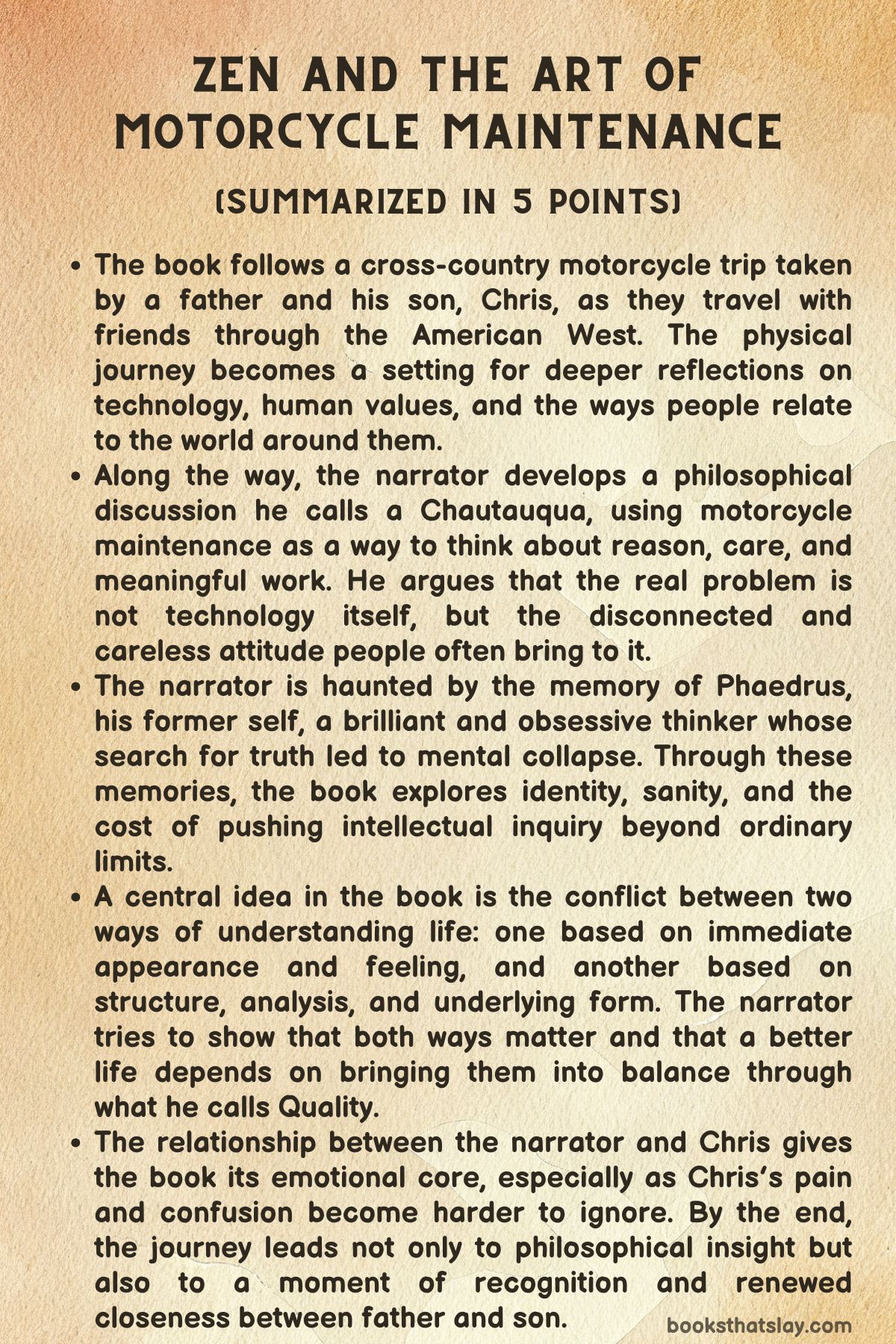
Zen and the Art of Motorcycle Maintenance by Robert M. Pirsig is a philosophical novel built around a father-and-son motorcycle trip across the United States. On the surface, it follows a journey through plains, mountains, and coastal roads, but its real subject is the search for a meaningful way to live in a world shaped by technology, reason, and personal pain.
The narrator reflects on care, work, thought, and the strain between feeling and analysis. At the same time, he faces the memory of a former self, called Phaedrus, whose intense pursuit of truth led to psychological collapse. The book is both travel story and meditation on Quality, identity, and repair.
Summary
The story begins with the narrator traveling by motorcycle across the American landscape with his young son Chris. They are joined for part of the trip by their friends John and Sylvia Sutherland.
The narrator values motorcycle travel because it places a person directly inside the environment instead of sealing them away from it. The changing weather, the open roads, the small towns, and the ordinary details of the land are all part of the experience.
He prefers secondary roads to fast highways because they allow time for attention, reflection, and real contact with places and people.
During the trip, the narrator develops a running philosophical talk he calls a Chautauqua. What prompts it, in part, is the tension he sees in John and Sylvia.
They dislike technology and want distance from it, while the narrator believes that this rejection is misguided. For him, the problem is not technology itself but the way people relate to it.
John refuses to work on his own motorcycle and would rather leave mechanical matters to specialists. The narrator sees this as a symptom of a deeper split in modern life, a division between people and the things they do, make, or depend on.
As they ride, the narrator recalls earlier experiences that shaped his thinking. He remembers mechanics who worked carelessly and without interest, turning repair into empty routine.
Their attitude convinced him that proper maintenance requires more than technical skill. It requires care, patience, and a sense of involvement.
He comes to believe that the failure of modern life lies not simply in machines or institutions but in the absence of genuine attention.
The journey also brings back troubling memories. The narrator keeps referring to a figure named Phaedrus, a person from his own past whose presence feels ghostly and threatening.
Gradually it becomes clear that Phaedrus is not a separate man in any ordinary sense, but a former version of the narrator. Phaedrus was brilliant, intense, isolated, and driven by philosophical questions.
He pursued reason with such force that he eventually suffered a mental collapse and underwent electroshock therapy. The narrator who now tells the story feels like the survivor of that destruction, living in the same body but uneasy about the return of the old self.
Chris, meanwhile, is restless, moody, and often difficult. His father worries about his emotional state and admits that doctors suspect some form of mental instability.
This worry deepens the emotional force of the trip. The narrator’s philosophical reflections are never far from his troubled relationship with his son.
Chris wants connection, reassurance, and honesty, but the narrator often withdraws into thought and memory.
A major part of the narrator’s thought is the distinction between two ways of understanding the world. He calls them romantic and classical.
Romantic understanding responds to immediate appearance, feeling, and surface beauty. Classical understanding looks beneath appearance to structure, form, and function.
John tends toward the romantic side, valuing experience while resisting technical explanation. The narrator insists that both modes are real and valuable, yet modern culture often treats them as enemies.
He believes this split causes much of the frustration people feel toward science, machines, and organized thought.
As the journey continues into Montana, the narrator revisits Phaedrus’s life in more detail. Phaedrus had been a gifted student from an early age, drawn to science and rational inquiry, but he became dissatisfied with conventional academic methods.
He found the scientific method unstable because any explanation can be replaced by countless new hypotheses. Instead of bringing certainty, rational inquiry seemed to multiply uncertainty.
This drove him into a wider search through philosophy, religion, and the history of thought.
Phaedrus studied Eastern philosophy, lived in India, served in Korea, and later returned to the United States to teach rhetoric and composition in Montana. There he began asking his students about Quality.
The question arose when he noticed that both teachers and students constantly judged work as good or bad without being able to say clearly what goodness itself meant. He became fascinated by the fact that people could recognize Quality before they could define it.
His teaching changed because of this problem. He experimented with writing assignments that asked students to begin from direct observation rather than from rigid formulas.
He also tried withholding grades in order to free students from mechanical ideas of achievement. The results were mixed.
Some students became more alive intellectually, while others grew confused or anxious. Even so, the experiment confirmed his belief that education often suppresses genuine thought by forcing students to chase approval instead of understanding.
Phaedrus’s inquiry into Quality led him beyond classroom method and into metaphysics. He was challenged to say whether Quality was objective or subjective.
If it was objective, it seemed to belong to the world of measurable fact. If subjective, it seemed to become merely personal preference.
He rejected both options. He concluded that Quality comes before the division between subject and object.
It is not produced by either side but is the source from which both are later derived. It is the immediate event of recognition, the moment of value before thought divides experience into observer and observed.
This conclusion had enormous consequences for him. He came to see Quality as a kind of pre-intellectual reality, something more basic than the categories through which philosophy and science usually operate.
When he later found similarities between this insight and the Tao of Chinese thought, the realization overwhelmed him. Instead of feeling that he had solved a problem, he felt that reason itself had been pushed beyond its familiar limits.
His thinking became more obsessive, his behavior more erratic, and his life unraveled.
The present-day journey mirrors this inner history. After parting with the Sutherlands, the narrator and Chris continue alone.
They visit old places connected to Phaedrus’s teaching life and meet people who still remember him. These visits make the narrator more aware that the boundary between himself and Phaedrus is weakening.
At the same time, Chris’s distress grows more visible. He becomes angry, exhausted, resistant, and desperate for emotional clarity.
The two leave the motorcycle for a time and hike into the mountains. This section reflects Phaedrus’s intellectual climb toward his theory of Quality.
Chris struggles physically and emotionally on the trail, and his father alternates between concern, irritation, and reflection. Even in the wilderness, the narrator keeps returning to the practical meaning of his ideas.
He explains that caring for a motorcycle is not just about repair. It is training in attention, patience, humility, and right action.
He later expands this into reflections on “gumption,” the energy that enables good work, and on the traps that drain it: ego, anxiety, boredom, impatience, rigid assumptions, and clumsy habits of thought.
As the trip moves westward, the narrator’s recurring dream of a glass door becomes more important. In the dream, he is separated from his family, especially Chris, who asks him to open the door.
The dream suggests guilt, emotional distance, and the fear that he has abandoned his family in some essential way. Eventually he realizes that the barrier is tied to his split identity.
The shadow he fears is his present self, and the force trying to break through is Phaedrus.
This crisis comes to a head near the Pacific coast. Chris breaks down, and the narrator tells him that he may send him home and enter a hospital himself.
During their confrontation, another voice seems to emerge through him, and Chris responds with relief rather than fear. In this moment, the narrator and Phaedrus are no longer entirely separate.
Chris, who has long sensed the truth, feels restored by this recognition. The father finally speaks with a kind of honesty that had been missing all along.
By the end of the journey, father and son ride on with a new sense of closeness. Chris can see past his father’s back and out into the world ahead.
The narrator feels that something has been recovered, not by erasing pain or solving every philosophical problem, but by accepting connection, care, and a more complete self. The road remains open, but the relationship between thought and life, machine and mind, father and son, has become less divided.
Key People
The Narrator
The narrator is one of the most unusual central figures in modern fiction because he exists in a state of division. He is at once a practical traveler, a father on a long journey, a philosophical teacher, and a man living in the aftermath of psychic collapse.
Much of his character comes from this tension between calm surface and buried intensity. He is observant, disciplined, mechanically capable, and often patient with material problems, yet emotionally he is far less secure.
He can diagnose a motorcycle problem with clarity, but he struggles to respond to Chris with the same steadiness. This contrast is essential to understanding him.
His intelligence is not simply a gift; it is also the source of alienation. He wants an integrated life in which thought, feeling, work, and care belong together, but he has lived through the destruction caused by pushing thought beyond ordinary human limits.
That history makes him both wise and wounded.
His character is also defined by his relationship to attention. He notices weather, roads, gestures, tones of voice, tools, and habits of mind with unusual precision.
He does not merely see the world; he constantly interprets it. This gives his voice authority, but it also places distance between him and others.
Even when he is among friends, he is often inward, translating experience into reflection. That habit makes him compelling as a thinker but difficult as a companion.
John and Sylvia sense this distance, and Chris suffers from it most deeply. The narrator clearly loves his son, yet his love is often filtered through anxiety, guilt, and abstraction.
He fears for Chris’s health, fears his inheritance, and fears his own inability to be emotionally present. His care is real, but it is often stern rather than comforting.
What makes him especially powerful as a character is that he is not simply recovering from a past self; he is haunted by one. His sense of identity is unstable, and much of the narrative energy comes from his effort to hold himself together while confronting memories of the man he once was.
He wants to explain, contain, and perhaps bury that earlier self, yet he also depends on that self’s insights. He is therefore both witness and evidence, philosopher and casualty.
By the end, his movement toward wholeness does not come from winning an argument or reaching total certainty. It comes from accepting that intellect without tenderness is incomplete, and that truth without relationship becomes destructive.
In Zen and the Art of Motorcycle Maintenance, the narrator becomes a portrait of a man trying to rebuild a self from fragments without losing the depth those fragments contain.
Phaedrus
Phaedrus is the narrator’s former identity, but he functions as far more than a mere earlier version of the same man. He is the concentrated form of the narrator’s intellectual hunger, stripped of balance and driven to an extreme.
As a character, he represents brilliance without rest. He is intellectually fearless, relentlessly analytical, and unwilling to accept inherited answers simply because institutions approve of them.
He does not want approximate truth or social usefulness; he wants first principles. That makes him extraordinary, but it also makes him dangerous to himself.
He cannot leave a question partly answered, and he cannot live comfortably inside conventions that seem false to him. This severity gives Phaedrus his tragic force.
He is not destroyed by lack of intelligence, but by the very intensity of his intelligence.
His emotional life is harder to access, yet that difficulty is itself part of his character. Phaedrus is reserved, solitary, and often detached from ordinary intimacy.
He has deep conviction, but little softness. His passion attaches itself to ideas with an almost religious force, and because of that, human relationships often seem secondary or obstructive to him.
Even so, he is not cold in any simple sense. His search for Quality is driven by a genuine longing to overcome deadness, falseness, and mechanical thinking.
He wants to restore something living at the center of reason. In that sense, his project is deeply human, even when his manner becomes severe or obsessive.
He is not merely a rational machine. He is someone who wants to rescue value from empty systems, and that desire gives him moral seriousness.
Phaedrus also carries symbolic weight within the narrative. He is the ghost of uncompromising inquiry, the figure who will not stop once a line of thought becomes painful, socially unacceptable, or personally destabilizing.
He pushes beyond the accepted divide between subject and object, art and science, method and feeling. Yet the cost of this vision is devastating.
His search leads to institutional punishment, mental collapse, and the loss of ordinary identity. Still, the novel does not treat him as simply mad or mistaken.
He is a figure of excess, but also of revelation. The narrator’s present self cannot reject him completely because too much of what is valuable comes from him.
Phaedrus remains the embodiment of a question that modern life tries to avoid: what happens when the pursuit of truth is so absolute that it tears apart the person seeking it?
Chris
Chris is far more than the child traveling behind the narrator on the motorcycle. He is the emotional center of the story because he constantly exposes what the adults around him would rather hide.
He is sensitive, unstable, needy, affectionate, angry, and perceptive in ways that exceed his age. At times he appears difficult, even exasperating, but his behavior gains meaning when seen as the response of a child living amid uncertainty he cannot control.
He senses that his father is withholding something fundamental. He does not fully understand the split between the narrator and Phaedrus, yet he feels its consequences in every silence, every withdrawal, every moment of emotional absence.
His repeated questions are not just childish curiosity. They are attempts to reach what has been hidden from him.
Chris’s restlessness and mood swings give him a fragile quality, but fragility is not the same as weakness. He is remarkably persistent in his desire for connection.
Even when he rebels, cries, wanders off, or resists authority, he is still trying to force recognition from his father. His distress comes partly from fear of abandonment, partly from confusion, and partly from his own unresolved emotional inheritance.
The narrator worries that Chris may share his vulnerability to mental illness, and the novel keeps that possibility alive without reducing Chris to a diagnosis. What matters more is that Chris carries emotional truths the adults struggle to admit.
He knows when language is evasive. He knows when his father is not fully present.
He knows that something unfinished stands between them.
As a character, Chris also introduces hope. His presence forces movement toward honesty.
The narrator can live for a long time in philosophical abstraction, but Chris continually brings matters back to the level of feeling, trust, and relationship. He asks simple questions that become impossible to avoid because they are morally direct.
By the close, Chris is essential to the narrator’s partial healing. The turning point does not happen through theory alone; it happens through contact with Chris’s pain and Chris’s faith.
His statement of recognition becomes one of the most meaningful moments in the narrative because it suggests that beneath fear and confusion, he has always carried an instinctive knowledge of who his father truly is. In Zen and the Art of Motorcycle Maintenance, Chris stands for the emotional claim that life makes upon thought: no philosophy is complete if it cannot answer a child who wants to be loved and told the truth.
John Sutherland
John Sutherland serves as one of the clearest counterpoints to the narrator. He is not unintelligent or shallow, but he approaches life from a perspective fundamentally different from the narrator’s.
He prefers immediate experience, visible form, and established practical arrangements over abstract inquiry into hidden structures. His resistance to motorcycle maintenance is not laziness alone.
It reflects a deeper rejection of the narrator’s kind of engagement with technology. John wants the motorcycle as an experience, a means of travel and enjoyment, not as an object of intimate mechanical concern.
He trusts specialists to handle technical matters and sees no need to invade every pleasing surface with analysis. In this respect, he embodies a recognizable modern attitude: dependence on systems combined with emotional distance from how those systems work.
His discomfort becomes sharper whenever the narrator tries to interpret it. John does not want to be diagnosed philosophically.
He reacts with irritation because the narrator’s explanations feel intrusive, even accusatory. This makes him an important character, since he reveals one of the limits of the narrator’s style of understanding.
John is not simply “wrong”; he is someone whose values are being pressed upon by a person unable to leave disagreement alone. His anger, then, is partly defensive pride and partly the frustration of a man who senses that the ground of his life is being judged by someone else’s intellectual framework.
At the same time, John’s stance has real limitations. His insistence on surface experience leaves him vulnerable to dependence, helplessness, and denial.
He wants the rewards of technology without the burden of understanding it. He also seems trapped by appearances, by what looks proper or professionally made, rather than by what is functionally or conceptually sound.
This becomes visible in his reaction to simple repairs that offend his sense of form. He values finish over essence.
Yet this does not make him merely superficial. It makes him representative of a divided culture in which beauty and utility are split apart.
John is therefore both an individual and a social type: a decent man whose discomfort reveals the emotional cost of living among machines one uses but does not inwardly accept.
Sylvia Sutherland
Sylvia is often quieter than the other central figures, but her role is subtle and significant. She brings emotional intelligence to the social dynamics of the trip, often perceiving tensions before they are openly named.
She is more receptive than John in some moments, yet she shares his unease with the narrator’s turn toward mechanical and philosophical talk. For Sylvia, the motorcycle journey seems to hold the promise of escape, relief, and beauty.
She wants the experience of the road as refreshment, perhaps even healing, rather than as an occasion for intellectual confrontation. This makes her more vulnerable to disappointment when the narrator’s reflections darken the atmosphere.
Her character also reflects a form of strain connected to modern life. The narrator senses in her a weariness associated with urban existence, with pressure, routine, and emotional depletion.
He hopes the landscape will restore her. That hope reveals something important about Sylvia herself: she appears as a person who longs for calm, but cannot fully find it.
She is drawn to the trip, but not to its discomforts; drawn to the natural world, but not to the hard practical demands that come with reaching it. This tension parallels the larger issue in the narrative of wanting freedom from modern systems while still depending on their conveniences.
Sylvia’s value as a character lies partly in how she humanizes the philosophical debate. John often responds with blunt resistance, but Sylvia’s reactions carry shades of sympathy, fatigue, curiosity, and quiet alarm.
She helps show that the conflict between ways of living is not merely theoretical. It affects moods, marriages, friendships, and one’s ability to feel at ease in the world.
She also sees the narrator and Chris with a concern that feels more openly compassionate than John’s. When she worries about them, her anxiety feels grounded in emotional reality rather than argument.
Sylvia may not dominate the narrative, but she deepens it by showing how intellectual and technological conflicts are lived inwardly as strain, loneliness, and longing for peace.
Robert DeWeese
Robert DeWeese stands as one of the few figures from the narrator’s past who can meet him without either romanticizing or condemning him. He represents a form of creative, humane intelligence that differs sharply from Phaedrus’s severe analytic style.
Robert is an artist, a teacher, and a man whose household offers warmth, informality, and imaginative freedom. His presence matters because he introduces an alternative model of seriousness, one based not on relentless abstraction but on creative openness.
The narrator respects him precisely because he cannot easily reduce him to his own categories. Robert suggests a way of being thoughtful without becoming devoured by thought.
He also functions as a bridge to the narrator’s earlier life in Montana. Through Robert, the past returns in a social and living form rather than only as private memory.
Yet Robert is not merely a reminder of what came before. He is someone who can receive the narrator in his altered state with a kind of loyalty that does not depend on perfect comprehension.
That generosity gives him unusual dignity. He neither collapses the narrator into his former identity nor pretends the past did not happen.
Robert’s importance also lies in his relation to art and making. His home, his conversation, and even the discussion around assembly instructions all support the narrator’s developing sense that good work cannot be reduced to mechanical procedure.
Robert helps create a setting where craftsmanship, perception, and freedom can coexist. In a novel deeply concerned with the failures of institutional thought, he represents a more hospitable form of intelligence.
He is evidence that the creative life can hold complexity without becoming tyrannical. His character therefore provides relief from the harsher intellectual climates elsewhere in the story and offers a glimpse of human fellowship not built on domination or retreat.
Gennie DeWeese
Gennie DeWeese has a smaller role, but her presence strengthens the atmosphere of refuge and human steadiness that surrounds the DeWeese household. She contributes to the sense that this home is one of the few places where the narrator and Chris are briefly held in an environment of ordinary generosity.
In a story full of tension, silence, and private torment, Gennie’s domestic warmth matters. She helps create a world that is neither clinical nor combative, neither suspicious nor emotionally barren.
That ordinary kindness is quietly important because it stands in contrast to the narrator’s fractured inner life.
Her character also helps mark the difference between social ease and intellectual struggle. Around her, the narrator is still inwardly troubled, but the setting becomes gentler.
This does not cure him, but it shows what he has been missing: a form of life in which care is expressed through hospitality, shared space, and everyday human acceptance. Gennie participates in that without needing to theorize it.
Though she is not developed as extensively as the major figures, Gennie helps sustain one of the novel’s underlying claims: sanity is not merely a matter of correct ideas but of human conditions that make wholeness possible. Her presence suggests stability without rigidity, affection without demand, and welcome without scrutiny.
In that sense, she enriches the emotional landscape of the narrative beyond her limited page time.
Sarah
Sarah appears within Phaedrus’s intellectual history as a colleague whose brief remark has lasting significance. Her importance lies less in psychological depth than in what she represents within the movement of Phaedrus’s thought.
When Phaedrus asks where one learns about Quality in the study of English, her answer directs him toward Ancient Greek thought and opens a path that becomes central to his later philosophical work. She functions as one of those quiet but pivotal figures who help redirect a life without fully knowing it.
As a character, Sarah embodies institutional knowledge used without aggression. She is not presented as grandly philosophical or dramatically transformative, but her contribution matters because it gives Phaedrus a historical point of entry into his obsession.
This is fitting in a novel where ideas often move through incidental remarks, classroom moments, and small exchanges rather than through formal revelations. Sarah’s presence reminds the reader that intellectual history is sometimes advanced not only by visionaries but by people whose practical familiarity with a field helps others recognize where to look.
She also indirectly highlights Phaedrus’s nature. He asks a question that is really much larger than the immediate academic context, and her answer becomes combustible only because of the kind of mind receiving it.
Sarah herself appears comparatively grounded, but in contact with Phaedrus’s intensity, even a modest response becomes the start of a major philosophical turn. That relation gives her a structural importance beyond the size of her role.
The Chairman
The Chairman at the University of Chicago is one of the novel’s clearest embodiments of intellectual authority hardened into dogma. He is not presented simply as foolish or incompetent; in fact, his power comes partly from his command of an established tradition.
What makes him important is the way he defends a system rather than pursuing truth wherever it leads. To Phaedrus, the Chairman represents the institutional mind at its most guarded: formal, strategic, hierarchical, and invested in preserving categories that Phaedrus wants to question.
Their conflict is therefore not only personal. It reflects a struggle between living inquiry and defended orthodoxy.
The Chairman’s obscurity, rigidity, and tactical classroom behavior all suggest a man whose relationship to knowledge is inseparable from status. He seems to use difficulty not always to clarify but to maintain control.
This makes him threatening to Phaedrus, who is already inclined toward combat when confronted with bad faith or conceptual weakness. Yet the Chairman is not merely an enemy.
He is also a symptom of the academic world Phaedrus cannot inhabit without attacking. He shows how institutions can turn philosophy into territory to be defended rather than a search to be shared.
His role is crucial in Phaedrus’s unraveling because he gives shape to the opposition against which Phaedrus defines himself. Without figures like the Chairman, Phaedrus’s intensity might have found a different outlet.
In conflict with him, that intensity sharpens into obsession. The Chairman therefore helps reveal both the limits of institutional thought and the self-destructive tendencies of a mind that cannot resist total confrontation.
Themes
Quality as a Reality Before Division
At the center of Zen and the Art of Motorcycle Maintenance is the idea that Quality cannot be reduced to either personal taste or objective measurement. The narrative keeps returning to moments when people recognize something as good before they can explain why.
That prior recognition matters because it challenges the habit of dividing the world too quickly into subject and object, feeling and fact, art and science. Quality exists first as lived value, as the immediate sense that something is right, fitting, alive, or true.
The philosophical force of this idea is enormous because it places value at the foundation of experience rather than treating it as an afterthought. This is why the narrator’s reflections move beyond technical matters into metaphysics.
He is not arguing that standards do not matter, but that standards arise from a more original encounter with value. The concept also gives the novel its emotional depth, since relationships, work, thought, and beauty are all tested by whether they carry this living rightness.
Quality becomes both a philosophical principle and a measure of human presence.
The Split Between Classical and Romantic Understanding
Much of the conflict in the narrative grows from two rival ways of seeing. One attends to immediate appearance, mood, and surface beauty; the other searches for underlying form, structure, and explanation.
Neither mode is false, yet each becomes limited when it excludes the other. The emotional discomfort surrounding technology, the tension between the narrator and the Sutherlands, and the larger unrest of modern culture all emerge from this split.
Machines come to seem ugly or oppressive when they are seen only as dead mechanisms, but they also become empty when treated only as useful objects without felt meaning. The novel insists that form and feeling must not be enemies.
A motorcycle can be understood as both a beautiful presence on the road and a complex system whose parts require care. This theme extends beyond mechanics into education, philosophy, and human relationships.
When one side dominates, life becomes either sentiment without discipline or analysis without warmth. The work’s deeper aim is not to choose between these ways of seeing but to imagine a richer order in which they meet.
Care, Craft, and the Moral Meaning of Work
Repair in the narrative is never just repair. The attention given to tools, adjustments, habits, and methods becomes a way of thinking about how one should live.
Work acquires moral significance because it reveals the quality of one’s relation to the world. Careless mechanics are disturbing not simply because they damage a machine, but because their indifference reflects a wider emptiness.
Good work, by contrast, requires patience, humility, responsiveness, and inward steadiness. It asks a person to stop treating objects as dead things and start meeting them with respect.
The point is not perfectionism in the narrow sense. It is the formation of character through involvement.
This is why the narrator links mechanical practice to peace of mind. A person who works well is not merely efficient; he is properly present.
Through this idea, the novel transforms ordinary maintenance into an ethical practice. The way one approaches a motorcycle, a sentence, a classroom, or a conversation becomes evidence of how one inhabits reality.
Craftsmanship is therefore not a side issue. It is one of the clearest expressions of disciplined care.
Identity, Inheritance, and the Possibility of Reconciliation
The journey is also about the struggle to live after psychic fracture. The narrator’s divided relation to Phaedrus gives the story its deepest emotional tension, since the past is not finished and cannot simply be rejected.
Identity appears not as a fixed possession but as something threatened by memory, trauma, and the failure of integration. This private conflict is inseparable from the father-son relationship.
Chris inherits confusion, fear, and unanswered questions, and his distress exposes the damage caused when one generation cannot make peace with itself. Yet the narrative does not remain trapped in loss.
It suggests that reconciliation is possible, though not through erasure. The narrator does not heal by proving that the past was unreal.
He moves toward wholeness by admitting what has been broken and by allowing contact where silence once ruled. This theme gives the ending its force.
Recovery is shown not as clean restoration but as a renewed capacity for truth, presence, and mutual recognition. The self can become livable again, but only when it stops defending itself against its own history.