Zen Mind, Beginner’s Mind Summary and Analysis
Zen Mind, Beginner’s Mind by Shunryu Suzuki is a classic introduction to Zen practice that presents Buddhism in a direct, simple, and practical way. Drawn from informal talks given to students in America, the book explains that Zen is not about collecting ideas, chasing mystical experiences, or improving the self in a conventional sense.
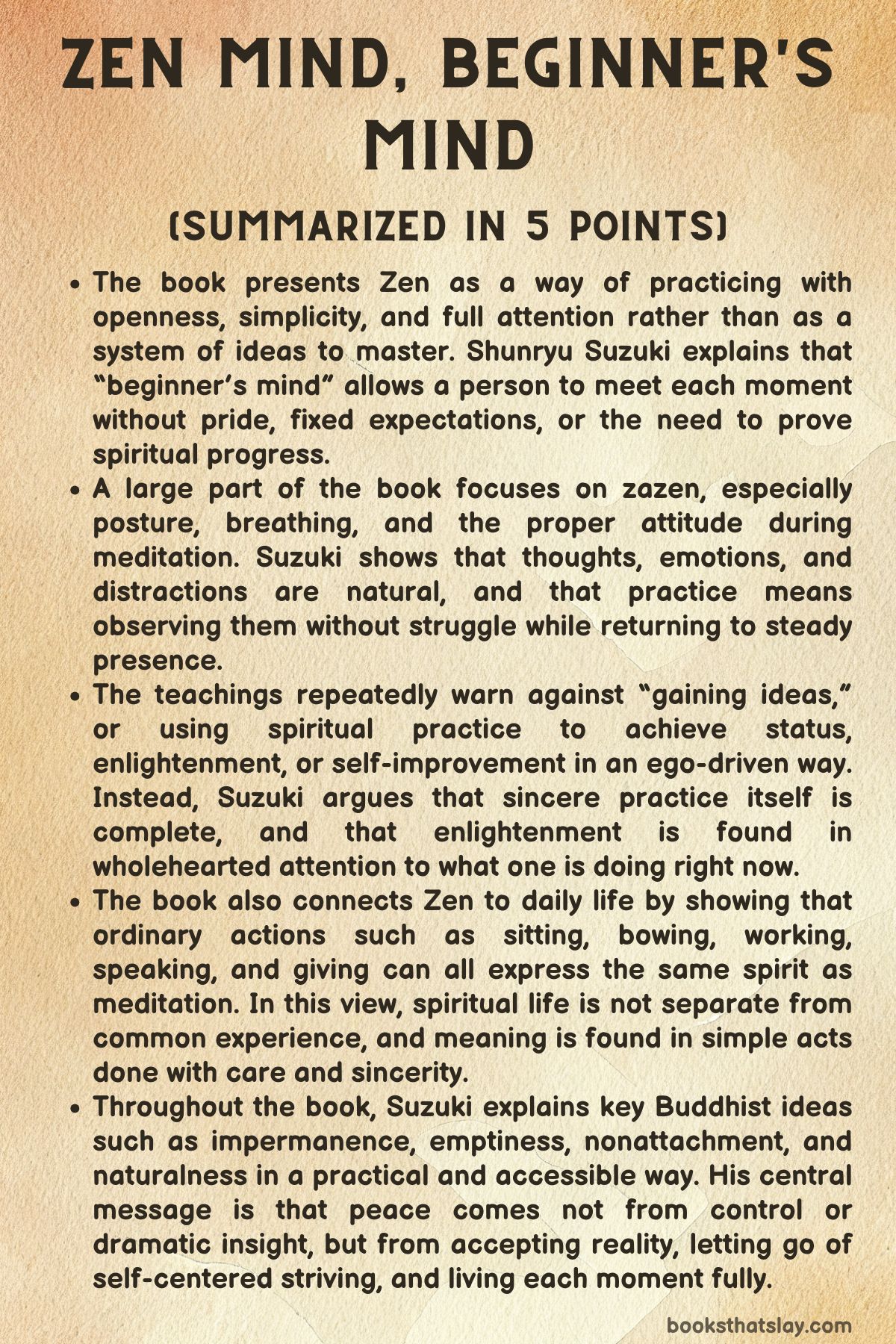
Instead, it teaches the value of meeting each moment with openness, sincerity, and freshness. Suzuki returns again and again to the idea of “beginner’s mind,” a state free from fixed views and self-importance. The book’s lasting appeal comes from how calmly it shows that ordinary practice itself is the heart of awakening.
Summary
Zen Mind, Beginner’s Mind presents Zen not as a theory to master but as a way of practicing and living with complete sincerity. The book begins by framing Shunryu Suzuki’s role in bringing Zen to America.
Unlike teachers who introduced Zen mainly through philosophy and scholarship, Suzuki taught through lived practice. His students and editors preserved his spoken talks, trying to keep their plainness and depth while making them understandable for Western readers.
This context matters because the book itself carries the quality of oral teaching: it repeats, circles back, and points readers away from abstract explanation toward direct experience.
At the center of the book is the idea of beginner’s mind. Suzuki says that the right spirit of practice is an open and receptive mind, one that does not assume it already knows.
This is difficult because people naturally turn practice into a project of self-improvement. They want progress, results, and confirmation.
Suzuki warns that this attitude weakens practice because it introduces ego and division. The person begins to stand apart from what they are doing, judging it, measuring it, and trying to use it to become something better.
For Suzuki, real practice happens when this separation drops away and one simply sits, breathes, and lives fully in the present activity.
A major part of the book explains zazen, seated meditation, in practical terms. Suzuki gives careful attention to posture, showing that the body is not secondary to the mind.
Sitting upright, balanced, and alert is itself an expression of awakening. The physical form matters because Zen is not an inward escape from life but a complete involvement of body and mind together.
Breathing also becomes central. Instead of controlling the breath, the practitioner observes it as it moves naturally.
This allows the sense of a rigid, separate self to soften. Through posture and breath, practice becomes simple and immediate, not something to think about endlessly.
Suzuki also reassures readers about the thoughts and feelings that arise in meditation. He compares thoughts to waves and troublesome emotions or self-concerns to weeds.
These are not signs of failure. The mistake is not that thoughts appear, but that people try to fight them, suppress them, or judge themselves for having them.
When left alone, mental activity loses some of its force. This teaching reflects one of the book’s strongest themes: peace does not come from domination or control.
It comes from letting things be what they are without adding struggle and self-centered commentary.
Again and again, Suzuki challenges the desire to gain something from Zen. He criticizes what he calls gaining ideas, the belief that one practices in order to secure enlightenment, purity, wisdom, or superiority.
The problem with such striving is that it strengthens the very ego Zen practice is meant to loosen. If enlightenment is treated as a goal in the future, then the present moment becomes only a means to an end.
Suzuki insists instead that practice and enlightenment are not two different things. To sit wholeheartedly is itself enlightenment.
This does not mean one reaches a dramatic final state. It means that the truth of practice is already present when one is fully there.
This same spirit appears in his discussion of ordinary conduct. Bowing, for example, is not about humiliation or worship of something distant.
It is an act that expresses respect for Buddha nature in everything. Zen is also described as nothing special.
Suzuki removes the glamour often attached to spiritual life and points readers back to everyday activity. The point is not to have unusual experiences but to live ordinary life with full attention and humility.
Preparing food, sitting in meditation, speaking honestly, or doing one task at a time can all express the same depth of practice.
The book also develops an attitude toward effort that differs sharply from common Western assumptions. Suzuki values repetition, constancy, and steady practice, but not ambitious striving.
Right effort means sincere application without obsession over results. Practice must be repeated endlessly, yet each repetition should be fresh.
Familiarity often produces boredom or impatience, but these too become part of practice. Zen is not a path of excitement or dramatic intensity.
Suzuki prefers calm regularity to emotional highs. This is why he often speaks of limiting one’s activity.
By narrowing attention to what is essential and fully entering one action, a person stops scattering energy through distraction and ambition.
Suzuki extends this insight into ethics and relationships. He writes about giving, mistakes, communication, and self-study in the same spirit.
True giving asks for no reward or self-congratulation. Mistakes in practice are unavoidable and even useful because they reveal the operations of ego.
Communication should be clear, straightforward, and free from the need to defend oneself or persuade others. Studying oneself, in Buddhist terms, does not mean building a stronger identity.
It means observing how self-centered habits arise and then learning to let go of them. In this way, self-study ends in self-forgetting rather than self-assertion.
As the book moves further, Suzuki explains broader Buddhist ideas such as impermanence, emptiness, naturalness, mindfulness, and nonattachment. He treats these not as abstract doctrines but as realities to be lived.
Everything changes, and suffering increases when people resist this fact or try to secure a lasting identity in what is unstable. Emptiness does not mean nothing matters; it means nothing exists independently or permanently.
Because nothing can be held in a fixed way, clinging becomes unnecessary. Nonattachment does not ask people to reject happiness or sorrow.
It asks them not to build a self around passing states. Mindfulness and readiness, in his view, are not intense self-monitoring but a calm, flexible capacity to meet things as they are.
Suzuki often returns to the difference between direct experience and philosophy. He knows that many readers are drawn to Buddhism as an interesting system of thought, yet he warns that intellectual understanding alone can become another barrier.
Knowledge, certainty, and attachment to concepts may close the mind. Practice matters more than explanation because Zen must be embodied.
Even enlightenment itself is presented in an ordinary way. Buddha’s awakening was not a fantastic event that lifted him out of common life.
It was a clear seeing of reality as it already is. In the same way, Suzuki describes awakening as something present in sincere practice rather than as a distant achievement.
By the end of the book, the message is consistent and unmistakable. Zen is not something to possess, prove, or display.
It is the continual practice of meeting each moment with openness, steadiness, and freedom from self-centered grasping. Beginner’s mind is valuable because it keeps life fresh and prevents practice from hardening into pride or habit.
The book leaves readers with a vision of spiritual life rooted in simplicity: sit correctly, breathe naturally, act wholeheartedly, accept change, and let go of the urge to turn experience into a possession. In that spirit, the ordinary life one already has becomes the place of practice and awakening.
Key People
Shunryu Suzuki
Shunryu Suzuki stands at the center of Zen Mind, Beginner’s Mind not as a conventional protagonist but as the shaping consciousness behind every idea in the text. His character emerges through his voice, method, and attitude rather than through dramatic action.
He appears as a teacher who consistently resists self-importance, refusing to present himself as a spiritual authority in a theatrical sense. What defines him most is his ability to make difficult Buddhist ideas feel immediate and livable.
He does not build his authority through abstraction, scholarship, or grand claims, but through steadiness, humility, and an insistence on practice. This gives him a quietly radical quality.
He teaches in a manner that removes ornament and brings attention back to posture, breath, repetition, and ordinary conduct.
His character is also marked by paradox. He is a guide who tells readers not to seek, a master who resists the glamour of mastery, and a spiritual teacher who keeps redirecting attention away from spiritual ambition.
That tension is essential to understanding him. He recognizes how easily the ego can attach itself even to religion, so his way of teaching actively interrupts pride, competition, and the desire for achievement.
He often sounds gentle, but beneath that gentleness is considerable firmness. He does not flatter the reader’s wish for progress in familiar terms.
Instead, he asks for sincerity without reward, effort without self-display, and discipline without possessiveness. This makes him a demanding figure, even when his language is calm.
Another important element in his characterization is his role as a bridge between worlds. He is presented as someone formed in Japanese Soto Zen who comes to America and addresses students shaped by very different habits of thought.
Yet he is not shown as someone diluting tradition for convenience. His character carries both fidelity and adaptability.
He understands that his audience tends toward analysis, personal striving, and conceptual certainty, so he repeatedly answers those instincts with simplicity and directness. In that sense, he becomes a translator not merely of language but of sensibility.
His significance lies in making Zen practice available without reducing its rigor.
What finally gives Suzuki depth is that he embodies the very qualities he teaches. The text suggests a person who has made ordinariness into a site of insight.
He does not present enlightenment as personal distinction. Instead, he represents a form of maturity grounded in ego-reduction, constancy, and openness.
His character therefore functions both as teacher and example: not someone to admire from a distance, but someone whose presence demonstrates how seriousness and simplicity can coexist.
Richard Baker
Richard Baker appears as an important interpretive figure because he shapes how readers first encounter Suzuki’s teachings. As Suzuki’s spiritual successor, he is not simply an editor or introducer but someone positioned within the lineage of transmission.
This role gives his character a dual function. He is both disciple and mediator, someone close enough to the teacher to understand the spirit of the talks, yet also aware of the challenges involved in presenting them to a broader audience.
His presence gives the work continuity. He suggests that Suzuki’s teaching is not a sealed personal legacy but something meant to continue through community and practice.
His characterization carries a sense of responsibility. Baker does not present himself as the center of attention; instead, he appears as someone trying to preserve what is difficult to preserve.
He understands that oral teaching, especially Zen teaching, can lose force when transferred into polished prose. The challenge is not only linguistic but cultural and spiritual.
Because of this, he comes across as careful and somewhat self-effacing, aware that editing can clarify but also distort. That tension gives him substance.
He is not merely endorsing Suzuki; he is trying to protect the integrity of a voice that resists systematization.
At the same time, Baker’s position reveals the importance of discipleship in the text’s wider world. He represents the student who has remained close enough to the teacher to absorb not only ideas but manner and orientation.
His significance lies in showing how spiritual teaching passes through human relationships, not just through doctrines. He stands for continuity, but also for the difficulty of carrying something living into another setting.
Through him, the reader sees that preserving a teaching requires interpretation, judgment, and humility.
Huston Smith
Huston Smith functions as a framing presence whose importance lies in recognition and comparison. He is the one who places Suzuki within a larger history of Zen in the West, and that gives his character the quality of an informed witness.
He appears as someone able to distinguish kinds of spiritual influence. Rather than blending all teachers together, he draws a clear line between scholarly explanation and lived instruction.
This makes him valuable not simply as a supporter, but as a thinker who understands what is unique about Suzuki’s contribution.
His character is marked by intellectual clarity, but unlike a purely academic observer, he does not reduce the subject to detached commentary. He recognizes spiritual seriousness when he sees it, and his respect for Suzuki helps establish the weight of the teacher’s presence.
At the same time, Smith’s comparative role highlights his own nature. He belongs to a world of interpretation, cross-cultural understanding, and public explanation.
He helps readers see why Suzuki mattered without trying to replace Suzuki’s voice with his own. That restraint is central to his characterization.
Smith also matters because he represents a bridge between religious scholarship and spiritual practice. He identifies the significance of Suzuki’s achievement in a way Western readers can understand, yet he does not pretend that understanding alone is enough.
His role is introductory but not superficial. Through him, readers are encouraged to approach the teachings with seriousness, while also seeing that the deepest part of the text lies beyond conceptual admiration.
Daisetz Teitaro Suzuki
Daisetz Teitaro Suzuki is presented as a major predecessor whose character is defined by intellect, exposition, and historical importance. He represents the earlier phase of Zen’s movement into the West, one centered on books, lectures, and conceptual interpretation.
His contribution is substantial because he prepared the ground. Without his scholarly work, many Western readers might never have encountered Zen at all.
This makes him a foundational figure, one whose labor of explanation opened a path for later teachers.
At the same time, his characterization is shaped by contrast. He is associated with the mystical, philosophical, and intellectually compelling side of Zen, while Shunryu Suzuki is associated with ordinary practice and communal life.
This difference does not diminish him; instead, it clarifies his distinct function. He stands for articulation, for making an unfamiliar tradition legible to a foreign audience.
Yet because the text values direct practice over conceptual mastery, he also becomes an implicit example of the limits of explanation. One may speak brilliantly about Zen and still not convey what daily practice feels like.
This contrast gives Daisetz Teitaro Suzuki a specific symbolic role. He embodies a form of access that is necessary but incomplete.
He is not criticized so much as repositioned. His legacy remains honorable, but the text makes clear that Zen cannot remain at the level of discourse.
In this way, his character adds depth to the book’s understanding of transmission: traditions enter new cultures first through language and interpretation, but they endure only when embodied.
Trudy Dixon
Trudy Dixon emerges as one of the quiet but indispensable figures behind the finished text. Her character is defined by devotion to preservation, sensitivity to language, and the difficult labor of shaping spoken teachings into readable form.
She is important because the book’s existence in its current form depends on her effort. Yet her role is not mechanical.
She is portrayed as someone deeply aware of the danger of over-editing material that relies on cadence, repetition, and suggestion. This makes her more than a compiler.
She becomes a caretaker of tone and meaning.
Her significance also lies in the kind of intelligence she represents. Dixon’s work requires attentiveness rather than dominance.
She must listen for flavor, implication, and rhythm, not merely for clear propositions. That suggests a character capable of patience and fidelity, someone willing to serve the teaching without turning herself into its center.
There is also a poignancy to her place in the book’s formation because others had to complete the work after her death. This lends her role a sense of incompletion joined with lasting contribution.
Through Dixon, the text reveals that transmission depends not only on teachers and heirs but also on those who preserve speech with care. She represents the often unseen labor through which a tradition survives cultural transition.
Her presence reminds readers that spiritual literature is also shaped by acts of listening, editing, and restraint.
Marian Derby
Marian Derby’s role is comparatively brief, but her importance is foundational. She is the disciple who first conceived of recording Suzuki’s talks, which means she recognized that his spoken teaching carried lasting value.
Her character can therefore be understood through receptivity and initiative. She is not presented as a public authority, yet she acts decisively in a way that changes how the teachings will live on.
Without that initial act of attention, the talks might have remained temporary moments rather than becoming a durable text.
Derby represents the student whose response to teaching is not passive admiration but practical care. She sees what needs to be preserved and responds to it.
That quality gives her a quiet strength. She does not dominate the narrative, but she matters because she helps create the conditions for memory and transmission.
In a work so concerned with practice, her role shows that devotion may take the form of concrete service.
Her presence also highlights the communal dimension of the world around Suzuki. Teachings are not transmitted by isolated genius alone.
They endure because students listen, record, organize, and protect what they have received. Derby stands for that first act of recognition.
She is the figure who understands that a spoken teaching, however modest it may appear in the moment, can carry a significance that deserves preservation.
Buddha
Buddha appears less as a fully dramatized figure than as a spiritual reference point whose characterization is essential to the book’s understanding of awakening. He is not portrayed as a distant supernatural being or the center of worship in a conventional religious sense.
Instead, he represents a human realization of things as they are. This matters because the text consistently resists making enlightenment seem exotic or unattainable.
Buddha is important precisely because he is presented as someone who saw clearly, not as someone elevated beyond ordinary life.
This portrayal strips away mythic grandeur and places emphasis on example. Buddha becomes the model for egoless awareness, not the object of spectacle.
His enlightenment is treated as ordinary in the deepest sense: a direct recognition of reality rather than an escape from it. That characterization supports the book’s rejection of spiritual ambition.
If Buddha’s insight is already related to the nature present in all beings, then awakening is not the private possession of an exceptional self.
Buddha also functions symbolically as a corrective to religious distortion. When practice turns into status, identity, or attachment to special experience, the example of Buddha restores simplicity.
He stands for the possibility that the clearest spiritual truth is also the least theatrical. Through that portrayal, the reader is pushed away from idealized fantasy and back toward sincerity in daily practice.
The American Zen Student
Although not a single named individual, the American Zen student acts as a recurring implied character throughout the work. This figure is important because many of Suzuki’s teachings are shaped in response to the assumptions, anxieties, and habits such students bring with them.
The American student is often intellectually curious, eager for explanation, drawn to self-improvement, and tempted to measure progress. As a character type, this student embodies cultural habits that the teaching repeatedly challenges.
There is ambition, idealism, impatience, and often a hidden competitiveness in this figure.
At the same time, the American student is not treated dismissively. Suzuki sees genuine possibility here.
In fact, the lack of inherited assumptions about Zen can make such students especially open. That is why beginner’s mind becomes both a challenge and an opportunity in Zen Mind, Beginner’s Mind.
The American student is caught between receptivity and restlessness, between sincerity and the desire to gain something. This tension makes the figure psychologically rich, even in generalized form.
This character type also gives the book much of its dramatic energy. Many of the text’s central oppositions—practice versus theory, openness versus certainty, sincerity versus ambition—take shape through the imagined struggles of these students.
In that sense, the American Zen student is not a background presence but a key human field in which the teaching is tested and made relevant.
Themes
Beginner’s Mind as a Way of Seeing
Openness is treated not as a pleasant attitude but as the condition that allows practice to remain alive. A mind crowded by conclusions, expertise, and spiritual ambition cannot encounter reality freshly.
The text keeps returning to the danger of familiarity because repetition can harden into habit, and habit can turn practice into performance. Beginner’s mind corrects this by asking the practitioner to meet each moment without possessiveness.
That does not mean becoming naïve or forgetting everything one has learned. It means not allowing knowledge to become a barrier between oneself and direct experience.
This is why the idea carries both humility and discipline. It refuses the vanity of mastery while demanding continuous alertness.
In Zen Mind, Beginner’s Mind, beginner’s mind also has ethical force because it reduces self-importance and makes room for genuine attention to others, to daily tasks, and to one’s own mental life without distortion. The freshness Suzuki values is therefore not decorative; it is the basis of a life less governed by pride, certainty, and habitual self-reference.
Practice Without Gaining Ideas
The text persistently questions the habit of turning spiritual life into acquisition. Instead of treating practice as a means to collect peace, wisdom, purity, or enlightenment, it argues that such motives distort the act itself.
Once the ego begins to practice for a result, the present moment is subordinated to imagined future reward. What appears to be discipline may then become disguised ambition.
This theme matters because it overturns one of the most common assumptions modern readers bring to meditation and religion: that the point is measurable self-improvement. Suzuki’s response is not to reject effort, but to purify it.
Right effort is sincere, exact, and steady, yet free from the wish to own what arises from practice. Such a view makes room for patience and reduces comparison, since there is no spiritual prize to win.
It also transforms frustration. Difficulty, boredom, and apparent lack of progress no longer prove failure; they become part of the field of practice itself.
The theme ultimately asks whether one can act wholeheartedly without trying to convert that action into personal advantage.
The Ordinary Nature of Awakening
The text removes spiritual life from the realm of spectacle and places it back into sitting, breathing, bowing, cooking, speaking, and walking. Awakening is not described as a dramatic escape from ordinary life but as a different way of inhabiting ordinary life.
This theme is central because it resists the desire for exceptional experiences that can be admired, remembered, or claimed. Suzuki repeatedly lowers the emotional temperature around Zen, insisting that it is nothing special.
That phrase is not dismissive. It is corrective.
It protects practice from fantasy and restores seriousness to simple actions. When the ordinary is fully inhabited, it no longer appears trivial.
Posture becomes meaningful, repetition becomes alive, and small gestures reveal one’s quality of presence. In this way, the text asks readers to stop searching for sacredness in unusual states while ignoring the shape of their daily conduct.
The effect is demanding rather than comforting, because it leaves no room for postponement. If awakening belongs to the everyday, then every ordinary act becomes a place where sincerity or self-centeredness is already being expressed.
Impermanence, Emptiness, and Nonattachment
Change is presented not as a philosophical abstraction but as a condition that touches identity, emotion, thought, and every human attempt at security. Much of suffering comes from treating passing states as possessions or trying to fix oneself within a permanent structure.
Against this, the text emphasizes emptiness and nonattachment, not as rejection of life but as freedom from clinging. Emptiness means that nothing exists in sealed independence, and the self cannot be secured as a permanent object.
This insight loosens fear because it weakens the demand that experience remain stable. Happiness can be enjoyed without panic over its ending, and sorrow can be allowed without turning it into identity.
The theme has a practical rather than merely metaphysical force. It changes how one breathes, practices, communicates, and responds to difficulty.
By accepting transience, the practitioner stops wasting energy on resistance to what cannot be held. Nonattachment then becomes a form of intimacy with reality rather than distance from it, because one is no longer relating to life mainly through grasping, defense, and fear of loss.