Zero Days by Ruth Ware Summary, Characters and Themes
Zero Days by Ruth Ware is a fast-moving thriller about grief, fear, and survival under extreme pressure. The novel follows Jacintha “Jack” Cross, a security specialist who tests physical vulnerabilities for clients by breaking into buildings legally as part of her job.
Her work depends on skill, nerve, and trust in her husband, Gabe, who handles the digital side. That trust is shattered when Jack returns home to find him murdered and quickly realizes that the police suspect her. What follows is a tense race across England as Jack tries to stay ahead of arrest, uncover the truth behind Gabe’s death, and hold onto herself while everything familiar falls apart.
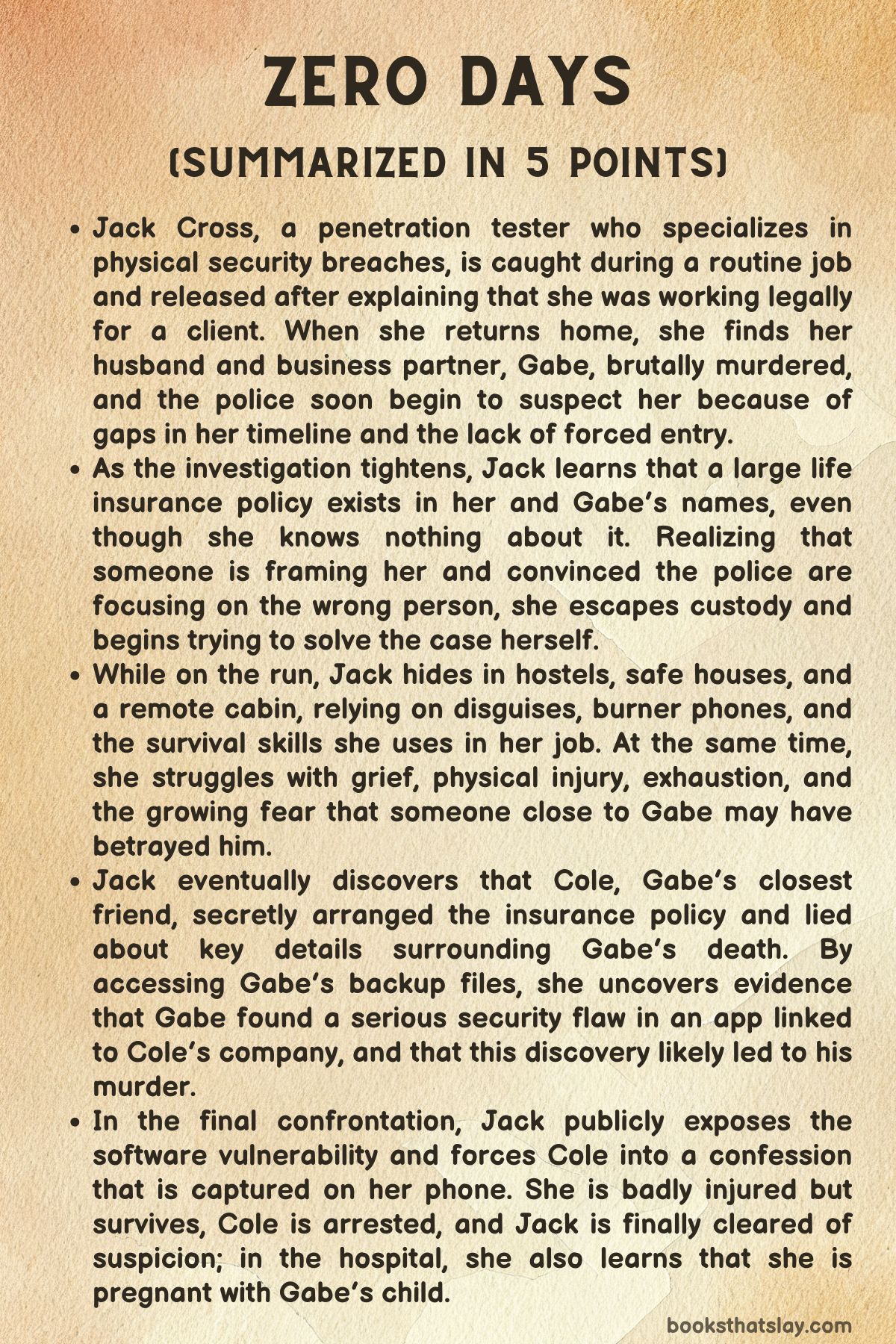
Summary
Jack Cross works in security testing with her husband, Gabe. Together they run a company that helps businesses find weaknesses before criminals do.
Gabe handles the technical hacking side, while Jack specializes in physical entry, deception, and escape. Early in the story, Jack is caught during a job after completing a break-in for a client.
What should have been an awkward but manageable professional situation becomes the start of a disaster when Gabe does not answer his phone. That silence feels wrong at once.
After being released from the police station, Jack returns to her home in South London and finds Gabe dead at his desk, his throat cut. The shock freezes her.
By the time she calls emergency services, precious time has passed, and that delay immediately casts suspicion on her. The police begin asking hard questions.
Jack cannot clearly account for every minute between leaving the station and arriving home. There are other troubling details too: no sign of forced entry, Gabe’s missing hard drive, and a bloody kitchen knife that seems to point toward a domestic killing.
Jack is taken to stay with her sister, Helena, but even there the pressure does not ease. Hel, a journalist, understands how such cases are built and can already see how badly the evidence looks for Jack.
When Jack is called back in for further questioning, matters get worse. Detectives reveal that a large life insurance policy exists in both her and Gabe’s names.
Jack has never heard of it. To the police, it looks like motive.
To Jack, it looks like a trap. She also learns how quickly the police are prepared to settle on her as the obvious answer.
Her distrust is sharpened by the presence of Jeff Leadbetter, her abusive ex-boyfriend, who is now a police officer. Jeff once controlled, stalked, and intimidated her, and when she previously tried to report him, the institution protected him rather than her.
Faced with the possibility of arrest and convinced that the police are missing the real story, Jack escapes from the station.
From that point on, the novel becomes a pursuit. Jack returns to her home in secret to retrieve tools, clothes, money, and whatever useful trace Gabe may have left behind.
She works out how the killer likely entered the house and slips in the same way, through a damaged bathroom vent. The home, still full of Gabe’s blood and absence, becomes both crime scene and private ruin.
She escapes again just ahead of officers and begins living as a fugitive. Hel helps her with supplies, a burner phone, and practical support, though every meeting carries risk.
Jack tries to think like both hunter and hunted. She changes her appearance, hides in a hostel, and reaches out to the one person she believes may help: Cole Garrick, Gabe’s closest friend.
Cole works in cybersecurity and shares years of history with Gabe. He seems devastated by the death and protective toward Jack.
He helps her secure communications and offers her a remote cabin as a hiding place. At first, this appears to be exactly what she needs: a safe space to rest and think.
But Jack is physically deteriorating. She has badly injured her side while fleeing and the wound is getting worse.
She is exhausted, hungry, feverish, and emotionally numb. Even while hiding, she cannot stop working through the details.
Small things bother her. Gabe had seemed distracted before his death.
Messages supposedly from Hel feel slightly off. Cole’s behavior, though generous, does not always ring true.
At the cabin, his emotional dependence on Jack becomes uncomfortable, especially when he kisses her. The moment exposes a disturbing selfishness beneath his concern.
Jack pulls away, and her instinct to trust him weakens.
When police find the cabin, Jack escapes once more. She then decides to investigate the insurance policy directly by breaking into the insurance company, using the same professional skills that once made her successful.
At the office she accesses the records tied to Gabe’s policy and finds something critical: an audio file connected to the policy setup. The voice on it is not Gabe’s.
It is Cole’s. This discovery changes everything.
Jack now knows that Cole secretly arranged the policy and that he has been much more deeply involved than he admitted.
Cole finally tells her part of the truth over the phone. He explains that Gabe discovered a valuable zero-day exploit, a hidden software flaw unknown to its developer.
Such flaws can be sold for huge sums because they allow access before a patch exists. Cole claims Gabe sold the exploit on the dark web and was then killed by the buyer, who took the hard drive containing the evidence.
But Jack is unconvinced. The explanation does not fit the man she knew.
Gabe had a criminal past as a teenage hacker, but he had built a different life. He was careful, thoughtful, and morally serious.
The story sounds too neat, and Cole’s lies about the insurance policy make him impossible to trust.
As Jack digs further, she realizes Cole has been manipulating more than one channel of communication. Messages she thought were from Hel were actually coming through a route Cole controlled.
Jack is now sick with infection, nearly out of money, and running on instinct. She concludes that Cole framed her not only to deflect police suspicion but also to keep her away from anything Gabe might have backed up online.
If she were jailed, she could not search for proof.
To reach Gabe’s cloud files, Jack needs access to a phone number the police now control. In desperation, she even contacts Jeff, knowing he still enjoys power over her.
He agrees to help only on humiliating terms, and that plan fails when Hel is arrested while trying to protect Jack. So Jack turns to a hacker who, in exchange for Gabe’s remaining Bitcoin and even her wedding ring, reroutes Gabe’s number to a burner phone long enough for her to pass two-factor authentication.
Inside Gabe’s backups, Jack finds the truth. Gabe had identified a dangerous flaw in a new app developed by Cerberus Security, Cole’s company.
The app allowed parents to monitor children’s contacts, browsing, and location. A hidden backdoor in such software would expose intensely private information and put families at risk.
Gabe had documented the issue and intended to report it properly. That means Cole’s story was false.
The strongest possibility is that Cole either created the flaw himself or became involved in covering it up for money. Gabe discovered too much, refused to stay quiet, and was killed because of it.
Jack knows she cannot simply hand this over and hope for the best. She no longer trusts the process to protect the truth quickly enough.
So she publicly posts Gabe’s findings and warns users that the app contains an unpatched vulnerability. Then, despite being close to collapse, she goes to Cole’s flat to confront him directly.
She enters the building by deception, climbs in through the balcony, and starts a final confrontation while secretly livestreaming what happens through her phone.
Cole panics when he sees the public reaction online. He admits enough to condemn himself.
He blames Gabe for refusing payoff money and for standing in the way. His words expose not only guilt but contempt.
Jack wants remorse, but what she gets is self-justification. Police arrive as Cole tries to flee.
Jack is struck and loses consciousness before she can see the immediate outcome.
She wakes in hospital after surgery. Her spleen has ruptured, and she has been unconscious for more than a day.
Hel is with her. Detective Malik tells her that Cole has been arrested and that the livestream helped clear Jack completely.
At last, the emotional barrier inside her breaks, and she finally cries for Gabe. In the same hospital room, Jack also learns that she is pregnant with Gabe’s child, news that completely changes the meaning of survival for her.
A year later, Jack is still working, still sharp, and still carrying grief. She conducts a penetration test at a police station set up by Malik, showing that her skills remain intact and that some measure of trust has been rebuilt.
Malik reveals that Cole died in custody under suspicious circumstances before trial, and that other leads connected to Gabe’s killing are still being pursued. Jeff has been disgraced and removed from the force.
Jack returns home to her daughter, Gabby, holding both sorrow and future in the same life. Gabe is gone, but what remains is not only loss.
It is love, anger, memory, and the hard-won decision to keep going.
Characters
Jacintha “Jack” Cross
Jack is the emotional and structural center of Zero Days, and nearly every part of the narrative is shaped by her skills, trauma, intelligence, and endurance. She is unusual for a thriller lead because her strengths are highly practical.
She does not solve problems through status, wealth, or institutional authority, but through observation, physical courage, improvisation, and a professional understanding of how systems fail. Her work as a penetration tester makes her fluent in risk, entry points, blind spots, and escape routes, and those same abilities become necessary once she is forced to survive outside the law.
What makes her compelling, though, is not only competence. She is grieving, exhausted, sick, hunted, and often frightened, yet she keeps moving because stopping would mean surrendering Gabe’s truth.
Her emotional life is also carefully layered. She is angry, suspicious, and self-contained, but beneath that hard exterior lies someone capable of deep attachment and loyalty.
Her history with abuse explains why she distrusts authority so strongly, while her marriage shows that she is still capable of trust when it is earned. By the end, Jack is not simply a survivor.
She becomes someone who carries grief forward without allowing it to erase her will to live.
Gabe Medway
Gabe is absent for much of the action because his murder triggers the plot, yet his presence remains powerful throughout. He is defined through memory, habit, emotional residue, and the traces he leaves behind in code, routines, and private gestures.
That structure matters because it shows how central he was to Jack’s life. He was not only her husband but also her professional partner, her stabilizing force, and the person with whom she built a language of trust.
Their marriage appears grounded in equality and mutual admiration. He respects her abilities, relies on her judgment, and supports her without trying to dominate her.
This makes him a sharp contrast to Jeff and helps clarify what healthy love has meant in Jack’s life. Gabe also carries moral importance in the novel.
Although he had a history of hacking as a teenager, the story ultimately presents him as someone trying to use his gifts responsibly. His discovery of the app vulnerability becomes proof of his conscience, because he intends to report it rather than exploit it.
That ethical instinct costs him his life. Gabe therefore functions as more than a victim.
He becomes the moral standard against which other characters are measured, especially Cole, whose betrayal is so devastating precisely because Gabe trusted him.
Cole Garrick
Cole is one of the most effective characters because he embodies betrayal in stages rather than all at once. At first, he appears to be a grieving friend, someone loyal to Gabe and protective of Jack.
His closeness to the couple gives him emotional access, and his technical expertise makes him seem useful rather than threatening. That is why his eventual exposure carries such force.
Cole is not presented as a simple villain from the beginning. He is someone whose intelligence, ambition, and emotional neediness gradually reveal a more corrupt core.
His betrayal operates on several levels at once: professional, moral, and intimate. He manipulates communication, engineers false trust, takes out the insurance policy, frames Jack, and attempts to control the story of Gabe’s death.
Even before the full truth is known, the unwanted kiss at the cabin signals that his idea of closeness is self-serving. He does not really see Jack in her grief; he sees an opening for himself.
That moment becomes a small but telling preview of his larger moral collapse. His final justification is equally revealing.
Rather than facing what he has done, he blames Gabe for being too principled and treats conscience as foolishness. Cole is frightening because he belongs to the same world as Gabe and Jack.
He looks like a friend, speaks like a professional, and behaves like a traitor.
Helena “Hel” Wick
Hel serves as Jack’s emotional anchor and one of the clearest examples of loyalty under pressure. She is not merely the concerned sister standing on the sidelines.
She thinks actively, questions the police version of events, notices patterns, and gives Jack practical help even when doing so places her at personal risk. Her work as a journalist shapes the way she interprets violence and evidence.
She understands how narratives are built in public, how suspicion forms, and how institutions decide what story they prefer. That makes her particularly valuable to Jack, because she can see early how easily the case might be turned against her.
At the same time, Hel is not idealized. She is frightened, sometimes blunt, and painfully aware that helping Jack could damage her own family’s stability.
Those tensions make her support feel earned rather than automatic. She also provides one of the few spaces in the story where Jack is treated as a person instead of a suspect or quarry.
Their relationship carries history, irritation, trust, and affection, which gives it the texture of a real sibling bond. Hel’s continued belief in Jack matters not because she is sentimental, but because she is perceptive.
She believes Jack because she knows her, and that knowledge becomes a counterweight to institutional suspicion.
Detective Sergeant Habiba Malik
Malik is one of the most interesting figures because she occupies the uneasy space between institution and truth. She begins as a threatening force in Jack’s life, the detective who sees the evidence pointing toward the widow and appears ready to close in.
From Jack’s perspective, Malik is another representative of a system that has failed her before, and the reader understands why Jack reads her with suspicion. Yet Malik is not written as cruel, lazy, or corrupt.
She is methodical, skeptical, and working within an evidence-based framework that really does make Jack look guilty. That distinction is important because it prevents her from becoming a cardboard antagonist.
As the story develops, Malik proves capable of revision. She is willing to change course when the evidence changes, and that flexibility separates her from more dangerous figures such as Jeff.
She also comes to recognize Jack’s innocence and the scale of the larger crime. By the later sections, Malik becomes part of the path toward justice, even if trust between her and Jack remains complicated.
Her role suggests that institutions are not monolithic. They can be damaged, defensive, and flawed, but individual actors within them may still choose rigor over ego.
Malik therefore represents procedural truth at its best, even while the novel remains sharply critical of policing as a whole.
Detective Constable Miles
Miles plays a quieter role than Malik, but that quietness is part of his function. He acts as a softer counterpart during the investigation, often appearing more measured and less confrontational.
This does not make him harmless, because he still participates in building the case against Jack, but it does make him more humane in tone. He seems genuinely aware of her exhaustion and distress, and that human response stands in contrast to the colder pressure of formal questioning.
Miles helps create the sense that the police are not a single mind but a group of people with varying instincts and levels of empathy. He also helps sharpen Malik’s characterization, because his presence makes her seem firmer and more direct by comparison.
In narrative terms, Miles is useful because he shows how ordinary procedure can still become dangerous when key assumptions are wrong. He is not driven by malice, yet Jack remains at risk in rooms where people like Miles are present.
That tension adds realism to the investigation and deepens the novel’s portrayal of institutional power.
Jeff Leadbetter
Jeff is not the central criminal figure, but he is one of the darkest presences in the story because he represents the long afterlife of abuse. His threat does not depend on mystery.
Jack already knows what he is capable of. He is controlling, humiliating, entitled, and deeply invested in power.
The novel makes clear that his abuse was not limited to private behavior within the relationship. After Jack left him, he stalked her, intimidated her, and then benefited from a policing culture that protected him rather than taking her complaint seriously.
That history explains why Jack’s fear of him remains immediate and physical. Even when he is not the murderer, he is still dangerous.
His behavior at the police station shows that he enjoys her vulnerability, and his later communications reveal how thoroughly he frames coercion as flirtation or authority. Jeff is useful to the story because he widens its understanding of violence.
Not all harm arrives in the form of a knife or contract killing. Some of it is bureaucratic, sexual, psychological, and ongoing.
He also serves as a contrast to Gabe. Where Gabe’s love is collaborative and respectful, Jeff’s version of attachment is ownership.
That contrast gives the novel one of its clearest moral distinctions.
Roland Wick
Roland is a smaller but important supporting presence because he contributes steadiness at a point when Jack’s world has completely collapsed. He is warm, decent, and visibly concerned, but he never overwhelms the emotional space with his own opinions.
His role is domestic and stabilizing. In a story full of surveillance, violence, suspicion, and pursuit, Roland represents the ordinary kindness of home life, family routine, and practical care.
His concern for Jack feels sincere, and his reaction to the police theory helps confirm just how alarming the situation is from an outsider’s perspective. He also highlights Hel’s family reality.
Jack is not moving through an empty support network; she is disrupting a household with children, responsibilities, and daily rhythms. Roland’s patience helps show what that support costs and why it matters.
Lucius Doyle
Lucius Doyle appears briefly, yet his role carries symbolic weight. He is a stranger who helps Jack when she is isolated, desperate, and increasingly unable to trust anyone.
He pays for her hostel room with no apparent motive except kindness and asks only that she pass that kindness on when she can. In a novel full of manipulation and hidden agendas, this small act matters.
It reminds both Jack and the reader that not every unexpected interaction conceals danger. His advice that some things are better said in person also nudges Jack toward an important decision later.
Lucius therefore functions as more than a fleeting helper. He stands for the moral fact that human generosity can still exist inside fear.
That note is especially important in a story where many institutions fail and several intimate relationships are corrupted.
Bill Watts
Bill Watts represents another form of ordinary decency, but his significance is more grounded in shared experience with injustice. When he recognizes Jack and chooses not to betray her, his reason is not blind sentimentality.
He says he knows what it means to be punished for something one did not do. That history gives his choice emotional force.
He does not claim certainty about every fact of her case; he responds to her as a human being whose distress feels real. His help is practical, calm, and without spectacle.
In a story driven by fear and pursuit, Bill’s brief appearance widens the moral world and shows that compassion can come from unexpected corners, especially among people who have felt the cruelty of systems firsthand.
Madrox
Madrox represents the transactional side of the digital underworld, a world in which skill has monetary value but almost no ethical content. He is not emotionally rich in the way the larger characters are, yet he is sharply drawn as someone nervous, opportunistic, and ready to exploit Jack’s desperation.
His deal with her is business, not loyalty. Even after she risks everything to meet him, he demands more payment because the Bitcoin value has shifted, and he takes her engagement ring without hesitation.
That exchange matters because it strips the story to survival economics. Jack is not dealing with friendship, law, or justice in that moment, only with leverage.
Madrox’s role underscores how fragile people become when they are forced into markets built on secrecy and urgency.
Mike Rake
Mike Rake is another passing but meaningful character who helps illustrate how Jack is perceived from the outside. He assumes she may be escaping abuse because of her battered appearance, and that mistaken assumption is revealing.
It reflects the visible toll of what she has endured and indirectly connects her current condition to her earlier history with Jeff. Mike responds with concern rather than intrusion.
He gives her transport, watches her closely, and seems to understand that she is in some form of danger even if he does not know the exact details. His presence adds to the pattern of strangers whose compassion helps keep Jack alive.
Verity Medway
Verity, Gabe’s mother, occupies only a small space, but she matters because she connects Jack to a future that still contains Gabe in another form. In the later section, her call about Jack’s daughter makes clear that family bonds have survived the devastation of Gabe’s death.
She also represents continuity. Gabe is gone, but his absence has not erased the web of relationships around him.
Through Verity, the novel gestures toward mourning not as isolation but as a reshaped family structure in which love remains active, practical, and daily.
Themes
Trust, Betrayal, and the Cost of Intimacy
Trust is treated as a necessity rather than a comfort. Jack’s life and work depend on it, because her profession requires absolute reliance on a partner who can guide, protect, and think alongside her under pressure.
That is why Gabe’s absence is not only emotional loss but structural collapse. Once he is gone, every bond around Jack becomes unstable.
The novel keeps asking what trust looks like after betrayal and whether survival requires suspicion. Cole is central to this theme because he weaponizes intimacy.
He is not an obvious outsider but someone folded into the private life of the marriage, which makes his deceit more destructive than a stranger’s violence would have been. Jeff shows another version of corrupted closeness, one based on possession and control.
By contrast, Hel and Gabe represent forms of trust built on respect and recognition. The novel does not romanticize dependence, but it does suggest that human life becomes almost unlivable without some faith in others.
What changes is Jack’s understanding of how trust must be earned. In Zero Days, intimacy can shelter, deceive, or destroy, and the line between those outcomes is drawn by character rather than appearance.
Institutional Failure and the Burden of Self-Defense
Formal systems are meant to protect the vulnerable, establish facts, and separate guilt from innocence, yet the story repeatedly shows how easily those systems can misread, dismiss, or endanger the very person they should help. Jack’s mistrust of the police is not irrational panic born from grief.
It comes from prior experience. She has already learned that reporting abuse does not guarantee protection and may instead invite retaliation, humiliation, and disbelief.
That history shapes every decision she makes after Gabe’s death. The murder investigation intensifies the problem because the police focus on the most convenient pattern: spouse, delay, missing time, insurance motive.
None of those details are irrelevant, but the speed with which they become a narrative reveals the danger of procedural certainty. The novel is careful not to depict every officer as corrupt, yet it remains critical of the institution’s habits.
Jack must become her own investigator, defender, strategist, and witness because the official process cannot be trusted to reach the truth quickly enough. The theme is not simply that authority fails.
It is that failure forces vulnerable people into exhausting acts of self-preservation that can then be used against them as evidence of guilt.
Technology, Access, and Moral Responsibility
The story uses cybersecurity not as decorative background but as an ethical field. Access is power, and the people who understand systems have the ability to expose, protect, exploit, or sell what others cannot even see.
The title concept of a zero-day exploit captures that danger with precision: knowledge exists before protection does. That gap between discovery and repair becomes a moral test for every major technical character.
Gabe discovers a vulnerability and intends to handle it responsibly. Cole treats hidden access as opportunity, whether for profit, influence, or concealment.
Jack stands between those worlds. She is not the coder Gabe is, but she understands that systems fail through human design, negligence, and greed.
The threatened users are not abstract victims either. The compromised app involves children and family data, which gives the technical issue immediate human stakes.
The novel therefore argues that knowledge in itself is morally neutral, but the use of knowledge is not. Expertise does not automatically produce integrity.
In fact, intelligence without conscience may be more dangerous than ignorance because it can hide harm behind sophistication, jargon, and the illusion of professional legitimacy.
Grief, Survival, and the Return of Hope
Grief in the novel is not presented as soft reflection or ceremonial sadness. It is physical, disorienting, angry, and often delayed.
Jack does not move through loss in a neat emotional sequence. She keeps functioning because she has to, and that necessity postpones collapse.
Her body carries what her mind cannot yet process: sleeplessness, nausea, pain, infection, numbness, and a near-total inability to cry. This makes grief feel less like an emotion than like a condition of existence.
At the same time, the novel refuses to reduce Jack to suffering alone. Survival becomes meaningful not because it is heroic in an abstract sense but because it is stubbornly tied to love.
She keeps going for Gabe, for truth, and finally for the child she did not know she was carrying. That late revelation does not erase the death at the center of the story.
Instead, it changes grief from an ending into a continuation. Hope arrives not as comfort but as obligation and possibility together.
The final movement suggests that healing is not forgetting, replacement, or closure. It is the difficult act of building a life in which sorrow remains real, memory stays active, and love still has somewhere to go.