You Shouldn’t Have Come Here Summary, Characters and Themes
You Shouldn’t Have Come Here by Jeneva Rose is a psychological thriller set in the haunting landscapes of rural Wyoming. The story begins with Grace Evans, a New Yorker seeking solitude, who books a stay at a remote ranch run by Calvin Wells, a quiet and rugged cowboy with secrets of his own.
What starts as an idyllic escape soon transforms into a chilling experience as Grace encounters unsettling townsfolk, a mysterious locked basement, and whispers of missing women. The novel explores deception, isolation, and hidden darkness, leading to shocking revelations about identity, obsession, and survival.
Summary
Grace Evans’s road trip across Wyoming takes a disturbing turn when she stops at an isolated gas station, Gunslinger 66. The scarred, unnerving attendant frightens her, forcing her to flee hastily.
Shaken, she eventually reaches the Airbnb ranch she booked along the Wind River, where she meets the owner, Calvin Wells. A tall cowboy with a scarred face and guarded demeanor, Calvin strikes her as both kind and mysterious.
Their first interactions leave Grace intrigued yet uneasy, especially when she notices a padlocked basement door and women’s clothing still in the drawers. Calvin explains the clothes belonged to his ex-girlfriend Lisa, who died in a car accident, a confession that unsettles Grace but also draws her deeper into his world.
Grace adjusts to life on the ranch, helping with chores, meeting livestock, and sharing meals with Calvin. Their attraction grows, tempered by moments of suspicion—such as the gift of a house key for “safety” and the odd familiarity shown by Betty, a local shop owner who seems to know too much about Grace without having met her.
While Grace immerses herself in the rural lifestyle, doubts creep in, heightened by a gruesome discovery of animal carcasses and eerie nighttime screams Calvin attributes to foxes.
Their bond deepens despite these warning signs. Grace cooks meals that impress Calvin, they share flirtations by the river, and he teaches her horseback riding.
An accident leaves her concussed, yet Calvin’s care strengthens their connection. Still, secrets loom large.
Grace notices inconsistencies in Calvin’s stories, encounters hostility from Charlotte—a woman who clearly resents her presence—and hears troubling rumors about a missing local girl named Briana. Grace’s unease intensifies when she meets Albert, introduced as another guest but later revealed to be Calvin’s uncle.
A turning point arrives at Calvin’s birthday barbecue. Grace learns Lisa’s death occurred on the same date, with Calvin’s brother Joe involved in suspicious circumstances.
Rumors swirl about Joe’s role, fueling distrust. The barbecue reveals cracks in the town’s close-knit relationships, from Betty’s declining health to Charlotte’s obsessive jealousy.
Later, Grace and Calvin share a romantic night where he confesses his guilt about Lisa’s death and his belief that Joe never recovered from the accident. Grace, however, remains unsure of what to believe.
Danger escalates when Grace is nearly mauled by a mountain lion and rescued by Calvin, only for Sheriff Almond to appear investigating Briana’s disappearance. Tensions rise as suspicions fall on Calvin, and Grace’s unease turns to fear.
She notices Calvin staging his house with books to appear more intellectual, and Charlotte confronts her with claims of sleeping with him. Grace accuses Calvin of lies, and his explanations only half-satisfy her.
Meanwhile, Betty warns Calvin that Grace doesn’t belong, pressing him to end things.
Grace discovers inconsistencies around Albert and suspects foul play in his sudden death from bee stings despite known allergies. When Calvin grows more controlling and physically aggressive, her trust shatters completely.
Their confrontation peaks when Grace finds evidence suggesting Briana may have stayed at the ranch. Calvin denies it, but Grace realizes she is in mortal danger.
The climax explodes when Calvin attacks her, confirming her fears. She fights back fiercely, drugs him, and forces him to confess.
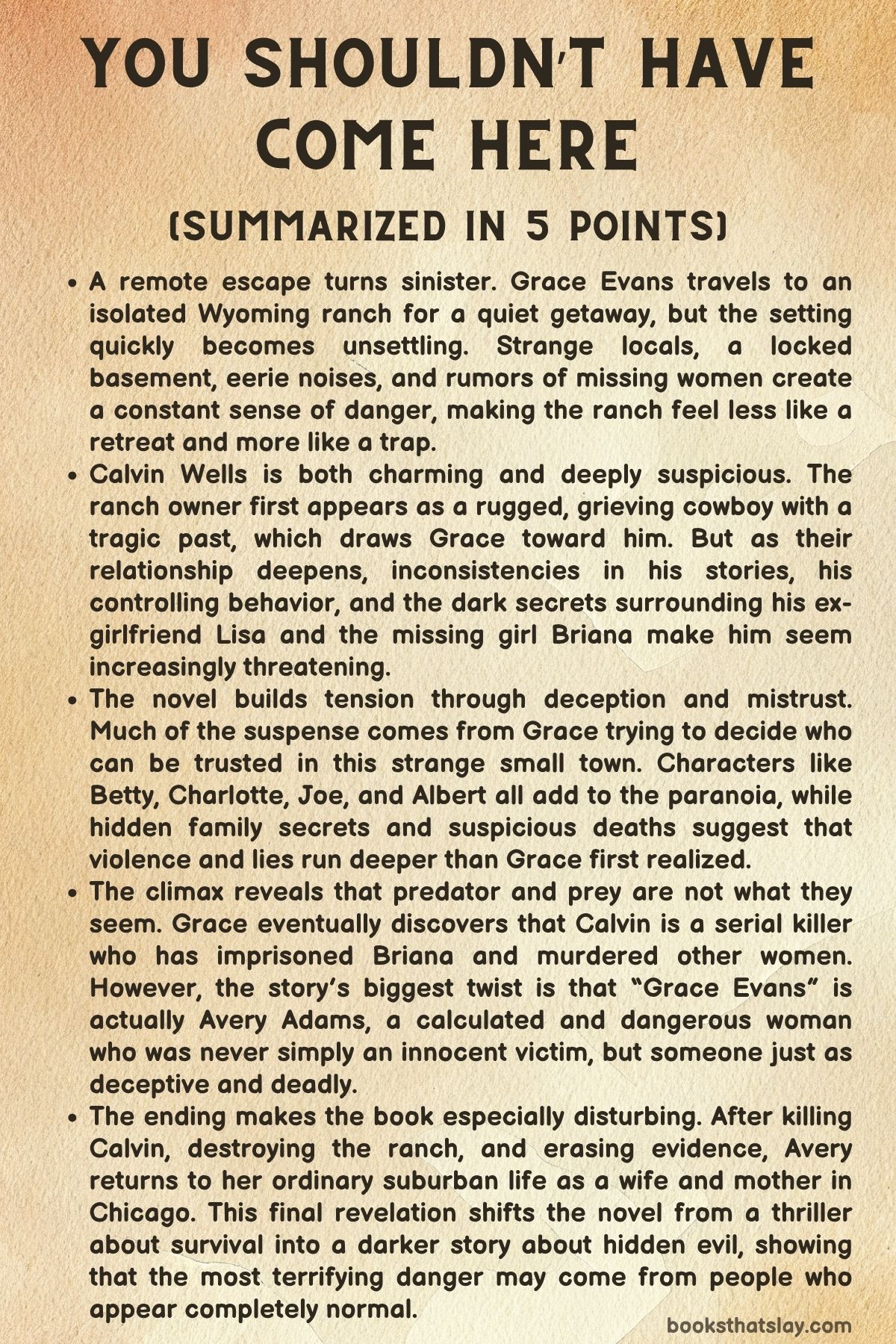
Calvin admits to causing Lisa’s death years earlier and reveals Briana is alive but imprisoned in a shed near the apiary. Before he can recover, Grace—whose true identity is Avery Adams—kills him.
After discovering a hidden closet with mounted human heads, Avery confirms Calvin was a serial killer. She torches the house, erasing evidence, and frees Briana but refuses to take her along.
Her carefully constructed “Grace Evans” persona is discarded as she burns every trace of her stay. She then meticulously switches vehicles, deletes digital accounts, and returns home to Chicago, where her real life awaits—a husband, children, and a suburban facade.
The final twist reveals Avery as more dangerous than Calvin. She thrives on deceit and violence, moving between identities while hiding behind the mask of an ordinary woman.
The “vacation” was not random—it was part of her predatory pattern. As she settles back into family life, the familiar itch returns, a chilling sign that she is far from finished.
Characters
Grace Evans / Avery Adams
Grace Evans, the identity under which Avery Adams enters You Shouldn’t Have Come Here, is the most intriguing character in the story. At first, she appears as a vulnerable, somewhat impulsive city woman searching for an escape from her urban life.
Her decision to travel alone to an isolated Wyoming ranch establishes her as adventurous but also naïve, willing to put herself at risk for the thrill of the unknown. However, as the story unfolds, her identity fractures to reveal Avery Adams, a cold, calculating manipulator who hides behind layers of deception.
Avery’s ability to charm Calvin and embed herself within the rhythms of the ranch community demonstrates her skill in psychological manipulation. She adapts quickly, using charm, sexuality, and feigned innocence to mask her true purpose.
What makes her chilling is her duality: the outward mask of Grace as curious and vulnerable, and the reality of Avery as a predator who stalks and destroys those who think they’re controlling her. By the end, her survival instincts, ruthlessness, and meticulous planning reveal her as not only a survivor but a predator in her own right, with her suburban family life acting as yet another disguise for her darker compulsions.
Calvin Wells
Calvin is at once charismatic, tragic, and monstrous. At the start, he exudes the archetypal rugged cowboy charm—stoic, hardworking, and devoted to his ranch.
His grief over the loss of his parents and ex-girlfriend Lisa adds layers of vulnerability that make him sympathetic. Yet, as Grace/Avery’s suspicions deepen, the cracks in his façade reveal a far more sinister truth.
Calvin is haunted by violence, his past littered with lies and acts of cruelty hidden beneath a mask of country hospitality. His need for control manifests in small gestures—locked doors, overprotectiveness, and evasive explanations—which gradually build into the revelation of his serial killings.
Calvin’s complexity lies in his duality: he genuinely longs for intimacy and connection, yet his twisted impulses ensure that such intimacy can only exist through domination and destruction. He embodies the theme of isolation turning to madness, with his ranch serving as both sanctuary and prison, and his character arc spirals from romantic figure to predator to victim of Avery’s calculated vengeance.
Joe Wells
Joe, Calvin’s troubled brother, serves as both a foil and an accomplice in Calvin’s dark world. His downward spiral after Lisa’s death highlights his instability, guilt, and self-destructive impulses.
While he is not painted with the same chilling precision as Calvin, Joe embodies recklessness and moral decay. His involvement in Lisa’s death—whether accidental or intentional—casts a long shadow, making him both suspect and tragic.
He is a man consumed by grief and guilt, using alcohol, anger, and arson as outlets for emotions he cannot reconcile. Joe’s dynamic with Calvin underscores the toxic influence of family bonds twisted by secrets, lies, and violence, showing how the Wells brothers are both victims and perpetrators of the darkness surrounding the ranch.
Charlotte
Charlotte represents jealousy, bitterness, and misplaced loyalty. Once close to Calvin, and even sharing intimacy with him shortly before Grace’s arrival, Charlotte becomes a symbol of small-town suspicion and resentment.
Her hostility toward Grace stems from both romantic rivalry and a deeper unease about outsiders disrupting the insular community. Charlotte’s character reveals how desire and loyalty can warp into antagonism, as she aligns herself with Calvin even when she senses danger.
Yet she also serves as a narrative device, amplifying Grace’s paranoia by validating the sense that something is “off.” Charlotte is less villainous than Calvin, but her complicity in upholding his façade—whether through denial or willful blindness—makes her dangerous in her own way.
Betty
Betty is one of the most unsettling secondary characters in the novel. On the surface, she appears to be a kindly, meddlesome maternal figure, the kind of woman who knows everyone’s secrets in a small town.
However, her knowledge runs uncomfortably deep, and her intrusions into Grace’s life blur the line between protection and manipulation. She calls Grace by name without being told, hovers with uncanny familiarity, and inserts herself into Calvin’s personal affairs with a sense of ownership.
Her relationship with Calvin is complex—at times maternal, at times overbearing, and at times almost conspiratorial. Betty’s declining health and skipped medication further highlight her instability, yet her influence over Calvin makes her a figure of quiet menace.
Her complicity, whether born of love for Calvin or fear of the truth, underscores how communities can enable darkness through silence and secrecy.
Albert
Albert’s brief but significant role underscores the theme of hidden truths and deception. Introduced as another Airbnb guest, he is later revealed to be Calvin’s uncle, a fact Calvin initially conceals.
His death—caused by a swarm of bees despite his severe allergies—feels suspicious and raises questions about whether it was truly accidental. Albert embodies the generational rot within Calvin’s family, a figure tied to the Wells’ dark history who ultimately becomes another casualty in the unraveling chaos.
His presence and death highlight how lies permeate the family, and how even kinship offers no protection against the destructive forces surrounding the ranch.
Briana Becker
Briana Becker represents the ultimate consequence of Calvin’s predatory nature. A missing woman whose case lingers in the background of the narrative, she emerges as the proof of Calvin’s monstrous reality when Grace discovers her imprisoned in the shed.
Briana is a victim, physically broken and emotionally scarred, but also a survivor whose endurance highlights the brutality Calvin inflicted. Her presence shifts Grace’s transformation from wary guest to vengeful executioner, providing the moral justification for Avery’s violent endgame.
Briana’s arc emphasizes the story’s central tension between predator and prey, survival and destruction, and the hidden horrors lurking beneath idyllic facades.
Daniel Adams and the Children
Though they appear only at the novel’s end, Daniel and the children deepen the disturbing complexity of Avery’s character. To them, she is a devoted wife and mother, seamlessly reintegrating into suburban domesticity after committing murder.
They represent the mask Avery wears to conceal her compulsions, her ability to compartmentalize violence from family life. Their presence reinforces the chilling reality that Avery is not merely reacting to Calvin’s evil but is herself a predator who thrives on deception.
They anchor the novel’s final twist, suggesting that Avery’s suburban family is not a sanctuary but another stage for her dark desires.
Themes
Isolation and Entrapment
The narrative in You Shouldn’t Have Come Here consistently circles back to the unsettling tension between isolation and entrapment. Grace, or rather Avery in disguise, seeks solitude in the remote Wyoming ranch, ostensibly for peace but in truth as part of a larger, manipulative scheme.
The vast landscapes of mountains, rivers, and plains create an environment that should offer freedom, yet paradoxically they become barriers, hemming her in. The padlocked basement, the unfamiliar neighbors who know her name, the suspiciously malfunctioning car, and even the reversed lock on her door reinforce a suffocating sense of confinement.
This contradiction is central to the story’s momentum—the ranch appears to offer sanctuary but steadily reveals itself as a cage. Avery, however, weaponizes this setting, turning Calvin’s attempt to trap her into an arena for her own deception.
Isolation here is not simply geographic; it is psychological, a slow stripping away of safety nets. The book shows how remoteness intensifies suspicion, amplifies danger, and creates a space where control can be manipulated more easily.
Entrapment evolves into a motif of survival and dominance—Calvin’s attempt to hold Avery against her will is turned back on him, and she escapes by exploiting the very isolation he thought would protect his crimes. The theme asks the reader to consider how environments designed to feel serene can transform into prisons when secrets and lies are buried beneath the surface.
Deception and Hidden Identities
Deception runs through every layer of You Shouldn’t Have Come Here, shaping both character and narrative. From the start, Calvin projects himself as a hospitable rancher, hiding behind the façade of rugged kindness while concealing the horrors lurking in his home.
The padlocked basement, his evasive responses about Lisa, and the missing girl Briana are small cracks in his carefully constructed mask. Grace, too, lives within deception, but hers is more calculated.
She arrives as Grace Evans, an innocent banker searching for adventure, but is in truth Avery Adams—a manipulative predator orchestrating her role down to dyed hair and colored contacts. The gradual revelation that she is not the victim but rather a mirror image of Calvin’s deceit reshapes the entire story.
The book forces the reader to confront how masks of normalcy—whether a cowboy rancher or a suburban mother—can conceal darker truths. What makes this theme particularly compelling is the interplay between Calvin’s impulsive, almost sloppy lies and Avery’s meticulous, orchestrated falsehoods.
Where Calvin hides bodies, Avery hides identities. Both characters rely on performance to achieve control, but Avery’s layered deception proves stronger, allowing her to infiltrate, manipulate, and finally destroy.
The novel underscores how deception is not only about concealing the truth but about constructing realities convincing enough for others to accept, even if only temporarily. This theme destabilizes the boundary between victim and predator, showing how both survival and predation thrive in falsehood.
Power, Control, and Manipulation
The story constantly circles around who holds power at any given moment, and how control is seized, lost, or wrestled back. Calvin initially appears to dominate his environment: the owner of the ranch, the protector with a shotgun, the man with local allies who seem to know more than they reveal.
His authority, however, becomes undermined as Grace questions his inconsistencies and slowly pulls at the threads of his secrecy. What makes this theme especially potent is how manipulation operates differently for each character.
Calvin exerts control through physical dominance, intimidation, and the implied threat of violence, reinforced by the isolation of the ranch and the complicity or silence of those around him. Avery, on the other hand, manipulates through psychological tactics—playing the role of guest, lover, confidante, and ultimately avenger, while concealing her true nature.
The turning point is not when Calvin traps her physically, but when she flips the balance by drugging him, interrogating him, and forcing confessions he has long buried. Control, in this narrative, is not stable but constantly contested, shifting between predator and prey.
What makes the ending so chilling is how Avery, after orchestrating Calvin’s downfall, simply reintegrates into her domestic life, exercising a subtler, long-term form of control—her ability to move between identities and environments unnoticed. The theme highlights how manipulation, whether brute force or cunning strategy, is central to survival but also exposes the terrifying capacity for dominance hidden behind ordinary appearances.
Violence, Trauma, and Human Darkness
Violence saturates the book, but it is not always immediate or overt. Much of it resides in the background—the pit of animal carcasses, the screams mistaken for fox calls, the locked shed concealing Briana.
These details steadily erode any sense of normalcy, foreshadowing the extreme brutality that eventually surfaces. Calvin’s violence emerges through his past and present: the staged accident with Lisa, his complicity in Briana’s disappearance, and the trophies of mounted human heads he keeps as grotesque symbols of dominance.
Yet the theme complicates itself with Avery’s own embrace of violence. Though positioned initially as a potential victim, she becomes the executioner, stabbing Calvin and burning his house to erase evidence.
The novel forces the reader to confront how trauma—Calvin’s upbringing in a broken, secret-laden family and Avery’s compulsions hinted at by the “itch in her back”—can evolve into patterns of destruction. Violence here is not random but deeply tied to secrecy, repression, and attempts at control.
The gas station explosion at the end is emblematic of how Avery erases not just her victims but the very traces of her alternate life, using destruction as a way to reset her reality. By the conclusion, the theme illustrates how violence is both a tool and a release, exposing the darkest instincts of humanity and leaving behind unsettling questions about cycles of predation and the thin line between survival and cruelty.