The Creative Act by Rick Rubin Summary and Analysis
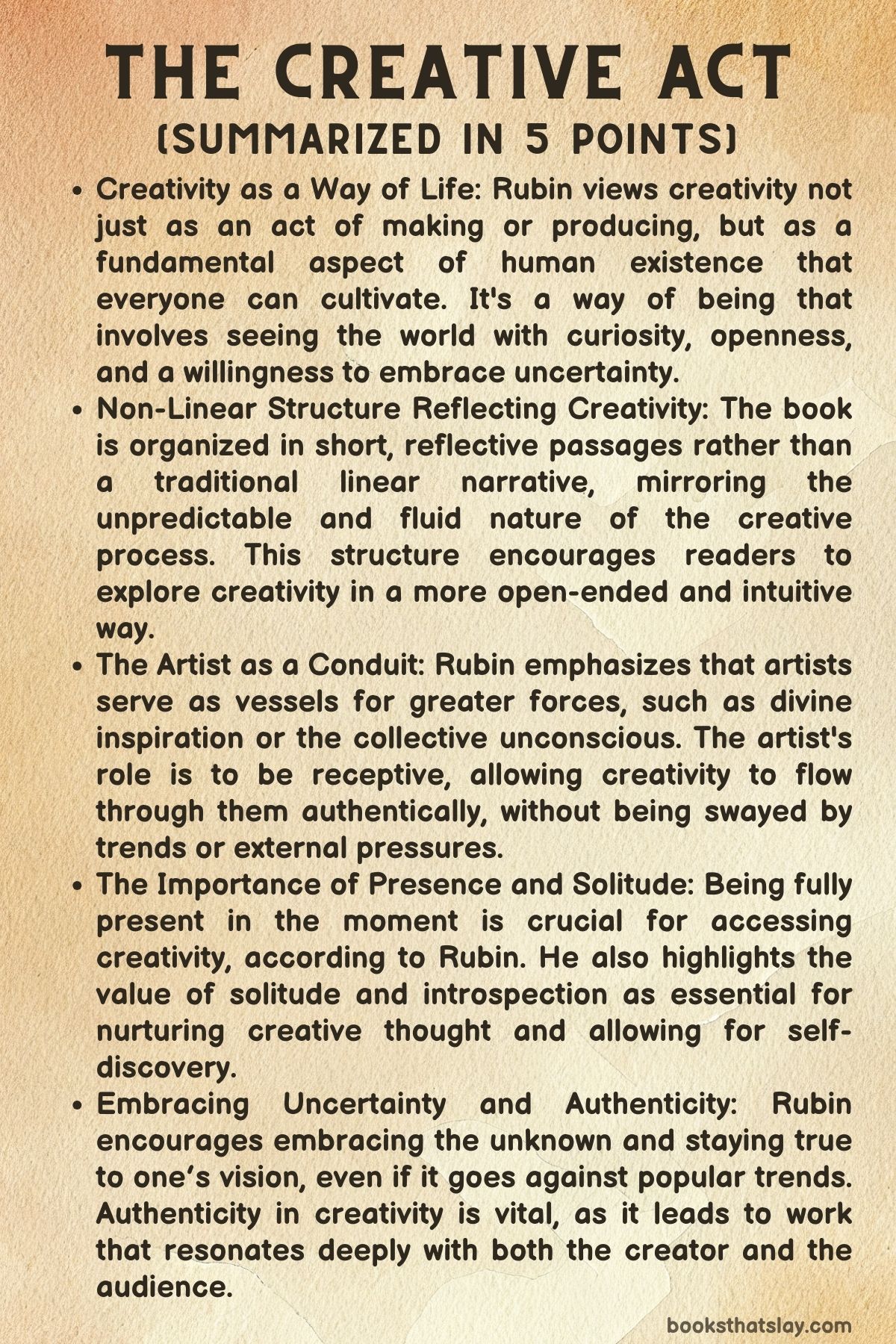
The Creative Act: A Way of Being by Rick Rubin is less a conventional book and more a philosophy of life. Rubin, a legendary music producer, reframes creativity not as the possession of a chosen few but as a birthright of everyone.
To him, creativity extends beyond making art—it is an orientation toward life, a way of perceiving, noticing, and shaping reality. Through concise reflections and practical wisdom, he guides readers to recognize creativity as an inexhaustible flow from the world around us, accessible whenever we quiet our minds and open ourselves to receive. The book is both meditation and manual, blending spiritual insight with grounded practices.
Summary
The book begins by challenging the belief that creativity belongs only to professional artists. Rubin asserts that everyone is a creator simply by living and making choices, whether arranging a room, cooking a meal, or solving a problem.
He describes life as continuous creation, where each perception and response shapes the world we inhabit. To live as an artist is to be fully attentive—sensitive to subtle signals and open to what draws or repels us.
Rubin places creativity within a larger cosmic framework. Just as nature cycles through rhythms and seasons, humans express themselves through ideas, inventions, and art.
Ideas, he suggests, come from a universal Source—an external, infinite reservoir from which inspiration arises. If one person does not manifest an idea, another may, because its time has come.
Artists act like antennas, tuning in to faint transmissions from this field. To hear these signals, the mind must quiet, creating space for imagination to emerge, much like the openness of childhood curiosity.
Awareness is central to this process. By observing without judgment, we allow objects and experiences to reveal themselves fully.
Expanding awareness enlarges the universe available to draw from, while deep looking uncovers hidden layers of reality. Rubin describes each person as both vessel and filter: we collect raw experiences in our vessel but interpret them through personal filters shaped by stories and culture.
To create freely, artists must soften these filters, expanding their receptivity to raw experience, which can then be expressed as art, inventions, or enterprises. The self itself becomes the true creative instrument.
Rubin emphasizes that art connects us to the unseen and spiritual. A finished work may be physical, but its impulse arises from a mysterious dimension beyond rational explanation.
Faith in unseen guidance allows artists to follow coincidences, instincts, and signs from the world. Everyday moments—a sunset, a fragment of music, a simple machine—can serve as portals into this dimension if we pay attention.
Practical advice follows. Rubin urges us to look for clues in daily life, where synchronicities often hint at creative direction.
He recommends regular practices such as meditation, walks, or mindful rituals to cultivate receptivity. He encourages immersion in great works, not to imitate but to refine taste and judgment.
Nature, too, is an endless teacher, reminding us of our interconnectedness and providing inspiration. Change, both within and outside us, ensures creativity never runs dry, as novelty constantly emerges.
The inner life is equally rich. Rubin advises drawing from memory, dreams, and the subconscious, which often harbor insights beyond the reach of rational thought.
Techniques like freewriting or dream journals help bypass conscious resistance. Even when creativity feels blocked, he reminds us the Source is still present; missed opportunities are replaced by new ones.
Finding environments that resonate with our state of mind also matters, as setting can either amplify or suppress inspiration.
The book also explores self-doubt as an inevitable companion to creation. Rubin reframes flaws and insecurities as potential strengths that give art authenticity.
Self-doubt can either paralyze or energize, depending on how it is handled. Lowering the stakes—treating creativity as play—lightens the burden of perfection.
Naming doubts can reduce their power, while recognizing the privilege of creation fosters gratitude. Distraction, when purposeful, can also spark ideas, as routine activities free the subconscious to problem-solve.
Collaboration plays a key role in creativity. No art exists in isolation; it emerges from traditions, tools, and audiences, as well as from negotiation between inspiration and craft.
Intention infuses work with hidden energy, making the process as important as the product. Rubin likens this to a bee’s unnoticed but essential role in sustaining ecosystems.
He also challenges rigid rules, presenting them as useful starting points but ultimately breakable. By experimenting with opposites and extremes, artists can avoid stagnation and discover fresh directions.
Listening is presented as a profound creative act—suspending judgment and opening to the world, people, and sounds around us. Patience is equally vital; true depth emerges from slowing down and respecting natural rhythms.
Maintaining a beginner’s mind fosters openness to new ideas, as illustrated by AlphaGo’s revolutionary approach to the ancient game of Go. Similarly, inspiration often arrives unbidden, like a flash of insight, and must be pursued with urgency before it fades.
Habits and routines provide the structure for sustained creativity. Simple rituals can free the mind from decision fatigue, allowing energy to flow into the work.
Gathering raw ideas as “seeds” without judgment, then experimenting playfully, allows creative projects to grow naturally. Failure is reframed as essential feedback, pointing the way forward rather than signaling defeat.
As works near completion, Rubin stresses the importance of refining and letting go. Sharing work can provide perspective, but the final decision rests with the artist’s intuition.
Many creators resist finishing, chasing perfection endlessly, but Rubin emphasizes that releasing work clears space for new creation. Creativity thrives on abundance, not scarcity; using and releasing ideas ensures the flow continues.
He distinguishes between experimenters, who generate ideas but struggle to finish, and finishers, who complete quickly but may lack depth. Both can learn from each other.
Temporary rules or constraints can stimulate innovation, while the essence of any work lies in stripping away excess until only what is essential remains. Great art comes from creating for oneself, not chasing external validation.
Success is defined as making the best work possible with sincerity, independent of commercial or critical reception.
The book warns against external pressures—critics, markets, or cultural expectations—that distort creativity. Instead, artists must tune in to their own sense of energy and transcend ego.
Surprises and mistakes are part of the process, often leading to breakthroughs. New ideas may at first be rejected but later recognized as transformative.
Competition, Rubin argues, is irrelevant; creativity is personal expression, not a race. At its core, art is a way of echoing existence, a record that says, “I was here.”
Rubin concludes by acknowledging the mystery of creation. Stories of genius often obscure the reality that creativity resists complete explanation.
The process requires trust—trust in oneself, in the Source, and in the continuity of ideas. By engaging sincerely, embracing imperfection, and letting go of outcomes, artists can continually renew themselves.
Creativity, he suggests, is not about producing masterpieces on command but about cultivating a way of being that keeps us attuned to the infinite flow of possibilities that surround us.
Key Metaphorical Figures
The Artist
In The Creative Act A Way of Being, the Artist is the central figure through which the book frames the human experience of creativity. The Artist is not limited to painters, writers, or musicians but represents every individual who participates in the act of perceiving, interpreting, and shaping the world.
The Artist is defined by attentiveness, sensitivity, and curiosity. Their work involves noticing subtle signals, embracing imperfections, and trusting the mysterious flow of inspiration.
The Artist embodies both vulnerability and resilience—constantly negotiating with self-doubt, distraction, and fear of judgment. Ultimately, this character symbolizes the possibility of living fully awake, treating creativity as a way of being rather than a profession.
Source
Another important character is Source, depicted as an inexhaustible external field of creative energy. Source is not personified in a literal sense but functions as a constant companion to the Artist, akin to a guiding presence.
It represents the collective reservoir of ideas, fragments, and possibilities waiting to be translated into form. Source is mysterious yet ever-present, appearing through sudden flashes of inspiration, dreamlike fragments, or subtle coincidences in daily life.
The relationship between the Artist and Source is reciprocal—the more the Artist opens themselves, the more readily Source reveals its offerings.
The Self
The Self emerges as both vessel and filter in Rubin’s framework. This character represents the internal landscape through which creativity passes before becoming art.
The Self gathers experiences, memories, and sensations, but also distorts and interprets them through personal biases and worldviews. It is simultaneously the tool of creation and the obstacle to it.
The Self’s capacity to expand, soften, or become more porous determines the breadth of what the Artist can receive from Source. In this sense, the Self is a lifelong companion whose growth and refinement directly shape the quality of one’s art.
Doubt
Doubt is characterized almost as a shadow figure, inseparable from the Artist. It manifests as fear, insecurity, and hesitation but also carries the paradoxical gift of authenticity.
Doubt makes art human, relatable, and imperfect in ways that resonate with others. It challenges the Artist to distinguish between uncertainty about their work and self-negation, offering an opportunity to grow.
Doubt’s role is both adversarial and instructive—at times paralyzing, at other times pushing the Artist toward breakthroughs and deeper sincerity.
Collaboration
Collaboration appears as a dynamic character woven into the fabric of creation. It embodies the reality that no work is made in isolation, as traditions, tools, audiences, and even one’s inner multiplicity all contribute to the process.
Collaboration is both ally and challenger, sometimes smoothing the creative path, at other times sparking friction that leads to greater innovation. Its presence reminds the Artist that creativity is a shared, communal act, even when the labor appears solitary.
Intention
Intention operates as a quiet yet steadying character, grounding the Artist’s efforts. It infuses art with sincerity, invisible energy, and coherence.
Much like a mentor figure, Intention aligns conscious and unconscious forces so that the work carries depth beyond surface technique. When the Artist becomes lost in distraction or perfectionism, Intention restores focus and reminds them of the larger purpose.
It is not about imposing meaning in advance but about honoring the care and devotion in the process itself.
Failure
Failure is one of the most paradoxical characters in the book. Often feared, it is instead portrayed as a guide and teacher.
Failure does not seek to defeat the Artist but to redirect them toward discovery. It appears repeatedly across the creative cycle, not as a dead end but as essential information.
In this sense, Failure is a companion in disguise—demanding humility, resilience, and openness. By reframing failure as progress, the Artist transforms it into an ally rather than an enemy.
Completion
Completion stands as the final yet elusive character in the creative journey. It embodies both release and renewal, urging the Artist to let go of their work and move forward.
Completion often wrestles with the Artist’s fear of impermanence or perfectionism, but its role is crucial in ensuring the cycle of creation continues. It is not rigid or absolute but intuitive, allowing the Artist to decide when a piece has reached its essence.
By closing one chapter, Completion makes space for the next, ensuring that creativity remains a living, breathing process.
Themes
Creativity as a Universal Human Condition
In The Creative Act A Way of Being, creativity is treated as a fundamental human quality rather than a specialized gift reserved for professional artists. The text insists that every individual participates in creation simply by being alive and engaged with the world.
A conversation, an improvised solution to a daily problem, or the simple act of rearranging a space becomes a creative gesture. This view democratizes creativity, liberating it from the elitist associations of artistic genius, and makes it central to how humans navigate reality.
Life is seen as an act of constant composition—perceptions are filtered, responses are chosen, and realities are shaped. Through this lens, existence itself becomes a medium, and the act of paying attention to one’s environment, emotions, and choices transforms everyday experience into art.
By redefining creativity as awareness and sensitivity, the book urges readers to live more consciously, recognizing that what they notice, emphasize, or ignore actively shapes their world. This theme pushes against the limiting belief that only trained professionals or extraordinary talents are “creative,” proposing instead that creativity is both the birthright and responsibility of all people.
The Source and the Flow of Ideas
The idea of “Source” provides a metaphysical frame for understanding inspiration. The text describes Source as an inexhaustible field of energy from which ideas originate, positioning the individual as a receiver rather than sole originator.
Creativity, then, is not a matter of producing from nothing but of tuning one’s awareness to signals already present in the universe. The act of quieting mental noise and cultivating openness becomes crucial, since inspiration is more readily accessed in states of stillness, curiosity, and receptivity.
This challenges modern notions of productivity that emphasize constant action; instead, the artist is asked to become a vessel for ideas, recognizing that imagination exceeds what can ever be fully realized in material form. Ideas move like clouds, recombining endlessly, and what appears innovative is often a new arrangement of timeless elements.
By placing responsibility on the individual to refine their receptivity rather than force originality, the text reframes creativity as a partnership with the unseen. This theme reminds readers that ideas cannot be hoarded and that creation is a cycle of receiving, shaping, and releasing back into the world.
Self-Doubt and Vulnerability
One of the most resonant themes in The Creative Act A Way of Being is the role of self-doubt in the creative process. Rather than presenting it as an obstacle to be eradicated, the text treats insecurity as an intrinsic part of making art.
Sensitivity, which enables artists to perceive subtle cues and generate meaningful work, also exposes them to fear of failure and judgment. The book highlights how imperfections, rather than diminishing art, often lend it authenticity and uniqueness.
Examples like the flawed Leaning Tower of Pisa or kintsugi pottery suggest that brokenness or incompleteness can become strengths. The theme emphasizes a shift in perspective—self-doubt becomes not a signal to stop but a companion to be acknowledged and managed.
By lowering the stakes of creation, viewing it as play, and distinguishing between doubting one’s work and doubting oneself, artists can continue forward without being immobilized. Vulnerability is presented as inseparable from resonance; only by risking exposure can art achieve depth and truth.
This reframing of insecurity offers a liberating perspective, encouraging creators to embrace doubt as a marker of sincerity rather than a barrier to expression.
Collaboration and Connection
Creativity is often imagined as a solitary act, yet the text dismantles this myth by showing that no work arises in isolation. Every piece of art carries the influence of traditions, tools, audiences, and even the multiple selves within the creator.
Collaboration is not only about working with others directly but also about recognizing the interconnected nature of cultural and personal input. Even when artists believe they are creating alone, they are in dialogue with predecessors and with those who will eventually encounter their work.
The theme emphasizes how collaboration introduces tension between inspiration and craft, intention and interpretation, yet this negotiation enriches the process. The perspective of the audience is treated as equally valid to that of the creator, acknowledging that meaning is never fully controlled.
Collaboration also extends to working with the subconscious, with nature, and with chance—all of which act as silent partners in creation. By embracing connection rather than clinging to isolation, the creative process becomes expansive, responsive, and deeply relational.
Rules, Experimentation, and Innovation
The book consistently challenges rigid structures by reframing rules as provisional guides rather than unbreakable laws. Conventions—whether inherited from culture, training, or personal habit—can be useful as starting points but ultimately risk constraining originality if followed blindly.
By encouraging experimentation with opposites, extremes, and even contradictions, the text highlights how breakthroughs often emerge from questioning what is assumed to be fixed. This openness to inversion prevents stagnation and broadens creative possibility.
Innovation is thus portrayed not as rejecting tradition outright but as engaging with it dynamically—absorbing lessons, bending structures, and discarding limits that no longer serve. The AlphaGo example illustrates how genuine innovation arises from disregarding long-held assumptions and approaching a field with fresh eyes.
The theme advocates a balance between discipline and rebellion: rules can sharpen skills, but they must eventually be transcended to allow authentic expression. Creativity here becomes not a linear following of steps but a living practice of risk, curiosity, and courage.
Patience and Process
Another central theme is the emphasis on patience as a creative virtue. In a culture that rewards speed and efficiency, the text proposes that true depth comes only through slow attention, repeated engagement, and acceptance of natural rhythms.
Shortcuts diminish richness, while time allows ideas to mature and subtle refinements to emerge. The stages of gathering seeds, experimenting, and nurturing ideas are described as cyclical processes, requiring trust that not all growth is immediately visible.
Even failure is reframed as an essential teacher rather than a defeat, pointing the way forward through lessons embedded in mistakes. Patience also manifests in waiting for inspiration rather than forcing it, honoring the reality that creativity cannot be summoned at will.
By portraying masterpieces as products of years of steady refinement rather than sudden strokes of genius, the book affirms the value of persistence. This theme offers a countercultural reminder that slowness, repetition, and endurance are not obstacles but essential conditions for meaningful creation.
Completion and Letting Go
The final stage of the creative cycle is framed as an act of release, where the artist must accept imperfection and decide that a work is finished. Completion is less about perfection than about intuition—the recognition that further adjustments risk diminishing vitality.
The text underscores the difficulty many creators face in letting go, warning against endless revision or paralysis born of perfectionism. By clinging to a single work, artists prevent the emergence of future projects, whereas releasing each piece allows for renewal.
The theme also stresses the abundance of creativity; ideas are not scarce but constantly replenishing. Trusting this flow liberates the artist from hoarding or overprotecting any single creation.
Sharing work, despite the vulnerability it entails, becomes necessary for growth. Success is reframed as the private satisfaction of having made the best possible effort with sincerity, rather than external recognition.
Completion, therefore, is not an end but a doorway to new beginnings, a practice of acceptance and faith in the ongoing process of creation.
Art, Meaning, and Responsibility
Throughout The Creative Act A Way of Being, the text challenges the notion that art must serve an explicit social or moral purpose. Instead, it presents art as a self-sufficient act whose meaning often emerges only after its creation.
Artists are cautioned against burdening themselves with the pressure of engineering messages, since doing so risks constraining the natural flow of ideas. The responsibility of the artist is not to fulfill external demands but to protect creative freedom and authenticity.
While art inevitably resonates with audiences and can influence culture, its first allegiance is to itself. By rejecting the myth of the tortured artist, the book also resists the idea that suffering is required for profundity.
Instead, it affirms that creativity can be a healing and sustaining force. This theme liberates creators from rigid expectations about what their work must “say” or accomplish, grounding responsibility not in external validation but in the honest act of making.
In doing so, it positions art as an offering to existence itself—a record of presence and a transmission of perception that affirms life without needing justification.