Princess of Blood Summary, Characters and Themes
Princess of Blood by Sarah Hawley follows Kenna, a former human who has become a Noble Fae and the new Princess of Blood House. The story follows her first days in this dangerous role as she struggles to protect her friends, rebuild a fallen house, and navigate a city where every alliance is temporary and every promise hides an angle.
Magic is alive in the walls, enemies watch from every direction, and politics are as deadly as blades. Kenna must grow into the kind of leader who can protect both humans and fae while wrestling with her past, her power, and the future she never expected to carry. It’s the 2nd book in the The Shards of Magic series.
Summary
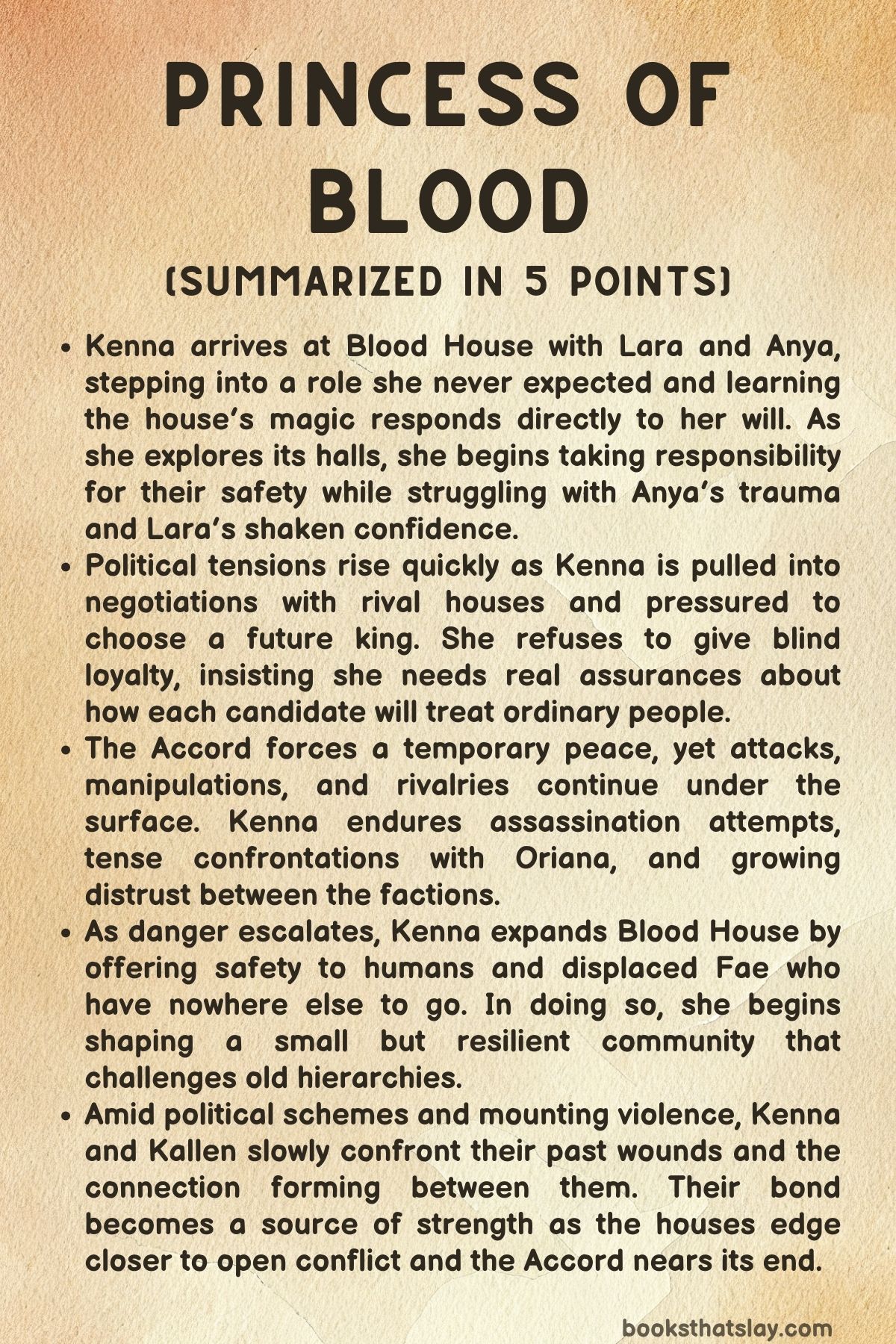
Kenna arrives at Blood House with Lara, the cast-out heir of Earth House, and Anya, her human friend still shattered by torture. Before the house’s ancient entrance, Kenna braves a deadly ward by placing her hand into the wolf-shaped grip, marking her as the new head of Blood House.
The Blood Shard accepts her, speaking in her mind and allowing her to claim Lara and Anya as members of the house. Inside, Blood House awakens: torches flare, a fountain of blood begins to run, and the space feels protective despite its violent history.
Kenna tries to comfort Anya, whose trauma makes her fear beds and quiet rooms. While exploring, Kenna learns she can influence the house’s magic like a network of threads.
She discovers that the secret tunnel Osric once used to slaughter Blood House was sealed by other fae; only the new princess can reopen it. In the kitchen she learns Blood House can conjure food from its magical reserves, and she prepares a meal for her small household just before the stones warn her of a visitor.
Lord Kallen of Void House arrives, telling her she is expected at a meeting with Prince Drustan of Fire House and Prince Hector of Void to discuss the future ruler of Mistei. After checking on Lara and Anya, Kenna dresses in a dangerous-looking gown with Caedo disguised as jewelry.
Kallen escorts her to a hidden chamber where Drustan, Hector, and Lady Gweneira of Light House gather. They discuss the unstable political landscape: Light House is leaderless, Earth House refuses to take a side, and alliances are fragile.
Drustan pushes Kenna to support him as king, relying on their past relationship to sway her. She refuses, draws Caedo when he insults her, and demands respect as Princess of Blood.
Drustan backs down.
Their political debate is interrupted when Ulric delivers a message from Imogen of Illusion House, who declares herself queen and calls for a traditional thirty-day peace period known as the Accord. The group is shocked but knows breaking the Accord would destroy public trust.
Kenna demands both Drustan and Hector provide written policies before she chooses whom to support.
Seeking answers, Kenna confronts Oriana of Earth House. Oriana avoids her, and Kenna is nearly killed by an Illusion attack that sweeps her into a treacherous water tunnel.
Oriana rescues her but accuses her of provoking danger. Their argument becomes bitter; Oriana demands a lost key, and Kenna lies about having misplaced it.
As Kenna leaves, she thinks Oriana whispers a plea to protect Lara.
Returning shaken, Kenna checks on the humans held in Mistei. Many fear the outside world and refuse to escape.
She persuades Maude and Triana to join Blood House. On her way back she encounters Kallen, who notices the key and questions her.
She admits someone tried to kill her, and he vows to help. Their conversation becomes unexpectedly intimate, and he asks her to take him with her when she explores the tunnels.
She agrees.
At Blood House, tensions rise as Lara struggles with insecurity and her loss of magic. Kenna insists the humans are not servants.
Over shared food, Kenna recounts recent events, and Lara finally admits she wants respect and vengeance. Kenna promises they will build power together.
Imogen later corners Kenna at a party, offering bribes and protection in return for loyalty. Kenna refuses.
Anya lashes out afterward, claiming Blood House is not a home, leaving Kenna devastated. During training, Kallen tells Kenna Imogen also tried to manipulate him.
They discuss how Imogen aims to fracture alliances by exploiting private desires.
At a Grimveld-themed party, Kenna stops Ulric from poisoning Gweneira by freezing her arm. Gweneira reveals the constant threat of assassination within her alliances.
Later, Hector hosts a smaller gathering. Kenna meets Lady Rhiannon, who mourns her son and condemns Oriana’s strict adherence to tradition.
Hector gives Kenna another political proposal. Una, his sister, tests Kenna’s intentions and leaves cautiously satisfied.
Kenna reads both Hector’s and Drustan’s policy letters, torn between their visions for humans and fae. She confides in the Blood Shard but receives no guidance.
When humans prepare to leave Mistei, Anya is too traumatized to join them. Kenna comforts her with an old memory.
At the tenth-day ball, Drustan admits his past actions were partly strategic but partly genuine. Kenna shuts down any chance of rekindling their relationship.
Kallen witnesses this and appears unsettled; Kenna assures him Drustan no longer has any claim on her. He tells her she deserves better.
When Light House falls to Torin and Rowena, survivors flee to Blood House. Gweneira is revived by Kenna’s blood magic.
Kenna offers sanctuary and helps craft false rumors to protect the escapees. She then meets Kallen in a secluded room and tells him she has chosen Hector as king.
Kallen, overwhelmed with relief, embraces her. He finally confesses he loves her and reveals his painful past: he once trusted a girl who betrayed him to Osric, who forced him to kill her.
Convinced he destroys what he loves, he has lived in self-hatred. Kenna rejects this belief and tells him she chooses him.
They make love for the first time, sharing vulnerability and desire, and promise no more running.
Kenna attends the masquerade, watching the political tension simmer. She confronts Oriana again, realizing the Earth queen will never change.
She meets with Hector, Una, and Kallen to prepare for the coming announcement. Imogen approaches to sow suspicion, hinting Torin wants Kenna dead.
Kenna exposes Torin’s coup at Light House, shaking Imogen.
Ulric later forces drugged wine on Kenna using an Illusion sprite. Overwhelmed by a violent surge of magic, she hallucinates Drustan attacking Kallen and snaps Drustan’s neck with blood magic.
The illusion fades; Drustan is alive but paralyzed. Torin seizes the moment, declares she has broken the Accord, and chaos erupts.
A massacre follows. Guards capture Kenna and chain her.
Imogen tries to maintain order, but Torin kills her. Sun Soldiers flood the hall, slaughtering guests.
Kenna searches desperately for Kallen. She sees Hector captured, Aidan rescued, and bodies scattered.
A soldier drags her toward the dais; she glimpses Kallen’s seemingly lifeless body under an iron net before Una spirits him away.
On the dais, Rowena orders Kenna’s right arm cut off to remove Caedo. After the arm is reattached, Caedo is locked away.
Torin and Rowena now control the scene, having engineered the disaster. As Kenna bleeds and watches leaders dragged off or dead, she realizes she was the spark they needed.
Rowena dusts her with sleeping powder, promising that their games are only beginning. As darkness takes her, Kenna clings to one thought: if Kallen lives, she will find her way back to him.
Characters
Kenna
Kenna stands at the heart of Princess of Blood, a woman transformed from human servant to Noble Fae and Princess of Blood House. Her journey is defined by trauma, rebirth, political chaos, and an unrelenting need to protect the vulnerable despite her own fear of becoming something monstrous.
She adapts quickly to her growing magical power—blood magic, the living dagger Caedo, and the sentience of the Blood House itself—yet remains deeply human in her empathy. Kenna struggles with the weight of leadership: every decision she makes affects not only politics but the safety of humans and changelings who look to her for protection.
Her character is marked by fierce loyalty, impulsive courage, and a moral compass that refuses to bend even under immense pressure. While she grows more ruthless out of necessity, she retains a core belief that rulers must serve the people rather than use them, setting her apart from the opportunistic Fae around her.
Her relationships—particularly with Kallen, Lara, and Anya—reveal her emotional complexity: she is nurturing, guilt-ridden, passionate, and stubbornly hopeful even in the face of betrayal and war.
Kallen
Kallen serves as a foil to Kenna’s compassion—quiet, lethal, and shaped by years of indoctrination under Osric. As Void House’s enforcer, he has lived as a weapon rather than a person, carrying deep self-loathing for the horrors he was forced to commit.
Behind his cold exterior lies a man marked by profound trauma: tortured as a youth, manipulated into betraying someone he loved, and taught that intimacy leads only to pain. Yet with Kenna, he begins to rediscover his own humanity.
His love for her is obsessive in intensity but grounded in devotion, respect, and a desire to protect rather than possess. His arc shifts from believing he destroys everything he loves to accepting that he can be a partner, not a burden.
Kallen embodies restraint, loyalty, and frightening capability; he understands violence intimately but ultimately longs for connection. His political suspicions, combat expertise, and emotional honesty provide Kenna with her most reliable ally—and the person who sees her not as a symbol, but as a woman worth choosing.
Lara
Lara, once the heir of Earth House and now a cast-out faerie stripped of power, carries crushing insecurity beneath her sharp tongue and bravado. She oscillates between resentment, envy, and fierce loyalty, particularly toward Kenna and Anya.
Lara’s trauma at losing her heritage, purpose, and sense of identity makes her prickly and defensive; she lashes out when she fears irrelevance or when faced with reminders of what she has lost. Yet she is perceptive, courageous, and driven by an earnest desire for respect rather than dominance.
She wants not just vengeance for her own suffering but justice for others who have been overlooked or wronged. Over time, she learns to redefine her value beyond noble lineage and begins forging a new identity within Blood House.
Her dynamic with Kenna evolves from tense alliance to genuine sisterhood, and despite her flaws, Lara proves herself to be one of Blood House’s emotional anchors and fiercest advocates.
Anya
Anya represents the human cost of the Fae’s political games. Once Kenna’s best friend, she emerges from Osric’s torture profoundly changed: traumatized, withdrawn, and unable to trust safety even when she desires it.
Her fear manifests in emotional volatility, anger, and a desperate need for control in small ways—choosing a servant’s room, curling on the floor, pushing Kenna away when affection feels unbearable. Anya’s pain is raw and unvarnished; she is a reminder that survival does not erase suffering.
Despite her walls, she still cares deeply for Kenna and Lara, and her eventual willingness to stay in Blood House suggests a fragile beginning of healing. She embodies resilience, even when she can’t see it in herself, and her journey reflects the difficulty of reclaiming autonomy and community after brutality.
Drustan
Drustan of Fire House is charismatic, ambitious, and dangerously accustomed to using charm as a political tool. His past affair with Kenna reveals both his manipulative tendencies and his genuine, if flawed, affection for her.
He operates from a place of loss—haunted by the memory of Mildritha—and struggles to distinguish desire, strategy, and emotion. Drustan craves power as much as he fears vulnerability; he wants the throne but refuses to confront the ways his ambition blinds him to people’s needs.
Yet he is not wholly callous. His apologies, his political proposals, and his moments of honesty show a man capable of honor, though rarely guided by it.
Drustan’s complexity lies in his contradictions: sincere yet self-serving, protective yet dismissive, wounded yet unwilling to heal.
Hector
Hector of Void House contrasts Drustan with his steadiness and strategic clarity. He is pragmatic, direct, and often brusque, but his motivations are grounded in responsibility rather than ego.
Hector sees the bigger picture—alliances, public support, resource distribution—and approaches politics with a seriousness that borders on severity. His protective instincts toward his people and his genuine willingness to consider human rights make him a surprisingly empathetic leader beneath his stern exterior.
Though he has moments of temper and distrust, he consistently treats Kenna as an equal and values honesty over manipulation. His bond with his sister Una and his grief over Talfryn further humanize him, revealing layers of familial devotion behind his political composure.
Gweneira
Gweneira of Light House begins as a poised and calculating political player, but her downfall exposes a more vulnerable woman desperate to reclaim her stolen legacy. After the coup by Torin and Rowena, she becomes a symbol of Light House’s suffering.
Her revival at Kenna’s hands marks a turning point: she shifts from aspiring ruler to vengeful survivor. Gweneira is proud, sharp-minded, and capable of great kindness when stripped of her defenses.
Her gratitude to Blood House, mixed with her lingering fear and anger, pushes her into a fierce determination to fight back. She becomes both an ally and a warning—proof of how quickly power can be lost in Mistei.
Oriana
Oriana, head of Earth House, is a study in rigid tradition and self-preservation. She clings to neutrality not out of wisdom but because it absolves her of responsibility, even as her house fractures around her.
Her coldness toward Kenna, her condescension, and her refusal to support Lara reveal a woman chained to fear of political instability. Yet she is not heartless; her rescue of Kenna from the lethal water tunnel and her whispered plea to take care of Lara hint at buried compassion.
Oriana is a tragic figure—one who clings so tightly to stability that she loses the very people she meant to protect.
Torin and Rowena
Torin and Rowena serve as the book’s most chilling antagonists: cunning, calculating, and hungry for power. Their coup at Light House and manipulation of the Accord’s collapse reveal ruthless ambition executed with surgical precision.
Torin delights in psychological warfare, using taunts, veiled threats, and orchestrated chaos. Rowena, colder and more methodical, wields cruelty with a smile—weaponizing medical knowledge, poisons, and torture.
Together they exploit the turmoil of Mistei to ascend, framing rivals and orchestrating massacres without hesitation. Their treatment of Kenna, from the mockery on the dance floor to the brutal amputation and imprisonment, encapsulates their belief that fear, not loyalty, maintains power.
Imogen
Imogen, Osric’s distant cousin, is an opportunist masquerading as a unifier. She fabricates legitimacy through spectacle, wealth, and manipulation, using the Accord to stall her enemies while consolidating power behind the scenes.
Imogen is dangerous not for her military might but for her psychological insight; she understands vulnerabilities and capitalizes on them with unnerving precision. Her bribes, veiled threats, and ability to turn allies against one another unravel the political landscape.
Yet her overconfidence and inability to control Torin ultimately lead to her downfall. Imogen is a mirror of Mistei’s political decay—a leader who rises through theatrics and falls through hubris.
Caedo
Caedo, the sentient dagger, is an eerie and enigmatic presence—a weapon with a will of its own. Caedo’s bond with Kenna is symbiotic but unsettling; it chooses her, guides her, and occasionally frightens her with its cryptic warnings.
It is fiercely protective, almost possessive, of its wielder and takes satisfaction in killing those who threaten her. Yet Caedo is not mindless: it provides insight into Kenna’s transformation and the magic surrounding the Blood Shard.
It represents the darker side of Kenna’s power—the part of her tempted by violence and vengeance—and its removal at the end symbolizes the stripping of her agency and identity. Caedo is both a confidant and a curse, reflecting the price of survival in Mistei.
Themes
Power, Identity, and Self-Definition
Kenna’s transformation from human to Fae and then to Princess of Blood House creates a constant tension between who she was and who she is expected to become. Her new powers, the authority of Blood House, and the political weight placed on her decisions force her to confront the fear that she may lose her sense of self.
Yet the narrative consistently shows her resisting the roles others attempt to project onto her—Drustan’s former lover, Hector’s potential ally, Imogen’s prey, or Rowena’s scapegoat. Her identity becomes something she must actively build rather than passively inherit.
The Blood House itself reflects this journey; it responds to her intentions, reveals hidden passageways, and allows her to define its membership. Instead of becoming a symbol of violence as its history suggests, she bends it toward protection, refuge, and autonomy.
Her struggle is not only political but deeply personal. She navigates the stigma of being newly Fae, the mistrust of humans who once viewed her as one of their own, and the pressure imposed by multiple factions trying to weaponize her existence.
Through this, Kenna shapes an identity rooted in empathy and choice rather than lineage or fear. This theme becomes especially potent in moments where she stands alone—rejecting Drustan’s manipulation, confronting Imogen’s coercion, or defying Rowena’s cruelty.
Identity in Princess of Blood is not fixed; it is something forged through resistance, agency, and loyalty to one’s internal compass even when the world demands conformity.
Trauma, Healing, and the Cost of Survival
The characters carry wounds that shape both their relationships and their decisions, and the book treats trauma as something that echoes through every moment rather than something that can be dismissed with a single act of heroism. Anya’s silence, terror of beds, and emotional volatility reveal trauma as an ongoing experience that alters how safety, trust, and identity are perceived.
Lara’s bitterness and desire for vengeance stem from years of humiliation and powerlessness, expressing themselves in sudden outbursts and an aching need for validation. Kenna’s own trauma surfaces through her near drowning, her uncertainty about death and rebirth, and the constant fear of what her blood magic might make her become.
Kallen’s past—torture, forced murder, and emotional conditioning—demonstrates how trauma can fracture self-worth so deeply that love becomes something frightening. Healing is portrayed not as a clean upward arc but as uneven progress marked by regressions, reluctant honesty, and imperfect but persistent attempts at connection.
These characters survive because they hold on to small gestures of care: blankets left in quiet rooms, shared bread, the courage to confess fear, or the choice to stay close even when distance feels safer. The book refuses to romanticize suffering; instead, it explores how trauma influences politics, loyalty, and love.
Survival has a cost, and healing requires more than endurance—it demands community, patience, and the willingness to confront the past without letting it define the future.
Corruption, Manipulation, and Moral Ambiguity
The political landscape of Princess of Blood exposes systems built on coercion, deceit, and strategic cruelty. Imogen’s bribes, Ulric’s illusions, Torin and Rowena’s calculated violence, and the manipulations woven into alliances demonstrate how power in Mistei is maintained through psychological warfare as much as physical force.
No faction is immune to ambition, and even the most well-intentioned characters carry shadows. Drustan oscillates between charm and condescension, using past intimacy to influence Kenna.
Hector offers appealing policies but hides dangerous secrets. Oriana clings to neutrality but allows her rigidity to cause suffering for those who depend on her.
The book presents politics as a terrain where truth is rarely pure and motives are layered. Even Kenna, who fights to remain ethical, must lie, bargain, and make alliances with imperfect people.
The narrative refuses to draw clean lines between good and evil; instead, it portrays a world where survival often requires navigating manipulation while trying not to lose one’s integrity. Corruption is systemic, but moral agency still matters.
Kenna’s insistence on valuing the lives of ordinary people becomes an act of rebellion against a political culture that treats individuals as expendable. The theme highlights the tension between personal ethics and the compromises demanded by leadership, suggesting that moral clarity becomes most meaningful when it is hardest to uphold.
Found Family and Chosen Loyalty
As Blood House resurrects itself under Kenna, the idea of chosen family becomes a stabilizing force amid chaos. Lara, Anya, Triana, Maude, and eventually even Gweneira form a community not linked by bloodline but by shared suffering, trust, and mutual protection.
These bonds counter the coldness, betrayal, and ambition rampant among the ruling houses. The house’s magic responds not just to Kenna’s intentions but to the emotional connections forming within it, turning a structure once associated with slaughter into a shelter for the vulnerable.
Found family becomes a deliberate act rather than an accident of circumstance. Characters question, clash, argue, and hurt one another, yet they return because belonging offers something more powerful than individual survival.
Kallen’s growth in particular reflects how chosen loyalty can reorient a life built on forced obedience. For Lara, the group represents a chance to reclaim worth.
For Anya, it offers the possibility of safety that does not demand performance. For Kenna, it becomes proof that leadership rooted in care can exist even in a world shaped by violence.
This theme underscores that power structures may be corrupt, but bonds chosen freely can create parallel systems of support strong enough to challenge oppression. Found family is not portrayed as perfect harmony; it is effort, forgiveness, confrontation, and the slow building of trust.
Love, Intimacy, and Emotional Vulnerability
Romantic intimacy in Princess of Blood is inseparable from emotional exposure. Kenna and Kallen’s relationship grows through honesty rather than seduction or political strategy.
Their intimacy contrasts sharply with Kenna’s past with Drustan, where desire was mixed with manipulation and secrecy. With Kallen, connection becomes a process of dismantling internal barriers—his belief that he destroys what he loves and her fear that her power corrupts everything it touches.
Their bond is shaped by mutual recognition: both have been used by stronger forces, both carry guilt, and both fear they may not be worthy of tenderness. Love emerges not as a dramatic revelation but as a gradual willingness to be seen fully.
The theme emphasizes that intimacy requires courage equal to that needed for battle. Moments of closeness occur in quiet spaces—sign language lessons, shared grief, confessions in dim rooms—and these reveal more about their characters than any political maneuver.
The love depicted here is not a rescue fantasy; it is a partnership rooted in trust, communication, and the understanding that vulnerability can be a source of strength. This theme ultimately reinforces the idea that in a world defined by betrayal and violence, genuine emotional connection becomes an act of defiance.