The Love Haters Summary, Characters and Themes
The Love Haters by Katherine Center is a romantic comedy about courage, self-acceptance, family wounds, and the strange risks people take when they begin to care deeply about someone. The story follows filmmaker Katie Vaughn, whose attempt to save her career sends her to Key West to profile a celebrated Coast Guard rescue swimmer.
What begins as a difficult professional assignment becomes a personal transformation. Through dangerous training, bright tropical clothing, an enormous dog, a complicated family conflict, and an unexpected romance, Katie learns that confidence is not something granted by admiration but something built through self-respect and brave choices.
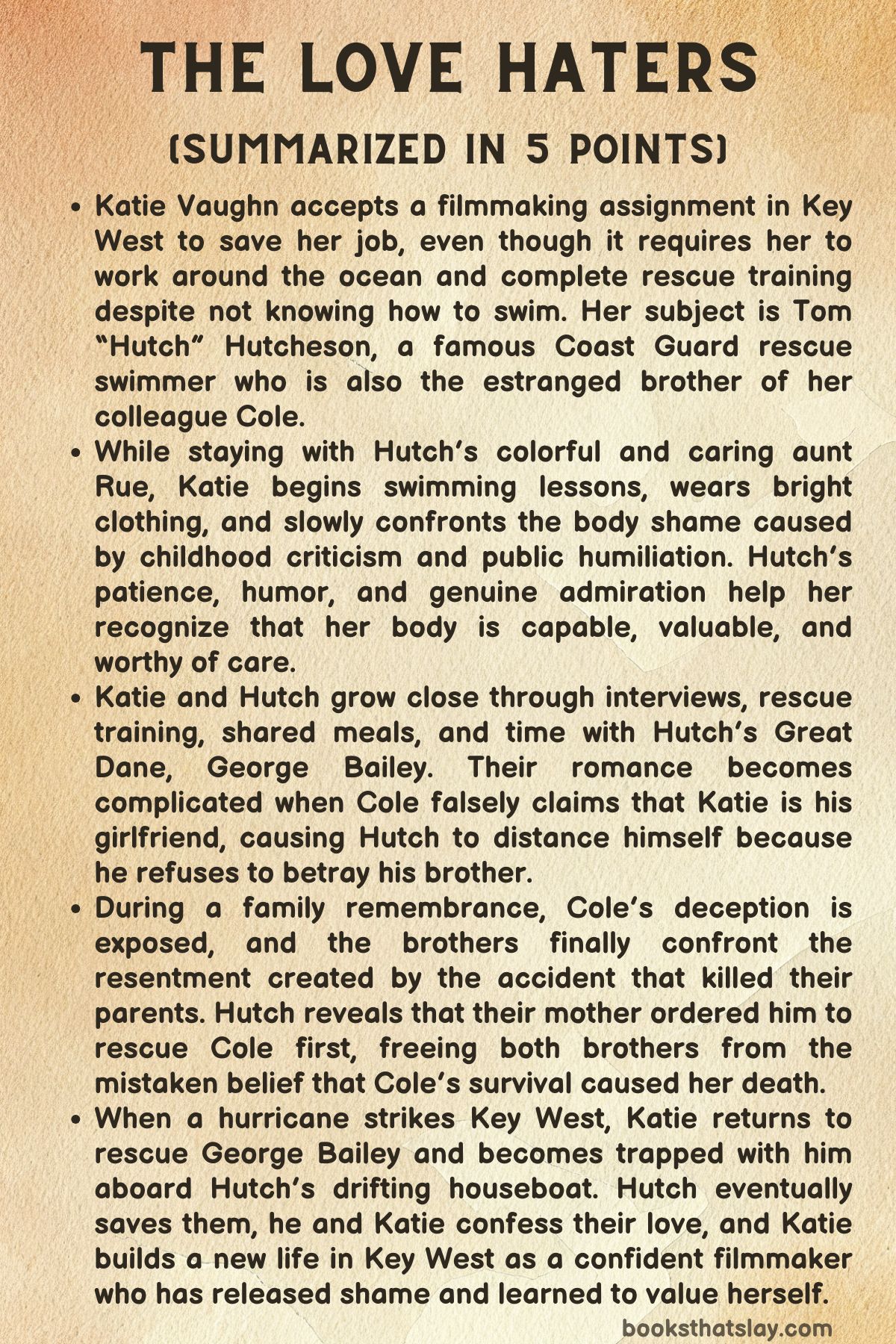
Summary
Katie Vaughn works for a struggling video-production company in Dallas that is preparing to dismiss half its employees. Her colleague Cole Hutcheson offers her a chance to protect her position by taking an assignment in Key West, where she will create a Coast Guard recruitment video featuring Tom “Hutch” Hutcheson, a famous rescue swimmer.
Katie immediately accepts, even though the assignment involves several serious problems. She knows almost nothing about the Coast Guard, cannot properly swim, and will be required to complete underwater helicopter-escape training before accompanying the rescue crew on flights.
Cole believes Katie is the right filmmaker because of her personal documentary series, Day in the Life, which celebrates ordinary women who have performed courageous acts. He encourages her to make a second, unofficial film about Hutch, whose fame began after he rescued Jennifer Aniston’s injured dog from a dangerous beach.
Hutch has refused nearly every interview request and has shown no interest in becoming a celebrity. Cole eventually explains that Hutch is his older brother and that the two men have been estranged for years.
Katie has also avoided romance for the past year. Her former fiancé, musician Lucas Banks, became famous after one of his songs went viral, and their relationship ended when he publicly cheated on her with another singer.
Before the betrayal, strangers had already attacked Katie’s appearance after photographs of her at an awards show appeared online. Their cruel comments led her to starve herself, count every calorie, wear only black, and attempt to make her body as unnoticeable as possible.
Although Katie later rejected the restrictive diet and began reading about body acceptance, her recovery remains incomplete. She still avoids mirrors, photographs, colorful clothing, swimsuits, and situations in which she fears that other people might judge her appearance.
Her fear of swimming has roots in childhood. After Katie’s mother left, her father married Angela, who placed twelve-year-old Katie on diets, commented constantly on her body, and taught her to associate being seen with being criticized.
Katie’s cousin and closest friend, Beanie, encourages her to treat the Key West assignment as an opportunity rather than a disaster. Before leaving, Katie begins creating a list of physical qualities she appreciates about herself, starting with her soft, well-shaped earlobes.
After a miserable journey involving delays, turbulence, spilled coffee, and lost luggage, Katie arrives in Key West. The tropical setting immediately affects her, offering vivid color, movement, warmth, and freedom in sharp contrast to the careful, invisible life she has built in Dallas.
Katie stays at the Starlite Cottages, which are operated by Cole and Hutch’s aunt Rue. Warm, energetic, and dressed in bright tropical patterns, Rue welcomes Katie without judgment and takes her to a clothing boutique called Vitamin Sea.
Because the shop has no mirrors, customers must decide whether they like clothing according to how it feels rather than how it makes their bodies appear. Rue persuades Katie to wear a flowing orange-and-pink caftan, and Katie experiences an unexpected moment of joy as she spins in it.
While Katie is still wearing the caftan without underwear beneath it, a handsome, serious man enters the shop. She soon realizes that he is Hutch, the rescue swimmer she has come to film.
The following morning, Katie joins Rue and her friends Ginger, Benita, and Nadine for a swimming lesson. Her panic increases when Hutch arrives as the instructor with his enormous Great Dane, George Bailey.
The excited dog knocks Katie across the wooden pool deck, leaving her backside filled with splinters. Hutch must remove them while the women openly tease the pair about their attraction, creating an embarrassing but unexpectedly intimate first meeting.
During the ordeal, Katie learns that Hutch rescued George Bailey from a puppy mill and patiently taught the frightened animal to trust people. His gentleness with the dog immediately challenges Cole’s description of him as distant, humorless, and emotionally closed.
Rue reveals that Katie cannot swim and persuades Hutch to give her private lessons. Katie does not yet tell him that she is also the filmmaker who will soon appear at his workplace.
When Katie arrives at the Coast Guard air station, Hutch is furious to discover that Cole has sent her in his place. Katie and Lieutenant Carlos Alonso overhear Hutch leaving Cole an emotional message in which he reveals that he arranged the video project as a way of bringing his brother home for an important family anniversary.
Hutch initially threatens to report Katie’s inability to swim, which would remove her from the assignment. Katie responds by proposing a bargain: he will train her and help her keep the job, while she will use her connection with Cole to encourage a reconciliation.
Their professional interviews are awkward because Hutch becomes stiff whenever the camera is turned on him. Katie finally breaks through his rehearsed answers by asking what rescue-swimmer training truly means, prompting him to explain that the swimmer becomes the final barrier between a victim and the sea.
Hutch begins teaching Katie how to walk through water, blow bubbles, float, and trust her natural buoyancy. When he explains that body fat helps people survive in water, Katie starts to see her body not as an enemy but as a capable physical instrument.
Their lessons become playful and increasingly intimate. Hutch teases her, shows his own physical imperfections, and helps her experience movement without constantly considering how she looks.
Katie asks Hutch to participate in her Day in the Life documentary, but he strongly refuses. He has already endured unwanted attention because of the dog rescue and does not want more of his private life turned into public entertainment.
The refusal threatens Katie’s career when Cole falsely tells their employer, Sullivan, that the documentary is nearly finished. At the same time, Lucas releases a successful song named after Katie, publicly expressing regret over losing her.
Although the song moves Katie, it does not make her want Lucas back. She recognizes that his betrayal permanently changed her feelings and that she no longer needs his regret to confirm her worth.
Katie becomes increasingly fascinated by Hutch as she films him at work. She notices that he performs small acts of kindness without seeking credit and collects pennies dated 1965 because that was the year his late mother was born.
Hutch also pays closer attention to Katie than Lucas ever did. While Lucas’s supposedly personal song gets her eye color wrong, Hutch immediately notices the differently colored section in her iris and researches the term sectoral heterochromia.
Katie eventually completes the required underwater helicopter-escape training. During one exercise, her swimsuit catches and tears, exposing her beneath the water, but Hutch improvises a covering from his rash guard and helps her finish despite her humiliation.
The experience changes Katie’s understanding of bravery. She realizes that courage does not require confidence, comfort, or freedom from embarrassment; it requires continuing even when fear is present.
Later, Katie discovers another cruel article criticizing her appearance and claiming that she has let herself go. Instead of agreeing with the attackers, she imagines defending the younger version of herself who first endured the abuse.
Hutch finds her near the water, and Katie tells him about Lucas, the online attacks, her starvation, and her lingering shame. Hutch responds with anger toward the people who hurt her and admits that he finds her overwhelmingly attractive.
Their first kiss confirms the emotional and physical connection that has been developing between them. However, Rue interrupts them, and Hutch becomes more guarded afterward.
While taking Katie home, Hutch explains the family tragedy behind his fear of public attention. His parents and Rue’s husband, Robert, died in the same car accident, while Hutch survived and rescued the younger Cole before the vehicle caught fire.
The family was then subjected to public gossip suggesting that Hutch’s father had been drinking. Because the speculation intensified Rue’s suffering, Hutch now sees celebrity attention as something that can reopen old wounds and exploit private grief.
Katie understands that pressuring him into a documentary would repeat the behavior he fears most. She tells Cole that she will abandon the project, even if the decision costs her job.
During Katie’s first helicopter flight, a training mission turns into a real emergency involving a capsized fishing vessel. Katie watches and films as Hutch enters the ocean and rescues a survivor, gaining extraordinary footage and witnessing the danger of his work firsthand.
Afterward, Hutch says he has agreed to participate in the personal documentary because Cole asked him to help Katie. His formal manner hurts her because she believes he is acting only for his brother rather than because of their growing relationship.
Katie spends twenty-four hours filming Hutch aboard his houseboat, the Rue the Day. After George Bailey knocks her and her equipment into the water, she proves that her lessons have worked by remaining calm and assisting in her own rescue.
She records Hutch exercising, repairing equipment, caring for George, rescuing a toad, and discussing the history of the boat. She also discovers that he secretly kept the hibiscus hair clip she lost during their first swimming lesson.
A violent storm frightens George Bailey, forcing Katie and Hutch to share a bed with the enormous dog between them. Hutch explains that his conflict with Cole began when Cole’s fiancée, Scarlett, attempted to seduce Hutch during the wedding festivities and called Cole an inferior version of his brother.
Although Hutch rejected Scarlett, Cole married her and continued blaming Hutch after the marriage quickly collapsed. Hutch’s guilt and loyalty now make him believe that acting on his feelings for Katie could become another betrayal of his younger brother.
Katie does not yet know that Cole has told Hutch she is his girlfriend. Cole invented the relationship to pressure Hutch into helping with the documentary, and he also told Sullivan that he planned to propose to Katie.
Cole and Sullivan unexpectedly arrive in Key West, and Cole publicly claims Katie as his girlfriend just as Hutch is dancing with her. Katie is furious, but Cole reveals that Rue has been diagnosed with early-stage heart failure and desperately wants both brothers present for the anniversary of the fatal accident.
Katie agrees not to expose the lie until the family remembrance is over. She refuses to behave affectionately toward Cole, but Hutch believes the relationship is genuine and forces himself to respect it.
At a bar, Cole provokes Hutch into a competitive drinking game and offers a kiss from Katie as the prize. Hutch wins but refuses to claim the kiss, insisting that Katie alone decides who has permission to touch her.
While carrying an intoxicated Cole home, Hutch indirectly describes Katie as unforgettable, impossible to understand, and impossible to stop wanting. Later, when Katie drives him back to his houseboat, he admits that he is struggling not to kiss her.
Katie nearly tells him the truth, but she realizes that revealing the deception could ruin Rue’s anniversary. She also refuses to kiss him while he believes she belongs to Cole, because Hutch would interpret the act as a betrayal and punish himself afterward.
During the family remembrance, Rue gives flowers to strangers and celebrates the lives of those who died rather than allowing the anniversary to become only a day of sorrow. She explains that awareness of mortality can make ordinary moments more valuable.
After dinner, Hutch finally admits that he brought the video project to Key West to bring Cole home and that he fell for Katie before learning she was supposedly Cole’s girlfriend. Cole then reveals that the relationship was fictional.
The brothers fight physically before confronting the deeper source of their resentment. Cole admits that he has always believed Hutch chose to save him instead of their mother during the car accident.
Hutch explains that their mother ordered him to take Cole first and return for her afterward, even though she understood that there would not be enough time. Cole was not the reason she died; saving him was her final decision.
Before Katie and Hutch can resolve their own conflict, Hurricane Rafael unexpectedly turns toward Key West. Coast Guard aircraft are moved away, residents evacuate, and Katie asks Hutch for one final kiss before he leaves with his crew.
Katie initially joins the evacuation but turns back when she learns that George Bailey is trapped aboard Hutch’s houseboat. The terrified dog refuses to leave, and the arriving storm destroys the dock and tears the boat from its moorings.
Katie and George endure a violent night at sea as the houseboat is battered and damaged. By morning, the vessel is sinking far offshore, and Katie prepares for the possibility that they will not survive.
As she waits for rescue, Katie apologizes to the body she has spent years criticizing. She finally understands that she has loved it all along because it has carried her, protected her, and remained hers through every painful experience.
A Coast Guard helicopter appears, and Hutch descends to rescue them. He hoists the injured George Bailey first, then returns for Katie as the houseboat sinks beneath her.
Suspended together below the helicopter, Katie and Hutch finally clarify Cole’s deception and confess their feelings. Hutch admits that love creates fear, jealousy, and irrational choices, while Katie suggests that they can hate love together.
Their kiss in the air begins a relationship based on truth rather than secrecy. The Coast Guard video and the personal documentary become major successes after Hutch sends the film to Jennifer Aniston, who shares it with millions of followers.
Katie’s job is saved, and she is offered a promotion, but she chooses to move permanently to Key West. She manages the Starlite Cottages, continues making documentaries, learns to swim confidently, wears bright colors, and builds a life beside Hutch.
Cole and Hutch begin repairing their relationship, Cole and Sullivan become a genuine couple, Rue remains active with proper medical care, and George Bailey recovers. Katie finally understands that letting herself go does not mean abandoning herself; it means releasing shame, fear, and the definitions imposed on her by others.
Characters
Katie Vaughn
Katie is the emotional center of The Love Haters, and her journey is shaped by the difference between appearing functional and actually feeling secure. At the beginning of the book, she is talented, observant, funny, and professionally capable, but her confidence remains vulnerable because years of criticism have taught her to treat visibility as dangerous.
Her discomfort with her body is not presented as simple insecurity. It is the result of childhood dieting, abandonment, public humiliation, betrayal, and a culture that encouraged strangers to treat her appearance as something they were entitled to evaluate.
Katie responds by trying to reduce herself physically and emotionally. Her black clothing, avoidance of mirrors, fear of swimsuits, and reluctance to declare her weight all reveal her desire to move through the world without attracting judgment.
Her assignment in Key West gradually interrupts this pattern. Swimming forces her to rely on the body she has distrusted, while Rue’s colorful clothing encourages her to choose pleasure rather than camouflage.
Katie’s courage also develops through action rather than sudden fearlessness. She completes underwater escape training while embarrassed, boards a rescue helicopter despite anxiety, returns during a hurricane for George Bailey, and endures the storm even when rescue appears impossible.
Her moral decisions are as important as her physical bravery. She refuses to manipulate Hutch into making a documentary, protects Rue during the anniversary, and does not kiss Hutch while he believes she is Cole’s girlfriend because she understands the emotional consequences for him.
By the conclusion, Katie does not merely accept praise from a desirable man. She becomes capable of valuing herself independently, choosing a meaningful life, and recognizing that her body deserves gratitude because it belongs to her.
Tom “Hutch” Hutcheson
Hutch is presented in The Love Haters as a physically exceptional rescue swimmer whose public reputation hides a deeply private and emotionally burdened man. His discipline, courage, and competence make him appear almost perfect, but that image prevents others from noticing how much guilt he carries.
His resistance to fame comes from experience rather than modesty alone. After the accident that killed his parents and Rue’s husband, public speculation invaded the family’s grief, teaching Hutch that attention can become a form of cruelty.
Hutch’s rescue of George Bailey reveals his essential nature. He is drawn toward frightened, vulnerable beings, and he helps them not through force but through patience, steadiness, and repeated demonstrations of safety.
The same qualities appear in his relationship with Katie. He teaches her to swim without mocking her fear, treats her body without disgust, notices details others overlook, and repeatedly protects her dignity during humiliating situations.
However, Hutch’s sense of responsibility can become excessive. He accepts blame for Scarlett’s behavior, allows Cole’s resentment to continue, and believes that his own desires must be sacrificed whenever they might cause his brother pain.
His withdrawal from Katie is therefore not emotional indifference. It reflects a rigid moral code combined with incomplete information, since he sincerely believes that loving her would betray Cole.
Hutch must learn that responsibility does not require accepting false guilt. His confrontation with Cole allows him to explain their mother’s final command, while his love for Katie forces him to acknowledge that avoiding emotional risk cannot protect everyone forever.
Cole Hutcheson
Cole is both a source of comedy and one of the story’s most emotionally damaged characters. His lies create much of the romantic conflict, yet those lies grow from insecurity, grief, jealousy, and a lifelong belief that he is less worthy than his older brother.
He admires Hutch’s strength while simultaneously resenting it. Scarlett’s declaration that Hutch was the superior brother confirms Cole’s deepest fear, even though Hutch neither encouraged nor accepted her advances.
Cole’s behavior toward Katie is often selfish. He sends her into the assignment without complete information, lies about the documentary, invents a romantic relationship, and treats her career as a tool for manipulating Hutch.
His decision to offer Katie’s kiss as a prize is especially revealing because it shows how easily his desperation can override respect for her autonomy. Hutch’s response corrects him by establishing that Katie’s consent belongs only to her.
Despite these failures, Cole is not without loyalty or affection. He wants Katie to survive the layoffs, understands her talent, returns to Key West for Rue, and eventually confronts the childhood belief that has poisoned his relationship with Hutch.
The revelation that their mother ordered Hutch to rescue him changes Cole’s understanding of his survival. Rather than being the person chosen instead of her, he becomes the child she deliberately protected through her final act.
Rue
Rue represents generosity, emotional wisdom, and the ability to live fully without denying pain. She has endured the deaths of her husband, sister, and brother-in-law, yet she refuses to organize the remainder of her life entirely around loss.
Her guardianship of Hutch and Cole demonstrates extraordinary compassion. She raises two traumatized boys while carrying her own grief and creates traditions that allow remembrance to coexist with kindness.
Rue immediately recognizes that Katie needs acceptance rather than correction. Through bright clothing, mirrorless shopping, swimming lessons, shared meals, and gentle humor, she gives Katie permission to experience pleasure without first earning it through physical transformation.
Her approach to mortality becomes especially significant after her heart-failure diagnosis. Rue does not pretend that illness is meaningless, but she refuses to allow fear of death to erase the value of being alive in the present.
The anniversary tradition of giving flowers to strangers captures her philosophy. Grief becomes an occasion for generosity, and remembrance becomes an active practice rather than a private imprisonment.
Rue is also the center of the chosen family at the Starlite. Her presence turns the cottages into a place where Katie, The Gals, Hutch, Cole, and eventually Sullivan can belong without having to present perfect versions of themselves.
Beanie
Beanie is Katie’s cousin, lifelong friend, and primary source of emotional honesty before Katie arrives in Key West. She knows the history behind Katie’s fears and can identify the difference between Katie’s claims of recovery and the insecurities she continues to avoid.
Her humor prevents difficult conversations from becoming overly solemn. She can joke about Hutch, swimsuits, romance, and Katie’s beauty list while still treating Katie’s pain seriously.
Beanie repeatedly encourages Katie to examine what she actually believes rather than what fear tells her. She helps Katie recognize that the swimsuit represents vulnerability, that Hutch’s behavior suggests attraction, and that Katie should expect clarity and respect in romantic relationships.
Most importantly, Beanie encourages self-validation. When Hutch becomes distant, she does not advise Katie to become more attractive or accommodating; she urges her to stop measuring her worth through his response.
Her friendship provides continuity between Katie’s old life and new identity. Even when she is physically absent, Beanie remains a voice of perspective, affection, and practical encouragement.
Lucas Banks
Lucas represents the type of romantic validation Katie once believed she needed. His proposal appears loving, but his rise to fame reveals that his commitment is vulnerable to attention, status, and temptation.
His public affair humiliates Katie, yet his failure began before the betrayal. He allowed her to stand alone while strangers mocked her appearance and did not create the emotional safety that a devoted partner should provide.
The later song named after Katie appears remorseful, but its inaccuracies expose the limitations of his attention. He can create a successful public performance about losing her without correctly remembering something as basic as her eye color.
Lucas therefore functions as a contrast to Hutch. One man turns Katie into material for a song after failing to see her clearly, while the other notices details, fears exploiting her pain, and values her apart from public approval.
Katie’s response to the song shows her growth. She can acknowledge that it is moving without interpreting his regret as a reason to return.
Sullivan
Sullivan initially appears as a threatening employer whose decisions may determine whether Katie remains financially secure. Her interest in marketable content and Hutch’s appearance makes her seem more concerned with commercial potential than personal integrity.
Her arrival in Key West exposes her vulnerability. Alcohol loosens her professional mask, and she admits to loneliness and dissatisfaction while Katie cares for her without using the situation for revenge.
Sullivan’s developing relationship with Cole is unexpected but thematically appropriate. Both characters hide insecurity beneath questionable decisions, social confidence, and attempts to control circumstances.
Her promise not to fire Katie may initially be unreliable because of her intoxication, but the success of the finished films eventually confirms Katie’s professional value. Sullivan’s role also shows that powerful people may be emotionally confused even when they appear certain and authoritative.
George Bailey
George Bailey is more than a comic animal companion. His history as a puppy-mill survivor reflects the book’s larger interest in fear, trust, healing, and the slow process of learning that the world can be safe.
Hutch’s treatment of George reveals his patience and tenderness before he is willing to reveal those qualities through conversation. The dog therefore gives Katie an early understanding of Hutch’s character that contradicts Cole’s description.
George repeatedly creates physical closeness between Katie and Hutch. He knocks Katie onto the pool deck, sends both of them into the water, forces them into the same bed during the storm, and later becomes the reason Katie returns to Key West during the hurricane.
His terror of thunder is not treated as weakness. Like Katie’s fear of water, it has a history and must be met with protection rather than ridicule.
Katie’s refusal to abandon George proves how completely she has absorbed the courage and compassion she admires in Hutch. By choosing to remain with a frightened animal during the storm, she becomes the final barrier between another vulnerable life and disaster.
Ginger, Benita, and Nadine
Ginger, Benita, and Nadine, collectively known as The Gals, create a community in which age, color, pleasure, and friendship are celebrated. Their presence challenges the idea that women become less visible, adventurous, or socially important as they grow older.
They welcome Katie without testing her appearance or requiring her to prove herself. Their teasing about Hutch is playful rather than cruel, and their openness helps Katie feel included in a social world that does not revolve around judgment.
The Gals also support Rue practically and emotionally. They participate in swimming lessons, celebrations, dinners, dancing, and the shared rhythms that make the Starlite feel like a home.
Their willingness to distract Sullivan demonstrates both loyalty and comic resourcefulness. More broadly, they show Katie that a joyful life can be built through friendship, ritual, movement, and mutual care.
Lieutenant Junior Grade Carlos Alonso
Carlos introduces Katie to the Coast Guard environment and helps reduce her fear of military formality. His friendly behavior allows her to see the air station as a community of skilled people rather than an intimidating institution.
He also becomes an accidental witness to the emotional conflict between Hutch and Cole. By overhearing Hutch’s voicemail with Katie, Carlos helps create the situation in which Katie understands that the assignment has a personal purpose.
His attempt to rescue George Bailey before the hurricane shows his willingness to help outside his official duties. Although he cannot move the terrified dog, his effort sets in motion Katie’s decision to return.
Carlos represents the supportive network surrounding Hutch’s dangerous work. Rescue is shown not as individual heroism alone but as cooperation among people who depend on one another.
Mira
Mira appears briefly but plays an important role in one of Katie’s most feared moments. Katie believes that declaring her weight before a helicopter flight will expose her to humiliation, but Mira handles the requirement privately and without judgment.
Her professionalism demonstrates that Katie’s anticipated shame is often more severe than the actual reaction of others. The scene does not suggest that Katie’s fear is irrational; it shows that old experiences have trained her to expect cruelty even in neutral situations.
Mira treats weight as practical information rather than a moral measurement. Through that simple response, she helps Katie separate the number from the years of meaning imposed upon it.
Scarlett
Scarlett never becomes an active participant in the present-day action, but her past behavior has lasting consequences. Her attempt to seduce Hutch and her declaration that he was superior to Cole deepen the brothers’ existing rivalry.
Her conduct is especially destructive because she makes Hutch responsible for attention he neither requested nor welcomed. Cole’s decision to blame Hutch allows him to avoid confronting Scarlett’s betrayal and his own decision to marry her despite the warning.
Scarlett therefore represents the damage created when comparison is used as a weapon. Her words turn Cole’s insecurity into resentment and encourage him to see Hutch’s existence as a personal judgment.
Angela and Katie’s Father
Angela’s treatment of Katie during childhood establishes many of the beliefs Katie later struggles to escape. By placing her on diets and repeatedly commenting on her stomach, Angela teaches a child that her body is a problem requiring constant supervision.
Katie’s father’s failure is quieter but equally important. Whether through agreement, passivity, or emotional absence, he allows Angela’s criticism to define Katie’s home environment.
Their influence explains why online comments have such power over Katie. The strangers are repeating a message she first received from adults whose approval and protection she needed.
The absence of a direct confrontation with them keeps the focus on Katie’s internal freedom. Her healing does not depend on receiving an apology; it depends on refusing to continue their work against herself.
The Hutcheson Parents and Robert
Although Hutch and Cole’s parents and Rue’s husband, Robert, died before the present action, their absence shapes nearly every major family decision. The accident creates Hutch’s guilt, Cole’s resentment, Rue’s traditions, and the brothers’ different responses to survival.
Their mother’s final command is the most important revelation in the brothers’ conflict. She knowingly tells Hutch to rescue Cole first, turning his survival from a source of shame into evidence of her protective love.
Robert remains present through Rue’s memories and the song “Heart and Soul,” which Hutch hums to calm himself and others. The annual Italian meal and other rituals keep affection connected to daily life rather than sealing the dead away from the living.
These deceased characters demonstrate how memory can either imprison survivors or help them construct meaning. The family begins healing when it replaces speculation, secrecy, and blame with the truth of what happened.
Themes
Body Acceptance and Freedom from Shame
Katie’s relationship with her body in The Love Haters is shaped by repeated experiences of being treated as though her physical appearance determines her value. Childhood dieting, online cruelty, Lucas’s betrayal, and public photographs combine to make her see her body through the imagined eyes of critics.
Her early attempt to heal remains intellectual rather than fully lived. She has rejected starvation and learned the language of body acceptance, but she continues wearing black, avoiding mirrors, fearing swimsuits, and treating visibility as a threat.
Key West changes this relationship through experience. Rue’s mirrorless shop asks Katie to judge clothing by sensation, while swimming requires her to understand her body according to what it can do rather than how it appears.
The beauty list gradually redirects Katie’s attention from criticism toward appreciation. Beginning with her earlobes may seem small, but the exercise teaches her to look at herself without immediately searching for defects.
The hurricane brings this development to its emotional conclusion. Believing she may die, Katie apologizes to the body she has attacked and recognizes that it has carried her through every experience, including the storm.
Her final self-acceptance is not based on becoming conventionally perfect or receiving Hutch’s desire. She values her body because it is inseparable from her life, identity, courage, and continued existence.
Courage as Action in the Presence of Fear
Courage is repeatedly separated from comfort, confidence, and physical fearlessness. Katie’s bravest actions occur while she is frightened, embarrassed, uncertain, or convinced that she may fail.
Learning to swim becomes the first practical challenge to her belief that fear should determine behavior. She begins by walking through water and blowing bubbles, gradually discovering that trust can be built through small actions.
The underwater helicopter training makes this principle explicit. When her swimsuit tears, Katie experiences the precise kind of exposure she has spent years avoiding, yet she completes the exercises despite her humiliation.
Hutch’s work provides a professional example of the same idea. His rescues require strength and training, but they also require entering situations in which danger cannot be completely controlled.
Katie later adopts this rescue ethic when she returns for George Bailey. She knows the hurricane is approaching and understands that turning back is dangerous, yet she cannot accept leaving a terrified animal alone.
Her endurance aboard the sinking houseboat completes her transformation. She prepares supplies, protects George, follows emergency instructions, and continues seeking survival even when hope becomes fragile.
The story therefore presents courage as a series of choices rather than a personality type. Fear remains present, but it loses its authority to make every decision.
Love, Trust, and Moral Responsibility
Romantic love is shown as powerful but ethically complicated. Attraction alone does not guarantee that two people should act, especially when incomplete information makes desire appear connected to betrayal.
Katie and Hutch’s relationship develops through attention, trust, humor, and repeated acts of care. He helps her feel safe in water, while she sees the private humanity beneath his public reputation.
Their difficulties begin when Cole turns romantic information into a tool. By claiming that Katie is his girlfriend, he places Hutch in a moral conflict and prevents both Katie and Hutch from interpreting each other’s actions accurately.
Katie’s decision not to kiss Hutch while he is intoxicated and misinformed becomes one of her strongest demonstrations of love. She understands that although the relationship with Cole is fictional, Hutch believes it is real and would therefore experience the kiss as a violation of his principles.
Hutch’s restraint is similarly painful but meaningful. He refuses to take advantage of Cole’s supposed permission because he believes that wanting Katie already places him at risk of repeating the family betrayal associated with Scarlett.
Their eventual union becomes possible only after the deception is exposed. The midair kiss matters because both characters finally possess the truth and can choose each other without manipulation.
Love is therefore not defined only by passion. It also requires consent, accurate knowledge, emotional responsibility, and a willingness to protect another person from choices they would later regret.
Grief, Forgiveness, and Chosen Family
The Hutcheson family has spent years living inside different interpretations of the same tragedy. Hutch carries responsibility for surviving and choosing whom to rescue, while Cole carries the belief that his survival caused their mother’s death.
Because the truth remains unspoken, grief transforms into rivalry. Cole interprets Hutch’s competence as proof of his own inferiority, and Hutch responds by accepting blame and suppressing his personal desires.
Their physical fight finally allows the childhood wound to emerge. The revelation that their mother ordered Hutch to save Cole removes the false idea that one brother’s life was purchased through the abandonment of another.
Forgiveness becomes possible not because the past is forgotten but because it is understood more accurately. Cole must accept that Hutch did not choose against their mother, while Hutch must stop treating Cole’s anger as a punishment he deserves.
Rue offers another model for living with grief. Her anniversary traditions preserve memory through flowers, food, stories, music, generosity, and companionship rather than silence.
The Starlite community expands this family structure beyond blood relationships. Katie, The Gals, Sullivan, George Bailey, and the Coast Guard crew all become part of a network held together by loyalty and care.
The story ultimately suggests that healing requires both truth and community. Pain becomes more bearable when people stop protecting old misunderstandings and allow others to share the weight of remembrance.