Rising Reign by Tessa Hale Summary, Characters and Themes
Rising Reign by Tessa Hale follows Wren, a wolf-shifter hybrid whose life has been shaped by cruelty, survival, and the unexpected bonds that save her. Dragged back to the brutal Red River pack ruled by her father, she must rely on instincts, stubborn resilience, and the loyalty of those who love her.
The story charts her rise from captivity to empowerment as she navigates political dangers, dark magic, shifting alliances, and the depth of connection with her five destined mates. It is a tale of rebuilding identity, claiming freedom, and learning the strength that comes from vulnerability, trust, and chosen family. It’s the 3rd book in The Wolves of Crescent Creek series by the author.
Summary
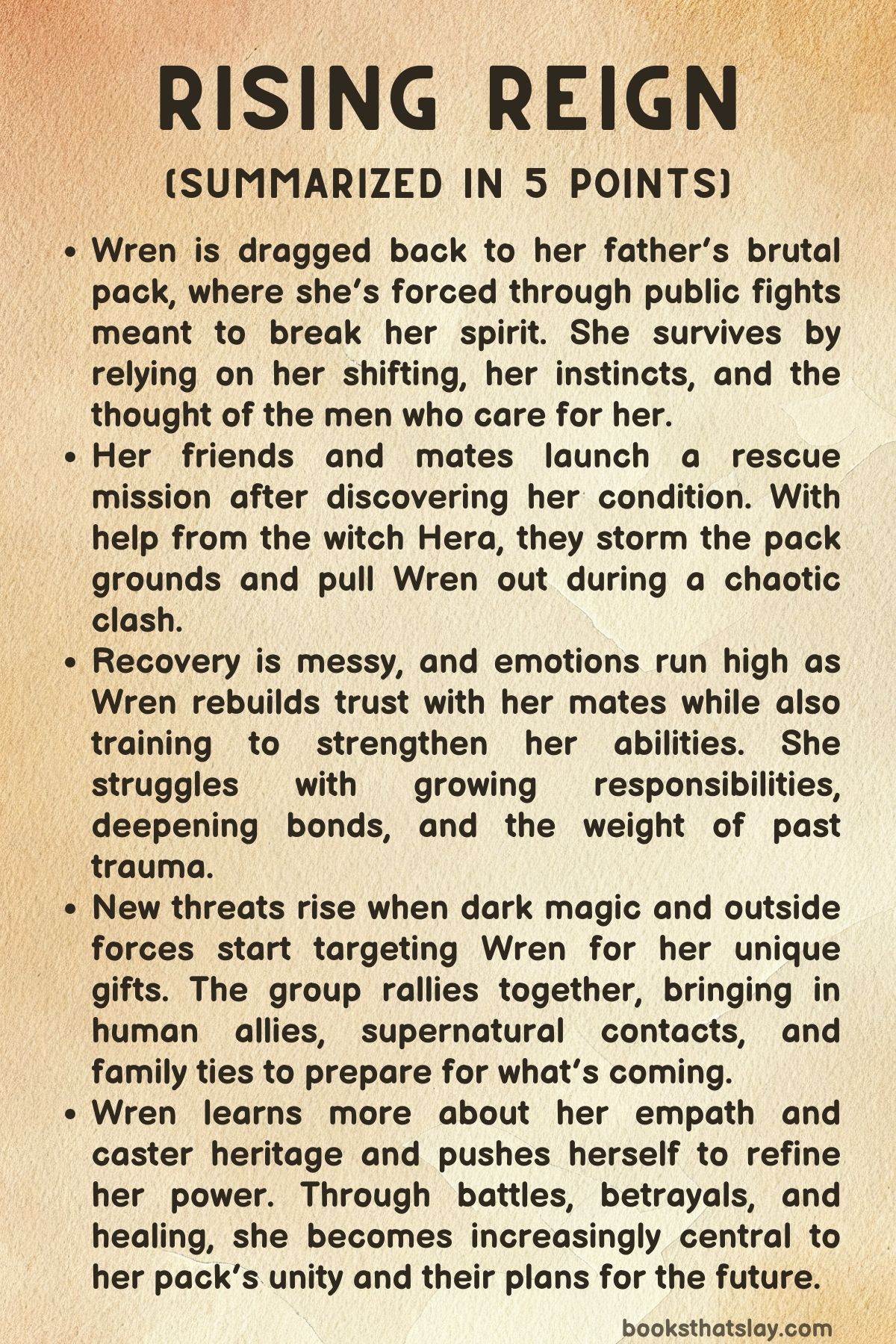
Wren, a submissive wolf-shifter and daughter of the ruthless alpha Bastian Boudreaux, is kidnapped from the Arcane pack and dragged back to Red River territory. Starved, tortured, and thrown into a pit, she survives by thinking of Kingston, Locke, Brix, and Puck—her four mates who have no idea where she is.
Wren is forced to fight repeatedly for basic needs, defeating numerous opponents despite her exhausted, injured state. Her father intends to keep her alive only long enough to use her for breeding, but his new healer reveals herself as Hera, a witch who once saved Wren in secret.
Hera wipes away her injuries with magic and warns her to be ready for escape.
In Colorado, Kingston and the Arcane pack locate Red River’s security feed and watch, horrified, as Wren stands before Bastian’s throne. Despite being outnumbered, they prepare for a rescue with Hera’s guidance.
During a Red River celebration, Wren is locked in a cage and tormented until Arcane fighters launch their attack. Arrows drop pack members from the trees, and chaos erupts.
Marcelle, Bastian’s enforcer, gets to Wren first and tries to kill her, but she uses Kingston’s knife to end him. As her mates reach her, a gunshot from a balcony hits Kingston when he shoves her aside.
They escape in a stolen vehicle, fleeing to a safe cabin where Hera saves Kingston’s life. Wren forms a mating bond with him to stabilize him, risking her own life in the process.
Once he wakes, they argue about her choice, confess love, and seal their bond completely.
The danger is far from over. They learn that Bastian had Marcelle resurrected by a dark mage coven.
Back in Arcane territory, tensions rise as Wren confronts Ender about his secret informant. Tensions grow between them as he refuses to reveal more.
Meanwhile, Wren reconnects with her human friends at Crescent Kingdom gym. When they demand answers about her supernatural nature, she and her mates reveal the truth about shifters, magic, and the threats hunting her.
She demonstrates her caster abilities by manipulating water and levitating one of her friends, cementing their trust.
As stress builds, Wren becomes withdrawn, overwhelmed by the constant fear surrounding her. Locke comforts her after an emotional breakdown, and they admit their love for each other.
He gives her a gold lock necklace enchanted with a locator. When Ender arrives home with a stranger named Rhys—a vampire with unusual gifts—the pack reacts defensively.
Rhys proves himself as Ender’s mysterious informant, capable of dangerous insight into their enemies. He and Hera begin helping Wren expand her empath abilities, though doing so is painful and risky.
During training, Ender accidentally reveals how deeply he cares for her, and the tension finally erupts into intimacy.
Wren continues to grow closer to each of her mates. She comforts Brix through his trauma, using enchanted ink to transform the nightmares etched into his tattoos.
She helps Puck confront painful memories involving his family, especially when his sister Clara—a strong alpha—arrives unexpectedly with her guards. Clara’s presence brings both warmth and danger, especially when one of her guards, Archie, tries to murder Puck while under Bastian’s influence.
Wren senses this through a frightening surge of bloodlust tied to her empathy. She kills Archie in self-defense, proving how far she has come in strength.
Training intensifies as dark mages begin moving against them. Rhys foresees Wren’s death if she cannot master her abilities.
Clara coaches her on shifting, helping Wren transform smoothly by trusting her wolf instead of forcing control. Wren becomes faster, more confident, and more powerful as both wolf and caster.
The threats escalate when a demon-controlled Franco attacks her with a soul-stealing blade. Ender takes the blow, and Hera uses a painful cleansing spell to save him.
They learn that dark mages targeted Franco to get to Wren because they know she is an empath. The pack prepares for a coordinated assault from both dark mages and Red River.
Wren’s heat arrives early due to her bonds, and her mates stay by her side through the intense experience until it passes.
Weeks later, Rhys collapses with a warning: the enemy is coming. Red River wolves, mercenaries, and dark mages attack Arcane territory.
The wards fall, and battle erupts across the forest. Wren fights a mage who wants her power and kills him with a partially shifted strike to the heart.
The remaining mages die when their leader collapses.
Marcelle, resurrected and monstrous, attacks Wren. With help from Puck, Ender, Franco, Rhys, and Hera, Marcelle is finally destroyed beyond returning.
Then Bastian arrives. In a vicious moment, he slashes Locke’s throat.
Wren fights to save him while Bastian admits he bargained with dark mages to use her as both breeding stock and sacrificial offering. Trapped with a magical barrier blocking her allies, Wren uses her empathy in a dangerous new way.
She drops her shields and absorbs the darkest emotions of every enemy fighter, including Bastian. The agony nearly kills her, but the enemies collapse under the weight of guilt and fear.
Bastian dies from the sudden storm of his own cruelty.
Wren loses consciousness. Locke is dying.
Hera cannot save them alone. Rhys reveals his true nature: a Nocturnae, an ancient and powerful vampire lineage.
He gives his own blood to Wren, igniting a surge of light through her body that heals both her and Locke. When she wakes, her mates explain that she absorbed the darkness of their enemies, freeing Red River survivors from Bastian’s influence.
Rhys leaves afterward, unwilling to burden them with the consequences of his identity.
Weeks later, Wren is strong again and welcomes friends into the Arcane home. They celebrate survival and newfound peace.
Five years pass. Wren graduates as a doctor specializing in mental health, leading a clinic for both humans and supernaturals.
Surrounded by friends, family, and her mates—Kingston, Puck, Locke, Ender, and Brix—she finally reveals her biggest news: she is pregnant. Joy fills the room as her mates embrace their future.
After years of cruelty, loss, and struggle, Wren stands at the center of a life built on freedom, love, and hope for the family she once believed she could never have.
Characters
Wren
Wren is the emotional and thematic core of Rising Reign, a character shaped by brutality yet defined by resilience, compassion, and an evolving sense of identity. Born a submissive wolf-shifter hybrid in a world where submissives are dismissed as weak, she spends much of her early life internalizing that lie.
Her father’s systematic cruelty, the Arcane pack’s initial suspicion, and her own suppressed nature abilities create a character who begins the story fractured. Yet as the narrative unfolds, Wren’s strength reveals itself not as dominance but as depth: her empathy becomes both a literal power and a symbolic reflection of her emotional courage.
She embodies the kind of quiet fierceness that grows through suffering rather than eclipses it. Her journey is also one of claiming agency—over her body, her bonds, her magic, and her pack.
She learns to redefine what power means, transforming her submissiveness from a vulnerability into an anchor of stability for everyone around her. Wren’s evolution is not only about surviving trauma but about transforming it, eventually becoming a healer, a leader, and the heart of a mismatched family bound together by loyalty and love.
Kingston
Kingston serves as Wren’s first true sense of safety, and his character blends steadiness with a fierce, almost instinctual protectiveness. As the de facto leader of the Arcane pack’s inner circle, he carries the weight of responsibility heavily, yet does so with a grounded calm that contrasts Wren’s turmoil.
Kingston’s relationship with Wren is built on mutual trust and emotional clarity; he loves her with open sincerity long before she can fully accept it. He is also the mate who most visibly channels stability as strength, always reminding Wren that leadership is not solely an alpha trait but a quality found in character.
His arc revolves equally around his devotion to Wren and his growth as a partner to her other mates, especially as he confronts threats that force him to balance strategy with raw emotion. Kingston represents what a true alpha should be: steady, protective, and deeply respectful of choice.
His willingness to follow Wren’s lead, even when terrified, reflects the book’s broader message that strength lies in unity rather than hierarchy.
Locke
Locke embodies intelligence under pressure, a character defined by his nervous brilliance, deep emotional sensitivity, and a fear of loss that borders on debilitating. As a submissive wolf like Wren, he understands the inner wounds she carries, and this shared foundation makes his relationship with her deeply connective.
Locke’s anxiety is a key aspect of his character—not portrayed as weakness, but as the natural reaction of someone who has lost too much and finally found something he cannot bear to lose again. His meticulous protections, constant vigilance, and obsessive tracking systems are less about control and more about a desperate attempt to prevent tragedy.
His love for Wren is tender and earnest, filled with quiet gestures and deep vulnerability. Locke’s development includes learning to trust—not only Wren’s strength but his own worthiness as a mate and protector.
His arc culminates in moments where his fear is confronted with truth: that Wren chooses him willingly, and that being protective does not mean being omnipotent.
Brix
Brix is a fusion of darkness and gentleness, carrying emotional trauma that bleeds into everything he does. As an artist and tattooist, he channels his pain into ink, creating a physical manifestation of his internal world.
His nightmares and guilt show a man haunted by past losses and terrified of repeating history. Yet Brix is also fiercely loyal, endlessly patient, and capable of adapting to Wren’s emotional wavelength in a way that few others can.
His bond with her grows slowly but deeply, grounded in shared vulnerability and the quiet ability to see each other’s shadows without judgment. When Wren helps transform his tattoos from depictions of trauma into symbols of hope, it reflects how she becomes a source of healing for him—and how he, in return, becomes a grounding presence for her.
Brix’s journey includes reconciling the darkness he carries with the future he desires, especially the fear that fatherhood will repeat his past. By the end, he embraces joy without undermining the reality of his scars, making him one of the story’s most emotionally layered characters.
Puck
Puck brings levity and warmth to the group, yet beneath his playful exterior lies a well of guilt and unprocessed trauma. He uses humor and flirtation as coping mechanisms, masking deep-rooted fears about abandonment, responsibility, and his violent past.
His history with his home pack, including the death of his brother and long-term estrangement from his family, shapes his insecurity about belonging. Wren becomes the catalyst for his emotional reconnection—not only with his family but with his own sense of worth.
Puck’s relationship with Wren is affectionate, joyful, and deeply tender, marked by his willingness to take emotional risks for her despite his fears. His arc is as much about confronting his past as it is about accepting he is worthy of unconditional love.
His reunion with his sister and the trust Wren places in him both help restore the parts of him he believed were lost.
Ender
Ender is the most conflicted and morally complex member of Wren’s circle. A trained killer accustomed to burying his emotions, he carries immense guilt for the role he played in Wren’s early suffering and for the secrets he keeps to protect her.
His lethal competence contrasts with his emotional uncertainty, creating a character caught between instinctive violence and an emerging capacity for tenderness. Ender’s love for Wren is intense, often overwhelming, and intertwined with self-loathing that makes vulnerability difficult.
His journey is one of learning to face—not flee—emotional connection. Their eventual breakthrough is charged, raw, and honest, symbolizing Ender’s willingness to stop running from his own heart.
His remorse, devotion, and eventual acceptance of love make him one of the novel’s most compelling arcs. Ender’s complexity also extends to his relationship with Rhys, whose influence pushes him toward growth rather than self-destruction.
Rhys
Rhys is an enigmatic force whose presence changes the shape of the story. First appearing as a mysterious informant with sharp humor and unsettling power, he later reveals himself as far more ancient and formidable than any of them realized.
As a Nocturnae, Rhys carries ageless wisdom, immense strength, and a loneliness that seeps through his sardonic charm. His relationship with the pack—and especially with Ender—is built on begrudging affection wrapped in exasperated mentorship.
Rhys sees what others cannot, both literally through visions and figuratively through his insight into emotional patterns. His bond with Wren is not romantic but deeply respectful, grounded in his recognition of her rare potential.
His willingness to risk revealing his true nature to save her life cements his role as an unexpected guardian. Rhys’s exit from the group carries the weight of a character who protects from the shadows, suggesting both sorrow and hope for the future.
Hera
Hera is the quiet backbone of the magical world in Rising Reign, a healer whose power is matched by her compassion and unshakeable loyalty. As a witch who once saved Wren in secret, her connection to Wren predates the main story and deepens with every crisis they face.
Hera bridges the mystical and emotional aspects of the narrative, offering healing that is as much spiritual as it is physical. Her growing relationship with Clara provides Levity and humanity, giving Hera depth beyond her role as a spellcaster.
She represents wisdom, resilience, and maternal strength, often functioning as the moral anchor of the group. Hera’s belief in Wren never wavers, and her guidance helps Wren understand not just magic, but her own worth.
Clara
Clara embodies alpha strength without cruelty, offering a direct contrast to Bastian’s tyrannical leadership. As Puck’s sister and a powerful alpha in her own right, she brings authority, elegance, and fierce protectiveness to the story.
Clara’s empathy and leadership skills extend beyond her own pack, quickly forming a meaningful bond with Wren. Clara’s abilities—especially her gift for mental compulsion—introduce important layers to the supernatural world, while her relationship with Hera adds emotional warmth.
She balances confidence with openness, offering Wren mentorship in the wolf aspects she never had the chance to learn. Clara’s integrity, decisiveness, and fierce loyalty make her one of the most admirable characters in the narrative.
Bastian Boudreaux
Bastian is the embodiment of corrupted power, a tyrant who weaponizes dominance, cruelty, and fear to control those around him. His abuse shapes the starting point of Wren’s emotional scars, making him a symbol of patriarchal violence and supernatural tyranny.
As both antagonist and father, he represents the ultimate violation of trust and responsibility, turning Wren’s childhood into a battleground. Bastian’s obsession with power, bloodlines, and control fuels the story’s central conflicts, and his alliance with dark mages deepens his moral decay.
His death—brought on not by a blade but by being forced to feel the weight of his own evil—serves as poetic justice that reflects the book’s core theme: true power does not come from dominance, but from the courage to face emotional truth.
Marcelle
Marcelle is a manifestation of violence without conscience, an enforcer who serves Bastian with fanatical loyalty and sadistic delight. He functions as both physical threat and psychological tormentor, representing the brutality of Red River’s oppressive culture.
His resurrection by dark mages turns him into an even more monstrous figure, illustrating how corrupted magic amplifies already twisted natures. Marcelle’s taunting, cruelty, and relentless aggression serve as external catalysts for Wren’s growth in combat and self-reliance.
His final destruction is not only a physical victory but an emotional release for the entire pack.
Themes
Identity, Self-Worth, and the Reconstruction of the Self
Wren’s journey in Rising Reign is marked by a constant struggle to understand who she is outside of the labels imposed on her—submissive, hybrid, daughter of a tyrant, victim, mate. Her identity has been shaped since childhood by Bastian’s cruelty, which taught her that her submissiveness equates to weakness and that her hybrid nature makes her unworthy of pack belonging.
Yet her experiences dismantle this belief piece by piece. When she survives the pit, the arena fights, and the emotional and physical torment, she proves not only her resilience but also her instinctive power, which has nothing to do with dominance structures.
Each relationship she builds—whether with her mates, her human friends, or allies such as Hera and Clara—adds layers to her understanding of herself. She learns she is not defined by strength alone, nor by trauma, nor by her lineage.
Her empath abilities, at first a source of fear due to the overwhelming intensity of others’ feelings, ultimately become a bridge to a deeper understanding of her own emotional landscape. The more she lowers her shields with those she trusts, the more she reconstructs a sense of self formed around compassion, autonomy, and choice.
By the time she stands on that graduation stage five years later, Wren’s identity is no longer fractured. It is whole, self-authored, and enriched by her roots rather than constrained by them.
Her acceptance of herself—wolf, caster, empath, survivor, mate, doctor—becomes the bedrock of her transformation from prey to protector.
Power, Autonomy, and Breaking Cycles of Abuse
Power in Rising Reign is depicted not as brute strength but as the freedom to choose one’s path. Bastian’s version of power depends on domination, coercion, and fear.
He shapes Red River into an environment where autonomy is stripped from every wolf, especially those deemed submissive. Wren’s emergence from that culture reflects the broader theme of reclaiming agency after abuse.
Fighting in the arena for basic human needs is the earliest step in her refusal to surrender control, even when everything has been taken from her. Later, when she chooses to bite Kingston, refuses to let Ender push her away, and asserts her right to make decisions about training, bonding, or risking herself, she consistently reclaims what Bastian tried to destroy: her sovereignty.
Her empath gift becomes the ultimate symbol of this reclaimed autonomy. Rather than allowing others’ emotions to drown her, she shapes that power into a weapon that dismantles the psychological numbing of their enemies.
Her final confrontation with Bastian—absorbing the darkness he relied on, turning it back on him, and forcing him to face the truth of his own cruelty—represents the complete overthrow of his ideology. Instead of perpetuating the cycle of violence by becoming what he wanted, she ends him through emotional truth, not brutality.
This victory marks the end of generational harm and establishes a new model of power founded on consent, empathy, and mutual respect.
Found Family and the Reconstruction of Community
The formation of found family is one of the most emotionally resonant elements of the story. Wren’s biological family gives her nothing but pain, deceit, and exploitation.
Yet throughout the narrative she gathers people who choose her—mates who protect her, humans who defend her despite their fear, allies who challenged their own worlds to help her heal. Each bond she forms is built on intentional care rather than obligation.
Kingston’s steady leadership, Brix’s vulnerability, Locke’s quiet emotional sensitivity, Puck’s fierce devotion, and Ender’s eventual surrender to love all knit together a relationship circle where Wren is valued, not used. The humans—Clyde, Franco, Juan, and Dina—add another dimension, proving that belonging isn’t limited by species or magical ability.
Hera and Clara extend that family across pack boundaries and supernatural lines, creating a community that operates through loyalty rather than hierarchy. This collective stands in direct contrast to Red River, where the pack structure is warped into a system of oppression.
Through shared meals, arguments, training, and even moments of humor, they build a model of pack life defined by choice and affection. By the epilogue, Wren’s community spans wolves, witches, humans, and a Nocturnae—all unified not by blood but by love, sacrifice, and mutual respect.
Their support gives her the foundation to build a clinic, pursue her purpose, and eventually welcome her child into a world shaped by connection rather than fear.
Trauma, Healing, and Emotional Intimacy
Healing in Rising Reign is neither immediate nor linear. Wren’s trauma is physical, magical, and psychological.
The effects of torture, forced isolation, and childhood emotional warfare linger throughout her relationships and responses. Her mates also carry their own wounds—Ender with guilt and self-loathing, Brix with grief and fear of repeating past failures, Locke with suffocating anxiety, Puck with unresolved family pain, Kingston with the burden of leadership.
The intimacy they form is built through open communication, vulnerability, and patience. Wren confronts each mate’s emotional walls while facing her own triggers.
Their bonds become therapeutic spaces where they can unravel, confront, and rebuild parts of themselves. The empath ability magnifies this theme: Wren’s power forces her to experience others’ pain, but it also teaches her boundaries, resilience, and emotional self-sufficiency.
Her medical training later symbolizes the culmination of this healing process—she channels her experiences into helping others recover from their own invisible wounds. The novel frames healing as a collective act, where love and honesty are essential, but self-determination is equally important.
By the end, Wren’s community is held together not because they are unscarred, but because they learned to navigate their pain together.
Sacrifice, Love, and the Complexity of Mateship
The mateship dynamic in Rising Reign complicates traditional romantic structures by emphasizing emotional multiplicity rather than exclusivity. Each mate offers Wren a different form of love—Kingston’s steadiness, Brix’s emotional rawness, Puck’s warmth, Locke’s empathy, Ender’s intensity—and she gives them each what they need in return.
Sacrifice becomes an expression of devotion throughout the story: Kingston takes a bullet meant for her, Locke willingly risks his life despite his terror of losing her, Brix lets her into the darkest corners of his mind, Puck faces the hauntings of his past, and Ender opens up despite believing he is unworthy of affection. Wren, in turn, repeatedly risks herself for all of them—not for duty or destiny, but because she chooses them.
Their bond is built not on supernatural compulsion but on trust, shared trauma, respect, and deep emotional investment. By the epilogue, this collective relationship has matured into something stable and joyful, demonstrating that love can be expansive, layered, and resilient.
The pregnancy reveal highlights the culmination of their journey: a future built jointly, with each mate contributing uniquely to the life they are creating together.
Justice, Consequence, and Moral Accountability
The novel consistently interrogates what justice looks like in a world where violence is common and power is unequal. Rather than framing justice as simple revenge, the narrative explores emotional and psychological accountability.
The collapse of Red River after Wren strips its wolves of numbing darkness forces them to confront the harm they caused while under Bastian’s rule. This moment reframes justice not as punishment alone but as restoration of moral awareness.
Even characters like Franco, who act under magical compulsion, grapple with guilt and responsibility after regaining autonomy. The story suggests that true justice involves confronting the truth of one’s actions, accepting the consequences, and choosing a different path.
Bastian’s final moments, overwhelmed by the cumulative weight of his cruelty, demonstrate the ultimate form of consequence. His death is not delivered by a blade but by an inability to withstand the truth of his own monstrosity.
This thematic arc reinforces that justice in Rising Reign is intertwined with moral clarity and emotional reckoning, not only external retribution.
Magic, Heritage, and the Balance Between Light and Darkness
Wren’s hybrid nature—wolf and caster—embodies the theme of duality. Her magic is tied to nature, emotion, and instinct, while her wolf brings physical power and pack connection.
Throughout the narrative, she struggles to balance the two halves, each carrying both risk and potential. Her empath ability lies at the heart of this tension.
At times it threatens to overwhelm her, especially when she absorbs others’ darkness. Yet it also becomes a beacon of light, capable of healing, truth-seeking, and even battlefield transformation.
The dark mages represent the corruption of magic for power and destruction, while Hera and Rhys represent paths where magic is used ethically and responsibly. Rhys’s true nature as a Nocturnae adds another layer, showing that even the most feared beings can be guided by moral purpose.
The contrast between dark and light magic is never simple; instead, the narrative insists that intention, discipline, and compassion determine how power shapes the world. Wren’s ultimate act—channeling darkness through herself and surviving it—symbolizes her mastery over her heritage and her ability to restore balance without becoming corrupted.