Seven Reasons to Murder Your Dinner Guests Summary, Characters and Themes
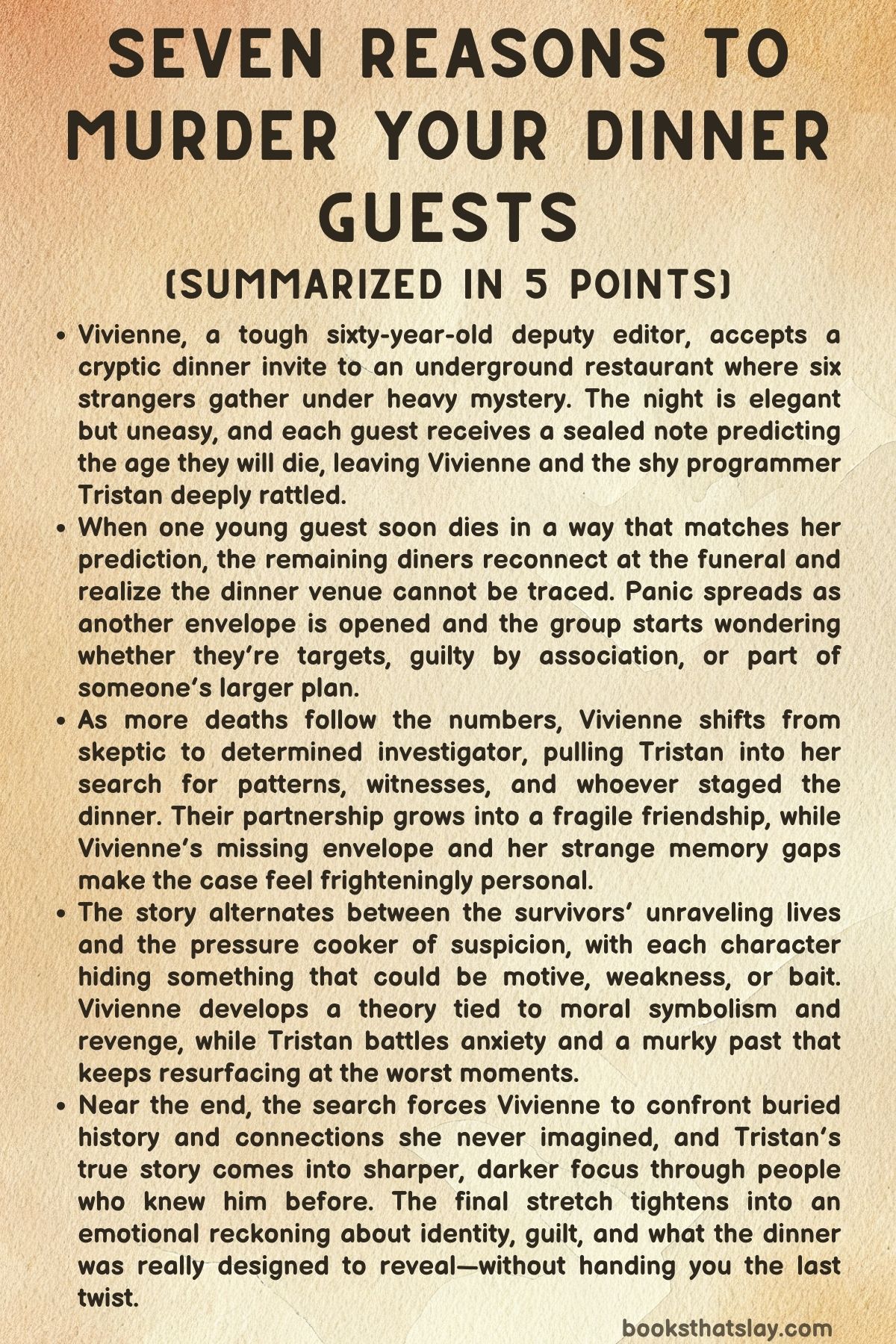
Seven Reasons to Murder Your Dinner Guests by KJ Whittle is a darkly comic, psychological mystery that begins with an odd invitation and grows into a study of guilt, fear, and the stories people tell about themselves. Seven strangers are drawn to a secret underground dinner in London, each receiving a sealed prediction of the age they will die.
When those numbers start coming true, the survivors are forced to question whether fate is at work or someone is arranging a very human kind of justice. The novel follows their unraveling lives with sharp observation, balancing suspense with biting social insight.
Summary
Vivienne is sixty, sharp-edged, and tired in the way people get tired when they’ve spent decades surviving on competence. She works as deputy editor at a magazine that is sinking fast, and she’s built her identity on never flinching, never needing, never letting anyone see softness.
One rainy evening she arrives on Salvation Road for an invitation to a place called Serendipity’s. There is no obvious restaurant, only a grim street and a door she can’t find.
Just as she’s about to leave, she meets Tristan, a shy freelance programmer holding the same black-and-gold envelope. He notices a hidden doorway marked 13.
They descend into an underground dining room that feels rich, theatrical, and slightly unreal, like it’s been staged just for this night.
Five other guests are already seated: Melvin, an older Welsh police officer with an easy manner; Matthew, a charming investment banker who enjoys being watched; Janet, a lingerie executive who clings to status and control; Stella, a wealthy young fashion YouTuber hungry for attention; and Dr. Gordon MacMillan, a celebrity nutrition doctor with a preacher’s certainty about food.
The host never appears. Conversation starts lightly, wine loosens tongues, and Matthew pushes flirtatious games that place everyone in little roles—admiring, laughing, competing.
Vivienne stays alert and distrustful. Tristan fades into the background, overwhelmed by noise and the polish of strangers.
Melvin keeps smoothing over tension with jokes.
Courses arrive in carefully timed waves. A foie gras starter, then steak, then chocolate dessert.
As the food lands, so do the small humiliations and hidden clashes: Vivienne needles Janet about her business and its body politics; Janet snaps back and makes a cruel joke about “big girls” in lingerie; Matthew’s compliment to “curvy girls” reads as a sly jab, leaving Janet exposed. Stella is alternately ignored and indulged by Matthew, craving his gaze.
Gordon eats more than he preaches, then retreats into diet talk again, as if confession can be burned off by theory. Through it all Vivienne keeps asking what the night is for, and gets nothing but blank staff smiles.
After dessert, each guest finds a tiny black envelope beside their glass. Janet opens hers first.
She drains of color, then erupts into panic. Vivienne grabs the card and reads it aloud: Janet will die aged forty-four.
Janet is already forty-four. Her terror becomes contagious.
The kitchen door is locked, the exit feels suddenly far away, and the dinner’s glamorous costume drops to reveal a trap. Gordon opens his card and sees fifty-three.
Matthew insists it’s a prank, tries to charm everyone back into calm. Tristan and Vivienne refuse to open theirs.
Melvin takes charge, gathers everyone’s details, and promises to look into it. They scatter into the night shaken, unsure if they’ve just been toyed with or marked.
Two weeks later Vivienne is back at work, tearing into a young travel writer, Cat, for sloppy editing. Cat cries and begs for mercy, explaining she’s exhausted from a late-night bar job.
Vivienne dismisses it as manipulation because she learned long ago that emotion gets you eaten alive. Then an email arrives from Melvin.
He has checked: Serendipity’s doesn’t exist, no business records, no clear trace. The message carries worse news: Stella has died after falling in front of a tube train at Sloane Square.
Vivienne is rattled. She remembers leaving the dinner dazed and later slipping into a fugue state at Oxford Circus, losing five hours and waking on a train to Heathrow with no memory of why.
When she searched afterward, her own sealed envelope had vanished. With Stella dead, the prediction game no longer feels like theatre.
She decides to attend the funeral.
At Stella’s funeral, crowds of teenage fans and photographers cluster outside the church. Matthew arrives uneasy, privately haunted.
After the dinner he took Stella home, had sex, and she dismissed him coolly afterward, remarking that they might meet again “unless my number’s correct. ” He also has his own fear brewing: a former school bully, Gareth Atkinson, has resurfaced and threatens to expose Matthew’s humiliating past to his colleagues.
He can’t shake the feeling that his life is about to be cut short—his card said twenty-nine, and he is nearly thirty.
The remaining guests avoid the service and gather at a wine bar instead, sitting in the same pattern as that first dinner, with an empty chair for Stella. Vivienne presses for theories; Melvin says the tube case looks accidental, though the dinner’s organizer is still unknown.
Gordon brings a shock: he retrieved Stella’s and Melvin’s envelopes from the dinner table. Against protests, he opens Stella’s.
The card says she would die at twenty-three—exactly her age. Horror sparks across the group.
Janet demands a private investigator. Vivienne wonders aloud if Stella’s recent exposure as a vicious online troll might have earned her enemies, and that they may be collateral targets.
They break up tense and fearful.
Outside, Melvin corners Matthew and admits he saw Matthew open his own envelope that night. Matthew confesses his number and his dread.
Melvin tries to steady him, insisting coincidence isn’t proof. Meanwhile Melvin’s personal life is cracking: he has begun a relationship with a male colleague, Christian, while his wife Mary battles cancer.
He is trying to reshape his life without destroying the people in it, but the strain leaves him reckless and raw.
Three months pass. Vivienne’s magazine collapses.
She runs into Cat in a shop with a small son and realizes Cat has been a single mother all along. The sight breaks something open in Vivienne.
She re-reads Cat’s earlier work and sees how cruel she has been. She apologizes, offers support, and shifts from iron to something more human.
During this time Vivienne and Tristan, who has been helping her build a blog, grow closer through weekly meetings. Tristan is gentle, awkward, and lonely, still bent from a breakup with Ellie, who is now pregnant with another man’s child.
He tries to reconnect with old university friends but cannot push himself through the door. He lies about it to Vivienne, ashamed of his fragility.
His anger leaks out in private, small acts of damage he quickly regrets.
Then Melvin emails again: Matthew is dead, having jumped from the thirty-second floor of his Canary Wharf tower. The report calls it suicide.
Gordon claims this confirms the predictions. Vivienne refuses to accept a neat answer.
She prints every article about Stella and Matthew, noticing how both deaths happened with eerie convenience. She and Tristan sneak up Matthew’s building to the roof and spot blind corners without CCTV.
Vivienne pockets a black object near the railing before security chases them off. Her suspicion hardens into determination.
The pattern continues. Janet is killed when a taxi hits her as she steps into the road.
Her death falls close to her prediction too. Vivienne, Tristan, and Melvin meet in a bar, shaken and cornered by the mounting body count.
Gordon bursts in, now gaunt and obsessive, demanding explanations. Janet’s widower Bill arrives with her sister Caroline and brother-in-law Giles.
Their strained interactions hint at betrayal. Melvin suspects Giles was first at the accident scene for a reason.
Vivienne develops a theory that the original dinner matched each guest to one of the seven deadly sins, and that someone is punishing them accordingly. Melvin, drunk and unraveling, finally opens his envelope and learns he is meant to die at sixty-one, only a couple of years away.
The number doesn’t make him panic so much as empty him out.
Months later Vivienne’s blog thrives, yet she is haunted by missing time and injuries she can’t explain. She feels watched by the future.
She and Tristan search Salvation Road for clues and meet a landlord who mentions a rental company tied to a name like Brookbanks, and who denies ever speaking to Melvin. Vivienne begins to suspect even Melvin is hiding pieces, whether to protect himself or because he’s lost control.
Then Gordon dies suddenly from an allergic reaction to sesame seeds found in an apple pie—though the bakery swears its pies contain no sesame. Vivienne is sure he was murdered.
With four deaths aligned to their numbers, the game is no longer a question. It is a hunt.
At a university lecture held in Gordon’s honor, Vivienne, Tristan, and Melvin listen to a professor speak about Gordon’s research into longevity. The campus unsettles Tristan, pulling up old shame.
In the crowded foyer afterward, he sees a blond woman who looks exactly like Janet. He freezes.
At that same moment his old friend Dave appears and recognizes him. Tristan is caught between the impossible sight and the return of a past he’s tried to bury.
Not long after, Vivienne and Tristan end up on Hungerford Bridge. What happens there is fragmented through Vivienne’s later memory loss, but the result is clear: they fall into the Thames.
Vivienne survives. Tristan does not.
Six months later she wakes from nightmares and hallucinations, her mind full of holes. She goes to Tristan’s funeral in his village, leaning on Cat for steadiness.
Tristan’s adoptive mother Susan is distant but grateful. In church, Vivienne reads a passage about seasons of life and death, and hears the priest mention Tristan’s fascination with a text that includes early discussion of the seven deadly sins.
Vivienne is stunned because Tristan never told her about that interest. It feels like another secret he kept.
At the wake, Vivienne sits before six empty chairs, remembering the dinner that started everything. Ellie, Tristan’s ex, speaks warmly of him, then reveals darker flashes from their relationship: control, rage, a hurtful streak.
Tristan’s old university friends add another layer, saying he was expelled after a fight and that a program he once called harmless was actually spyware he used to monitor women. Vivienne realizes how much of Tristan was edited for her benefit.
In the bathroom Susan confesses Tristan was adopted after she pressured her husband into taking an abandoned baby from a hospital. She hands Vivienne a white package from Tristan’s flat, begging her to keep the adoption secret.
As Vivienne leaves, Tristan’s father follows her. He introduces himself as Jim, but Vivienne recognizes him as James—the married lover from her youth who abandoned her when she became pregnant.
The shock knocks loose a memory she has buried for forty years. On the train she opens the package and finds a letter she wrote James long ago, telling him about her pregnancy.
Tristan had kept it. The truth lands with unstoppable clarity: her baby did not die, as she had been led to believe.
Tristan was her son.
Inside the package is also a black envelope. At last, her missing prediction returns to her.
The card says she will die at sixty-three. She is sixty-three now.
Vivienne stands alone as the final survivor of the dinner, holding a number that has caught up to her, and realizing that the mystery she chased was braided through her own life from the start. Fate and murder, guilt and love, the seven strangers and the one child she thought she’d lost—everything comes to rest in her hands, just as the clock runs out.
Characters
Vivienne
Vivienne is the gravitational center of Seven Reasons to Murder Your Dinner Guests, and the story tracks her shift from armored cynic to someone forced into painful self-knowledge. At sixty, she has built her identity on competence and emotional restraint, a survival style shaped by early career sexism and a belief that softness equals vulnerability.
That worldview makes her sharp, intimidating, and often cruel in professional settings, as seen in how she bullies Cat to rewrite an article under a fake deadline. Yet her hardness is also a mask for an old wound: a youth defined by abandonment, suppressed grief, and a life shaped around not needing anyone.
The dinner invitation activates her investigative instincts and her mistrust of spectacle; she is the only guest who refuses to sink into the flirtation and games, and her suspicion becomes the moral spine of the group as deaths accumulate. What complicates her heroism is her fragility under the surface: fugue states, missing hours, and a growing dread about her own predicted “number” suggest trauma reasserting itself through the body and mind.
Her relationship with Tristan is the emotional hinge of her late-life transformation—starting as a pragmatic alliance and turning into genuine affection and reliance—only to be twisted into an almost mythic revelation. By the end, her recovered memory that Tristan was her lost son explodes the story’s psychological architecture: the mystery is no longer only about an external killer, but about the way Vivienne’s life has been constructed on repression.
Her final envelope reading “sixty-three” lands as both a literal threat and a symbolic reckoning—death as prophecy, and also as the collapse of the old self she can no longer inhabit.
Tristan
Tristan begins as the quiet, anxious outsider at the dinner, and his interior life steadily emerges as one of the novel’s darkest and most tragic threads. On the surface he is a shy freelance programmer, socially overwhelmed and eager to disappear into the background, and his awkwardness reads at first as harmless sensitivity.
But the later summaries reveal a complicated, volatile psyche under that timidity. His breakup with Ellie fractures his sense of self, unleashing rage he barely understands; his impulsive vandalism of cars shows how thin his control really is.
He longs for connection but is paralyzed by fear of judgment, demonstrated when he arranges to meet his friends and then cannot enter the pub, choosing instead to lie about it. This pattern—wanting intimacy, fleeing it, then lying to preserve a stable image—runs through his life, including his half-truths to Vivienne about his past.
The revelations at his wake recast him sharply: his university expulsion, the spyware origins of Moralia, and controlling behavior toward Ellie suggest he once used intellect and surveillance to manage insecurity, especially around women. That history does not make him a straightforward villain; rather, it paints him as someone whose anxiety and need for control curdled into harm, and who never found the tools to change.
He becomes a mirror for the novel’s themes: how shame mutates people, how secrets metastasize, and how identity can be built from lies even to oneself. His death on Hungerford Bridge—triggered by panic—feels tragically inevitable, and the final twist that he is Vivienne’s son reframes his entire life as a quiet orbit around a mother who never knew she had him.
In that light, his longing, his loneliness, and even his destructiveness read as the aftershocks of a foundational abandonment he could sense but never name.
Melvin Williams
Melvin functions as the story’s humane ballast, the figure who keeps the group tethered to ordinary decency while the mystery grows stranger. A warm, older Welsh police officer, he arrives at Serendipity’s as a natural mediator—using humor to soften tension, encouraging Tristan’s clumsy eating, and taking practical control when Janet’s card triggers panic.
His steadiness is professional as well as personal: he gathers contact details, investigates the restaurant’s nonexistence, and tries to interpret Stella’s death through evidence rather than superstition. Yet Melvin isn’t a simple moral anchor; he is quietly collapsing under private contradictions.
His affair with Christian while his wife Mary battles cancer exposes a man split between duty and desire, tenderness and betrayal. The drinking, the evasions, and the flirty text Vivienne glimpses on his phone hint at someone spiraling into risk as guilt narrows his options.
The prediction in his envelope—sixty-one—hits him like a verdict not because he fears death abstractly, but because it arrives at the peak of his ethical crisis, forcing him to confront what kind of man he wants to be before time runs out. Unlike Gordon, he refuses to live as a project of defiance against a number; he insists on letting life unfold, which reads as courage but also as exhaustion.
His role in the narrative is tragic in a quieter key: a good man making bad choices, trying to serve justice in a case that resists rational shape, and perhaps sensing that the real battle is less about catching a killer than about surviving the consequences of his own secrecy.
Matthew
Matthew is the novel’s sharpest illustration of surface charm masking desperation. At the dinner he performs confidence—handsome banker, smooth flirt, socially dominant—turning conversation into games designed to keep attention on himself.
His flirting with both Janet and Stella isn’t just vanity; it’s a strategy for control and validation, and when his quip about liking “curvy girls” lands as a dig, it reveals his talent for cruelty disguised as playfulness. After Stella’s funeral, his inner voice strips away the persona.
He remembers taking Stella home, being used and dismissed, and feeling emasculated by her indifference. His panic about his predicted death at twenty-nine becomes real not only because the number is close, but because it exposes his hollow center.
The resurfacing of Gareth Atkinson, the childhood bully who threatens to reveal his humiliating past, shows how Matthew’s adult identity is built as a defensive rebranding over a core of shame. He is terrified of being seen as weak or ridiculous again, and that terror makes him vulnerable to manipulation.
When he dies by jumping from his building, it is framed publicly as suicide amid banker stress, but narratively it lands as a convergence of guilt, fear, and possible external coercion. Matthew embodies a key tension of Seven Reasons to Murder Your Dinner Guests: the way social power can be both armor and trap, and how people who seem invincible from across a table may be running from ghosts that still own them.
Janet Tilsbury
Janet is introduced as forceful and glamorous—a lingerie-company managing director who enjoys the spotlight and knows how to hold a room. At Serendipity’s she is quick to play along with Matthew’s flirtatious games, partly because she likes being desired and partly because she is attuned to hierarchy.
Her clash with Vivienne exposes her insecurity beneath the polish: when the conversation turns to bodies and lingerie shows, Janet defends the industry’s narrow beauty standards in a way that feels less ideological than anxious, as if staying aligned with those standards is how she preserves her own status. The card predicting she will die at forty-four detonates her composure instantly.
Her hysteria reads as fear, but also as outrage at losing control of her narrative; the idea that someone else could define her ending is intolerable to her. Afterward she becomes frantic, emailing the group to hire a private investigator, and she carries the story’s most immediate human terror—panic without philosophical distance.
Her later death, struck by a taxi after stepping into the road, lands with bitter irony: a woman who lived as a curator of appearances reduced to a sudden, messy public end. The wake also adds a final layer of ambiguity to her life, implying an affair with her brother-in-law Giles.
That revelation doesn’t cheapen her; it humanizes her. Janet is someone who chased desire, power, and reassurance wherever she could find it, and her secrecy suggests loneliness inside the success.
She represents how fear of aging, fading desirability, and losing relevance can make people complicit in cruel systems—and how those same fears can make them easy to terrify.
Stella Cooke
Stella is the youngest guest and the most emblematic of modern celebrity culture in the novel. She enters as a twenty-two-year-old fashion YouTuber with wealth, fame, and the bored confidence of someone used to being watched.
At dinner she expects attention and initially sulks when Matthew overlooks her, then perks up the moment he engages her, revealing how even someone saturated in followers can starve for immediate validation. Her online persona, however, is only half the story.
After her death, the group learns about her hidden life as a secret troll, suggesting a split between curated brightness and covert cruelty. That duality makes sense for a character raised in privilege and audience pressure: she is both product and producer of spectacle, simultaneously needing love and lashing out for power.
Her predicted death age—twenty-three—turns her into the story’s first proof that the envelopes may be more than a prank, and her fall in front of a tube train becomes the mystery’s opening wound. Whether her death is accident or murder, Stella’s narrative function is to show how public life doesn’t protect anyone from private consequence.
She is also a kind of distorted innocence: immature, vain, sometimes vicious, but still startlingly young to be dead. The novel uses her as a catalyst to force the older guests into confrontation with mortality and guilt, while also inviting the reader to see how a culture of hidden online violence can leak into real-world revenge.
Dr. Gordon
Gordon is the novel’s clearest portrait of obsession disguised as rationality. Initially he appears as a polished TV nutrition doctor, lightly comic in his self-importance and his overeating anxiety, drifting back to diet talk whenever conversation threatens to become intimate.
But after the envelopes, his professional identity metastasizes into fanaticism. Learning his number is fifty-three, he approaches it like a research problem, convinced that discipline can defeat fate.
He isolates himself from his wife Elizabeth and daughter Louisa, reduces life to calorie math and controlled exercise, and begins stalking the group’s predictions as if they’re data points in his personal experiment. His insistence on opening Stella’s envelope at the wine bar, despite the group’s distress, reveals his moral blind spot: he values certainty over human feeling.
The more predictions come true, the more he hardens into certainty that he is right, and his cold tone after Matthew’s death shows a man who would rather be validated by tragedy than admit mystery or helplessness. His own death—an allergic reaction to sesame that seems planted—becomes the ultimate irony.
The man who tried to outthink mortality is undone by a microscopic sabotage. Gordon represents one of the story’s central sins in thematic terms: pride in the disguise of scientific control, the refusal to accept human limits, and the emotional cost of turning life into a battle against inevitability.
Cat
Cat begins as a secondary workplace figure, but her role is quietly vital to Vivienne’s arc. She is Vivienne’s travel writer—young, exhausted, and emotionally transparent in a way Vivienne despises because it mirrors everything she trained herself not to be.
When Cat cries in the office, Vivienne reads it as manipulation; later, seeing Cat with her small son Charlie reframes those tears as the strain of single motherhood, grief, and precarious survival. Cat is not written as weak so much as worn down by structural pressures: late-night bar work, unstable childcare, rent worries, and the fresh pain of her mother’s death.
Her courage is mundane and persistent, the kind that keeps going without applause. Her presence forces Vivienne to confront her own internalized cruelty and the ways she reproduces the very sexism that once shaped her.
When Vivienne apologizes and becomes kinder, Cat functions as the first proof that Vivienne can change. Even later, Cat continues to anchor Vivienne socially, pushing her toward dating and normal life, and she shows up during Vivienne’s recovery after the bridge fall with baby Angharad, embodying care without judgment.
Cat represents compassion as an unglamorous daily practice, and her storyline helps shift the novel from pure noir mystery into a study of how people heal—or fail to—through community.
Ellie
Ellie appears through Tristan’s eyes and later in conversation, and she stands as a clear window into his contradictions. She is pregnant with another man’s child, visibly tired and trying to manage her life under Dale’s irritability.
To Tristan she is both loss and accusation—the future he wanted, the proof he failed. Her memory of him at the wake is tender at first: loving, attentive, seemingly stable.
But she also recalls flashes of anger and control, like ripping up her childhood book, moments that hint at why she left. Ellie isn’t framed as saint or villain; she is a woman who loved someone complicated, recognized danger in him, and tried to urge him toward help.
Her surprise at learning about his panic attacks underscores how he hid large parts of himself even from those closest to him. Ellie’s role is partly to humanize Tristan by showing he was capable of real care, and partly to indict him by revealing the harm threaded through that care.
She embodies the novel’s theme of intimacy distorted by insecurity, and she serves as an emotional counterbalance to Vivienne’s later discovery—reminding us Tristan lived whole relationships beyond his secret origin.
Dale
Dale is a brief but pointed sketch of everyday coercion. He is Ellie’s boyfriend, curt with her at the bus stop, impatient about lateness, and indifferent to how exhausted and pregnant she is.
The narrative gives him little interiority because he functions more as atmosphere than plot engine: a reminder that small cruelties often travel under the banner of normal life. His presence sharpens Tristan’s jealousy and regret, but it also hints that Ellie’s world remains difficult even after leaving Tristan.
Dale represents a quieter, socially acceptable form of control, contrasting with Tristan’s more obviously volatile version. In doing so, he helps the novel underline that harm doesn’t always announce itself dramatically; sometimes it is just the daily erosion of kindness.
Gareth Atkinson
Gareth is the shadow of Matthew’s past made flesh. A former school bully, he reenters Matthew’s life not through violence but through humiliation—threatening to expose an old class photo and the nickname “Matty Mucus.
” What he wields is social memory, and for someone like Matthew, whose adult self is built on status and reinvention, that threat is existential. Gareth’s cruelty is petty but effective, reminding us that childhood power dynamics can persist as lifelong traps.
He also serves a structural purpose in the mystery: his timing and menacing messages raise the possibility that Matthew’s death was nudged rather than chosen. Whether or not Gareth is directly involved in the killings, he embodies the idea that the past can murder you slowly by stripping away the identity you depend on.
Bill Tilsbury
Bill is Janet’s widower, and his grief is one of the novel’s most grounded emotional notes. He arrives at the bar after Janet’s death devastated and confused, describing their marriage with a mixture of love and dawning realization that he did not fully know her.
His admission that Janet was in Notting Hill for unexplained reasons introduces betrayal into mourning, but Bill’s portrayal remains sympathetic: he is not angry so much as shattered by the incomplete map of her life. His pain also heightens the moral stakes of the mystery; these are not abstract victims in a puzzle but people whose deaths ripple outward through families.
Bill represents innocence caught in the blast radius of secrets, and his presence forces the group—and reader—to reckon with what solving the mystery must mean for those left behind.
Caroline
Caroline, Janet’s sister, appears briefly but leaves a strong impression through the strained family tableau at the wake. With baby Tabitha in her arms and Giles beside her, she radiates unease, caught between supporting her grieving brother-in-law and confronting the suspicion that her own husband may have been involved with Janet.
Caroline’s role is essentially that of a silent witness to rot inside domestic respectability. She represents the collateral damage of betrayal and the way women often become the emotional shock absorbers of family scandal, holding children and appearances together while men’s actions fracture the center.
Giles
Giles is Caroline’s husband and Janet’s brother-in-law, and he carries the novel’s insinuation of hidden lust and moral compromise. The clue that he was first on the scene at Janet’s accident, combined with Bill’s comment about Janet’s unexplained Notting Hill visit, suggests a secret affair.
Giles is never fully exposed on-page, which makes him more unsettling: an ordinary man whose respectable surface may conceal predation or guilt. In the deadly-sins framework Vivienne proposes, he aligns with illicit desire and betrayal, showing how the mystery’s violence may be intertwined with private transgressions rather than random fate.
Christian
Christian is largely off-page, but his importance is emotional and thematic. As Melvin’s male colleague and lover, he represents the life Melvin wants but cannot honestly claim.
Christian’s relationship with Melvin is not framed as destructive in itself; the destruction comes from secrecy, timing, and Melvin’s fear. Christian therefore embodies both liberation and catastrophe: a chance at authentic love, and a trigger for Melvin’s guilt and risk-taking.
Through Christian, the novel explores how moral crises can be born not from desire but from the choices people make around it.
Mary Williams
Mary is Melvin’s wife, battling cancer while unknowingly living inside her husband’s duplicity. Though she appears indirectly, her presence is heavy.
She represents endurance in the face of illness and the kind of loyalty that becomes tragic when met with deception. Mary’s situation intensifies Melvin’s moral conflict and underscores one of the novel’s cruelest truths: that secret lives don’t only endanger the secret-keeper but also the vulnerable people depending on them.
Lauren
Lauren, the ambitious intern at Vivienne’s magazine, is a small but telling figure. Vivienne uses her as a threat against Cat, weaponizing workplace competition to enforce obedience.
Lauren represents the younger generation’s hunger for opportunity in a shrinking industry and the way toxic leadership reproduces itself by pitting vulnerable workers against each other. Even without much narrative time, she helps show the ecosystem that shaped Vivienne’s hardness—and that Vivienne must unlearn.
Susan
Susan is Tristan’s adoptive mother, and her outward coolness at the funeral masks a life shaped by longing and guilt. She once pressured Jim into acquiring a baby boy abandoned at a hospital, an act born from grief over miscarriages and a desperate need to be a mother.
Her admission that Tristan was adopted, and her request that Vivienne keep it secret, reveal how deeply she feared losing him even after raising him. Susan’s chilly reception of Ellie and her awkward apology to Vivienne show a woman clinging to control in the only arena still open to her: memory, narrative, and propriety.
She is both sympathetic and unsettling—someone who loved fiercely but also crossed ethical lines to get that love. Her role complicates the idea of motherhood in the novel, preparing the ground for Vivienne’s final revelation.
Jim (James)
Jim is Tristan’s father, but his identity unfurls as a devastating personal ghost for Vivienne. At the funeral he first appears as a grieving parent, steadying Susan and embodying the conventional image of marital unity.
Then he becomes James—Vivienne’s married lover from forty years earlier who abandoned her when she became pregnant. This dual role makes him one of the story’s most morally charged figures.
His earlier betrayal is not erased by his later fatherhood; instead it becomes the hidden root of the novel’s tragedy, linking Vivienne’s lost child, Tristan’s adoption trauma, and the long arc of secrecy that shapes both their lives. Jim represents the way a single act of cowardice can reverberate for decades, creating a chain of pain that no one in the moment could foresee.
His calm claim that it is mere coincidence Vivienne befriended his son reads as denial bordering on cruelty—another attempt to control a story already cracking open.
Dave
Dave is one of Tristan’s old university friends and symbolizes the life Tristan might have reclaimed but couldn’t face. Tristan’s dread about meeting him shows how shame has isolated him; Dave’s simple act of waiting with two beers becomes heartbreaking evidence that friendship was still available.
Later, when Dave appears at the university lecture and recognizes Tristan, he triggers a collision between past and present that overwhelms Tristan. Through Dave, the novel shows how recovery depends not just on wanting to reconnect but on tolerating the vulnerability that reconnection requires.
He is also part of the chorus at the wake that reveals Tristan’s hidden history, functioning as a narrative instrument of truth—friends as the keepers of the self you tried to edit out.
Eddie and Fergus
Eddie and Fergus, the other university friends, share a similar function to Dave but with a sharper edge. Their appearance at the wake and their candid disclosures puncture the idealized Tristan Vivienne knew.
By revealing the spyware roots of Moralia and his expulsion after a fight, they expose the gap between Tristan’s self-presentation and reality. They are not cruel in doing so; they are simply factual, the way old friends can be when they no longer protect the persona someone built later.
Collectively they represent the inescapability of history, and the way communities retain versions of us that cannot be rewritten by private reinvention.
Themes
Mortality, Prediction, and the Fight Over Meaning
The entire premise of Seven Reasons to Murder Your Dinner Guests turns on a private confrontation with death that becomes public, contagious, and psychologically corrosive. The dinner party envelopes reduce something unknowable into a single number, and that reduction is what makes the prediction so destabilizing.
It is not only the possibility of dying young that terrifies the guests, but the thought that their lives might already be written in advance. The moment the cards are read, ordinary experiences—commuting on the Tube, walking past a road, eating dessert—start to feel like rehearsals for an ending.
The story shows how prediction changes behavior even before any violence is confirmed: Gordon begins treating his body like a laboratory, Melvin drinks and spirals because the future feels closer than he expected, Matthew’s fear sharpens his paranoia about humiliation and exposure, and Vivienne’s missing envelope becomes a void she cannot stop circling. The prediction therefore operates like a virus of interpretation: every coincidence becomes evidence, every accident becomes suspicious, and the boundary between chance and design erodes.
Yet the book doesn’t present fate as a simple external force. The predictions become a mirror for how each character already lives with death in some form—through regret, hidden shame, or fear of losing control.
When deaths begin to align with the numbers, the question is not only “who is killing? ” but also “what does it mean to live when your ending feels scheduled?
” Vivienne resists the numbers because she senses the trap: if you accept the card, you let someone else command the narrative of your life. Her refusal to treat the prediction as truth is an act of rebellion against a world that turns lives into consumable stories, statistics, and headlines.
By the final reveal, the prediction is both fulfilled and stripped of its mystique; it is real in its timing, but it is not the final authority on how Vivienne understands her life. The theme ultimately presses on a human paradox: people crave certainty about death, but certainty can destroy the possibility of living freely.
Guilt, Repressed History, and the Return of the Self
Vivienne’s journey is powered as much by memory as by mystery. The deaths and the envelopes reopen parts of her that she has sealed away—her early career humiliations, her harshness toward Cat, and most importantly, her buried maternity and loss.
The book treats guilt as something that does not fade; it waits in the background, shaping choices and sharpening judgments until a shock forces it into daylight. Vivienne’s editorial cruelty toward Cat first looks like professional toughness, but later reads as self-punishment displaced onto someone younger and more vulnerable.
Her worldview was built in a sexist workplace where showing emotion meant being devoured, so she learned to survive by cutting first. That survival strategy becomes a moral wound, and the narrative tracks her slow recognition of the cost.
The mystery plot is a mechanism that keeps bringing her back to what she avoids. Her fugue states and lost hours are not just thriller elements; they represent the mind protecting itself from a truth it can’t yet carry.
Each death pushes her closer to the past she refuses to name. Tristan’s presence in her life is especially charged: she thinks she is rescuing a fragile friend, but she is also orbiting the life she once lost.
The final revelation—that Tristan was her son, that her baby did not die—turns guilt into something more complicated than blame. It becomes grief for the years destroyed by secrecy and denial, and rage at how easily a young woman’s life can be quietly rewritten by male abandonment and social pressure.
What is striking is that the return of memory does not function as a clean redemption arc. Vivienne does not become innocent once she knows the truth.
Instead, the book suggests that confronting guilt is less about erasing it and more about letting it be integrated into a fuller self. The recovered letter, the adoption secret, and the black envelope together force her to inhabit reality without anesthesia.
In that sense, guilt becomes a doorway to identity: the only way forward is to stop performing hardness and accept the vulnerable parts she once treated as weakness.
Isolation, Connection, and the Fragility of Trust
From the first descent into the hidden restaurant, the book frames human connection as both necessary and dangerous. The guests are strangers, yet they are pushed into sudden intimacy by the ritual of eating together, flirting, confessing, and finally fearing together.
The dinner party shows how quickly people fabricate alliances—Matthew and Janet bonding through performance, Stella seeking validation, Melvin acting as caretaker, Tristan shrinking into silence, Vivienne scanning for threat. These roles aren’t accidental; they are defenses against loneliness.
The envelopes then fracture the temporary family they form, demonstrating how fear makes trust brittle.
Tristan’s storyline intensifies this theme by revealing loneliness as a kind of invisible illness. His panic attacks, his failure to meet Dave, his vandalism spree, and his compulsive lying to Vivienne are not villainy in a simple sense, but evidence of someone who cannot tolerate being seen.
He wants rescue but recoils from closeness because closeness risks exposure of his shame. Vivienne, who has built a career on command and distance, also struggles with trust, but in a different register: she trusts facts more than people, and when facts begin to wobble, she becomes emotionally unmoored.
Their relationship grows in the space between these wounds. Weekly meetings, the blog project, and shared investigation create a slow, practical intimacy not based on glamour or romance but on being present in each other’s fear.
Melvin’s subplot highlights another aspect of fragile trust: the cost of living a double life. His affair with Christian while Mary is ill shows how a person can be simultaneously loving and dishonest.
His attempt to open up to Vivienne in drunken despair suggests that connection sometimes arrives only when defenses collapse. Even Gordon, who appears cold and domineering, is driven by loneliness after he leaves his family; he simply chooses control instead of tenderness.
The murders (or suspected murders) become a ruthless stress test for relationship. When survival feels uncertain, people turn either toward others or away from them.
The tragedy is that hiding and mistrust often become self-fulfilling, feeding anxiety and making manipulation easier. By the end, Vivienne is physically alone as the last survivor, but emotionally less isolated than she was at the start because she has finally allowed attachment to reshape her.
Power, Gendered Survival, and the Cost of Hardness
Vivienne’s character anchors a theme about power in professional and social life, especially for women working inside systems built to dismiss them. Her leadership style—sharp, skeptical, sometimes cruel—did not grow from natural temperament alone.
It was learned in an earlier workplace where sexism punished softness and rewarded ruthless competence. The book makes clear that her hardness is a survival tool that later turns into a moral burden.
Her treatment of Cat is revealing: she reads tears as manipulation because tears were once used against her, and she assumes that any display of vulnerability will be exploited. This is the psychology of someone who has had to negotiate power without ever being allowed to relax.
The dinner party conversations echo the same structures. Janet’s comment about “big girls in bras” is not only body shaming; it is a performance of internalized industry cruelty, a way to stay aligned with male approval.
Matthew’s flirtation games thrive because women are subtly nudged to compete for his attention, even in a professional cross-section of strangers. Stella, despite her wealth and platform, still defaults to seeking validation from the man at the table, showing how cultural scripts can trap even those who look free.
The theme also involves classed power. Matthew’s banker status gives him confidence that rules bend for him, until the threat of past humiliation exposes how precarious that confidence is.
Gordon’s celebrity doctor persona makes him believe he can manage reality through expertise, turning mortality into a problem to solve and other people into data points. Vivienne rejects these postures because she recognizes them as rehearsed power, not truth.
Yet she is not immune to the same impulse; her investigative drive partly grows from needing to reclaim mastery over a life that once slipped from her control.
Importantly, the book does not glorify hardness as empowerment. It shows how a life built on defensive toughness can flatten empathy, distort relationships, and delay healing.
Vivienne’s shift toward Cat is not sentimental; it is a political and personal reorientation. She learns that power without gentleness becomes another kind of violence, and that her survival strategy must evolve if it is not to replicate the very systems that damaged her.
Obsession, Control, and the Limits of Rationality
The predictions trigger different forms of obsession, and the novel uses these responses to explore how humans cling to control when faced with uncertainty. Gordon provides the clearest example: he turns the envelope into a scientific challenge, convinced that discipline can outmaneuver fate.
His calorie restriction, isolation from family, and relentless tracking of the other guests show a mind trying to convert fear into method. The cruelty of his obsession is that it erases joy and intimacy, leaving him alive in body but diminished in spirit long before his death.
His inability to accept vulnerability makes him easy to manipulate, because he is already living inside a cage of his own construction.
Matthew’s obsession is different but equally destructive. For him, control is about image.
The prediction revives old shame about his school nickname and the threat of exposure. His life depends on staying admired and untouchable, so the envelope feels like a hostile audit of his carefully curated self.
His fear becomes paranoia, and paranoia narrows his capacity to judge reality. If his death is suicide or murder, it still reads as the endpoint of someone whose identity rests on fragile external approval.
Vivienne’s obsession with the mystery is more ambiguous. On one level it is the ethical refusal to let evil hide behind coincidence.
On another level it is a way to outrun her own predicted end and the buried grief she carries. Her fugue states imply that the mind can resist truth even as the conscious self hunts for it.
This tension shows that rational inquiry does not always grant stability; sometimes it becomes a mask for panic. Melvin reflects the opposite posture—he looks at Gordon’s notes and chooses to let life happen.
Yet his drinking and reckless behavior show that acceptance can also be a kind of collapse if it arrives without support.
Through these contrasts, the theme argues that control is not always strength. The wish to dominate uncertainty can corrode judgment, isolate people, and make them behave in ways that invite disaster.
The limits of rationality appear when fear becomes the real driver. The novel suggests that survival depends less on perfect control and more on honest self-awareness, community, and the ability to live without guarantees.
Moral Judgment, the Seven Deadly Sins, and the Hunger to Punish
Vivienne’s theory about the seven deadly sins is not just a detective clue; it mirrors a deeper theme about how societies organize punishment. Each guest is implicitly selected to represent a moral flaw or social vice—vanity, greed, lust, gluttony, wrath, envy, sloth—and the dinner becomes a kind of theatrical courtroom.
Whether or not the killer is motivated by this schema, the very possibility that someone is staging deaths as moral retribution exposes a human appetite for judgment. The restaurant’s artwork of animals dressed as people reinforces this: the guests are being turned into symbols, reduced to caricatures, and watched as if in a fable where vice deserves a lesson.
The novel interrogates how easy it is to label people as sinners and then justify cruelty toward them. Stella’s exposure as a troll invites revenge fantasies from those she hurt online; her death becomes legible as “consequence” even when it might have been accident or murder.
Janet’s body shaming and corporate ruthlessness make her an obvious target for moral condemnation, and even Vivienne admits she blamed Janet before the taxi death. Gordon’s arrogance and voyeuristic control of others turn him into a figure people feel licensed to despise.
Matthew’s predatory flirtation and obsession with status similarly tempt readers into satisfaction at his downfall. The book is careful here: it shows that moral labeling can create a halo around violence, making it feel righteous.
At the same time, the story complicates the idea of sin by revealing the pain behind these behaviors. Tristan’s anger and surveillance history are framed as monstrous, yet they arise from abandonment and a fractured sense of self.
Vivienne’s coldness, once a kind of professional vice, is rooted in the brutal training of misogynistic power. Melvin’s infidelity is wrong, but his love for Christian grows alongside the exhaustion of caring for a sick spouse and living a closeted life.
By tying deaths to moral categories, the novel invites readers to ask whether punishment ever truly corresponds to virtue or vice, or whether moral frameworks are often just costumes for cruelty. The final effect is uneasy: even if a killer uses the sins as a map, the narrative refuses to let that map become a moral justification.