The Belles Summary, Characters and Themes
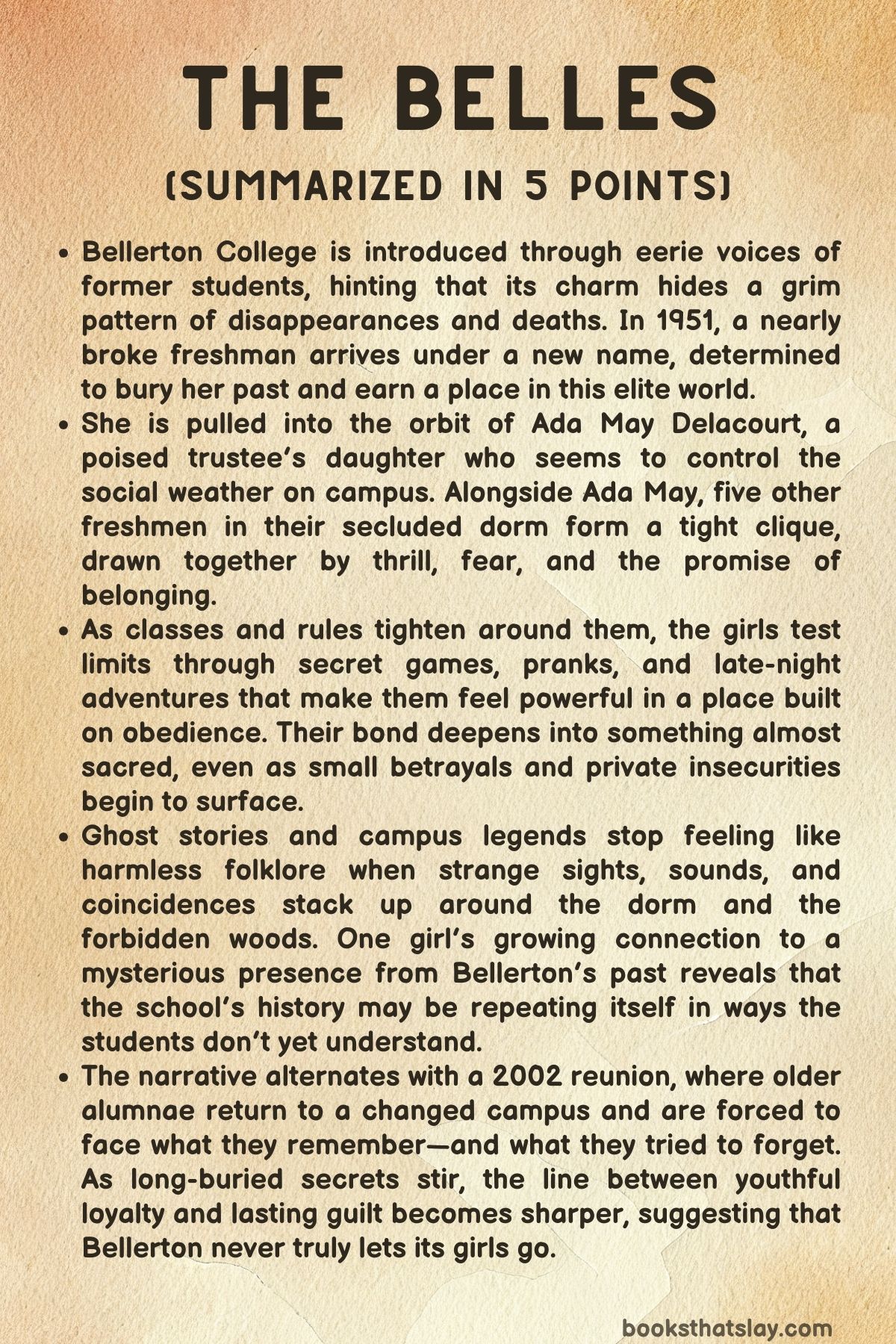
The Belles by Lacey N. Dunham is a gothic campus novel that follows a freshman class at the elite Bellerton College in Virginia, a place famous for tradition, secrecy, and a disturbing pattern of girls who vanish or die. In 1951, a poor young woman arrives under a stolen identity, hoping Bellerton will remake her life.
Instead, she is pulled into an intense dorm sisterhood whose loyalty curdles into cruelty. The story moves between that year and a 2002 reunion, where the past refuses to stay buried. It’s about status, belonging, and what institutions will do to protect their myths.
Summary
Bellerton College is introduced through the voices of girls who enrolled there and never left. They speak from beyond the grave, describing generations of students who disappeared in the woods, died in strange accidents, or were quietly removed.
Their warning is clear: Bellerton’s beauty, reputation, and polished rituals hide something hungry and unsafe.
In the fall of 1951, Deena Evangeline Williams arrives as a freshman after a long journey with almost no money and a fierce plan to reinvent herself. She is not the real Deena Williams; she has taken her half sister’s name as part of a bargain meant to bury a family scandal and give her access to Bellerton’s world.
Assigned to South Hall, a small, aging dorm that houses only six freshmen, she is immediately dazzled by Ada May Delacourt, a trustee’s daughter from one of Bellerton’s old families. Ada May acts as if the campus belongs to her.
She graciously arranges Deena’s room upgrade behind the scenes, framing it as a secret kindness. Deena clings to that attention, determined to learn this place’s codes and be worthy of Ada May’s approval.
The next morning Deena’s new comfort is shaken when Sheba Wyatt, tall, forceful, and furious, storms into her room insisting it was intended for her. Ada May arrives in perfect control, persuading Sheba to move beside her instead.
Deena notices afterward that the string holding her room key has been carefully cut, not broken. The detail nags at her, suggesting Ada May’s favors come with hidden edges.
At breakfast Deena starts alone, but Nell Lawton-Peters, eager and chatty, and Mary Burden, quiet and odd, sit with her. Yet Deena abandons them to trail Ada May’s popular circle.
During South Hall’s formal meeting she meets the rest of her dormmates: nervous Nell, confident and androgynous Fred Scott, wealthy Texan Prissy Nicholson, domineering Sheba, and Ada May. Deena tells them a practiced story about being an orphan raised by her grandmother, leaving out the theft of her identity and her desperate stake in this new life.
Senior class president Peggy Donovan leads a campus tour. Whispers about past deaths surge in the library, but Peggy shuts them down sharply.
She warns the freshmen never to go into the woods, where girls have vanished before. At the stables Deena is startled by Ada May’s black stallion, falls, and twists her foot.
Ada May catches her, soothing her embarrassment and deepening Deena’s craving to be seen as someone who belongs.
The tour ends at President Tibbert’s home, where Mrs. Tibbert greets the girls with a smile that quickly turns punitive.
When Prissy asks for milk, Tibbert forces her to drink an entire glass until she vomits, then lectures the freshmen about obedience, reputation, and the centennial celebration approaching. The encounter teaches them that status will not protect them from Bellerton’s authority.
As classes begin, Deena struggles to keep up. She leans on Sheba, Fred, and Nell for help, but feels too exposed to ask Ada May directly.
When Prissy refuses to study with her, Deena steals Prissy’s dropped homework during a rainstorm and copies it to survive academically, sliding further into fear and self-justification.
The mood in South Hall turns eerie. Fred claims she saw a cloaked figure after curfew.
Ada May adds a story about a girl who fell from a roof and now haunts campus. Bored and spooked, the six freshmen begin pranking their sloppy, half-drunk housemother to convince her the dorm is haunted.
They move her belongings, knock on walls after lights-out, and deny everything. Soon the girls hear real drafts, tapping at windows, and distant crying.
Their game stops being funny. They can’t tell whether they have frightened themselves or awakened something older.
The story cuts to June 2002, Bellerton’s 150th anniversary reunion. Peggy, now older and uneasy, returns to a campus transformed by modern buildings and a highway beside the once-dreaded woods.
She walks with Ann Goodchild, an old friend who still insists the college was haunted. Curious and tense, they step into the woods and reach the creek.
Peggy probes the muddy bottom and strikes something solid. Ann says it’s a rock, but Peggy digs it out and finds a human skull.
The sight yanks her straight back to her senior year, when a girl vanished and nobody spoke of it again.
Back in 1951, the freshmen watch the Senior Serenade, a Bellerton rite performed while staff are sent away. Masked seniors form a circle and raise a doll dressed as a little wife.
One kisses it, then stabs it with scissors. The group passes the scissors from hand to hand, shredding the doll until only its head remains.
Deena is sickened, while Ada May shrugs it off as tradition. Peggy and Ann then approach warmly, joking about the campus “demon cat,” another fable used to scare girls into line, and hinting they watch the freshmen closely.
Mrs. Tibbert is revealed as a constant observer, spying from the library attic and recording every rule broken or followed.
Obsessed with protecting Bellerton’s honor because of a ruined friend in her youth, she visits South Hall and declares the six girls a special freshman set: the Bellerton Belles. The title is both praise and leash, and she warns she can revoke it at any time.
The girls bond under the label. Ada May helps Deena cover her poverty, even teaching her how to order shoes so she won’t look out of place.
The Belles invent a cruel game of hair-pulling and bathroom dares, and Deena wins by refusing to flinch. Still, her grades remain low, so she accepts Fred’s help writing her papers in exchange for cleaning Fred’s room.
When a history professor humiliates Fred, the others defend her, and their loyalty hardens into something like a pact.
After a nearby Air Force plane crash rattles the campus, the girls break curfew, hide in the stables, and share secrets. The housemother catches them missing the next morning but is forced into silence because her own negligence could be exposed.
Ada May leads the negotiation: the housemother will keep their secret if they keep hers. The girls feel a heady new power.
Soon after, Sheba marks each of their palms with an ink X and they swear that if one falls, all fall. A bulb pops during the oath, and darkness rushes in.
Deena sees a shadow outside—possibly Mary.
Ada May later reveals unsettling truths about her family’s history. One night Deena notices an old yearbook page honoring a long-dead Mary Burden, dated 1848–1865, and realizes the Mary she has been drawn to is a ghost.
Mary silently warns her not to tell anyone. Deena, frightened but also comforted by the secret bond, keeps Mary to herself as a private proof that she matters here.
Over Christmas break everyone leaves except Deena and Sheba. Deena wanders into the woods, finds a hidden path, and stumbles on poor tin-roofed houses that mirror the life she fled.
A cleaning woman, Alice, angrily throws her out and calls Bellerton girls rotten. Humiliated and furious, Deena pelts Alice with rocks, then returns shaken and more committed than ever to staying a Belle.
She sleepwalks into the snow and is escorted back by the English professor, who casually notes Bellerton’s ghost stories.
In January the Belles sneak into the forbidden woods together and claim the creek as their shared refuge. Not long after, Ada May is thrown from her horse and badly injured.
Deena sees Mary’s cloaked figure nearby and then finds Ada May’s emerald ring in the grass, which she pockets. Mary leads Deena to a buried box containing Mary Burden’s diary.
Reading it, Deena learns that as a student during the Civil War, Mary was terrorized by a clique led by Ada Jackson, Ada May’s ancestor. Girls died or vanished, and Mary’s final entries show she feared for her life, then abruptly stop.
Deena starts to understand that Bellerton’s disasters are not random. Mary tells her plainly there are no accidents here and urges her to leave.
Deena refuses. She believes she has earned her place.
Without Ada May fully active, cracks appear among the Belles. Nell grows desperate and steals from Prissy.
The others confront her, and in a burst of rage they hold her down and rip out clumps of her hair, leaving a bald patch. Nell sobs and begs to stay, admitting her family is struggling after divorce.
Deena, cold and cornered by her own lies, retaliates by revealing Nell’s private fear about her sister’s illness. Ada May, watching, frames the cruelty as harmless fun.
The group’s bond now runs on punishment.
Later, the Belles corner the drunk poet-professor in the stables after curfew because he has threatened their safety. In a frenzy of fear and unity, Deena attacks first and the others join, beating him until he collapses.
A cover story spreads that he fell while drunk. The next night they break into his house.
There, Deena’s buried past surfaces in her mind: her grandmother once tried to poison Deena’s half sister, leaving the real Deena catatonic; to avoid scandal, Deena’s father arranged for the poor granddaughter to take the girl’s name, allowance, and Bellerton place. Deena has lived inside someone else’s life ever since.
In the professor’s house Deena pushes the Belles to steal trophies of control. They snatch small items, laughing.
Ada May suddenly turns on Deena, cutting her palm hard and warning her without words. The tension between them tightens into a private war.
By April, May Queen nominations arrive. Deena nominates Ada May to smooth things over.
When Ada May, only a freshman, becomes a finalist and then wins, the campus erupts. Ada May gives a speech claiming Bellerton as her inheritance and promising to defend it from girls who don’t belong.
As she passes Deena she calls her “Lettie,” revealing she knows Deena’s true name. Deena is trapped by terror.
She refuses to vote for Ada May, but Ada May wins anyway, clearly backed by Tibbert.
Deena falls violently ill afterward. Ada May nurses her while searching her room, pressing a glass bead with Deena’s real initials into her hand as proof of knowledge.
Deena experiences a vision that shows Mary being poisoned long ago by Ada May’s family and dragged away to die. The pattern is unmistakable: Bellerton removes the unworthy to protect itself.
Deena wakes convinced Ada May has tried to do the same to her.
When Deena returns to strength, the Belles keep her at arm’s length. They plan a final illegal night ride before the centennial crowning and invite her.
Deena admits she cannot truly ride, another lie exposed, but still climbs behind Ada May on Brutus, begging for inclusion. The ride becomes a hunt.
The girls shove, claw, and scream accusations about Deena’s fraud. Ada May drives Brutus faster into the woods.
Deena’s ribbon catches a branch, she slips, and she falls to the ground. Her neck snaps.
She dies alone under the trees with her ribbon dangling above her.
The Belles tell themselves it was her choice to ride and that they were only playing. Mrs. Tibbert discovers Deena missing but learns from Mr. Williams that the real Deena is safe at home and the dead girl was an impostor.
The police search confirms the fraud, and Tibbert erases Deena from records to avoid scandal. She had seen five riders return on four horses and understands what the Belles have done.
She lets it stand.
The Belles weigh Deena’s body down and dump it in the creek, tying her black ribbon around her neck. Soon Deena’s ghost appears to Ada May, attacking her in fury.
At the May Queen ceremony, Ada May sees Deena and many other dead girls among the crowd. The celebration feels infected by the truth she can’t stop seeing.
Years later, as implied by the 2002 timeline, Deena’s remains and many more bones are uncovered. Investigations reopen old deaths, lawsuits follow, and students flee.
Bellerton finally closes. Ada May lives under the weight of what she helped preserve.
She returns to the ruined campus, haunted by the girls the college consumed, and in the end climbs out of a window and lets go, finishing the long cycle of Bellerton’s violence at last.
Characters
Deena Evangeline Williams / “Lettie” (the impostor Deena)
Deena is the novel’s emotional center and its most tragic study in self-invention. Born into poverty and carrying the weight of a family crime, she arrives at Bellerton with a stolen name and a desperate hunger to be transformed by the institution’s glamour.
Her intelligence and ambition are real, but they’re constantly undercut by fear of exposure, which pushes her into morally slippery choices—copying Prissy’s homework, hiding her past, and clinging to Ada May’s approval even when it turns cruel. Deena’s longing to belong makes her both sympathetic and frightening: she internalizes Bellerton’s hierarchy so deeply that she accepts humiliation and danger as the price of membership.
Her bond with Mary’s ghost shows her capacity for intimacy and conscience, yet she uses even that supernatural connection as leverage to protect her fragile position. In the end, Deena becomes the latest iteration of Bellerton’s pattern: a girl deemed “unworthy” and disposed of, but also someone whose own lies and fixation on status make her vulnerable to the machine she tries to master.
Ada May Delacourt
Ada May is Bellerton’s living embodiment—beautiful, aristocratic, and ruthlessly fluent in the campus language of power. From her first encounter with Deena, she performs generosity as dominance, offering favors that create debt and loyalty.
She is charismatic enough to unify the Belles and sophisticated enough to manipulate conflicts without ever appearing to dirty her hands, which makes her both queen and architect of the clique’s moral collapse. Ada May’s lineage ties her to Bellerton’s historical violence, and her speech as May Queen reveals the ideology she protects: Bellerton belongs to certain families and certain kinds of girls, and she sees herself as the gatekeeper.
Yet her control is not just social; it is psychological. She watches, tests, and ultimately punishes Deena in ways that echo her ancestors’ treatment of Mary Burden, suggesting that cruelty is a family inheritance as much as a personal choice.
Her later life—haunted by Deena and the other dead girls—shows the cost of being a perfect Bellerton product: she wins the crown but loses her soul, and her suicide reads like the institution finally consuming its most devoted daughter.
Sheba Wyatt
Sheba enters the story as force and volatility—tall, imperious, and quick to assert territory, yet also deeply loyal once she chooses her people. Her early aggression toward Deena is the reflex of someone used to having her status threatened, but over time she becomes one of the Belles’ fiercest protectors, especially of Fred.
Sheba’s complexity sharpens through her later narration in 2002, where her outwardly stable suburban life is revealed as a shell around unresolved love and guilt. She carries the grief of what the Belles did and what was done to her, making her both perpetrator and casualty of Bellerton’s culture.
The novel frames her as someone who craved freedom and intensity, and found it through the Belles, but who never escaped the emotional consequences of their oath. Her enduring love for Fred positions her as the most openly human of the group: she is capable of harm, but also of genuine attachment that survives the institution.
Fred Scott
Fred is the Belles’ quiet axis of integrity, projecting calm confidence in a body and persona that resist Bellerton’s rigid femininity. Androgynous, observant, and academically strong, she represents another kind of outsiderhood—one rooted less in class and more in identity and being “out of type” for Bellerton’s expectations.
The cruelty she endures in the history classroom shows how the college polices belonging, and the way the Belles rally around her is one of their last moments of protective solidarity before that same loyalty curdles into violence elsewhere. Fred’s sensitivity to the uncanny—the cloaked figure, the atmosphere of South Hall—marks her as someone who senses Bellerton’s rot earlier than the others.
Her relationship with Sheba, implied as love, is a tender countercurrent to the clique’s brutality, suggesting that real connection can exist even inside a poisoned system. Fred ultimately survives physically but not untouched; in Sheba’s later memories, Fred is the emotional wound that never heals, indicating that Bellerton’s damage lingers beyond graduation.
Prissy Nicholson
Prissy begins as a wealthy Texas heiress conditioned to expect indulgence, but Bellerton’s discipline humiliates her early, teaching her that money does not exempt her from institutional control. She hides sharpness beneath a girlish surface, using humor and flirtation tactically—distracting a professor to protect Fred, baiting Deena about the Vandorns, and repeatedly probing for weak spots.
Her 2002 narration reframes her as a woman who has learned to live with secrets, including her concealed romance-writing career and her knowledge that Deena was an impostor. Prissy’s pleasure in holding that secret without exposing it is important: she is not a moral rescuer, but someone who enjoys the power imbalance secrecy provides.
Still, she is also a product of Bellerton’s training in performance and containment, and her adult life shows how that training turns women into careful curators of acceptable selves. Prissy’s mixture of complicity, insight, and self-protection makes her one of the novel’s most realistic portraits of privilege under pressure.
Nell Lawton-Peters
Nell is the story’s picture of vulnerability shaped into desperation. She arrives needy and friendly, trying hard to be liked, and her anxiety makes her easy prey for the Belles’ shifting standards of loyalty.
The thefts from Prissy’s room are not born from malice but from panic about her family’s financial collapse and social shame, yet Bellerton and the Belles interpret weakness as betrayal. Her punishment—being held down and partly scalped—shows how quickly the clique’s rituals slide from play into cruelty, and how Deena, in particular, weaponizes Nell’s confession about her sister’s illness.
Nell’s tragedy is that she believes belonging requires self-erasure; even after being brutalized, she begs to stay, accepting the group’s definition of love as pain. She stands for the girls Bellerton most easily destroys: those without money or armor, whose longing for acceptance becomes the lever used against them.
Mary Burden
Mary operates on two intertwined levels: as a historical girl whose diary reveals Bellerton’s original sin, and as a ghost who haunts the campus with warning rather than vengeance. In the diary, she is perceptive and increasingly terrified, documenting the arrival of predatory elite girls and the way “accidents” serve social purification.
As a spectral presence in 1951, she is tender toward Deena yet blunt in her message that Bellerton kills girls who don’t fit. Mary’s choice to frighten Brutus to lead Deena to the diary suggests she is less a malevolent spirit than a guardian of truth, trying to interrupt a repeating cycle.
At the same time, her inability to fully save Deena underscores the institution’s power: even the dead cannot stop Bellerton from reenacting itself. Mary is the conscience of the book, a reminder that the campus’s beauty is built on buried bodies and erased names.
Peggy Donovan
Peggy is Bellerton’s memory made flesh—first as the stern senior class president who suppresses gossip and enforces rules, later as the older alumna whose reunion walk reopens the past. As a student, she performs authority in the way Bellerton taught her: decorous, controlling, and aligned with institutional reputation.
Yet her tenderness to Prissy after Tibbert’s humiliation hints that she is not cruel by nature, only trained to prioritize order. In 2002, Peggy’s nostalgia is complicated by dread, and the discovery of the skull in the creek becomes both literal and symbolic proof that Bellerton’s polished narrative was always a lie.
She represents the generation that survived by not looking too closely, and her later unraveling shows that repression has an expiration date. Peggy’s arc is less about guilt for a specific act and more about the slow moral awakening of someone who finally allows herself to see what was always there.
Ann Goodchild
Ann is Bellerton’s persistent witness. As a senior she joins Peggy in the performance of tradition and authority, but she is also the one who openly names the campus as haunted—both supernaturally and ethically.
Her story of a student seeming to vanish in fog suggests that Bellerton’s reality bends under the weight of its history, and her continued insistence on the haunting in old age keeps the past alive. Ann’s lost Senior Serenade mask in 2002 is a small but telling detail: she cannot hold onto Bellerton’s symbols because she has never fully accepted their meaning.
She functions as a chorus figure across timelines, the one who keeps saying the quieter truth everyone else tries to smooth over.
Mrs. Tibbert
Mrs. Tibbert is the novel’s clearest portrait of institutional cruelty disguised as moral guardianship.
She operates Bellerton like a surveillance state, noting girls’ habits, enforcing handbooks, and staging obedience as the highest virtue. Her origin story—watching her friend Ginger’s pregnancy destroy her prospects—warps into fanaticism, making her believe that control is protection and that shame must be prevented by any means.
She humiliates Prissy publicly, engineers Ada May’s rise, and quietly erases Deena once her imposture is revealed, prioritizing the college’s image over human life. Tibbert’s satisfaction in the Belles’ violence reveals her complicity: she doesn’t merely tolerate the system, she breeds it, rewarding unity even when it becomes predation.
She embodies how patriarchy can be enforced through women trained to fear disorder more than injustice.
President Tibbert
The president is less visible than his wife but still significant as the male face of authority propped up by her machinery. His house functions as a symbolic throne room in the campus tour, reinforcing the idea that Bellerton’s center is not the girls but the institution’s patriarchal leadership.
His relative absence from daily cruelty highlights the novel’s point that systems often rely on quieter male sanction while women are made the instruments of enforcement.
The South Hall housemother
The housemother is a worn-down counterpoint to Tibbert’s rigid ideal. She is sloppy, often drunk, and initially treated as comic prey for the freshmen’s pranks, which reveals how little respect the girls have for weak authority.
Yet once she discovers the Belles have been out all night, she becomes frighteningly pragmatic, trading mutual silence instead of invoking discipline. Her fear afterward shows she understands exactly what kind of power she has yielded to Ada May’s clique.
She represents the adults Bellerton consumes too: caretakers trapped between rules they can’t uphold and students who are becoming dangerous under those same rules.
The young English / poet-professor
The poet-professor begins as a shadowy, almost romanticized figure glimpsed after curfew, but he quickly crystallizes into a threat—drunk, contemptuous, and predatory in the way he taunts the girls. His willingness to hint at punishment and “the lash” exposes the sexual power imbalance Bellerton shelters.
The Belles’ brutal beating of him is one of the book’s most morally tangled episodes: it is self-defense against a real danger, yet also a moment where the clique tastes collective violence and finds it thrilling. He is both villain and catalyst, helping accelerate the Belles’ transformation from rebellious friends into a unit capable of killing.
Saul (groundskeeper)
Saul appears briefly but carries thematic weight as a keeper of suppressed history. His tending of the founders’ cemetery alongside his own ancestors positions him as someone who literally maintains the layers Bellerton prefers to forget—especially its Black labor and buried truths.
His shock at seeing Ada May near the cemetery hints that she is transgressing boundaries of class, race, and family secrets, and that the Delacourt legacy is entangled with the land’s older, darker stories. Saul symbolizes the histories that frame Bellerton from outside its white female myth.
Alice (cleaning woman)
Alice is a sharp, grounding intruder from the world Bellerton tries to seal out. When Deena finds the poor houses beyond the woods, Alice’s anger articulates the social violence underpinning the college’s elegance.
She names what Deena is trying not to be—a poor girl dazzled into cruelty by proximity to wealth. Deena’s rock-throwing attack on Alice is chilling because it shows Deena turning on her own origins in order to protect her fantasy.
Alice is a moral mirror that Deena smashes.
The real Deena Williams (catatonic half-sister)
Though absent in person, the real Deena is the source of the imposture and a ghostly presence of another kind: a living victim erased so another girl can take her future. Her poisoned, catatonic state exposes the brutality of the family bargain that puts Lettie into Bellerton, and it underscores the novel’s theme of disposability—girls exchanged, renamed, and hidden to preserve reputation.
Deena’s grandmother
The grandmother is the first architect of Deena’s stolen life, committing the poisoning that collapses the family’s moral center. Her act is rooted in warped protection and resentment, and the fallout shows how violence done in private domestic space echoes later in institutional space.
She represents the inheritance of desperation: Deena doesn’t arrive at Bellerton innocent of cruelty because she was raised inside it.
Esther Vandorn and the Vandorn family
Esther and the Vandorns are Bellerton’s off-stage engines of class reality. Their purchase of Deena’s father’s former house after the mysterious incident connects old money to private scandal, and Prissy’s casual familiarity with them reinforces how tightly elite networks interlock.
They are the social world Deena is trying to penetrate, and the reason her imposture feels like a bomb waiting to go off.
Brenda Carter, Bess, Ada Jackson, Lydia Booth
These figures function as extensions of Bellerton’s long timeline of agreeable surfaces and lethal traditions. Brenda and Bess are reunion-era echoes of the same social policing—women whose reputations become gossip currency decades later.
Ada Jackson and Lydia Booth, seen through Mary’s diary, are the prototype Belles: privileged girls who enforce belonging through cruelty. Mr. Gray, who marries Ada Jackson, anchors that cruelty to patriarchal reward, showing that Bellerton’s female violence has always been entwined with serving male-centered structures.
Themes
The seduction and violence of belonging
From Deena’s first moments at Bellerton, acceptance functions like a drug: she is broke, lonely, and ashamed of her origins, and the campus offers a glittering chance to become someone else. The Belles clique, especially Ada May, embodies the social ideal Deena thinks will save her.
What makes this theme sting is how quickly belonging turns conditional and then punitive. The girls’ rituals of unity—hair-pulling games, secret oaths, shared pranks, and late-night adventures—feel at first like rebellious intimacy against a suffocating school.
But the same mechanisms that create closeness also enable cruelty. The oath “if one falls, all fall” is not just a pledge of care; it’s a contract that demands self-erasure.
Deena’s hunger to be “truly one of them” pushes her into theft, lies, and complicity. Once she is invested, the group can raise the cost of membership without resistance.
The Nell episode shows this clearly: the Belles narrate their assault as “fun,” then use Nell’s desperation to enforce submission. Belonging becomes a currency traded for obedience, and any weakness becomes material for control.
Deena is not only a victim of this dynamic but also shaped by it; she weaponizes secrets, turns on Nell, and presses the girls to steal from the professor to intensify their shared power. Her death is the logical endpoint of conditional belonging: when the group decides she threatens their identity, they reframe violence as play and expulsion as inevitability.
The later timeline confirms how long this kind of belonging haunts its survivors. Sheba, Prissy, and Ada May carry decades of guilt, desire, and dread because once you have built your selfhood inside a circle that eats its weak, you never fully step outside it.
The campus itself mirrors the clique: beautiful, exclusive, promising transformation, but demanding sacrifice, and quietly discarding those who don’t fit.
Identity as performance, theft, and survival
Deena arrives at Bellerton under a stolen name, and the novel treats identity not as a stable essence but as something performed under pressure. Her reinvention begins as survival: poverty and family scandal have taught her that truth is a liability.
At Bellerton, the performance becomes more complex because every social interaction is a test. Her rehearsed orphan story, her imitation of Ada May’s poise, even her copied homework are all attempts to align her outer self with the world she wants access to.
This theme gains power because the book refuses to make identity play a simple moral failure. In a system designed to elevate lineage and money, Deena’s fraud is both understandable and tragic.
She wants dignity, safety, and choice, yet the only path she can see is to become a version of someone the institution will accept. The cruel irony is that Bellerton itself runs on similar thefts and performances: the college sells prestige while hiding bodies, Mrs. Tibbert preaches virtue while protecting the school’s image at any cost, and Ada May performs gracious leadership while orchestrating exclusion. Deena’s hidden past also shows how families manufacture identities to dodge shame.
Her father’s bargain to swap Deena into her half sister’s place is a chilling example of identity as a transactional cover for male reputation. The girls around her model different performances too.
Prissy acts the frivolous heiress while concealing her creative life; Sheba performs hard certainty while holding secret love for Fred; Fred negotiates gender expectations in a space that punishes difference. These layered performances create a constant anxiety that someone will be “found out,” and that fear makes people both defensive and cruel.
When Ada May finally calls Deena by her real name, it is not only exposure but a declaration of ownership: Ada May controls which identities count. Deena’s hallucinated vision of Mary’s poisoning links her fate to a long lineage of girls whose identities were judged unworthy.
The institution doesn’t just erase bodies; it erases narratives. Deena’s disappearance is made clean by labeling her an impostor, as if the crime were her existence rather than the violence done to her.
The book suggests that in an oppressive social order, identity theft is less an aberration than a mirror of the system’s own lies.
Power, surveillance, and the manufacture of obedience
Bellerton’s charm masks a rigid power structure that reaches into every corner of student life. The most visible face is Mrs. Tibbert, whose rule is paternalistic, theatrical, and punitive. Her forced milk punishment of Prissy is not about manners; it is a public lesson that compliance matters more than dignity.
Her constant watching from the attic turns the campus into a stage where girls internalize the gaze of authority. The theme of surveillance expands beyond Mrs. Tibbert into traditions and peer structures. The Senior Serenade ritual, with its masked circle and doll mutilation, dramatizes what Bellerton expects of women: you may be celebrated, but only if you accept the role assigned to you, and only after you symbolically destroy the self that might resist.
The ghosts and legends function like an informal surveillance system too. Warnings about the woods, tales of dead girls, and the demon cat story keep students anxious and bounded.
Fear becomes a tool that polices movement and imagination. The Belles, once formed, replicate the same logic.
They watch one another for weakness, punish deviation, and demand unity in language that echoes institutional discipline. The pact with the housemother is a small coup that teaches them that power can be seized through secrets, but it also binds them to a culture of mutual blackmail.
Their attack on the professor shows how quickly oppressed subjects can adopt the methods of their oppressors; they justify violence as protection and then craft a cover story that the institution gladly accepts because it preserves reputation. The college’s responses to danger are always about continuity and image.
Disappearances are rewritten as accidents or moral failures, and paperwork is adjusted to remove disruptive truths. The ultimate expression of this theme is Deena’s erasure from the records once her imposture is revealed.
Mrs. Tibbert’s relief signals that the school’s true loyalty is not to students but to the myth of Bellerton.
Even after the campus closes, the reunion scenes show how surveillance lingers psychologically. Peggy’s walk through modern Bellerton triggers old fear because the landscape still feels like a witness to buried acts.
The skull in the creek is a literal remainder of an authority that used secrecy to keep its power intact. The book argues that obedience is not natural; it is manufactured through spectacle, fear, and the promise of belonging, and it produces cycles of harm that outlive the institution itself.
Class, privilege, and the logic of disposability
Class difference is the quiet engine behind nearly every conflict. Deena’s poverty is not just a background fact; it shapes her posture, her academic struggle, her envy, and her constant calculation of risk.
She enters a world where money is assumed, lineage opens doors, and ignorance of these codes is treated as a moral defect. Ada May’s effortless authority comes from being a trustee’s daughter with deep Bellerton roots.
Sheba’s entitlement to rooms and respect is backed by her father’s status. Prissy’s wealth cushions humiliation and allows her to hide her writing as a harmless eccentricity rather than a threat to survival.
Nell’s middle-class fragility makes her vulnerable to shame when her family collapses. Fred, though not defined primarily by class, still suffers at the hands of faculty who read difference as not belonging, a judgment tied to the elite image Bellerton protects.
The institution’s traditions operate as class theater: they celebrate heritage while reminding newcomers that they are guests on someone else’s stage. Deena’s Christmas walk to the poor settlement is a sharp moment in this theme.
The houses resemble her past, and her rage at being seen there reveals how class shame can turn inward and violent. Alice’s accusation that Deena is becoming rotten like the wealthy girls forces Deena to confront that she is chasing not only comfort but a hierarchy that requires someone below her.
Her rock-throwing is a desperate attempt to silence the part of herself that knows she is still “from there. ” Bellerton’s murder culture is also classed.
The girls eliminated across generations are often those deemed unworthy, disruptive, or scandal-risking. Mary’s death in the diary era is tied to powerful ancestors protecting their status.
Deena’s death is justified because she is an impostor whose exposure would stain the school. The response is not grief but administrative cleanup.
Even the police search becomes a mechanism to restore class order: once her origin is known, her life counts less, and her disappearance becomes manageable. The later unearthing of bodies and lawsuits finally breaks that logic, not because the elite suddenly grow moral, but because the sheer number of disposables makes the myth unsustainable.
The book shows privilege not as personal nastiness alone, but as a social machine that decides whose safety matters and whose body can be hidden to keep a beautiful story intact.
Desire, rivalry, and the volatile bonds between women
The relationships among the Belles are charged with longing, admiration, jealousy, and fear, and the novel treats female intimacy as both refuge and battleground. Deena’s fixation on Ada May has the intensity of first love: Ada May rescues her socially, touches her hair, gifts her a ribbon, and offers the addictive line that Deena is truly one of them.
That tenderness is real enough to hook Deena, yet it is inseparable from dominance. Ada May’s closeness is a method of shaping Deena into a loyal subject.
Sheba’s feelings for Fred add another layer. Her present-day confession that she never stopped loving Fred reveals how desire was forced underground at Bellerton, turning affection into something that could only be expressed through protection, possessiveness, and later guilt.
Nell’s anxiety about Sheba and Fred’s closeness shows how rivalry grows inside tight groups when love has no healthy outlet. The Belles constantly oscillate between caretaking and cruelty, and that oscillation is one of the book’s most unsettling emotional truths.
They defend Fred against a professor’s humiliation, then later rip out Nell’s hair without remorse. They nurse Deena when she is ill, then freeze her out once Ada May brands her a threat.
The pattern suggests that within a system that pits women against one another for scarce status, love becomes entangled with fear of exclusion. Traditions like the Serenade train girls to perform unity while competing for approval, and this insecurity infects friendships.
Even the shared violence against the professor can be read as warped solidarity: they circle Sheba to protect her from his coercion, but the act also gives them a thrill of shared power that binds them in secrecy. The model of womanhood Bellerton teaches is thus paradoxical: be devoted to other women when it serves the institution’s image of sweetness and order, but punish any woman who threatens that order.
The result is intimacy that can never fully trust itself. In the 2002 scenes, the women’s gossip, nostalgia, and avoidance show how that training persisted.
They still struggle to speak plainly about what happened or what they wanted from one another. Ada May’s final end is steeped in this theme: the ghosts she sees are not just victims; they are reminders of bonds she corrupted and severed.
The novel portrays female relationships as profoundly meaningful, but shaped into dangerous forms by hierarchy, repression, and the constant fear that love might cost you your place in the circle.
Haunting as history that refuses erasure
The supernatural element in The Belles is less about jump scares and more about memory that will not stay buried. The campus is introduced through the voices of girls who never left, framing Bellerton as a place built on accumulated silences.
Ghost stories circulate as entertainment, but they are also incomplete testimonies about real harm. When the freshmen prank the housemother with fake hauntings, they accidentally echo the college’s deeper truth: the dead are already part of daily life, and their presence shapes behavior.
Mary Burden’s ghost is the clearest expression of this theme. She approaches Deena not as an abstract spirit but as a girl whose story was cut off by violence and then hidden.
The diary she leads Deena to is a literal artifact of suppressed history, and Mary’s insistence that there are no accidents at Bellerton reframes every legend as evidence of a pattern. The haunting also operates psychologically.
Deena’s illness and visions blur the line between supernatural warning and trauma resurfacing. Her past—poisoning, identity theft, family bargains—returns in bodily form, suggesting that even without ghosts, the past inhabits the present.
The 2002 timeline strengthens the theme by showing how hauntings persist across generations. Peggy’s memory of fog swallowing her friend, Ann’s lost mask, and small items going missing suggest that the campus keeps repeating its logic because its history was never faced.
The discovery of the skull in the creek is the moment where haunting becomes undeniable material fact. What looked like myth is revealed as bone.
Importantly, the haunting is not only carried by victims. Ada May is haunted by Deena and the other dead girls because she is both heir and agent of Bellerton’s violence.
Her final act of letting go from the window feels like the end of a long sentence passed down through bloodlines and tradition. When the campus closes and investigations begin, the haunting shifts from private fear to public reckoning.
The dead finally force the living to look. In this sense, the supernatural is a narrative tool for historical accountability.
Bellerton tries to erase girls who don’t fit, but the book argues that erased lives do not vanish; they return as stories, guilt, and eventually evidence. Haunting becomes the form justice takes when institutions protect themselves too well for ordinary truth to survive.