A Love Letter to Whiskey Summary, Characters and Themes
A Love Letter to Whiskey by Kandi Steiner is a contemporary romance told through Brecks “B” Kennedy’s eyes as she looks back on the years-long pull between herself and Jamie Shaw. What begins as a quiet crush in high school grows into a bond that refuses to fade, even when life keeps pushing them apart.
Set between Florida, California, and later Pittsburgh, the story tracks first love, friendship lines that blur, and the way trauma and timing can shape desire. It’s a book about choosing each other again and again, and finally learning to choose at the same time.
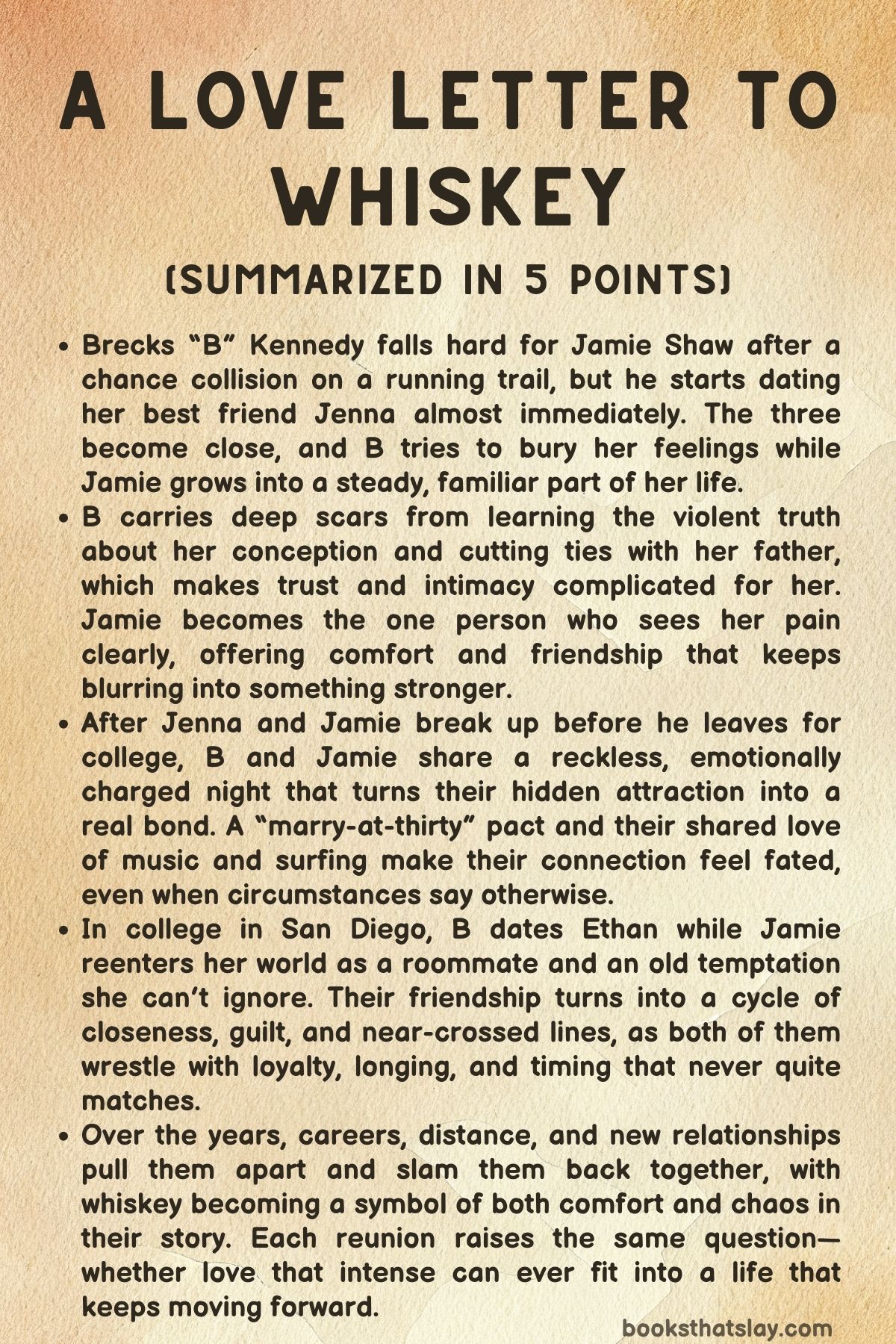
Summary
Brecks Kennedy, who insists everyone call her “B,” meets Jamie Shaw in high school in South Florida after they collide on a running trail. She is instantly drawn to him, but her best friend Jenna Kamp snaps at Jamie, and he turns his charm toward Jenna.
Jenna and Jamie start dating within days, and B slips into the role of third wheel, trying to bury her feelings while the three of them become a constant trio. Jamie treats B like a true friend, which only deepens her attraction and her guilt.
B’s guarded nature comes from a brutal family truth. Her mother once told her that B’s parents were old friends who dated briefly, but later confessed the real story: B was conceived when her father assaulted her mother as a teenager.
Her mother named her “Brecks” after counting his freckles during the attack. When B confronted her father, he showed no regret.
She cut him out of her life and shortened her name to “B” as a way to reclaim herself. This history makes intimacy hard for her and shapes her fear of trusting love.
One afternoon B goes surfing alone to clear her head, and Jamie unexpectedly joins her. Their teasing turns into easy conversation about dreams beyond Florida, especially college in California.
Later, when B’s SUV breaks down, Jamie drives her home. In the Jeep ride they discover shared loves—classical music, piano, and a kind of calm understanding that feels rare to B. Because B’s car will be stuck in the shop for weeks, Jamie offers to drive her places.
B knows this is risky since he is still with Jenna, but the time together becomes a habit neither wants to lose.
As the school year ends, Jenna breaks up with Jamie because he is graduating and leaving for California and she refuses long distance. B argues for him so fiercely that Jenna jokes B should date him, and B is shaken by how true that sounds.
Jamie disappears for a while, then shows up at a graduation party B hosts. The night is hot, messy, and full of alcohol.
Jamie is cocky, drunk, and magnetic. In the kitchen, a flirtation finally crosses the line: they share whiskey shots, trade daring words, and lock into a charged game of attraction.
The party ends in a disaster that leaves B terrified of her mother’s reaction, but Jamie stays to help her clean. They escape to the beach before dawn, eat burritos from a drive-through, watch the sunrise, and talk about the future.
Jamie admits Jenna wasn’t “the one” and makes a playful pact: if they’re both single at thirty, they will marry each other. B agrees while telling herself it’s only a joke, yet it anchors itself inside her.
A year later B begins college at Alder University in San Diego. The moment she arrives, she hears Jamie’s voice behind her—he is there too, pulled off the waitlist and now living in her orbit again.
But B has a boyfriend, Ethan, an ambitious student leader with political goals. When Ethan introduces Jamie as his roommate, Jamie turns cold and avoids B for weeks.
B throws herself into campus life and tries to be happy with Ethan, yet Jamie’s presence keeps tugging at her attention.
At a loud beach-house party, B steps onto a balcony to breathe and finds Jamie alone. Their sharp banter slips into flirtation, and Jamie starts texting her to hang out.
B refuses at first, but Jamie shows up at her dorm one morning and insists on taking her out. They roam San Diego together—coffee at a cat café, a failed attempt to see the Dr. Seuss collection, easy laughter that feels like home.
The next day he buys her a wetsuit and takes her surfing at dawn. The closeness cracks open everything B has been suppressing.
Jamie admits he avoided her because he couldn’t stay away, then kisses her. B kisses back, then panics because of Ethan.
Jamie pulls away, ashamed, but neither of them is able to return to ordinary friendship.
They keep seeing each other in the name of “friends,” while Jamie dates other girls and Ethan grows increasingly uneasy. Ethan confronts B and begs her to put him first.
B tries to pull back from Jamie, but when Jamie calls late one night in distress, she goes. He confesses that his father’s accounting firm is collapsing in the recession and he feels helpless.
B comforts him, and the night slides into another kiss—this time deeper, more physical, crossing lines they can’t redraw. B continues hiding these moments, torn between loyalty and longing, until life rips the ground out from under her in ways that send her retreating from everyone, including Jamie.
Years pass in a pattern of love and separation. B and Jamie finally admit they belong together, but when B takes a job in Pittsburgh to start her career, she refuses Jamie’s plea for long distance.
Jamie is crushed, believing he has waited for her through every storm. He forces himself to let her go and later starts dating Angel Connelly, a woman connected to his family’s workplace.
The relationship becomes serious. When B returns to town and sees Jamie with Angel, she accuses him of having moved on too quickly.
They fight brutally, confessing old wounds and missed chances, and end in a fragile, distant truce.
Eventually Jamie proposes to Angel and asks B to be part of the wedding. B comes back for it, and the old pull lights up again.
On a camping night with the wedding party, they share laughter, memories, and a kiss that nearly becomes more. B stops it, reminding Jamie he is still committed to someone else.
The next day everything detonates: Angel cheats the night before the ceremony, and the wedding is canceled. Jamie flees, hollowed out.
B finds him drinking alone, leaves a key to her hotel room, and they finally sleep together, giving in to years of hunger and grief. By morning Jamie admits he has loved B all along and asks her to be with him.
She agrees, believing they will sort out the wreckage.
But Angel has one last weapon. She and Jamie had signed their marriage certificate early for logistical reasons; after the canceled ceremony, Angel signs and files it anyway, trapping Jamie in a legal marriage.
She threatens to use hotel evidence of Jamie with B to claim infidelity and take half his assets, including his stake in his father’s firm. Jamie’s lawyer orders silence.
Cut off from B for two years, he tries a few anonymous calls, but she never answers. B, devastated by his disappearance, rebuilds herself and eventually falls in love with Bradley “Brad” Neil, a kind entrepreneur.
She accepts Brad’s proposal.
The day Jamie’s divorce is finalized, he receives B’s wedding invitation. He flies to Pittsburgh in the rain and confronts her.
They erupt into heartbreak and anger, then sleep together again, unable to resist the bond. In the morning B insists she will marry Brad, believing she and Jamie only destroy each other.
Jamie finally tells her the truth about the forced legal marriage and his gag order, but the damage is done. B marries Brad, yet the marriage collapses within months, leaving her numb and separated.
Later Jamie comes back quieter and gentler, still loving her but unwilling to keep wounding her. He leaves her a birthday gift with a note asking her not to let them go.
B realizes she still wants him, so she writes and publishes a novel that is her full confession—a love letter asking him to choose her freely. Jamie reads it, goes to her, and tells her he has always chosen her.
They reunite without excuses, marry in a small beach ceremony in California, and build a life together near the ocean. The story closes with B riding in Jamie’s Jeep to surf, finally wearing his wedding band too, certain that the long, painful arc of their love has found its home.
Characters
Brecks “B” Kennedy
B is the emotional and narrative core of A love letter to whiskey—a woman whose capacity for love is matched by her instinct to self-protect. Her childhood trauma defines the key tension in her personality: she craves intimacy and permanence, yet distrusts them because her very origin story is rooted in violence.
The revelation about her conception and the cruel indifference of her father don’t just wound her; they reorganize her identity. Choosing the nickname “B” is both a rejection of the man who hurt her mother and a way of reclaiming control over what her name means.
That need for control spills into her romantic life, shaping how she handles Jamie: she wants him intensely, but she also fears what wanting him might cost her. B’s internal conflict is not simply about cheating or timing; it’s about whether she’s allowed to want happiness without it turning into harm.
Her writing career later becomes a second kind of self-assertion—she turns pain into language, and language into choice. Even when she makes messy decisions, B is never shallowly impulsive; she is someone trying to survive longing without losing herself, and the book charts her slow move from endurance to ownership of her own desires.
Jamie Shaw
Jamie is the gravity around which B’s life keeps orbiting, but he is not a static romantic ideal—he’s a man shaped by loyalty, expectation, and emotional fear. On the surface he has a straightforward trajectory: sunny, charming, athletic, family-oriented, planning to inherit stability through his father’s accounting firm.
Underneath that, he is unsettled by how little that neat future satisfies him. B awakens in him a sense of being truly seen, and that comfort becomes his addiction as much as she is hers.
Jamie’s major flaw is not a lack of love but a lack of emotional courage at crucial moments: he wants B, but he also wants to be “good,” and he struggles when those two things collide. His avoidance patterns—ghosting after graduation, disappearing during the legal marriage trap, and clinging to silence under pressure—are the ways he tries to keep control and avoid more damage, but they also become the very damage.
The story tracks his maturation from someone who loves intensely but inconsistently, into someone who finally claims responsibility for choosing B in a way that doesn’t ask her to wait in the dark. Jamie’s devotion is real throughout; what changes is his ability to carry that devotion into action.
Jenna Kamp
Jenna is more than the “best friend” or the first girlfriend in a love triangle—she represents the life B thinks she should be living, the version of ease and certainty B envies and resents at the same time. Jenna’s early magnetism with Jamie is effortless, and that effortless bond becomes the first thing B believes she can never compete with.
Yet Jenna is not depicted as cruel; she is impulsive, bold, sometimes oblivious, but also loyal in her own way. Her breakup with Jamie is a key portrait of her pragmatism and self-protection: she ends things not because she lacks feeling, but because she refuses to dilute her life into long-distance uncertainty.
Later, even as B and Jamie’s history deepens beyond her, Jenna stays threaded through their story as a witness and sometimes a reluctant mirror. She highlights a theme that runs through the book: love isn’t only about intensity—people choose what they can live with.
Jenna chooses clarity and momentum. B chooses longing.
Jamie gets caught between both models of love.
Ethan
Ethan is the clean, hopeful alternative path—he embodies safety, ambition, and social polish. He isn’t an antagonist in the ordinary sense; he genuinely cares for B, treats her well, and imagines a future with her that looks respectable and stable.
That’s precisely why he matters. Ethan’s relationship with B exposes her hunger for something wilder and more consuming than good intentions.
He offers steadiness, but B experiences that steadiness as emotional quiet to the point of suffocation. Ethan’s insecurity about Jamie isn’t petty; it’s perceptive.
He senses the intimacy between them long before B is ready to admit it. Through Ethan, the book explores how a love can be healthy on paper and still wrong in the body.
He functions as a contrast that sharpens the reader’s understanding of B and Jamie’s connection: not because Ethan is lacking, but because he cannot give B the specific kind of aliveness she associates with love.
Angel Connelly
Angel is the story’s clearest portrait of love twisted by possession and fear. She enters Jamie’s life at his most broken, and their relationship grows from his loneliness rather than his deepest self.
Angel wants Jamie wholeheartedly, but she wants him as something she can secure, not something she can share with the truth of his past. Her jealousy is not baseless—she senses that B is the unspoken center of Jamie’s heart—and that awareness curdles into desperation.
Her cheating on the eve of the wedding is both retaliation and panic, a self-sabotaging act rooted in the belief that she’s already losing. The most destructive thing she does is legal rather than romantic: filing the marriage certificate, weaponizing hotel footage, and using the system to trap Jamie.
Angel becomes a symbol of how love can be used as leverage, and how the desire to “win” someone can erase empathy. She is not written as a cartoon villain, but as a person whose insecurity metastasizes into cruelty.
Bradley “Brad” Neil
Brad is another version of safety, but at a later, more exhausted stage of B’s life. Where Ethan represents youthful ambition and a future-to-build, Brad represents adult competence and a life already built—successful, kind, and ready to shelter her from chaos.
B’s fast attachment to him signals not sudden healing but the opposite: she is in the fragile high of being “clean” from Jamie, desperate to anchor herself to something that won’t burn. Brad’s tragedy is that he is real and loving, yet he is standing in the path of a love story that B has never finished grieving.
When B marries him, it’s less betrayal of Brad than betrayal of her own truth. Their short-lived marriage shows how unresolved obsession doesn’t disappear just because a new love arrives.
Brad is important because he proves that B isn’t chasing Jamie due to lack of options—she’s chasing him because he is her unfinished self.
River
River operates as a quieter echo of B’s pattern: he is the relationship B clings to when she’s trying to stay away from Jamie. The fact that she returns to him in Pittsburgh while secretly building hope for Jamie underlines how she uses “good enough” intimacy as a substitute for the love she actually wants.
River is less defined than Ethan or Brad, but that softness is purposeful—he is the blur of comfort, not the blaze of transformation. His presence helps show how B’s addiction to Jamie warps time: even when she’s with someone else, she’s not fully there.
River represents the half-life B accepts when she doesn’t believe she can have full love.
Santana Shaw
Santana is Jamie’s stabilizer and lifeline, the sibling who pulls him back from collapse when B leaves and he is spiraling. She embodies grounded loyalty—she doesn’t romanticize Jamie’s pain, but she refuses to let him rot in it.
Santana’s role is subtle but essential: she strengthens the theme that love isn’t only erotic or romantic—it’s also family dragging you into daylight when you want darkness. Through her, we see Jamie as more than a lover; we see him as a brother and son whose world includes people who expect better from him.
Sylvia Shaw
Sylvia has a sharper edge than Santana and functions as both protector and moral compass. She often recognizes the stakes before Jamie does, sensing the destruction that secrecy and avoidance will bring.
When the wedding implodes, her grim hug to B reflects her understanding of the inevitable collision. Sylvia’s presence stresses that Jamie’s family is not blind to his feelings for B, and that his choices are being watched by people he loves.
She is the sibling who reminds Jamie of consequence and responsibility, even when he wishes he could escape them.
Ali
Ali appears mostly around the early party scene, but she helps characterize the ecology of B’s youth. Her drunken sickness amid the trashed house is part of the chaotic backdrop against which B and Jamie’s bond sharpens.
Ali is less a developed individual and more a symbol of teenage excess and the recklessness that catalyzes the B–Jamie turning point. Her presence emphasizes the contrast between the shallow chaos of the party world and the deeper, quieter intimacy B finds with Jamie at sunrise.
Claire
Claire matters not because of screen time but because of impact. Through gossip and accusation, she acts as a spark that ignites one of Jamie and B’s most explosive confrontations.
Claire is an example of how outside noise distorts fragile relationships; she represents the social pressure and rumor culture that intrudes upon private truth. Her role underscores how B’s fear and insecurity can be manipulated by suggestion, especially when she’s already stumbling through heartbreak.
Charlie
Charlie is a small but telling presence in the wedding section, functioning as a gatekeeper and buffer during crisis. He is part of the groomsmen ecosystem, loyal to Jamie and aware of the volatile emotional terrain around B. His refusal to let B into the rehearsal room is not cruelty but protective instinct—he knows the implosion happening inside will wound her.
Charlie’s role underlines how many people orbit the B–Jamie bond and quietly adapt to its heat, even when they can’t name it.
Themes
Love as an addiction and a cycle of craving
From the first collision on the running trail to the late-night whiskey toasts, the bond between B and Jamie is framed less like a sweet romance and more like a compulsion that rewires judgment. A love letter to whiskey keeps returning to the idea that desire can behave like a substance: it comforts, it destabilizes, and it pulls people back even after they swear they’re done.
B knows early that her feelings are dangerous because Jamie is with Jenna, yet she keeps accepting rides, surfing mornings, secret talks, and eventually kisses. Each encounter functions like a “hit” that relieves longing in the short term but deepens dependence long term.
The story shows how addiction doesn’t require constant contact; even years apart, the attachment stays active in memory, voice mails, and unfinished conversations. Their relationship is not only about wanting each other but about needing the feeling the other person creates—urgency, intensity, the sense of being fully seen.
What makes this theme more than a metaphor is how both characters talk and act like people negotiating relapse. After the broken wedding and their night together, B enters a self-made recovery program, cutting off contact, deleting numbers, and rebuilding structure the way someone escaping a habit would.
She becomes “clean,” and the language around that shift suggests withdrawal and sobriety rather than heartbreak alone. Yet when Jamie reappears, the body remembers faster than the mind.
The relapse is not painted as glamorous; it brings guilt, confusion, and collateral damage. Still, the narrative also respects that some addictions are rooted in real connection, not illusion.
Their craving is destructive when it replaces honesty and choice, but it is also proof of a love that neither time nor other partners erase. The theme therefore sits in tension: addiction is a warning about losing agency, but it is also the shape their love takes until they learn to handle it without hiding, lying, or postponing life.
Friendship, loyalty, and the cost of wanting what your friend has
The triangle between B, Jenna, and Jamie begins in ordinary teenage closeness—running together, hanging out after school, sharing rides—and then slowly turns into a moral stress test. B’s crush is immediate, but her loyalty to Jenna forces her into silence.
That silence is not neutral; it shapes everyone’s future. B tries to be a good friend by convincing herself she can step aside, yet she keeps building intimacy with Jamie through private jokes, car rides, surfing trips, and emotional disclosure.
Even when she does not act on attraction, the closeness creates a quiet betrayal because it forms a second relationship inside the first. Jenna isn’t shown as a villain at the start; she’s simply a friend who falls in love.
The tragedy is that B’s loyalty is real but incomplete. She protects Jenna’s relationship on the surface while feeding something underneath that Jenna can’t see.
Later, friendship becomes the stage for consequences. Ethan’s insecurity, Angel’s suspicion, and the social ripples around B and Jamie all grow from the same problem: other people sense a bond that outranks them.
The theme shows how loyalty is not just about avoiding overt cheating but about guarding emotional boundaries. The story also makes space for messy human truth—teenagers and young adults are learning who they are while also learning how to be fair to others.
B’s argument to Jenna not to break up with Jamie reveals the double edge of loyalty: sometimes defending your friend’s relationship can be a mask for defending your own longing.
Yet friendship is also presented as refuge. Jenna remains a necessary anchor in B’s life even when their paths diverge.
Sylvia and Santana pull Jamie back when heartbreak threatens to hollow him out. In the long gaps of separation, friends serve as the scaffolding that keeps both leads functional.
The cost of wanting what your friend has is enormous—guilt, broken trust, distance, and years of regret—but the story refuses simple judgment. It shows that loyalty can coexist with desire, but only at a price, and that price is usually paid later with interest.
Trauma, identity, and the struggle to feel safe in your own name
B’s family history is not treated as a background detail; it is the emotional engine of who she becomes. Learning that her conception came from assault fractures her relationship to her own body, her surname, and even her given name.
Choosing to be called “B” is not a casual nickname—it is an attempt to edit a story she never consented to be part of. The theme explores how trauma can make identity feel contaminated, as if the self is built from someone else’s violence.
Her father’s lack of remorse intensifies that injury, confirming her fear that the world will not protect her unless she protects herself first.
This history helps explain her guardedness with love. B isn’t only afraid of hurting Jenna or Ethan; she’s afraid of losing control, of being swallowed by desire, of repeating patterns where someone else’s needs define her.
She is also wary of future plans that seem prewritten—marriage, kids, taking over a family firm—because she knows how easily “what should happen” can hide a deeper harm. The trauma theme therefore links directly to her skepticism about timing and commitment.
She is not simply indecisive; she is trying to ensure that her life is chosen rather than assigned.
The story also suggests that intimacy with Jamie is both threat and healing. He is one of the first people to hear her origin story and respond with tenderness rather than discomfort or pity.
That moment builds a kind of safety that she struggles to find elsewhere. At the same time, her attraction to him feels dangerous because it risks turning her into someone who lives around another person’s gravity.
Trauma survivors often crave intensity because it resembles certainty, and the book shows B resisting that pull while still being drawn to it. Identity, in this sense, is a daily negotiation: between wanting love and wanting autonomy, between the past she inherited and the self she is trying to author.
By the end, her writing becomes a way to reclaim narrative control. The “love letter” is not only romantic; it is a declaration that her voice belongs to her, and that she can name her life on her own terms.
Timing, distance, and the pain of choosing too late
Separation is not just circumstance in this story; it is a pattern that repeats until both characters confront it directly. Florida to California, college to careers, engagement to divorce—distance keeps arriving right when intimacy peaks.
The theme isn’t merely “star-crossed lovers,” but the specific way timing becomes an excuse for avoidance. B repeatedly says it’s not the right time, and she is often right in a practical sense.
She has school, grief, work, and emotional overload. Jamie also faces real obligations: family pressure, business responsibilities, legal threats.
Still, practicality can shade into self-protection. Postponing the relationship prevents them from risking full commitment, and delaying commitment prevents them from testing whether love can survive ordinary life.
The narrative shows how timing problems can be partly self-made. When B refuses long-distance, it is a choice rooted in fear of chaos and failure.
When Jamie accepts Angel’s attention, it is a choice rooted in loneliness and the need to build a life that doesn’t pause for B forever. Each decision is understandable, yet each creates the next barrier.
The theme therefore treats timing as a moral landscape, not fate. People are responsible for how they respond to misalignment.
Distance also changes perception. During separations, memory becomes louder than reality, which intensifies obsession.
B listens to old voicemails; Jamie clings to the idea that she is waiting. Their imagined versions of each other become so powerful that real conversations can’t keep up.
When they reunite, they often behave as if no time has passed, which sets them up for the same crash: love without planning, passion without infrastructure, promises without follow-through.
What finally breaks the cycle is not perfect timing but a different kind of choice. B writes her truth and asks Jamie to choose freely.
Jamie returns not in a spiral of jealousy but in clarity. The story suggests that timing rarely becomes “right” on its own; it becomes workable when people stop using it as a shield and start building a shared plan in spite of uncertainty.
Love survives not because the calendar cooperates, but because the characters learn to cooperate with each other.
Forgiveness, accountability, and growing into love that can last
A long relationship history creates injuries that don’t vanish just because feelings remain. This theme tracks how B and Jamie repeatedly hurt one another—through silence, avoidance, harsh words, and disappearing acts—and how survival requires more than reunion.
Forgiveness in A love letter to whiskey is not quick or sentimental. B does not forgive Jamie when he vanishes after the broken wedding; she goes through rage, pleading, collapse, and finally detachment.
Her later refusal to drop everything for him is not cruelty; it is a boundary formed from years of being left without explanation. Jamie, similarly, carries wounds from waiting, from being rejected when he tried to commit, and from watching her move toward Brad.
Their pain is symmetrical even when their actions aren’t.
Accountability enters the story through truth-telling. The legal marriage to Angel is a brutal twist, but it also highlights how secrets poison love even when they are forced by fear.
Jamie’s silence might have been advised, but its impact is still B’s abandonment. When he finally explains, the explanation does not erase the harm; it simply makes the harm legible.
This is a key movement of the theme: healing requires understanding, and understanding requires honesty no matter how ugly the context is. B’s book functions the same way.
She doesn’t write a fantasy ending to escape guilt—she writes a record of her failures, her longing, and her love. In doing so, she takes responsibility for her part in the damage.
Growth is shown as slow and unglamorous. B tries another marriage and learns that moving on without emotional closure can hollow out a life.
Jamie tries commitment with Angel and learns that love chosen as a substitute cannot fully settle the heart. Both of them learn that passion alone won’t protect them from repeating old harms.
The later reunion feels earned because it follows internal change, not just external coincidence. Jamie arrives softer, less possessive.
B arrives clearer, less afraid of declaring what she wants.
By the end, forgiveness is not forgetting; it is deciding that the future matters more than the past without pretending the past was small. Accountability is not punishment; it is the shared work of making sure love stops being a wound and becomes a home.