The Retired Assassin’s Guide to Country Gardening Summary, Characters and Themes
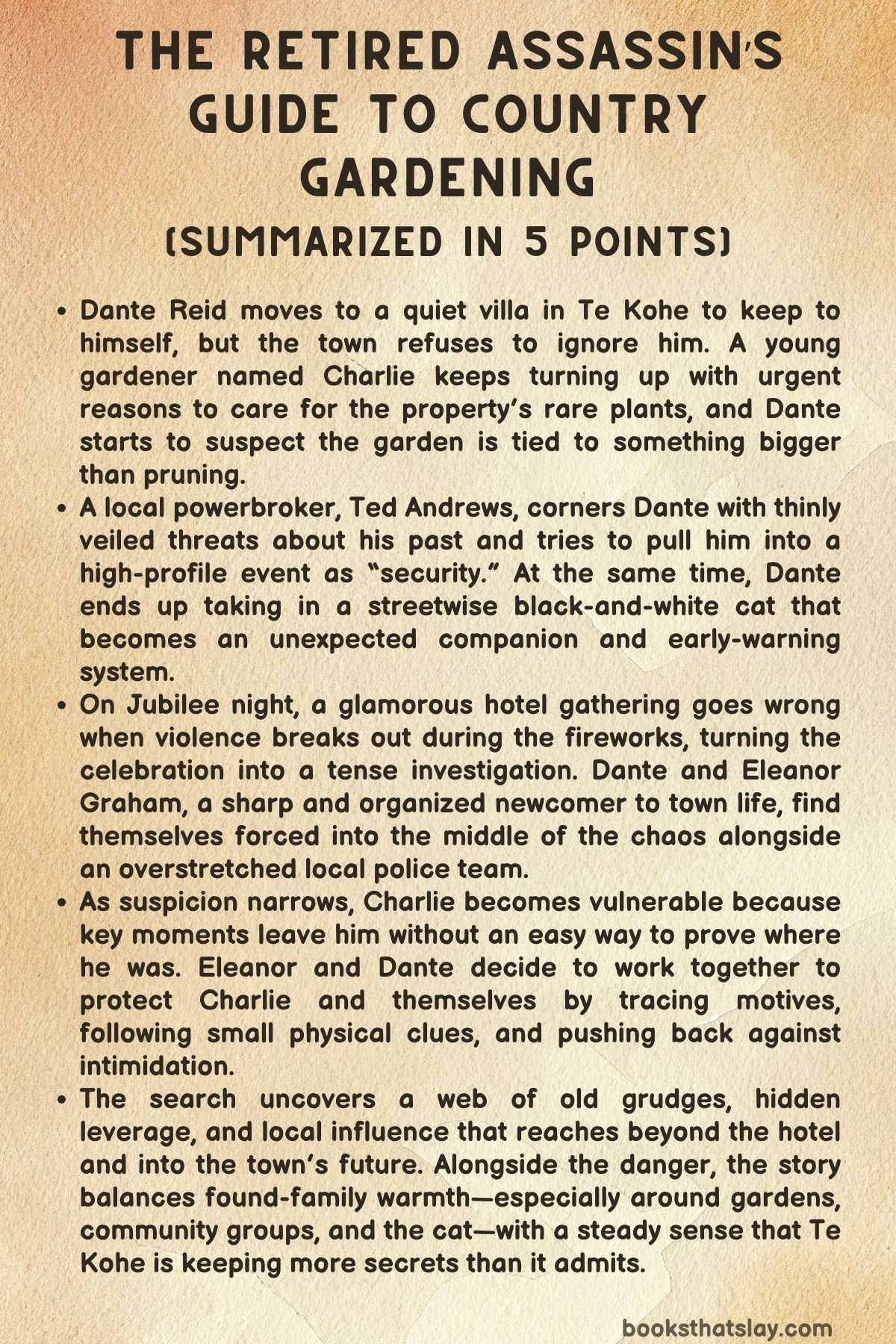
The Retired Assassin’s Guide to Country Gardening by Naomi Kuttner is a cozy-but-sharp mystery with an unusual pairing at its center: Dante Reid, a retired professional killer who wants nothing more than quiet, and Charlie Wilson, a young gardener with an unsettling gift for seeing ghosts.
Dante’s new life in a seaside New Zealand town is immediately disrupted by nosy locals, a rare corpse flower in his glasshouse, and a wealthy bully who tries to drag him back into “security work.” When a public celebration ends in gunfire and a death, Dante and Charlie are pushed into an investigation where the garden, the dead, and the living all have secrets.
Summary
Dante Reid arrives in the small coastal town of Te Kohe looking for anonymity and silence. He has bought a big, aging villa with high hedges and plenty of room to keep people at a distance.
The town does not cooperate. Neighbors are eager to welcome him, strangers think they’re entitled to conversation, and Dante’s instinct to assess threats never fully switches off.
He tries to settle into a routine anyway—careful, solitary, and controlled—until his watch alerts him to movement on his property.
A young man appears at his door early one morning. Dante, wary, arms himself while he answers.
The visitor is Charlie Wilson, the longtime gardener for the home’s previous owner. Charlie is polite but unusually intense.
He insists the grounds require regular maintenance, especially the glasshouse, which contains rare plants. The most important is an enormous corpse flower tuber that could sprout and bloom soon, drawing crowds from every plant society in the region.
Dante wants no visitors, no events, and no obligations, but Charlie presses hard, even offering to work for free. Dante finally agrees to weekly visits—Fridays only—because he refuses to compromise a private Thursday commitment.
Charlie’s concern isn’t only botanical. He asks Dante a strange question about justice: what should happen if someone did something terrible long ago but can’t be proven guilty now?
Dante answers in the way he lives—proof matters, evidence matters, and without it, accusations are just noise. After Charlie leaves, it becomes clear he experiences the town differently than Dante does.
Charlie can see ghosts, speak with them, and sense when something is about to happen by the way spirits gather and watch.
Dante’s attempt to keep his head down fails again when he goes for breakfast at the Pepper Tree Hotel. Ted Andrews, a slick local powerbroker, inserts himself into Dante’s space like he owns it.
Ted brags that he has contacts and has looked into Dante’s past, implying he can poison the town against him with rumors. Ted then tries to hire Dante as security for a major Jubilee night party at the hotel.
Dante refuses, repeating that he is retired. Ted doesn’t take no for an answer.
A handwritten note appears at Dante’s home, repeating the offer and making the threat explicit: cooperate, or Ted will make sure Te Kohe starts asking questions Dante can’t afford.
Around the same time, a black-and-white cat slips into Dante’s house and refuses to leave. Dante tries to hold his boundaries, but the cat is persistent and oddly fearless.
What begins as irritation turns into reluctant care. The cat becomes a quiet companion in a house Dante intended to keep empty.
Jubilee night arrives with fireworks, formalwear, and Ted’s showy performance of wealth and influence. Dante attends as security, not because he wants to, but because Ted has backed him into a corner.
The guest list includes investors, local officials, and Ted’s close associate Janice Enderby, a sharp, legally connected woman with a talent for cruelty. Eleanor Graham is also present—an elegant older American who is new in town but carries herself like someone used to running complicated rooms.
During dinner, tensions flare between Ted and a wealthy investor named Noah. Ted proposes a wager using a shell game, turning the dining room into his personal stage.
Noah is baited, embarrassed, and maneuvered into losing an expensive watch. The moment reads as entertainment to the guests, but Dante notices how Ted likes control and how he punishes people in public.
When everyone moves to the balcony for the fireworks, the celebration fractures. A loud bang cuts through the end of the show, and Ted shouts that he’s been shot.
Panic takes over. Dante reacts fast, pulling Ted inside and scanning for danger.
In the confusion, Eleanor notices Janice slumped and still. Janice has been shot in the head and is dead.
Ted’s wound is a superficial graze, but the situation has become a murder scene, and the shooter has vanished into the night.
Only one local officer, Rosie Kimble, is on hand at first. Eleanor steps into the vacuum and organizes the chaos: she lines guests up for details, gets doors secured, and tries to keep people from contaminating evidence.
Dante examines the space and finds a broken window in a small pantry overlooking the balcony—an apparent firing point. Soon Sergeant Hemi arrives, irritated and overstretched, and the guests are released after giving contact information.
Instead of leaving, many hover to drink, gossip, and build theories. Dante watches how quickly a small town can turn a tragedy into a social event.
Afterward, Ted berates Dante for failing to stop the attack and says he won’t pay. Dante insists on his fee and an extra charge for being dragged into a murder investigation.
Ted refuses further protection, retreats into his fortified estate, and leaves in his large vehicle with a driver. Eleanor, unsettled, senses that assumptions are forming too quickly—especially Ted’s insistence that the shot was meant for him.
The next morning, Charlie’s world tightens. A ghost—his deceased godfather, Pete Morrow—warns him the police will suspect him.
Charlie lacks a solid alibi for the critical minutes during the fireworks and has a history of friction with Ted. Charlie’s nervous habit of speaking aloud to spirits makes him seem unstable to anyone who can’t see what he sees.
Eleanor meets Charlie through the town’s flower arranging circle and quickly realizes he is in real danger of becoming the convenient suspect.
Eleanor visits Dante with cheesecake and blunt logic: only two people currently lack clear alibis—Dante and Charlie. Clearing Charlie will clear Dante, and if the police lock onto Charlie, Ted’s influence could cement the outcome.
Dante doesn’t want involvement, but he recognizes the trap. If he does nothing, the town will crawl into his life anyway.
He agrees to help Eleanor investigate, partly because she offers a future favor and partly because his sense of control is already slipping.
Eleanor, acting on instinct and experience, slips into the Pepper Tree’s back areas and searches the pantry where the shot may have come from. She finds a hidden bullet lodged in the wall—evidence the police may have missed or dismissed.
Inspector Avery, a homicide detective brought in from Auckland, catches her in the act and threatens charges for tampering. He throws her out and warns her not to interfere again.
Eleanor leaves angry but energized; she now knows the case is sloppy in places, and she plans to exploit that.
Dante and Eleanor begin mapping motives and opportunities. Rumors in town suggest Charlie might have snapped because Janice once spread nasty stories about Charlie’s father after his death.
Another theory points to Ted’s enemies, including a gang figure. Dante rejects the idea of a random, untrained killer choosing such a public moment.
The timing during fireworks and the location suggest planning, not impulse.
Dante’s private life reveals another layer: he attends an online Assassins Anonymous meeting. He has been “homicide-free” for 104 days and clings to a strict vow not to kill again.
He admits he feels tested by current events, but the group’s rules are clear—no killing, no arranging killing, no exceptions. Dante ends the call determined to solve the case without breaking his promise, even if violence tries to pull him back.
Charlie’s police interview goes poorly. Under pressure, he comes across as evasive and strange, especially when he struggles to explain gaps in his timeline without mentioning ghosts.
Eleanor takes him for ice cream afterward and forces him to recount every question and every mistake. Then Charlie admits the truth: he can see the dead, and on Jubilee night he saw his father’s ghost.
The ghost showed a fatal injury—evidence of murder, not accident. Charlie believes Ted killed his father ten years earlier and is now trying to frame him, possibly because Charlie is nearing his twenty-first birthday and something important may be triggered by that milestone.
Eleanor doesn’t claim to accept the supernatural as fact, but she believes Charlie believes it—and she trusts his character. Charlie also tells her a ghost lingers in Eleanor’s house, and that cats can act as early warning systems for restless spirits.
Eleanor files the information away without ridicule, treating it as one more strange detail in a town already full of them.
Ted escalates. He phones Eleanor to threaten her directly, boasting he has researched her history and can harm her through local politics.
He claims he can evict her flower arranging group by raising rent and can push a road change that would cut through her neighborhood, including her home. He offers a deal: stop investigating, and he will spare her.
Eleanor pretends fear to keep him talking, then decides the threat proves she is close to something real.
Eleanor and Dante confront the town’s law office and learn more about Charlie’s father, Adrian Wilson. Adrian co-owned the Pepper Tree with Ted.
After Adrian disappeared, Ted ended up with Adrian’s shares, not Adrian’s wife Delia—an outcome that looks suspicious. Eleanor pressures the lawyer, Leonard Finch, until he admits the will could have been swapped and that Janice benefited around that time, including a sudden upgrade in lifestyle.
Eleanor concludes Janice likely helped Ted steal the hotel, then later used her knowledge as leverage. She suspects Janice had planned to send Charlie a package containing proof.
They next focus on Sione, the hotel’s sous chef, who sent Charlie away to fetch port during the fireworks. Inspector Avery blocks Eleanor at first, then grudgingly allows her to sit in as support if she stays quiet.
Eleanor doesn’t stay quiet for long. She challenges Sione’s account until he breaks.
Sione admits Ted had blackmailed him over stolen wine he sold to pay for medicine for his child. Under threat, Sione was ordered to send Charlie away at exactly the wrong time, creating the gap that now makes Charlie look guilty.
Avery promises confidentiality unless the admission becomes necessary in court.
Eleanor tries a different tactic with Avery: she invites him to the bowling alley and turns cooperation into a contest. The match ends without a clear winner, but Dante steps in and bowls with startling skill, forcing Avery into a bargain.
Avery reveals the key forensic link: the bullet that killed Janice matches the bullet Eleanor found lodged in the pantry wall. The evidence supports a single weapon and a deliberate firing position, tightening the timeline and pointing away from a chaotic accident.
That night, Charlie’s home is attacked. Someone picks the lock, forces the door, and chases him into the dark.
Charlie escapes and calls emergency services, then runs to Dante’s villa for safety. The attackers set a fire in Charlie’s kitchen, causing major smoke damage.
Dante investigates and notes details: heavy work boots and two motorcycles—signs of hired men. Charlie stays at Dante’s home, shaken and exhausted, while ghosts gather around him in the unfamiliar space.
The threat convinces Dante that Ted is no longer playing political games; he is sending muscle. Dante and Charlie conclude the attacker’s goal was intimidation or elimination, and that Ted likely wants any incriminating evidence intercepted before it reaches Charlie.
Eleanor calls, and the three move from investigation to confrontation.
Dante and Charlie break into Ted’s mansion, which is filled with smoke and armed security. Dante fights with methodical precision, disarming and binding guards without killing them.
Charlie, guided by Pete’s ghost, navigates corridors and avoids gunfire. In a surveillance room, Charlie spots the object they believe holds answers: a metal sea chest from his childhood, hidden in storage.
They realize police are on the way due to shots fired, and Pete urges them to let authorities find the evidence. Charlie fears Ted will move it again.
They retreat to regroup, knowing time is short.
They encounter Viktor, a hired enforcer, sitting calmly with Dante’s cat. Viktor announces he wants out—Ted isn’t paying enough for the chaos—and he has already called the police.
He returns the cat without a fight and lets Dante leave. Before fleeing, Dante sabotages Ted’s escape routes by sending Ted’s vehicle crashing through the estate gates, leaving them broken and open for police.
When Eleanor hears from Avery, the immediate win collapses: the sea chest at Ted’s mansion is empty. Ted has anticipated searches and moved the real evidence.
Then a new emergency hits—Ted has secured approval to bulldoze Eleanor’s row of houses immediately and has begun digging. Eleanor believes Ted intends to bury Adrian’s remains beneath the construction and erase them forever.
Eleanor, Dante, and Charlie rush to the demolition site. Ted stands there like a man certain he owns the future.
Eleanor rallies neighbors and supporters, calls Avery, and declares she can explain both murders. She confronts Ted publicly with a reconstructed sequence: Ted engineered the night to frame Charlie.
He arranged for Charlie to be missing at the key moment, staged a superficial injury to himself, and used the fireworks to mask the real shot that killed Janice. He then created noise and confusion to distort the timeline and push suspicion toward Charlie, all while aiming to seize or destroy any proof Janice planned to send.
Eleanor searches Ted’s truck and finds cement bags, a crude memorial statue, and a duct-taped sandbag. She cuts the bag open—only sand.
Watching Ted’s reaction, she realizes the statue is the true hiding place. She orders people back and topples it.
The statue shatters, spilling human bones mixed with sand. Police arrive, seize the scene, and arrest Ted.
Under pressure and fear, Ted blurts a confession: he killed Adrian and Janice and wants “her” away—suggesting he is haunted by more than legal consequences.
After Ted’s arrest, Charlie and Pete go to the cemetery, where Pete finally remembers how he died. Pete explains Adrian created a trust to protect Delia and Charlie from Ted’s forged will, naming Pete as executor.
Ted poisoned Pete and tried to force him to reveal the trust deed’s location. Pete refused and died for it.
Pete then remembers where he hid his copy: buried in a tin beneath the corpse flower pot in Dante’s greenhouse. Charlie digs it up and finds the deed and a DVD message from Adrian.
With the deed recovered, the legal truth catches up to Ted. Avery confirms Janice’s package was found in Ted’s safe, containing proof that Adrian’s half of the hotel belongs to Delia and Charlie.
Charlie watches the DVD and hears his father’s love, his plans, and his reassurance that Charlie’s ability to see ghosts is real. Adrian’s ghost appears briefly, speaks to Charlie, urges him to live fully, and then fades, leaving Charlie with grief, relief, and a sense of permission to move forward.
Weeks later, life in Te Kohe shifts again as the corpse flower in Dante’s glasshouse finally begins to bloom. The event draws the exact attention Dante feared.
Eleanor organizes a controlled visiting afternoon for local plant societies, managing crowds and tea service with military efficiency. Dante endures the social invasion with help from Eleanor and Charlie, surprised to find that the town’s curiosity feels less threatening now that he has allies.
The bloom is massive and foul-smelling, and the community treats it like a rare festival.
As the greenhouse warms and the plant releases pollen, two older ghosts observe and warn that something new is approaching—something Charlie has not yet recognized. Dante remains committed to his vow, Charlie remains caught between worlds, and Eleanor remains alert to the way power tries to return in different forms.
The murders are solved, Ted is exposed, and Te Kohe settles—at least for now—under the watchful eyes of the living and the dead.
Characters
Dante Reid
Dante is the story’s guarded center: a retired professional killer who moved to Te Kohe to disappear into quiet routines, yet carries his old reflexes like a second skin. From the opening scene—cleaning a disassembled Glock, reacting to a yard alert, answering the door armed—he reads the world as threat-first, which makes the town’s friendliness feel like a kind of surveillance.
In The Retired Assassin’s Guide to Country Gardening, Dante’s “retirement” is less about becoming harmless and more about choosing restraint every day, and that restraint becomes his defining moral struggle once a murder drags him back toward violence. His Assassins Anonymous commitment gives him an explicit code—no killing, no arranging kills—and the plot keeps tightening pressure around that vow, forcing him to solve problems with strategy, intimidation, and skill rather than execution.
Beneath the hyper-competence, Dante’s loneliness is obvious: he wants privacy but also quietly needs connection, which is why the cat’s intrusion matters and why Charlie’s earnest presence disarms him. By the end, Dante’s arc isn’t about reclaiming his past power; it’s about proving to himself that he can still be effective without becoming who he used to be, even as Te Kohe keeps testing the boundaries of his new life.
Charlie Wilson
Charlie appears at first as an overly eager gardener, but he quickly becomes the emotional heartbeat of the book: sincere, anxious, and unexpectedly brave. He is young—still forming his adult identity—and that makes him vulnerable to manipulation by older, more entrenched figures in town, especially once the murder investigation needs an easy suspect.
Charlie’s intensity about the garden is not just horticultural passion; it reads like a mixture of duty to the late owner, protective stewardship over rare plants, and a desperate need for stability in a life marked by unresolved grief. His ability to see ghosts is the story’s most intimate kind of sensitivity: it makes him a bridge between the living and the dead, but it also isolates him, because stress makes him talk to people no one else can see and invites suspicion.
In the book, Charlie’s gift functions like both a compass and a burden—he gains insight into truths people hide, yet he cannot always prove what he knows, which mirrors the book’s recurring theme that justice requires evidence. His growth is steady: he begins reactive and fearful of authority, then learns to accept support, set boundaries, and take action under pressure, as seen when he fights back during the break-in and later contributes meaningfully in the manor confrontation.
Charlie’s final release comes not through revenge but through confirmation—his father’s message, the trust deed, and a brief farewell—that lets him move forward without being anchored solely to loss.
Eleanor Graham
Eleanor is competence wrapped in charm: an elegant older American woman who enters as a potential organizer for a future corpse-flower crowd and rapidly reveals herself as the book’s sharpest strategist. She reads people quickly, refuses to be pushed around by status, and steps into leadership the moment the shooting shatters Jubilee night.
Her power isn’t physical; it’s social intelligence, procedural instinct, and a willingness to do what others hesitate to do—ask hard questions, confront respected locals, and keep moving when authority stalls. In the story, Eleanor’s investigative style is both pragmatic and theatrical: she can soothe a room into cooperation, then pivot into pressure, and finally into performance when she needs the truth to land publicly.
That public performance is not vanity; it is a tool she uses because she understands community dynamics—if the town is a stage, she will control the spotlight rather than let Ted’s rumors decide the script. Eleanor is also emotionally grounded: she believes Charlie in a human sense even when she cannot accept his ghost-sight literally, and she recognizes Dante’s guardedness without trying to pry it open.
Her stake becomes deeply personal once Ted threatens her home and her community, turning her from concerned citizen to determined opponent; yet she remains principled in her end goal, aiming to expose the truth through proof and process rather than vigilantism.
Ted Andrews
Ted is the novel’s central human predator: a polished local powerbroker who treats Te Kohe as a private empire and other people as assets to control. He weaponizes gossip, status, and legal leverage the way an assassin might weaponize a blade, and his first real interaction with Dante is an attempted recruitment through coercion—“work for me or I will make your life unbearable.” That pattern defines him: he rarely persuades, he pressures; he rarely negotiates, he extorts.
Ted’s villainy is not theatrical cruelty but calculated entitlement, and that makes him more believable and more dangerous because he hides behind civic language—development, investment, community benefit—while committing deeply personal harms. His shell-game scene is a condensed portrait of him: he creates a rigged system, invites public participation, then takes what he wants while calling it sport, and the same logic later appears in his broader “shell game” with evidence and misdirection.
Ted’s escalation—from rumor threats to intimidation, arson, and ultimately murder—shows a man who cannot tolerate losing control, especially as the past catches up to him. His unraveling at the end, panicked and haunted, underlines a final irony: the figure who tried to control every narrative is undone by a truth that can no longer be contained, and by fear that slips past his carefully built walls.
Janice Enderby
Janice is defined less by page-time than by the consequences of her absence, and the story uses that to make her death feel like a key turning point rather than a simple plot device. She is portrayed as sharp-tongued, legally connected, and opportunistic—someone who moved close to power and profited from it—yet she is also the person whose murder exposes the rot under Te Kohe’s glossy façade.
Janice functions as both collaborator and potential threat: she likely helped Ted consolidate stolen control years earlier, then later positioned herself to benefit again, possibly through blackmail, which turns her into someone Ted cannot safely keep around. Her rumored cruelty toward Charlie’s family gives the town a simplistic story of motive, making it easy for suspicion to fall on Charlie, and that is precisely what makes her character important—she becomes the “convenient reason” other people use to avoid looking upward at Ted.
Even in death, Janice retains agency through what she intended to send: the incriminating package represents her attempt to finally convert private leverage into an outcome, whether out of conscience, revenge, or self-protection. Her ghost’s delayed anchoring also reinforces the book’s idea that some truths resist immediate clarity, and that the dead, like evidence, can take time to surface.
Delia Wilson
Delia is quiet resilience: a woman who has endured a decade of unresolved loss and institutional dismissal without getting the closure she deserved. She is not positioned as a detective or fighter in the same way Eleanor is, but her presence supplies the emotional reality behind the conspiracy: Adrian’s death did not just shift property shares, it hollowed out a family.
In The Retired Assassin’s Guide to Country Gardening, Delia’s situation highlights how “legitimate” systems—wills, witnesses, business arrangements—can be manipulated to dispossess someone who lacks influence, especially in a small town where powerful men and compliant professionals form informal alliances. Her concern for Charlie is protective and practical, and the way others discuss her shock at the will reading shows how completely she was sidelined in a moment that should have safeguarded her.
Delia’s eventual restoration—through the trust deed and the recovery of truth—feels less like winning and more like finally being allowed to stand on ground that was always meant to be hers.
Pete Morrow
Pete is both comic friction and moral urgency: the ghostly godfather who intrudes into Charlie’s day-to-day life with blunt warnings and emotional pressure. Unlike many “mentor” figures, Pete is complicated by death; he cannot act directly in the world, but he can push Charlie to act, and his advice is shaped by guilt, loyalty, and unfinished responsibility.
Pete represents the cost of Ted’s long-term corruption—he is not collateral damage from a single bad night, but the result of systematic coercion that reaches into family structures and legacies. His gradual recovery of memory gives him an arc that parallels the investigation: fragmented facts become coherent, and coherence becomes liberating.
When Pete remembers how he died and why he refused to give up the deed’s location, he becomes a figure of integrity—someone who chose sacrifice over complicity. His final peace is not sentimental; it is earned through the restoration of the trust’s purpose and the completion of his duty to protect Charlie and Delia.
Inspector Avery
Avery is the story’s embodiment of institutional friction: capable, skeptical, and intensely protective of procedure, especially once civilians start poking at evidence. He reads Eleanor as interference and Charlie as a likely suspect, and he uses pressure tactics that feel harsh but realistic for someone trying to control a volatile investigation.
Avery’s role is not to be an antagonist in the moral sense but to raise the cost of amateur sleuthing, forcing Eleanor and Dante to be smarter about how they move. He is also a measuring stick: when he concedes something—like ballistics linking the bullets—it signals genuine progress rather than wishful thinking.
Avery’s eventual cooperation is incremental and conditional, which makes it believable; he is persuaded by facts, not charm, and his grudging respect lands because it has to be earned.
Constable Rosemary “Rosie” Kimble
Rosie is the conscience and the human face of local law enforcement: present at the moment of crisis, trying to do her job in a situation that outstrips her authority and resources. She follows procedure, takes statements, and stays steady while more powerful personalities compete to control the narrative.
Rosie’s importance is subtle: she shows how precarious justice can be in a small town when the “machine” is thin—one constable on scene, a superior distracted, and a community eager to gossip instead of cooperate. Her willingness to work with Eleanor’s organizing instincts, even when Eleanor is not an officer, suggests Rosie values outcomes and calm over ego.
Sergeant Hemi
Hemi represents the limitations of local policing under pressure: he arrives late, irritated, and focused on crowd control rather than nuance, partly because he is juggling multiple problems at once. His handling of the aftermath—letting guests linger, shifting responsibility to the maître d’, moving upstairs—creates the kind of procedural looseness that allows rumors to flourish and evidence to feel precarious.
Hemi is not corrupt; he is overextended and perhaps too accustomed to small-town incidents, which makes a high-stakes case like this one difficult to contain. He becomes the backdrop against which Avery’s sharper, more disciplined approach stands out, reinforcing the story’s tension between local familiarity and external scrutiny.
Viktor
Viktor is the professional violence Dante refuses to be: a hired enforcer who treats danger as a job and loyalty as a fee-based contract. His presence raises the threat level from small-town intrigue to something closer to Dante’s former world, and he functions as a mirror that reflects what Dante might become again if he lets circumstances rewrite his ethics.
Viktor’s brief truce and his decision to call the police show a pragmatic self-interest rather than virtue—he is not sentimental, just finished with a bad employer. That nuance keeps him from being a cartoon villain; he is a mercenary operating on incentives, and the moment he returns Dante’s cat without conflict underscores that his violence is transactional, not personal.
Adrian Wilson
Adrian’s physical absence is the story’s long shadow, shaping motivations a decade later. He is remembered as a father and partner whose death was never properly resolved, which makes him both victim and catalyst: the missing body and the suspicious transfer of shares create the vacuum Ted exploited.
Adrian’s deliberate creation of a trust and a recorded message reveals a man who anticipated risk and tried to protect his family beyond his lifetime. His brief appearance as a ghost near the end is less about spectacle and more about confirmation—Charlie is not delusional, and Adrian’s love and planning were real.
That validation closes a psychological loop for Charlie while also reframing the “mystery” as not merely who killed Adrian, but how far someone went to erase him.
Grace
Grace functions as Eleanor’s grounded sounding board: a friend embedded in town life who tracks the investigation’s mood and the police’s progress without being consumed by it. Her presence at the flower arranging club scenes reinforces the book’s social ecosystem, where communal hobbies become information networks and emotional support systems.
Grace helps show why Eleanor is effective: she is not operating alone, but within a web of relationships that can spread warnings, gather observations, and keep vulnerable people like Charlie from being isolated.
Billy
Billy is the blunt truth-teller of the friend group, the one willing to ask the uncomfortable question—did Charlie do it—because saying the fear aloud can sometimes defuse it. That bluntness can sting, but it also clarifies stakes and exposes how quickly suspicion can harden into assumption.
Billy’s role underscores a core theme: in tight communities, narratives form fast, and the line between concern and accusation is thin. Billy also highlights Charlie’s vulnerability—how easily he can be cornered by other people’s certainty—making Eleanor’s protective advocacy feel more necessary.
Leonard Finch
Leonard embodies the fragile hinge between legality and morality: a lawyer whose role should guarantee integrity, yet whose past instability and compromised confidence make him susceptible to pressure and hindsight doubt. His account of Adrian’s will and the suspicious shift of shares suggests either negligence or manipulation, and the fact that he cannot firmly swear to legitimacy becomes a crack Eleanor can widen.
Leonard represents how “paper truth” can be engineered, and how the people tasked with safeguarding it may be the easiest to destabilize. He is not portrayed as a mastermind, but as someone who benefited from looking away—or at least from not looking too closely—until the past became dangerous.
Sione
Sione is the moral turning point among the coerced: a man cornered by desperation, who made one wrong choice for understandable reasons and then got trapped by Ted’s leverage. His theft to pay for medicine humanizes him immediately, and his later lie about Charlie’s movements shows how quickly survival choices can become tools in someone else’s plot.
Sione’s confession matters because it supplies a concrete mechanism for framing Charlie, turning vague suspicion into an intentional strategy. He also illustrates Eleanor’s approach at its best: she doesn’t just accuse; she finds the pressure point that lets truth emerge, then pushes for accountability without needless cruelty.
Mr Whittaker
Whittaker is the self-important civic voice who confuses status with credibility and wants his “pillar of the community” label recorded like evidence. His instinct to blame an underpaid staff member without proof exposes the class reflex that makes scapegoating easy and justice harder.
Whittaker’s brief appearance is a sharp snapshot of how towns protect their powerful by redirecting suspicion toward the convenient and the vulnerable, reinforcing why Eleanor’s insistence on facts is so important.
Bernard
Bernard acts as the town’s rumor conduit: well-meaning but quick to narrativize, offering theories that reflect local grudges and folklore more than proof. He introduces alternative suspects and motives in a way that shows how communities metabolize crisis—by telling stories fast enough to soothe uncertainty.
Bernard’s presence helps define the investigative environment Eleanor and Dante must work in: a place where gossip is a force as real as evidence, and where shaping perception can be nearly as consequential as uncovering truth.
Mrs Davison
Mrs Davison is the absent owner who still governs the plot through what she left behind: the villa, the rare garden, and particularly the corpse flower that becomes both a social magnet and a symbol of unavoidable attention. Her lasting influence is also literal, as her ghost appears later, suggesting that the house and garden retain memory and intention.
She represents the idea that stewardship persists beyond death, and that certain legacies—like rare plants or buried documents—continue to shape the living.
Charlotte Evans
Charlotte Evans appears as one of the older ghosts who observe and warn, positioning her as part of the story’s wider spiritual ecology. Where Pete is personal and urgent, Charlotte feels more like a guardian presence, someone who understands patterns in the town’s unseen currents.
Her watchfulness and final warning help frame the ending not as total closure but as a pause between storms: Te Kohe has dealt with one buried truth, yet the environment—both social and supernatural—suggests more is coming, and Charlie’s role in that future remains unresolved.
Themes
Reinvention under unwanted attention
Dante arrives in Te Kohe with a clear goal: become unremarkable, stay private, and keep the past from catching up. That hope collapses almost immediately, not because he is careless, but because the town’s social ecosystem is built around noticing newcomers and pulling them into community routines.
His villa, meant to be a barrier, becomes a stage where people appear at the door with expectations—Charlie with gardening schedules, Ted with coercive “requests,” and eventually police with questions. What makes this pressure sharp is that Dante’s desire for quiet is not simple introversion; it is self-protection shaped by a violent career and a vow that demands constant self-control.
Each intrusion forces him to practice a new kind of discipline: restraint rather than dominance, negotiation rather than threat, and patience rather than pre-emption. Even when he arms himself on instinct, he keeps choosing not to escalate, which shows that “retired” is not a switch but a daily decision.
The town also becomes a mirror that reflects the limits of reinvention. Ted can pull strings and hint at London contacts, reminding Dante that reputations travel and that secrecy is fragile.
Meanwhile, Dante’s home is not a clean slate: hidden weapons, reflexive risk calculations, and a weekly Assassins Anonymous meeting reveal a life still structured around harm, even when he refuses to commit it. The theme gains depth because Dante’s reinvention is not presented as a pure moral makeover; he still uses intimidation, strategic force, and break-ins when the situation demands it.
The story tests whether someone can change while keeping the skills that once made them dangerous. By the time the crisis peaks, Dante is not “peaceful” in the conventional sense, but he is governed by a chosen boundary—no killing—and that boundary becomes his new identity.
Te Kohe does not allow him to disappear, yet it also forces him to practice being a person among people, which is the kind of reinvention he did not know he needed.
Power, coercion, and the price of silence
Ted Andrews represents the everyday face of control: not a shadowy mastermind, but a man who understands how to weaponize social standing, property, and paperwork. His leverage is rarely physical at first.
He uses gossip as a threat, reputation as currency, and the fear of being watched as a collar around Dante’s neck. The coercion works because it is plausible; in a small town, rumours can function like law, reshaping who gets trusted, who gets hired, and who gets left alone.
Ted’s “party security” offer is structured like a favour, but it carries the logic of blackmail. Once Dante accepts the premise that Ted can define his public image, Dante’s retirement becomes conditional on Ted’s approval.
That dynamic shows how power often operates: not by constant force, but by making resistance feel more costly than compliance.
The same pattern spreads outward. Ted squeezes Sione through a private weakness and turns him into a tool for manufacturing Charlie’s lack of alibi.
Ted threatens Eleanor through rent and urban planning, turning civic infrastructure into a weapon. Even Janice’s role fits this theme: she benefits from the will change, then later appears positioned to exploit Ted with knowledge, suggesting a chain where corruption creates mutual hostage-taking.
Silence becomes the commodity everyone is pressured to sell. Sione is pushed to lie; townspeople are pushed to speculate; Dante is pushed to “keep the peace” by submitting; Eleanor is pushed to stop asking questions.
The story makes coercion feel systemic rather than personal, because the town’s institutions—council decisions, legal offices, policing constraints, social clubs—can be bent by someone who knows where the seams are.
What finally breaks Ted is not simply exposure, but the collapse of his controlled narrative. Eleanor’s public reconstruction at the demolition site is a direct attack on the social spell he casts.
She forces the truth into a space where it cannot be privately managed, bribed, or dismissed as gossip. The crowd becomes a counterweight to Ted’s influence, showing that communal attention can be used against a bully as effectively as it can be used to isolate a newcomer.
This theme insists that power thrives when people are afraid to speak, and it weakens when silence becomes more uncomfortable than confrontation. By the end, Ted’s threats lose value because the community sees the pattern behind them, and that recognition is more damaging than any single piece of evidence.
Evidence, truth, and the ethics of certainty
The plot keeps returning to a difficult question: what should be done when someone is believed to have committed a serious wrong, but proof is missing or contested? Charlie asks Dante this early, and the question becomes a moral anchor for the entire investigation.
Dante’s answer—evidence is needed—sounds straightforward, yet the story shows how complicated it becomes when the people involved are frightened, manipulated, or dismissed. Charlie believes Ted killed his father because he sees his father’s ghost with a clear sign of violence.
Eleanor cannot accept the claim literally, but she accepts Charlie’s sincerity and treats the information as a lead rather than a verdict. That stance matters.
It draws a line between believing a person and declaring a case solved, and it protects Charlie from being reduced to “the weird kid who talks to himself” when the police and townspeople are looking for an easy narrative.
This theme also plays out through the tension between official procedure and private action. Eleanor’s discovery of the bullet lodged in the pantry wall is a turning point, but it comes through conduct that risks undermining the investigation.
Inspector Avery’s warning about tampering is not merely bureaucratic scolding; it highlights a real dilemma: the urgent need to stop a powerful suspect can push good people into shortcuts that threaten the integrity of proof. The story does not treat evidence as a simple scavenger hunt.
Evidence has rules, custody, and consequences, and those constraints exist to prevent the very kind of manipulation Ted relies on. Yet the story also acknowledges that institutions can be slow, distracted, or compromised, which tempts outsiders to step in.
Dante’s personal code intensifies this theme. He is capable of solving problems the fastest way, and the fastest way would often involve killing or arranging a killing.
The Assassins Anonymous meeting makes the moral stakes explicit: certainty is never an excuse to execute someone. Even if Dante feels sure Ted is guilty, his vow demands a different route—exposure and proof, not elimination.
The final unmasking succeeds through a blend of forensic linkage (matching bullets), coerced testimony reclaimed (Sione admitting Ted’s threats), and physical discovery (bones hidden inside the statue). The story argues that truth becomes socially real when it is supported by evidence that can withstand challenge, not just by conviction or supernatural insight.
That is why the ending feels like accountability rather than revenge: Ted is not removed by violence; he is cornered by proof he cannot talk his way around.
Friendship, community, and chosen responsibility
The relationships in Te Kohe are not sentimental extras; they function as a structure that either traps people in fear or helps them act with courage. Dante initially reads friendliness as intrusion, and in a narrow sense he is right—people do show up uninvited, ask questions, and assume access.
Yet over time, that same closeness becomes the reason Charlie is not destroyed by suspicion and intimidation. Eleanor chooses to protect Charlie not because it is convenient, but because she recognizes that the town’s reflex to gossip is turning into a weapon pointed at a young man with no social armour.
Her support is practical—attending interviews, steering him away from self-incrimination, pushing adults to take him seriously—yet it is also emotional, because believing him when others mock him gives him stability when his own confidence collapses.
Dante’s connection to Charlie and Eleanor also shifts his understanding of responsibility. At first, he tries to keep everything transactional: pay the gardener, refuse invitations, meet obligations only when forced.
The murder investigation breaks that posture. When the only people without alibis are Dante and Charlie, Dante could still walk away and let the system grind Charlie down.
He does not, and the reason is telling: clearing Charlie also clears Dante, but it also gives Dante a purpose that is not violence. The work becomes a replacement for the old job, with a different moral centre.
Even the cat plays into this theme as a quiet symbol of attachment. The animal ignores Dante’s boundaries, claims space, and turns his home into a shared place rather than a bunker.
It is difficult to remain a ghost of a man when something living insists on curling against your throat at night.
The community theme stays complicated. Te Kohe is capable of casual cruelty—public gossip in the café, assumptions about Charlie’s “oddness,” and the eagerness to pin blame on someone convenient.
But it is also capable of collective protection when Eleanor mobilizes people at the demolition site and turns individual fear into shared action. The controlled public viewing of the corpse flower at the end shows another side of community: ritualized togetherness that is annoying but harmless, a form of belonging Dante can endure because he is no longer alone in it.
Responsibility becomes chosen rather than imposed. Eleanor takes risks because she refuses to be bullied.
Charlie grows from anxious and isolated into someone who can act, fight back, and still stay kind. Dante becomes the person who protects without killing.
The theme suggests that community is not automatically good, but it can be shaped into something that supports truth and safety when people decide to show up for one another.
Death, haunting, and unfinished business
Ghosts in Retired Assassins Guide to Country Gardening are not a decorative supernatural element; they act as a system for showing how the past remains active until it is properly faced. Charlie’s ability to see and speak with the dead creates a parallel investigation that runs alongside the legal one.
His father’s appearance on Jubilee night is not random; it arrives when the stakes are highest and when Charlie is vulnerable to being framed. The ghost does not deliver a neat explanation, but he provides a truth that cannot be ignored: the death was violent.
That single image reframes a decade-old disappearance into a likely murder, pushing Eleanor to look for motive and paperwork, and pushing the story toward the forged will and the stolen hotel shares.
The haunting theme is also about communication limits. Ghosts are present, but they are not omniscient narrators who can solve everything.
Pete, for example, guides Charlie, warns him, and later remembers crucial details about his own death only when events force the memory loose. This makes the supernatural feel like a form of trauma memory rather than a magical shortcut.
The dead are stuck in patterns, partial recollections, and emotional urgency. Janice’s ghost is mentioned as not yet anchored enough to question, which reinforces that death does not instantly produce clarity.
Instead, the dead require time, attention, and the right conditions to speak. That approach keeps the focus on the living having to do real work: confronting threats, uncovering evidence, and persuading others.
The resolution of unfinished business is strikingly concrete. The hidden trust deed is not found through a vision; it is dug up from the greenhouse, beneath the corpse plant pot, exactly where a careful person would hide something from a predator like Ted.
Pete’s peace comes when he can finally explain what happened—poison, coercion, refusal, and sacrifice—and when Charlie retrieves the proof that protects Delia and himself. Adrian’s DVD message bridges worlds: a father leaving care and guidance, and also validating Charlie’s strange life as real.
The final brief appearance of Adrian’s ghost is less about shock and more about closure, an affirmation that love can persist even when life ends violently.
This theme connects back to Dante in a quieter way. Dante is haunted without ghosts.
His past threatens him through memory, habit, and the fear of breaking his vow. By placing a literal haunting beside Dante’s moral haunting, the story suggests that unresolved harm takes many forms.
Some of it lingers as spirits in hallways, and some of it lingers as a person’s reflex to reach for a gun. In both cases, release requires truth, accountability, and a decision to live differently.
The last warning from older ghosts that “something new is coming” keeps the theme open-ended: closure is possible for certain deaths, but the world does not stop producing unfinished business, and Charlie’s gift ensures he will keep encountering it.