First by Ali Hazelwood Summary, Characters and Themes
First by Ali Hazelwood is a sci-fi romance set in a drowned future where humanity survives in fortified underwater strongholds. Society is rigidly divided into Alphas, Betas, and Omegas, each shaped by biology, law, and expectation.
At the center stand General Gabriel Agard, a feared Alpha commander, and Sofia Kuznetsov, a rare “cold Omega” whose body has never followed the rules laid out for her. Their connection begins as a weapon in a political war but grows into something that challenges an entire power structure.
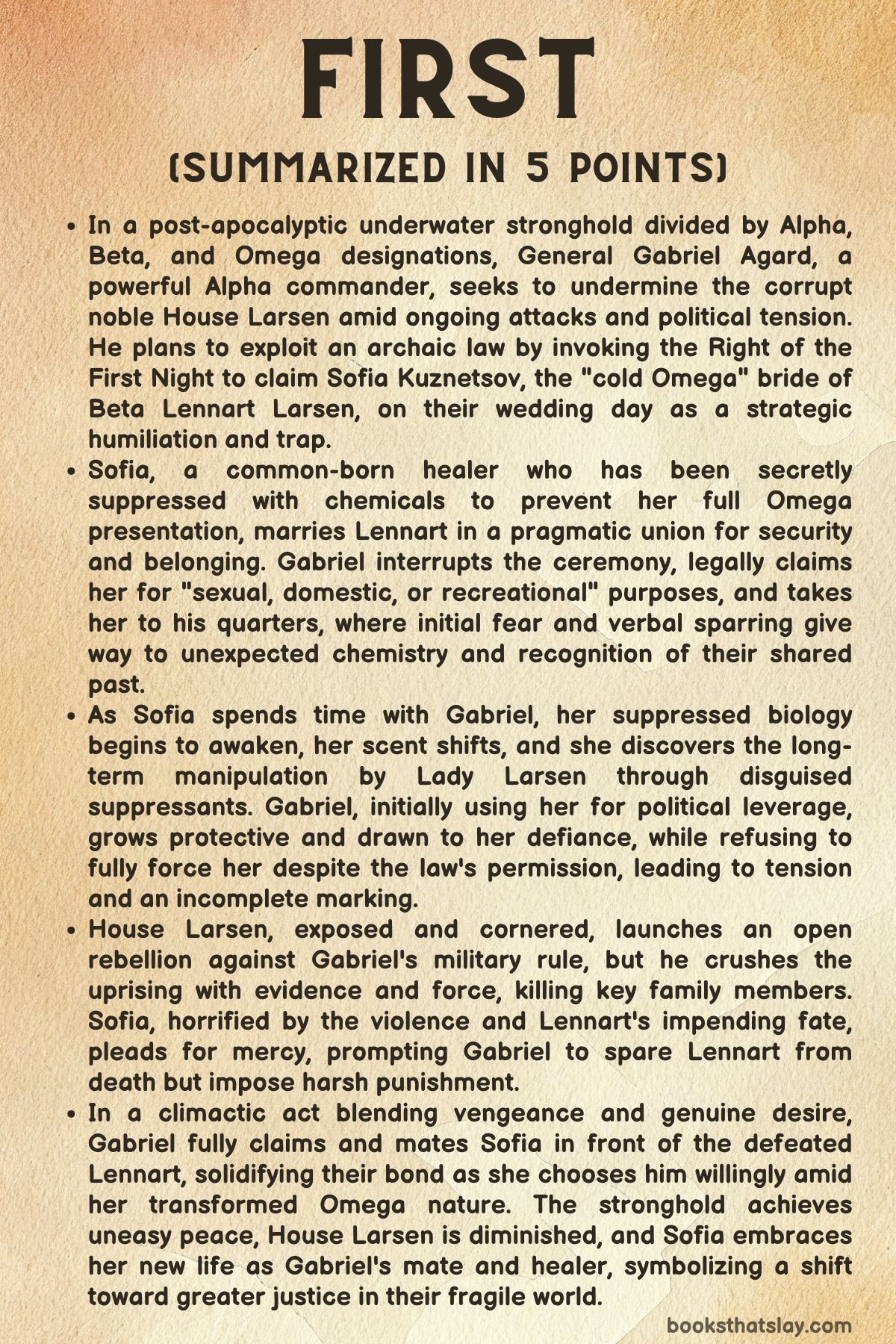
Summary
In a future where the oceans have swallowed the land, humanity shelters in submerged strongholds constantly threatened by pressure, flooding, and failing systems. People are born Alpha, Beta, or Omega, and those labels decide their roles.
Alphas dominate the military and security, Betas make up most of the population, and Omegas are rare and tightly controlled, prized for fertility and bonding. Against this backdrop, General Gabriel Agard commands the northern stronghold, protecting thousands while locked in a bitter political conflict with the noble House Larsen.
The story begins with an attack on Gabriel’s secure operations suite. A team of Alphas storms his command center, breaching high-level security with the severed head of a guard to fool retinal scans.
Gabriel and his officers — including Martia, his fierce second-in-command; Bastian, his seneschal; and his calculating brother Ivar — fight off the intruders. Clues on their armor and a mutilated tattoo suggest a connection to House Larsen, whose members already resent Gabriel for promoting common-born soldiers and challenging noble privilege.
With more than half a dozen strikes in a single year, Gabriel is convinced the Larsens are behind the escalating violence, but he lacks the proof to crush them openly.
Ivar proposes a more subtle attack: exploiting an ancient law during an upcoming marriage. Lennart Larsen, the youngest son of House Larsen and a Beta, is set to marry Sofia Kuznetsov, an Omega healer of common birth.
Sofia is what people call a “cold Omega” — her body never fully presented, meaning she does not experience heats or form the intense bonds expected of her designation. The Larsens have hidden this fact to avoid scandal.
Ivar believes that by invoking a long-forgotten statute at the wedding, they can pull House Larsen into a trap that is technically lawful.
Before the ceremony, the story follows Sofia in her daily life as a healer in the stronghold’s dim, pressurized corridors. Raised by a kind, principled engineer father, she works long hours caring for injured soldiers and technicians who keep the habitat functioning.
While patching up a wounded Alpha, Ulf, her scent briefly reveals her Omega status, reminding her of what she lacks: the full hormonal cycle that would make her desirable in the way society expects. An accidental blow from Ulf leaves her bruised just before her wedding.
Her friend Lara Larsen — Lennart’s sister — helps her prepare and worries about the growing conflict between her family and General Agard, who killed Lara’s brother Gustav after he harmed an Omega.
Sofia’s arrival in House Larsen’s luxurious quarters throws into relief the gap between her modest origins and noble comfort. Lady Larsen shows genuine warmth, covering Sofia’s bruise and helping her into a ceremonial gown made of white fabric and metal.
Sofia feels grateful for Lennart’s steady kindness; they are friends more than lovers, but she hopes their marriage will give her a place to belong. As they walk to the ceremony, word spreads that General Gabriel Agard is attending, to everyone’s unease.
Years earlier, Sofia treated his wounds as an apprentice healer, and his rough courtesy then left a quiet impression on her.
During the mating ceremony, Lennart vows devotion, and Sofia, veiled and barefoot as tradition dictates, steels herself for a life that is safe if not passionate. Then Gabriel steps forward.
In front of nobles, officers, and witnesses, he invokes the Right of the First Night, an archaic law granting the general the power to claim the mate of any noble on their wedding night for “sexual, domestic, or recreational” purposes. Refusal means death.
Gabriel’s real aim is to humiliate House Larsen and provoke rebellion under legal cover. Since Lennart’s family complies instead of resisting, Sofia is formally handed over to the man who is both her protector and her enemy.
In Gabriel’s quarters, Sofia expects brutality, but what follows is a strange, charged evening of verbal sparring. She is frightened but refuses to beg, studying the general and even joking about the “monster” in the room — which turns out to be his lynx, Alex.
Gabriel is thrown off balance by her composure, sarcasm, and intelligence. He notices her bruise and is unexpectedly protective, demanding to know who hurt her.
Drawn to her scent and presence, he approaches the line he set for himself, but an explosion in the south wing pulls him away before anything happens. The night ends with desire and unfinished tension rather than the violence everyone expected.
The next morning, over breakfast, their confrontations continue in a quieter way. Sofia challenges his assumptions and defends Lennart, while Gabriel accuses House Larsen of corruption and attacks on his soldiers.
He refuses to release her unless Lennart comes personally. During these exchanges, they piece together their shared past: she was the apprentice who once treated his wounded arm.
Realizing how much her father, Kuznetsov, meant to him, Sofia sees a different side of the general. Gabriel, in turn, recognizes that Sofia is not truly cold; her scent and reactions hint that something inside her is changing.
As days pass, Sofia meets Andreas, Ivar’s mate, in the military gardens during a rare Low Tide. She confides her confusion about Lennart, Gabriel, and the strange awakening of her Omega instincts.
Andreas confirms that her scent has shifted; she now smells like a fully presenting Omega. Meanwhile, Lennart finally comes to demand her return.
Ivar insists they honor the law and give Sofia a choice. In a taut, intimate scene, Gabriel asks if she wants to go back.
Sofia, torn between loyalty and longing, chooses Lennart. Gabriel, furious and wounded, still refuses to force her body.
Instead, he marks her with his scent without fully claiming her, ensuring everyone will believe the Right was fulfilled.
Back at House Larsen, Sofia is met not with comfort but anger. Lennart blames her for dishonoring him and his family.
Lara helps Sofia wash and quietly points out that her scent has transformed. Together they investigate and discover evidence that Lady Larsen has been secretly dosing Sofia with suppressants for years, disguised as harmless drinks and vitamins, to keep her “cold” and suitable for a Beta son.
A hidden letter from Gabriel to Kuznetsov confirms a longstanding connection between the general and Sofia’s father. Confronted, Lady Larsen admits the manipulation just as alarms signal a full-scale emergency.
House Larsen has moved from covert schemes to open rebellion. Gabriel, armed with confessions from captured guards, persuades the ruling council to let him act.
He leads the army against the Larsen forces, crushing the uprising and personally killing Lord Larsen and his eldest son. The stronghold survives, but at a cost of blood and fear.
Sofia wakes after the battle in Gabriel’s bed once more, disoriented but alive. He tells her the revolt is over and reveals Lennart bound and bleeding nearby, sentenced to slow death.
Sofia, horrified, pleads for his life. Gabriel relents enough to spare Lennart from execution but vows harsh punishment.
In a raw and dominating display meant to end the conflict once and for all, Gabriel claims Sofia fully in front of Lennart. What begins as vengeance becomes a complete mating between two people who now understand each other’s strength, damage, and devotion.
Sofia accepts him, certain that he is the partner her nature has been straining toward.
In the aftermath, the stronghold settles into an uneasy peace. House Larsen is broken but not annihilated; Lara trains under Martia, reshaping her future away from her father’s shadow.
Sofia returns to her work as a healer, now openly mated to General Gabriel Agard. In their own ceremony, she again walks barefoot through stone corridors, but this time by choice, following the path toward the man waiting for her.
Their bond, forged through law, war, and hard decisions, becomes a promise to rebuild a harsher world into something more just — starting with the lives they share.
Characters
Gabriel Agard
Gabriel Agard, the commanding Alpha general in First by Ali Hazelwood, embodies the archetype of power tempered by inner conflict. He is a man forged by war and loss, leading the northern stronghold with ruthless efficiency and a sense of moral duty rooted in survival rather than compassion.
Gabriel’s authority is absolute—his soldiers revere and fear him in equal measure. Yet beneath his imposing presence lies a man deeply scarred by betrayal, political manipulation, and the burden of leadership in a fractured world.
His hatred toward House Larsen stems from both personal vendetta and ideological contempt, as he perceives their aristocratic corruption as a threat to the fragile equilibrium of their underwater civilization. Gabriel’s invocation of the archaic “Right of the First Night” initially appears as pure cruelty, but as the story unfolds, it becomes evident that his brutality conceals layers of longing and restraint.
His encounters with Sofia Kuznetsov transform him—her defiance, intellect, and suppressed strength awaken a tenderness he has long buried. Gabriel evolves from a symbol of domination into a figure of redemption, discovering through Sofia the possibility of love not rooted in power but in parity.
His journey mirrors the thematic core of the novel: the collision between duty and desire, control and vulnerability, law and love.
Sofia Kuznetsov
Sofia Kuznetsov, later Sofia Larsen and ultimately Gabriel’s mate, serves as the emotional and moral center of First. An Omega born into a world that commodifies her kind, Sofia’s “cold” condition—her inability to experience the biological heat that defines Omegas—renders her both an anomaly and an object of pity.
Yet her perceived defect becomes her greatest strength. Sofia’s intelligence, empathy, and courage allow her to challenge the rigid hierarchies of her world and the violent assumptions of its most powerful men.
Her calm defiance in the face of Gabriel’s claim subverts his expectations and gradually disarms him, turning what begins as an act of humiliation into a profound connection. Through Sofia, Hazelwood explores themes of autonomy, consent, and self-discovery; she reclaims her identity from those who sought to control it—her husband Lennart, his family, and even Gabriel himself.
The revelation that she had been drugged for years with suppressants underscores her loss of agency, but her response—to confront, to reclaim, and to choose—marks her transformation. Sofia’s eventual awakening as a true Omega parallels her emotional liberation.
By the end, she emerges not as a victim of circumstance but as an architect of her own destiny, symbolizing resilience in a world defined by subjugation.
Ivar Agard
Ivar Agard, Gabriel’s younger brother and political strategist, represents the pragmatic intellect behind the general’s military dominance. Unlike Gabriel, whose impulses often stem from emotion and principle, Ivar operates within shades of moral ambiguity.
He is shrewd, manipulative, and calculating, always balancing political outcomes against ethical costs. His plan to exploit Sofia’s condition for the destruction of House Larsen reveals a willingness to use individuals as pawns in the pursuit of stability.
Yet Ivar’s motivations are not purely self-serving; he genuinely believes in preserving order within their fragile underwater society. His dynamic with Gabriel is one of tension and reluctant loyalty—he challenges his brother’s emotional volatility while relying on it to enforce their shared vision of justice.
Through Ivar, the novel examines the compromises required of leadership: the necessity to act immorally for the sake of a greater good. His quiet bond with his mate Andreas adds depth to his character, showing that beneath his calculating exterior lies a man capable of devotion and moral reflection, though one who rarely allows sentiment to overrule strategy.
Lennart Larsen
Lennart Larsen, Sofia’s Beta husband, personifies weakness cloaked in civility. At first glance, he appears kind and accommodating, offering Sofia acceptance despite her inability to bond.
However, his affection proves conditional, shaped by his family’s obsession with social status. Lennart’s compliance with his father’s schemes—marrying a “cold” Omega for political gain—reveals his complicity in the very corruption Gabriel condemns.
His passive demeanor contrasts sharply with Gabriel’s commanding presence, highlighting the broader conflict between Beta neutrality and Alpha dominance. When Sofia’s awakening begins, Lennart’s insecurity transforms into cruelty; he resents her newfound power and autonomy, interpreting her change as betrayal.
In the end, his downfall is both tragic and deserved—he becomes a symbol of the old order collapsing under the weight of its hypocrisy. Hazelwood uses Lennart to critique the moral cowardice of those who benefit from oppressive systems yet claim innocence by avoiding confrontation.
Lady Larsen
Lady Larsen embodies the intricate duality of maternal love and aristocratic preservation. Her affection for Sofia seems genuine at first, but her later confession—that she administered suppressants to prevent Sofia’s natural development—exposes the sinister undercurrent of her care.
She represents a generation of women who perpetuate their own subjugation by upholding oppressive traditions in the name of protection and propriety. Lady Larsen’s motivations are deeply human—fear of scandal, desire for family stability—but her actions are unforgivable in their violation of Sofia’s autonomy.
Through her, Hazelwood interrogates the ways in which patriarchy recruits women as its enforcers. Lady Larsen’s eventual downfall parallels the destruction of her House, signifying the end of a world governed by deception and control masquerading as love.
Martia
Martia, Gabriel’s second-in-command, serves as both a mirror and a foil to him. Fierce, disciplined, and loyal, she embodies the military’s unyielding ethos.
Her skepticism toward Sofia and her criticism of Gabriel’s growing attachment underline her role as the voice of reason amid chaos. Martia’s perspective offers insight into the military culture that sustains Gabriel’s authority—one built on obedience, sacrifice, and the suppression of personal emotion.
Yet beneath her rigid exterior lies admiration and protectiveness toward her commander, suggesting a complex blend of loyalty and unspoken affection. Martia’s evolution—from a skeptical soldier to a reluctant ally of Sofia—reflects the broader transformation of their society: from a world of command and submission to one that begins to recognize empathy as strength.
Andreas
Andreas, Ivar’s mate, is one of the few characters in First who embodies genuine kindness untainted by ambition or politics. His conversations with Sofia offer moments of clarity and moral grounding within the turbulent narrative.
As a Beta bonded to an Alpha of immense intellect and power, Andreas represents quiet resilience—the strength of those who influence change not through domination but through understanding. His recognition of Sofia’s transformation and his warning to her about her awakening highlight his empathy and perceptiveness.
In a world ruled by hierarchy, Andreas stands as a reminder that compassion and honesty are revolutionary acts in themselves.
Lord Larsen
Lord Larsen is the embodiment of hereditary corruption and the decaying aristocracy that First seeks to dismantle. Proud, cruel, and obsessed with lineage, he views people—especially Omegas—as property to be used for political leverage.
His contempt for Gabriel and his defiance of military law spark the chain of events that lead to his family’s destruction. Lord Larsen’s worldview, grounded in entitlement and fear of losing status, contrasts sharply with Gabriel’s meritocratic ideology.
His interactions with Sofia reveal the depth of his moral decay: even in her vulnerability, he perceives her only as an instrument to preserve his House. His death at Gabriel’s hands marks not just the end of a man but the symbolic collapse of an entire social order built on exploitation.
Themes
Power, Law, and the Weaponization of Authority
Authority in First is never neutral; it is a tool that can protect or destroy depending on who wields it and why. The Right of the First Night is the clearest symbol of this idea: an archaic statute that should have remained an embarrassment of history becomes Gabriel’s sharpest political weapon.
On paper, it is couched in legal language and justified through tradition, allowing the general to claim the bride of a noble House under the guise of legitimate power. In practice, its invocation at Sofia’s mating ceremony is a public act of humiliation designed to bring House Larsen to its knees without firing a shot.
The law does not create justice; it merely provides a framework that can be bent toward cruelty or reform. Gabriel’s choice to use that framework reveals how violence in this world is often sanitized by legal language and ceremony.
At the same time, the narrative refuses to leave Gabriel’s actions as simple villainy. His campaign against House Larsen is rooted in real grievances: murdered soldiers, extortion of civilians, systemic exploitation.
The law becomes a knife he is willing to use because every other tool has failed. Yet even as his motives have a moral core, the way he asserts power over Sofia’s body and future is morally compromised.
The book suggests that institutional power always risks collapsing into personal vendetta, especially when leaders believe that they alone truly understand justice. By the end, the same man who invokes a brutal ancient right also uses his authority to dismantle the corrupt House Larsen and stabilize the stronghold.
The tension between those two uses of power forces the reader to question whether any system built on coercion can deliver genuine safety, or whether justice in this world always arrives filtered through blood, fear, and public spectacle.
Class, Nobility, and Social Reordering
The underwater stronghold of First functions as a pressure chamber where old aristocratic privilege is forced to confront a new military-driven order. Noble Houses like the Larsens cling to land-based ideas of lineage and status, even though the land itself is gone.
Their power is inherited, insulated by luxury levels, private wings, and the unspoken assumption that noble blood inherently deserves more safety and comfort than the lives of engineers and soldiers. Against this stands Gabriel’s meritocratic military structure, which has elevated commoners and made technical competence and battlefield loyalty more valuable than titles.
The conflict between House Larsen and the general is not only personal; it represents a collision between two social systems. Sofia embodies the crossing point between them.
She is a commoner by upbringing, a healer working on the edges of dangerous infrastructure, yet through her father’s reputation and her Omega biology she becomes a political commodity for the Larsens. Her marriage to Lennart is meant to shore up their standing by attaching a “valuable” Omega to their declining house, presenting a union between old nobility and heroic commoner legacy.
Gabriel’s intervention exposes how fragile that façade is. Once he applies legal pressure, the Larsens’ veneer of honor collapses into sabotage, cowardice, and the quiet horror of what they have done to Sofia’s body across years.
The book suggests that aristocratic power in this drowned world persists mainly through secrecy and manipulation, while military power is blunt, public, and often brutal. Neither side is clean, but the military’s willingness to accept commoners and Betas into meaningful roles hints at a path out of strict hereditary hierarchy.
Lara’s later training with Martia and the survival of a diminished but not annihilated House Larsen point toward a new order in which birth alone no longer guarantees dominance, yet the scars of class exploitation remain etched into the stronghold’s walls and into Sofia’s life.
Bodily Autonomy, Consent, and Control over Omegas
Control over Omega bodies is the quiet engine behind many of the most disturbing events in First. Sofia’s life is shaped by decisions made about her biology without her knowledge or consent.
From the outside, she appears to be a “cold Omega,” a rarity that makes her seem safe for a Beta husband, an anomaly that conveniently avoids the intense mating cycles that threaten social stability. Only later does she discover that this unusual state is not a quirk of nature but the result of deliberate chemical suppression.
Lady Larsen has been feeding her suppressants disguised as vitamins and soothing drinks for years, trimming away Sofia’s agency under the pretense of care. That revelation transforms their relationship: what once looked like maternal support is exposed as a carefully curated captivity.
Sofia’s body has been treated as infrastructure, like the stronghold’s walls and pumps, adjusted and maintained to serve the House’s political goals. The Right of the First Night adds another layer: even at the moment when Sofia is supposed to enter a consensual mating with Lennart, her fate is seized by a law that prioritizes political warfare over personal will.
The general has legal permission to use her for sexual, domestic, or recreational purposes, language that reduces her existence to a set of functions. Yet within this brutal framework, the story also explores how Sofia pushes back.
Her verbal defiance when Gabriel first confronts her, her willingness to analyze his motives, her eventual confrontation with Lady Larsen over the suppressants, all assert that consent is not only about physical acts but about truthful information and the right to understand one’s own body. The narrative does not present a clean fantasy of perfect autonomy; instead it shows how, in a world built on hierarchy and scarcity, consent is constantly negotiated, violated, and reclaimed.
Sofia’s eventual decision to remain with Gabriel, marked as his mate, is complicated by everything that has been taken from her. The theme urges the reader to sit with that discomfort rather than resolving it neatly, acknowledging how power, desire, and agency can collide in ways that are both empowering and ethically fraught.
Love, Desire, and the Conflict between Duty and Emotion
Romantic and sexual bonds in First are inseparable from duty, making love feel both dangerous and politically charged. Sofia’s initial commitment to Lennart is rooted in gratitude, affection, and a sincere desire to build a stable household.
He has accepted her supposed coldness without resentment, and she believes that in a harsh world, companionship and mutual respect are enough. The mating ceremony is framed as the culmination of that choice, yet it is interrupted at the precise moment when duty and personal feeling should merge into a shared future.
Gabriel’s invocation of the Right fractures that arc. From then on, Sofia’s heart and body are pulled between two men who represent different versions of love.
Lennart stands for safety, the promise of a quiet life, and the familiar story she has told herself. Gabriel represents danger, intensity, and a bond that feels like a force of nature, amplified by biology and history.
The book does not pretend that this conflict can be resolved by simple moral equations; instead, it leans into the messy reality that desire does not always align with prior commitments. Sofia’s growing attraction to Gabriel, her arousal during their charged encounters, and her eventual surrender to him in front of Lennart occur in a context of war, vengeance, and emotional turmoil.
That scene, especially, complicates any straightforward reading of romance, combining public humiliation, consensual surrender, and the culmination of long-suppressed longing. Duty in this world is unstable: Lennart’s sense of obligation to his family leads him into moral failure, while Gabriel’s duty to his soldiers drives him into acts that damage innocent lives.
Sofia’s final choice of Gabriel is less a rejection of duty and more a redefinition of it. She chooses a bond where loyalty, passion, and shared purpose align more closely with her own sense of self, even if this bond emerged from coercive beginnings.
Love here is not soft; it is a force that can heal, devastate, and reorder the world around it.
Survival, Catastrophe, and the Fragility of Civilization
The flooded Earth in First is more than a dramatic backdrop; it shapes every choice the characters make and reinforces how tenuous their civilization has become. Humanity lives in submerged strongholds where a single structural failure or coordinated sabotage could drown thousands.
The constant presence of the ocean, pressing against metal and stone, reminds everyone that their world rests on engineering, discipline, and cooperation. Engineers like Sofia’s father are revered because they keep catastrophe at bay, not through magic but through maintenance and sacrifice.
This fragile equilibrium makes political conflict far more dangerous. When House Larsen conspires to weaken the military wing and stage attacks, they are not merely grabbing for power; they are gambling with the survival of the entire population.
Gabriel’s fury is rooted in this awareness: to him, corruption is not just immoral, it is an existential threat. The repeated explosions, raids, and bloodied corridors show how close the stronghold is to tipping from order into chaos.
Everyday life reflects this precariousness. Sofia’s work in the infirmary is a patchwork of injuries from infrastructure maintenance and military defense.
Her rare chance to travel outside the stronghold, paid for by Gabriel’s old gratuity, underlines how confined and controlled existence has become. Even social roles, like the Alpha, Beta, and Omega designations, can be read as adaptations to a world where efficient division of labor and predictable behavior patterns are invaluable.
At the same time, the story hints that relying too heavily on rigid categories and authoritarian structures is itself a vulnerability. When those in power act selfishly, the entire system trembles.
The final stabilization after House Larsen’s fall is therefore more than a romantic happily-ever-after; it is a reprieve for a species still living at the mercy of the tides. The world of the stronghold remains dangerous, but through painful transformation, it edges closer to a society where survival is shared responsibility rather than a stage for a few Houses to play out their rivalries.