Little Stranger Summary, Characters and Themes
Little Stranger by Leigh Rivers is a dark romance that pushes past conventional boundaries and centers on obsession, control, trauma, and forbidden desire.
The story follows Olivia and Malachi, two adopted siblings whose bond begins in childhood and grows into something secretive, intense, and deeply destructive. Their connection is shaped by neglect, abuse, fear, and dependence, making love and possession almost impossible for them to separate. The novel mixes psychological tension with taboo romance, showing how both characters cling to each other as protector, temptation, and home. It is an unsettling story meant for readers prepared for morally disturbing characters and extreme emotional conflict.
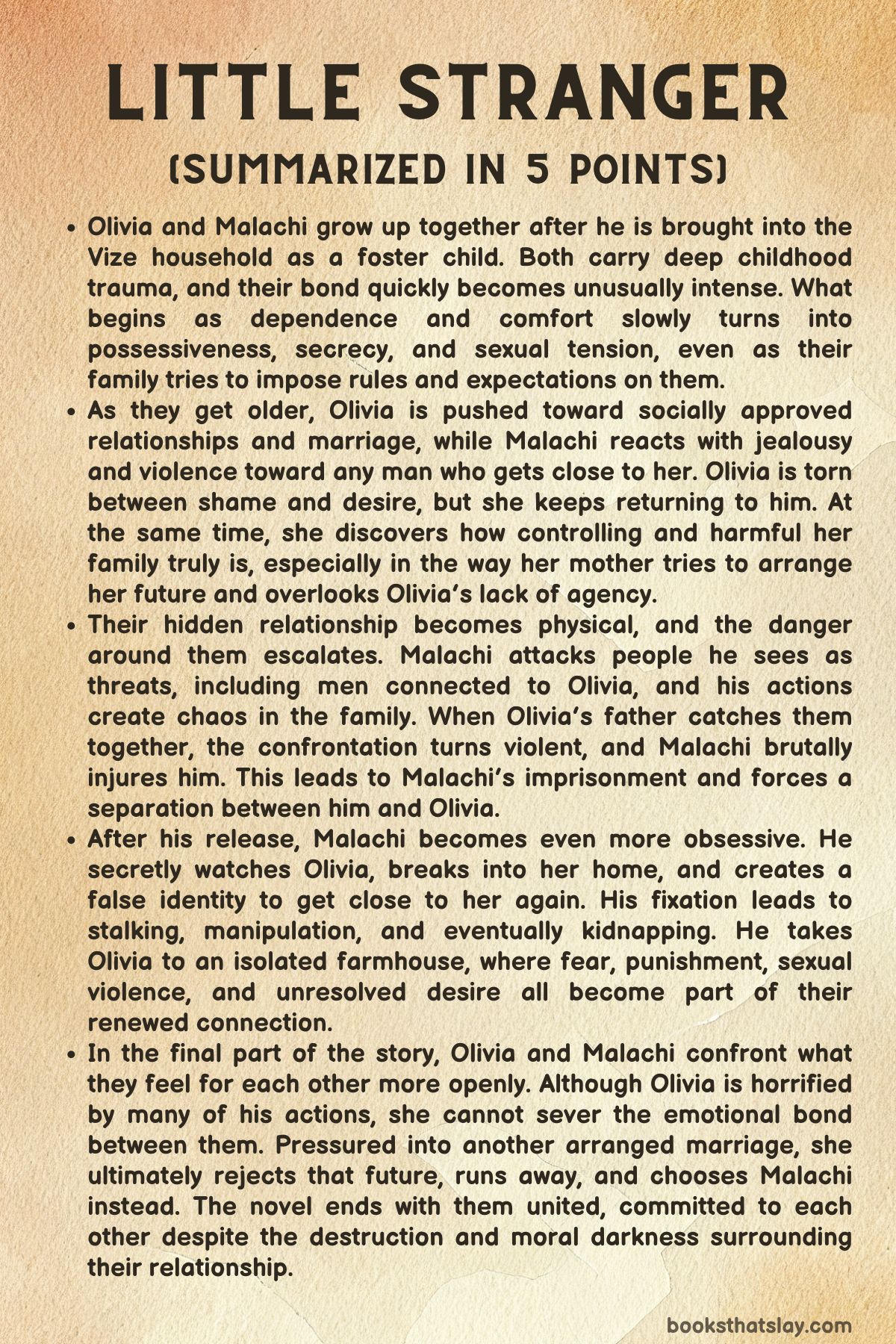
Summary
Olivia first meets Malachi when she is a child and her adoptive family brings him home as a foster child. From the beginning, he stands apart from everyone else.
He does not speak, though he can hear, and he communicates through sign language. Olivia is confused by him at first, but she is also drawn to him.
Their adoptive mother welcomes him warmly and expects the whole household to adjust around his needs, while their father is colder and more suspicious. Even as a child, Malachi becomes attached to Olivia in a way that feels stronger than ordinary sibling affection.
He seeks closeness, comfort, and possession all at once.
As they grow up together, Olivia and Malachi become each other’s safest place. Both carry damage from early childhood.
Malachi’s past is marked by abuse and emotional deprivation. Their shared pain creates a private world between them.
They sleep near each other, calm each other’s nightmares, and rely on contact and routine for comfort. What begins as emotional dependence slowly changes into physical tension.
Their family notices moments that cross a line, such as kisses that seem too intimate, and their father responds to Malachi with anger and violence.
By their teenage years, Olivia is increasingly aware of Malachi as a young man rather than only as her brother. She notices his body, his moods, and the way he watches her.
He is intensely jealous, constantly monitoring where she goes and who she sees. He acts as though she belongs to him, and Olivia is disturbed by how often that possessiveness excites rather than repels her.
She keeps trying to frame their closeness as normal, but her thoughts and reactions tell her otherwise.
At the same time, the family around them is deeply dysfunctional. Their mother, Jennifer, hides controlling behavior under the language of care and respectability.
Their father, Jamieson, is frightening in a different way: harsh, violent, and especially cruel toward Malachi. Olivia loves her adoptive parents in some ways, but she also fears them and knows their protection comes with conditions.
Malachi, though dangerous, is also the one person who seems ready to defend her at any cost.
That pattern becomes clearer when Olivia starts interacting with boys her parents approve of. Malachi reacts violently to any male attention directed at her.
The fallout is ugly. Instead of treating Olivia like a person with agency, the adults around her discuss marrying her off to smooth things over.
Jennifer pushes Olivia toward men such as Adam and Parker, treating marriage and sex as tools for negotiation and control. Olivia becomes furious, but she also feels trapped.
Malachi’s violence makes everything worse, yet his rage comes from a place that feels, to Olivia, like absolute loyalty.
As the pressure on Olivia’s future grows, her secret relationship with Malachi turns openly sexual in private. Their encounters begin with kissing, touching, and the language of “lessons,” as though pretending this is instruction can make it less real.
That pretense fails quickly. Olivia wants him and is ashamed of it.
Their intimacy is tied to dominance, jealousy, fear of being caught, and the thrill of doing something forbidden. Olivia keeps telling herself that what they are doing is wrong, but she also keeps returning to him.
Malachi makes it clear that he has never thought of her as a true sister and does not believe there is any reason they should stay apart.
The situation becomes even darker when Olivia learns how much her parents have controlled her sexual life. She overhears that Jennifer arranged sexual encounters between Olivia and men such as Adam and Parker.
What Olivia thought were dates or obligations are revealed as violations disguised as family planning. This changes the emotional balance of the story.
Malachi’s obsession is dangerous, but Olivia also sees him as the one person who responds to her abuse with fury rather than denial. When Parker becomes violent and humiliates Olivia at a party, she calls Malachi for help.
He arrives and beats Parker brutally. At home, the truth about Jennifer’s role comes out, and the family fractures further.
After this, Olivia and Malachi become more reckless. Their secrecy no longer feels temporary.
Olivia is afraid she is falling in love with him, and that thought terrifies her because she cannot imagine a future where such a relationship is allowed. Malachi, however, does not hesitate.
He keeps pressing for more, and his possessive language becomes even more explicit. Olivia tries to pull back when she hears rumors that he is seeing another girl, Anna.
Feeling hurt and betrayed, she confronts him. But when he comes to explain himself, the argument turns sexual again.
Their inability to stop choosing each other leads to disaster when Jamieson catches them together.
The confrontation is explosive. Jamieson attacks Malachi, Olivia tries to defend him, and Malachi beats Jamieson so badly that he is left with lasting brain damage.
In the chaos that follows, Olivia and Malachi still choose each other physically, even beside the unconscious body of her father. It is the point where every boundary fully collapses.
Malachi is sent to prison, and Olivia testifies in court. Though the legal case punishes him for assaulting Jamieson, the truth of their sexual relationship is dismissed or disbelieved by others.
The narrative then shifts to Malachi’s point of view after his release from prison. He has spent months obsessed with Olivia from afar.
He stalks her, breaks into her apartment, drugs her, watches her through hidden cameras, and reads her journals. He is enraged that she did not come for him, convinced that she owes him loyalty and reunion after everything that happened.
His fixation becomes more calculated and cruel. He creates a false identity, “Kai,” and begins luring Olivia into interactions without revealing who he is.
Olivia, meanwhile, is living under continued pressure to marry a man chosen for her future, but she has not emotionally escaped Malachi. She keeps reminders of him, reads his letters, and cannot let go of the connection.
Their flirtation leads to a Halloween festival where Malachi, still disguised, turns her fantasies of fear and pursuit into reality. He chases her through a corn maze, sexually assaults her, drugs her, and kidnaps her, taking her to a farmhouse he bought for the purpose of keeping her.
At the farmhouse, Malachi subjects Olivia to captivity, pain, and repeated sexual abuse. He hides his face at first, wanting her fear, her dependence, and eventually her recognition.
Olivia resists in some ways and submits in others, torn between fear, desire, guilt, and longing. When he finally reveals himself, the emotional center of the story changes again.
Rather than rejecting him completely, Olivia admits she suspected who he was and confesses that part of her wanted punishment because she blames herself for his imprisonment.
Even then, reconciliation is not simple. Olivia acknowledges their bond and her love, but she also tells Malachi that what he did to her is not easily forgiven.
Malachi, for the first time, shows some insecurity beneath his brutality. Olivia questions whether he is capable of love in a healthy sense, and he fears that his love may never be enough for her.
He lets her leave, hoping she will come back by choice rather than force.
Two weeks later, Olivia is being pushed toward another marriage, this time to Xander. Exhausted and heartsick, she confesses to her parents that she loves Malachi and that he was the only one who truly protected her.
Jamieson, changed by everything that has happened, finally sides with Olivia and admits he has been watching Malachi’s efforts to improve through therapy and speech work. At the church, Olivia cannot go through with the wedding.
Encouraged by her father, she runs.
She goes to the farmhouse and returns to Malachi willingly. There, they confess their love openly and choose each other without reservation.
In the final scenes, they imagine a future built around possession, sex, and total commitment. Malachi still sees himself as her protector and is prepared to use violence if needed.
Olivia accepts him as he is and tells him she does not want him remade into someone else. The book ends with the two of them united at last, convinced that whatever is broken in them makes sense only when they are together.
Characters
Olivia Vize
Olivia is the emotional center of the novel, and much of its tension comes from the contradiction between how she sees herself and what she repeatedly chooses. She begins as a child marked by neglect, loss, and instability, and although adoption gives her physical safety and material comfort, it does not erase the deeper damage left by her early years.
Because of that, she is highly responsive to protection, attention, and possession, especially when they come from Malachi. One of the most important things about Olivia is that she is not written as passive in a simple way.
She is pressured, manipulated, and abused by the adults around her, but she also has strong desires of her own, and that complexity makes her difficult to reduce to either victim or willing participant. She often recognizes that something is wrong, yet recognition alone does not change what she wants.
Her psychology is built around confusion between care and control. She has grown up in an environment where authority is often violent or coercive, so tenderness and danger become linked in her mind.
This helps explain why she is drawn to roughness, secrecy, and the thrill of transgression. She feels shame constantly, but that shame does not create distance from her desires; instead, it deepens them.
Olivia is intelligent enough to question what is happening around her, especially when she begins to understand how much her mother has arranged and controlled her future, but she has been conditioned to accept that her body and choices are negotiable. Her attachment to Malachi grows stronger because he seems to reject the hypocrisy of the adults around them.
He is dangerous in plain sight, while others disguise their cruelty as respectability.
Olivia’s emotional conflict is what gives her character depth. She wants to be chosen freely, yet she is drawn to being claimed.
She wants love, but she struggles to believe it can exist in any form that is not tangled with obsession, ownership, or violence. Her arc is not about moral recovery or independence in a conventional sense.
Instead, it is about admitting the truth of what she feels and choosing the person who, in her mind, has always belonged closest to her. That choice is disturbing, but it is written as emotionally consistent with everything she has experienced.
By the end, Olivia stops trying to force herself into the role of obedient daughter or suitable bride and embraces a future defined by her own dark version of devotion.
Malachi
Malachi is the most volatile and unsettling figure in the story because he combines emotional damage, extreme possessiveness, and an almost absolute fixation on Olivia. From childhood, he is marked as separate from others.
His refusal to speak is not a physical inability but a psychological response to neglect and abuse, and that silence becomes central to how he relates to the world. He does not communicate in ways that make other people comfortable, and this contributes to his isolation.
At the same time, his silence gives him an aura of mystery and containment, as though all his feeling is being compressed inward until it becomes something explosive. His attachment to Olivia forms almost immediately, and the novel presents that attachment not as sibling affection that later changes, but as obsession that takes root early and only becomes more explicit with age.
What makes Malachi compelling as a character is that he is not written as merely cruel for the sake of cruelty. He is controlling, violent, invasive, and at many points terrifying, but his actions come from a deeply damaged internal logic.
He does not separate love from possession. In his mind, to protect Olivia, to watch her, to punish others, and to keep her close are all expressions of the same devotion.
He is emotionally stunted in many ways, but he is not emotionally empty. In fact, one of the more tragic parts of his characterization is that he seems to feel too intensely in one narrow direction and almost nowhere else.
Olivia becomes the center that organizes his entire inner life. Everyone else is secondary, disposable, or threatening.
His violence is both practical and symbolic. He attacks the men around Olivia because he sees them as trespassers.
He reacts with fury not only to real harm but to the idea that anyone else could touch her, define her future, or claim intimacy with her. This makes him frighteningly consistent.
Even when his actions become criminal and monstrous, they follow the same emotional rule he has lived by since childhood: Olivia is his. At the same time, the novel gives glimpses of vulnerability beneath that certainty.
His struggle with speech, his insecurity about whether his kind of love is enough, and his desire for Olivia to choose him rather than merely submit to him all reveal someone who is not as invulnerable as he wants to appear. The later parts of the story show that for all his brutality, he still craves recognition, emotional legitimacy, and proof that he is not merely being tolerated.
Malachi also represents the novel’s darkest idea of romantic constancy. He does not move on, adapt, or redirect himself.
Prison, separation, and rejection only intensify his focus. That makes him both the central threat and the central romantic figure.
His character is effective because the story never asks the reader to mistake him for safe or healthy; instead, it presents him as someone whose love is inseparable from damage. By the end, his desire to improve exists, but it does not erase who he is.
He remains dangerous, obsessive, and possessive, yet he is also the person Olivia understands most completely.
Jennifer Vize
Jennifer is one of the most important antagonistic forces in the novel because her control operates under the appearance of maternal care. She sees herself as a rescuer and organizer, someone who saves children, builds order, and makes practical decisions for the good of the family.
On the surface, she is softer and more nurturing than Jamieson, especially in the early parts of the story, but as the plot develops, it becomes clear that her love is deeply conditional. She wants dependence, obedience, and moral presentation more than she wants her children’s autonomy.
Her protectiveness is tied to image, propriety, and management. This makes her a deeply unsettling character, because she can frame manipulation as concern and coercion as guidance.
Her treatment of Olivia is especially revealing. Jennifer believes girls should be preserved, arranged, and delivered into marriage according to a controlled plan.
She reduces Olivia’s future to a set of social and transactional decisions, and in doing so, she repeatedly denies Olivia personhood. The revelation that she arranged sexual encounters as part of that system of control is one of the clearest signs of how warped her moral thinking has become.
She may justify her choices as practical or necessary, but they are acts of betrayal. Jennifer’s version of motherhood depends on the idea that she knows best, and once that belief is threatened, she becomes colder and harsher.
Her relationship with Malachi is equally revealing. She is more receptive to him than Jamieson at first, but that openness has limits.
Once his obsession with Olivia becomes harder to deny, Jennifer shifts toward fear and containment. She labels him as dangerous and speaks of him as a threat to the household.
There is some truth in her fear, but the novel also shows that she fails to take responsibility for how her own controlling environment contributes to the family’s breakdown. Jennifer wants order without honestly confronting the violence and damage already inside her home.
As a result, she functions as a character who exposes how authority can look polished while remaining profoundly abusive.
Jamieson Vize
Jamieson begins as a harsh patriarchal figure whose authority is based on fear, discipline, and intimidation. He is physically abusive toward Malachi and emotionally imposing toward the rest of the household.
Olivia loves him, but that love is shaped by fear, which immediately signals that his role as father is compromised. He represents the bluntest form of control in the family.
Unlike Jennifer, who often masks coercion with reasoning and maternal language, Jamieson acts through anger, force, and command. His presence is especially important in showing that the family is not a safe haven, even though it appears respectable and wealthy from the outside.
At the same time, he is not static. One of the more surprising parts of his characterization is that he changes more than the reader may initially expect.
Early on, he is openly hostile to Malachi and dismissive of his place in the family. He also seems comfortable with patriarchal assumptions about Olivia’s future, even if he is less calculating than Jennifer.
But as events escalate, Jamieson becomes a more layered figure. When the truth about Parker’s abuse and Jennifer’s role in arranging Olivia’s sexual encounters comes out, he is horrified, and that horror suggests he has not fully understood what has been happening in his own home.
His moral failings are serious, but he is not as coldly deliberate as Jennifer.
After the assault that leaves him with brain damage, Jamieson becomes an even more interesting character because the story allows him a partial moral reckoning. He does not become gentle or idealized, but he does begin to see Olivia’s suffering more clearly and to recognize Malachi in a less simplistic way.
His later willingness to protect Olivia from Xander and to acknowledge Malachi’s efforts toward change suggests that he is capable of growth, even if imperfectly. Jamieson’s late support matters because it breaks the pattern of absolute paternal control that has shaped so much of Olivia’s life.
He remains a damaged and damaging man, but he also becomes one of the few adults in the story who eventually shows some capacity to reassess his own power.
Molly
Molly is a smaller presence in the plot, but she serves an important symbolic role. As the younger foster child entering the household later in the story, she represents innocence arriving into a family already full of secrets, control, and emotional violence.
Her background echoes the histories of Olivia and Malachi, since she too comes from a home shaped by neglect and drug exposure. This parallel matters because it reinforces one of the story’s recurring ideas: the family keeps repeating cycles of rescue without healing the deeper structures that produce harm.
Molly’s responses also help illuminate the adults around her. She is more direct and emotionally honest than many of them, and her discomfort with Xander shows that she can sense danger or wrongness even when adults insist everything is proper.
Her reaction to Olivia’s confession about Malachi is striking because it mixes shock with a strange romantic acceptance, which reflects the morally distorted environment she is entering. Molly is not developed as fully as the central characters, but she works as a mirror for the family’s patterns and as a reminder that these patterns may continue unless someone breaks them.
Adam
Adam functions less as a fully independent character and more as an example of how Olivia is treated as an object in negotiations between families. His role is significant because his connection to Olivia is shaped by arrangement, expectation, and coercion rather than genuine intimacy.
He becomes one of the approved male options placed in Olivia’s path, and his family’s response after Malachi attacks him shows how marriage is treated as a solution to male violence and public embarrassment. Adam’s presence therefore helps expose the transactional values operating beneath the family’s polished exterior.
He is also important because he complicates the story’s moral landscape. He is not presented as a romantic rival in any meaningful emotional sense.
Instead, he is part of the machinery that tries to move Olivia into a socially acceptable future. Whether passive, pressured, or complicit, he stands for a model of heterosexual normalcy that offers Olivia no real freedom.
He matters because he is acceptable on paper while being emotionally empty in her life.
Parker
Parker represents entitlement in a more openly predatory form. Unlike Adam, who is tied to family arrangement and social expectation, Parker embodies the uglier side of wealth, status, and male access.
He is one of the clearest examples of the harm created by Jennifer’s attempts to manage Olivia’s life through marriage and sex. Parker’s violence at the party reveals how quickly the illusion of respectable courtship collapses into humiliation, threat, and coercion.
He treats Olivia as something purchased and owed, which makes explicit what has been implicit in Jennifer’s decisions all along.
As a character, Parker does not need deep interiority because his function is to make visible the dangers Olivia has been forced to endure under the name of family strategy. His cruelty also intensifies Malachi’s role as avenger and protector.
That does not justify Malachi’s violence, but it explains why Olivia experiences his brutality as proof of loyalty. Parker helps push the story toward that emotional logic by showing Olivia the difference between being traded and being violently defended.
Anna
Anna is a brief but meaningful figure because she introduces the possibility that Malachi might direct his attention elsewhere, which Olivia cannot bear. Anna is described as attractive, kind, and socially desirable, making her a useful contrast to Olivia’s self-doubt and inner turmoil.
The rumor or appearance of intimacy between Anna and Malachi triggers one of Olivia’s strongest emotional reactions, not because Anna is deeply developed, but because she exposes Olivia’s jealousy and the depth of her attachment.
Anna’s importance lies in what she reveals rather than what she does. She shows that Olivia wants exclusivity from Malachi even while trying to deny the full meaning of their relationship.
She also shows how Malachi’s attempts to provoke jealousy can spiral into disastrous consequences. In that sense, Anna is less a rival than a catalyst who helps bring hidden feelings into the open.
Xander
Xander appears late, but he is important as the final embodiment of the future Olivia is expected to accept. He is another man selected according to family and social logic rather than emotional truth.
His controlling attitude toward Olivia’s appearance and behavior signals that he would continue the same structure of possession and domination already present in her life, only in a more publicly acceptable form. He is not terrifying in the same way Malachi is, but he represents a cleaner, more respectable version of control, and that makes him thematically important.
His function in the story is to force a final choice. By the time Olivia is pushed toward marriage with him, she fully understands that choosing obedience will not save her.
Xander is therefore less a romantic contender than a narrative pressure point. He stands for the life Olivia is supposed to want, and her rejection of him becomes a rejection of the entire system that has tried to define her.
Abbi
Abbi plays a small social role in Olivia’s life, but she helps establish the ordinary teenage world that exists around the main relationship without ever truly reaching Olivia. Through friendships, parties, and shared activities, she represents the kind of normal youth Olivia might have had in a different story.
Her presence highlights the gap between Olivia’s outward life and her private reality. Even in ordinary social settings, Olivia is carrying secrecy, fear, and desire that isolate her from her peers.
Themes
Obsession as a Substitute for Love
In Little Stranger, love is repeatedly stripped of its gentler associations and recast as fixation, surveillance, possession, and emotional dependency. The central relationship is built on the belief that complete attachment is the highest proof of devotion.
That idea shapes not only how the two leads see each other, but also how they interpret fear, jealousy, sexual desire, and loyalty. Instead of treating obsession as a warning sign that should create distance, the story presents it as something the characters experience as intimate and reassuring, even when it becomes destructive.
This gives the novel its unsettling emotional core. What should feel like a violation often feels, to them, like proof that they matter absolutely to one another.
This theme works because obsession is not shown as random intensity. It grows out of deprivation.
Both characters come from backgrounds marked by neglect, instability, and emotional injury, so they do not approach affection with a healthy sense of proportion. They are drawn to extremes because extremes feel reliable.
A person who watches every move, reacts violently to rivals, and refuses to let go may appear safer than people who speak of care but abandon, manipulate, or trade them. Obsession becomes their private language of permanence.
They trust excess more than moderation because moderation resembles indifference.
The novel also makes obsession inseparable from identity. The male lead does not merely want closeness; he organizes his entire sense of self around one person.
His jealousy is not occasional but foundational. In the same way, the female lead measures safety, danger, shame, and desire through the emotional hold he has over her.
That dynamic gives the relationship an all-or-nothing quality. Other people become secondary, and ordinary social rules begin to look irrelevant compared to the absolute force of their attachment.
The result is a world where obsession is not an intrusion into love but the form love has taken for people who do not know how to separate care from ownership.
What makes the theme particularly disturbing is that the story does not fully challenge this logic from the inside. The characters repeatedly return to the belief that being unable to live without each other is romantic rather than catastrophic.
That is why the novel can feel less like a story of recovery and more like a study of how wounded people can transform fixation into a personal ideal. Obsession is not presented as a phase to outgrow.
It becomes the emotional structure through which the characters understand commitment, desire, and destiny.
Trauma and the Corruption of Intimacy
Intimacy in this story is shaped by early damage long before the central romance becomes sexual. The bond between the protagonists develops in the shadow of neglect, abuse, abandonment, and fear, which means closeness is never neutral.
Physical comfort, emotional dependence, and sexual awakening all emerge from the same wounded foundation. As a result, the story repeatedly suggests that trauma does not stay contained in memory; it alters the form that future attachment takes.
What might otherwise have been sibling closeness, teenage longing, or romantic curiosity is transformed by the characters’ histories into something far more unstable and morally disordered.
This theme is especially effective because trauma is not treated as background information that merely explains behavior in a simple way. It actively shapes desire.
The female lead’s confusion about what she wants is linked to the fact that she has grown up in environments where her safety depended on adapting to coercion and reading danger closely. Her attraction to roughness, control, and fear is not presented as a detached preference but as something entangled with what she has survived.
The male lead’s possessiveness and inability to form ordinary attachments also arise from a childhood where neglect and emotional deprivation taught him that closeness must be seized and defended, not calmly received. Together, they turn intimacy into a site where old wounds are replayed rather than healed.
The adults around them deepen this corruption. The home that should provide protection instead reinforces control, fear, and distorted ideas of care.
Parenting becomes management, discipline becomes violence, and sexual boundaries are violated under the guise of family strategy. Because of that environment, the younger characters learn to associate love with domination and secrecy rather than trust.
Their bodies become one of the main places where this emotional damage appears. Sexual contact is bound up with punishment, shame, reassurance, retaliation, and comfort, often all at once.
The story shows how difficult it is for them to distinguish genuine choice from conditioning when their entire emotional education has been warped.
What emerges is a bleak but consistent vision of trauma’s afterlife. The characters are not only haunted by what happened to them; they are drawn to recreate its emotional logic.
They seek intensity because calm feels alien. They treat pain as closeness because pain has always accompanied attention.
The novel does not romanticize trauma in a simple sense, but it does present a world where intimacy has been so thoroughly shaped by damage that tenderness itself becomes difficult to recognize. That is what makes the emotional atmosphere so troubling.
Love does not cleanse trauma here. Trauma determines what love feels like.
Control, Ownership, and the Illusion of Protection
Control operates at every level of the novel, from family structure to romance to sexuality, and it is often disguised as concern. Parents claim to know what is best, suitors act as though access to a woman can be arranged through family approval, and the central male figure insists that domination is the same as devotion.
This creates a world in which nearly every important relationship is shaped by questions of ownership. Who decides a future, who has access to a body, who has the right to watch, guide, punish, or protect—these are the questions that drive much of the conflict.
The story repeatedly suggests that people rarely seek control while admitting it is control. They call it care, duty, morality, or love.
The family is central to this theme. Olivia is treated less as a person developing her own desires than as someone whose future must be managed.
Respectability, marriage, and sexual purity become tools through which authority is exercised over her. The adults claim to be safeguarding her, yet their choices repeatedly expose her to violation and humiliation.
That contradiction is crucial. Protection is shown not as the opposite of control but as one of its favorite disguises.
By making coercion appear practical or respectable, the family preserves its self-image while deeply harming the person it claims to love.
The romance reflects this structure in a more extreme form. Malachi sees Olivia not as a separate person with whom he must negotiate closeness, but as someone who belongs with him in a way that overrides ordinary rules.
His surveillance, jealousy, and violence are all expressions of this belief. Yet the story complicates the theme by showing why that ownership feels meaningful to Olivia.
In a life where so many others have made decisions about her without honesty, his possessiveness can appear more truthful because it does not pretend to be moderate or polite. He does not hide that he wants absolute access.
That does not make his behavior safe or justifiable, but it does explain why the emotional logic of the story treats him differently from the socially approved men around her.
The theme becomes especially sharp in the contrast between respectable control and explicit control. Suitors chosen by family, social expectations around marriage, and parental planning all represent forms of domination that society can accept.
Malachi represents domination that cannot be normalized so easily because it is too raw, too obsessive, and too visibly violent. Yet the novel keeps asking whether the difference is moral or simply cosmetic.
By placing these forms of control side by side, it exposes how often the language of protection hides a desire to possess. That is one of the darkest ideas in the book: ownership can wear many faces, and the most dangerous one is not always the one that looks frightening first.
Silence, Voice, and the Struggle to Be Known
Speech and silence carry unusual weight in this story because language is never just about communication. It is about power, recognition, vulnerability, and identity.
Malachi’s refusal to speak is one of the defining facts of his character, but the novel makes clear that silence is not emptiness. His muteness grows out of psychological injury and years of being ignored, so it becomes both a wound and a defense.
By withholding his voice, he expresses his alienation from a world that failed him. Silence becomes part of how he controls access to himself.
It also makes his rare attempts at speech feel emotionally loaded, especially when those attempts are directed toward Olivia.
This theme matters because it expands beyond him. Many characters in the novel are unable or unwilling to say what is true.
The family keeps secrets, avoids naming abuse honestly, and hides coercion beneath polite language. Olivia herself often knows more than she is prepared to confess.
She minimizes, reframes, and delays admitting the depth of her attachment because speaking it aloud would make it undeniable. In that sense, silence is not only Malachi’s condition.
It is the atmosphere of the whole household. Things are felt, acted out, and enforced long before they are spoken clearly.
That makes the story’s emotional world one where language arrives late, often after damage has already been done.
When speech does emerge, it often marks a major emotional shift. A name spoken aloud can carry more force than a long conversation.
This is especially true in relation to love. The characters struggle not only with whether they feel love, but with whether they can recognize and name it in a way that feels real.
Malachi’s fear that his form of love may not count, and Olivia’s fear of what admitting her feelings would mean, both show that voice is tied to legitimacy. To say something is to make a claim about what it is.
At a broader level, the novel suggests that being known is both desired and feared. The characters long for total recognition from each other, yet they are also shaped by secrecy and concealment.
Voice becomes precious because it risks exposure. Silence becomes seductive because it preserves control.
In Little Stranger, this tension gives emotional intensity to even small acts of communication. Speech is never casual.
It is either a surrender, a declaration, or a threat.