The Borrowed Life of Frederick Fife Summary, Characters and Themes
The Borrowed Life of Frederick Fife by Anna Johnston is a warm, bittersweet novel about loneliness, guilt, second chances, and the strange ways people find family. At its center is Fred, an elderly man who is poor, alone, and nearly invisible to the world, until an accident places him inside another man’s life.
What begins as a case of mistaken identity slowly becomes something deeper: a story about care, regret, aging, forgiveness, and the human need to belong. Through humor and sorrow, the novel asks whether a person can change the meaning of a life, even after most of it seems already spent.
Summary
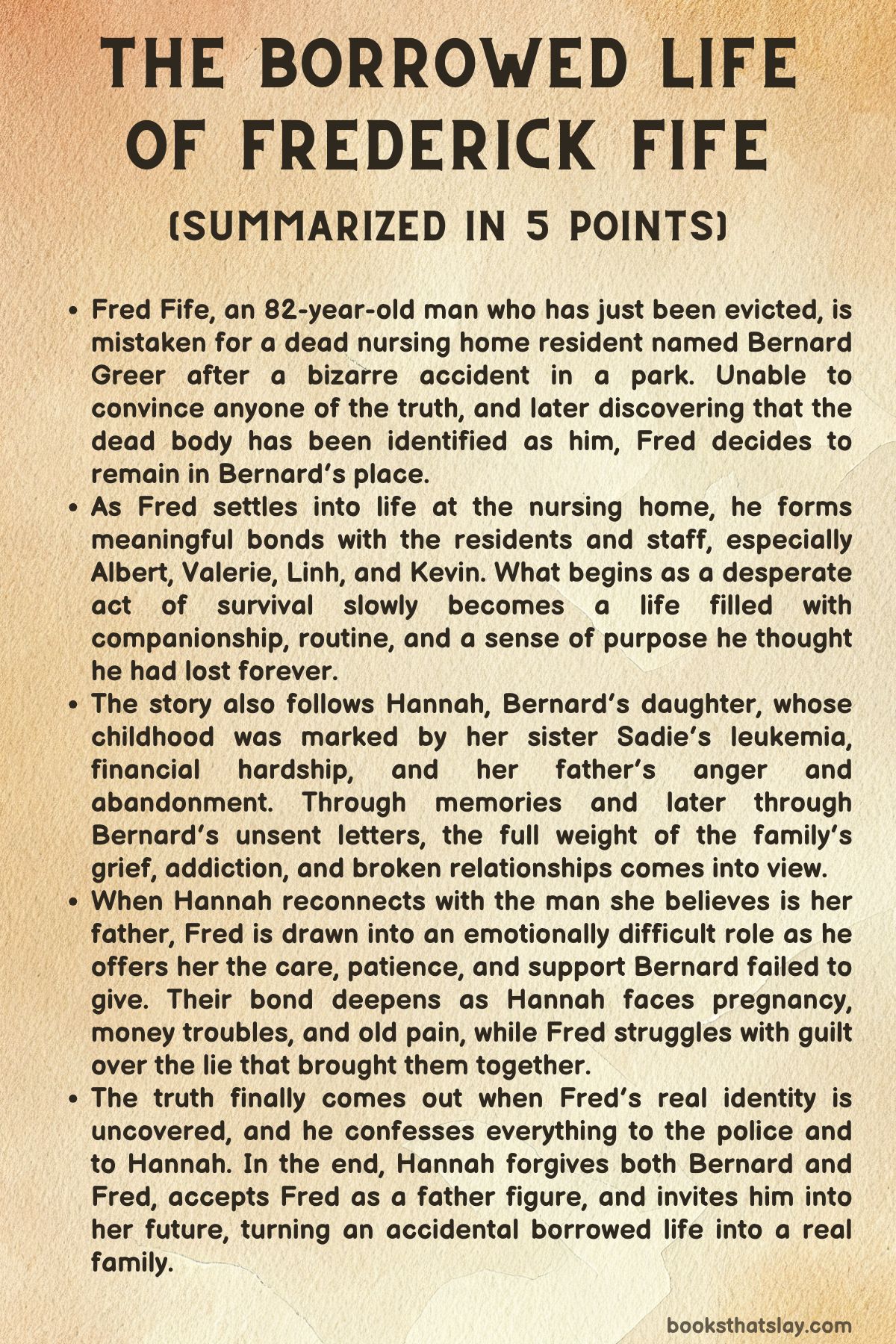
Fred Fife is 82 years old, broke, and recently evicted. With nowhere to go, he drifts through a park, where residents from a nursing home are out on an excursion.
There he notices that one of the men in a wheelchair has died. As Fred tries to move the chair back toward the group, he stumbles, and the dead man’s body rolls away into the river.
Before Fred can explain what happened, a caregiver mistakes him for the dead resident, Bernard Greer, and he is swept into the confusion. Because Fred closely resembles Bernard, and because Bernard has dementia, nobody questions the idea that the man now in the wheelchair is Bernard himself.
Fred wakes at the nursing home shocked and humiliated, especially because he has been placed in Bernard’s room and is treated as though he belongs there. He insists that he is not Bernard, but the staff assume his protests are part of dementia-related confusion.
At first, Fred only wants to escape. He tries to leave, tries to get back to what little remains of his former life, and thinks of finding identification to prove who he is.
But events keep pushing him back. The police return him.
The staff continue to care for him as Bernard. Slowly, Fred understands that nobody is prepared to believe the truth.
As he spends time in the facility, Fred becomes part of its daily rhythm. He meets residents and workers who begin to matter to him.
Albert, another resident with dementia, mistakes Fred for his late brother and speaks to him with affection and trust. Valerie, Albert’s devoted wife, visits every day and treats Fred with warmth.
Linh, an aide from Vietnam, shares stories and food with him. Kevin, a kind young nurse, listens to Fred and treats him with dignity.
Even in a place built around frailty and routine, Fred finds companionship he has not had in years.
The story also follows Hannah in both past and present. In childhood, Hannah grows up in a home overshadowed by fear, money troubles, and her sister Sadie’s leukemia.
Sadie’s illness reshapes the family. Their mother struggles to keep everything together, while their father, Bernard, becomes increasingly angry, harsh, and emotionally absent.
Hannah witnesses broken promises, outbursts, and tension that fill the house with uncertainty. Sadie’s suffering is especially painful because she remains tender and forgiving even as the adults around her fail to cope.
After Sadie dies, Bernard leaves the family completely, abandoning Hannah and her mother. His absence becomes one of the deepest wounds in Hannah’s life.
Back at the nursing home, Fred learns that the body found in the river has been identified as Frederick Fife because Fred’s wallet was in the coat covering Bernard’s lap. In the eyes of the world, Fred is dead.
The discovery frees him from fear of being blamed for Bernard’s death, but it also gives him a troubling opportunity. Since his own life has effectively ended on paper, he decides to continue living as Bernard.
This choice is practical at first: he has shelter, food, and care. Yet the lie grows more serious once real emotional bonds begin to form.
Fred starts finding traces of Bernard’s past, including letters Bernard wrote to his daughter but never sent. These letters reveal regret, shame, and an attempt at apology that never reached Hannah.
Fred becomes curious about the man whose identity he has taken. Bernard was not simply cruel and uncaring; he was damaged by grief, depression, and gambling addiction.
None of this excuses the hurt he caused, but it complicates the image Hannah has carried for years.
When Hannah comes to the nursing home to confront the father who abandoned her, Fred is thrown into the most difficult position of all. He knows he is deceiving her, yet he also senses how badly she needs acknowledgment, remorse, and tenderness.
He apologizes to her and gives her one of Bernard’s letters. Hannah leaves angry and unsettled, but she begins to notice that this version of her father feels different.
His eyes seem gentler. His words carry real care.
She cannot make sense of it.
Fred’s life in the nursing home becomes fuller even as the danger of discovery grows. He helps Albert, spends time with Valerie, and even arranges a joyful mock wedding for Albert and Valerie when Albert believes his wedding day has come again.
It is one of the novel’s most moving moments, because Fred creates happiness in a place so often defined by loss. Yet sorrow is never far away.
Albert dies soon after, and Fred grieves him deeply. Albert’s death reminds Fred how attached he has become to this borrowed life and to the people inside it.
Hannah, meanwhile, faces her own crisis in the present. She is pregnant, financially strained, and no longer with the baby’s father, Mike, who did not want children.
Her fear about the future exists alongside her unresolved anger toward Bernard. As she reads the letters he wrote years earlier, she learns more about his gambling addiction, his despair after Sadie’s illness, and his shame over the pain he caused.
She begins, cautiously, to soften. She is not ready to forget the past, but she becomes willing to see that Bernard was more broken than monstrous.
Fred, still pretending to be Bernard, steps into a fatherly role Hannah never truly had. He listens to her, accompanies her to medical appointments, worries about her finances, and makes things for her baby with his hands.
A yellow pair of knitted booties and a handmade birdhouse become expressions of love, repair, and memory. These gestures matter because they answer needs that were neglected long ago.
Fred cannot give Hannah back her childhood, but he can offer steadiness and kindness in the present.
At the same time, Denise, a nursing home worker, grows suspicious. She has noticed that “Bernard” is hearing better, remembering more, and behaving unlike the man whose records describe severe decline.
Denise is carrying heavy burdens of her own, including problems at home, exhaustion, and increasing alcohol use. When she finally pieces together the truth, she does not expose Fred immediately.
After a night in which Fred protects her from the consequences of her drinking and helps care for residents in her place, a bond of trust forms between them. Denise sees that whatever Fred has done, he has not acted out of malice.
The question of Bernard’s money raises the stakes. Fred discovers that Bernard set aside a large sum in trust for Hannah, protected by legal arrangements because Bernard did not trust himself with the money after his gambling addiction.
Fred realizes that for Hannah to receive it, Bernard must be officially dead. He begins planning how to end the false identity he has been living under.
But before he can control events, the situation collapses. Missing sleeping pills trigger alarm, police arrive, and Fred is arrested after the truth starts to come out.
Once exposed, Fred tells the full story. He explains the accident in the park, the mistaken identity, and the lie that followed.
Hannah receives a final letter from Fred in which he confesses everything and says that he loves her as though she were truly his daughter. This revelation hurts her, because the connection she formed was real even if it was built on falsehood.
At the same time, she now understands that Bernard did love her in his damaged way and had tried, too late, to provide for her future.
Hannah eventually forgives Bernard for the pain of the past and forgives Fred for stepping into his place. At Bernard’s funeral, she finds herself speaking not about the father who failed her, but about the man who showed her care when she needed it most.
That emotional truth matters more than blood or legal identity. After the service, she calls Fred “Dad,” giving him the belonging he has longed for and offering herself a new version of family.
In the end, Hannah invites Fred to live with her and her baby. The life Fred borrowed becomes, in a sense, his own through love, honesty, and chosen family.
The novel closes on renewal: Hannah names her child Dawn Sadie Greer, honoring both Fred’s late wife and her lost sister. What began in accident and deception ends in mercy, connection, and a future shaped not by what was broken, but by what can still be made whole.
Characters
Frederick Fife
Frederick Fife is the moral and emotional center of The Borrowed Life of Frederick Fife. At the beginning, he is a man reduced by age, poverty, and invisibility.
He has lost his home, his wife, and the ordinary structures that once gave his life shape. What makes him compelling is that he is not introduced as a heroic figure in any grand sense.
He is frightened, lonely, physically vulnerable, and capable of questionable choices. His decision to continue living as Bernard begins in panic and practicality rather than in calculation.
That moral uncertainty is essential to his character. He is not a fraud in the simple sense, because he never enters the false identity to exploit people in a cold-blooded way.
Instead, he slips into it because the world leaves him so little room to survive as himself.
As the story moves forward, Fred becomes a study in the difference between legal identity and moral identity. Though he is living under another man’s name, he often behaves with more tenderness, attentiveness, and responsibility than Bernard appears to have shown in his earlier life.
Fred notices people. He listens carefully.
He takes the emotional lives of others seriously. His bond with Albert shows his instinctive kindness, because he does not dismiss Albert’s confusion but meets him where he is.
His conversations with Linh and Kevin reveal his wit and emotional intelligence. His growing care for Hannah is even more significant, because he gives her the patience and warmth she should have received from a father long ago.
Through these relationships, he stops acting like a man who is merely hiding and starts acting like someone who is trying to become useful, loving, and present.
Fred is also shaped by grief that has never fully left him. His memories of Dawn, their pregnancy loss, and the family life they never had explain why his attachment to Hannah and her baby becomes so powerful.
He is not simply pretending to be a father; he is responding to an old ache in himself. That longing gives his actions great emotional force, but it also makes his deception more painful.
He truly loves Hannah, which means the lie is not shallow or convenient. It cuts into his conscience because he knows that real love should rest on truth.
This conflict makes him one of the novel’s richest characters: a man who behaves generously while living dishonestly, and who must finally accept that good intentions do not erase the cost of deception.
By the end, Fred emerges as a character defined not by the identity he borrows but by the care he gives. He does not become admirable because he is flawless.
He becomes admirable because he remains open to love even after enormous loss, and because he learns that belonging cannot be kept through secrecy forever. His final acceptance of truth completes his arc.
He begins as a discarded old man trying to survive one more day and ends as someone chosen, claimed, and loved.
Hannah Greer
Hannah is one of the novel’s most emotionally layered characters because she carries both childhood injury and adult resilience. As a child, she grows up in a home marked by illness, fear, money stress, and emotional instability.
The suffering of her sister Sadie shapes her entire early life, but the deeper damage comes from what that suffering does to the family. Hannah learns very young that adults can fail, withdraw, or explode under pressure.
She watches her father become harsh and unreachable, and she watches her mother shoulder impossible burdens. These experiences make Hannah guarded, observant, and prematurely mature.
Even as a child, she is trying to understand moods, anticipate conflict, and make sense of pain that no child should have to organize.
In adulthood, Hannah still lives with the emotional consequences of abandonment. Her anger toward Bernard is not a passing resentment but a wound built over years of silence.
She did not merely lose a parent; she was left to interpret that absence without comfort, stability, or closure. This is why her scenes with “Bernard” carry so much force.
She is not seeking sentimentality. She wants acknowledgment.
She wants someone to admit the harm. She wants the truth of her childhood suffering to be seen.
Her responses are therefore complex and believable. She does not soften quickly, and when she does begin to open, she remains suspicious of change that feels too sudden.
Her reluctance protects the integrity of her character. She is not written as someone who forgives because the plot requires it, but as someone who struggles honestly with what forgiveness might even mean.
Her pregnancy deepens her characterization in important ways. It places her at the edge of motherhood while she is still carrying unresolved pain from her own experience as a daughter.
She worries about money, the future, and whether she can hold a life together on her own. At the same time, the pregnancy sharpens her understanding of what her mother endured and what care really requires.
This added pressure does not make her weak; it reveals her endurance. She keeps working, keeps thinking, keeps making choices, even when she is frightened and alone.
Her practical toughness coexists with emotional vulnerability, which makes her feel fully human.
What makes Hannah especially moving is her capacity to change without becoming simplistic. She begins by confronting the father she believes abandoned her, and she ends by accepting both the truth about Bernard and the emotional reality of Fred.
That shift is not a betrayal of her anger. It is a sign of growth.
She learns that forgiveness does not require denial of harm, and that love can arrive in an unexpected form. Her final acceptance of Fred as “Dad” is powerful because it is chosen, not inherited.
Hannah’s arc turns pain into discernment rather than bitterness, and that makes her one of the most memorable figures in The Borrowed Life of Frederick Fife.
Bernard Greer
Bernard is a fascinating character because his presence dominates the story even though he is dead for almost all of it. He exists through memory, letters, records, and the emotional aftermath he leaves inside other people.
At first, he appears to be the novel’s absent villain: a father who abandoned his wife and daughters during the worst period of their lives. Hannah’s recollections justify that view.
He is angry, volatile, disappointing, and emotionally dangerous. He cannot carry the weight of Sadie’s illness with steadiness or grace.
Instead, he becomes consumed by his own pain and turns outward in ways that wound the people around him. In this sense, Bernard represents a kind of parental failure that leaves damage far beyond the original crisis.
Yet the novel refuses to keep him flatly monstrous. Through his letters and through what others slowly uncover, Bernard becomes more tragic and morally complicated.
He is a man destroyed by grief, depression, and gambling addiction, and by his inability to bear his own helplessness. That does not excuse what he did, but it does change how he is understood.
His efforts to write to Hannah, his legal protection of money for her future, and his expressions of regret show that he was not indifferent. He was ashamed, avoidant, and emotionally broken.
He lacked the courage and steadiness required to repair what he had damaged while he was alive and present. His failure is therefore not a lack of feeling but a failure of action and responsibility.
Bernard matters because he becomes the measure against which Fred is judged. The irony at the center of the story is that a stranger inhabits Bernard’s place and offers Hannah more emotional honesty than Bernard managed in life.
This contrast does not erase Bernard. Instead, it throws his tragedy into sharper relief.
He loved badly, hid badly, and repented too late. The trust he creates for Hannah suggests that part of him never stopped trying, but he chose structures and distance over human contact.
He wanted to provide, but not to face. He wanted to apologize, but not to stand in front of the person he had hurt.
In the end, Bernard becomes a figure through whom the novel explores the gap between remorse and repair. He is not remembered as purely evil, nor is he redeemed cheaply.
He remains responsible for profound harm. At the same time, he is granted the dignity of being seen as weak, guilty, and human rather than one-dimensional.
That balance gives the story much of its emotional maturity.
Denise
Denise is one of the most sharply observed secondary characters because she embodies strain, competence, collapse, and moral hesitation all at once. She works in a nursing home environment that is demanding, underfunded, and emotionally heavy, and she is also carrying serious pressures in her home life.
Her husband’s behavior, her daughter’s needs, her exhaustion, and her creeping dependence on alcohol make her a portrait of someone trying to function beyond her limits. Importantly, the novel does not reduce her to a stereotype of the overwhelmed caregiver.
Denise is irritable, suspicious, and sometimes harsh, but these qualities emerge from a deeply stressed life rather than from cruelty for its own sake.
Her attention to detail makes her one of the first people to notice that “Bernard” is changing in ways that do not fit his medical history. She is observant enough to register the improvement in hearing, memory, and continence, and practical enough to know that something is wrong.
This makes her a narrative threat to Fred, but she is more than an obstacle. Denise becomes a mirror of the book’s concern with hidden suffering.
Fred is living under a false identity, while Denise is living behind the appearance of coping. Both are concealing truths, though in very different ways.
When she drinks on the job and nearly collapses under the weight of her life, her own vulnerability becomes impossible to ignore.
Her relationship with Fred changes the meaning of her role. At first, she is suspicious and even antagonistic.
Later, after he protects her and sees her at one of her lowest moments, their connection becomes one of mutual recognition. Denise realizes that Fred is not a predator who set out to exploit the weak, and Fred sees how deeply she is struggling.
Her decision not to expose him is ethically messy, which suits the novel’s larger interest in imperfect moral choices. She does not make the legally tidy choice; she makes the human one.
That choice suggests that she has come to judge Fred by the care he gives rather than by the falsehood alone.
Denise’s arc is also significant because it points toward recovery through honesty. When she finally admits to her supervisor that she is not well and needs leave, she does something Bernard never fully managed and Fred delays for too long: she tells the truth before total collapse.
Her character broadens the novel’s emotional world by showing that caregiving can coexist with resentment, love with exhaustion, and competence with private breakdown.
Albert
Albert brings much of the novel’s tenderness, humor, and sadness. Living with dementia, he often mistakes Fred for his late brother, also named Fred.
This confusion could have been treated merely as a plot convenience, but instead it becomes one of the deepest emotional relationships in the story. Albert’s mind does not operate according to ordinary logic, yet his feelings remain genuine.
His affection, trust, and recurring certainty that his wedding is near all reveal that love persists even when memory fractures. Through Albert, the novel presents dementia not as the disappearance of the person, but as a reorganization of time, identity, and recognition.
Albert’s connection to Fred allows Fred to become useful in a pure and immediate way. There is no social performance needed with Albert.
He accepts Fred wholeheartedly, even if under mistaken recognition, and that acceptance gives Fred comfort when he is still disoriented and frightened. Their friendship is built on small moments, repeated conversations, and the emotional truth of companionship.
Albert’s dependence on Valerie and his occasional refusals also show the complexity of care. He can be difficult, vulnerable, sweet, and confused within the same stretch of time.
The arranged “wedding” is central to understanding Albert’s importance. In that scene, his inner world is not corrected or dismissed.
Instead, the people around him honor it with kindness. This gives Albert dignity.
He is not treated as a problem to manage but as a man whose joy matters. His delight in the ceremony and Fred’s best man speech turn the episode into an affirmation of memory, devotion, and chosen compassion.
Albert’s happiness there is real, even if its context is altered by dementia.
His death marks one of the novel’s most painful turning points because it forces Fred to confront attachment and mortality more directly. Albert’s loss leaves a silence behind him, and Fred’s grief shows that their bond was never superficial.
Albert represents both what dementia takes away and what it cannot erase: the human need for love, ritual, and familiar presence.
Valerie
Valerie is the novel’s clearest image of enduring devotion. As Albert’s wife, she visits him daily and remains emotionally committed even though dementia has altered their shared life.
Her character is important because she is not sentimentalized into sainthood. Instead, she is shown as patient, loving, and deeply faithful in ordinary acts of presence.
She understands Albert’s confusion and sorrow, and she keeps meeting him with gentleness. Through her, the story examines what it means to love someone who is still physically here but cognitively altered.
Valerie also plays a major role in validating Fred. She welcomes him into conversations, treats him as company rather than burden, and notices his kindness toward Albert.
Her approval matters because she is perceptive. When she responds warmly to him, the reader understands that Fred’s goodness is visible to others, not just felt internally.
At the same time, Valerie carries memory for Albert, for the brother he lost, and for the marriage they built together. She lives at the crossing point between past and present, holding together stories that Albert himself can no longer reliably tell.
Her response to the mock wedding is one of the most revealing aspects of her character. She does not reject the event as absurd or painful.
She receives it as a gift because it gives Albert joy and restores, for a moment, something precious between them. This openness shows emotional intelligence and generosity.
Valerie understands that literal correctness matters less in that moment than the emotional truth of the bond being honored.
After Albert’s death, Valerie becomes a figure of grief handled with grace. Her sorrow does not erase her warmth.
She continues to speak of Fred with respect, and her perspective helps Hannah begin to trust the changed man before her. Valerie’s character adds maturity to the novel because she shows that love in late life can be active, resilient, and full of dignity even when touched constantly by decline and loss.
Linh
Linh brings warmth, practicality, and quiet emotional wisdom to the nursing home setting. She is one of the first staff members with whom Fred develops an easy rapport, and their conversations reveal how quickly genuine human connection can form when people feel seen.
Her background, including her life in Vietnam and the estrangement she has experienced in her own family, gives her a perspective shaped by distance, migration, and emotional separation. This makes her especially sensitive to Fred’s pain and later to the significance of Hannah’s estrangement from Bernard.
What distinguishes Linh is her kindness without naivety. She is not written as an idealized angelic caregiver.
Instead, she is attentive, lively, and perceptive. She understands the nursing home as both workplace and emotional landscape, and she responds to residents as individuals rather than tasks.
Her gesture of bringing Fred pho is small but revealing. It shows her instinct to care for people in personal ways, not merely procedural ones.
Fred’s fondness for her, and his attempt to encourage a connection between Linh and Kevin, also show how naturally she draws affection.
Linh becomes particularly important after Albert’s death, when Fred is grieving and beginning to lose his footing emotionally. She does not force grand speeches on him.
She encourages him gently toward food, movement, and reconnection. Her own experience of estrangement allows her to speak meaningfully about distance between parents and children, and this helps sustain Fred when he fears that his bond with Hannah may not last.
Her relationship with Kevin also adds a lighter note to the narrative without making her feel secondary. She is not there simply to complete someone else’s romance.
She stands on her own as a person who combines humor, steadiness, and emotional intelligence. By the epilogue, her wedding invitation marks continuity and hope, suggesting that relationships formed in this place of illness and grief can still lead toward future happiness.
Kevin
Kevin represents decency, openness, and the possibility of care uncorrupted by cynicism. As a newer nurse at the facility, he is not yet hardened by routine, though he is not unrealistically innocent either.
He listens carefully, treats residents respectfully, and remains emotionally available in ways that contrast with the brisk impersonality often associated with institutional care. His conversations with Fred show that he sees more than symptoms.
He is willing to hear stories, ask questions, and respond to people as individuals with histories.
Kevin’s role in the novel is quieter than that of some others, but it is essential. He helps create the sense that the nursing home is not only a place of decline; it is also a place where affection, embarrassment, flirtation, and companionship continue.
His growing interest in Linh adds human lightness, and Fred’s encouragement of that connection shows how Kevin invites trust. He is the kind of person around whom others can be a little softer.
He also matters because he highlights Fred’s ability to build relationships across generations. Fred does not become isolated within the elderly residents alone.
He engages Kevin with humor and warmth, and Kevin responds without condescension. This dynamic gives Fred dignity and keeps him from being framed only as someone in need of care.
Instead, he can still mentor, encourage, and influence others.
Kevin’s presence may not drive the central moral conflict, but he helps shape the emotional environment in which the larger transformations become possible. He represents an ethic of caregiving grounded in patience and ordinary kindness, and that steadiness enriches the world around the main drama.
Sadie Greer
Sadie’s life is short, but her significance is immense. She is the emotional center of the family’s past and the loss around which so much of the damage forms.
Her leukemia brings fear and sorrow into the household, yet Sadie herself is not defined only by illness. She is tender, vulnerable, and often more emotionally generous than the adults around her.
Her concern about death, her innocence, and even her acts of forgiveness reveal a child trying to make sense of suffering with remarkable softness.
Sadie’s presence exposes the strengths and failures of everyone else. Hannah’s love for her is immediate and protective.
Their mother’s care becomes more strained and heroic under the pressure of Sadie’s illness. Bernard’s inability to bear the reality of what is happening becomes one of the central fractures in the family.
Sadie therefore functions not as a symbol only, but as a real person whose suffering calls forth the truth of others.
One of the most moving aspects of her characterization is her forgiveness. Even after Bernard breaks her favorite cup, she responds with gentleness.
This moment captures the painful innocence that surrounds her throughout the story. She does not fully understand the adult failures around her, but she feels them and still offers love.
That generosity becomes unforgettable, especially because it is set against a home increasingly unable to hold itself together.
Sadie continues to shape the present long after her death. Hannah visits her grave, speaks to her in memory, and understands her own life partly through the loss of her sister.
Bernard’s guilt is inseparable from Sadie. Fred’s connection to Hannah is deepened by his awareness of this missing child and by his own grief over children never born.
Sadie remains a moral and emotional presence throughout the novel, representing innocence touched by suffering but not emptied of love.
Dawn
Dawn appears mainly through Fred’s memories, but she is central to understanding his emotional life. As Fred’s late wife, she represents companionship, tenderness, and the life he once imagined would continue in a fuller form.
Their pregnancy loss leaves a lasting wound in both of them, and the absence of children becomes one of the silent griefs of Fred’s life. Dawn is therefore not only a lost spouse; she also stands for an unrealized future.
Her importance lies in how she continues to shape Fred’s choices. His love for Hannah, his attachment to the unborn baby, and his emotional response to knitted baby clothes are all connected to the life he and Dawn never got to have.
He does not approach Hannah from abstract benevolence alone. He is carrying an old love and an old sorrow, and Dawn remains inside both.
She gives depth to Fred’s fatherly yearning, because it is tied not merely to loneliness but to a marriage that once held shared hopes.
The fact that Hannah names her child Dawn Sadie Greer at the end confirms Dawn’s symbolic importance. She becomes part of the new family language, a bridge between Fred’s lost past and the future he unexpectedly gains.
Though she is absent in the direct action, her presence is felt as a source of memory, tenderness, and unfinished love.
Patricia
Patricia brings energy, unpredictability, and comic disruption into the nursing home world. She is not a minor figure in the sense of mere decoration, because her boldness repeatedly alters Fred’s experience of the place.
Her early sexual pursuit of Fred is chaotic and uncomfortable, immediately showing that the home is not a flat landscape of passivity. Its residents remain full human beings with impulses, desires, and unruly personalities.
Patricia therefore helps break sentimental assumptions about old age.
She also becomes useful in practical ways, especially through her mobility and her status as someone allowed certain freedoms. Fred’s borrowing of her scooter and his maneuvering around her show that Patricia exists at the edge of order within the institution.
She is difficult to contain, which makes her both comic and disruptive. Yet even these traits contribute to the novel’s broader point that old age does not erase individuality.
Patricia’s competitiveness and social presence in later scenes, including public activities, help make the nursing home feel lived in rather than merely functional. She adds color and unpredictability without being turned into a joke.
Even when she creates trouble, she reminds the reader that every resident has a history and a force of personality that extends beyond medical charts.
Ruby
Ruby appears less centrally than some others, but she is important to the novel’s picture of dependency, care, and institutional life. Her interactions with Denise and Fred reveal the intimate labor involved in looking after vulnerable people.
Ruby’s room becomes the setting for one of the story’s critical moments, when Denise’s drinking impairs her ability to do her job and Fred steps in to help. This scene does not make Ruby into a passive prop; instead, it emphasizes how dependent residents are on the integrity and steadiness of caregivers.
Her presence helps reveal Fred’s capacity for responsibility. Faced with a situation that could lead him to self-protection, he instead chooses to preserve Ruby’s dignity and comfort.
Through her, the story shows care not as sentiment but as action. Dressing someone, assisting someone, and protecting someone’s privacy all become morally meaningful acts.
Ruby also contributes to the sense that the nursing home contains many lives moving beside the central plot. She is part of the world Fred comes to inhabit, and her presence broadens the emotional scope of that world.
Greg
Greg, Denise’s husband, is an important offstage force whose impact is felt through Denise’s anxiety and emotional depletion. He is associated with temper, instability, and the kind of domestic pressure that leaves Denise perpetually tense.
Even without dominating the page, he shapes how the reader understands Denise’s exhaustion. Her life outside work is not a refuge.
It is another place of strain, fear, and disappointment.
Greg matters because he extends one of the novel’s recurring patterns: people are often carrying private burdens that are invisible in public settings. Denise may appear irritable or distracted at work, but those traits are partly the result of what she is surviving at home.
Greg therefore functions less as a fully developed independent figure and more as an influence that reveals Denise’s emotional context.
His presence also strengthens the book’s interest in households where care is compromised by anger, resentment, and unspoken pain. In that sense, he echoes Bernard, though in a different storyline.
Both men affect women and children through their inability to manage themselves responsibly. Greg’s importance lies in how clearly he shows that domestic unhappiness is not confined to one generation or one family.
Mike
Mike’s role is relatively small, yet his significance in Hannah’s present life is clear. As the father of her baby who ends their relationship after learning of the pregnancy, he represents a familiar form of emotional withdrawal.
He does not carry the same narrative complexity as Bernard, but his decision places Hannah in a vulnerable position and reinforces the novel’s interest in how women are often left to absorb the practical and emotional consequences of men’s refusal.
Mike also serves as a contrast. Against his retreat, Fred’s chosen commitment to Hannah becomes even more meaningful.
Fred has no biological obligation to remain, yet he does. Mike does have that obligation, yet he leaves.
This contrast is not subtle, but it is effective. It shows that family responsibility is not secured by blood alone; it depends on action, steadiness, and love.
Because Hannah is already carrying the wound of one abandoning father, Mike’s exit threatens to repeat an old pattern in a new form. That repetition gives added urgency to her bond with Fred and explains part of why his support matters so much.
Andrew Mora
Andrew Mora, Bernard’s lawyer, is a practical but significant character because he reveals the hidden structure of Bernard’s remorse. Through him, the truth of Bernard’s financial decisions comes into focus.
Bernard did not simply leave chaos behind; he created legal safeguards to ensure that Hannah would inherit the money he could not trust himself to manage. Mora’s calm explanation adds a crucial layer to Bernard’s character, showing intention, foresight, and a late effort at protection.
Mora functions as a bridge between emotional and legal truth. He confirms facts that feelings alone cannot establish.
In a novel full of mistaken identity and emotional uncertainty, his role is stabilizing. He makes clear that Bernard’s love existed, even if it was damaged by shame and distance.
That revelation reshapes both Fred’s understanding and Hannah’s.
Though Mora is not deeply developed in personal terms, he is essential to the moral architecture of the ending. He helps expose the difference between what Bernard failed to do in person and what he still tried to do for Hannah’s future.
Themes
Chosen Family and Earned Belonging
Family in The Borrowed Life of Frederick Fife is not treated as something guaranteed by blood, law, or biology. Instead, the novel repeatedly asks what makes a person truly belong in another person’s life.
Fred enters Hannah’s world through deception, which should make genuine connection impossible. Yet the emotional truth that develops between them becomes stronger than the official lie beneath it.
This tension gives the theme its force. The story does not claim that chosen family is simple or that emotional bonds automatically erase betrayal.
Rather, it shows that care, consistency, and emotional presence can create a real sense of kinship even where biology has failed to do its work.
Fred’s relationship with Hannah is the clearest expression of this idea. Bernard is her father by blood, but he was absent when it mattered most.
Fred is a stranger wearing Bernard’s identity, yet he listens, accompanies her to appointments, worries over her finances, celebrates her future child, and offers the kind of practical tenderness that fatherhood should include. This creates a painful contradiction.
Hannah’s deepest experiences of fatherly care come from the wrong man, yet they are not false in emotional terms. The novel insists that love is measured through action, not merely origin.
That is why Hannah’s eventual acceptance of Fred as “Dad” feels earned rather than sentimental. She is not denying history; she is naming the truth of what he became to her.
This theme also extends beyond Hannah and Fred. Albert and Fred create a brotherly bond through confusion, yet the affection is real.
Valerie welcomes Fred into her orbit because she recognizes his humanity. Linh and Kevin form attachments that grow inside an institution often associated with endings rather than beginnings.
Guilt, Regret, and the Long Work of Moral Repair
Regret runs through the novel in many forms, but it is never treated as equal to repair. Characters feel sorry, haunted, ashamed, or burdened by what has happened, yet the story keeps asking whether those feelings can become anything useful.
Bernard is the clearest example. His letters show remorse over his daughter’s suffering, his failures as a husband and father, and the destruction caused by grief and gambling addiction.
He understands, at least later, that he caused lasting harm. But the emotional power of his regret is limited by the fact that he stayed away.
He wrote instead of appearing. He arranged money instead of facing his daughter.
He felt deeply, but feeling deeply did not undo abandonment.
Fred’s arc offers a different version of this theme. He is not guilty in the same way Bernard is, but once he begins living as Bernard, he too becomes trapped between affection and dishonesty.
He regrets his deception more intensely as his love for Hannah grows. This is crucial because it means conscience in the novel is connected to love.
The more Fred cares, the more painful the lie becomes. He cannot rest in easy self-justification because the people around him are no longer abstractions.
They are specific human beings whose trust matters. His eventual confession matters precisely because the novel does not allow him to remain comfortably good while hiding the truth forever.
Denise adds another dimension to the theme. Her drinking, emotional exhaustion, and secrecy place her on the edge of professional and personal collapse.
Her turning point arrives when she stops pretending she is fine and admits that she needs help. That moment is small compared with the novel’s larger revelations, but it is morally significant.
It shows that repair begins not with private shame but with truthful acknowledgment. Denise cannot fix her life through guilt alone.
She has to speak.
The novel also makes clear that moral repair is rarely clean. Hannah’s forgiveness is gradual and divided.
She forgives Bernard only after learning more about his inner collapse, and even then she cannot erase what happened. She forgives Fred, but not because what he did was acceptable.
She forgives because she recognizes the love within the wrong. This distinction matters.
The story does not confuse forgiveness with approval, nor regret with redemption. Repair requires truth, vulnerability, and the willingness to let another person decide what your remorse can mean to them.
By treating regret as emotionally real but morally incomplete, the novel resists easy consolation. People do not earn absolution merely by suffering over what they have done.
Yet the story is not harsh. It allows for mercy when remorse leads to honesty, responsibility, and changed action.
That balance gives the book much of its emotional depth.
Aging, Invisibility, and Human Dignity
The novel gives unusual seriousness to old age, not as a background condition but as a lived human reality full of desire, humor, humiliation, memory, and vulnerability. Fred begins the story as someone society has almost stopped seeing.
He is old, poor, recently evicted, and moving through public space with no real protection. His invisibility is social before it is emotional.
He is easy to overlook, easy to misidentify, easy to discard. That invisibility makes the mistaken identity plot possible, but it also reveals a larger truth: old people, especially poor old people, are often handled as administrative problems rather than as full persons.
Once inside the nursing home, the novel expands this idea rather than simplifying it. Institutional life includes routine indignities, medical oversight, assumptions about confusion, and the reduction of identity to charts and symptoms.
Yet the story refuses to present the residents as flattened victims. Patricia is sexual, disruptive, and bold.
Albert is confused yet emotionally vivid. Ruby, Tony, and others remain dependent but not meaningless.
Their humanity persists in habits, preferences, attachments, embarrassments, and pleasures. This is one of the novel’s quiet strengths.
It restores complexity to people who are often represented only through decline.
Fred’s experience is especially important because he discovers that being treated as Bernard gives him material security but also places him inside a system where personhood is fragile. He is washed, medicated, watched, corrected, and interpreted.
Sometimes that care is compassionate. Sometimes it is careless or rushed.
The novel captures the unstable balance between necessary support and the loss of autonomy that can accompany advanced age. Fred’s resistance to being managed is not just comic.
It reflects a profound need to remain a self.
At the same time, the story shows the dignity that can still flourish in late life when people are treated with patience and imagination. The mock wedding for Albert, the chess games, the knitting, the haircut, the outings, the small shared meals and jokes all become acts of resistance against the idea that old age is only waiting for death.
These scenes insist that meaning does not disappear when the body weakens or memory changes. Joy still matters.
Ritual still matters. Friendship still matters.
The novel’s treatment of aging is therefore neither sentimental nor cruel. It acknowledges dependency, confusion, physical decline, and institutional vulnerability.
But it also argues that dignity survives in relationship. To be seen, spoken to, listened to, and included is not decorative.
It is essential. Fred’s journey from social invisibility to chosen belonging gives this theme its full emotional shape.
He does not become younger or stronger. He becomes recognized.
Grief, Loss, and the Possibility of Renewal
Loss is everywhere in the novel, but it does not function as a single event. It accumulates across years and across kinds of absence.
Sadie’s death is the most obvious wound, yet the story is equally concerned with other losses: Fred’s wife, the child he and Dawn never had, Bernard’s collapse under grief, Hannah’s lost childhood, Albert’s fading mind and eventual death, Denise’s loss of emotional stability, and the quiet losses that come with aging itself. What makes the treatment of grief so strong is that the novel does not isolate it in one dramatic scene and then move on.
Grief lingers, alters behavior, distorts relationships, and shapes identity over long stretches of time.
Sadie’s death is central because it becomes the fracture that the family never survives. But the story shows that grief is not only about mourning the dead.
It is also about mourning the self one might have been if loss had not occurred. Hannah loses not only her sister but also the possibility of a secure childhood.
Bernard loses his emotional footing and, in many ways, his moral coherence. Fred loses the imagined family he once hoped for with Dawn.
These forms of grief are harder to name, yet they are just as powerful. The novel treats them seriously, showing how people may continue living while carrying versions of life that never came into being.
At the same time, the story does not reduce grief to permanent ruin. Renewal is possible, but only in altered form.
Nothing returns exactly as it was. Sadie is not restored.
Bernard cannot undo the years he missed. Fred cannot recover his life before poverty and loneliness.
Yet new forms of attachment emerge. Hannah can still become a mother.
Fred can still become a father in a chosen sense. Kevin and Linh can move toward marriage.
Even the naming of Hannah’s baby gathers old sorrow into new life, joining Dawn and Sadie in a future-facing gesture.
This theme is moving because the novel refuses cheap healing. Renewal does not arrive through forgetting.
It arrives through incorporation. People carry the dead with them.
They remember, rename, rebuild, and continue. The birdhouse Fred remakes is a perfect expression of this idea: a damaged object from the past is not replaced by pretending the old break never happened.
Instead, a fragment of what was broken is worked into something newly made. That image captures the novel’s deepest understanding of grief.
Loss remains part of the structure. It is not erased.
But it need not be the end of love, hope, or belonging.