Chaotic Summary, Characters and Themes | Shantel Tessier
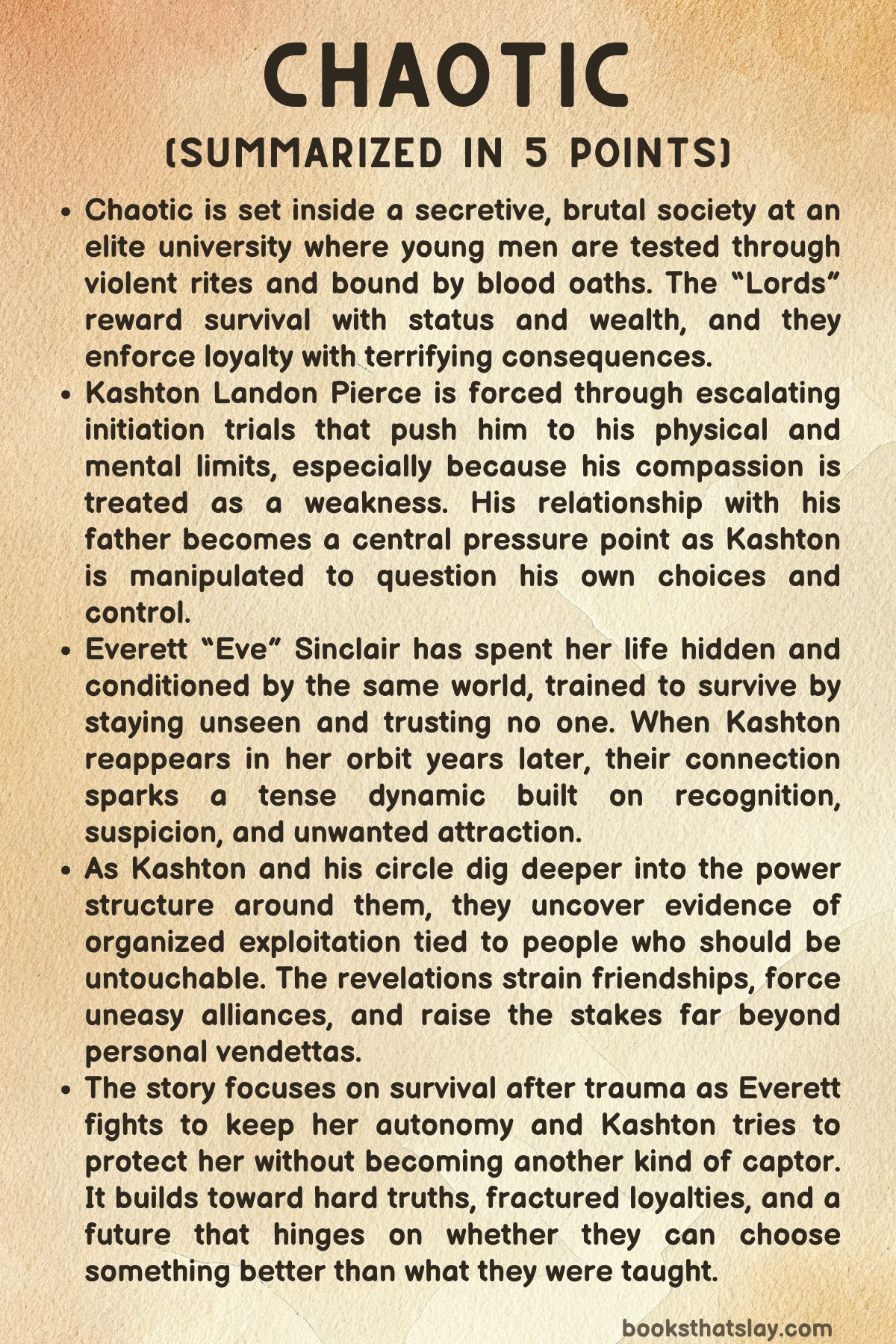
Chaotic (L.O.R.D.S. #7) by Shantel Tessier is a dark romance set inside the “Lords” world, where power is inherited, violence is ritual, and survival is treated like a privilege. At Barrington University, young men are molded through engineered fear, blood oaths, and tests meant to strip away empathy.
Kashton Landon Pierce is pushed through these trials by a father who wants him hardened or broken. Years later, one woman—known as Everett “Eve” Sinclair—reappears in his orbit, carrying secrets tied to the same society. Their connection sparks obsession, resistance, and a fight for control over their own futures.
Summary
Kashton Landon Pierce grows up under the shadow of a secret society known as the Lords, a network that hides behind wealth and influence while running brutal traditions in plain sight. At Barrington University, entry into their inner circle is earned through initiation trials designed to destroy weakness.
Kashton’s father, a Lord, oversees his son’s early tests with calculated cruelty because Kashton still shows compassion—something the society considers unacceptable.
During Kashton’s freshman initiation, he’s locked in a cell for days with barely any food or water, left to weaken until his body shakes with exhaustion. When he’s finally dragged into an arena called Carnage, masked Lords watch from above as if the violence is entertainment.
He’s given a brief chemical boost and a knife, then ordered to fight a larger opponent to the death. Injured and barely standing, Kashton manages to win, killing the man and collapsing as the drug fades.
He survives, but only earns the right to face the next round of trials.
In sophomore year, his father drugs him again and he wakes in an elevator descending into Carnage’s underground level. The place reeks of blood, and Kashton hears a woman pleading nearby.
The voice is unmistakable: Ashtyn, Adam’s twin sister and someone connected to his closest circle. He rushes to her cell and sees her restrained to a table, unable to reach her because the door won’t open and the keys vanish.
A masked Lord appears, assaults Ashtyn, then cuts her throat in front of Kashton. Moments later, Kashton finds what looks like his friends—Adam, Saint, and Haidyn—hanging with their throats cut.
Before he can process it, he’s struck and knocked unconscious.
Kashton wakes restrained to a chair while his father watches, cold and satisfied. His father frames the entire horror as Kashton’s failure: he didn’t “save them,” so he deserves the consequences.
To push him toward self-destruction, his father places a gun with a single bullet within reach and begins a countdown, daring Kashton to end his life. Kashton turns the gun toward his father instead, but at the last second fires away.
Then his phone rings. Haidyn is alive, calling him to meet up with Saint and Adam—who are also alive.
Ashtyn, too, is alive. The blood and bodies are gone.
Kashton realizes he has been drugged and manipulated; his father admits it was a hallucinogenic test designed to break him by making him feel responsible for everyone’s deaths. His father leaves Kashton with the gun anyway, suggesting there may come a day when Kashton uses it the “right” way.
By junior year, Kashton and his friends—Adam, Saint, and Haidyn—operate like a unit inside the Lords’ world. During an initiation carried out on a massive yacht party, they dispose of targets into the Atlantic with practiced efficiency.
While searching for Haidyn, Kashton collides with a blonde woman in a red dress. An older Lord grabs her and drags her away.
Hearing distress, Kashton follows, bursts into a suite, and kills the man during the confrontation. The shaken woman introduces herself as Eve, stays with him briefly, then disappears—taking his suit jacket.
When Kashton’s friends arrive, they confirm the dead man matches Kashton’s assigned target, even if the photo was outdated. They dump the body overboard and move forward.
In senior year, the final oath comes due. Kashton and the others are tied to posts in a courtyard while Lords gather to witness their last step into full membership.
Kashton’s father brands him with the Lords’ mark, formally welcoming him as a Spade brother—an enforcer tasked with punishing betrayal and protecting the society’s rules.
The story also follows Eve, whose real name is Everett Sinclair. As a child, she’s treated as property by her father and introduced early to the adults who control this world.
She learns to hide emotion, anticipate violence, and survive by staying useful. She also has moments where she seems to “see” another girl that no one else acknowledges, hinting at deeper fractures in her history.
Years later, Everett works in a cathedral-like setting where punishment is carried out under the guise of ritual. A captive Lord is cut and stitched like a lesson meant for others.
When Kashton and Haidyn arrive to retrieve the punished man, Everett forces herself to appear calm and professional, then urgently contacts an ally afterward—warning that the men have found her.
Kashton, unable to let go of the woman who vanished from the yacht, begins watching Everett. He tracks her to a gated community, learns her name through a realtor, and buys a house directly across the street so he can keep her within sight.
The realtor mentions a “daddy” figure who paid for Everett’s home, confirming her life is still tied to hidden power. Kashton is sure she can sense him watching.
He tells himself he won’t let her disappear again.
Everett, meanwhile, knows she has been hunted and controlled her entire life. She refuses to give any man the satisfaction of dictating where she can go.
One night she heads to a rundown bar beside a motel, dressing to appear like an easy target while staying alert. A married man approaches, predatory under polite flirting.
Everett plays along, guides him to a room, then quickly kills him—clean, efficient, and without hesitation. Kashton witnesses only the beginning and expects to find her trapped with another man.
Instead, he arrives after she’s gone and discovers the body: the man’s throat cut and a Lords crest branded into his chest. Under the bed, Kashton finds a hidden duffel with tools and weapons, recognizing Everett staged the encounter as a controlled execution.
He pockets the dead man’s phone and realizes Everett isn’t a victim waiting to be rescued—she’s someone trained to survive by striking first.
Kashton returns to Carnage, where the Spade brothers’ lives are already unstable: disappearances, kidnappings, and secrets piling up. Then Adam appears to die, triggering grief and fury.
Kashton attacks Easton “Sin” Sinnett, blaming him because Sin delivered Adam to Carnage under orders. Soon after, Kashton receives instructions sending him, Saint, and Haidyn to an airfield at midnight.
On a private jet, they meet allies and discover the truth: Adam is alive, his death staged as part of a covert operation connected to Dollhouse, a trafficking system involving breeders and the sale of children outside the society. Sin played his role convincingly because anything less would have gotten him killed—and risked his pregnant wife, Ellington, being “regifted” to another Lord.
Kashton tries to repair the friendship, but Sin keeps distance out of fear and self-preservation.
Everett confronts Kashton in the cemetery behind the cathedral at 3 a.m., furious that he’s stalking her. The confrontation turns physical when Kashton kisses her, but Everett uses the moment to sedate him with an injection to the neck.
She leaves him unconscious with a taunting warning that she won’t be controlled. Kashton wakes later, amused and more determined, treating her resistance like a challenge he intends to win.
Soon after, Everett returns to the cemetery and finds a mutilated woman’s body dumped there as a message. Police question her, but Everett calls her “attorney,” a Lord powerful enough to shut the inquiry down.
She knows the system won’t find a real record of her existence because the Lords erased her official identity long ago.
Then the worst of her past resurfaces in a recorded video: Everett restrained inside Dollhouse while a Lord named Evan demonstrates a “training” system meant to force compliance through chemicals, starvation, restraint, and mechanized assault. The footage shocks Kashton, Saint, and Haidyn—especially when it reveals a powerful man connected to Haidyn.
The truth hits harder: Everett is Haidyn’s half-sister. Bill, tied to Haidyn’s family, admits he once bought Everett out of Dollhouse for three million dollars, claiming he did it to save her and never touched her.
Medical records reveal she was severely malnourished, injured, assaulted, drugged, and driven to suicide attempts. She also became infertile due to injuries from a crash.
The group learns Garrett Spade and other men abused her for years and intended to use her as a breeder.
Haidyn confronts Everett publicly at Carnage, demanding whether she knew they were related. She admits she knew and never planned to tell him, believing she had to keep that door closed to survive.
Humiliated and panicked, Everett runs home—only to find an envelope containing her old records and a photo proving someone is dragging her history into the open.
Evan then appears inside her house, revealing he is her half-brother and claiming she “belonged” to him. He torments her with more recordings and attacks her after stealing her gun.
Everett fights back, stabbing him, but he seriously injures her and nearly overpowers her. She locks herself in the bathroom, bleeding, prepared to kill herself rather than be taken again.
Kashton, Saint, and Haidyn arrive in time, break in, and find her on the floor with a knife at her throat. They stop the bleeding, rush her to Carnage, and confirm through surveillance that Evan had been waiting for her, escalating the attack after she fled earlier.
As more threatening videos arrive from unknown numbers, Kashton becomes focused on protecting Everett, but she reacts badly to anything that resembles control. When he tries to take her to a therapist outside the Lords’ world, she panics, attacks him, and runs.
Her injuries reopen, forcing him to bring her back for stitches and sedation to keep her from tearing herself apart. Everett wakes ashamed and frightened, but Kashton stays firm: he still wants her, and he intends to keep her alive while Evan remains a threat.
Everett’s relationship with Ashtyn shifts when Ashtyn admits she treated Everett poorly out of fear and shame. In Las Vegas, Ashtyn had been involved with a couple, believing the woman was Everett.
Later, when Everett appeared at a wedding reception, Ashtyn panicked, thinking Everett would expose what happened and destroy Ashtyn’s marriage to Saint. The truth is darker and stranger: the woman in Las Vegas was Everett’s identical twin, Vivian, impersonating her for years.
Everett confirms she was in Vegas too, working with Adam to monitor Ashtyn and ensure Saint didn’t kill her. The revelation brings a tense reconciliation.
Everett feels relief knowing Vivian is dead and Evan has been imprisoned.
In the hospital, Devin and Gavin uncover hidden records from Everett’s time in the Lords’ control. A supposed fertility doctor, “Dr. Kelly Fran,” appears to be fake.
Devin presses Everett about what she remembers: as a teenager, she was taken, restrained, sedated, and returned sore and confused. Devin reveals the truth—her eggs were collected and frozen for years.
Though Everett believes she can’t carry a child, Devin explains that with Kashton’s sperm and a surrogate, they can still have biological children. The news hits both of them hard, opening a future Everett never allowed herself to imagine.
Sin and Ellington step in, offering help. Laura is medically cleared to act as surrogate, and the process moves forward, though it triggers Everett’s trauma because Laura once played a role in her captivity.
Everett fights through the panic anyway, pulled between fear and the desire to claim something good for herself.
Meanwhile, Kashton and the Spade brothers want Sin to become a Spade brother too, believing it’s the only way to protect Ellington and their children if Sin is killed or exposed—so Ellington won’t be “regifted.” Ellington resists, furious and terrified, but Sin insists it’s about survival.
Devin later uncovers more: Kashton’s father was a founder, and the men in power weren’t only trying to force Everett into pregnancy—they also planned to profit from her eggs because of her genetics. Another blow lands when Devin concludes Everett was never truly pregnant in the past.
Everett insists she was, describing the “proof” she was shown, but Devin explains fertility drugs can create false positives, and paperwork can be fabricated. The hysterectomy she believed followed a miscarriage was actually punishment, designed to permanently remove her ability to carry a child after her eggs had been taken.
Everett collapses under the realization that she carried years of guilt over a baby that never existed.
Kashton tries to steady her as they plan a life away from Carnage. He admits that when he believed Everett had died, he created a gravesite for her, her mother, and the baby she thought she lost, trying to give her a sense of family and rest even in death.
In the end, Kashton confronts Adam for keeping secrets, including the truth about the false pregnancy, and cuts him off completely. He also confronts Bill, who admits he orchestrated key events to keep Everett from being pulled deeper into Adam’s dangerous work and to place her in Kashton’s path.
Bill mentions a rumor that Everett might have been a triplet, but urges Kashton not to tell her, fearing it would trigger another spiral.
Eighteen years later, Kashton and Everett have built a stable life with their two children, Kennedy and Kaidyn. Everett continues therapy with support from Ellington and a community that holds her up instead of owning her.
Their home is affectionate and grounded, marked by what they survived, but no longer controlled by the Lords’ world.
Characters
Kashton Landon Pierce
Kashton is shaped by a brutal paradox: he has an instinctive compassion that his world treats as weakness, yet he’s forced to survive by becoming exactly what that world rewards—ruthless, efficient, and frightening. His initiations don’t just test endurance; they are engineered to break his identity, especially through his father’s staged “loss” designed to turn empathy into guilt and guilt into self-destruction.
What makes Kashton compelling is the way he refuses to fully surrender that core softness even while he learns to weaponize control; he kills when pushed, enforces when required, and still reacts viscerally to injustice when it’s in front of him. His fixation on Everett begins as protective obsession—an urge to prevent her from “slipping away” again—but it evolves into something more complex: a need to be chosen by someone who has never been allowed to choose freely.
Throughout the story, Kashton’s growth is less about becoming gentler and more about learning that safety cannot be manufactured through surveillance, force, or possession; the only kind that lasts is the kind Everett can consent to, even when her trauma makes consent messy, defensive, and volatile.
Everett “Eve” Sinclair
Everett is a survivor built out of secrecy, deprivation, and forced performance, and she functions like someone who learned early that being “good” doesn’t keep you alive—being prepared does. Her identity is fragmented by design: raised as a hidden asset in the Lords’ ecosystem, treated as property, and conditioned to expect punishment disguised as “care.” As an adult, her competence is striking—she can stage vulnerability as bait, read predators instantly, and execute violence with cold precision—yet those skills come from a life where intimacy equals danger and attention equals captivity.
Everett’s autonomy is her religion; even routine choices (going to the bar, walking into risk) are acts of defiance against a world that trained her to obey. The Dollhouse footage and later harassment expose the story’s cruelest truth about her: powerful men tried not only to control her body but to commodify her biology, turning reproduction into profit and punishment into policy.
Her panic around therapy and restraint isn’t irrational; it’s trauma memory dressed as present-tense logic, and the narrative repeatedly shows how easily “help” can resemble captivity to someone who was medically violated and chemically controlled. Her eventual stability isn’t depicted as forgetting the past, but as reclaiming authorship—accepting support, building family on her terms, and allowing love to be something other than a trap.
Haydyn
Haydyn reads as the most emotionally combustible of the Spade brothers, and his volatility makes sense once his personal stake is revealed: Everett is his half-sister, and her suffering becomes both a family betrayal and a moral indictment of the people closest to him. His rage is not only grief or protectiveness; it is humiliation at having been kept ignorant, plus horror at realizing his life is entwined with the very machinery that destroyed her.
The revelation that he once spared a captive woman during initiation, only for his father to reroute that mercy into Everett’s later nightmare, weaponizes Haydyn’s one “good” choice and turns it into lifelong guilt by association. He responds the way many trauma-adjacent characters do—trying to seize control through confrontation, public demands, and rigid certainty—because uncertainty is intolerable when the truth is this ugly.
Yet beneath the aggression is a real longing to repair what cannot be repaired; his insistence that Everett needs care, structure, and protection can be sincere while also repeating the Lords’ logic that safety is something men impose. His arc is essentially a struggle between those two impulses: protect through control, or protect through respect.
Saint
Saint embodies the Spade brother identity as a kind of disciplined violence—less impulsive than Haydyn, less openly haunted than Kashton, but no less dangerous. He moves through Carnage and the Lords’ rituals like someone who understands the rules intimately and has decided the only way to survive is to become fluent in brutality.
His relationship to Ashtyn is a pressure point because it connects his personal life to the chaos the Lords manufacture: disappearances, staged realities, and manipulations that punish vulnerability. Saint’s significance in the group is partly structural—he’s one of the pillars of their brotherhood—and partly thematic, because he represents what happens when you normalize horror: you can still love, still commit, still build a life, but the cost is constant proximity to violence as a language you never stop speaking.
Adam
Adam is the story’s strategist and the most morally complicated of the brotherhood because his actions consistently blur the line between protection and exploitation. His staged death and involvement in the Dollhouse operation position him as someone willing to sacrifice personal trust for operational secrecy, even when that secrecy destroys relationships.
The most corrosive part of Adam’s role is not the deception itself but the asymmetry of knowledge—he decides what others are allowed to know, and he does it in a world where ignorance can be lethal and truth can be shattering. The revelation that he slept with Everett while knowing her identity and history makes him emblematic of the Lords’ broader corruption: even “allies” can replicate harm when power dynamics are baked into the environment.
By the end, Kashton severing ties with Adam isn’t just personal betrayal; it’s a refusal to accept a version of loyalty that demands silence about abuse.
Ashtyn
Ashtyn is both a symbol and a person: symbolically, she is used early as the face of helplessness in Kashton’s hallucinatory trial, making her a tool in his father’s psychological torture, and that alone shows how little the Lords value women’s bodies and voices. As a person, she carries fear-driven cruelty—especially toward Everett—because her own history is riddled with flight, survival by reinvention, and the constant threat of exposure.
Her suspicion of Everett at the wedding reception isn’t born from simple jealousy; it’s panic from someone whose life depends on certain truths never surfacing, particularly truths tied to Vegas, Saint, and a lookalike woman who destabilized her sense of reality. Her reconciliation with Everett matters because it’s not a tidy forgiveness scene; it’s an admission that shame can turn people vicious, and that survival strategies can become weapons against the wrong targets.
Easton “Sin” Sinnett
Sin is defined by constraint: he operates under orders in a system where refusal can cost not just his life but his family’s safety, especially Ellington’s status as a “regiftable” commodity within the Lords’ marriage economy. His role in Adam’s staged death makes him a lightning rod for Kashton’s grief, which is tragically appropriate because Sin is one of the few characters who seems genuinely terrified of the machine they all serve.
He isn’t trying to win power so much as avoid annihilation, and that makes him more human and more cornered than the others. Sin’s refusal to fully reconcile with Kashton isn’t stubbornness; it’s survival math—friendship is risk, closeness is leverage, and exposure is fatal.
When the Spade brothers try to pull him deeper for protection, it lands as both pragmatic and horrifying: the only way to keep his wife safe is to bind himself tighter to the very institution that endangers her.
Ellington “Elling”
Ellington’s power is quiet but immense because she is one of the few characters who consistently names the truth beneath the Lords’ language: that “protection” often means ownership, and that security offered by violent men always has a price. Her pregnancy raises the stakes of every decision Sin makes, but the narrative also treats her as more than a motive—she has memory, fear, and a clear-eyed understanding of what becoming “protected” can cost.
Her anger at the plan to make Sin a Spade brother isn’t naïveté; it’s the reaction of someone who knows that climbing the ladder in a corrupt system doesn’t remove the system’s teeth. The epilogue’s detail that Everett continues therapy with Ellington is meaningful because it suggests Ellington becomes a stable witness—someone who understands the Lords’ world but isn’t seduced by it, and who can help Everett separate help from control.
Bill
Bill is one of the most unsettling figures because he presents as a rescuer while operating with the same godlike entitlement that defines the Lords: he buys Everett for an enormous sum, positions her in paths of danger, and withholds truths “for her own good.” Even when he insists he never sexually exploited her and frames his actions as love for her mother or a long attempt to save Everett from Garrett Spade, the method is still commodification—he solves a human problem with a purchase, reinforcing the market that created the problem. His later confession that he orchestrated key events to keep Everett from being pulled deeper into Adam’s work reveals a mindset where people are pieces on a board, not owners of their lives.
Bill’s complexity lies in the possibility that he is both protective and profoundly controlling, and the story uses him to underline a central theme: in this world, even “saving” can be a form of domination.
Kashton’s Father
Kashton’s father functions as the purest expression of the Lords’ ideology: he believes compassion is a defect and treats fatherhood as another arena for conditioning. His cruelty is deliberate and instructional—starvation, confinement, engineered combat, and the hallucinogen-fueled scenario are not impulsive abuse but curriculum.
What makes him especially dangerous is his philosophical coldness: he reframes torture as “lessons,” murder as “failure to save,” and suicide as a reasonable endpoint for weakness. By leaving Kashton a gun and implying he might use it “properly” one day, he plants a seed of self-destruction as inheritance, turning masculinity into violence pointed either outward or inward.
He is less a character you empathize with and more a mechanism of generational corruption—proof that the Lords reproduce themselves not just through breeding, but through indoctrination.
Garrett Spade
Garrett Spade is the story’s institutional monster, a figure whose power seems to extend into every violation Everett endures. He embodies the Lords’ practice of turning women into infrastructure—breeders, collectors’ items, disposable bodies—and his interest in Everett’s fertility and genetics reveals how thoroughly the society fuses sexual violence with eugenic-style profit.
Even in absence, his influence drives the plot because the damage he caused is still active: the frozen eggs, the fabricated pregnancy narrative, the hysterectomy as punishment, and the lasting fear that Everett’s body is never truly her own. Garrett’s death doesn’t resolve his impact, which is part of the point; systems built on exploitation don’t end when one perpetrator dies, because their procedures and secrets persist.
Evan
Evan is a personalized extension of Dollhouse cruelty: where the Lords are a system, Evan is the hand tightening the straps. His “training system,” chemical control, and mechanized punishment frame consent as something that can be engineered, which is precisely why his later intrusion into Everett’s home feels like a continuation of captivity rather than a new threat.
The half-sibling reveal adds a grotesque intimacy to his obsession, as if he believes biology grants ownership; he positions Everett as something that “belonged” to him and uses recordings and evidence not to seek justice but to reassert dominance. Evan’s role is also narrative escalation: he forces the other men to confront, unfiltered, what Everett survived, stripping away any comforting illusions that harm was ambiguous or “in the past.”
Vivian
Vivian operates like a ghost that wears a face: an identical twin who destabilizes identity, trust, and memory for everyone connected to Everett. The twist that Vivian impersonated Everett for years reframes prior paranoia and misrecognition, especially Ashtyn’s fear that Everett was returning to ruin her life.
Vivian’s presence suggests that in a world where women are treated as interchangeable assets, the ultimate horror is literal interchangeability—one woman’s face becoming another woman’s threat. Everett’s relief that Vivian is dead is not callous; it’s the exhausted relief of someone whose life has been repeatedly hijacked by other people’s narratives, and who cannot afford another version of herself being used against her.
Charlotte
Charlotte functions as a smaller-scale mirror of what the Lords do on a larger scale: she is moved, retrieved, and treated as someone whose location and safety must be managed by powerful men. Her presence beside Everett at Carnage emphasizes how normalized female endangerment is in this world, and how women can become collateral in conflicts between men.
Even without extensive interiority in the summary, Charlotte’s role heightens urgency, giving Haydyn’s “pick her up” request the weight of a potential last call and reminding the reader that chaos in this society spills onto anyone nearby.
Amber
Amber appears in the practical machinery of Kashton’s pursuit—helping him secure a house across from Everett—so she represents how easily obsession can be supported when wealth and connections remove friction. She isn’t framed as malicious, but her role shows that stalking can be disguised as logistics when the stalker has resources and the system doesn’t protect the target.
In that sense, Amber becomes part of the story’s critique: enabling doesn’t require evil intent; it only requires unquestioning participation.
Devin
Devin serves as the investigator and truth-extractor, the character who turns suspicion into documented reality. His discovery of hidden medical records and the fake “Dr. Kelly Fran” identity exposes how the Lords rely on bureaucratic camouflage—paperwork, clinics, and professional language—to sanitize assault.
Devin’s most important function is emotional as well as factual: he dismantles Everett’s belief that she was truly pregnant, replacing a lifetime of guilt with a different grief, and that kind of revelation is both mercy and violence. By offering the possibility of biological children through surrogacy, he also shifts the narrative from survival to futurity, creating a path that isn’t defined by what was taken but by what can still be built.
Gavin
Gavin is the clinical witness to Everett’s injuries and the quiet validator of how severe her past was: malnourishment, dehydration, assault indicators, suicide attempts, and long-term reproductive harm. In a story full of men who reinterpret harm to suit their agendas, Gavin’s role is grounding because medicine, at its best, names reality without moral spin.
His presence also highlights the tragedy that Everett’s body became a project for powerful men—injure it, control it, harvest from it—and that healing requires someone who treats her as a patient, not an asset.
Laura
Laura is one of the most emotionally thorny supporting characters because she occupies both the trauma-space and the healing-space in Everett’s mind. Everett’s fear during the surrogacy procedure isn’t just procedural anxiety; it’s a flashback response to a history where “treatments” were coercion and “tests” were threats.
The fact that Laura is medically cleared to carry Everett and Kashton’s child forces Everett to confront a brutal psychological contradiction: someone associated with her captivity is now part of her future. Laura’s narrative function is to show how recovery often involves contaminated symbols—things that once meant harm can later mean hope, and the nervous system doesn’t accept that switch easily.
Dr. Kelly Fran
“Dr. Kelly Fran” is less a person than a mask, but the mask is the point. The fake identity embodies institutional predation: the Lords don’t only hurt people in basements; they build professional-looking corridors to funnel abuse through hospitals, paperwork, and plausible deniability.
The alias represents how systems of power launder violence through legitimacy, making crimes harder to prove and victims easier to discredit.
Kennedy and Kaidyn
Kennedy and Kaidyn, seen in the far-future epilogue, represent a radical outcome for this world: continuity without captivity. Their existence is not just a happy ending detail; it’s a thematic rebuttal to the Lords’ breeding economy and genetic profiteering.
Where the society tried to turn Everett’s reproduction into property, her eventual family is framed as chosen, nurtured, and supported—evidence that the past can shape a life without owning it.
Themes
Power, Ritual, and the Machinery of Control
From the opening explanation of how the Lords operate, Chaotic frames power as something manufactured through ritual rather than earned through merit. The initiations are not simply tests of endurance; they are structured systems designed to break autonomy and replace it with obedience.
The blood oaths, the branding, the public spectatorship of violence, and the way punishment is staged like theater all communicate that the Lords’ authority depends on making people participate in their own fear. What makes this especially corrosive is how control is normalized as “tradition,” so cruelty becomes an institution rather than a personal failing.
Kashton’s journey shows how the society weaponizes proximity: the people who should protect you—fathers, mentors, family allies—are the very ones permitted to harm you, which traps candidates in a world where resistance feels pointless. The hallucinogen episode is a concentrated example of this logic.
The goal is not only to scare Kashton, but to rewrite his sense of reality and responsibility, so that even what he sees and feels can be turned into evidence of his weakness. In that environment, power is not merely physical dominance; it is the ability to define the narrative afterward and force the victim to carry the meaning.
The society’s rules around “chosen” women and mandatory marriages extend the same framework into intimacy, treating relationships as property assignments that reinforce hierarchy. Even when Kashton gains status as a Spade brother, the story keeps questioning whether advancement inside a violent system is victory or simply another method of containment, because acceptance requires agreeing that this structure is the world’s natural order.
Trauma, Memory, and the Fight to Keep the Self Intact
The book repeatedly shows that trauma is not confined to the moments of violence; it survives as a pattern that shapes perception, body responses, and decision-making. Everett’s life is defined by being erased and hidden, and that invisibility becomes both shield and prison.
Her routines—how she moves through public spaces, how she reads threats, how she sets traps—are survival skills built from repeated harm, yet they also reveal how little room she has to live without anticipating danger. The narrative treats memory as unstable not because it is vague, but because it has been manipulated by people with power.
The falsified pregnancy is devastating precisely because it demonstrates that even deeply held grief can be manufactured and used as leverage. Everett’s belief in a lost child becomes a long-term instrument of control, producing guilt that keeps her compliant and ashamed, and then that “truth” is ripped away, forcing her to mourn not only what she thought happened but also the years stolen by the lie.
Kashton’s hallucinogen trial mirrors this, showing how psychological torment can be designed to create emotions that feel authentic—panic, blame, helplessness—while being entirely engineered. Across both characters, the theme is not simply “they suffered,” but that suffering reshapes identity: Everett’s panic around therapy, her instinct to flee when she senses restriction, and her readiness to choose death over recapture show a nervous system trained to treat help as another trap.
Recovery, then, is not presented as forgetting; it is portrayed as rebuilding trust in one’s own mind and body after other people have tried to claim ownership over them.
Violence as Currency and the Moral Cost of Survival
In Chaotic, violence is not random; it is a form of social currency that grants access, status, and safety. Kashton’s early trials demonstrate that survival itself is an entry fee, and once paid, it changes what he is expected to do for others.
The story pushes the reader to notice how quickly a person can be forced into committing harm to avoid becoming the harmed one, and how that shift complicates moral identity. Kashton is repeatedly positioned at the edge of compassion, yet he is also trained to kill, dispose of bodies, and enforce rules that erase people.
His discomfort does not absolve him, and the narrative keeps that tension alive by showing him both as someone capable of protective instinct and as someone whose role requires brutality. Everett’s motel-room execution adds another layer: she uses violence with precision, not as cruelty, but as a controlled response to predation.
That scene reframes the usual victim narrative; she is not powerless, and her capacity to kill becomes a sign of the world she was shaped by. Yet the book also suggests the cost of such competence: when violence becomes the reliable solution, it narrows the range of possible lives.
The Lords’ world encourages this narrowing because it rewards those who can do harm without hesitation, creating a culture where empathy is a liability. Even operations against Dollhouse, which appear aimed at stopping exploitation, still require deception, staged deaths, and ruthless calculation.
The result is a moral landscape where characters often choose between two terrible options, and the “right” choice is defined less by ethics and more by what keeps them alive and keeps their people from being taken.
Identity Erasure, Secrecy, and the Politics of Being “Unreal”
Everett’s statement that she officially doesn’t exist reveals how secrecy becomes a political weapon. In Chaotic, invisibility is not simply hiding; it is a structural condition created by powerful men who can delete records, erase histories, and decide who counts as a person.
That kind of erasure is a form of violence because it removes access to protection, justice, and recognition. When police can’t find records, it’s not just convenient for the Lords—it ensures that victims cannot appeal to systems outside the Lords’ control.
The story repeatedly shows how secrecy fractures relationships as well. Adam staging his death, Bill withholding essential truths, and the constant use of misinformation create a world where intimacy is always compromised by strategy.
This forces characters into a paranoid logic: if everyone is hiding something, then trust becomes dangerous. The twin revelation amplifies this theme by making identity itself unstable.
Vivian impersonating Everett turns the idea of self into something that can be stolen and used, and it also explains why Everett’s social world reacts to her with suspicion and fear. The rumor of a possible triplet extends the same instability into the future, suggesting that even family history is uncertain in a world built on concealment.
What stands out is how secrecy functions as both survival and control. Everett hides because disclosure could get her killed or reclaimed, but the Lords hide truths to keep power.
The same tool—silence—serves opposite purposes depending on who wields it. The book’s later movement toward stability suggests that healing requires more than escaping violence; it requires becoming visible on one’s own terms, with a name, a community, and a life that cannot be revised by someone else’s files.
Brotherhood, Loyalty, and the Damage Caused by Necessary Lies
The bond among Kashton, Adam, Saint, and Haydyn is portrayed as intense, but it is repeatedly strained by the same environment that forged it. Their loyalty functions as a survival pact inside a world that treats friendship as leverage.
When Adam’s death is staged, the grief is real because the performance succeeds, and that success shows how the Lords’ culture demands that even allies be manipulated. The Dollhouse operation reveals why secrecy is used—exposure would mean death or worse—but the emotional cost is severe.
Kashton’s rage at Sin, and later the fracture between Kashton and Adam, demonstrate how betrayal can occur even when intentions are protective. Haydyn learning Everett’s identity and the withheld truth about her past detonates years of trust in seconds, because it confirms that the people closest to him decided what he was allowed to know about his own family.
Sin’s fear for Ellington also shows how loyalty is distorted by the society’s rules: marriage and pregnancy are not purely personal; they are political vulnerabilities that can lead to “regifting.” That forces men into decisions that look like ambition but are actually defensive moves to keep loved ones from becoming property. Brotherhood in Chaotic is therefore not idealized; it is shown as something constantly tested by power structures that reward deception.
The epilogue’s quieter community—Everett supported by Ellington, family life grounded in stability—suggests an alternative model of loyalty, one less about secrecy and dominance and more about shared care. But the earlier damage remains important: the story shows that “doing it for the right reasons” does not prevent harm when the method is lying, and that rebuilding trust requires more than explanations—it requires changed behavior and a willingness to accept consequences, even if that means losing a friendship forever.