Diamond Dust Summary, Characters and Themes
Diamond Dust by K F Breene is a fast-paced fantasy romance set between magical San Francisco and a corrupted fae realm where power is political, deadly, and often personal. Daisy, an ordinary human in the middle of an extraordinary magical community, is abducted into Faerie and forced into court “games” designed to entertain royals and destroy rivals.
Her best chance at survival is Tarianthiel, a feared, brilliant warrior with a ruined past and a plan that could change an entire kingdom. As Daisy discovers what she truly is—a living key to balancing magic—she becomes both a weapon and a prize, with gods, courts, and monsters watching her every move. It’s the 2nd book and the conclusion of the Shadowbound Fae series.
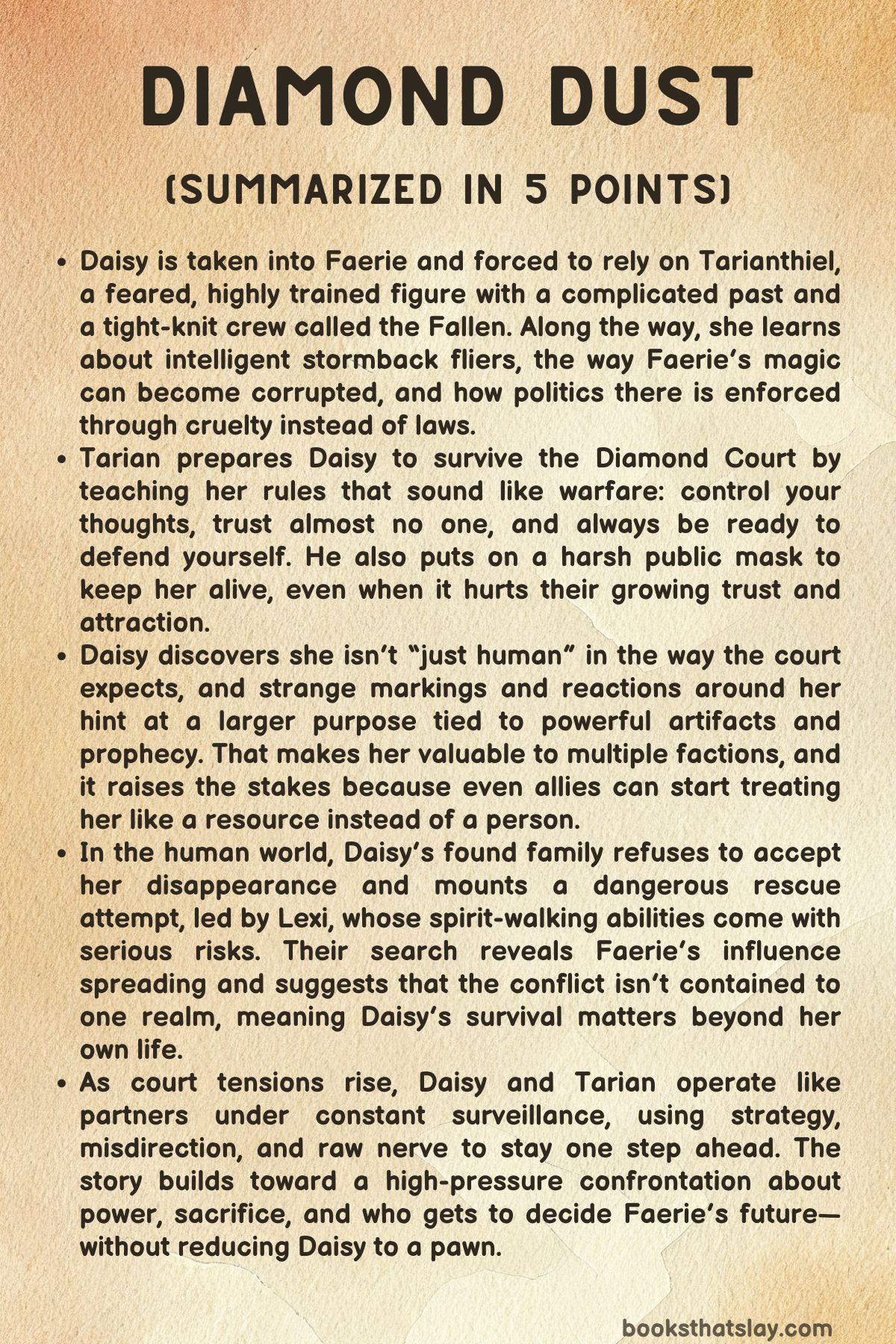
Summary
Daisy is taken from her life in magical San Francisco and dragged into Faerie, where the rules are cruel and the powerful treat people like property. Her captor and reluctant protector is Tarianthiel—Tarian—leader of a brutal-looking group called the Fallen.
They aren’t ordinary fae soldiers. They carry themselves like trained elites, marked by scars, ink, and a shared hatred of the court that broke them.
Tarian’s goal isn’t simply to keep Daisy alive. He needs her to survive long enough to play a dangerous role inside the Diamond Court.
Before entering the castle, Tarian introduces Daisy to the stormbacks: massive winged creatures with fur, feathers, horns, and the intelligence to judge a rider’s worth. They communicate mind-to-mind through images and emotion, and they loathe fae corruption.
Daisy can’t shield her thoughts, which makes her a risk, but she forces herself to stay steady under their scrutiny. One stormback, Stratow, takes a particular interest in her, sensing she doesn’t feel like the fae they dislike.
As they prepare to fly, Daisy learns that Faerie’s magic functions like a system that feeds back into itself. When royals or powerful creatures become twisted by unbalanced power, it spreads into the land and the people.
The more corruption grows, the more the entire realm changes—shadows become predators, cruelty becomes normal, and survival depends on learning the rules quickly. Tarian explains that some beings can’t be saved, and balance sometimes requires destruction.
Daisy also begins to understand who Tarian really is. Beneath his intimidating presence, he carries marks that identify him as something rare and feared: a High Sovereign with a past tied to the Celestials.
He has endured trials that no one else has completed, and his success made him a threat to the Diamond Court long before Daisy arrived. The Fallen reveal that they once had wings—taken from them by Equilas—leaving them grounded, stripped of proof of what they were.
Tarian blames himself for their suffering and tries to keep Daisy emotionally distant, even as attraction between them keeps breaking through.
When Daisy rides Stratow with Tarian behind her, the flight is terrifying: freezing air, brutal speed, and the sense that a single mistake means death. Tarian shields her with magic and his body, and Daisy holds on, not just to survive, but because she understands one thing clearly: if she breaks, her family back home will pay the price.
Stratow calls her unusual—possibly important—and warns her to be careful.
They arrive at a huge castle after dark. The Fallen become tense immediately, treating the place like a battlefield.
They warn Daisy that the shadows themselves can spy, kill, or trap her. Then Tarian switches personas.
In front of watchers, he becomes cold and vicious, orders Daisy to be thrown into the dungeon, and speaks about her in degrading terms to sell the illusion that she is nothing more than his captive. Daisy is hurt and furious, but she keeps her anger focused on staying alive.
In the dungeon, Daisy is chained, inspected, and treated like an object by shadow-faced guards. She holds back her urge to attack too early, learning that escalation can get her killed before she ever finds a way out.
Soon, she is taken for a procedure meant to control her mind: a “mind shiv” that forces a temporary barrier in her thoughts so she won’t be exposed to mind-reading nobles. The pain is severe, and when it ends, the technician—Bangs—panics.
Instead of the expected dark mark, Daisy’s neck shows shimmering symbols like diamond dust.
The fear in the room shifts fast. Bangs suspects Daisy isn’t human at all, and he hints that Tarian may be plotting against the royals.
Lennox thinks a quick solution: kill the technician. Daisy, still raw and overstimulated from pain and fear, reads the intent as a direct instruction and kills Bangs instantly.
Kayla and Lennox are stunned, then impressed. Daisy isn’t just tough—she is lethal.
Tarian returns to the dungeon and stages a scene for eavesdroppers, using sex and intimidation to reinforce the idea that Daisy is under his control and that anyone who touches her will die. A mutilated guard left as a warning makes the point.
In private, Tarian checks Daisy’s neck and realizes the diamond-dust mark signals prophecy and danger. It may force him to publicly claim her in a way that paints a target on both of them.
He warns her to hide the mark and knocks her unconscious to end the encounter cleanly for any unseen listeners.
While Daisy fights to survive in Faerie, her family and allies back in San Francisco organize a rescue. Alexis “Lexi,” a Spirit Walker with terrifying abilities over souls, tries to track Daisy across realms.
At first she can sense Daisy like a fading echo, then Daisy vanishes as she crosses into a different spirit plane. Lexi, Kieran, and their group eventually enter a portal to Faerie and find a waypoint land used to funnel livestock and stolen people into the courts.
Lexi discovers stranded spirits everywhere—evidence that death and magic work differently here, and that many never find peace.
Inside the Diamond Court, Daisy is pulled deeper into political violence. A scribe named Eldric pierces her mind shield with ease and calls her “Chalice,” implying she can balance magic by strengthening it or stripping it away.
He warns that the king will alter the court games to torment her. Tarian confirms Eldric’s knowledge is usually reliable and begins shaping Daisy into something the court will fear.
Daisy accepts the role with grim clarity: if she has power that can ruin the corrupt rulers, she will use it.
As Daisy and Tarian move through the court, Daisy sees the spread of twisted magic on nobles’ skin—black vein-like lines, grayish rot, and an ugliness they can’t or won’t recognize in themselves. A noblewoman flirts with Tarian, and jealousy triggers Daisy’s instinctive power.
She siphons the woman’s magic without fully understanding her limits, draining life as easily as breath. The court notices.
Daisy then makes a public display with Tarian, using shock and dominance to send a message: touching her comes with consequences. The price becomes real when a noble collapses dead, and whispers spread that Tarian caused it.
The royal family proves worse than rumors. The princess Elamorna attacks Daisy’s mind.
The king himself appears grotesquely degraded by corrupted power, and he focuses on Daisy with hunger and entitlement. He holds a diamond chalice that calls to Daisy’s core, and Daisy realizes the court isn’t just cruel—it is collapsing under its own rot.
Living shadows crawl and whisper about killing her. When the shadows strike, Daisy can’t simply erase them, so she learns to fight differently: she traces the source of conjured magic, finds the root, and snuffs it out.
The moment she succeeds, the Fallen stare at her like they’re seeing a weapon the court can’t handle.
The danger escalates fast. Ambushes come in corridors, conjured creatures swarm, and Daisy’s survival becomes a constant series of brutal choices.
Tarian admits the king’s fixation changes everything: Daisy is now a prize the king intends to claim, and if the royals think they can control chalice magic without Tarian, they will kill him. Daisy and Tarian agree on a shared goal—destroy the court before it destroys them.
Eventually, the conflict reaches a ritual designed to reset power in the realm. Daisy, marked by diamond dust and strange changes in her eyes, stands at the center with Tarian.
Eldric oversees multiple chalices arranged in a circular array, and the diamond chalice responds to Daisy like it recognizes her. Daisy accepts that she may need to die to stop the spreading corruption and protect the human world from what’s leaking through the portals.
Tarian tries to stop her, offering alternatives, but Daisy refuses to gamble with time when the threat is growing.
When Daisy takes the chalice and the ritual begins, the power is too much. It floods her body, crushes her from the inside, and tears her soul free.
At the same time, Lexi and the rescue team storm the castle, guided by strange helpers and rising pressure in the air that signals massive magic. They arrive to find Daisy dead in Tarian’s arms.
Lexi refuses to accept it. She forces open the veil between life and death and sees a local afterlife god trying to claim Daisy.
Another figure—Hades—appears and pushes Daisy to fight her way back, admitting the gods are playing games with stakes Daisy never agreed to. Lexi reconstructs what anchors Daisy’s soul to her body, uses spirit power to pull her back, and with help from Kieran and Faelynn, forces Daisy’s return.
Daisy wakes, clutching the chalice and reaching for Tarian, alive by sheer will and the stubborn love of her people.
The victory is interrupted when the battlefield shifts into a divine hall with thrones—a place where gods hold court. Equilas and others reveal they engineered much of what happened, treating Daisy and Tarian like pieces in a contest.
They declare Daisy the crystal chalice and name her Tarian’s fated mate, claiming even Tarian’s ink changed because of their bond. They offer Tarian a cruel choice tied to the Diamond Throne, one that would demand more blood to secure power.
Daisy rejects their trap. She refuses to be a tool for divine entertainment and chooses the human world instead.
A deal is made: Tarian will live in San Francisco with restrained magic and altered appearance, unable to claim the throne. The Fallen regain their wings and choose their own futures—many following Tarian to help guard portals and keep Faerie’s influence from spreading unchecked.
Months later, the household in magical San Francisco is loud and chaotic again, but changed. Daisy now carries power that can either strip magic away or boost it, and she keeps her identity quiet to avoid becoming a target.
Tarian adapts to the human world with his own brand of flair, the Fallen carve out purpose as guardians, and Daisy settles into a new reality: she survived a court built to break her, and she came home with the strength to ensure no one gets to use her—or her family—ever again.
Characters
Daisy
Daisy begins as a human “Chester” who is suddenly thrust into Faerie’s violent political ecosystem, and her defining trait is how quickly she adapts without losing her moral center. What makes her compelling in Diamond Dust is the way fear and defiance coexist in her: she is genuinely terrified on Stratow’s back, struggling for breath and control, yet she turns that terror into resolve by anchoring herself to her family and the promise that she will survive to protect them.
Her power as the chalice is not just a magical upgrade; it becomes a psychological pressure-cooker that forces her to decide what kind of person she will be when survival requires brutality. Daisy repeatedly chooses action over passivity—killing Bangs when she believes Lennox’s thought is an instruction, siphoning magic from a flirting noblewoman until the woman dies, and learning to “see” the structure of conjured magic so she can sever it at the root.
At the same time, she refuses to let Faerie’s corruption define her future; even after death and resurrection, she keeps her identity grounded in chosen family, humor, and stubborn agency, ultimately rejecting the gods’ designs and choosing a life in the human world where she can wield her crystal chalice power on her own terms while hiding it to avoid becoming a symbol people fear.
Tarianthiel (Tarian)
Tarian is built from contradictions: he is both protector and threat, both the most capable player in the court’s blood games and someone disgusted by what those games force him to become. His history as a Celestial prince and High Sovereign explains the aura of authority people momentarily recognize before fear overrides it, and his “rings of ascension” mark him as a singular outlier—someone who has mastered every trial and therefore represents an existential political problem to the Diamond Court.
The deepest tragedy in Tarian’s character is that competence becomes a curse: his advantages make him useful, but also make him dangerous to the ruling order and devastating to those who follow him, including the Fallen who lost their wings because of his proximity to power. His relationship with Daisy is not a soft escape from that life; it is a strategy and a tether, because intimacy becomes camouflage, distraction, and sometimes the only way to keep her mind and body from being taken by sentient shadows or mindgazers.
Yet under the ruthless persona he performs, Tarian’s tenderness is persistent—he creates safety in flight, warns her to kill first, arranges mind protection, and repeatedly positions himself as the target so Daisy can remain alive long enough to learn. His arc in Diamond Dust resolves when he rejects the throne-and-murder path demanded by fae tradition and by Equilas’s “choice,” choosing instead a constrained life in the human world, which is the first truly self-directed decision he’s been allowed in centuries of manipulation.
Stratow
Stratow represents a non-fae intelligence that refuses to be subordinated by court politics, and his presence is a reminder that Faerie’s ecosystem contains powers that do not automatically accept royal authority. He is ancient-feeling, sarcastic, and proudly independent, communicating through emotions and images while still understanding language well enough to judge character and intent.
Stratow’s interaction with Daisy highlights how quickly he evaluates “otherness”: he finds her strange, amusing, and unexpectedly worthy, not because she is strong in a conventional sense, but because she carries courage and sincerity that cut through fae artifice. His storm-making ability also functions as a narrative embodiment of balance—storms are not punishment but nature, and his comfort inside them contrasts with Daisy’s fear, underlining her humanity.
By calling her an “unlikely hero” and treating her as someone who might shift the realm’s fate, Stratow becomes one of the first beings in Faerie to acknowledge Daisy as more than property or spectacle.
The Stormbacks
The stormbacks are a collective character in their own right: sentient, proud, and deeply attuned to magical “purity,” acting as living barometers for corruption in the land and in rulers. Their refusal to tolerate fae arrogance flips the usual hierarchy—fae nobles who dominate courts cannot dominate these creatures, because stormbacks can simply refuse service.
Their mind-to-mind communication also creates a special kind of vulnerability for Daisy, who cannot shield her thoughts early on, forcing her to develop self-control not as etiquette but as survival. Symbolically, stormbacks embody a form of natural judgment that exists outside law; they do not debate politics, they feel imbalance, and their discomfort around twisted magic is an ecological warning about what the courts have done to their world.
The Fallen (as a group)
The Fallen function like a scarred brotherhood whose humor and cruelty are both coping mechanisms and battlefield discipline. Their uniform look—tattoos, shaved heads, minimal armor—reads like a deliberately constructed identity, replacing the status and beauty of wings with visible toughness and unity.
What defines them is not just loyalty to Tarian but shared violation: Equilas stripped their wings and erased proofs of what they were, leaving only scars, which turns them into living evidence of divine and royal violence. They oscillate between mocking Daisy and protecting her because they understand exactly what it means to be used as an object in the court’s games, and their instructions—trust only them, eat only what they provide, assess every room for weapons—show a worldview where survival depends on constant readiness and preemptive force.
Even when they perform cruelty in public, it is frequently tactical theater, a mask designed to keep them and Daisy alive inside a system that punishes softness.
Kayla
Kayla is the Fallen member who most clearly embodies pragmatic caretaking, a protector who understands that tenderness must often be disguised as rough handling in hostile environments. She is sharp-eyed about threats that are social as well as magical, and she translates court realities into actionable rules for Daisy without sugarcoating them.
Kayla’s anger is morally instructive: she is furious when Daisy is harmed, but she channels that rage into strategy—hiding Daisy’s knife, insisting on a cell that preserves Daisy for the games, selling the illusion of captivity in the corridors, and disposing of Bangs’s body to protect their larger plan. Her respect for Daisy grows fast because Daisy proves she can act decisively and lethally, and Kayla’s support becomes one of the stabilizing forces that keeps Daisy from being isolated into helplessness.
Revana
Revana plays the role of reinforcing the Fallen’s hard-earned doctrine: survival in the twisted court requires becoming what the court expects you to be, at least on the surface. She helps contextualize Tarian’s abrupt switch into cruelty as a deliberate adaptation to corrupted power and royal scrutiny, and her value lies in her ability to treat emotional pain as a tactical risk.
Revana’s presence underscores the group’s internal discipline—no matter what they feel, they prioritize the performance that keeps Daisy alive and keeps their enemies uncertain.
Gorlan
Gorlan embodies the Fallen’s blunt physicality and the constant hair-trigger violence of court life, but he is also a measuring stick for Daisy’s transition into the group’s reality. When Daisy spits and accidentally hits him, the moment reveals how thin the line is between insult and lethal consequence in this environment.
Later, his willingness to fight alongside the others, coat blades with blood-magic, and treat Daisy’s participation as both dangerous and impressive shows that he respects competence more than status. Gorlan’s character reinforces that among the Fallen, worth is proven through action, not lineage.
Lennox
Lennox is a quiet hinge-point character because he demonstrates how thought, intention, and violence blur in a world of mind access. His internal “Kill him, quickly” is read by Daisy as a literal directive, and that misunderstanding becomes a pivotal revelation: Daisy is not an ordinary captive who freezes, she is a weapon who moves.
Lennox’s shock turning into impressed respect shows how rapidly Daisy alters people’s expectations, and his role as escort and enforcer places him in the uncomfortable middle ground between following orders and recognizing that the “slave” in front of him is becoming something far more dangerous than the court understands.
Niall
Niall functions as part of Tarian’s guard reality, the kind of steady presence that signals how much of Tarian’s life is spent anticipating ambush. His conversations with Daisy emphasize preparation, boundaries, and the fact that even within “safe” quarters, nothing is truly safe.
Niall’s role is less about individual transformation and more about reinforcing the system Daisy is entering: everyone is a sentry, everyone is a potential target, and loyalty is demonstrated through readiness.
Faelynn
Faelynn is the story’s crucial counterbalance between violence and repair, serving as both literal healer and moral proof that care still exists inside a rotten court. Her healing of Daisy after shadow magic slices her open keeps Daisy alive long enough to become a true threat to the royals, but Faelynn’s importance expands later when she arrives during the resurrection attempt and supports the fragile work of returning a soul to a damaged body.
She represents competence without cruelty, suggesting that even within corrupt systems, some individuals choose restoration over domination, making her a quiet pillar of the protagonists’ ability to keep going.
Bangs
Bangs is a minor character with major thematic weight because he illustrates how institutions of control operate through “procedures” framed as routine. The mind-shiv is presented as protection while functioning as a means of containment, and Bangs’s panic when he notices Daisy’s unusual result shows how quickly professionals become liabilities when they discover inconvenient truth.
His death is a sharp demonstration of Daisy’s evolving lethality and of how court survival often punishes hesitation; the moment also signals that Daisy’s body is becoming a living text of prophecy, something that terrifies anyone who understands what it implies.
Eldric
Eldric is a knowledge broker who weaponizes literacy and loopholes, and he functions as the story’s interpreter of prophecy and power mechanics. As a scribe who can bypass mind shields, he represents a subtler kind of dominance than brute force, because he can reach inside where others cannot.
His calling Daisy “Chalice” and describing her as a balancer—able to amplify or wither magic—frames her not as a prize but as a systemic correction, which is why he pushes urgency and warns that the king will reshape the games around torment. Eldric’s delight in the ritual objects lighting for Daisy reveals his own obsession with the architecture of magic, and his role in the final ritual makes him morally ambiguous: he is essential to saving the realm, but he is also comfortable treating Daisy’s potential death as a necessary mechanism in a grand design.
Princess Elamorna
Elamorna embodies the court’s sexualized cruelty and the way power in this realm expresses itself as humiliation and violation. Her history of publicly torturing Tarian and trying to force arousal is not merely personal sadism; it is political theater designed to break a rival and demonstrate ownership in front of an audience that feeds on degradation.
The black vein-like marks on her body make her a visual emblem of twisted magic’s spread, and her repeated attempts to invade Daisy’s mind show that her power is predatory and entitled. Elamorna’s conflict with Daisy and Tarian is also a clash of control styles: she uses coercion and spectacle, while Daisy and Tarian use strategic intimacy and public defiance to flip shame into intimidation.
The King of the Diamond Court
The king is the most concentrated symbol of the realm’s rot: physically grotesque from twisted magic and politically sustained by a culture that normalizes corruption because admitting it would collapse the hierarchy. His fixation on Daisy is not romance or even simple lust; it is acquisitive hunger tied to the chalice’s pull, a desire to consume what might restore or elevate power.
By declaring Daisy unprotected because she is human while simultaneously “guaranteeing” her protection for his own purposes, he demonstrates how law in the court is merely the king’s appetite translated into policy. His possession of the diamond chalice and the way it calls to Daisy positions him as a gatekeeper of the very power that could end his reign, which is why his presence is both immediate threat and inevitable target.
The Queen
The queen’s sidelined position, marked by a smaller throne and reduced visibility, signals a court where even the highest-status figures can be diminished when they no longer serve the dominant narrative. She functions as a portrait of complicity and survival within tyranny, someone present at the center of power but not necessarily controlling it.
Her reduced role also highlights that the court’s true drivers are corruption, spectacle, and fear, not stable governance or partnership.
The Princes
The princes illustrate different trajectories of decay and the faint possibility of something else. The badly affected prince shows what twisted magic does when it saturates a person beyond recovery, turning royalty into another strain of sickness in the system.
The youngest, described as gentler, suggests that temperament still exists under the corruption, which complicates the simplistic idea that all royals are identical monsters. Together they emphasize that the royal family is not a unified front of personalities, but a unified front of privilege that still feeds the same diseased cycle.
Alexis “Lexi”
Lexi is the story’s moral fury made functional, a rescuer whose love expresses itself through relentless motion and terrifying capability. As a Spirit Walker who can rip out souls and reanimate bodies, she carries power that is inherently high-stakes, and her struggle to control it makes her both dangerous and disciplined, someone constantly choosing restraint so she can be effective when it matters.
Her search for Daisy shows the limits of power across realms: the soul-tracking echo vanishing is a reminder that even the strongest abilities have boundary conditions. Lexi’s defining moment is the resurrection, where she refuses to accept cosmic ownership and physically drags a friend back from death by rebuilding soul anchors and forcing a path through resistance from gods.
Even when the afterlife god steals Mia and John, Lexi’s response is not collapse but recalibration, and that adaptability under duress makes her the backbone of the human-side family.
Kieran
Kieran is the pragmatic magical engine of the rescue effort, the one whose power translates into breached doors, blasted stone, summoned waves, and sustained physical interventions like pumping Daisy’s heart when seconds matter. He balances Lexi’s spirit-domain dominance with tangible battlefield control, making him the kind of ally who can hold the line while others do delicate work.
His later role in negotiating the deal that allows Tarian to live in the human world shows that Kieran is not only a combatant but also a builder of systems, someone thinking in terms of long-term containment like portal guarding rather than just immediate victory.
Bria
Bria operates as a steadying teammate within the human crew, someone present in the logistical and emotional reality of Daisy’s disappearance and the push into Faerie. While she is less individually spotlighted than Lexi or Kieran, her role matters in the collective competence of the rescue group, especially during the undead retaliation where coordinated fighting and survival determine whether the team can keep moving.
Bria’s presence reinforces that Daisy is not saved by a single hero but by a network that refuses to let her be isolated.
Frank, John, and Mia
These ghost allies reveal how loyalty can persist past death, and they expand the story’s concept of family into the spirit domain. Their insistence on coming despite Lexi’s objections shows agency rather than passive haunting, and their discovery that many spirits are trapped in the waypoint land exposes a spiritual ecology damaged by the courts’ activities.
When the local god claims Mia and John for “safekeeping,” it reframes ghosts as assets contested by divine authorities, not just companions, and it heightens the stakes of Lexi’s power: every use of spirit becomes an act that attracts predators.
Jack
Jack’s role in pumping Daisy’s heart alongside Kieran highlights him as part of the human team’s hands-on reliability, someone who contributes through immediate, physical effort when magic alone is not enough. In a narrative full of grand powers and divine games, Jack represents the grounded reality that sometimes survival depends on persistence and muscle, not prophecy.
Mordecai
Mordecai functions as both a personal stake and a living proof of what Daisy’s world contains: he is tied to the household’s history, to being cured, and to the fierce protectiveness that defines their found family. His frantic sprint toward Daisy when the rescue team nears the ritual room reads like instinctive loyalty, and his wolf form underscores the blend of domesticity and danger that characterizes their lives.
In the epilogue, Daisy’s playful “trap” for him on the stairs shows how affection and mischief survive even after trauma, and Mordecai becomes part of the story’s insistence that home is not fragile—it is loud, persistent, and worth fighting for.
Thane
Thane appears as a berserker force in the undead clash, a character defined by raw battlefield effectiveness. His inclusion emphasizes that the rescue is not a neat, surgical mission; it is war against unnatural escalation, requiring allies who can carve a path when the corridor becomes a slaughterhouse.
The Afterlife God (Nvran)
Nvran is territorial, possessive, and predatory in a way that mirrors the fae court’s ownership culture, except elevated to divine scale. His claim over Daisy’s soul exposes how little “death” means as an escape when gods treat souls as property, and his confrontation with Lexi reframes the rescue as rebellion against cosmic jurisdiction.
Nvran’s actions—seizing Mia and John, blocking spirit access, asserting “mine now”—make him an antagonist of autonomy, the embodiment of a universe where power assumes it has the right to take what it wants.
Hades
Hades is the unexpected divine ally whose motivations are not purely altruistic, which makes him more believable and more dangerous. He admits to bets and games, but he also pushes Daisy to resist forced calm and forgetting, effectively handing her back her agency at the moment it is being chemically smoothed away by godly influence.
His willingness to be blackmailed or bargained with, and to lurk as counter-pressure behind Nvran, shows him as a god who respects leverage and choice more than obedience, making him a crucial wedge Daisy can use to pry herself out of the gods’ plans.
Equilas
Equilas is the architect of manipulation, a central god who treats lives as pieces in a designed outcome and calls that design “fate.” The revelation that Equilas stripped the Fallen’s wings and engineered much of the path that made Daisy the crystal chalice recasts earlier suffering as intentional experimentation. Equilas offers Tarian a “choice” that is functionally a trap—kinghood through ritualized murder or surrender to afterlife control—demonstrating how divine authority frames coercion as agency.
By praising Daisy for surviving unprecedented power while admitting to meddling and betting, Equilas becomes the story’s sharpest critique of cosmic governance: an entity who claims stewardship while behaving like a gambler with a realm as the table.
Themes
Power as Balance and Contamination
Faerie runs on the idea that magic is not just a tool but an ecosystem, and the story treats imbalance like an infection that spreads through bodies, politics, and land. The stormbacks’ discomfort around “corrupted, unbalanced magic” establishes that corruption has a measurable presence that even non-fae can sense, and that observation becomes a moral compass more trustworthy than court etiquette.
The royals’ visible black vein-like lines and gray skin show corruption as both literal decay and social normalization: it is everywhere, obvious, and yet unspeakable because naming it threatens the hierarchy. That silence is part of the contamination.
The court survives by insisting rot is merely style, status, or inevitability, while everyone privately adapts to the consequences—servants fearfully bow when relief appears, nobles recoil because truth has finally become visible. Daisy’s chalice nature reframes power from domination into regulation: she can amplify magic or wither it, which makes her terrifying because she represents consequences.
She is not a weapon that only destroys; she is a correction mechanism that exposes what the court has been hiding from itself. Even the rituals and chalices show how institutions try to mechanize balance for control—stacking artifacts, building arrays, reducing the throne to gold so one chalice can stand above the others—turning what should be a self-correcting system into a monopoly.
The most unsettling part is that “balance” can demand cruelty: Tarian warns he will need to become harsh to counter darkness, and the book keeps returning to the uncomfortable idea that restoration sometimes requires force. Yet it also argues that contamination is not fate.
Daisy learns to sense the “root” of conjured magic and cut it off at the source, implying that healing is possible when someone stops reacting to symptoms and targets the structure that keeps feeding the disease.
Ownership, Bodily Autonomy, and the Politics of Consent
Control is repeatedly asserted through bodies: marks, chains, inspections, clothing, public displays, and the constant threat of being taken. The ownership mark placed on Tarian by Equilas and the way recognition “fades” into fear shows a world where identity is overwritten by branding.
Daisy’s captivity is not only about physical restraint; it is about forced interpretation. She is introduced as a “human captive,” moved like property, and evaluated like livestock, including the dungeon inspection framed as “needing an intact female.” The horror is intensified by how procedural it is.
No one sees themselves as monstrous because the system provides scripts: guards follow protocol, servants gossip, royals treat desire as entitlement. Against that, the story uses staged intimacy as both shield and weapon.
Tarian performs cruelty and sexual control to protect Daisy from eavesdroppers, turning the court’s expectations against it. That strategy is morally messy because it uses the same imagery the court uses, but the intent is survival rather than consumption.
Daisy’s later choice to initiate explicit public sexual acts reverses the gaze: instead of being displayed by the court, she uses display to destabilize social dominance and provoke fear. Still, the book does not pretend that reclaiming agency is clean or purely empowering; Daisy’s siphoning can kill, and her anger can slide into execution.
Autonomy here is not a slogan—it is constant risk management in an environment where being “protected” often means being owned. Even the mind shiv, described as protection, is forced onto her through pain, and its aftermath reveals she is not a normal captive at all.
Her diamond-dust mark becomes another kind of branding, but unlike the court’s marks, it does not erase her. It signals that her body cannot be reduced to property without consequences that exceed the court’s control.
Performance, Masks, and the Weaponization of Identity
Nearly every major character survives by acting, and the story treats performance as a form of combat. Tarian’s abrupt shift from tenderness to a cold persona—ordering Daisy to the dungeons, insulting her, threatening violence—shows that truth is unsafe in public and that identity can be a tactical costume.
The Fallen also perform: they drag Daisy roughly, joke crudely, and maintain the visual uniformity of shaved heads, tattoos, and minimal armor-like clothing, crafting intimidation as a language the court understands. Daisy learns quickly that in this environment, the difference between being underestimated and being targeted can be a single expression, a visible mark, or a word overheard by the wrong mind.
Mindgazer magic escalates this theme into paranoia: thoughts are not private, so even internal reactions become performance. The mind shield is not only protection; it is a way to control what version of Daisy the court is allowed to see.
The court itself is built on pageantry that hides violence in plain sight: “games” are framed as sport and tradition, but function as political blood sport where outcomes can be engineered and people are discarded for strategy. This is why Daisy being presented as a “champion of the court” is not merely a disguise; it is a forced role inside a ritualized arena.
The story also explores how performance reshapes self. Tarian tells the Fallen to turn mirth into cruelty, implying that acting brutal long enough can corrode genuine emotion.
Daisy’s own arc shows the opposite danger: acting fearless and lethal enough can harden into reflex, making mercy feel like weakness even when it is strategically wise. When Daisy later appears in an ornate gown with visible diamond-dust ink and strange rings around her pupils, the performance becomes symbolic: she embodies prophecy and power in a way no mask can hide.
That visibility breaks the usual rules. Servants bow because the role finally aligns with reality; nobles recoil because acting no longer controls the narrative.
The theme lands on a sharp conclusion: the only performance that truly disrupts the court is refusing to accept the role it assigns—Daisy’s insistence on leaving rather than becoming a pawn in the gods’ or the throne’s script.
Fate, Prophecy, and Resistance to Divine Manipulation
Prophecy is not romantic destiny; it is a machinery of control operated by beings with the power to treat lives like wagers. Daisy’s diamond-dust mark is interpreted as prophecy, and the pressure to “fully claim her publicly” suggests that fate is enforced through social mechanisms as much as cosmic ones.
Eldric’s certainty, the chalice’s thunderous response, and the ritual array imply a prewritten map where Daisy’s body and soul are expected to serve as a conduit for saving Faerie. What makes the theme sting is the revealed scale of interference: the gods admit they engineered outcomes, watched suffering, and even bet on it.
This reframes earlier trauma—Tarian’s past humiliation, Daisy’s captivity, the brutal games—as not merely the byproduct of a corrupt court but entertainment and experimentation for higher powers. The afterlife sequence intensifies the violation: a local afterlife god claims Daisy, attempts to enforce calm and forgetting, and treats souls as possessions.
Even rescue has cosmic costs, as Lexi’s spirit access is blocked and allies are taken “for safekeeping” without consent. Yet the story’s stance is not nihilistic.
Resistance becomes meaningful precisely because the manipulators are real and powerful. Daisy’s refusal to accept the offered binary—throne or death, king or afterlife—asserts a third option: departure.
She uses threats, bargaining, and leverage, even pulling Hades into an alliance through pressure rather than reverence. The narrative argues that prophecy may describe power, but it does not own choice.
Daisy can carry the crystal chalice and still reject being a sacrificial object. Tarian can be fated mate and still refuse a crown built on murder.
By ending with negotiated constraints—rounded ears, restrained magic, monitored portals—the book treats freedom as imperfect but chosen, built through decisions made under coercion rather than granted by destiny. Fate exists, but its victory is not guaranteed; the most radical act is refusing to let divine interest define what “saving the world” must cost.
Survival Ethics and the Cost of Necessary Violence
The story repeatedly forces a calculation: what kind of person do you become when survival demands brutality, and how do you keep that brutality from becoming identity? Daisy is instructed to “kill first,” assess rooms for weapons, trust almost no one, and treat shadows as potential assassins.
These are not heroic mottos; they are rules of a predatory environment. The dungeon scenes show the psychological weight of endurance: Daisy chooses not to escalate during the invasive inspection, not because she is passive, but because she recognizes that one kill might trigger retaliation she cannot survive yet.
That moment frames survival as strategic restraint, not weakness. Later, the Bangs incident flips the equation.
Daisy interprets “Kill him, quickly” literally and snaps Bangs’ neck, revealing that her lethality is immediate and decisive—but also that she can be manipulated by language, stress, and urgency. The book does not sanitize this; it makes the reader sit with how quickly a threatened person can become an executioner, and how easily violence can feel like the only rational option.
Tarian embodies the other side of the theme: he chooses to become frightening, sexually predatory in appearance, and publicly cruel because being seen as soft would get Daisy and the Fallen killed. He carries guilt for what his advantages caused and for what his strategies force others to endure.
The Fallen’s scars—wings stripped, proof removed—add a communal dimension: survival is collective trauma management. Even “justice” in the court is distorted into punishment of innocents, like executing a dead fae’s mate, teaching Daisy that rules are weapons, not protections.
The battles with shadow-creatures and the discovery that Daisy can cut magic at its root show a shift from reactive violence to targeted dismantling: instead of killing endlessly, she learns to end the source that keeps producing threats. That is a moral evolution as much as a tactical one.
The theme culminates in Daisy’s willingness to die in the ritual to prevent wider collapse, then her forced return to life, which reopens the central question: if survival keeps being demanded of her, how does she choose what she is saving—Faerie, her found family, or her own right to exist without being used?
Found Family, Loyalty, and Home as a Chosen System
The emotional center of Diamond Dust is not the court, the chalices, or the gods; it is the insistence that “home” is built by people who show up, protect, argue, and stay. Daisy’s motivation is repeatedly anchored in family—first her birth family and then the loud, chaotic household she belongs to.
When she breaks down crying on Stratow’s back, what steadies her is not pride or prophecy but memory of why she must endure. Lexi’s devotion is fierce and complicated: she can rip souls, rebuild prongs, and challenge gods, yet she is also protective in a way that feels parental, calling the group her “kids” and refusing to accept Daisy as a casualty of cosmic politics.
That loyalty is contrasted with institutions that treat individuals as expendable: the Celestials fail to intervene, the court treats champions as disposable, and the gods treat lives as entertainment. The Fallen extend the theme by showing loyalty forged through shared loss rather than ideology.
They tease Daisy, then teach her survival, then risk themselves beside her, creating a bond that is earned through action. Tarian’s relationship with the Fallen also complicates leadership: he can command harshly, yet his guilt shows he sees himself as responsible for their suffering, not merely their superior.
The story uses repeated rescues—Tarian intercepting servants, the team storming the castle, Faelynn healing, Kieran pumping Daisy’s heart—to underline that belonging is practical. It is food and water only when safe, a knife returned at the right time, someone standing guard, someone taking risk when you cannot.
In the end, the choice to leave Faerie rather than rule it is framed as choosing a life where relationships are not subordinate to crowns or divine bets. The epilogue in magical San Francisco completes this theme by normalizing extraordinary people into domestic chaos: portal-guard systems, guardians settling in, a public-facing Tarian, Daisy hiding her true status to avoid fear, and playful traps on the stairs.
The message is clear without being sentimental: power may change worlds, but the meaning of survival is measured in the ability to live among people who are yours by choice, not by chains, prophecy, or bloodline.