Lost Lambs Summary, Characters and Themes
Lost Lambs by Madeline Cash is a darkly comic, small-town thriller that starts with petty church irritations and ends in something much larger and uglier. At its center is the Flynn family—two parents in a collapsing marriage and three daughters trying to survive neglect in three very different ways—alongside Father Andrew, a priest whose cynicism and compromises keep catching up with him.
What begins as gossip, gnats, and parish politics shifts into a story about power, secrecy, and how institutions protect themselves. The book builds tension through messy family dynamics, blunt humor, and escalating danger.
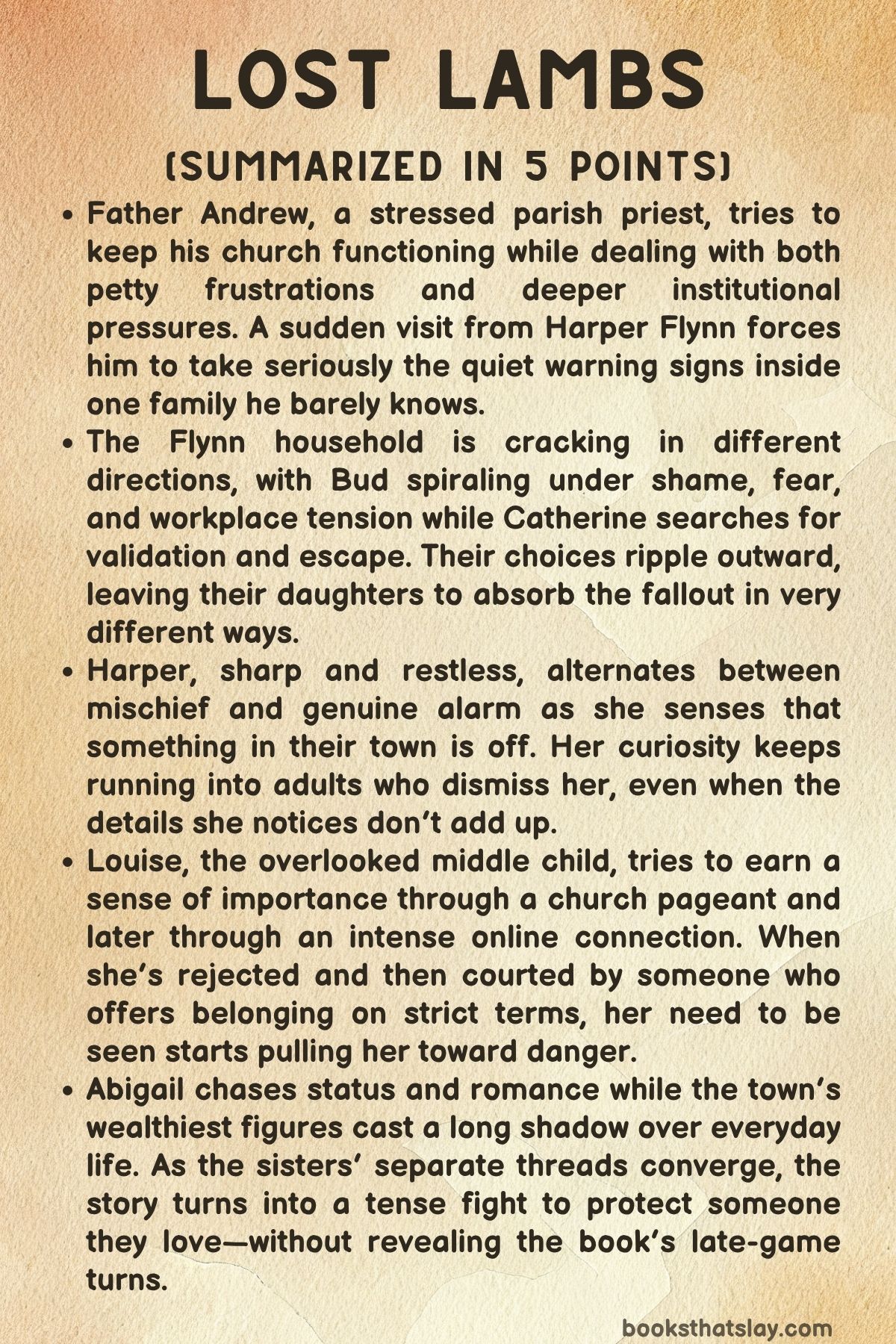
Summary
Father Andrew, the priest of Our Lady of Suffering, is losing his patience. The church has a worsening gnat problem, and he decides the culprit is Miss Priscilla Winkle, a demanding parishioner who keeps bringing plants inside from the orchid nursery where she volunteers.
Father Andrew complains about her in the mandated therapy sessions the diocese requires after earlier scandals, insisting she’s disruptive, cheap, and exhausting. As he sets traps and sprays around the sanctuary, he worries the insects are only the beginning—that the church will become a magnet for worse infestations, a living symbol of rot he can’t control.
On April 1st, Father Andrew is preparing to leave for a French film screening when Harper Flynn appears in his office. Harper is the youngest Flynn daughter, sharp and restless, from a family that has avoided church for ages.
Their absence is famous: skipped services, ignored events, forged chapel notes. Father Andrew recently met Harper’s father, Bud Flynn, who stopped by to ask a “hypothetical” question about suicide and hell.
Father Andrew responded with doctrine—suicide as mortal sin—and tried to guide Bud toward a deeper conversation, but Bud fled, leaving behind a five-dollar bill and a smoothie punch card in the collection basket.
Harper sits down and begins a confession at lightning speed. She admits she lies constantly, then drops the real reason she came: she thinks her father is trying to kill himself because she saw him searching online for the least painful way to die.
When Father Andrew tries to respond carefully, Harper abruptly pivots into a dramatic, outrageous list of crimes and “sins”—stealing medication, selling drugs, setting fires, vandalizing the church van, even sending pornography through her dad’s work email. Then she admits she made most of it up to force a reaction.
She says she’s bored, ignored, and sick of virtual Sunday school. She demands a verdict: Is she going to hell?
Can she be excommunicated? Father Andrew offers narrow reassurance without committing to anything, distracted by gnats buzzing around his face and his own discomfort.
After Harper leaves, he locks up and crosses the parking lot—only to find a pocketknife jammed into the church van’s tire. At least one of Harper’s claims wasn’t invented.
Bud Flynn, meanwhile, is spiraling in private. Alone and exhausted, he swallows pills he has taken from Harper’s room and goes through the motions of daily self-destruction.
He sits in the family minivan, surrounded by trash and takeout containers, and prepares to drive it into the sea to end his life. The vehicle’s sensor chirps about a phantom passenger because of the weight of the mess.
Bud fumbles with the radio and Bluetooth, stalled by small annoyances and numb habits. Then his middle daughter, Louise, appears at the window.
She climbs into the passenger seat and calmly helps him with the phone pairing. Their talk is strained and awkward—Bud tries to ask about dinner, makes clumsy comments that sound sexist before he corrects himself, and stares at the decaying house behind them.
He fixates on the “arrangement” that opened the marriage and the humiliation of his wife’s entanglement with their neighbor, Jim Doherty. Louise’s presence interrupts the suicide attempt long enough for Bud to hand her the keys and abandon the drive.
Catherine Flynn, Bud’s wife, is in her own fog: smoking weed, soaking in an oatmeal bath, and arguing with their eldest daughter, Abigail. Abigail is dressed to go out with her boyfriend Wes, a quiet soldier Harper nicknames “War Crimes Wes.” Catherine tries to forbid the relationship, then calls Bud and lies that she cooked an elaborate dinner, even though the kitchen is nearly empty.
Catherine’s story reveals how she got here: lonely and angry, she grew close to Jim Doherty, a neighbor who runs a pub and makes pottery. He listens, flatters her, urges her to see herself as an artist.
Catherine begins taking photographs again, then shifts into nude self-portraits she exchanges with Jim. Instead of hiding it as an affair, she proposes an open marriage as a “moral workaround.” Bud resists, but Catherine frames it as the only alternative to divorce.
The daughters fracture in different directions. Harper is brilliant, understimulated, and hungry for a puzzle.
She teaches herself languages, stirs chaos, and briefly notices suspicious gaps in Bud’s harbor cargo records before backing off when threatened with being shipped to a wilderness program. Abigail, obsessed with beauty and misery, meets Wes at an exclusive party at Alabaster Manor, hosted by tech billionaire Paul Alabaster.
At the party, a creepy man offers Abigail champagne; Wes warns her not to drink it, and she pours it into a plant. They start dating.
Abigail later returns home at dawn, finds Bud asleep in the minivan, kicks him awake in disgust, drinks vodka, and drags herself to school.
Louise, the overlooked middle child, is desperate to be seen. She impulsively signs up for the church’s Spring Inner Beauty Pageant after finding a thread of hope in it.
She also has an online “Canadian lover” named Yourstruly (YT) from a middle-child chat room, who encourages her to attend because it’s a big Christian gathering. At church, Father Andrew is arguing with Miss Winkle about bringing flowers inside when Louise interrupts and insists she wants to join.
Father Andrew tells her sign-ups closed long ago and tryouts start the next day, but Louise pleads, saying she “can’t go unnoticed forever.” Miss Winkle bluntly suggests not everyone is meant to be a beauty queen. Father Andrew, worn down, relents and has Louise fill out a pink questionnaire.
Louise’s answers are strange and bleak—she claims she’s “experimenting with Islamic fundamentalism,” describes a dream about burning alive in class while nobody reacts, and admits she has no talent. Father Andrew writes “TBD” and tells her to return the next day.
Louise trains in the rain, balancing an encyclopedia on her head. She asks Bud for hundreds of dollars for pageant clothes; he refuses.
She retreats to the family tree house, now stuffed with old junk, and confides in YT that she’s afraid she isn’t pretty enough. YT tells her beauty isn’t physical or even “inside,” but proven through dedication to God, and he pushes her toward Arabic, claiming people speak it in Canada.
Louise tries to switch her school language elective to Arabic, only to learn the school doesn’t offer it.
At tryouts, Louise watches other girls perform with polished talents and sympathetic stories. When her turn comes, she panics and claims her talent is holding her breath.
The room laughs, then grows uneasy as she keeps going, far past what looks safe. Girls begin timing her and cheering.
Father Andrew orders her to stop. Louise refuses, driven by the hope that endurance will finally make people notice.
She collapses unconscious.
The next day, the finalist list is posted. Louise is not on it.
Humiliated and furious, she storms into Father Andrew’s office, accusing him of punishing her over rumors involving her sister. Father Andrew says passing out isn’t an approved talent and insists the winner must be a stable “pillar” of the community.
He suggests Louise needs help and asks about therapy. Louise leaves in tears and messages YT, who tells her the rejection is blasphemy and that her family and religion have abandoned her.
He promises acceptance if she follows instructions secretly. He starts by asking if she can get aluminum and potassium perchlorate.
Bud’s life keeps unraveling at work. He’s an accounts-and-systems manager at Alabaster Harbor™, distracted and disheveled.
After he gives his assistant Dottie flowers and makes her uncomfortable, his boss Allen warns him. Then Bud digs into old shipping logs and finds something worse: a recurring pattern of cargo entries that repeat every year on the same date, with key details redacted.
Bud thinks the harbor’s massive volume is being used to hide illegal shipments. Allen dismisses it and repeats the company motto, “Transparency Where It Counts,” implying that if something is hidden, it “doesn’t count.” Bud refuses to drop it, newly clinging to religion as a backbone.
Soon he receives a note ordering him to attend a meeting at Alabaster Manor.
Under surveillance, Bud meets Paul Alabaster in a grand, decaying estate. His phone is confiscated.
Alabaster hears Bud’s concerns, then reframes them as a loyalty test. He makes it clear Bud’s job is not to ask questions.
He mentions Bud’s daughters by name and hints he has been watching the family, including Harper’s earlier suspicions about the town’s cedar-ball sculptures. Bud is sent home with a huge check and lavish food—payment and warning at once.
At home, Catherine hears rumors that Bud is involved with Miss Winkle. Catherine plans a secret hotel night with Jim Doherty but backs out after he shows her a basement display of crude ceramic vaginas he calls his “masterpieces,” each linked to women from his past.
Repulsed, she tries to reset her identity with grocery shopping and then dyes her hair in a hotel room, half reinvention, half panic.
The story turns openly dangerous when Wes grows suspicious of Alabaster. He meets an underworld contact who shows him a photo: Paul Alabaster, the harbor doctor Orson Lancaster III (“Dolt”), and a masked third man beside an unconscious tied-up girl labeled “AB.” The contact identifies the third man as Father Andrew, who has been forced into discreet consulting for the Alabasters through blackmail over a past hit-and-run.
Soon after, Wes is fired and his badge is deactivated.
Bud tries to escape with his daughters by visiting his father, using airline miles, but airport security flags Louise as on the no-fly list. They’re escorted out.
At home, Bud searches the tree house and finds bomb-making materials and a pyrotechnics manual. Louise admits she was building a “baker’s bomb” for the pageant under YT’s guidance.
YT has been caught, and authorities found Louise’s name on a list.
Wes and an ally investigate the harbor and find a hidden container that shows signs of human captivity: carved messages in an unfamiliar language, tally marks tracking time, and damage around the lock from people trying to escape. Wes realizes the “missing cargo” is real and horrifying.
Then Abigail disappears. Grounded and without phones, Harper and Louise answer a ringing “Everything drawer” phone and hear their friend Tibet: Abigail went to a party at Alabaster Manor and isn’t responding.
Tibet claims Paul Alabaster is running a child-trafficking operation. Harper breaks into Abigail’s room, forces open her diary, and finds confirmation that Abigail went despite Wes’s warnings.
Harper and Louise track Wes through an old movie ticket and take a taxi to his apartment. Wes panics; Marshall, his one-armed veteran roommate, produces a hidden gun.
Against Louise’s suggestion to call police, they rush to the manor.
At Alabaster Manor, Harper and Louise sneak inside and stumble through industrial kitchens into a masked gathering of wealthy men. They run into Father Andrew, who urgently tells them to leave.
When they insist Abigail is inside, he grimly points them toward Paul Alabaster’s study.
Abigail, alone and determined, has arrived with a Taser bought at school. Inside, she is isolated and guided by Dolt to Alabaster, who offers her a drink containing a paralytic substance.
She becomes numb and helpless. Alabaster explains an annual masked “trial” for rich men chasing life extension through blood rituals tied to youth.
Dolt draws Abigail’s blood—about 650 milliliters—into chalices. The men drink ceremonially.
Abigail is then locked in a dark room.
Wes, Marshall, Harper, and Louise move through the manor as chanting and organ music fill the rooms. They reach the locked study.
Marshall shoots the lock, triggering alarms. Behind another locked door they hear thuds; he shoots again.
Abigail calls out, barely able to move. When the door opens, they find not just Abigail but a room holding twenty other captive girls, silent and terrified in the darkness.
The rescued girls are brought to the Flynn house, starving and exhausted. Harper explains the container, the ritual, and the scale of what they’ve uncovered.
Bud and Catherine call the police. As sirens close in, Bud drives to the now-empty manor and answers a ringing rotary phone.
Paul Alabaster taunts him, minimizes the girls as “mice,” and claims he’ll escape because his family built the harbor. Police swarm the estate, but key figures vanish: Paul Alabaster, Dolt, and Father Andrew disappear.
In the aftermath, families retrieve the kidnapped girls. Some return home; some remain in town and enroll in school.
Reporters flood the streets. The Flynns are treated as local heroes, and Tibet provides a guest list to authorities.
Abigail recovers with Wes close by, and they attend a school dance together, trying to act normal while the town reshapes around the scandal.
Louise, shaken by her near-radicalization and still aching to belong, drifts away from her old faith. During community service at a Jewish retirement home, she meets a boy named Caleb and begins gravitating toward Judaism because it offers structure, attention, and a different kind of acceptance.
Months later, the story ends on a quieter note: the Flynn family, battered but together, celebrates Harper’s birthday in a crowded restaurant booth, laughing and drawing. A local boy named Myles watches them and, for a brief moment, is pulled into their warmth—proof that even after damage, a family can still create a small center of safety.
Characters
Father Andrew
Father Andrew, the priest of Our Lady of Suffering, reads as a man whose public role as a moral guide is steadily eaten away by irritation, exhaustion, and self-protective cynicism. The gnat infestation becomes more than an environmental nuisance; it mirrors his feeling that his church—and his authority—are being contaminated by forces he can’t fully control, from parishioners he dislikes to institutional oversight like mandatory therapy and harassment training.
His sessions reveal how readily he turns people into symbols of what he resents, especially Miss Winkle, who becomes a convenient vessel for his contempt about “unreasonable” demands, dwindling donations, and his own sense of being trapped in a thankless vocation. Yet the most defining layer is the hidden bargain underpinning his position: he presents himself as constrained by doctrine and propriety, but his actual constraint is blackmail and complicity.
When he is later identified as someone who consults for Paul Alabaster and is linked to the manor’s ritualized abuse, Father Andrew becomes the story’s clearest portrait of corrupted spiritual authority—someone who uses the language of safety, discretion, and “it isn’t safe here” not to protect innocence in general, but to manage risk and preserve the machinery he’s attached to. Even his brief attempt to send Harper and Louise away can be read less as redemption than as containment, a reflex to reduce exposure when the situation is slipping.
Miss Priscilla Winkle
Miss Priscilla Winkle initially appears through Father Andrew’s hostile framing—an aggravating parishioner with plants and complaints—but the narrative steadily reveals her as a complicated mixture of wounded caretaker, moral entrepreneur, and quietly hungry human being. She runs Lost Lambs, the church-based group that absorbs Bud when he is most unstable, and she does it with a style that blends metaphorical “healing language” with a kind of social pressure that keeps people talking and keeps her central.
Her life with Perry, her brain-damaged daughter, gives her a persistent loneliness and an identity built around responsibility, which makes her simultaneously sympathetic and dangerous: she knows how to cradle someone’s pain, but she also benefits from being needed. Her relationship with Bud evolves in a way that feels less like seduction than mutual desperation finding a shape—Bud wants comfort that doesn’t shame him, and Miss Winkle wants to be chosen, touched, and thanked after years of being overlooked.
That “Thank you” at her climax crystallizes her psychology: intimacy is not merely pleasure for her, it is recognition and proof of worth. She can be bluntly unkind, as when she punctures Louise’s pageant fantasy, yet she is also a facilitator of transformation, giving Bud a structure to survive and, ironically, a language of faith that he later tries to apply to truth-telling at the harbor.
In the moral ecosystem of Lost Lambs, she is neither saint nor villain; she is a person building meaning where she can, even if the structure she builds sometimes leans on other people’s collapse.
Bud Flynn
Bud is the novel’s portrait of a man hollowed out by humiliation, inertia, and an inability to metabolize shame. His early “hypothetical” question about suicide shows his core pattern: he wants permission, or at least relief, without having to name his own desperation directly, and he retreats as soon as the answer demands real self-examination.
His spiral is physical and banal—pills, porn, clutter, the minivan full of takeout—because his despair isn’t poetic; it’s domestic rot. He is also a man whose masculinity is brittle: he tries to say the “right” modern things, then stumbles into sexist assumptions, then corrects himself too late, and the awkwardness exposes how out of step he feels with the world and with his daughters.
The open-marriage “arrangement” doesn’t liberate him; it converts his marriage into a stage where he performs injured pride, while Catherine’s desires make him feel obsolete. Yet Bud is not only passive: once he notices the recurring redacted cargo pattern at Alabaster Harbor™, he becomes briefly alive with purpose, because the discovery offers him something he can be good at—seeing systems, finding anomalies, naming truth.
That impulse is met with institutional intimidation, and his encounter with Paul Alabaster weaponizes what Bud values most—his children—turning paternal love into leverage against him. Bud’s eventual role in the rescue arc, and his decision to call the police, reframes him as someone who can choose responsibility when the stakes finally become undeniable.
He remains flawed—his boundary violations with Dottie, his volatility, the roughness of his reconciliation sex with Catherine—but the story treats him as a man who stumbles toward decency not because he becomes pure, but because he finally sees evil clearly enough to stop negotiating with it.
Catherine Flynn
Catherine is driven by a craving that is both ordinary and explosive: she wants to feel like a person again, not merely a wife, mother, or household manager. Her weed, bath rituals, fights with Abigail, and performative phone call about an “elaborate dinner” she didn’t cook are all ways of managing shame while reaching for control.
The relationship with Jim Doherty begins as validation—he calls her an artist, listens to her, makes her feel seen—and that “being seen” becomes addictive enough that she escalates from photography to nude self-portraits to a negotiated loophole that formalizes her desire without the moral branding of “affair.” What makes Catherine compelling is that she isn’t written as simply selfish; she’s written as someone whose selfhood has been compressed by years of domestic expectation, and whose attempt to expand it turns messy, sometimes cruel, and sometimes pathetic. Her revulsion at Jim’s “masterpieces” in the basement is a turning point because it forces her to confront the difference between being desired and being reduced; the ceramics expose how easily a woman’s body can become a man’s archive, and Catherine recoils from the version of herself that could have become another object on his shelf.
Her hair dye episode reads like a private crisis of aging—an attempt to outrun time, desirability loss, and the panic that her worth has an expiration date. When she and Bud collide after his meeting at the manor, their argument and the sex that follows show how intimacy can be used as anesthesia and as punishment at once.
After the rescue, Catherine’s role shifts toward family cohesion and survival, suggesting that her hunger for “more” doesn’t vanish, but it is recontextualized by trauma, public scrutiny, and the sudden seriousness of what the town has been hiding.
Harper Flynn
Harper is the family’s sharpest blade—brilliant, restless, and allergic to boredom—yet her intelligence reads less like a gift than an affliction in a life that offers her no worthy target. Her confession scene with Father Andrew is essentially performance art: she weaponizes shock, invents sins, and tests boundaries because neglect has taught her that extremes are the only reliable way to make adults react.
The most important thing about Harper is that she sees patterns early—Bud’s suicide search, the harbor record gaps, the surveillance implication of the cedar balls—and then she learns, repeatedly, that truth is punished when it threatens adult comfort. That punishment doesn’t make her obedient; it makes her strategic.
Her obsession with the cedar-ball “watching” narrative is both paranoid and perceptive, because the town really is being watched and controlled, just not in the tidy way she first imagines. Harper’s emotional style is matter-of-fact, almost clinical, which can look like coldness but functions as armor in a household where chaos is constant and sincerity gets exploited.
When Abigail goes missing, Harper becomes the engine of action, pushing past fear and hesitation, using evidence, logistics, and decisiveness to force a rescue. In the aftermath, when the family is briefly warm and cohesive, Harper’s birthday scene suggests what she’s been starving for all along: not stimulation, but belonging that doesn’t require her to set something on fire to earn attention.
Abigail Flynn
Abigail is built out of contradictions that make sense for a teenager trying to control pain through aesthetics: she is “obsessed with beauty and misery,” drawn to status, yet desperately sensitive to rejection. Her relationship with Wes begins at a party that frames the whole town’s hierarchy—Alabaster Manor as glamour and menace—and Abigail’s choice to date him is partly romantic, partly aspirational, and partly self-defense: if she is desired by someone dangerous or elite-adjacent, she can believe she matters.
Her behavior—vodka at dawn, casual cruelty, impulsive violence like punching Millie Biddle—reads as the flip side of vulnerability; she strikes first because being laughed at feels annihilating. When Wes grows distant, her insecurity turns into a narrative that she is being replaced, and the school’s taunts weaponize that fear until she explodes.
The most tragic dimension of Abigail is how she confuses attention with safety: she goes to Alabaster Manor because she wants to be noticed and because she believes she can manage risk with a Taser and attitude, only to discover she is dealing with power that doesn’t play by social rules at all. Her drugging and blood-taking are an extreme literalization of what the story has been warning about—wealth consuming youth—and Abigail’s survival becomes less a “lesson learned” than an exposure to something that permanently changes how she understands control.
Her later dance with Wes, awkward and tender, doesn’t resolve her trauma, but it does show her reaching for a softer version of intimacy—one that doesn’t require spectacle or suffering to feel real.
Louise Flynn
Louise is the novel’s clearest study of what invisibility does to a person. As the overlooked middle child, she doesn’t simply want attention; she wants proof she exists in other people’s minds, and she wants it badly enough to risk humiliation and physical harm.
The Inner Beauty Pageant becomes her chosen stage because it offers a socially sanctioned way to be looked at, but Louise’s awkward questionnaire answers and lack of talent reveal the deeper issue: she doesn’t know what she is, only what she is not. Her breath-holding performance is both horrifying and heartbreaking because it turns self-erasure into a bid for recognition—she tries to become memorable by nearly disappearing.
When she is rejected, the injustice she feels isn’t only about the pageant; it’s about a lifetime of being passed over while louder identities win. That emotional vulnerability is exactly what “Yourstruly” exploits.
The online relationship gives Louise a script—devotion, secrecy, righteousness—and replaces her hunger for attention with a hunger for approval, which is easier to chase because it has rules. Her drift toward constructing a bomb shows how belonging can mutate into radical obedience when a lonely person is given a mission that promises significance.
After the rescue and exposure, Louise’s later gravitation toward Judaism is telling: she is not merely switching religions for novelty; she is searching for a community that notices her, a structure that feels relational rather than performative, and a tradition that gives her a role not contingent on beauty or spectacle. Louise’s arc insists that the opposite of invisibility isn’t fame—it’s connection.
Wes
Wes is deliberately opaque, and that opacity is part of his function: he is a fantasy object for Abigail and a danger signal for the reader, yet he is also a genuinely compromised young man trying to survive inside predatory systems. His nickname, “War Crimes Wes,” and the mercenary background rumors create an aura that attracts Abigail’s status-hunger and her taste for melodrama, but the story also undercuts the myth with mundane realities like his autoimmune bowel disorder and his cramped living situation with Marshall.
Wes’s silence is not purely brooding masculinity; it is practiced containment, the skill of someone who knows information can get you killed. His employment under Paul Alabaster’s surveillance-heavy security regime shows how power recruits violence and then discards it; once Wes asks questions, he is abruptly fired, his badge deactivated, his value erased.
His choice to investigate Alabaster despite warnings shows a moral line that still exists in him, even if his methods are shady and his world is grim. When Abigail threatens self-harm to force answers, Wes responds by trying to protect her, which suggests he understands the destructiveness of desperation because he lives close to it.
In the rescue sequence, Wes becomes action rather than mystery, moving through the manor with purpose, aligning with Marshall, and risking himself to free captives. He is not framed as a spotless savior; he is framed as someone trying to do one clean thing in a life coated with coercion, secrecy, and violence.
Marshall
Marshall, Wes’s one-armed veteran roommate, is a compact embodiment of the story’s themes about bodies used up by power and then repurposed as tools. He lives literally behind a hidden wall panel that stores a gun, which signals how normalized readiness-for-violence is in his world.
Where Wes hesitates and strategizes, Marshall acts—shooting locks, forcing doors, accepting alarms—because subtlety is a luxury he does not seem to believe in. He also provides a social counterweight to Wes: their shared history implies trauma and loyalty, and Marshall’s presence makes clear that Wes’s “danger” is not a teenage rumor but a practiced capacity.
Yet Marshall is not written as reckless for its own sake; his decisiveness is what makes the rescue possible, and his willingness to intervene suggests a moral clarity about what matters when confronted with a room full of captive girls. In a novel full of people who rationalize, Marshall is a character who stops rationalizing and starts breaking things.
Jim Doherty
Jim Doherty begins as the charming neighbor who offers Catherine empathy and artistic validation, but his true nature is revealed through the way he collects women as artifacts. His pub-owner, potter persona feels grounded and soulful at first, yet the basement display of ceramic vaginas exposes the predatory underside of his “appreciation”: he doesn’t simply admire women; he catalogs them, immortalizes them, and claims authorship over their intimacy.
The fact that he calls them “masterpieces” is the key—he frames women’s bodies as his creative output, turning their humanity into his legacy. Jim’s role in the plot is less about the affair itself and more about illustrating how easily Catherine’s desire for selfhood can be manipulated by someone who flatters her into vulnerability, then reveals he was never really seeing her; he was seeing a future object.
His presence also parallels Paul Alabaster on a smaller scale: both men consume women, one with crude art and intimacy, the other with ritual and power.
Paul Alabaster
Paul Alabaster is the novel’s embodiment of institutional evil dressed as legacy wealth and civic ownership. He doesn’t merely commit crimes; he frames them as tradition, necessity, and philosophical experimentation, wrapping brutality in the language of ethics, life extension, and “trial.” His manipulation style is elegant and sadistic: he offers liquor, checks, food; he speaks as if he’s reasonable; then he drops the real weapon—proof he knows Bud’s daughters by name, proof he watches, proof he can reach into Bud’s home life.
His harbor motto, “Transparency Where It Counts,” becomes a thesis statement for elite impunity: legality and openness are not principles to him, they are tools deployed selectively to protect the powerful and erase the vulnerable. The annual ritual at the manor is not presented as random depravity; it is presented as an extension of the same logic that enables the redacted cargo pattern—systems so large and normalized that disappearance becomes routine.
Even his taunting phone call at the end shows his core belief: that he is untouchable because the town’s identity and economy are built on his family’s foundation. His vanishing act after the police arrive underscores the novel’s grim realism about power: exposure is possible, but accountability is never guaranteed.
Orson Lancaster III
Orson Lancaster III, self-styled “Dolt,” functions as the clinical face of cruelty—someone who turns torture into procedure and disguises atrocity with professional detachment. He is “doctor” as costume and as threat, guiding Abigail with false authority, administering paralytic substances, and extracting her blood with the calm of someone performing a routine.
His role in the ritual makes explicit how science and medicine can be corrupted into service of elite fantasies, especially fantasies about youth as resource. Where Alabaster supplies ideology and power, Dolt supplies method: measurement, milliliters, technique.
He is frightening not because he rages, but because he is efficient.
Allen
Allen, Bud’s boss, is a smaller antagonist but an essential one, representing the everyday bureaucratic enforcement that keeps larger horrors protected. He polices Bud’s behavior toward Dottie and frames it as liability management, then shifts seamlessly into shutting down Bud’s cargo concerns, implying that missing transparency is itself proof the matter “doesn’t count.” His pressure is corporate, not theatrical: perks, benefits, career framing, soft threats about pay grade.
That mundanity is the point—Allen is the kind of person who doesn’t need to kidnap anyone to be complicit; he simply keeps the machine lubricated by discouraging questions and redirecting conscience into compliance.
Dottie
Dottie appears briefly but sharply as a reminder that Bud’s pain does not excuse his impact. She becomes the recipient of his awkward, boundary-crossing attempt at connection when he gives her flowers, and her response—naming her boyfriend and later keeping distance—shows a clear-eyed instinct for self-protection in a workplace where power dynamics matter.
Dottie also serves as a reality check in Bud’s “truth-seeking” arc: even while he is uncovering something real at the harbor, he is still capable of making women uncomfortable in small, normalized ways. Her inability to find vendor information in the system further reinforces the story’s theme that disappearance can be engineered quietly through records, permissions, and databases.
Perry Winkle
Perry, Miss Winkle’s brain-damaged daughter, functions as an unexpected moral witness: she is gentle, literal, and concerned about termites feeling pain, which makes her seem naive until she delivers one of the story’s most consequential observations—Bud’s nighttime visits to her house. Perry’s presence destabilizes easy judgments about intelligence and awareness; she notices what others miss not because she’s strategically sharp, but because she’s present and unfiltered.
She also humanizes Miss Winkle beyond her abrasive exterior, showing the constant caregiving reality that shapes her loneliness and her fierce need for meaning.
Tibet
Tibet is a minor but catalytic figure, representing teenage subculture’s ability to transmit truth faster than adult institutions. Her drug-and-smoke companionship with Abigail places her close enough to see warning signs, and her phone call to Harper and Louise becomes the trigger that converts suspicion into action.
By handing over a guest list to authorities later, Tibet demonstrates a kind of pragmatic courage: she participates in the reckless social world around Alabaster Manor, but when confronted with real harm, she chooses evidence over silence.
Millie Biddle
Millie Biddle serves as the social pressure point that reveals Abigail’s fragility. Her taunting doesn’t cause Abigail’s insecurity so much as activate it publicly, turning private fear into a public status contest.
The punch that follows is less about Millie as a person and more about what she represents in that moment: the school’s cruel pleasure in watching someone fall, and Abigail’s inability to endure humiliation without violence.
Mother Superior
The Mother Superior operates as the institutional voice of discipline in Harper’s school life, a figure who responds to Harper’s protests with punishments and warnings. Her role highlights how authority often treats “disruptive” intelligence as a behavioral problem rather than an alarm bell, which contributes to the broader theme that systems prefer quiet compliance over inconvenient truth.
Caleb
Caleb appears late but meaningfully as a doorway for Louise into a different kind of belonging. Meeting him during community service at a Jewish retirement home positions him not as a dramatic savior figure but as an embodied alternative: a person and a community that offer Louise attention, ritual, and connection without demanding she become a spectacle.
His presence matters because Louise’s vulnerability has been repeatedly exploited by institutions and strangers; Caleb represents the possibility of being welcomed rather than recruited.
Myles
Myles, the local boy who watches the Flynn family celebrating Harper’s birthday, functions as an outsider lens on the family’s transformation. He doesn’t drive the plot; he crystallizes its emotional aftermath.
By being unexpectedly pulled into their warmth, he shows what the Flynns have gained after horror: a fragile, hard-won capacity to be together in a way that radiates outward. Myles’s brief inclusion suggests that healing in Lost Lambs is not only private recovery but the reemergence of community gravity—the ability for a damaged family to become, even momentarily, a place where someone else feels safe.
Themes
Moral authority under institutional pressure
Father Andrew is asked to function as a moral center while his own inner life keeps undercutting the role. The therapy sessions, mandated after previous scandals, are supposed to be a safeguard, yet they also become a place where he rehearses irritations and grudges—especially toward Miss Winkle—rather than confronting the moral weight of his position.
His impatience with parishioners, fixation on superficial “respectability,” and desire to escape into small comforts make his authority feel procedural instead of pastoral. When Harper arrives for confession, the situation demands patience and discernment: a child is signaling distress in a chaotic home, and her father has already hinted at suicidal ideation.
Father Andrew’s responses show how an institution can train someone to avoid risk rather than take responsibility. He offers guarded reassurance, tries to keep control of the conversation, and ends the encounter without taking decisive action.
That choice matters because it models the book’s view of authority as something that can become defensive and self-protective, especially when oversight exists mainly to reduce liability.
His later involvement with Paul Alabaster pushes the same theme into darker territory. A priest who should represent conscience becomes an accessory once blackmail enters the picture.
The power imbalance is the point: Alabaster can weaponize secrets, money, surveillance, and social status to turn moral language into a tool of control. Father Andrew’s private resentment toward modern restrictions, including sexual harassment training, adds another layer—he interprets accountability as persecution, which helps him justify complicity.
By the time Harper and Louise encounter him inside the manor, his urgent warning to leave lands as a distorted echo of what he should have been doing all along: protecting the vulnerable. Even then, he redirects them deeper into danger, implying that his loyalties are already misaligned.
In Lost Lambs, moral authority is shown not as a stable virtue but as a job title that can be hollowed out when the person holding it prioritizes comfort, reputation, or fear over care.
Neglect, attention hunger, and the ways children learn to signal distress
The Flynn daughters live in a household where the adults are physically present but emotionally unavailable, and each girl develops a different strategy to be seen. Harper turns neglect into provocation.
Her confession is less about guilt and more about testing whether any adult will react with genuine seriousness. She invents escalating crimes because ordinary honesty has stopped working as a signal.
The lie about her father searching for painless suicide methods lands differently: it may be true, it may be partly true, or it may be a calculated mixture. The uncertainty is central, because it reflects how a child in an unstable home may learn that dramatic language is the only language that gets attention.
Harper’s intelligence makes this sharper rather than easier—she can detect patterns, suspect surveillance, and sense corruption, yet she is still trapped in the powerless position of a teenager whose warnings can be dismissed as “acting out.”
Louise shows the quieter version of the same hunger. She is not trying to shock the way Harper does; she is trying to become undeniable.
The pageant is attractive because it promises structured recognition: a stage, an audience, a title. Her questionnaire answers are bleak because her inner life has been shaped by invisibility—she imagines burning alive while everyone ignores her, and the image is not about melodrama so much as social truth inside her family.
When she chooses breath-holding as a “talent,” she is converting self-harm into performance without naming it as self-harm. The room’s reaction—laughter turning into tension, cheering mixed with discomfort—captures the social habit of rewarding extremes after first mocking them.
Father Andrew’s refusal to advance her because she is not a “stable community pillar” is especially cruel in this context: he is punishing a child for being destabilized by the very environment adults created. That rejection becomes the opening exploited by “Yourstruly,” who offers what her real world withholds: focused attention, certainty, and a narrative where her pain proves her value.
Even Abigail’s storyline echoes the theme through a different lens. She uses romance, status, and aestheticized misery to create an identity that feels noticed.
Her vulnerability to Alabaster’s party is connected to the same root: when home is chaotic and love feels conditional, attention from powerful or mysterious figures can feel like proof of worth. The novel treats adolescent “bad behavior” as communication shaped by neglect, showing how kids escalate signals when the ordinary ones are ignored and how predators rely on that escalation to pull them closer.
Predation as a system: surveillance, secrecy, and normalized exploitation
Paul Alabaster is not portrayed as a lone monster operating outside society; he is portrayed as someone who can operate because society has built him the infrastructure to do it. The harbor’s motto, “Transparency Where It Counts,” functions like a corporate confession: the institution decides what counts, then hides everything else behind procedure, volume, and jargon.
Bud’s discovery of repeating redacted cargo is important not only as a clue but as a model of how exploitation can be routinized. A recurring pattern that everyone treats as normal is the book’s idea of institutional camouflage.
The system is designed so that an ordinary employee can notice wrongdoing but cannot name it inside official channels without being warned, isolated, or bought off. Bud is offered perks, pressure, and finally a large check—tools that turn moral resistance into a “personal problem” rather than a civic obligation.
Surveillance intensifies this theme. The cedar-ball sculptures, the monitoring inside the manor, the confiscated phone, and the way Alabaster knows the daughters by name show a world where the powerful gather information constantly while insisting others accept ignorance.
That asymmetry is what makes predation scalable. When Harper suspects the cedar balls are watching, the story later validates the instinct: she is not paranoid so much as living in a town where paranoia is a rational response to being observed without consent.
The ritual at the manor—wealthy men drinking Abigail’s blood under the cover of a “trial” and pseudo-science—pushes exploitation into symbolic territory, but it still reflects the same social logic. These men treat youth as a resource they can extract and consume, and they wrap the act in prestige and secrecy so it looks like tradition rather than assault.
The complicity of respected figures completes the system. Father Andrew’s presence, the harbor doctor “Dolt,” the staffers enforcing rules, and the black cars removing problems suggest a network where roles that should protect people instead protect the operation.
Even when resistance appears—Wes investigating, Bud refusing to drop the issue—the system tries to absorb it through intimidation or payment. The eventual rescue does not erase the theme; it clarifies it.
The operation collapses only when multiple threads connect: a teenager’s suspicion, a boyfriend’s fear, a father’s accidental discovery, a sibling’s urgency, and direct action that breaks locks. The story presents predation as something that thrives in plain sight when wealth can purchase silence, when institutions define accountability in self-serving ways, and when the community is trained to treat anomalies as someone else’s problem.
Fractured intimacy and the search for belonging after betrayal
The Flynn parents’ marriage is defined by loneliness disguised as negotiation. Catherine’s “loophole” framing of an open arrangement is not an attempt at shared freedom; it is an attempt to avoid naming that she wants out while also wanting to keep the structure of family life.
Bud’s spiraling, his pills, and his near-suicide attempt show how betrayal lands as humiliation and loss of meaning, not just loss of fidelity. Their conversations are filled with misfires—half-apologies, defensive corrections, and the constant awareness that they are failing in front of their children.
Catherine’s interaction with Jim Doherty shows a craving to be seen as more than a mother and wife, but the moment she encounters his basement display of crude ceramic vaginas, she is confronted with a different kind of objectification: not romance, but collection. Her disgust signals that what she wanted was recognition, not being turned into a trophy in someone else’s private archive.
Bud’s connection with Miss Winkle reflects the same hunger from the other side. He receives tenderness and gratitude, and the “Thank you” becomes a shock because it suggests a form of intimacy that is not transactional or contemptuous.
Yet it also exposes how fragile his boundaries have become. He is drawn to whoever offers comfort, which makes him easy to manipulate—by the harbor, by religion as a coping structure, and by his own desperation.
The daughters absorb these fractures in different ways. Abigail seeks belonging through a relationship that becomes a status shield; Harper seeks it through certainty and crusades; Louise seeks it through any framework that promises attention and meaning, first Christianity, then the online voice that pretends to guide her, and later Judaism through community service and a new relationship.
Louise’s shift is especially telling: she is not switching traditions as an intellectual hobby; she is moving toward a place where she experiences connection, routine, and being noticed without having to injure herself to earn it.
The closing movement—rescued girls at school, the family’s public “hero” status, and the scene of warmth at Harper’s birthday—does not present healing as a clean return to normal. It suggests that belonging becomes possible when people stop performing roles and start acting like a unit again: eating together, laughing, drawing, making room for someone like Myles to be pulled briefly into their orbit.
That warmth matters because it contrasts with earlier isolation. Intimacy is repeatedly damaged by betrayal, secrecy, and self-interest, but the story still argues that belonging can be rebuilt through shared attention, honest involvement, and the willingness to protect each other without outsourcing that duty to institutions or titles.