Meet the Newmans Summary, Characters and Themes
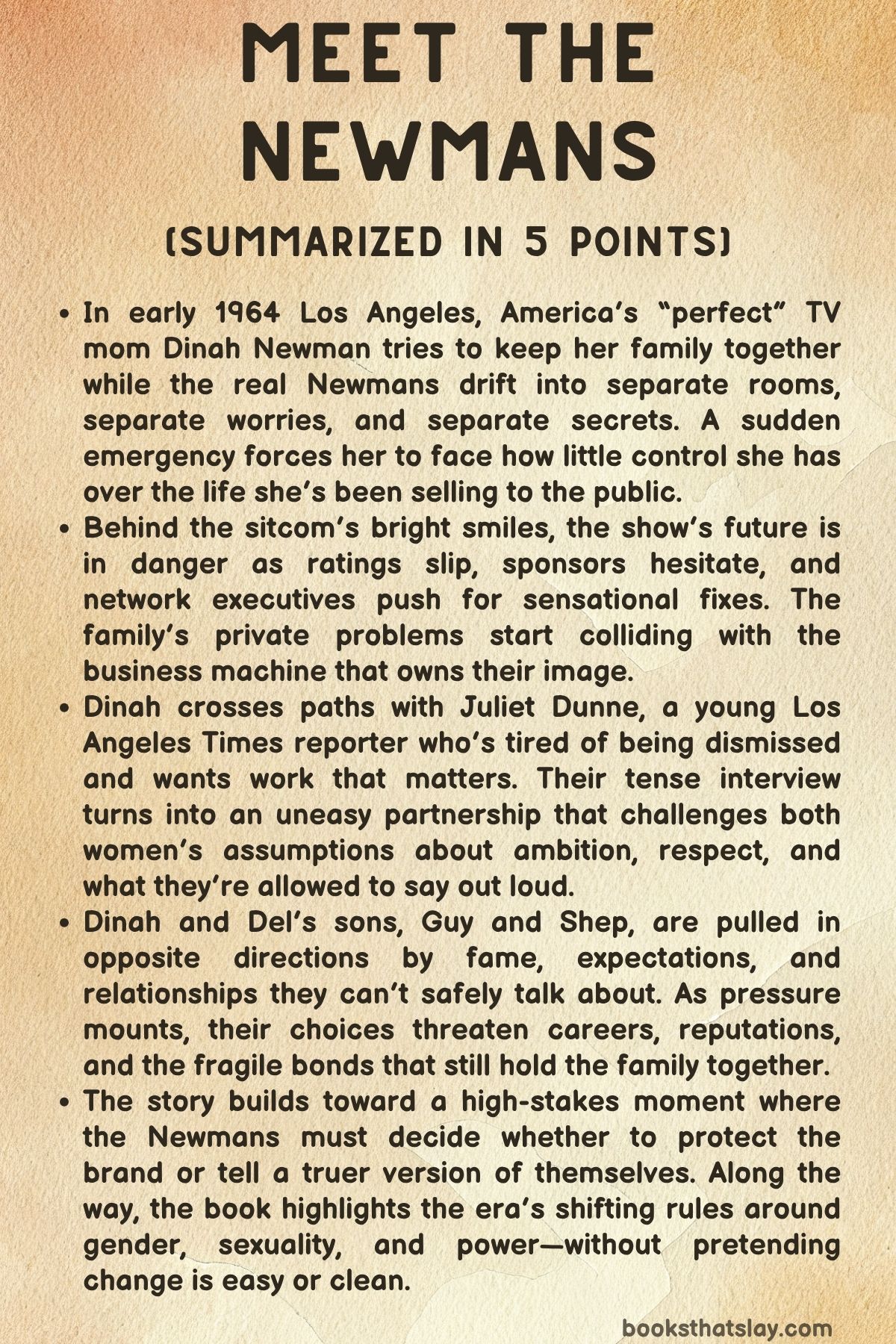
Meet the Newmans by Jennifer Niven is a behind-the-scenes novel set in 1964 Los Angeles, where America’s favorite television family is anything but stable once the cameras stop. Dinah Newman is famous for playing the perfect wife, but privately she’s tired, frightened by strange symptoms, and lonely inside a marriage that has gone quiet.
Her husband Del is fighting failing ratings, studio pressure, and secrets he can’t share. Their sons—golden Guy and volatile teen idol Shep—are caught between fame, desire, and the rules that keep them in line, until one accident forces all of them to face what’s real.
Summary
On March 20, 1964, Dinah Newman stands in her kitchen staring at burned pork chops, furious at herself for trying—and failing—to make dinner like the woman she plays on television. On TV, the Newmans smile through another episode of Meet the Newmans, the picture of comfort and order.
In the real house, the rooms feel hollow. Del is late, Shep roars in and out on his motorcycle, and Dinah is alone with her thoughts, including a dangerous daydream about doing something that would shatter her reputation and her marriage.
Dinah’s unease has another edge: her body has begun to feel strange. Without telling Del, she visits Dr. Berke in Beverly Hills and describes numbness spreading through her hands, neck, and shin, along with exhaustion and sudden heat.
She insists she’s fine—her life is “perfect”—even while she’s scared the doctor will find something serious. Blood is drawn, rest is advised, and Dinah leaves wanting one thing most of all: to see Del and feel reassured.
Del, however, is carrying his own dread. The day before, he receives a telegram—five words: “I need to see you.” It isn’t signed, but Del knows exactly who wrote it, and the message drags old fear into the present.
On top of that, their show is sliding. Ratings are dropping, the reviews are turning, and Del has discovered their finances are far worse than Dinah realizes.
He has spent heavily—on cars, collectibles, and production decisions—and he has also used money to protect the family’s image, quietly paying to smooth over trouble before it reaches the press.
Across the city, Juliet Dunne drives into the Los Angeles Times newsroom after a night with a famous musician who once wrote a hit about her. She wants real reporting, but she’s treated like a helper and pushed into soft features.
Her editor assigns her a story on Dinah Newman, especially now that a New York critic has called Meet the Newmans outdated and past its moment. Juliet sees the assignment as both a chance and an insult: a door that opens only into a room men already control.
At CBS, the Newman sons are also cracking under pressure. Shep—teen idol, musician, and magnet for scandal—tries to end an affair with Lorrie Cabot, only to have her announce she’s eight weeks pregnant.
The news terrifies him. He knows the show’s morals clause, the studio’s hunger for control, and his father’s temper.
He tears through the city on his motorcycle, chased by sirens, trying to outrun consequences. Guy, older and more disciplined on the surface, sits in a makeup chair braced for disaster.
He’s been called to meet CBS president James T. Aubrey, and he fears what the studio suspects: that his private life, including his love for his “roommate” Kelly Faber, could destroy him if exposed.
The meeting with Aubrey confirms the worst. Kodak is pulling out as sponsor because the press is sour and the numbers are down.
Aubrey reveals a gossip item hinting Guy and Kelly are lovers and makes it clear CBS has already paid to contain it, but won’t keep doing so. Then he delivers his plan: save the show by centering the sons—especially Shep, whose teen-fan frenzy can be exploited in the new post-Beatles pop climate.
Aubrey proposes pushing Guy and Eileen Weld (Guy’s on-screen fiancée) into a real-life marriage to “fix” the rumor machine. He goes further, suggesting Del and Dinah be written out and sent away—“Florida”—so the sons can carry the brand.
The finale, he demands, must be a live wedding broadcast as a stunt. Del is given an ultimatum: find a sponsor, or the ship goes down.
The strain spills onto the set. During a football-toss scene, Del—desperate to prove the show still has energy—joins the game and runs with the ball like a kid.
Guy and Shep tackle him, and Del hits the artificial grass hard. He insists he’s fine, forces a smile, and keeps working, but he looks sick and unsteady afterward.
Dinah, watching him, feels how close everything is to collapsing.
Juliet arrives at the Newman home to interview Dinah. The house is familiar because it doubles as the show’s on-screen home, but the atmosphere is sharper than expected.
Juliet challenges Dinah’s public persona and the way Meet the Newmans sells a narrow idea of womanhood. She pushes on unequal pay, on what women can’t do, on the cost of pretending.
Dinah tries to hold her ground, then snaps, shuts off the recorder, and ends the interview. Before Juliet leaves, Dinah strikes back with a pointed question about Juliet’s own experiences being reduced to a man’s accessory.
Juliet walks away shaken, realizing she and Dinah may be trapped in different cages built from the same materials.
The next blow lands fast. After Kodak refuses to reconsider, Del drives west toward the ocean instead of home, foggy and exhausted.
He finds Shep’s cigarettes, smokes, turns up the radio, and sings along to Shep’s hit without thinking. His focus slides.
His car drifts. A horn blares.
Del tries to correct, but the palm tree comes too quickly. The crash leaves him in surgery, then in a coma, registered under an alias to keep reporters away.
Dinah races to the hospital and learns the truth from producer Sydney Weiss. She calls Guy and orders him to keep Shep away from the chaos, but Guy insists on coming.
He and Kelly drive to the hospital, their private bond tightened by fear and by the studio’s pressure to use Guy’s fake wedding as a shield.
While Del lies unconscious, Shep keeps spiraling. Lorrie presses him toward marriage and a tidy future he doesn’t want and can’t afford.
He clings to Eileen, who sees both his charm and his damage. On set, Guy tries to hold things together, but Shep arrives late, hungover and high, and the brothers erupt into a chaotic cake fight that ends only when Dinah forces them to stop.
Under the anger is something uglier: Guy’s resentment at being responsible, Shep’s terror that he’ll be forgotten once the screaming fans move on, and the guilt both carry over Del’s condition.
Sponsors come and go like weather. Sydney briefly secures Procter & Gamble, but press trouble follows, including a Life magazine feature that paints Shep as reckless and hungry for escape.
Aubrey rages and warns Shep he’s being watched. In the middle of filming, Shep breaks script and kisses Eileen, and she kisses him back—until Guy storms in and drags Shep away.
The triangle becomes a weapon the studio can use, and a threat that can ruin them all.
Dinah, left alone with decisions and hospital bills, begins searching Del’s office for answers. She finds financial records that reveal how little they truly have.
Worse, she discovers a deed to a Santa Monica house in Del’s name and a long trail of monthly checks to “M. Leslie” that stretch back twelve years. The find cracks her open.
Is it an affair? A second life?
A secret shame? Her fear becomes action: she drives to the house, sneaks onto the property, and is caught by a neighbor.
Police arrest her as a “Peeping Tom,” humiliating her in the same city that worships her image.
That night becomes a collision of disasters. Shep and his friend Hutch are arrested after a fight on the Strip.
Guy and Eileen arrive at the station, coming from their own crisis tied to a raid on a gay bar where Guy was caught with Kelly. Then Dinah is marched out of the cells wearing Shep’s sunglasses, and the family stares at each other as if seeing strangers.
They drive home in bitter silence, a caravan of fame, damage, and secrets.
Out of this wreckage, something unexpected forms: Dinah calls Juliet. The Times has softened Juliet’s interview until it’s barely hers, and Juliet is ashamed.
Dinah, however, wants more than an apology—she wants help. Together, Dinah and Juliet begin writing a new finale for Meet the Newmans, one that admits the world is changing and that women are tired of being told their place is the kitchen floor.
They write Dinah’s character throwing away her apron and handing it to the boys: your turn.
As the live broadcast approaches, the family begins, piece by piece, to choose honesty over performance. Guy takes control as director and demands Del stop undermining him.
Shep writes new music and, in a rare moment of maturity, accepts Guy’s love for Kelly without judgment. Dinah forces Del to respect the script she and Juliet created, insisting this ending belongs to more than one man’s idea of safety.
Even Del, weakened but awake again, starts to see that clinging to the old version of their show—and their marriage—will end them.
CBS executives and censors try to crush the finale, furious about the feminist edge, the missing wedding, and even a sharp joke about pleasure and housework. Dinah stands her ground, and Del backs her publicly.
The final push comes from Mrs. Sunbeam and a group of executive wives, whose enthusiastic approval makes it harder for the network to pretend the episode is unacceptable.
On April 24, 1964, Meet the Newmans airs live in color to a massive audience expecting a wedding. Instead, viewers watch Dinah’s character confront a world where legal and economic power belongs to husbands by default.
She steps into Del’s role, brings other women into the story—including a new Black character, Renee—and refuses to return to being only a housewife. The episode ends in a nightclub: Dinah sings “I’m a Woman,” then introduces Shep, who debuts “The Girl That Doesn’t Leave You.” The audience demands an encore, the show runs long, and Dinah caps the night with a line that becomes legend—making clear, in plain language, what she will not pretend anymore.
After the finale, Dinah and Juliet meet to imagine what comes next, including a new series about two women navigating a newsroom. Juliet receives a cassette from the Musician—an intimate song meant for her—and she walks through the city listening, accepting love, loss, and her own future at once.
Years later, the Newmans gather one last time in 1969 before the Toluca Lake house is sold. Dinah and Del live in Laguna Beach; Guy and Kelly build a quiet life together while keeping their truth guarded; Shep and Eileen are married, raising children, including Shep’s daughter with Lorrie.
Del’s health never fully recovers, but the family has moved beyond the old set’s walls. Over a final dinner, Dinah and Del share a private joke: the show didn’t really end.
It simply continued off camera—messier, freer, and finally their own.
Characters
Dinah Newman
Dinah is the emotional center of Meet the Newmans, a woman whose public identity as “America’s beloved TV housewife” has calcified into a costume she can barely breathe inside. Her opening attempts at cooking are not really about dinner; they’re about control, proof of worth, and a longing to feel chosen again in a marriage that has slipped into silence and separate beds.
Dinah’s private smoking, her fantasy of a scandalous affair, and her fixation on “blowing up everything” show how trapped she feels by the wholesome brand she helped build, and how badly she craves a self that belongs to her rather than to an audience. Her numbness and hot flashes function on two levels: a possible medical crisis and a metaphor for emotional anesthesia after years of performing perfection.
Dinah’s arc turns when the show’s collapse and Del’s accident force her to confront money, power, and legality—what she cannot do without a husband—and she finally recognizes that her “perfect” life has been engineered by other people’s expectations. By partnering with Juliet, Dinah becomes more than a symbol; she becomes an author of her own narrative, pushing the finale into a declaration of agency and desire, and ultimately carrying that courage into her life beyond the set.
Del Newman
Del is both architect and captive of the Newman image, a man who has spent years converting family life into a controlled product and then discovering the product has started controlling him. Outwardly he is the confident creator-star, but internally he is anxious, financially cornered, and haunted by an unnamed past that arrives as a telegram with five words.
His spending on rare cars, collectibles, production choices, hush money, and quiet generosity reveals a complicated morality: he wants to protect people and protect the brand, but he also indulges impulses that endanger the family’s stability. Del’s irritability and withdrawal after turning forty-five read like the crash of midlife disillusionment against the relentless demand to keep smiling on camera.
His concussion and accident literalize what has already been happening psychologically: he is disoriented, drifting lanes, unable to reconcile the story he sells with the life he actually lives. Yet Del is not written as a simple antagonist to Dinah’s liberation; his eventual willingness to back her in Aubrey’s office, yield directing space to Guy, and accept Guy’s love for Kelly shows a man capable of growth when forced to stop managing everyone else.
By 1969, Del’s post-accident fragility and new identity as an author and grandfather suggest he finally found a way to matter beyond ratings—less as a controller of narratives, more as someone living inside one with honesty.
Guy Newman
Guy is the dutiful eldest son who has been trained to hold the family’s façade together, and that training becomes his trap. His anxiety in the makeup chair and fear of Aubrey’s summons show how deeply the studio’s power has seeped into his nervous system; he anticipates punishment the way an employee anticipates a boss, not the way a son anticipates a father.
Guy’s private life—his relationship with Kelly and the “roommate” cover—places him at the intersection of love and survival in a world that treats exposure as catastrophe. His withdrawal from law school without telling Del captures a central contradiction: Guy wants autonomy and artistry, especially directing, but has learned to pursue both in secrecy, which multiplies his shame and volatility.
When the studio pressures him to marry Eileen to “fix” rumors, Guy becomes a battleground where corporate interests try to rewrite a human life as public relations. His growth is clearest when he steps into directing with confidence, fights Del’s interference, and finally demands the space to lead—an act that is less rebellion than adulthood arriving.
Guy’s relationship with Shep is a mix of exasperation, protectiveness, and envy; he resents being made “grandpa” so Shep can be the star, yet he also keeps trying to anchor his brother to responsibility. Guy’s most profound shift comes when Del invites honesty and accepts him; that acceptance doesn’t erase the danger of the era, but it gives Guy a foundation to build a quieter, truer life afterward.
Shep Newman
Shep is the story’s volatile spark—teen idol, musician, and self-sabotaging romantic—who senses that his fame is both power and a cage. He is furious that CBS and Del control his image and money, but he also fears that once the frenzy fades, nothing real will remain; this insecurity drives his recklessness as much as any youthful bravado.
The pregnancy revelation from Lorrie is a moral and existential ambush: it forces Shep to confront adult consequences in a world that sells him as a clean-cut fantasy, and the show’s morals clause turns private life into an employment risk. His connection with Eileen is not just lust or rebellion; she represents a kind of understanding he can’t find in the screaming crowd, and his kiss with her on the porch—improvised, disruptive—shows how he tries to seize authenticity even when it detonates relationships.
Shep’s drug use, arrests, and emotional collapses are not glamorized; they read as symptoms of pressure, grief over Del’s coma, and a desperate longing to be seen as an artist rather than a brand. At the same time, Shep is capable of tenderness and surprising openness, especially when he accepts Guy and Kelly’s relationship without judgment, suggesting that his instincts are often more humane than the world around him.
By the end, Shep’s music becomes his exit route from “Shep Newman” into a self that can build a family, take responsibility for his child, and still chase genuine creativity.
Juliet Dunne
Juliet is a young reporter trying to grow a serious voice inside an institution determined to reduce her to “Lifestyle” labor and soft features. Her ambition is constantly undercut by sexism: men claim credit for her work, editors dilute her strongest writing, and her newsroom treats her as disposable.
Juliet’s first interview with Dinah is combative because she sees Dinah as a symbol of the very constraints suffocating women in 1964; she attacks the persona and expects to find emptiness behind it. What complicates Juliet is that she is also vulnerable to the same machinery of reduction—once as a musician’s “arm candy,” now as a woman whose reporting is filtered through male gatekeeping—so her moral certainty has fractures.
When she and Dinah reconcile, Juliet becomes a catalyst for Dinah’s transformation while Dinah becomes proof to Juliet that change can come from inside the very structures she wants to overthrow. Juliet’s attachment to the Musician functions like a parallel storyline about being turned into someone else’s narrative; she wants love and inspiration, but she refuses to be branded as a muse.
Her arc is not just professional; it’s political and personal, culminating in her newsroom confrontation and her willingness to co-author a risky finale that names women’s desires out loud. The final cassette from the Musician lands as a bittersweet closure: Juliet accepts love without letting it define her, and that balance mirrors the career she is trying to build—truthful, unsentimental, and her own.
Eileen Weld
Eileen begins as an on-screen fiancée and a convenient studio solution, but she steadily reveals herself as sharper and more emotionally literate than the men arranging her life. She reads books about loneliness and refuses the fantasy that marriage fixes emptiness, which makes her a quiet counterargument to the show’s old formula even before the finale rewrites it.
Eileen is pulled into a triangle not of her own making—Guy as the studio-approved partner, Shep as the emotionally electric temptation—but she refuses to become a passive prize; she sets boundaries, withdraws when the kiss with Shep complicates everything, and uses restraint as power rather than weakness. Her compassion shows in small moments, like checking on Shep after the Life fallout, where she recognizes depth in him beyond scandal.
At the same time, she is not a savior figure; she demands communication and accountability, especially once Shep’s baby becomes reality, and her willingness to “try” with him is conditional on honesty, not charisma. Eileen’s role is crucial because she exposes how women on the periphery of fame are expected to absorb men’s chaos; she survives by staying clear-eyed, choosing what she will and won’t carry.
Kelly Faber
Kelly is written as both intimate partner and political conscience, embodying a courage that is everyday and dangerous in equal measure. As Guy’s “roommate,” he lives inside the violence of enforced invisibility, yet he refuses to internalize shame; his secret “GAY IS GOOD” shirt is a quiet act of defiance that signals a future pushing against the present.
Kelly’s activism—pickets, civil rights involvement, and refusal to retreat into private comfort—contrasts with Guy’s fear-driven caution, creating a relationship dynamic where love is tangled with risk tolerance. The bar raid sequence underscores what is at stake: their world can collapse not because of personal failure, but because the state and the culture are primed to punish them.
Kelly’s steadiness shows when he pushes Guy toward what matters—Del’s condition, family truth, the right to grieve publicly—suggesting that he understands life cannot be managed the way the studio manages stories. By 1969, Kelly and Guy raising adopted children while keeping their sexuality secret reads as both a victory and a compromise: they built a family, but the world still demands silence, and Kelly’s earlier courage makes that silence feel like a cost rather than a choice.
Sydney Weiss
Sydney is the pragmatic engine behind keeping the show afloat, a producer who lives in the space between art, commerce, and scandal management. He is constantly breathless with crisis—accident logistics, hospital aliases, sponsor deals, press containment—which makes him feel like a man perpetually sprinting to stop a public narrative from turning lethal.
Sydney’s value to the Newmans is not tenderness but competence; he can secure Procter & Gamble one day and lose them the next, and that volatility reveals how little control anyone truly has once sponsors and executives decide a product is too risky. At times Sydney comes off cynical, yet he also shows genuine loyalty in the ways he shields the family and steps in when Hutch calls for help.
His laughter at the absurdity of disasters colliding is not cruelty so much as survival humor from someone who knows the machine will keep grinding regardless of who gets hurt. Sydney represents the entertainment industry’s middle layer: not the villain at the top, not the talent crushed at the bottom, but the fixer who keeps the illusion operational.
James T. Aubrey
Aubrey is the clearest embodiment of institutional power in Meet the Newmans, a man who speaks in ultimatums because he believes people are replaceable and stories are assets. He treats the family as a ship heading toward his iceberg, and that metaphor reveals his worldview: he is not merely making decisions, he is a force of nature, indifferent to personal cost.
Aubrey’s plan to write Del and Dinah out, exploit the sons, and push a real-life marriage to “fix” rumors shows how the network conflates morality with marketability; what matters is not truth, but what keeps sponsors calm. He also functions as a pressure device that forces other characters into authenticity: Dinah’s defiance, Del’s eventual support, and the finale’s risk all sharpen because Aubrey’s control is so blunt.
As an antagonist, he is effective precisely because he is not melodramatic; he is banal in his certainty, the kind of man who can destroy lives while believing he is simply doing business.
Dr. Berke
Dr. Berke plays a brief but pivotal role by puncturing Dinah’s insistence that everything is “perfect.” His questions about menopause and his decision to test for something serious force Dinah to admit—at least to herself—that her body is carrying truths her performance cannot suppress. He represents an authority figure who is not trying to control Dinah’s image but is still part of a system that interprets women’s experiences through limited frameworks.
The importance of Dr. Berke is less in diagnosis and more in disruption: the possibility of illness becomes a mirror that makes Dinah measure her life and realize how little of it feels like her own.
Flora
Flora, the housekeeper, sits at the edge of the Newman glamour and quietly exposes its hollowness. Dinah’s dependence on her labor highlights the gap between the show’s homemaking fantasy and the reality that the “perfect housewife” is propped up by unseen work.
When Dinah impulsively asks Flora if she’s fulfilled, it is a moment of misdirected searching—Dinah trying to understand womanhood by peering into someone else’s life—yet it also shows Dinah’s growing awareness that she has been disconnected from real people. Flora’s presence grounds the story in class dynamics: the family’s crises are loud and public, but the household’s daily functioning still relies on a woman whose feelings are rarely centered.
In the simplest terms, Flora is reality inside a house built as a set.
Lorrie Cabot
Lorrie is often treated by others as a threat or inconvenience, but she functions as the story’s blunt instrument of consequence. Her pregnancy announcement forces Shep’s fantasy of endless youth into a collision with responsibility, and it also exposes how fragile his freedom actually is when money, trust funds, and studio rules control him.
Lorrie’s insistence on a planned future—marriage, house, stability—can read as naïve, but it also reflects the limited scripts available to women, especially when pregnancy becomes social leverage and social danger at once. She is angry, demanding, and unwilling to disappear, which makes her disruptive to the family brand, yet the narrative uses her to show that “good” and “bad” behavior are labels imposed by a culture more than truths about a person.
Lorrie’s presence keeps the story from romanticizing Shep’s rebellion; she is the reminder that someone else’s life is attached to his choices.
Tommy “Hutch” Hutchins
Hutch is Shep’s friend and collaborator, serving as both companion and witness to Shep’s spirals. He is the person who walks beside Shep when the idol mask slips, hearing the fears about being forgotten and seeing the ways fame corrodes the self.
Hutch also anchors Shep in music as something real, not just a commodity, which is why their partnership matters beyond friendship. When chaos erupts—arrests, brawls—Hutch’s instinct is practical care, calling for help when Shep is too lost to manage consequences.
He represents the fragile possibility of a normal relationship in an abnormal life.
Boyd Hartley
Boyd is a newsroom gatekeeper who embodies editorial control, steering Juliet into assignments that serve the paper’s agenda more than her ambitions. His push for a Dinah feature is less about curiosity and more about capturing a cultural moment shaped by criticism that the show is outdated.
Boyd’s role is important because he shows that Juliet’s struggle is not just about individual sexism but institutional shaping of narratives: even when she finds a sharper truth, the system edits it into something safer.
Nick
Nick functions as Juliet’s ally and a glimpse of partnership that isn’t romanticized. He takes her ambition seriously and challenges her to notice what the show leaves out—its whiteness and male-centered framing—pushing Juliet to widen her lens rather than simply win status within the same narrow rules.
His invitation to collaborate on his mother’s murder case later also suggests a future where Juliet earns bylines and agency through teamwork instead of permission. Nick’s presence is a small but meaningful counterweight to the newsroom’s hostility: proof that mentorship and respect can exist, even if they are rare.
Renee
Renee’s importance is symbolic and structural: she represents the deliberate expansion of the show’s world during the live finale, a choice that signals Dinah and Juliet’s refusal to let the story remain safely isolated inside white domestic fantasy.
Even with limited detail, Renee stands for the social realities pressing in from outside the set, and her inclusion marks the finale as not just a feminist shift but a broader confrontation with who gets to exist in “America’s Favorite Family.”
Themes
Public Image Versus Private Reality
Dinah’s life moves back and forth between two versions of herself: the woman the country believes it knows and the woman alone in her kitchen, failing at dinner, smoking at the window, and trying to locate the feeling of being wanted. What makes the contrast sting is that the public version isn’t just a mask she wears; it is a product that has been sold, sponsored, and repeated until it becomes a set of expectations everyone around her treats as real.
Watching the episode alone while the “perfect” family smiles on screen turns the living room into a kind of evidence locker: proof that the public story continues even when the private one is falling apart. Del’s separate office, their unspoken move into different beds, and the way nobody in the house is where they’re “supposed” to be create a domestic emptiness that the show’s laugh track can’t cover.
The theme gains force because the consequences of private truth are not only emotional but professional and financial. Gossip items, sponsor anxiety, and network threats mean that a rumor can cost jobs, money, and safety.
Guy’s relationship with Kelly is treated as a corporate liability rather than a human relationship, and the suggestion that a real marriage could “solve” rumors shows how the industry tries to replace truth with a performance that photographs well. Shep’s fame functions the same way: he can’t have a normal birthday, can’t make a mistake without it becoming a headline, and can’t be a teenager without being handled like a commodity.
Even the hospital requires an alias and secrecy, as if reality itself must be managed. By the time Dinah is arrested for looking into the Santa Monica house, humiliation becomes public spectacle in the same way her success always was.
The story keeps returning to the idea that visibility is not the same as being known, and that the more famous the family becomes, the less room they have to be honest without punishment. The live finale becomes the one moment where they try to reverse the arrangement: instead of hiding private reality to protect the public image, they put the private reality on television and dare the world to accept it.
Control, Autonomy, and the Cost of Being Managed
Nearly every major conflict is driven by someone else trying to steer a life for ratings, respectability, or damage control. Del believes he is protecting his family by controlling outcomes—spending money to suppress stories, making deals with police, planning career paths, and smoothing over crises before anyone else feels them.
But that protective control slides into isolation and secrecy, and the more he tries to manage everything alone, the more fragile the whole structure becomes. Dinah’s desire to make dinner is small on the surface, yet it carries the weight of autonomy: she wants to act rather than be arranged.
Her doctor visit in secret points to the same urge. She is tired of being treated as someone whose body, schedule, and identity are supervised by others, including her own role as “America’s” homemaker.
The network’s demands turn autonomy into a battleground. Aubrey’s plan to write Del and Dinah out, push the sons forward, and even pressure Guy and Eileen toward a real marriage is a blunt statement that the family’s personal lives belong to the corporation when convenient.
Guy’s fear is not only about being outed but about losing authorship of his own future; he wants directing, wants honest love, and is forced to consider whether compliance is the price of survival. Shep fights control differently, through speed, pills, smoke, and reckless performance, yet those rebellions still happen inside the cage of his manufactured image.
Even his music becomes contested territory: he wants “serious” work, while executives want a safe teen idol. Juliet’s newsroom experience mirrors the same theme in another workplace.
Her reporting is trimmed, credited away, and reshaped to fit what male editors and institutional caution will allow, turning her ambition into a constant negotiation for basic authority. What’s striking is how often control is justified as “for your own good” or “for the show,” which exposes how power hides behind responsibility.
The story’s turning point comes when Dinah and Juliet write a finale that refuses to be managed into harmlessness. Their script insists that a woman can act, decide, and lead without asking permission, and it forces Del to confront a truth he has avoided: control does not prevent loss, and it often accelerates it by cutting off honest conversation.
When Del finally steps back and lets Guy direct, it is not simply a professional concession; it is a family learning that autonomy is a form of love, not a threat to it.
Gender Roles, Work, and the Battle Over What Women Are Allowed to Want
The pressures on Dinah are not only marital; they are cultural, contractual, and ideological. She lives inside a moment when a woman’s public value is often measured by how well she embodies a prescribed domestic ideal.
Juliet’s confrontation makes the theme explicit by challenging the messages Dinah has been paid to promote, including advice that keeps women smaller than their abilities. Dinah’s first instinct is to defend herself by saying her life is “perfect,” which shows how deeply the performance has entered her own self-assessment.
Yet her numbness, her fantasies, and her longing for a different self point to a desire that has been treated as inappropriate: the desire to be more than useful, more than pleasant, more than the person who keeps the set lit and the family fed. Her medical fears add another dimension.
The body becomes a reminder that time and biology are not polite; menopause is mentioned, but the deeper issue is that Dinah is not allowed to change in public. She is supposed to remain a fixed symbol while the world moves.
Juliet represents a younger woman meeting different obstacles that lead to the same conclusion: talent is not enough when institutions are designed to keep women in supporting roles. She is demeaned at work, her strongest writing is softened, and a significant story about the Alaska earthquake is credited to a man, reinforcing that women’s labor can be used while women’s authority is denied.
Their collaboration on the finale becomes a kind of mutual permission slip: Dinah gets to articulate what she cannot say in her own marriage, and Juliet gets to practice power in writing that reaches millions rather than being trapped in a newspaper column. The sponsors and censors react with alarm because the script does not merely add “strong lines” for a character; it argues that the entire household order depends on women doing unpaid, unrecognized work without complaint.
The reactions of the executive wives, especially Mrs. Sunbeam, show the theme’s complexity: the gatekeepers of the old norms include women too, and the change that matters is not only political but emotional—women acknowledging their own hunger for recognition, choice, and pleasure. The finale’s famous joke about not getting an orgasm from shining the floor is not there for shock; it names the lie that women should be satisfied by service alone.
By giving Dinah ambitions to write and sing and by putting her in the driver’s seat during Del’s incapacity, Meet the Newmans argues that competence and desire are not moral failures in women. They are human facts that the culture has been trained to deny.
Love Under Threat: Secrecy, Shame, and the Risk of Losing Each Other
Affection in this story exists under constant pressure—from gossip, law, contracts, police, and the fear of being seen accurately. Guy and Kelly’s relationship shows how love can be both sustaining and dangerous when society treats it as scandal.
Their private ring, their careful decisions about where to go, and the terror of raids make intimacy feel like something that must be protected like contraband. The threat is not abstract; it is immediate, enforced, and humiliating, and it shapes Guy’s temperament, his anger at the studio, and his desperation to control what little he can.
When Del is pushed to “fix” rumors with a public marriage, love is again treated as a tool: a marriage would be used as a shield for the brand, not as a choice for two people. Shep’s romantic confusion with Eileen adds another angle: his feelings are real, but the world keeps making them performative.
Eileen is a colleague, an on-screen fiancée, and a person he wants, and the boundaries blur because the show profits from the blur. His impending fatherhood with Lorrie forces him into adulthood before he has any stable self, and her insistence on marriage and a “planned future” shows how quickly love can be framed as obligation rather than connection.
Dinah and Del’s marriage carries the quietest, most painful version of the theme. Their distance is not driven by lack of history but by the way fear and secrecy corrode tenderness.
Del hides money problems, hides a Santa Monica house, and receives a telegram that reopens old wounds, and his silence becomes its own betrayal because it leaves Dinah alone with her imagination. Dinah’s response—fantasies, drinking, dancing, investigating the house—are not random acts; they are attempts to find where the truth is located when nobody will speak it.
The hospital crisis forces the family into sharper honesty. The sons’ fights and humiliation at the sheriff’s station show what happens when stress breaks the polite surface: resentment spills out, and love has to survive the messy parts of people.
What makes the later reconciliation meaningful is that it arrives not through grand declarations but through acts of recognition. Del accepts Guy’s love for Kelly; Dinah insists on shared authorship of the finale; Shep apologizes and is held responsible without being crushed; Juliet is treated as an equal collaborator rather than a hired helper.
Love becomes safer when shame is reduced and when people stop using secrecy as a substitute for communication. The five-year later snapshot confirms the cost: some secrets remain because the world is still dangerous, yet the family has learned to choose one another more directly.
The home that once felt like a set becomes, finally, a place where relationships exist for themselves and not only for the camera.