No One Knew Summary, Characters and Themes
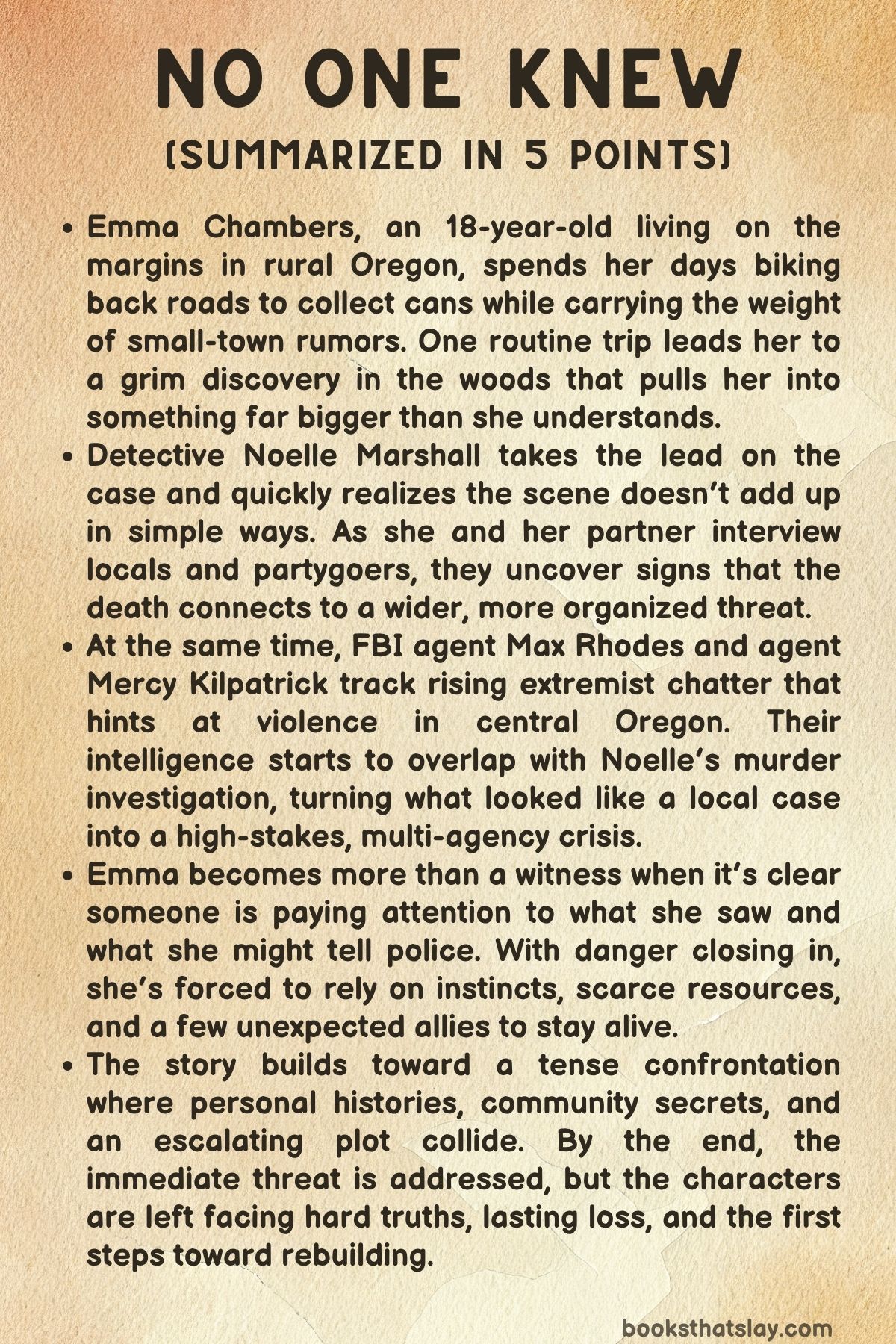
No One Knew by Kendra Elliot is a crime thriller set in rural central Oregon, where small-town life hides bigger dangers. Eighteen-year-old Emma Chambers is scraping by on the edges of her community when she stumbles onto a corpse in the woods.
Detective Noelle Marshall takes the case and quickly realizes it isn’t an isolated killing. As the investigation widens, the FBI tracks signs of extremist violence, and personal threats begin to close in on the people trying to stop it. The story moves from lonely backroads to high-stakes scenes, showing how fear, secrecy, and loyalty can turn deadly. It’s the 2nd book in the Noelle Marshall series.
Summary
Emma Chambers spends her days biking the backroads outside Eagle’s Nest, Oregon, collecting recyclable cans for cash. At school she’s treated like she doesn’t belong, and even on the road she can’t avoid judgment.
One morning, while stopping again and again to pick up empty beer cans, Emma is confronted by an older woman, Anita Forkner, who questions why she isn’t in school and criticizes the way she’s being raised. Emma keeps riding and turns toward a wooded clearing known as a party spot for local teenagers, hoping the trash left behind will help her earn a little more money.
The clearing is littered with remnants of weekend drinking, and Emma fills her bag quickly. She pushes deeper into the trees, searching for more cans away from the mess and noise.
That’s when she notices a single Nike shoe and then sees something far worse: a nude male body lying face down. Emma is terrified and sickened, but she does the one thing she can—she reports it.
Detective Noelle Marshall arrives to find multiple agencies already on scene. The medical examiner, Dr. Natasha Lockhart, confirms the victim is male and appears to have been shot in the forehead.
The body has been moved after death, suggesting someone tried to stage the scene or delay discovery. Noelle learns the teenager who found the body is Emma, a girl Noelle has noticed biking near her new home.
Emma is wary of law enforcement and anxious about how her father will react if she cooperates, but she agrees to answer questions. She explains her route and admits she stopped at the party site.
The one person she remembers seeing earlier on the road is Anita Forkner.
Noelle needs leads, so she asks Emma about the teens who use the party clearing. Emma hesitates, afraid of retaliation and of becoming the town’s target again, but she eventually provides names with the condition that her identity be protected.
Noelle gives her a ride home to confirm her ID and sees the hard truth of Emma’s life: a rundown trailer, cold rooms, and scarce food. Noelle leaves Emma a card with her direct number, sensing the girl may be at risk in ways Emma won’t say out loud.
As Noelle starts interviewing teenagers, she and Detective Evan Bolton find a familiar pattern: plenty of drinking, plenty of people, and very little anyone wants to admit. One teen points them toward an older former student with a reputation—Trevor Baylor—who sometimes brings hard liquor and drifts around the edges of the high school crowd.
Noelle also receives word from Dr. Lockhart about the victim’s tattoo, a distinctive image that might help identify him once they figure out what it represents.
At the same time, FBI special agent Max Rhodes and agent Mercy Kilpatrick are tracking alarming signals of possible domestic terrorism in central Oregon. They review vague threats and references to extremist “boogaloo” culture, a term used in antigovernment circles.
Mercy meets her confidential informant, Cory, who brings troubling information: three suspicious men were seen in the area, paying cash and acting secretive, and one of them left with Cory’s sister, Rachel Johnson. Cory and Rachel can’t provide names, but they can describe faces, a vehicle, and behavior that feels predatory.
Back in Eagle’s Nest, Officer Ben Cooley is worried about Emma. He has seen enough to know she’s living without real support.
Quietly, the local department uses a private community fund—managed with help from Lucas Ingram and the formidable Ina Smythe—to deliver groceries, firewood, and supplies. Ina shows up at Emma’s trailer with Lucas, pushes past Emma’s embarrassment, and makes sure she has food and heat.
Emma, who has learned not to rely on anyone, doesn’t know how to handle kindness that comes without a price.
That night, Emma’s fragile sense of safety breaks. She wakes to her stray orange cat, Cornbread, panicking at the door.
A flashlight flickers outside. Two men whisper near the house, asking about her missing bike and whether “the girl” is home.
Emma hears the front door unlock—someone knows where a hidden key is. She grabs a handgun, her phone, and a stash of cash from her father’s room, then escapes out a window and runs into the woods.
Emma makes it to her Uncle Tommy’s farm before dawn. Tommy nearly shoots her when he finds her in the barn, but once he realizes who she is, he brings her inside and listens.
Emma admits she hasn’t seen her father, Gage Chambers, in months. Tommy is furious, and he insists she stay with him.
When they return to Emma’s place to collect her things, they find signs of a break-in. The intruders took almost nothing of value, as if they were searching for Emma herself.
Soon the investigation escalates sharply. A car bomb detonates in the courthouse parking lot.
Max and Mercy respond, and Noelle and Evan are pulled in. The targeted vehicle belongs to Judge Howard Holtz, but the blast also reveals something horrifying: a nude, bound man in the judge’s trunk, shot in the forehead in the same style as the body found in the woods.
The killings are no longer a single case—they’re part of something organized.
Noelle struggles during the autopsy, overwhelmed by the brutality, but Dr. Lockhart’s work provides critical answers. The first victim is identified as Michael Munoz.
The burned victim from the trunk is Eli Chisholm. Both were restrained, both were shot at close range, and fibers suggest the same type of bindings were used.
Noelle and Evan notify Michael’s sister, Louisa, who reveals Michael’s recent spiral: job loss, growing anger, and new friends obsessed with guns and antigovernment talk. Louisa also shares a chilling detail—Michael once told her young son not to be scared if a bomb went off because he would be “safe.”
Following the trail, Noelle and Evan find Michael’s missing truck at Carson Vohland’s house. Carson admits Michael had been staying with him and meeting with men who framed their ideology as “training” and “preparation.” Carson recognizes Michael’s chest tattoo as part of a set others in the group have.
Evan identifies it as a symbol linked to boogaloo culture, reinforcing the FBI’s fears. The murder investigation and the terrorism chatter begin to merge into a single picture.
Emma, meanwhile, overhears a conversation at Tommy’s barn that makes her blood run cold. A stranger boasts about what he did “with the judge’s car” and admits killing Chisholm and “the other one” because they were liabilities.
Emma recognizes the voice as one of the men who broke into her home. She leaves a whispered message for Noelle, but fear and chaos keep her from staying reachable.
The threats become personal for Max. His sister Keira receives flowers with a note accusing Max of being a murderer, and later Max receives surveillance photos of Keira taken that same day.
Someone is watching his family. Under pressure, Max confesses a painful piece of his past: years earlier, as a SWAT sniper, he killed an eighteen-year-old hostage-taker to save a child, and that shooting fractured his family and left lingering hatred that someone may now be exploiting.
A raid on a suspect property goes wrong when a bunker explodes, killing and injuring agents, including people close to Max. The blast appears designed to draw responders into a trap.
Noelle finds Max burned and shaken but alive, refusing to stand down until the team is safe. The explosion feels like a warning shot, not the main attack, and the task force scrambles to figure out what the real target is.
Then the worst-case scenario becomes real. Max’s supervisor, SAC Jeff Garrison, sends a satellite location from a remote retreat where government leaders and their families are gathered at a district attorney’s cabin—an ideal place for kidnappers to seize power and attention.
The team races into worsening weather, aware that time matters more than caution.
Emma wakes in a dirt-walled cell, confirming what everyone fears: she has been kidnapped. She is moved to a larger cabin where hostages—judges, officials, and leaders—are tied and guarded by armed men.
The leader, Mark, rants about power and betrayal while using fear to keep control. Tommy is there too, seemingly cooperating, but Emma senses he’s being forced into it.
SWAT closes in. A captured guard turns out to be Trevor Baylor, linking the kidnappers directly back to the earlier investigation.
Negotiations begin, but the group fractures as some followers panic and try to flee. In the confusion, women and children escape with SWAT’s help, but Emma remains trapped inside with Mark.
Tommy finally confronts Mark, and the truth comes out: Mark used Emma as leverage to force Tommy’s cooperation. As Mark tries to retreat into the woods with Emma as a human shield, Max takes the shot.
He kills Mark cleanly, saving Emma, but the cost is devastating. Tommy is mortally wounded in the final exchange.
Before he dies, he tells Emma that her father is dead—killed months earlier by Mark—and that the men behind the plot have been controlling her life from the shadows for far longer than she knew.
In the aftermath, Emma is taken in by Noelle, who brings Cornbread and Emma’s horse, Harley, to her property so Emma can heal with what she loves close by. Ina Smythe makes it plain that Emma is not alone anymore.
Investigators confirm the extremist leader eliminated dissenters within his own ranks, explaining the earlier murders, and the task force dismantles what’s left of the operation. Emma asks about finding her missing mother, but Noelle can’t uncover anything recent and suspects darker truths.
Noelle arranges legal help for Emma’s future, and, shaken by how close she came to losing Max, she chooses a life fully committed to him. Max, scarred but steady, tells her he loves her and wants their future together.
Characters
Emma Chambers
Emma is the emotional center of No One Knew—a teenage girl forced into adulthood by poverty, isolation, and the long shadow of her mother’s disappearance. Her habit of biking back roads for recyclable cans is more than a way to earn money; it’s a survival routine that also signals how invisible she is to the community until catastrophe makes her “useful” to adults with authority.
Emma’s mistrust of law enforcement isn’t teenage attitude so much as learned caution shaped by her father’s worldview, yet she still shows a stubborn moral clarity: she tells the truth as best she can, protects what little she has, and keeps trying to do the right thing even when fear is chewing through her. What makes Emma compelling is the way her toughness coexists with tenderness—she cares for chickens, grooms Harley, and takes in Cornbread—small acts that reveal her longing for safety and belonging.
By the end, she has lost almost everything familiar, but she has not been broken; instead, she becomes someone the community chooses to protect, and someone capable of imagining a future beyond mere endurance.
Noelle Marshall
Noelle is the story’s steady investigative force, but her strength is portrayed as human rather than invulnerable. She’s competent, observant, and methodical—someone who arrives at a scene already reading people and patterns—yet she’s also deeply affected by what the job requires, especially when the violence becomes intimate and grotesque.
Her reaction during the autopsy is important because it reframes “professionalism” as something that includes limits and adaptation, not just stoicism; she learns what she can and cannot do, then rearranges the division of labor with Evan rather than pretending she’s unaffected. Noelle also serves as a moral counterweight to the book’s extremism plotline: she uses authority to protect the vulnerable, not dominate them, and her decision to push resources toward Emma through the community fund shows leadership that’s quiet, practical, and brave in its own way.
Her relationship with Max adds emotional risk to her work, and the book uses that risk to show how she chooses connection anyway—building a life that includes love while still carrying the burden of what she sees.
Max Rhodes
Max is shaped by duty and consequence, and the book repeatedly tests whether his competence can shield the people he loves. As an FBI agent pulled into a domestic terrorism threat, he embodies the federal lens—chatter, patterns, escalation—yet he’s not presented as detached; he’s emotionally exposed through family tensions and the long scar of a past shooting that still defines how others see him.
The targeting of his sister and the delivery of surveillance photos weaponize his personal life, forcing him to operate under pressure that is both professional and intimate. Max’s defining trait is controlled restraint: he endures pain, refuses to center himself even when injured, and keeps prioritizing others.
That restraint becomes pivotal in the final confrontation, where he must act decisively without surrendering to panic or vengeance; the shot that saves Emma is framed as an act he can live with, not an act that consumes him. By the end, Max moves toward a future with Noelle not as a fantasy escape, but as a hard-won decision to keep living fully after trauma.
Mercy Kilpatrick
Mercy functions as a bridge between worlds: she has proximity to militia culture and its vocabulary, but she chooses law enforcement and accountability rather than tribal loyalty. Her value to the investigation isn’t just technical; it’s interpretive—she can hear coded language and recognize symbols like “boogaloo” in a way that helps the team understand what they’re truly facing.
Mercy’s personal stakes are quieter than Max’s, but they’re sharp: she knows how easily ideology becomes identity, and how identity becomes justification. Her interactions with Cory and the truth about Rachel’s pregnancy position Mercy as someone who carries grief responsibly, turning pain into action by supporting the living rather than romanticizing the dead.
In the group dynamic, Mercy often supplies clarity without ego, and her presence keeps the narrative from collapsing into simplistic “good vs bad” binaries—she understands how radicalization happens even as she refuses to excuse it.
Evan Bolton
Evan is the investigative partner who steadies the workflow and protects the team’s effectiveness, often by absorbing the parts of the job others can’t or shouldn’t have to handle. He’s pragmatic, calm under pressure, and quietly empathetic—someone who doesn’t dramatize fear or disgust, but notices it in others and responds with respect.
His support of Noelle during the autopsy aftermath is a small but defining moment: he normalizes her reaction, adjusts their roles, and keeps them moving forward without shame. Evan also represents institutional memory and local competence; he can navigate the social terrain of Eagle’s Nest and the surrounding communities, recognizing which interviews will be productive and which will hit a wall.
He’s not a flashy character, but he’s essential—one of those professionals who makes heroism possible by being reliable when everything is unstable.
Truman Daly
Truman is the kind of small-town chief who has to balance public order, limited resources, and community politics, and his personality reflects that constant pressure. He can be brusque and irritated, especially when pulled in too many directions, but he also shows a protective instinct toward the town’s vulnerable residents.
His stewardship of the quiet community fund reveals a version of leadership rooted in discretion and local trust: he understands that help can become humiliation if it becomes gossip. Truman’s interactions with Noelle and Evan highlight both the constraints and strengths of local policing—he knows the families, the reputations, the likely dead ends, and he uses that knowledge to steer the investigation.
In a story about power abused through extremism, Truman represents power used imperfectly but sincerely to keep people safe.
Ben Cooley
Ben is introduced as a familiar uniformed presence, but he quickly becomes one of the earliest adults who truly sees Emma’s reality. His concern isn’t performative; he notices concrete details—cold rooms, an empty fridge, unsafe steps—and translates those observations into action through the private fund.
Ben’s role emphasizes that protection isn’t only about chasing suspects; it’s also about recognizing neglect and stepping in before it becomes tragedy. He’s also a subtle counterpoint to Emma’s fear of law enforcement: Ben shows that a badge can represent care and steadiness rather than threat.
Even when he can’t solve the larger conspiracy, he helps change Emma’s odds of surviving it.
Dr. Natasha Lockhart
Dr. Lockhart represents scientific truth in a narrative full of rumor, coded ideology, and misinformation. Her observations about livor mortis, body movement, timing, and restraint marks repeatedly ground the investigation in evidence rather than speculation.
She is also emotionally steady without being cold; she communicates the brutality of what she sees in a professional manner that allows detectives to translate horror into actionable facts. By linking patterns across victims—bullets recovered, binding similarities, differences in injury—she helps transform isolated crimes into a connected threat.
In a story where extremists manipulate narratives, Lockhart’s role underscores that bodies don’t lie even when people do.
Anita Forkner
Anita appears briefly, but she matters as a snapshot of the town’s social atmosphere: judgmental, intrusive, and confident in her right to police other people’s choices. Her confrontation with Emma highlights how Emma is treated—watched, assessed, and dismissed—long before anyone realizes she’s in danger.
Anita’s presence also reflects the everyday cruelty that can thrive in small communities, where gossip becomes a kind of social currency. Even without major plot involvement, she helps explain Emma’s isolation and why asking for help does not come naturally to her.
Gage Chambers
Gage is largely defined through absence and aftermath, which is fitting because his impact on Emma is more about the environment he created than the words he speaks on page. He appears as a father who has failed materially and emotionally—unemployed, drinking, prideful, aligned with ideas that keep Emma suspicious of help—yet the story hints at something darker beneath the neglect.
The later revelation that he was killed months earlier reframes Emma’s hardship as not merely familial dysfunction but the residue of a violent power struggle she never understood. Whether through ideology, cruelty, or simple collapse, Gage is part of the machinery that left Emma unprotected, and the possibility that he harmed Emma’s mother deepens his role as a source of unresolved dread even after death.
Uncle Tommy
Tommy begins as Emma’s last resort and becomes her safest anchor, a man whose protective instinct is immediate even when he’s angry and frightened. He lives close to the land and close to the local networks that the extremists exploit, which places him in a morally dangerous position: he is pressured into proximity with people capable of murder.
Tommy’s love is expressed through action—taking Emma in, retrieving her belongings, trying to keep her alive—rather than through gentle language. His final choices define him: he confronts Mark, tries to save Emma, and dies with the truth finally spoken.
Tommy’s arc is tragic because it suggests he has been surviving alongside monsters for a long time, and only when Emma is threatened does he fully step into open resistance.
Ina Smythe
Ina is blunt, forceful, and socially fearless, which makes her a powerful antidote to the shame and silence that keep Emma isolated. She treats Emma like someone worth protecting immediately, without waiting for permission from gossip networks or fragile pride.
Ina’s “soft spot for strays” is not sentimental; it’s a philosophy of intervention—if someone is vulnerable, you act, and you act decisively. She also embodies community infrastructure that is informal but real: the fund, the quiet delivery of groceries, the insistence that help is a right, not a favor.
Ina’s presence signals a shift in Emma’s world from neglect to belonging, and she helps convert Emma from a hidden hardship into “their girl now,” someone the town claims and safeguards.
Lucas Ingram
Lucas operates as a community facilitator, the kind of person who makes institutions feel human. As receptionist and local connection point, he’s positioned where information, needs, and reputations flow, and he uses that position to help rather than control.
His involvement in delivering groceries and firewood shows a willingness to step beyond job description when someone is in trouble. Lucas also reflects how small towns can be protective when they choose to be—quietly, practically, and without fanfare.
Cory Johnson
Cory is courageous in a way that doesn’t look like action-movie heroism; she’s brave through proximity, observation, and the willingness to risk herself for information. As an informant, she moves in spaces where extremists and sympathizers overlap, using social skills to pull details out of people who think they’re in control.
Her choice to engage a man from the suspicious group at a bar shows a dangerous intelligence: she understands how to make someone talk, but she also understands how quickly that can turn lethal. Cory’s grief is threaded through her choices, especially after learning the truth about Rachel; she carries personal loss while still doing work that could prevent future deaths.
The decision to compile Rachel’s poems into a book becomes her way of refusing to let violence be the final author of her sister’s story.
Rachel Johnson
Rachel is mostly seen through forensic findings and the memories of others, which mirrors how victims are often reduced to “the case.” Yet the narrative restores her humanity through the details that matter: her connection to Cory, her time at America’s Preserve, and the quiet tragedy of her pregnancy and death. Rachel’s choices—leaving with a stranger, being pulled into risk—sit at the intersection of youth, vulnerability, and the predatory nature of the group.
Even without extensive page time, she functions as a warning signal in the plot: the extremists are not just talking, not just training, but killing people who become inconvenient.
Keira Rhodes
Keira represents the collateral damage of targeted violence: she is not an investigator, not a suspect, but she becomes a lever used to control and punish Max. The flowers and the note are designed to contaminate her life with his past, turning family into a battlefield.
Keira’s presence also highlights Max’s fractured family dynamics; the threat forces contact and urgency, revealing emotional distance that existed long before the current case. She is important because she makes the cost of the conflict immediate—this isn’t only about institutions under attack, it’s about ordinary people being terrorized to send a message.
TJ
TJ’s role is primarily as Keira’s partner and as part of Max’s threatened inner circle. He functions as a stabilizing presence in the family unit that is suddenly forced into crisis behavior—cash, burner phones, leaving immediately.
Even in limited exposure, TJ helps show how quickly “normal life” collapses under targeted intimidation, and how preparedness becomes a form of survival even for those who never asked to be involved.
Judge Howard Holtz
Judge Holtz is a symbol of institutional authority, and the attack on him is both personal and strategic. The bombing and the body in his trunk transform his status from powerful decision-maker to frightened potential victim, which is exactly the psychological inversion the extremists want.
Holtz’s fear for his family is significant because it humanizes the target and highlights the cruelty of using loved ones as pressure points. His list of people who have threatened him illustrates the breadth of resentment that public officials can accumulate, but the plot makes clear that this attack isn’t a lone grudge—it’s part of a wider plan meant to destabilize governance through terror.
Tamara Holtz
Tamara appears as the domestic anchor within the judge’s fortified world, the person managing children and keeping family life moving while danger presses in. Her ordinary actions—driving to a grocery store, shepherding kids away during questioning—contrast sharply with the extremity of the threat, underscoring how terrorism invades the mundane.
Tamara’s presence emphasizes what is actually at stake in attacks like this: not abstract “government,” but families living inside the blast radius of political violence.
Mark Bourdon
Mark is the clearest embodiment of ideological violence in the story: charismatic enough to lead, ruthless enough to kill, and pragmatic enough to use hostages as tools rather than people. He frames his actions in the language of power and abuse, but his behavior reveals something else—control for its own sake, enforced through fear, coercion, and murder.
Mark eliminates dissenters as “liabilities,” showing that the movement’s talk of freedom masks an internal structure that punishes autonomy. His kidnapping of Emma and the threat against Tommy demonstrate his strategy: he doesn’t just attack institutions, he weaponizes the vulnerable to force compliance.
Mark’s end is deliberately stark: he dies in the moment his control breaks, and the narrative treats his death less as triumph and more as the hard necessity of stopping someone who will not stop.
Trevor Baylor
Trevor functions as both local troublemaker and connective tissue between the teen party world and the extremist violence. His earlier evasiveness and nervousness suggest he is used to lying to authority, but not necessarily built for the level of brutality unfolding around him.
His later identification as a captured guard at the hostage site transforms him from a suspicious peripheral figure into a direct participant. Trevor’s usefulness to the investigation—providing intel about hostage numbers and internal dissatisfaction—suggests someone who is in over his head, caught between bravado and fear.
He represents how extremist groups can recruit people with shaky judgment, giving them a sense of belonging and importance that collapses the moment real consequences arrive.
Michael Munoz
Michael is depicted as a man who slid into radicalization, and his story is told through the observations of those left behind. His increasing anger, isolation, and obsession with guns, combined with job loss and new associates, creates a portrait of someone becoming unrecognizable to family.
The fact that he was murdered by the very world he was drifting toward underscores a brutal truth: extremist ecosystems often consume their own, especially when paranoia and “operational security” turn people into disposable risks. Michael’s carelessness with weapons around a child shows he wasn’t just politically troubled—he was dangerously irresponsible—and his death becomes both a clue and a tragedy, especially as his sister realizes she didn’t even recognize he was missing.
Louisa Munoz
Louisa is a grounded, protective parent whose decisions are shaped by the constant calculus of safety. Her choice to force Michael out is painful but principled; she prioritizes her son over loyalty to her brother, and she establishes boundaries that many families struggle to enforce.
Louisa also carries complicated guilt—she didn’t realize he was missing, she couldn’t stop his downward spiral, and now she must deliver the news to their mother. Her contributions to the case are practical and brave: she shares uncomfortable details, identifies risk behaviors, and offers leads, all while processing shock.
Louisa’s character emphasizes that families of radicalized individuals are often both victims and unwilling witnesses.
Austin Munoz
Austin is significant because he represents innocence placed in proximity to danger—first through unsecured guns, later through the chilling remark about bombs that suggests Michael exposed him to violent ideas. Austin’s presence raises the stakes beyond adult conflict; it highlights how ideology and weapon culture can seep into children’s minds, not through propaganda speeches but through casual, trusted conversations.
Even without direct action, Austin functions as an ethical alarm bell for the investigation.
Carson Vohland
Carson is the jittery caretaker friend who provides a window into the group’s daily habits and mentality. He comes across as anxious and possibly frightened of being seen as complicit, which makes sense because he enabled proximity even if he didn’t participate in violence.
His descriptions of “training,” antigovernment talk, avoiding technology, and the shared tattoo reveal how the group created identity through symbols and secrecy. Carson’s home literally hosting Munoz’s truck turns him into an inadvertent evidence locker.
He represents the peripheral enablers around extremist movements—people who may not plan attacks but normalize the culture that incubates them.
Eli Chisholm
Eli is presented primarily as a victim whose death clarifies the pattern: restraints, execution-style shots, and tactical disposal. The contrast between his treatment and Munoz’s—one beaten, the other not—suggests internal group politics about punishment, loyalty, and fear.
Eli’s body being placed in the judge’s trunk also shows how the killers use corpses as messages and tools, not merely as consequences. He is less a developed person on page and more a grim instrument that reveals the perpetrators’ methods and escalation.
Hammaker
Hammaker appears as a property owner whose bunkers become a trap, and his role underscores coercion within extremist structures. The later information that he was threatened into appearing at the cabins suggests he may not have been the mastermind, but rather someone caught in a violent hierarchy.
His environment—bunkers, hidden spaces, booby traps—reflects preparedness culture pushed into lethal territory. Hammaker’s function in the plot is to show how “prepping” aesthetics can be converted into murder logistics when fear and ideology are fused with cruelty.
SAC Jeff Garrison
Garrison represents high-level federal leadership, and his disappearance and the retreat location shift the threat from scattered violence to coordinated destabilization. He becomes both target and hostage, which reorients the team’s urgency: this is no longer a case with victims after the fact, but a crisis with lives actively at risk.
Garrison’s involvement also reveals the attackers’ strategic thinking—striking at leadership gathered in one place, aiming for maximum political and psychological impact.
SAC Stevens
Stevens appears amid the bunker blast aftermath, injured and shaken but alive, functioning as a marker of how close the operation came to total disaster. His survival outside the bunker highlights the attackers’ intent to maximize casualties through timing and confinement.
Stevens’ presence also underscores institutional vulnerability: even organized teams with armor and protocols can be outmaneuvered by someone willing to rig death into the environment itself.
Agent Keyes
Keyes’ death is one of the book’s starkest reminders that the protagonists are not protected by narrative convenience. She enters the bunker doing her job and is killed by a calculated trap, making her a symbol of service met with deliberate cruelty.
The visual details of her injuries and the frantic response around her intensify the emotional weight of the investigation, forcing characters like Noelle and Max to confront the cost of “just one more lead.”
ATF Agent Reed
Reed’s death alongside Keyes reinforces that the threat is not selective or clean—it is indiscriminate against anyone perceived as an obstacle. His presence also highlights interagency cooperation, and his loss underscores how terrorism fractures not just buildings and bodies but operational capacity, trust, and morale.
Reed is part of the book’s insistence that the stakes are real and that success, when it comes, is purchased with grief.
Agent Preston
Preston is defined through leadership under extreme pressure during the hostage situation. He coordinates SWAT movement, containment, and rescue in conditions where a single miscalculation could trigger mass execution.
His role illustrates the shift from investigation to tactical crisis management: decisions must be fast, information incomplete, and lives are actively on the line. Preston’s value is in disciplined escalation control—moving the operation forward while minimizing the chance of a catastrophic outcome.
DA Ferrandis, the Governor, the Mayor, and other hostages
These figures function as the human embodiment of civic structure, but the book portrays them most importantly as frightened people—some with families nearby—reduced to vulnerability by armed men who believe violence grants legitimacy. Their presence turns the extremists’ plan into something larger than revenge; it becomes an attempted spectacle of power meant to create panic and a “vacuum at the top.” The separation of women and children, the bindings, and the use of hostages as shields show how the attackers convert governance into theater, trying to prove that institutions are helpless.
Even without deep characterization, the hostages matter because they reveal what the antagonists are actually targeting: stability itself.
Cornbread
Cornbread is more than a pet; he’s a symbol of Emma’s instinct to care even when she can barely care for herself. His presence at key moments—his frantic warning at the door, his return to the porch, his eventual move to Noelle’s property—tracks Emma’s journey from isolated survival to shared safety.
Cornbread also acts like an emotional grounding point: when human adults fail Emma, she still finds a living creature she can protect, and that bond becomes a small proof that she is capable of love and being loved.
Harley
Harley represents continuity, work, and calm—a living routine that steadies Emma when everything else is chaos. Grooming Harley is one of the few moments where Emma’s body and mind can settle, which is why the scene becomes narratively important when she overhears dangerous conversation.
Harley’s relocation to Noelle’s property at the end signals a practical kind of healing: Emma’s life is still damaged, but the pieces of it that made her feel real and capable are not all gone.
Themes
Isolation as a Social Sentence
Emma’s life is shaped by the kind of isolation that isn’t chosen, but assigned. She lives on the edge of town life in rural Oregon, and the daily routine of biking back roads for recyclable cans quietly signals how little safety net she has.
It is not simply poverty; it is poverty made visible, the sort that turns a person into a rumor before they become a friend. At school, she’s treated as an outsider and forced to carry a story she didn’t create: her mother’s disappearance becomes a stain other people feel entitled to interpret.
That social exile is reinforced by adults too—Anita Forkner’s drive-by judgment is a small scene, but it shows how quickly a community decides what a “good” childhood should look like and how harshly it punishes deviations. Emma’s wariness around law enforcement adds another layer: she is isolated not only by peers, but by what she has been taught to fear, making even help feel dangerous.
When she finally accepts groceries and firewood, it isn’t framed as charity that restores dignity; it’s an intervention that exposes how thoroughly she has been living without support. The intruders who target her later exploit this isolation with brutal efficiency.
They know she is alone enough that intimidation might work, and they act as if her home is unprotected territory. Even when Emma reaches Uncle Tommy, safety is conditional and fragile, tied to whether adults can protect her from forces she barely understands.
In No One Knew, isolation is not just loneliness; it is a mechanism that makes people easier to ignore, easier to threaten, and easier to use as leverage. The story keeps returning to a hard truth: when a person is treated like they don’t belong, predators notice first, and protectors arrive later.
Fear as a Tool of Control
Fear in this story is not merely an emotional response to violence; it is an intentional strategy used to shape behavior. The murders carry an execution-like signature—close-range shots to the head—and that consistency communicates something to anyone paying attention: there is a group willing to decide who is disposable.
The bombing escalates this message from individual death to public spectacle, turning civic space into a warning sign. The courthouse attack doesn’t just threaten one judge; it signals that institutions can be penetrated, humiliated, and used to broadcast power.
That same logic shows up at the personal level when Emma is stalked at night. The whispered conversation outside her door is chilling because it treats her as an object to be handled: “the girl” becomes a problem to solve, not a person.
Fear becomes an instrument that pushes her into flight, separating her from home and stability while also cutting her off from normal channels of help. The hostage plot extends this dynamic to an entire community of leaders and families.
Taking hostages isn’t only about demands; it’s about rewriting the relationship between citizens and government through terror, forcing officials to experience helplessness while their loved ones are in danger. Even the smaller details—stolen license plates, surveillance photos, anonymous taunting messages—show fear used as a form of remote management.
Max is not attacked only through physical harm; he is attacked through the implication that those close to him can be reached anytime. That pressure is meant to distract, destabilize, and isolate him, pulling him away from clear thinking and normal procedure.
Fear functions like a currency: it buys silence, hesitation, obedience, and sometimes betrayal. The narrative makes a pointed argument that terror succeeds when it convinces people the threat is everywhere, the rules no longer matter, and resistance will cost more than compliance.
Community Responsibility Versus Private Pride
The book spends significant time showing how help can be offered with care, and how receiving it can feel like humiliation when pride has become a survival tactic. Emma’s home life is marked by scarcity—cold rooms, an almost empty fridge—and yet the barrier to assistance isn’t only logistical.
It is emotional and cultural: in a small town, being known can feel like being exposed, and accepting help can become a public label. That’s why the community fund matters so much.
It exists quietly, deliberately designed to support people without turning their hardship into entertainment. Ben Cooley’s instinct to use it for Emma shows a version of policing that recognizes harm is not limited to crime scenes.
Ina Smythe’s arrival turns that idea into action, and her approach is blunt because she understands how pride can be used as an excuse to let a kid go hungry. She doesn’t ask Emma to perform gratitude or explain herself; she treats the need as self-evident and the response as non-negotiable.
That insistence is important because it redefines dignity: dignity is not pretending you’re fine, but being allowed to live safely. The tension between community responsibility and private pride also appears in law enforcement dynamics.
Noelle tries to protect Emma’s confidentiality when asking for party names, acknowledging that in a tight social web, being seen as a “snitch” can become a danger of its own. The story repeatedly shows people deciding whether to look away or step in—RJ’s partial cooperation, Carson’s nervous admissions, Cory’s risky choice to engage someone suspicious, and Tommy’s tragic involvement.
Each choice sits on a spectrum between self-protection and collective responsibility. By the end, Emma is taken in, her cat and horse are brought to safety, and Ina says, in effect, that Emma now belongs to them.
That line lands because it is the opposite of rumor-driven exclusion: it is a community claiming responsibility for someone who has been left to manage adult problems alone. Pride is portrayed as understandable, even necessary, but also as something that can be manipulated by hardship until it becomes a cage.
Community responsibility becomes the force that breaks the cage—imperfectly, sometimes too late, but decisively when it matters.
Moral Injury and the Cost of Protecting Others
Max and Noelle carry different versions of the same burden: what it costs to keep showing up after you’ve seen too much. Noelle’s reaction to the autopsy is a clear depiction of professional exposure colliding with human limits.
She is competent at scenes, interviews, and strategy, but the physical intimacy of death in the morgue overwhelms her. The important point is that she does not fail the job; she meets a boundary that the job often pretends shouldn’t exist.
Evan’s response—adjusting their division of labor without shame—models a healthier ethic: protecting the living includes protecting the investigators from unnecessary damage. Max’s moral injury is more layered because it includes public backlash and family fracture.
He once killed an eighteen-year-old to save a child, and even though the act fits a narrative of heroism, the consequences poison his personal life. That history returns not as melodrama, but as a pressure point when he faces another moment requiring lethal force.
The story shows that traumatic decisions don’t end when the trigger is pulled; they echo through relationships, reputation, and self-concept. When Max is targeted through his sister, and later physically burned in a blast, the danger becomes both professional and intimate.
The result is not just pain, but a narrowing of emotional space—life becomes a series of threats to manage. Yet the hostage climax forces a final confrontation with that cost.
Max shoots Mark to save Emma, and the scene is structured to show how difficult it is for him to do it, even when it is necessary. The shot resolves the immediate danger, but it does not erase the psychological weight of repeating a life-or-death decision.
At the same time, the book refuses to reduce moral injury to a single character’s suffering. Emma’s losses—her father’s death, Tommy’s death, her own captivity—create a parallel portrait of what survival can demand from a young person who never asked to be brave.
The closing movement, with Noelle choosing to build a future with Max and to care for Emma, frames healing as an active commitment rather than a clean recovery. Protecting others is shown as meaningful, but never free.
The story’s emotional realism comes from treating that cost as something people must carry, share, and respond to—otherwise it becomes the next hidden violence.