On Sundays She Picked Flowers Summary, Characters and Themes
On Sundays She Picked Flowers by Yah-Yah Scholfield is a dark, intimate story about survival, isolation, and the dangerous comfort of being seen by someone who understands your damage a little too well. Judith “Jude” Rice grows up under relentless cruelty from her mother, and adulthood offers no rescue—only the slow, terrifying realization that freedom will cost her everything.
After a killing that feels like both escape and sentence, Jude disappears into a strange cottage in the Georgia woods, where the house seems to remember pain and the forest watches back. What follows is a long reckoning with love, hunger, and the kind of truth that can’t be unlearned.
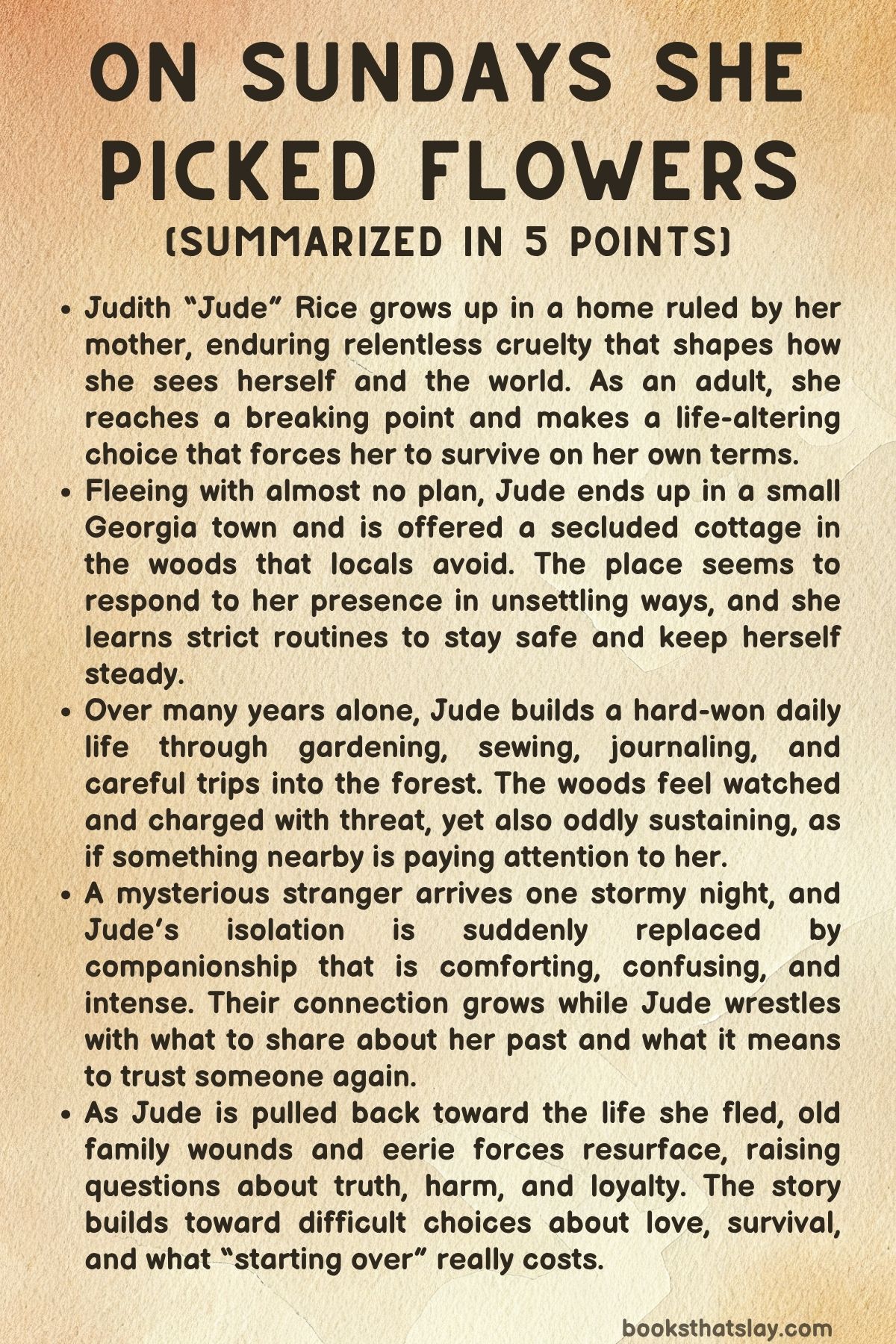
Summary
Judith “Jude” Rice is raised in a home ruled by her mother, Ernestine, whom Jude calls Ma’am. Jude’s childhood and early adulthood are shaped by constant punishment: beatings, insults, and control that strip her of dignity and leave her marked inside and out.
For years Jude searches for a way out—through faith, through hope that someone will step in, through the idea that her mother might change—yet every attempt ends the same way, with Ma’am tightening her grip. As Jude reaches her thirties, the idea of escape stops feeling possible.
She begins to believe there is only one permanent exit.
One evening, Jude cooks dinner in Ma’am’s kitchen with a suitcase already packed. When Ma’am comes downstairs and realizes Jude intends to leave, she erupts.
She insists Jude has no right to go, no real life beyond the house, and no claim to space that belongs to her. Jude tries to stand her ground, saying she cannot live there anymore.
Ma’am answers with humiliation and violence, striking Jude hard enough to cut her face with a ring. Something in Jude finally breaks.
She fights back, clawing and striking as years of fear and rage pour out at once. The struggle turns frantic and ugly, and Ma’am overpowers Jude, pinning her down and choking her until Jude’s vision fades.
On the kitchen floor, Jude’s hand finds a knife. Even as the blade slices her palm, she grips it and drives it into Ma’am’s face and head.
Ma’am reels away, sees the ruined reflection of herself, vomits, and collapses. Jude crawls after her, watches her body twitch and sputter, and then ends it by cutting her throat.
The moment the fight stops, Jude is left with shock, blood, and the eerie silence that follows a lifetime of noise.
Jude cleans herself as best she can, bandages her wounds, and does something unsettlingly practical: she changes into one of Ma’am’s dresses. She repacks her suitcase with clothes, headscarves, books, sewing supplies, and a first-aid kit.
She takes the small savings she has—$350—then steals Ma’am’s canary-yellow 1965 Pontiac and drives without a clear destination. She moves on instinct, pushing across county lines with coffee, brief naps, and a need to keep going before fear can catch up.
Near the Chattahoochee-Oconee forest in northern Georgia, the Pontiac dies late at night. Jude walks into a small town called Whitney, hoping for a room.
At an inn, a weary innkeeper feeds her leftovers but warns that her bruises and her skin color make her vulnerable here. Jude breaks down, begging for anything that keeps her from returning to the place she fled.
The innkeeper agrees to let her rest in a tiny housekeeping room for a short time. Before dawn, the innkeeper wakes her with an alternative: a cottage in the woods no one wants because locals claim it is haunted, surrounded by stories of spirits and danger in the trees.
Jude pays $100. The innkeeper packs her suitcase with supplies—blanket, canned food, seeds, matches, batteries, kerosene, a lamp—and hands her keys and a rough map.
She promises Jude’s car will be brought later.
Jude follows the path into the forest, overwhelmed by darkness, strange sounds, and the feeling that she is being studied. She loses her way.
Something large moves near her, close enough that she senses fur and breath at her neck. Her flashlight fails.
She runs, dropping her things, until she reaches an open field and spots the cottage. Inside, the air feels wrong.
Doors slam, footsteps echo above her, and a sickness rises in her stomach as if the house itself is angry. The kitchen resembles Ma’am’s kitchen so closely it rattles Jude’s sense of reality.
Several upstairs rooms are locked from the inside. The attic is crowded with covered furniture and old belongings that give Jude an inexplicable sense of recognition.
Exhaustion finally forces her to sleep.
Jude stays. Days become months, and months become years.
She builds a quiet life of routine: gardening, quilting, writing in a journal, and moving through the woods only in daylight, always retreating before night. At first the cottage is violent, throwing objects, filling rooms with gas, buckling floors, and calling her name as if it knows her.
Jude tries prayers and small rituals, searching for any pattern that changes the house’s behavior. Eventually she finds one: every Sunday evening she lights lamps and candles in the windows.
The glow calms the disturbance and turns the cottage into a beacon in the dark.
The forest has its own presence. Jude hears growls and roars and comes to believe a “beast” lives nearby.
Sometimes it leaves dead animals or strange offerings at her door. Jude’s sleep is troubled by recurring dreams—Ma’am, footsteps, and a knock at the door she never fully answers.
Then one autumn night, the knock becomes real. A soaked woman stands outside with uncanny black eyes and a hungry intensity.
She calls herself Nemoira. Jude lets her in, uneasy but unable to refuse.
Nemoira devours food like someone starving, and Jude finds herself drawn into the strange task of caring for her, even preparing a bath upstairs.
The intimacy of the bath unsettles Jude. Nemoira’s presence awakens feelings Jude doesn’t know how to name, and even accidental contact sends her into panic.
Yet the next morning Jude throws herself into hosting, cooking a grand breakfast, setting the table with flowers and fine dishes, and savoring the idea of company after so many years alone. Nemoira fits into the cottage with surprising ease.
When Nemoira washes dishes, the house stays calm, as if approving. Jude listens for chaos that never comes, and that silence feels like permission.
Nemoira has nowhere to go, and Jude fears sending her out into woods that still feel dangerous. Jude offers her the sunroom.
Weeks pass, and Nemoira becomes part of Jude’s daily life: sharing meals, walking with her, helping after nightmares, rewrapping gauze after Jude’s episodes of self-harm, and asking careful questions about Jude’s past. Jude shares fragments but refuses to speak the worst truth.
Nemoira warns that she might be harmful, but Jude insists she trusts her anyway, clinging to the steadiness Nemoira brings.
Jude eventually allows Nemoira to join her on Sunday walks. Their closeness deepens through small domestic moments and through Jude’s craft; she begins sewing threads from Nemoira’s clothing into a major quilt, binding Nemoira into her work as if it could make her stay.
As winter approaches, they harvest, preserve food, chop wood, and keep the fires going together. Jude feels herself opening, but she still guards the story of Ma’am behind her teeth.
One evening, Nemoira persuades Jude to walk later than usual, closer to nightfall, promising they will carry lamps. Nemoira leads Jude to a hidden glade that feels untouched by normal seasons, centered around a massive willow.
In that strange light, Jude finally admits pieces of her history: Ma’am’s ring, the cruelty, and the fact that her mother is dead. On the way back, Nemoira moves ahead and disappears.
Jude finds huge pawprints and the abandoned lamp. The beast appears—a scarred grizzly bear.
Jude approaches in terror, touches its fur, and recognizes the eyes. She whispers Nemoira’s name, realizing Nemoira and the bear are the same being.
Back at the cottage, Nemoira shifts into human form again. Jude demands honesty; Nemoira claims there are no more secrets.
Nemoira admits she has watched Jude for years, drawn to the Sunday lights, sometimes bringing food as offerings. Overwhelmed by desire and relief, Jude kisses her.
Nemoira responds with a hunger that is not only physical, and they spend the night together.
On the anniversary of Ma’am’s death, Jude falls violently ill, trapped in fever dreams filled with Ma’am and the house’s restless force. Nemoira cares for her, sometimes curled at the bed in bear form like a guard.
As Jude recovers, she admits the date and finally confesses out loud that she killed her mother. Nemoira listens, sees the scars, and understands the abuse.
She frames Jude’s act as survival, not evil, and holds her with an acceptance Jude has never received from anyone.
The story briefly shifts to Jude’s aunt Phyllis, who remembers finding Ernestine’s corpse and how Jude vanished afterward. Phyllis and her sister Lillian have been living in the haunted Atlanta house, enduring its violent outbursts.
The house calls for Jude, and the family history refuses to stay buried.
Many years after she fled, Jude returns to Atlanta with Nemoira. They stay in a motel nearby, and Jude is cautious in public, aware of how dangerous the world can be for someone like her—and for whatever Nemoira truly is.
Nemoira hunts at night, and Jude cleans the blood from her. Jude recalls a past incident when Nemoira was shot while hunting and Jude found her bleeding in human form, snarling until Jude’s scent brought her back.
The danger becomes real again when Nemoira is shot in the city. Jude forces her to survive, and later Jude finds a hunter’s shredded corpse in the woods and takes his gun.
Jude chooses to confront her aunts in a public place: a Sunday church service at Blessed Streams Baptist. After the benediction, she approaches Lillian and Phyllis.
Lillian is hostile, but Phyllis—torn between anger and longing—invites Jude to dinner at Ma’am’s house. Inside, Jude is sickened by the decay.
The walls display family photos, yet Jude is absent from them, erased. During dinner Lillian needles Jude until the table begins to shake violently.
Jude calms it by speaking softly and touching the furniture, revealing she has learned how to soothe restless forces. That night Jude cannot bear her old bedroom and sleeps instead in Ma’am’s room, with Nemoira beside her.
Later Jude sees the stain on the kitchen floor where her mother died, a mark the house refuses to release.
Jude decides the house will not keep winning. She begins cleaning with relentless determination, airing out rot, scrubbing grime, repairing what she can, cutting back vines, and making the space livable.
The house resists, but Jude persists until it quiets, though the stain remains. Phyllis quietly offers Nemoira a photo album filled with pictures of Jude as a child, proof that someone kept evidence of her existence even if the walls did not show it.
Then Lillian disappears. Nemoira’s point of view reveals what she has hidden: she has hunted humans for food for a long time, slipping into human spaces, gaining entry, and killing her hosts.
She has continued doing this in Atlanta. She lies calmly when police ask questions, and Phyllis grows afraid of her.
When Phyllis finally tells Jude she believes Nemoira killed Lillian and fears she will be next, Jude sends Phyllis away, choosing to face what is happening herself.
Jude stays in the house with Nemoira and begins reshaping her life with startling firmness—changing her clothes, cutting her hair, refusing the role she was forced into as a child. But the house insists on truth.
One day Jude hears violent rattling from her old dresser as if it demands to be opened. In the last drawer she finds trophies: teeth, bones, shredded fabric, jewelry, and Lillian’s scarf.
The realization hits with full force—Nemoira has been feeding Jude human flesh, and the “gamey, sweet” meals were people. Jude is sick, enraged, and devastated, not only by the horror but by the intimacy of the betrayal.
Jude confronts Nemoira with the bundle of remains. Nemoira admits it without flinching and argues that Jude already knew she was an animal.
She claims it changes nothing, and then twists the knife: Jude killed her mother with a blade, so Jude has no right to judge. Nemoira insists they are alike—both capable of killing, both shaped by hunger and harm.
Jude locks herself away, shaken by the similarity and by how badly she still wants Nemoira.
The next day Jude moves through the neighborhood as if trying to remember what ordinary life feels like, then returns and cooks beef stew, preparing herself for the decision she knows is coming. That night, at the table, Jude attacks with a knife.
Nemoira transforms into a bear, and the fight tears through the house with brutal speed. Jude is clawed and slashed, yet she keeps fighting, managing to stab Nemoira’s belly and open a fatal wound.
They crash down the stairs, and in the kitchen Jude forces herself through terror and pain, grabbing a butcher knife and cutting Nemoira’s throat. Nemoira shifts partly back toward human as she dies in Jude’s arms, leaving Jude with blood, grief, and a second killing that feels different but no less final.
Jude butchers Nemoira with ritual care, saving the pelt and wrapping the heart and liver. She loads what remains into her car and drives back to the isolated cottage near Whitney, returning to the place where she once learned control.
Ten years pass with Jude living alone, wearing a cloak made from Nemoira’s fur, still haunted by memory and by cravings she does not fully name. Then Nemoira appears on Jude’s porch again—scarred but alive—bringing deer as an offering and promising no more lies.
Jude lets her in. Later, Jude asks to see the bear, and Nemoira transforms.
Jude touches her fur with the same mixture of fear and longing that has guided her life for decades, and they agree to begin again, knowing exactly what the other is capable of now.
Characters
Judith “Jude” Rice
In On Sundays She Picked Flowers, Jude is built out of endurance, rage, and a painstaking, hard-won capacity for tenderness that keeps getting tested. Her childhood under Ernestine’s rule doesn’t simply “damage” her; it trains her nervous system to expect violence as the price of existing, so her early hopes—prayer, rescue fantasies, dreams of reconciliation—read as survival strategies rather than naïveté.
When she finally kills her mother, the act is not framed as a clean liberation but as the brutal moment where self-preservation and taboo fuse: Jude chooses life, and the cost is that she must carry her own capacity for lethal violence as an intimate fact about herself. That complexity follows her into the woods and into the cottage—she builds routines, gardening, quilting, and journaling, not because she is naturally serene, but because structure is how she keeps the past from spilling into the present; even her Sunday lamps become a ritualized boundary between safety and chaos, a way of negotiating with terror rather than defeating it.
Jude’s longing for companionship is equally complicated: after so many years of solitude, she is both starved for intimacy and primed to interpret closeness as danger, which makes her relationship with Nemoira feel like a collision between craving and alarm. Her arc is defined by the question of control—who has it over her body, her home, her story, her appetite—and by the end, when she kills Nemoira and later lets her back in, Jude reads as someone who cannot return to innocence but can still renegotiate terms: she becomes a person who survives by making rules, breaking them when necessary, and living with what those breaks reveal about her.
Ernestine “Ma’am” Rice
Ma’am functions as both an individual abuser and the central shaping force in Jude’s inner world, so her presence lingers long after her death as memory, fear, and a model of domination. Ernestine’s cruelty is methodical rather than impulsive; she humiliates as much as she harms, constructing a reality where Jude’s autonomy is treated as theft and leaving is framed as impossible because Jude is told she has no rightful space—not even a room, not even a self.
The kitchen confrontation that ends in murder shows Ma’am’s core mechanism: escalation through entitlement, the certainty that violence is a legitimate tool to correct disobedience, and the assumption that Jude’s body is something she can slap, cut, or choke into compliance. Yet the narrative also refuses to let Ma’am remain a simple monster-shaped outline; her ring, her house, her lingering stain on the floor, and the way the home “won’t stay clean” all suggest that Ernestine’s legacy is a kind of contamination—trauma embedded into domestic space, passed along like inheritance.
Even in death, Ma’am continues to operate as the voice Jude must argue with internally: the standard of what punishment “should” look like, the figure Jude fears she might resemble, and the original template of love twisted into control.
The Innkeeper
The innkeeper appears briefly, but their impact is outsized because they represent the first human intervention that is neither exploitative nor sentimental. They read Jude’s bruises and understand the social danger around her—especially the collision of visible injury, racialized vulnerability, and small-town threat—so their refusal to rent a regular room isn’t rejection so much as risk assessment.
What makes the innkeeper significant is how practicality becomes compassion: food, a short rest, a charged but workable option, and a bundle of supplies that turns Jude’s flight into something closer to survival. The innkeeper also serves as the hinge between “ordinary” harm and the uncanny: they are the one who translates local rumor into an escape route, effectively placing Jude into the haunted cottage as if giving her a hiding place the world has abandoned.
That choice positions the innkeeper as a moral contrast to the story’s main predators—someone who doesn’t demand Jude’s story, doesn’t claim to save her, but still changes the outcome by acting decisively when Jude cannot afford delay.
Nemoira
Nemoira is the most volatile character because she embodies both sanctuary and predation, and the story keeps forcing the reader to live inside that contradiction the way Jude does. On first arrival, Nemoira is staged like a temptation and a threat at once—uncanny eyes, ravenous hunger, an unsettling magnetism—yet she also brings a kind of softness Jude has never been allowed: calm hands after nightmares, tea after episodes, steadiness when Jude is unraveling.
Nemoira’s intimacy operates as an antidote to Jude’s isolation, and the relationship initially feels like a repair narrative where care and desire begin to overwrite old scripts of domination. But Nemoira’s revelation reconfigures everything: she is not merely dangerous in the abstract; she has been actively shaping Jude’s reality, watching her for years, feeding her, testing the boundaries of trust, and eventually admitting a long history of hunting humans.
Her shapeshifting makes her a literal double-self—woman and bear—but the real duality is ethical: she can perform tenderness while practicing consumption, and she can speak devotion while treating deception as permissible. When she argues that Jude and she are the same because Jude killed her mother, Nemoira isn’t simply accusing; she’s attempting to collapse moral categories so that hunger and survival, murder and escape, predator and victim become indistinguishable.
That argument is seductive precisely because it contains a shard of truth—Jude has killed, Jude has rage—but it is also manipulative, because it ignores consent, scale, and deceit. Nemoira’s death at Jude’s hands turns their romance into a mirror of Jude’s first killing: once again Jude fights a figure who overwhelms her physically, once again she survives through a knife, and once again the aftermath is ritualized rather than triumphant.
Nemoira’s later return, scarred and offering “no more lies,” leaves her as a figure of recurring temptation—an embodiment of the dangerous comfort of being understood by someone who is also capable of devouring you.
“The Beast”
The beast is not just a creature in the woods; it is the story’s externalization of Jude’s fear and desire moving through the same body. Before it is identified as Nemoira, it functions as the nightly boundary Jude refuses to cross, the proof that darkness is inhabited by something stronger than her, and also—through its offerings—an eerie version of care that arrives without explanation.
The beast’s presence shapes Jude’s rules: daylight only, lamps on Sundays, the cottage as a lit island in a hostile sea, and those rules become the scaffolding of her sanity. Once the beast is revealed, the symbol tightens: the thing Jude has named as threat is also the source of companionship, which forces Jude to confront how often her life has taught her to accept danger as the entrance fee for connection.
Even after Nemoira’s unmasking, the beast remains thematically distinct because “the bear” isn’t only Nemoira’s form; it is appetite, instinct, violence, and the part of the world that does not negotiate morally. Jude’s later request to see the bear again at the end suggests that what she is choosing is not ignorance of danger, but a controlled encounter with it—touching the edge of the monstrous while trying to set terms that protect her from being consumed.
Phyllis
Phyllis is the character most visibly trapped between loyalty to family and horror at what that loyalty has cost. Her interlude in the laundromat positions her as someone still moving through ordinary life—laundry, routine, small decisions—while carrying a private archive of violence: the memory of Ernestine’s corpse, Jude’s disappearance, and the years spent living inside a house that behaves as if it remembers every injury that happened there.
Unlike Lillian’s overt hostility, Phyllis’s conflict is quieter and therefore more revealing: she invites Jude to dinner, participates in a tense attempt at reunion, and later gives Nemoira the photo album that proves Jude existed in the family’s visual history even when the house’s wall of photos tries to erase her. Phyllis also becomes the story’s most direct moral witness once Nemoira’s killings in the city come into view; her fear is not abstract suspicion but a dawning understanding that the danger is sitting at the table, wearing a human face.
When she tells Jude she believes Nemoira killed Lillian and fears being killed herself, Phyllis is attempting a last act of protection—imperfect, late, but real—and the tragedy is that Jude’s craving for connection has already made the warning almost impossible to accept without shattering the life Jude rebuilt.
Lillian
Lillian operates as the harsh voice of generational damage—the person who has survived the same family system and responds by reproducing its cruelty rather than breaking it. Her hostility toward Jude feels less like righteous anger and more like a defense of the family’s fragile equilibrium: if Jude returns and names what happened, then the story Lillian has used to endure—about duty, toughness, acceptable suffering—collapses.
Lillian’s needling at dinner and physical grabbing of Jude’s arm echo Ma’am’s tactics, suggesting how abuse migrates through siblings and becomes normalized as “just how we were raised.” Yet Lillian is also a measure of what the haunted house does to people who stay: she lives inside rot and unrest until it becomes ordinary, and she seems to resent Jude not only for leaving but for having the audacity to come back changed. Her disappearance is deliberately chilling because it is both supernatural-mystery and domestic reckoning: a woman who perpetuated harm vanishes into a story where harm has learned new shapes.
In that sense, Lillian’s role is to show that surviving the same origin does not automatically produce empathy; it can also produce a person who clings to cruelty as identity, and that makes her especially vulnerable to Nemoira’s logic of predation.
Nemoira “The Bear”
When the narrative shifts and Nemoira names herself as “the bear,” On Sundays She Picked Flowers turns her from a gothic love interest into a self-justifying predator, and the change is not just informational—it is a transformation of how language works. In this voice, hunting humans is described as history and habit, something older than Jude and almost separate from morality; hospitality becomes a tactic, and intimacy becomes camouflage.
What makes this perspective terrifying is its calmness: Nemoira can describe eating people with the same steadiness with which she lets Jude wash her wounds, which shows that she is not divided by guilt but by convenience. This version of Nemoira also clarifies how she understands Jude: not simply as beloved, but as a chosen companion who can be inducted into her worldview through shared secrecy and shared taste.
By feeding Jude human flesh and keeping it hidden, she tries to manufacture equivalence—if Jude has consumed, then Jude is implicated; if Jude is implicated, then Jude must stay. That strategy reveals Nemoira’s deepest fear beneath her dominance: abandonment.
She is powerful enough to kill easily, but she is desperate enough to lie repeatedly to preserve the one relationship that makes her feel less alone, which is why her final promise of “no more lies” reads as both an offering and a warning—because for Nemoira, honesty is not a default virtue but a negotiated condition, something she may choose only when it serves a new version of survival.
Themes
Survival, Agency, and the Cost of Self-Rescue
Judith Rice’s life is shaped by a long education in what it means to survive when the person who should protect you is the one who hurts you. Under Ma’am’s rule, Jude’s early hopes for rescue—through prayer, decency, endurance, or outside intervention—are repeatedly proven unreliable.
That repeated disappointment matters because it trains her into a harsh clarity: escape is not a gift that arrives; it is a decision that has consequences. When Jude kills her mother, the act is not framed as a neat triumph or a single moment of empowerment; it reads as the last door left in a house where every other exit has been locked, mocked, and punished.
The violence has the logic of survival, but it also stains Jude’s sense of herself. She does not step out of Ma’am’s kitchen as a “freed” person; she steps out as someone carrying a new burden—proof that she is capable of lethal action, and fear about what that capability means.
That burden follows her into the woods and into the years of solitude. The cottage becomes an extension of agency: routines, rules, and boundaries replace the unpredictability of her childhood.
Even the Sunday lamps function like a ritualized declaration of control—an act that says, “This is my space, and I will decide how it holds me.” Yet the story keeps insisting that self-rescue is never clean. Jude’s competence—gardening, quilting, preserving, tending wounds—sits beside her self-harm, nightmares, and sleepwalking, showing that survival can coexist with ongoing damage.
Later, when Jude confronts Nemoira’s deception and the reality of the meals she has been fed, the theme sharpens further. Jude’s earlier act of killing Ma’am becomes a mirror held up to her: Nemoira argues that violence is part of Jude’s identity, not merely her history.
Jude’s refusal to accept that equivalence is crucial. She insists that there are differences between a desperate act done to stop ongoing harm and predation treated as appetite.
In On Sundays She Picked Flowers, agency is portrayed as something Jude has to keep choosing, especially when her past is used against her to justify new violations.
Haunted Spaces as Memory That Refuses to Stay Past
The haunted houses in Jude’s life function less like spooky settings and more like physical evidence that trauma does not remain politely in the mind. The cottage in the woods behaves as if it has a nervous system: it slams doors, throws objects, fills rooms with gas, and calls Jude by name.
That aggressiveness feels personal, but it also feels historical, as though the building carries earlier suffering that recognizes Jude’s own. The most unsettling detail is how the cottage’s kitchen resembles Ma’am’s kitchen.
The resemblance suggests that Jude cannot simply relocate and expect her body to forget. Even in a new place, the architecture of her fear reappears—same domestic layout, same cues, same sense that a home can be a trap.
Jude’s response to haunting is revealing. She does not treat it as a puzzle to solve for curiosity’s sake; she treats it like another abusive force that must be managed.
The Sunday practice of lighting lamps and candles turns into a negotiation with the house, as if safety is built through consistent signals and boundaries rather than through a single victory. This parallels the way people with long-term abuse histories often manage triggers: not by erasing them, but by learning patterns, preparing for them, and reclaiming small areas of choice.
The house’s early violence gradually quiets, which implies that attention, routine, and steadiness can change a hostile environment. But the haunting never becomes a sentimental metaphor about “healing fixes everything.” The story keeps the supernatural pressure alive enough to show that the past is not merely remembered; it can feel present and demanding.
The Atlanta house extends this theme in a different direction. It is not only haunted; it is decayed, filthy, and resistant to being cleaned, as though the family’s history has soaked into every surface.
Jude’s campaign to scrub, repair, and replant is an act of confrontation. Cleaning becomes a moral and psychological stance: she refuses to live inside rot that others have normalized.
Yet the corpse-shaped stain remaining on the kitchen floor underscores a limit—some marks persist even when you work relentlessly. That limit does not erase progress; it defines it.
Jude can make rooms breathable, can force windows open, can make the house quieter, but she cannot pretend the death never happened. Haunted space is memory made physical: it argues with you, resists your efforts, and still demands to be acknowledged even after you’ve changed everything you can.
Love, Desire, and the Risk of Letting Someone In
When Nemoira arrives, the story shifts from endurance to vulnerability, and that shift is dangerous precisely because it is desired. Jude’s solitude has given her safety but also hunger—for touch, for witness, for ordinary companionship.
Nemoira’s presence offers relief from the long self-reliance that has been both shield and prison. The charged bath scene captures how unfamiliar safety can feel to someone trained by harm.
Jude is not only attracted; she is overwhelmed, frightened by her own wanting, and desperate to regain control of her body’s responses. Her panic, the self-cutting, and the retreat into the linen closet show how intimacy can activate the same alarm system that violence once did.
The body does not neatly categorize sensation into “good” and “bad” when it has learned that closeness often precedes injury.
The domestic rituals Jude builds for Nemoira—flowers on the table, elaborate meals, insisting Nemoira should not wash dishes—are not simply hospitality. They are attempts to rewrite the script of Jude’s past, where domestic labor was demanded with cruelty.
With Nemoira, Jude wants the home to become a place of chosen care rather than forced service. It matters, too, that the house calms around Nemoira.
Jude reads this as confirmation that Nemoira belongs, that the environment itself approves. That belief deepens the risk: Jude begins to treat the relationship as proof that her life can finally hold tenderness without punishment.
But the story refuses to present desire as automatically truthful. Nemoira’s bear nature and her long observation of Jude complicate the romance with a surveillance undertone: Jude has been seen for years without consent, kept alive and fed by someone who was also hungry.
Even after Nemoira’s revelation and their night together, intimacy continues to operate alongside secrecy. Nemoira’s caregiving during Jude’s fever feels genuine, yet it also places Jude in a position of dependence, which is exactly the position Jude fears.
Later, in the city, Jude’s caution—keeping distance from Nemoira in public, worrying about human danger—highlights the constant negotiation between private love and public threat. The relationship offers real comfort, but it also tests Jude’s boundaries in ways she does not fully understand until the trophies are found.
At that point, love becomes a crisis of consent: Jude realizes she has been drawn into a hidden reality and fed something she would not have chosen. The story treats intimacy as both medicine and hazard, especially for someone whose past taught her that “being wanted” can be another form of being used.
Moral Boundaries, Deception, and the Question of What Makes a Monster
The book sets up a brutal ethical problem by placing Jude—a survivor who killed her abuser—beside Nemoira—a predator who kills for food and pleasure, and who hides that truth behind charm and tenderness. The tension is not simply “human vs.
beast.” It is about whether violence can be morally distinguished by context, consent, and necessity. Nemoira tries to collapse those distinctions.
She points to Jude’s killing of Ma’am and argues they are the same kind of creature. That argument is psychologically shrewd because it targets Jude’s deepest fear: that her worst act defines her more than her reasons do.
If Jude accepts Nemoira’s framing, then she must accept a world where survival violence and predatory violence are morally equivalent, and where love can excuse anything.
Jude’s rejection of that framing is one of the most important moral moves in the story. She does not deny what she did; she faces it, confesses it, and carries it.
But she refuses to let her past be used as a license for ongoing harm. Nemoira’s deception—feeding Jude human flesh without her knowledge—turns the relationship into an ethical trap.
The horror is not only the cannibalism; it is the removal of choice. Jude’s appetite is manipulated, her trust exploited, her care recruited to clean blood off a body she thought was simply hunting animals.
The discovery of Lillian’s scarf and the hidden trophies makes the moral betrayal unavoidable: Nemoira did not merely “have a nature.” She curated lies, selected victims, and used domestic intimacy as cover.
The final confrontation shows Jude drawing a boundary with her body on the line. Killing Nemoira echoes the earlier kitchen killing, but the meaning shifts.
With Ma’am, Jude kills to stop immediate strangulation and end a lifelong captivity. With Nemoira, Jude kills to stop a pattern of predation and to reclaim consent and truth in her own life.
The ritual care with which Jude butchers Nemoira afterward complicates easy moral comfort; it suggests that Jude is not untouched by the animal logic Nemoira celebrated. She can be precise, methodical, even reverent in violence.
Ten years later, when Nemoira returns promising honesty, the book pushes the theme into unresolved territory: can a boundary survive desire, loneliness, and the memory of tenderness? Jude’s choice to invite Nemoira in again is not portrayed as naïve; it reads as the dangerous complexity of a person who knows evil intimately, knows love intimately, and still chooses to negotiate a life between them.
Monstrosity is not reduced to species or supernatural form; it is measured through truthfulness, consent, and whether hunger is allowed to become entitlement.