Such a Perfect Family Summary, Characters and Themes
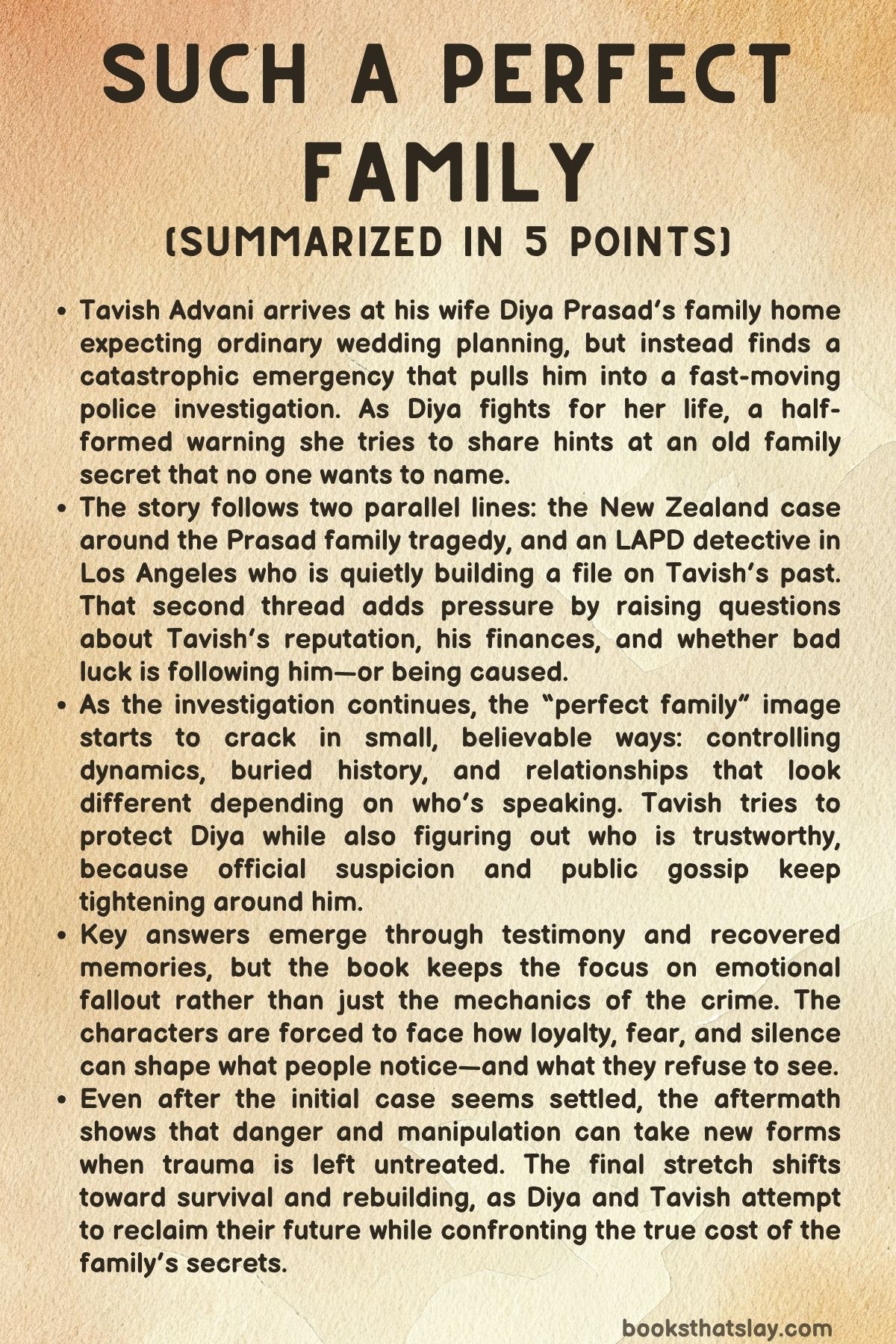
Such a Perfect Family by Nalini Singh is a tense, character-driven thriller set in New Zealand and the South Pacific, built around marriage, loyalty, and the secrets families keep to survive. Tavish Advani thinks he’s finally found a steady life with Diya Prasad, even if her parents want a glossy reception to match their idea of perfection.
Then, in a single morning, the Prasad home becomes a crime scene and Diya is left fighting for her life. As investigators circle and old accusations resurface, Tavish is forced to question everything he believed about the people he married into—and about himself.
Summary
Five years after burying Susanne Winthorpe, Tavish Advani drives through Rotorua on a bright October day with a box of cake samples for Diya Prasad. Though Tavish and Diya are already married, her parents insist on holding a formal reception months later.
He heads toward the Prasad family’s lakeside property on Lake Tarawera, thinking about details as ordinary as frosting flavors. The moment he turns into the long driveway, he sees thick black smoke rising above the trees.
It isn’t geothermal steam. It’s fire.
Tavish speeds up and rounds the bend to find the Prasad house engulfed in flames. The front has already blown outward—glass scattered across the lawn, the roof partially collapsed, and smoke piling into the sky.
Neighbors run and shout that emergency services have been called. Tavish barely hears them.
He screams for Diya and charges forward, trying to get inside despite the heat and choking smoke. The front entrance is caved in and impassable.
He circles, searching for another way through the living area’s wide folding doors, but flames roar through the empty frames. Desperate, he pushes toward the back, toward the lake, hoping Diya made it outside.
On the grass near the patio, Tavish trips over a body. It’s Diya.
She’s soaked and barely conscious, gripping his shirt with what strength she has left. She tries to speak—something about “Annie”—and then goes slack.
Tavish’s hand comes away wet, but it isn’t water. It’s blood.
Diya’s dress is saturated in spreading red patches. She hasn’t been burned; she’s been stabbed, again and again.
Tavish lifts her and runs, while behind him the house erupts in a massive blast that throws fire and debris outward. A neighbor’s wife, a nurse, helps on the lawn as paramedics arrive.
They open Diya’s clothes and see the extent of her injuries—multiple deep knife wounds across her torso. Firefighters surge past to tackle the blaze.
Another survivor appears: Shumi, Diya’s sister-in-law and best friend, is carried in limp and dripping, pulled from near the lake. She, too, has been stabbed.
Two ambulances race to Rotorua Hospital with both women in critical condition.
At the hospital, Diya is taken straight into surgery. Tavish is kept out, forced into a waiting role that feels like punishment.
He changes into scrubs, sits near the ICU corridor, and learns he can’t be told details about Shumi because he isn’t family. Still, he tries to do what he can: he searches online for Shumi’s relatives, reaches her father through his workplace, and convinces him the call is real.
The Kumar family scrambles to fly in from overseas.
Police arrive to interview Tavish. He corrects them—Diya is his wife, not his fiancée—and he learns only Diya and Shumi are confirmed alive.
Investigators suspect multiple deaths at the scene but can’t identify remains yet because the fire and explosion destroyed so much. Tavish lists the cars that were present and notes that Vihaan “Bobby” Prasad, Diya’s brother and Shumi’s husband, hasn’t been found.
The implication lands hard: Bobby might be dead—or missing.
At the same time, far from New Zealand, LAPD Detective Callum Baxter takes notes on a suspicious fatal crash involving an elderly woman named Virna Musgrave. Her son claims she was conned by a charming man: Tavish Advani.
Baxter starts pulling Tavish’s history and finds more than he expects—other women linked to Tavish, other deaths, other whispers that could be coincidence or could be pattern. Baxter’s interest becomes a pressure point that reaches across the ocean.
In New Zealand, Detective Senior Sergeant Rose Ackerson and Constable Jeffrey Wong press Tavish for answers while Diya is still in surgery. Ackerson notices every inconsistency and asks why Tavish wasn’t with the family when the attack happened.
Tavish explains Diya sent him to collect cake samples. Ackerson then shifts to his life: why he left Los Angeles, how he makes money, whether he benefits financially if Diya dies.
Tavish realizes she’s not just gathering facts—she’s measuring him as a suspect.
Diya survives surgery but remains in a medically induced coma. Tavish is allowed brief visits with her in ICU, shaken by the machines and the stillness of her face.
Shumi is also critical, separated in an overflow unit. When Shumi’s parents and brother Ajay arrive, Tavish asks about Diya’s last words.
Ajay corrects him: Diya didn’t say “Annie.” She said “Ani,” the name of an adopted sister who died when she was three. The family story is vague, full of missing pieces and old guilt.
Tavish tries to make sense of what happened by looking beyond the hospital. He returns to the burned property’s perimeter and watches forensic teams sift through rubble.
He learns Diya suffered eleven stab wounds, and that a head injury may be as dangerous as the knife injuries. Tavish begins to suspect the violence wasn’t random.
He tells Ackerson about possible anger toward Bobby’s business, Elektrik Ninja—recent firings, debts, and the sort of resentment that can turn ugly. But Ackerson keeps circling back to Tavish’s past, including the Musgrave case and earlier deaths tied to his name.
Under mounting pressure, Tavish digs on his own. Ajay confides in him about Bobby’s darker side: harsh control, a volatile temper, and troubling incidents that suggest Shumi may have been abused.
Tavish sneaks into Bobby’s company warehouse and steals overdue invoices, finding evidence the business was collapsing. He tips police anonymously, thinking bankruptcy and pride could explain a family annihilation that ends in fire.
Then Shumi wakes enough to talk—and what she says shifts the case. She refuses to speak with her own family and insists on talking only with Tavish and Ackerson present.
Shumi reveals that the night after Diya’s engagement party, she discovered she was pregnant and told Bobby. He acted thrilled—until later, when he struck her in the stomach and she miscarried.
The next morning he forced her to pretend everything was normal. Soon after, Shumi and Diya returned inside the Prasad home and found Rajesh and Sarita on the floor, Bobby holding a knife.
Shumi says Bobby shoved Diya, stabbed Shumi, attacked Diya, and left both women for dead before setting the fire. Ackerson treats Shumi’s statement as closure: Bobby killed his parents, tried to kill his wife and sister, lit the blaze, and died in it.
A joint funeral is held because the remains are too damaged to separate cleanly. Diya and Shumi attend under medical supervision.
Public grief mixes with shock, and people struggle to reconcile Bobby’s violence with the person they thought they knew. Diya, still recovering, cannot fully accept that her brother harmed Shumi.
Shumi, meanwhile, performs cheerfulness like armor—busy, caring, talkative—almost as if she can keep horror away by refusing to name it.
After Diya is discharged, Tavish moves Diya and Shumi into a secluded rental near Lake Taupo to escape reporters and create a safer recovery space. The quiet doesn’t bring peace.
One night, Tavish grows unusually drowsy and wakes to smoke and darkness. He finds Diya unconscious.
As he calls emergency services, Shumi appears and calmly admits what she has done: she drugged him so he wouldn’t interfere, started the fire, and planned to pull Diya out afterward. When Tavish fights back, Shumi attacks with a knife, stabbing him repeatedly while insisting it was supposed to be only her and Diya—she is the one meant to “look after” Diya.
Tavish manages to strike her down and drags Diya outside, collapsing on the lawn with a blade still lodged in him.
The emergency call captures enough of Shumi’s words to destroy her innocence act. Ackerson tells Tavish that Shumi fooled everyone, and that Ajay is devastated but remains the only person she will see.
The case, once blamed on Bobby alone, cracks open into something far more complicated: obsession, control, and a protector narrative turned lethal.
In Fiji, after Tavish recovers enough to travel, Diya begins connecting pieces she couldn’t face before. Tavish, in return, admits a separate secret: he helped Susanne die on her own terms, a confession meant to be honest rather than strategic.
As Diya’s memory returns in fragments, she recalls the morning at Lake Tarawera more clearly. In an argument, she pushed her father and he fell and died.
When Sarita tried to call for help, Shumi attacked and killed her. Diya was stabbed during the struggle, fought back, and ultimately stabbed Shumi to stop her.
Then she smelled petrol and realized Shumi had already prepared the fire. Bobby had been hiding in the roof cavity, and Diya believes he likely couldn’t escape once the blaze took hold.
Diya also recognizes the long shadow of Ani’s death, and how blame and silence were shaped over years in ways that kept Diya dependent and unsure of her own memories. With the truth finally named, Diya chooses to carry her family’s ashes back to Fiji and also decides she wants a separate ceremony for Bobby—one that acknowledges what he did without reducing him to only that act.
Tavish and Diya, bruised by violence and by the lies that surrounded it, begin building a future based on what they now know, not what they were told to believe.
Characters
Tavish Advani
Tavish is positioned as both rescuer and suspect, a man whose instinct is to move toward catastrophe even when it burns him—literally and reputationally. In Such a Perfect Family, his first defining trait is devotion expressed through action: he runs into the inferno at Lake Tarawera, he refuses to leave Diya in the ambulance, and he keeps vigil in ICU with a stubborn, almost single-minded loyalty.
That loyalty, however, is constantly shadowed by his history—three women connected to him have died under unusual or suspicious circumstances—and the narrative uses that shadow to keep Tavish morally interesting rather than purely heroic. He can be tender and reverent, placing a religious statuette by Diya’s bed and speaking to her as if she can hear him, but he can also be reckless and self-protective, dodging police calls, sneaking into Bobby’s warehouse, and preparing contingency plans when he feels the system turning on him.
What makes Tavish compelling is the tension between how he experiences himself, as a man trying to do right after a messy past, and how institutions perceive him, as a charming opportunist with a trail of tragedies. The story repeatedly asks whether love in his hands is salvation, manipulation, or both.
Diya Prasad (Diya Advani)
Diya is the emotional center of Such a Perfect Family, and her arc is built around survival, self-reclamation, and the slow unearthing of memory. At first she appears as the beloved wife and dutiful daughter whose life is framed by her family’s expectations—down to the insistence on a reception after the legal marriage—but the violence strips away that curated surface and reveals how much of Diya’s identity has been shaped by control, secrecy, and guilt.
Her near-death and coma create a literal silence around her, which other characters fill with their own narratives: the police treat her inheritance like motive, her family history becomes evidence, and Shumi’s “protection” becomes a cage. When Diya begins to recover, she doesn’t simply return to herself; she reconstructs herself, integrating horrific truths about her family and her own actions, including the deeply destabilizing revelation that she pushed her father during an argument and that his death was not a neat murder-story but a chaotic, human accident with monstrous aftermath.
Diya’s strength is not shown as constant toughness; it is shown as the willingness to face what she suppressed, to reframe loyalty without denial, and to choose a future with Tavish that is not built on comforting lies.
Shumi Kumar Prasad
Shumi is the story’s most devastating contradiction: the person who appears as victim, best friend, and sister-in-law, yet ultimately reveals herself as the true architect of terror. Her outward presentation is carefully curated—soft, helpful, eager to caretaking, conveniently silent when others might interrogate inconsistencies—and that performance functions as both camouflage and control.
Shumi’s psychology is anchored in obsessive attachment: she doesn’t merely love Diya, she believes she owns the role of Diya’s protector, and that belief justifies to her every violation, including arson, drugging, and attempted murder. Importantly, the book doesn’t make her evil in a simple, theatrical way; it shows her as someone who can plausibly pass as wounded and harmless because she has learned to weaponize sympathy and because her obsession mimics devotion until the moment it turns predatory.
Her confession scene crystallizes her worldview: Tavish is not a person to her, he is an obstacle; Diya is not fully autonomous to her, she is a responsibility Shumi insists only she can hold. The late revelations in Fiji deepen the horror by reframing earlier events as long-term manipulation—Shumi is not simply reacting to trauma, she has been shaping Diya’s life, relationships, and family narratives for years, which makes her the embodiment of love distorted into possession.
Vihaan “Bobby” Prasad
Bobby is the character the story initially positions as the obvious monster, then later complicates by splitting culpability between what he did, what he was believed to have done, and what others needed him to represent. Bobby has the profile of a pressure-cooker: an identity built on dominance, success, and image, paired with a collapsing business that threatens to expose him as failing.
The narrative ties his volatility to family dynamics—Rajesh’s harshness, possible confinement and control in childhood, and the parents’ pride-and-pressure model—which doesn’t excuse Bobby but explains how violence and shame can become his default language. Shumi’s hospital statement paints him as the perpetrator of the lake-house massacre and of intimate partner violence, and for much of the story Bobby functions as the missing piece whose disappearance “answers” the case.
Yet the final truth undermines that certainty: Bobby becomes a tragic, almost incidental casualty of Shumi’s arson and Diya’s desperate escape, and his role shifts from sole villain to a damaged man used as the easiest container for blame. Even when Diya chooses to hold a separate ceremony for him, it isn’t absolution; it is her refusal to let her brother be reduced to a single narrative, because simplifying him would be another form of the family’s old control.
Dr. Rajesh Prasad
Rajesh is portrayed as the family’s gravitational force—respected, disciplined, externally admirable—and also as a source of quiet cruelty that poisons the household from the inside. His morning swims and professional title form a veneer of stability, but the accounts of Bobby’s upbringing suggest a man who confuses achievement with worth and control with care.
Rajesh’s parenting style appears authoritarian and psychologically damaging, including hints of punishment through isolation, and that history matters because it explains why the Prasad family can look “perfect” while breeding fear and secrecy. Rajesh’s death is especially tragic because it is not framed as a deliberate killing by a conventional villain; it is the result of a family argument escalating into a fatal fall, followed by frantic, morally catastrophic decisions by others.
That messy reality makes Rajesh feel more human and more unsettling: he is not simply a murdered patriarch, he is a man whose dominance shaped everyone’s reflexes, and whose end exposes how fragile the family’s composure always was.
Sarita Prasad
Sarita functions as the emotional glue of the Prasad household, the person whose devotion to family and tradition helps maintain the appearance of warmth even as darker truths run underneath. She is present through domestic detail—prayer spaces, reception planning expectations, the atmosphere of the home—and through Diya’s deep attachment to her.
Sarita’s tragedy is that her instincts are protective in a conventional, maternal way, but she is operating inside a system where protection often means silence. When the crisis hits, Sarita tries to do the normal, moral thing—call for help—only to be met with Shumi’s violence, which makes Sarita a symbol of how “normal” goodness is powerless against a predator who has been hiding inside the family circle.
Even after her death, Sarita’s presence persists through Diya’s gestures of remembrance and spirituality, suggesting Sarita is part of what Diya is trying to preserve as she rebuilds: the parts of family that were real, even if the family itself was not safe.
Ajay Kumar
Ajay is both witness and moral hinge, a character whose love for his sister collides with the unbearable need to see her clearly. He arrives carrying fragments—like the correct name “Ani” and the half-known family history—then becomes the person who can validate what Shumi’s marriage looked like from the outside: bruises, fear, career abandonment, social isolation, and troubling incidents that never quite “proved” anything until it was too late.
Ajay’s role is painful because he is repeatedly placed in the position of choosing whom to believe, and the story uses him to show how families rationalize warning signs when the alternative is explosive truth. After Shumi is exposed, Ajay’s devastation is layered with helplessness; he remains the only person she will see, not because he endorses her, but because he is trapped in the cruel privilege of being her last link to humanity.
His presence keeps the book from turning Shumi into a simple monster by highlighting the collateral damage of loving someone who becomes unimaginable.
Detective Senior Sergeant Rose Ackerson
Ackerson represents institutional suspicion with a human face: sharp, relentless, and often certain before certainty is earned. She is immediately positioned as someone who sees patterns and is willing to press hard, which is both her strength and her flaw.
She asks the right questions about motives—inheritance, opportunity, prior deaths—but her focus on Tavish becomes a kind of tunnel vision that repeatedly sidelines alternate explanations and fuels Tavish’s paranoia and rash choices. Ackerson’s approach also exposes how easily the system can misread grief as performance and competence as calculation, especially when the person in question has the wrong kind of past.
At the same time, her presence is crucial to the story’s pressure: she forces characters to speak, to justify, to confront implications they’d rather avoid, and she becomes the authority figure the survivors must navigate while they themselves are still unraveling what happened. Even when the case appears “closed,” Ackerson’s certainty feels unsettling because the book later reveals how incomplete her version of events was, suggesting that justice can arrive with the correct outcome for the wrong reasons.
Constable Jeffrey Wong
Wong is a quieter procedural presence, but his role matters because it shows how investigations are built from small, physical details rather than big theories. Retrieving Tavish’s discarded, bloodstained shirt is not a dramatic gesture; it is the practical act that reminds the reader that trauma scenes become evidence scenes whether survivors are ready or not.
Wong functions as the grounded counterweight during interviews—less interpretive than Ackerson, more task-focused—and his relative restraint makes him a subtle contrast to the more aggressive suspicion driving the narrative. He also highlights a theme running through the story: that the truth is often in what people throw away, overlook, or do impulsively in shock.
Detective Callum Baxter
Baxter is the parallel narrative’s engine of doubt, the character who refuses to let coincidence feel comfortable. His Los Angeles notes create a second lens on Tavish, one that frames him as a potential predator who targets wealthy older women, benefits financially, and leaves behind deaths that can be explained away—until they can’t.
Baxter is compelling because his obsession looks like diligence and like personal fixation at the same time; he is the investigator who cannot stop pattern-matching, and the story uses him to keep Tavish morally ambiguous long after Tavish’s heroism would otherwise settle the question. Baxter’s frustration with bureaucracy—cases shelved, chiefs redirecting him—adds a layer of realism and bitterness, and his fear that Tavish will harm someone else creates a lingering sense of threat that the New Zealand investigation alone cannot contain.
Yet Baxter is not purely reliable; his conviction can harden into bias, and that ambiguity mirrors the book’s broader fascination with how narratives form around charismatic men and dead women.
Andrew Ngata
Ngata enters as the voice of procedural protection, but he also embodies the idea that truth and survival are not the same thing in a legal system. He doesn’t ask Tavish to be morally perfect; he asks him to be strategically quiet, to stop feeding a narrative that authorities are already eager to believe.
Ngata’s presence shifts Tavish from reactive panic into guarded calculation, and in doing so highlights Tavish’s vulnerability: despite his confidence and intelligence, he is still someone who can be cornered by implication and past rumor. Ngata also functions as a reminder that innocence does not automatically protect you from suspicion, especially when money, inheritance, and prior scandal are in play.
Aleki
Aleki is the story’s small mercy, the friend who shows up with practical help when the world becomes incomprehensible. Aleki’s role is not to solve mysteries but to keep Tavish functional—clothes, a place to stay, tangible support that counters the coldness of police questioning and hospital rules.
This matters because the book is saturated with institutions that have procedures rather than comfort, and Aleki represents the human network that holds survivors up when they can’t hold themselves. Aleki also helps define Tavish’s character through contrast: Tavish’s isolation is not total, and his ability to accept help reveals he is not simply a lone, self-mythologizing hero.
Joseph
Joseph, the neighbors’ teenage son, appears briefly but sharply at the moment of crisis, and his presence emphasizes how public catastrophe becomes communal responsibility. He is part of the improvised triage that keeps Diya alive, giving his T-shirt for pressure on her wounds, and his quick information—fire department already called—anchors the scene in realism rather than melodrama.
Joseph functions as a reminder that survival in the story is often dependent on ordinary people acting without hesitation, and that the line between witness and participant can vanish in seconds.
Tim
Tim, the neighbor who speaks with Tavish later, is a small but important character because he provides social context the official narrative misses. He notices how Shumi is barely mentioned on condolence notes, which quietly signals the depth of her isolation and the family’s public-facing hierarchy of grief.
By giving Tavish information about Shumi’s engineering background and connecting him to Richard, Tim acts as an informal node in the truth network—someone outside the family who can still observe patterns inside it. His role reinforces a key theme: people often see what families hide, but they only understand it in hindsight.
Richard
Richard is the loyalist, the friend who clings to the family’s preferred image even when reality fractures it. He defends Bobby reflexively and seems to know more than he admits, making him feel like the kind of person who helped sustain silence around abuse by normalizing Bobby’s behavior or reframing it as stress.
His speech at the joint funeral is revealing because it tries to hold two incompatible truths at once: acknowledging Bobby’s atrocity while insisting on listing his good deeds and the pride his parents felt. Richard embodies the community impulse to soften horror with nostalgia, and his presence shows how easily social circles become complicit—not through direct violence, but through storytelling that polishes what should be confronted.
Violet
Violet is the character who extends the threat beyond the family home, suggesting that the danger is not only what happened at Lake Tarawera but also what can happen when someone weaponizes anonymous influence. Her warning about receiving anonymous cards and being attacked introduces a wider perimeter of menace, implying a campaign designed to isolate Diya socially and destabilize her reputation.
Violet’s role also deepens Diya’s post-trauma reality: survival is not only physical healing but the realization that someone may have been shaping her life from the shadows, including her workplace relationships. By bringing this information right before Diya’s discharge, Violet becomes a harbinger that recovery does not mean safety, and that the story’s central villainy has roots that extend into everyday spaces.
Virna Musgrave
Virna appears through Baxter’s investigation, and her characterization is largely constructed by what her death and estate reveal about vulnerability, trust, and the narratives families build afterward. She is framed as wealthy and elderly, a target for both genuine companionship and potential exploitation, and her suspicious crash becomes a symbol of how easily the deaths of older women are dismissed as accidents or age-related mishaps.
The claimed transfer of money to Tavish, the lack of paperwork, and the suspicion of vehicle tampering position Virna as a pivotal figure in the question of who Tavish really is. Even without extensive direct presence, Virna matters because she turns Tavish’s romance-history into a pattern of possible predation, and she shows how money can distort grief into accusation, particularly through Jason’s certainty that his mother was conned.
Jason Musgrave
Jason functions as the accuser whose grief becomes prosecutorial, and his role is essential because it demonstrates how suspicion is often born from a need to impose order on loss. His claim about a “Romeo” conning Virna is both plausible and potentially biased, and the story uses him to complicate the reader’s trust in Tavish.
Jason’s perspective is emotionally legible: if his mother died suspiciously and money moved, then someone must be responsible, and Tavish is the simplest answer. Whether Jason is right or wrong in every detail, he represents the force that turns private tragedy into an investigation, and he shows how the bereaved can become relentless when institutions offer ambiguity instead of closure.
Susanne Winthorpe
Susanne is Tavish’s origin wound, the first love whose death sets the emotional and thematic template for everything that follows. She is wealthy, older, and deeply significant to Tavish, and the circumstances of her death—cancer, refusal of treatment, rapid decline, a suicide ruling, cremation—create a perfect storm of doubt that can never be conclusively resolved.
Susanne’s significance is less about plot mechanics and more about what she does to Tavish’s interior life: she becomes the grief that shapes his later relationships, the shadow Baxter can’t ignore, and the reason Tavish’s devotion can look like desperation. The later admission that Tavish helped Susanne die on her own terms reframes their relationship as intimate and morally complicated rather than simply romantic, and it underscores one of the book’s central questions: when does love become an act that others will interpret as control?
Jocelyn “Joss” Wai
Joss represents the chaotic middle chapter of Tavish’s past, a relationship that seems to have been fueled by grief, intensity, and self-destruction. Her death—officially accidental, tied to intoxication and a fall—adds to the pattern that makes Tavish look cursed at best and culpable at worst.
Joss is important because she illustrates how tragedy clusters around Tavish not only in neat, financial-story ways but also in messy, human ways: bad decisions, substances, emotional volatility. Tavish’s nightmares about her suggest unresolved guilt that is emotional even if it is not criminal, and her presence in the narrative keeps the reader aware that Tavish’s capacity for love includes the capacity for harm through proximity to instability.
Joss, like Susanne and Virna, becomes part of the story’s critique of how society narrates women’s deaths—either as their own fault, a lover’s fault, or a mystery that never quite becomes anyone’s responsibility.
Ani
Ani is the absent child whose death functions like a curse on the Prasad family, shaping every relationship through blame, secrecy, and fear. Ani is talked around, misremembered, and turned into a pressure point, which is exactly how trauma behaves inside families that refuse truth.
The revelation that Diya’s head injury echoes the rock attack that killed Ani ties the past to the present in a visceral way, making Ani not just a tragic memory but a template for violence repeating. Ani’s role becomes even darker when the later truths suggest Shumi’s long reach into the family’s history, implying that Ani’s death was never simply a childhood accident but part of the same pattern of control and harm.
Ani, therefore, is not only a character but a psychological lever: she explains why Diya carried guilt, why the family clung to appearances, and why the truth was so dangerous that people were willing to kill to keep it buried.
Themes
Reputation, Image Control, and the Violence of “Keeping Up”
The Prasad family’s public presentation is treated like a non-negotiable asset, and the planned reception becomes a symbol of that pressure rather than a celebration. Even though Tavish and Diya are already married, the insistence on staging a later event suggests that legitimacy, status, and social approval matter as much as the marriage itself.
That same obsession with appearances shows up in how the family manages discomfort: Shumi is expected to smile through harm, Diya is kept on tight rails, and Bobby’s identity is fused to the idea of success. When Bobby’s business begins collapsing, the threat is not only financial—it is existential.
Bankruptcy becomes a humiliation narrative he cannot tolerate, especially if it means losing control to a potential investor. The story repeatedly shows how shame turns combustible when a person has been trained to believe that being admired is the same as being safe.
The Lake Tarawera attack initially reads as catastrophic intrusion, but the clues quickly point inward: “overkill,” staging through fire, and the careful effort to erase traces. Even the funeral choices reflect image management, with a combined ceremony driven partly by the condition of the remains and partly by the need to close the public account quickly.
Later, the way condolence notes focus on the parents while barely mentioning Shumi reveals how selective public sympathy can be, and how easily a polished family narrative can erase the most vulnerable member. In Such a Perfect Family, reputation is not just social background noise; it actively shapes choices, silences warnings, and rewards denial until the accumulated pressure explodes into irreversible harm.
Control, Possession, and the “Protector” as Predator
Protectiveness is repeatedly presented as a mask that can hide domination, and the book makes the reader track how care can be weaponized. Shumi’s role as Diya’s best friend and sister-in-law creates instant trust, and her helpfulness is so consistent that it becomes a kind of social shield—she appears indispensable, gentle, and self-sacrificing.
That surface makes it harder for others to read her controlling behavior as threatening, especially because it comes packaged as concern. The later revelation that Shumi drugged Tavish, set another fire, and attempted to isolate Diya exposes the core logic: Diya is not treated as a person with agency but as a possession that must be guarded from “outsiders,” even a husband.
Shumi’s language about being the one meant to “look after” Diya reframes love as entitlement, and entitlement as a reason to harm. The story also shows how control spreads through systems, not just individuals.
Rajesh’s intense pressure on Bobby, the controlling restrictions around Diya’s movements, and the expectation that Shumi perform happiness despite injury create an environment where domination can be normalized. Once that normalization exists, a predator does not need to invent new rules; they simply push existing ones to a brutal extreme.
Shumi’s willingness to curate what Diya knows—deciding when Diya can handle truth, deciding who can speak to police, deciding what story can be told—demonstrates that control is as much about information as it is about physical force. Even when Bobby is blamed, the misdirection works because the family already has internal patterns of fear, obedience, and silence.
The “protector” figure becomes terrifying precisely because the controlling behavior is initially rewarded as loyalty, and because the language of care makes coercion sound morally justified.
Memory, Hidden Truths, and the Cost of Denial
The narrative treats memory as unstable under trauma, but it also shows how selective forgetting can be encouraged by family dynamics and personal survival instincts. Diya’s fragments—first the half-spoken reference to “Ani,” later the delayed recovery of what happened the morning of the attack—create a structure where the truth arrives in waves rather than a clean revelation.
That pace is not just a thriller device; it reflects how people process unbearable events when their sense of safety depends on not seeing too clearly. Diya’s long-standing burden around Ani’s death demonstrates how a family story can fossilize into identity.
If you are told, directly or indirectly, that you are responsible for a childhood tragedy, the guilt becomes a tool others can use to keep you compliant, apologetic, and eager to make amends forever. The later discovery that Ani’s death is entangled with Shumi’s actions shows how false narratives can be planted early and maintained through repetition, secrecy, and emotional leverage.
The book also highlights denial as a communal practice. Diya struggles to believe Bobby could have harmed Shumi, even when evidence and testimony are clear, because admitting it would collapse her internal picture of home.
Shumi, in turn, uses cheerful chatter and compulsive caretaking to avoid confronting what she has done and what was done to her, turning performance into anesthesia. Tavish’s own history adds another layer: the recurring suspicion around him, the pattern detectives think they see, and his eventual confession about Susanne complicate the question of what truth means when someone’s past is already framed by public assumption.
The story suggests that denial is not simply lying; it is often a negotiated truce people make with reality to keep functioning—until the hidden parts demand payment. The cost of denial is measured in delayed warnings, misdirected justice, and relationships built on partial knowledge that cannot hold once violence forces the full story into the open.
Justice, Suspicion, and How Systems Choose Their Villains
The investigation thread exposes how quickly institutions can settle on a convenient suspect, especially when a person already fits a narrative that feels familiar. Tavish is treated as suspicious not only because he is present at the disaster, but because he carries a history that can be shaped into a pattern: wealthy older women, death nearby, money transferred, rumors of manipulation.
The cross-continental attention from Detective Baxter turns Tavish into a movable target, and the reader watches how confirmation bias forms in real time. Once the idea exists that Tavish is a “type,” every detail becomes proof: his financial knowledge, his calm under pressure, even his decision to prioritize Diya in the ambulance over staying at the scene.
Meanwhile, information that disrupts that narrative—Bobby’s abuse, the controlling family environment, the business collapse—struggles to get equal traction. Ackerson’s repeated focus on Tavish’s inheritance potential shows how law enforcement can interpret grief through an accounting lens, sometimes reasonably, sometimes reductively.
The story does not argue that suspicion is always wrong; it argues that suspicion is often shaped by the investigator’s preferred story, especially when that story is neat and portable. The Musgrave case in Los Angeles also demonstrates how power affects momentum: a chief can shelve an investigation, reassign a detective, and effectively reduce a homicide suspicion to a private obsession.
At the same time, the New Zealand case shows how “closure” can be declared too early when one explanation appears to fit—Bobby as the single source of violence—because it reduces complexity and public uncertainty. Only later does the fuller truth emerge, including Shumi’s role and Diya’s own recovered memory, revealing how institutional conclusions can be both plausible and incomplete.
Justice is portrayed as something that can be bent by reputations, constrained by bureaucracy, and influenced by storytelling instincts, leaving survivors to carry the burden of truth even after a case is said to be finished.