The Book of Blood and Roses Summary, Characters and Themes
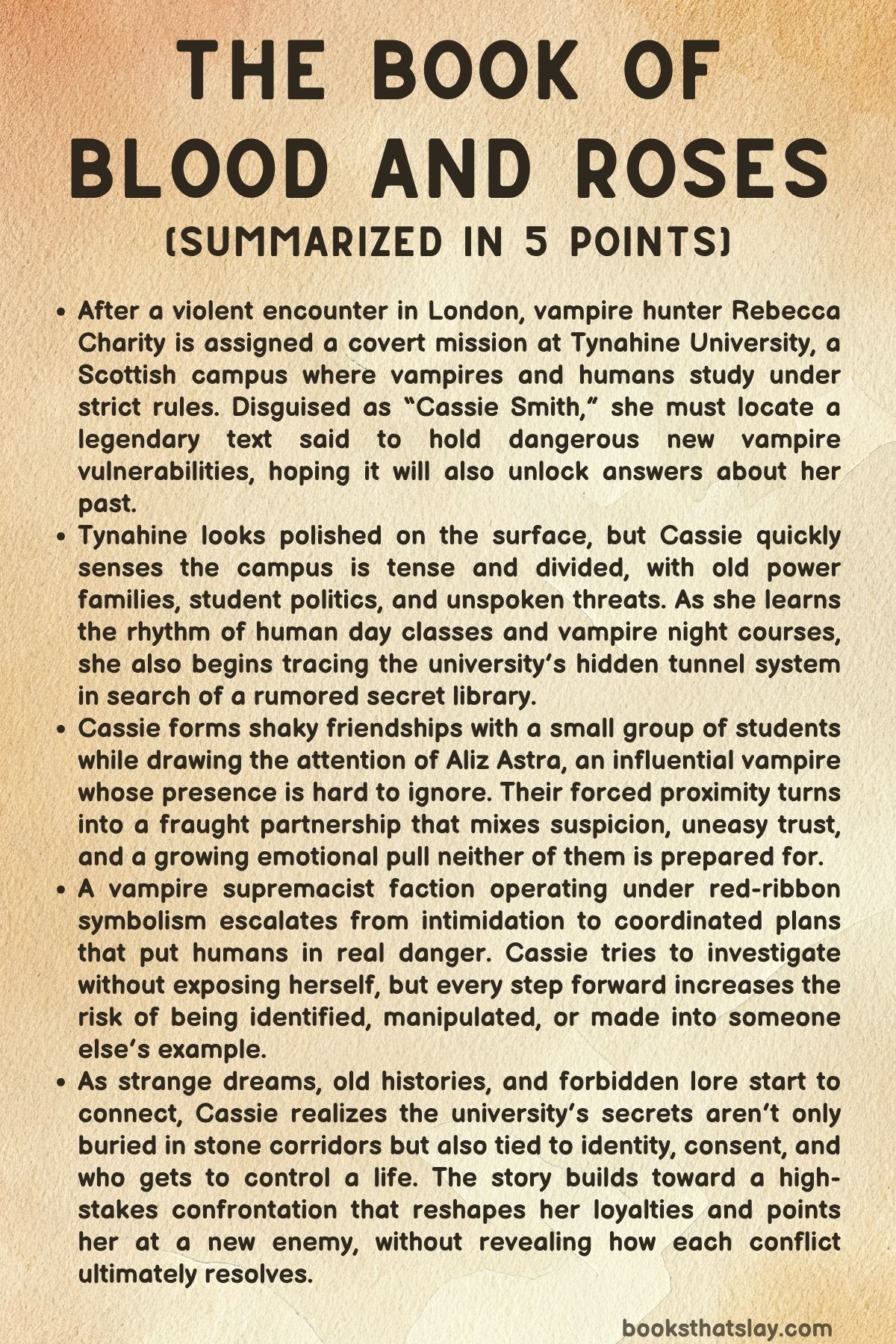
The Book of Blood and Roses by Annie Summerlee is a dark-academic paranormal thriller set at Tynahine University in Scotland, a vampire institution that has begun admitting humans under strict rules and uneasy politics. The main character, Rebecca Charity, is a trained vampire hunter working for Callisto, an organization that claims to protect humanity.
Under a fabricated identity, she infiltrates the university to locate a legendary lost text said to contain secret ways to kill vampires and undo vampirism. What begins as an undercover search quickly becomes a survival game of rival factions, hidden tunnels, forbidden magic, and a dangerous bond with a powerful Astra heir.
Summary
Rebecca Charity, a vampire hunter for Callisto, barely survives a nightmarish incident at a London blood club when a vampire tries to compel her into killing herself. She resists, kills the vampire instead, and reports to her supervisor, Penny.
Penny takes her to a hidden Callisto base and offers a bargain: a new mission, a promotion, and answers about the murder of Rebecca’s parents—if Rebecca succeeds. The assignment is to infiltrate Tynahine University in Scotland, a vampire university recently opened to human students, and find a legendary missing text: The Book of Blood and Roses, said to contain vampire weaknesses and forbidden knowledge.
Penny gives Rebecca a new identity, Cassie Smith, a wealthy heiress accepted into the school, and warns her to keep her real purpose hidden.
On the journey north, Rebecca remakes herself into Cassie with a new look and manner, while privately dreading Scotland for reasons she won’t name. When she arrives near Inverness, she’s collected by a human driver who serves as a Familiar to a vampire professor.
He explains the odd structure of campus life: humans attend Integration lessons during the day and vampires attend their own classes at night, with humans allowed into certain spaces under strict rules. The university gates display a message that feels more like a warning than a welcome: “We Invite You In.”
Cassie is assigned Room 904 in Tynarrich Hall. The room seems normal at first, until she notices details that don’t fit.
She hides weapons in a concealed compartment and panics when she realizes she forgot the garlic-based supplements that mask the scent of her rare Type-S blood—blood that vampires find unusually tempting. She hurries to take them and rushes to the welcome lecture, where two deans address the new intake: a human Day Dean and a vampire Night Dean, Faust Nocth.
Nocth presents Tynahine as a modern institution following the Treaties of 1912, claiming the campus vampires drink synthetic blood and obey rules meant to keep humans safe. He also lists “courtesy restrictions” for human students: no crosses, no prayers, and no garlic.
Cassie hears the polished speech and recognizes it as politics, not reassurance.
Trying to establish a cover, Cassie befriends Stephan, a human student dating a vampire named Ife. Stephan takes her to Kinsnet Library, a vast, vampire-filled hall where humans feel instantly outnumbered.
Cassie tries not to show fear, but the library’s atmosphere makes her hyper-alert, and a misunderstanding behind the shelves nearly pushes her into drawing a hidden silver blade. Before leaving, she notices a striking white-haired vampire watching her from above: Aliz Astra.
That night, Cassie learns her room has been altered by vampire architecture. A curtain now divides the space, and on the far side sits a coffin.
She realizes she has a vampire roommate. Her first instinct is violent, but she doesn’t know who it is, and killing the wrong vampire could destroy the mission.
She sleeps poorly and relives old trauma—her parents’ deaths during a “parched” vampire attack in London, and the way Penny found her afterward and shaped her into a hunter.
Under Penny’s orders, Cassie stays in the room and begins investigating the campus’s underground tunnels, using a specialized compass to map newer corridors and older, maze-like passages. Penny believes the rumored hidden ninth library lies beneath the university and may contain The Book of Blood and Roses.
Cassie attends Integration lessons with Professor Clemence, where she challenges the official story that the vampire Council has reformed under its long-ruling president, Ares Astra. At meals, Cassie learns about internal vampire divisions: Heritage vampires versus Converts, and the way families like the Astras hold power even when they pretend they don’t.
Cassie keeps seeing Aliz Astra, and others warn her that Aliz treats the university as her personal territory. While exploring underground, Cassie finds signs of an organized group: a dusty room with a clean meeting table and papers labeled “Minutes of the Red Ribbon Society.” Portraits and old artifacts hint at deeper history, including an image labeled “Ada, Dreamwalker of Rome.
1582” that resembles Aliz. Later, Cassie stumbles into a music tradition class taught by Dr. Sven Gustavsson, a vampire who plays cello and speaks with unsettling intimacy about vampiric immortality.
When he mentions The Book of Blood and Roses, Cassie presses for details. She learns the book is a lost compendium tied to vampire-killing methods, spells, cures, and possibly a way to reverse vampirism—exactly the kind of knowledge the Council would erase.
Penny adds pressure by assigning Cassie another task: a human girl has been found half-drained in Inverness. Cassie investigates and discovers something worse than a random attack.
At a pub, she follows a compelled waitress into a warehouse where a group of vampires treat feeding like a procedure: they restrain her, discuss her blood, and cut her to draw it while keeping her alive. Cassie attacks, manages to kill one vampire, and calls for help for the victim, but most of the group escapes.
The methodical approach confuses her. This wasn’t hunger.
It was planning.
Cassie returns to campus before dawn and finally discovers the identity of her roommate: Aliz Astra. Aliz is amused by Cassie’s late return and treats the room as her property, expecting Cassie to leave.
Cassie refuses, and their hostility becomes immediate and personal. Cassie tries to hide her hunter wounds and evidence of the fight, while Aliz’s attention remains sharp and predatory.
As Cassie settles into campus life with Ife, Julia, and Stephan, she learns about the Red Ribbons: a vampire supremacist group, associated with Converts, that resents human integration and wants the treaties broken. Cassie notices vampires wearing red ribbons around their necks, and she starts connecting the Inverness attack to the campus faction.
Despite Penny’s warning to avoid direct confrontation, Cassie follows the Red Ribbons into their underground gallery and witnesses a meeting where members drink real human blood and talk openly about undermining integration. Their plan is calculated: compel a human student into murdering a vampire to “prove” humans can’t be trusted, then force humans out of Tynahine.
They decide their target will be Stephan.
Cassie tries reporting the threat, but campus security dismisses her. She warns her friends directly, and Ife claims she’s alerted Night Dean Nocth, who says he is investigating.
Cassie doesn’t trust that reassurance. She digs deeper into the archives searching for grimoires and hidden references, but the university fights back in stranger ways: bookcases shift as if the room itself is hostile.
Cassie is confronted by Jannet, the Red Ribbon leader, who tries to compel her into killing a vampire named Elia Tamarit and then herself. Cassie fights back with silver, burns Jannet, and escapes—but she’s injured by a venomous scratch.
The venom spreads fast, and Cassie collapses in her room.
Aliz finds her and reacts with urgency rather than cruelty. To stop the venom, Aliz cuts her own palm and presses her blood into Cassie’s wound.
The pain vanishes instantly, but the “cure” leaves a mark: a black crescent moon with thorns, matching the Astra crest. Aliz later explains what happened under the full moon: they accidentally formed a blood contract.
The mark claims Cassie as Aliz’s Familiar.
Cassie attempts to separate from Aliz by requesting a room move, but Nocth refuses and warns her the bond will worsen if they are apart. He describes the old blood-bound Familiar contracts: strength, healing, and heightened senses for the human, but a growing loss of autonomy.
Humans who flee before the bond settles often suffer nightmares, hallucinations, and pain until they return. Trapped, Cassie creates a defensive saltward circle around her bed, declaring it her “house,” forming a faint barrier that forces Aliz to keep distance unless invited.
Cassie’s garlic supplements run out, and her “real” blood scent returns. Aliz struggles, especially when synthetic blood begins tasting sour and unsatisfying.
Their nights turn tense and intimate, shaped by the pull of the bond and by shared dreams of an abandoned palace and a hedge maze. The dreams feel like memories neither of them fully owns.
A Gaelic message in the tunnels—“Dear sister, you have my blood”—appears and vanishes, as if the walls themselves are alive. Cassie and Aliz begin recording dreams as required, realizing their visions overlap.
The pressure escalates when Cassie and Aliz visit the abandoned Astra hunting lodge, the same place from their nightmares. They find evidence of Ada Astra, Aliz’s dead older sister, and Ada’s Familiar, Catherine Lovelace—marked with the same thorned moon symbol.
Notes suggest Catherine was immune to compulsion and bound by a witch-made curse. The implications hit Cassie hard: Callisto’s founder may have been an Astra Familiar, tying the hunter organization to the very vampire dynasty it claims to fight.
Looking out from the lodge, Cassie recognizes the hedge maze layout as matching her tunnel map, suggesting the maze is a guide to the hidden library.
When Cassie and Aliz find a final passage guarded by magic, it attacks their minds with tailored illusions—rushing water for Cassie, burning sunlight for Aliz—and throws them back. The library is protected by something ancient and lethal.
A major blood party approaches in Inverness, and Cassie suspects the Red Ribbons are expanding their operations. At Inverness Castle, she infiltrates an event where compelled humans are herded as prey and vampires gather for entertainment.
A hostess announces a head start before the chase. Cassie tries to force an escape by urging humans to run, but the situation becomes chaos—and then the story’s focus shifts sharply when Aliz locates the secret library.
Inside the hidden underground space, Aliz encounters Ada Astra as a blue-glimmering ghost. Ada behaves like a bored aristocrat, but she immediately recognizes Cassie’s bond and speaks openly about Familiars as soul-bound servants whose wills eventually merge with their vampire’s.
Aliz rejects the idea of owning Cassie, yet Ada treats it as inevitable. Cassie and Aliz search for The Book of Blood and Roses, but the shelves betray them: volumes crumble into dust.
Ada explains Ares Astra destroyed her research. The library is no longer physical.
The books exist only as memory and haunting.
Ada provides a possible remedy to break the blood contract: both vampire and recipient must drink an enemy’s blood from an “eternal fountain” beneath a full moon. Ada clarifies the brutal meaning—an “eternal fountain” is a vampire’s disembodied heart.
To break the bond, they must consume a heart under the full moon. Before they leave, Ada whispers to Cassie that the library is inside her head and calls her “Blood of Callisto,” hinting she knows Cassie’s true identity.
Elia Tamarit later explains that Ada’s mind functions as the library, remembering every book perfectly, and her ghost clings to the world because her collection was burned. Elia proposes using the upcoming Halloween Ball at the hunting lodge as cover to perform the heart ritual, and she suggests Gustavsson as a target if he is tied to the Vassals.
Meanwhile, Penny calls and congratulates Cassie, promoting her to Stake and reinforcing the deal: deliver The Book of Blood and Roses, and Penny will reveal who killed Cassie’s parents. Cassie lies that she hasn’t found it.
The lie poisons her already unstable trust with Aliz. When Aliz discovers Cassie’s deception and hears Penny’s contempt for vampires, she lashes out.
In the argument, Aliz accidentally compels Cassie with a question, proving the bond is tightening and Cassie’s free will is at risk. Terrified, Cassie runs.
Cassie confides in Julia, who reveals her own origin: a group hijacked a London Underground train, sorted passengers, and kept newly made vampires in silver cages until they became parched. Julia escaped during the chaos and shows an insignia—a red V crossed by a silver sword—identifying the Vassals.
Cassie realizes the same forces that shaped Julia’s suffering may connect to her parents’ deaths, and to Callisto’s recruitment tactics.
As the Halloween Ball arrives under a full moon, Cassie and Aliz prepare to trap Gustavsson and complete the ritual. Cassie lures him upstairs, but Gustavsson surprises her: he calls her “Rebecca,” exposing her identity, attacks her, and compels her toward suicide.
Aliz intervenes, but Gustavsson escapes by transforming into a bat after Cassie wounds him with silver.
Then Penny appears, armed, and escalates everything. She threatens Aliz to force Cassie to hand over The Book of Blood and Roses.
Cassie insists there is no book to give, and Aliz confirms the truth: the “library” was Ada’s ghost and memory, not a recoverable object. Penny reacts with fury and fear, shoots Aliz with silver, burns her with prayers, knocks Cassie unconscious, and disappears.
Cassie hunts Gustavsson into the hedge maze. There, he reveals the ugliest truth: he helped recruit hunters for Callisto by testing young women, using compulsion and trauma as tools.
He admits Callisto ordered Rebecca’s parents’ deaths to motivate her recruitment, staging a “Feast of the Parched” in which starving newly sired vampires were unleashed to massacre targets. He confirms the Vassals were involved.
Cassie attacks, but Gustavsson stabs her and drives a stake through her torso, immobilizing her while he torments her with details about her mother’s death.
Aliz arrives in time, decapitates Gustavsson with a silver sword, tears out his still-beating heart, and forces Cassie to bite and drink under the full moon. The Familiar mark flares with agony, then the sensation vanishes.
The contract is broken. Cassie tells Aliz her real name: Rebecca Charity.
Together they destroy Gustavsson completely.
Afterward, Dean Nocth sends an official message framing Gustavsson as a rogue attacker and promising a Council investigation. Nocth privately questions Rebecca about the heart ritual, and she admits what she did without apology.
He offers her a chance to leave, assuming Callisto will send her elsewhere, but Rebecca has changed. Now that she knows Callisto engineered her parents’ deaths and used her grief as leverage, she decides she is done serving them.
Instead, she intends to hunt Callisto’s leadership, including Penny, and expose the system that manufactured her.
Rebecca remains at Tynahine for the semester, staying close to her friends and Elia. Aliz disappears for weeks after a Council hearing, leaving Rebecca in a quiet, aching uncertainty.
When Aliz returns from Hungary, she admits she didn’t know how to speak after everything that happened and only just got her phone back. On the roof, Rebecca admits she lied and hid her identity, while Aliz admits she loves her even without the bond.
They choose to be together by choice rather than compulsion, fully aware that Callisto, Penny, and the Vassals remain threats waiting beyond the university walls.
Characters
Rebecca Charity (Cassie Smith)
Rebecca is built out of contradiction: a trained predator who keeps getting forced into the position of prey, a young woman taught to survive through control who is repeatedly confronted with how fragile control really is. Her opening scene at the London blood club establishes her defining trait—resistance—not just to vampiric compulsion, but to every system that tries to script her life, whether that’s Callisto’s chain of command or the university’s polished claims of “integration.”
Taking on the Cassie Smith persona isn’t simply a disguise; it becomes a psychological pressure test that exposes how much of Rebecca’s identity has been shaped by trauma and institutional conditioning.
The mission to find The Book of Blood and Roses initially looks like a standard retrieval job, yet it steadily reveals itself as bait: a mechanism to keep her obedient by dangling answers about her parents. Across the story, Rebecca’s arc is less about learning to fight—she already can—and more about learning to choose what she fights for.
Her growing connection to Julia, Ife, Stephan, Elia, and especially Aliz pushes her away from hunter absolutism and toward moral specificity: she begins separating “vampire” from “enemy,” and “human” from “innocent,” until the real antagonist becomes the machinery that manufactures violence on both sides. By the end, when she decides to turn her aim on Callisto’s leadership, it completes a shift that has been building all along: the person who once believed she could be rewarded with truth finally decides she will take truth by force and set her own terms for justice.
Penny
Penny functions as the story’s most insidious kind of villain: the caretaker who speaks in the language of protection while practicing domination. Her authority over Rebecca is not only professional but emotional—she is positioned as rescuer after the murder of Rebecca’s parents, which lets her convert grief into leverage and obedience into “purpose.” Penny’s defining method is strategic withholding: she refuses details about survivors, refuses the truth about the past, refuses context for danger, and keeps Rebecca chasing the next permission slip—promotion, disclosure, “everything.” That pattern turns Penny into a living embodiment of Callisto’s ideology: sacrifice now, answers later, and if you hesitate you are ungrateful.
What makes her especially dangerous is how well she understands Rebecca’s psychology; she gives Rebecca just enough validation to keep her compliant and just enough mystery to keep her hooked. When Penny finally appears at the Halloween Ball as an armed interruption, the mask drops: she is not there to safeguard a young operative but to seize control of the narrative and the prize, even if it means torturing Aliz and knocking Rebecca out.
Her later betrayal—confirmed through Gustavsson’s revelations—reframes Penny’s earlier “mentorship” as grooming, and her promises as a trap designed to create a weapon who wouldn’t question why she was pointed at certain targets. Penny’s role ultimately clarifies the central moral pivot of the book: the greatest threat isn’t merely vampire hunger, but human institutions that engineer hunger—literal and metaphorical—to keep power.
Aliz Astra
Aliz arrives as spectacle—white hair, aristocratic confidence, predatory attention—and initially seems designed to embody every fear a vampire hunter would carry into a vampire university. Yet the longer she shares space with Rebecca, the more Aliz becomes a study in constrained desire: she is powerful, privileged, and still profoundly limited by her own biology, her family name, and the political theater of “reformed” vampirism.
Her arrogance reads differently once the story reveals how synthetic blood has weakened and soured her world; her taunting becomes a coping mechanism for deprivation and for the suffocating expectation that the Astra heir should be untouchable. The accidental blood contract is the crucible that forces Aliz to confront what she does not want to be—an owner, a master, a vampire who turns a person into property—and her refusal of that role is what separates her from the more ideological predators around her.
At the same time, Aliz is not sanitized into a harmless romantic interest; her hunger is real, her temper is real, and her capacity to compel is frightening precisely because it surfaces even when she doesn’t mean it to. The relationship tension is therefore not a simplistic “enemy-to-lover” progression but a negotiation over personhood: Rebecca demands to be seen as human, Aliz struggles to see herself as something other than a hunger wearing a crown.
Her climactic choice to kill Gustavsson, tear out his heart, and use it to free Rebecca is an act of violent mercy that redefines her power—not as domination, but as protection at a cost she never wanted to pay. When she disappears after the Council hearing and later returns, the gap underscores her most human trait: she runs from vulnerability, not from danger.
By the end, Aliz’s love is meaningful precisely because it is chosen without magical coercion; it is the first time in the story that intimacy is not tied to leverage, treaty clauses, or blood law.
Faust Nocth
Faust Nocth is the polished face of institutional compromise, the kind of leader who speaks in rules and procedures because procedure is the safest way to hide what he’s willing to tolerate. He presents Tynahine as treaty-compliant and civilized—synthetic blood, no compulsion, orderly integration—yet the reality Rebecca uncovers suggests his administration is reactive rather than protective, and his control is more public-relations than moral certainty.
Nocth’s most revealing trait is that he understands exactly how dangerous the Blood Familiar bond is, and he uses that knowledge to keep Rebecca and Aliz contained: his refusal to move rooms is framed as safety, but it also ensures the problem stays manageable inside a single doorway. His willingness to provide Marcus’s donated blood under a treaty loophole shows pragmatic compassion, but it also demonstrates how easily ethics becomes paperwork in his hands; what matters is not whether the situation is right, but whether it can be justified.
Even his final interrogation carries this ambiguity: he is not shocked that Rebecca broke the bond by eating a heart, he is shocked that she admits it so plainly, as if honesty is the true breach of decorum. Nocth ultimately represents the story’s gray middle—less monstrous than Callisto and the Red Ribbons, less trustworthy than he appears—an authority figure whose primary loyalty is to stability, even if stability requires letting certain harms happen quietly.
Elia Tamarit
Elia is the story’s quiet hinge between knowledge and power, the character who makes information feel dangerous not because it is forbidden, but because it reveals who has been lying. As librarian and as someone embedded in the hidden infrastructure of the university, Elia embodies a different kind of strength than Rebecca’s combat training or Aliz’s lineage: she understands systems, memory, and what survives when books are burned.
Her calm acceptance of Ada’s ghost and her matter-of-fact explanations about the library’s true nature imply long familiarity with secrets, and a survival strategy built on patience rather than confrontation. Elia’s guidance is never purely altruistic; she is strategic about what she shares and when, especially regarding the bond, Ada’s presence, and the ritual to erase it.
Yet her strategy repeatedly aligns with preserving Rebecca’s agency, which makes her a moral counterpoint to Penny’s manipulations. She offers Rebecca options, not commands, and she treats Rebecca’s autonomy as real even when blood magic threatens to overwrite it.
By proposing the Halloween Ball as cover and by identifying Gustavsson as a likely target, she shows the sharp edge beneath her composure: Elia is willing to weaponize tradition against predators, and she understands that sometimes the only way out of a curse is through a darker door. In the epilogue, her continued friendship with Rebecca suggests she is also a builder—someone who preserves community after catastrophe, and who keeps the story’s central resource, truth, from being owned by any single faction.
Ada Astra
Ada is less a character who “appears” than a force that occupies space, like a haunting that refuses to be reduced to tragedy. Her ghostliness is not passive; she taunts, observes, and manipulates the room as if death merely stripped away the need for politeness.
What makes Ada frightening is the blend of intimacy and distance: she knows Aliz deeply enough to press the most sensitive wounds, yet she regards Rebecca with the cold interest of someone evaluating a tool or a prophecy. The revelation that her library exists as memory—after Ares burned her work—turns Ada into a symbol of suppressed knowledge that still refuses erasure, and her survival as a ghost becomes an indictment of the violence required to control information.
Her explanation of Familiars as soul-bound servants reframes the romantic tension as existential horror, forcing Rebecca and Aliz to acknowledge the stakes of desire under blood law. Ada’s remedy for breaking the bond is likewise revealing: it is brutal, archaic, and intimate, suggesting a worldview in which liberation often demands sacrificial violence.
When she calls Rebecca “Blood of Callisto,” Ada becomes the story’s prophetic eye, implying she can see identities and histories that others pretend are hidden. She functions as a reminder that old power structures do not die cleanly; they linger, they speak, and they keep score.
Dr. Sven Gustavsson
Gustavsson begins as a seductive kind of safety: a gifted teacher, an artist, a vampire who offers a protected office and speaks with cultivated regret. That presentation is precisely what makes his eventual unmasking so devastating—he is not merely a predator, he is a recruiter, an architect of harm who uses refinement to disguise ideology.
His origin story about being stalked and sired is framed like romantic tragedy, but it also reveals the foundation of his psychology: obsession, entitlement, and the belief that someone else’s will is negotiable if you want them enough. His repeated proximity to The Book of Blood and Roses is narratively fitting because he embodies the same theme as the lost text: forbidden knowledge used not to liberate, but to control.
When he compels Rebecca at the Halloween Ball and calls her “Rebecca,” the power dynamic snaps into focus—he has always been watching, always collecting leverage, always testing how far he can push someone toward self-destruction. His confession in the hedge maze is the book’s moral detonation: Callisto didn’t merely respond to monsters, it manufactured them, orchestrating massacres and parental deaths as recruitment fuel.
Gustavsson is monstrous not because he kills, but because he turns killing into a bureaucratic pipeline and treats trauma as a tool for shaping loyal hunters. His death at Aliz’s hands is therefore not just revenge; it is symbolic severance, the moment the story chooses to destroy the elegant lie that violence can be purified by calling it a mission.
Ife
Ife serves as one of the story’s most grounded lenses on coexistence, embodying a vampire identity that is neither apologetic nor supremacist. Through her relationship with Stephan and her friendship with Rebecca, she demonstrates what “integration” could look like in practice: imperfect, constantly negotiated, and reliant on trust that can be broken at any moment.
Ife’s awareness of heritage-versus-convert tensions and her warnings about the Astra family show that she understands the social ecosystem of Tynahine far better than a newcomer should, and she uses that understanding to keep herself and her friends alive. Her hope that the lost text stays lost is telling—not because she fears truth, but because she fears how quickly truth becomes a weapon in the wrong hands.
When the Red Ribbons threaten Stephan, Ife responds with action, gathering names and escalating concerns, even if institutional responses remain sluggish. She represents a third path between Callisto and vampire supremacists: a commitment to survival that does not require dehumanizing the other side, paired with the hard realism that treaties are fragile and safety is always provisional.
Julia
Julia is the character who most directly exposes the hidden cost of the world’s “rules,” because her very existence as a convert vampire carries the imprint of organized cruelty. Her artistry contrasts with the brutality of her backstory, making her feel like someone who keeps making beauty in defiance of what was done to her.
When she describes the hijacked London Underground train, the silver cages, and the engineered starvation that created parched vampires, the story’s violence shifts from accidental horror to deliberate policy—harm designed as a method. The insignia she reveals links that policy to the Vassals and broadens the threat beyond campus politics into something systemic and transnational.
Julia’s sexuality disclosure alongside Rebecca’s also matters thematically: it builds intimacy and solidarity in a setting where bodies are constantly politicized, desired, hunted, or owned. Her offer to sire Rebecca is both tender and terrifying, because it is presented as a form of rescue that would still cost Rebecca her human life; Julia understands that survival sometimes comes as a trade, and she is willing to offer that trade out of love, not control.
She stands as a living counterargument to Callisto propaganda: vampires are not a single moral category, and some of the most monstrous acts in this world are committed by humans who claim they are preventing monsters.
Stephan Lazaar
Stephan is introduced as approachable normalcy—human, chatty, helpful—and that normalcy becomes his narrative function: he shows what integration looks like for someone without Rebecca’s training or Aliz’s power. His relationship with Ife places him in the vulnerable middle, where affection becomes a political statement and basic safety cannot be taken for granted.
The Red Ribbons’ decision to target him is not accidental; it is a strategic strike against the symbol of coexistence, because compelling a human to murder a vampire would justify expelling humans and collapsing the university’s experiment. Stephan therefore becomes a proxy battlefield for larger ideological wars, and his presence forces Rebecca to care about consequences beyond her mission.
He also highlights Rebecca’s growing shift: early on she is cautious and weapon-ready around vampires, but protecting Stephan requires her to trust vampires like Ife and Julia, proving that alliances can be morally necessary even when they are emotionally difficult.
Professor Clemence
Clemence represents institutional idealism with an academic veneer, a human authority figure who teaches “integration” while standing inside a structure that can erase human safety the moment it becomes inconvenient. Their role is important because Rebecca actively pushes back in class, challenging the narrative of reform under Ares Astra and refusing to accept that policy statements equal moral change.
Clemence functions less as an antagonist and more as a measuring stick: the integration curriculum is exposed as incomplete because it cannot account for coercion, underground factions, or the lived experience of someone like Rebecca. Through Clemence’s lectures, the story shows how easily education becomes propaganda when it is designed to smooth conflict rather than confront power.
Marcus
Marcus appears briefly but carries a concentrated thematic weight: he is the humane face of the Familiar system, demonstrating how consent can exist inside coercive structures and still feel complicated. His blood donation is framed as voluntary and medically necessary, yet it also underscores that the university’s stability is often purchased through quiet sacrifices made by people in service roles.
Marcus’s presence in Nocth’s office turns the act of feeding into bureaucracy—measured in liters and scheduled across days—revealing how institutions domesticate violence without truly dissolving it. He is not portrayed as weak; rather, he is a reminder that many people survive in this world by making themselves useful to power and hoping usefulness buys them safety.
Jannet
Jannet embodies ideology turned into intimate threat: she is not merely a member of the Red Ribbons but their local enforcer, using compulsion as a tool of political theater. Her attempt to force Rebecca to kill Elia and then herself mirrors the opening scene at the London blood club, creating a deliberate echo that shows how coercion is the central horror regardless of who wields it.
Jannet’s presence in the archives—where knowledge should be safe—also symbolizes the corruption of learning spaces by extremist movements. The venom wound she inflicts is more than physical danger; it becomes the mechanism that pushes Rebecca into the accidental bond with Aliz, making Jannet an indirect catalyst for the story’s central relationship and for the theme of agency threatened from multiple directions.
Stella
Stella operates as a portrait of complicity: close enough to the Red Ribbons to participate, not bold enough to fully own what they are doing, and therefore susceptible to intimidation and silence. Her role shows how extremist groups maintain power through a spectrum of involvement, where not everyone is a mastermind but many are willing to look away.
When Rebecca threatens her into silence, it underscores how fear becomes a language everyone in this world speaks, even those trying to resist it.
Ares Astra
Ares Astra’s influence is felt more than seen, which is appropriate for a character defined by institutional dominance. As the long-ruling president who allegedly shepherded reform, Ares represents the question the book keeps asking: can power truly reform itself, or does it simply rebrand?
The revelation that he burned Ada’s research is a decisive answer—whatever “treaty compliance” looks like on the surface, Ares has been willing to destroy knowledge to preserve control. His actions turn the Astra name into a paradox for Aliz: a source of privilege that is also a legacy of violence and censorship.
Even absent from most scenes, Ares functions like gravity—shaping choices, restricting movement, and determining which truths are allowed to exist.
Catherine Lovelace
Catherine exists through artifacts—paintings, records, the mark—and that partial presence makes her hauntingly influential. As Ada’s Familiar and as someone described as immune to compulsion under a witch-made curse, she becomes the story’s historical mirror for Rebecca: proof that the bond Rebecca fears is not an isolated accident, but part of a repeating pattern where human agency is contested through blood law.
The connection implying Callisto’s founder was once an Astra Familiar destabilizes the hunter-versus-vampire binary and suggests that the organizations at war may be entangled at the root. Catherine symbolizes the buried history that institutions on both sides would prefer remain myth, because myth is easier to control than documentation.
Dr. Cieri
Cieri appears mainly in Rebecca’s nightmares, but that placement is meaningful: Cieri represents the cost of Rebecca’s training and the moral injury beneath her competence. The memory is not framed as triumph but as sickness and shame, suggesting that Rebecca’s body remembers what her ideology tried to justify.
Cieri’s function is to remind the reader that even “successful” missions leave residue, and that Rebecca’s eventual rejection of Callisto is not sudden—it is built from accumulated moments where victory felt indistinguishable from harm.
Themes
Identity as Performance and as Truth
Rebecca’s decision to live as Cassie Smith is not a simple disguise but a sustained experiment in what identity demands when it must be believable to others and survivable to the self. The details matter: the hair, the glasses, the “heiress” posture, the scripted mannerisms that let her move through a predatory environment without triggering suspicion.
Yet the longer she stays at Tynahine, the more the cover begins to behave like a second skin that changes what she notices, what she can admit aloud, and how she is treated. The university’s structure reinforces this pressure.
Humans are expected to study “Integration” as if coexistence is a syllabus rather than a daily negotiation of fear and desire, while vampires are expected to behave according to rules that sound progressive but still place humans in a managed, conditional category. Rebecca is simultaneously hiding her blood type, hiding her weapons, hiding her history, and hiding her motives, and each act of concealment moves her further away from speaking plainly even to people who become her friends.
That distance becomes costly once Aliz enters her life in a way that cannot be kept tidy. Aliz sees through small inconsistencies, others pick at Rebecca’s accent and background, and the institution itself keeps asking her to declare what she is—student, human, guest, threat—without giving her the safety to answer honestly.
The moment her real name surfaces later is not only a reveal but a collision between the self she built to function and the self she has been trying not to feel. The arc suggests that the most dangerous lie is not the alias but the habit of withholding, because it slowly turns relationships into surveillance and turns survival skills into a prison.
In The Book of Blood and Roses, identity becomes something that can protect you, but it also becomes a weapon that cuts you off from intimacy, solidarity, and even self-recognition.
Consent, Coercion, and the Politics of Control
Vampire power in this story is defined less by fangs than by authority over choice. Compulsion sits at the center of the moral conflict because it forces the question that the treaties and the university rules try to avoid: what does “peace” mean if one side can overwrite the other’s will?
Rebecca’s earliest confrontation at the blood club makes the stakes immediate—she is ordered to slit her own throat, and survival depends on resisting a force designed to make resistance impossible. That event doesn’t stay isolated; it becomes a pattern that reappears in quieter, more socially acceptable forms.
The campus normalizes a hierarchy where humans are told what symbols to avoid, what substances to avoid, what behaviors might “provoke” vampires, as if preventing harm is mostly the human’s job. The Red Ribbons push this logic into open cruelty by planning to compel a human into committing violence, not only to punish but to manipulate political outcomes.
Their plan shows how coercion works as propaganda: force someone to do harm, then claim their nature is the problem. What makes the theme more unsettling is that coercion does not only come from obvious villains.
Rebecca’s handler uses withholding and conditional promises as leverage, shaping Rebecca’s actions by rationing truth about her parents and her past. Even when Aliz is not intending harm, the blood contract reveals another form of control: a bond created without informed consent, then explained after the fact with warnings that separation leads to pain, nightmares, and mental collapse.
The relationship between Rebecca and Aliz has genuine tenderness, but it is haunted by the possibility that tenderness could be indistinguishable from conditioning if the bond tightens. When Aliz accidentally compels Rebecca with a question, the terror is not only about the moment but about what it implies: that even love can become a mechanism of obedience if power remains unequal.
The eventual breaking of the bond matters because it restores the premise that affection must be chosen repeatedly, not enforced biologically or magically. The story shows control as a spectrum—from explicit mind-force to institutional “rules,” from ideological extremism to a mentor’s manipulation—and keeps returning to the same demand: relationships and politics are only ethical when consent is real, informed, and revocable.
Institutional Corruption Behind Moral Language
The world around Rebecca is full of official narratives that claim order, reform, and safety, and nearly every one of those narratives is exposed as incomplete or self-serving. The Treaties of 1912, the synthetic blood program, and the university’s public commitment to integration all function like a public relations shield, a way to say “progress” while keeping underlying power structures intact.
The Night Dean presents the campus as a model of restraint, but the story repeatedly shows that enforcement is selective and that danger is simply pushed out of sight. Predation does not vanish; it becomes organized.
Humans are still treated as vulnerable bodies that must be managed, and vampires who reject restraint form clubs, societies, and secret gatherings that thrive because the institution either cannot or will not uproot them. The Red Ribbon Society is the most visible example of this, but the deeper indictment is that extremist movements grow in the gaps left by polite governance.
When campus security dismisses Rebecca’s warnings and frames concern as prejudice, that isn’t neutrality; it’s institutional self-protection. It keeps the university’s image clean while leaving humans to absorb the risk.
The same pattern appears at larger scale with Callisto. Callisto frames itself as a righteous response to vampire violence, yet its recruitment practices reveal a system built on trauma engineering.
Rebecca’s parents’ deaths are treated as fuel, not tragedy, and the group’s leadership uses staged horror to manufacture loyalty. That is corruption wearing the mask of purpose: the organization’s moral language becomes a tool that justifies anything, including murder and psychological conditioning, as long as it produces obedient hunters.
Even the academic world is implicated through figures like Gustavsson, who blends mentorship, scholarship, and predation—using knowledge and authority to test, compel, and shape young recruits. The presence of Ada’s burned research, preserved only as memory, adds another layer: institutions do not only harm people; they erase knowledge that threatens their control.
When Ares Astra destroys Ada’s work, it reads like an attempt to limit what can be imagined—especially anything that could change the balance between vampires and humans. The book treats institutions as machines that speak in ethics while operating in incentives: protect reputation, preserve hierarchy, eliminate destabilizing truths, and convert individuals into assets.
Rebecca’s shift at the end—from serving Callisto’s mission to targeting its leadership—lands as a refusal to let institutional narratives define what justice is supposed to look like.
Intimacy Under Unequal Power
The bond between Rebecca and Aliz develops in a space where attraction, fear, and dependence are impossible to separate cleanly, and that messiness is the point. They begin as roommates under conditions neither chose, with territory disputes that reflect deeper anxieties: Aliz’s entitlement to space and status, Rebecca’s readiness to kill as a reflex, and both of them testing what the other might do if pushed.
The blood contract forces proximity and turns ordinary closeness into risk. Sleep becomes political, because the bond can tighten through bites, dreams, and involuntary pull.
Hunger becomes a moral stress test, because Aliz’s restraint is not just personal virtue but a constant negotiation with her own body and with the synthetic blood system that is failing her. Rebecca’s side of the intimacy is equally complicated.
As a hunter, she has been trained to see vampires as targets; as a person, she begins to see Aliz’s loneliness, the damage done by family power, and the ways Aliz has also been shaped by coercion and deprivation. Their relationship moves forward through moments of care that cannot be dismissed as manipulation—Aliz healing Rebecca when she is poisoned, Aliz trying to resist biting even when Rebecca’s blood scent becomes overwhelming, Rebecca stepping outside her saltward circle to force honesty rather than fantasy.
At the same time, the story refuses to romanticize the imbalance. If Aliz can compel, if the mark can reshape Rebecca’s mind, if separation can induce pain and hallucinations, then intimacy risks becoming captivity even when both people want tenderness.
The narrative keeps asking what love means when one person’s body holds leverage over the other’s autonomy. The breaking of the bond through the heart ritual is a brutal answer: freedom is reclaimed through violence against a shared enemy, but the emotional aftermath is still raw.
Aliz’s devastation at Rebecca’s lies shows how secrecy corrodes trust, yet Aliz’s decision to love her “even without the mark” reframes the relationship on new terms—chosen rather than enforced. That choice is not presented as a neat resolution; it is a commitment made in full knowledge of danger from Callisto, from political factions, and from the past that still reaches into their lives.
Intimacy is not a safe haven outside conflict; it is one of the main arenas where power must be confronted, renegotiated, and refused, so that affection can exist without ownership.