The Future Saints Summary, Characters and Themes
The Future Saints by Ashley Winstead is a contemporary music-industry novel about sudden fame, private grief, and the price of keeping a band—and a person—functioning when everything is breaking. Theo Ford, a label fixer with a reputation for saving doomed acts, is sent to manage an indie-rock trio whose momentum has stalled.
Their singer, Hannah Cortland, is talented, volatile, and still living in the shadow of her sister Ginny’s death. When a live performance goes viral, the band rockets into the spotlight, drawing attention, pressure, and manipulation from executives and the internet. Theo becomes both guardian and accomplice, caught between profit and care, while Hannah fights to survive herself.
Summary
Theo Ford, an artist-relations manager at Manifest Records, arrives in Bonita Vista to deal with the Future Saints, a once-promising indie-rock band now falling apart. At a small hometown venue called the Hideout, he watches drummer Kenny Lovins, bassist Tarak “Ripper” Ravishankar, and lead singer Hannah Cortland stumble through a set that should feel effortless but doesn’t.
Hannah drinks onstage and looks detached, and the crowd’s patience thins. Theo tries to get a read on the situation by chatting with a superfan named Minnie and the bartender, who both say the band used to be electrifying until their manager died about ten months earlier.
Near the end of the night, Hannah announces new material, and the music turns darker. During the final song—later known as “Six Feet Under”—Hannah suddenly locks in.
The room changes as she sings with startling intensity, ending the performance on her knees. Theo, shaken by what he’s witnessed, goes backstage and introduces himself as their new manager.
Backstage, Hannah is already resigned to the idea that the band is finished. Her friend Ginny is with her, while Kenny and Ripper argue excitedly about whether the last song could be a single.
Bowie, their tour manager, tries to wrangle logistics. Theo steps in, explains Manifest sent him, and pushes them to focus on the overdue album they owe the label.
Hannah reacts with hostility, calling him a corporate spy. Kenny and Ripper back her up.
Theo then drops the threat: Manifest is ready to drop them, cancel their contract, and sue to recover the advance unless they cooperate. Hannah explodes, declares she’s done with the band, and storms out.
Theo vents to his best friend Bryan, who tells him to take the easy win: the band broke up, so let the label sue and move on. Theo can’t shake the feeling that Hannah’s quitting is not the whole story.
That night, the hotel manager summons him because the band has thrown a rooftop pool party that’s spilling into public chaos. Theo finds Hannah at the center of it, taunting him.
But when he points out the hotel staff could be punished, Hannah abruptly takes responsibility and clears people out. Theo warns her again about the contract and a noncompete clause that could keep her from releasing music elsewhere.
Hannah insists no one wants to hear what she’s writing now. Theo shuts off the rooftop power to force the party to end, then immediately falls into the pool, giving Hannah one more reason to laugh and walk away.
The next day everything changes. A clip of “Six Feet Under” explodes on TikTok under a caption calling it the saddest thing someone has ever seen, and millions of viewers start hunting for the song.
Theo, Kenny, and Ripper barge into Hannah’s trashed hotel room to show her the numbers and the comments. Manifest wants to capitalize immediately—extend the tour, release the single, and use the sudden attention to build the album.
Kenny and Ripper plead with Hannah to come back for a few more shows, promising that if she still wants to stop afterward, they’ll end it together. Hannah, exhausted and cornered by the momentum, agrees.
With almost no time, the band scrambles to prepare for a major show at the Sunset Theater in Los Angeles. Rehearsal is a mess.
Kenny brings crystals and rituals, Ripper pushes for more spotlight, and Hannah works from a black notebook filled with lyrics. Theo uses his authority to force focus, sometimes turning the band’s irritation toward himself so they’ll unite as a group.
When he reads Hannah’s notebook, he’s stunned by the rawness of the writing—especially a song titled “Family Fruit.” He gives blunt, practical notes about structure and payoff, and the band reluctantly tries his changes.
Theo learns more about what happened to their former manager when Bowie explains she drowned in a surfing accident. Theo initially treats it like another tragic industry story until he asks about “sister magic” and Bowie clarifies: Ginny was Hannah’s sister, Virginia Cortland.
Theo realizes he’s been operating with the wrong assumptions and has been careless about the grief that shapes everything. After Hannah disappears for a night, Theo waits outside her place to apologize in person.
Hannah is unimpressed by the gesture, but Theo insists on staying involved because the show is that night and he’s still her manager.
Hannah takes Theo to a skate park that used to be her safe place with Ginny. She climbs a fence into a restricted area and skates hard, trying to outrun her own head.
Theo, out of his element, follows awkwardly. As she rides, Hannah tells him about her childhood: strict parents, school struggles, a diagnosis that labeled her “difficult,” and a constant comparison to Ginny, who was treated as gifted.
Hannah felt like the disappointment, until Ginny chose to step away from the gifted track and build a life with Hannah through music. Ginny became the band’s manager, their organizer, and Hannah’s proof that she wasn’t alone.
Kenny and Ripper join them, joking and calling Hannah “Banana,” and Theo sees how the band can snap back into closeness even after ugly fights.
That night at the Sunset Theater, the Future Saints play to a packed crowd, their viral moment translating into real bodies in the room. Theo is proud and wary.
Hannah then announces a new song Theo didn’t approve, and Theo notices Bowie’s evasiveness. Hannah drinks onstage despite Theo’s rule against alcohol.
The band plays “Family Fruit,” now fully formed, and the audience loves it. As they leave the stage, Hannah leans too far to high-five fans and falls headfirst into the crowd.
Security hauls her out, and she laughs it off, but the venue owner panics about liability and demands answers. Theo calms him down—only to discover the band has left without him.
Their bus pulls away, with Kenny and Ripper hanging out the windows laughing while Theo is stranded.
The clip of Hannah’s fall becomes another TikTok trend, turning her into a meme at the same time her fame accelerates. In San Francisco, Manifest forces Hannah into a remote therapy session with Dr. Xavier, the label’s on-call therapist.
He frames her problems bluntly—substance use, impulsive decisions, and a refusal to deal with grief. Hannah dodges, refuses to fully acknowledge Ginny is gone, and hides that she still experiences Ginny as present.
When pressed, she talks about how she started playing music, the baby-blue guitar her father gave her, and how her mother blamed Hannah for pulling Ginny into Hannah’s orbit. Hannah admits what she wants most is her sister back, and Dr. Xavier asks her to accept that it can’t happen.
She can’t answer.
As the band’s shows sell out, the internet turns Hannah into a fascination: a “sad girl” icon, a chaos magnet, a constant clip waiting to happen. A Rolling Stone reporter, Matt Sanford, arrives to cover them, and Theo begs the band to behave.
Hannah does the opposite, dragging Matt into their world and promising parties. After a strong show, Hannah brings Matt onstage for the final song.
He produces whiskey, drinks, and hands it to Hannah. Theo signals no, but Hannah drinks anyway, holding Theo’s gaze as the crowd cheers.
The night spirals into a party at Dr. G’s house—costumes, stunts, drugged tea, and dares. Theo refuses the drugged drink and pretends to swallow a pill Hannah offers, secretly spitting it out.
The party turns dangerous when Ripper’s dare sets someone’s robe on fire and Matt gets so intoxicated he tries to ride a boogie board down a staircase, crashing hard. Hannah and Theo drag him to a bed and leave him to sleep it off.
On the roof afterward, Hannah and Theo talk more honestly. Theo admits his childhood poverty, bullying, and his father leaving.
Hannah calls him a people pleaser obsessed with being “good.” Attraction flares between them, but the moment breaks. Theo realizes Hannah thinks he took Molly—because she believes they shared the same pill—and he sees how easily perception becomes another kind of trap.
On the way to Las Vegas, Theo becomes more embedded in the band’s private world. The band pranks him, holds secret rehearsals, and keeps writing without him.
At the MGM, paparazzi swarm, and Theo meets Booker Morris from another act who calls Theo the “Grim Reaper,” implying Theo is known for ending careers. The band freezes, suddenly seeing Theo as a threat rather than a helper.
Hannah shuts down and storms off, leaving Theo feeling both guilty and disposable.
Then a pop star, Sasha Thee Pop Princess, publicly mocks Hannah and suggests the story about Hannah’s dead sister is fake, daring fans to “investigate” because Ginny is hard to find online. The rumor ignites.
Soon TMZ footage shows Hannah snapping at paparazzi after an SNL rehearsal when a reporter asks about Sasha’s claim. Hannah tries to grab the camera, screaming that people should never talk about Ginny that way.
Theo hauls her away as the spectacle grows.
At SNL, Manifest CEO Roger Braverman inserts himself into everything. He praises Hannah’s chaos as marketable, then critiques her styling and demands she lean into a darker “sad girl” image.
Theo, hungry for Roger’s approval and career advancement, backs him up, betraying Hannah in small but cutting ways. At the after-party, Roger pushes drinks on Hannah and brags about controlling her brand.
In a room full of dares and attention, Hannah—drunk, angry, and overwhelmed—shaves a strip of hair off her head with clippers to satisfy the crowd.
The next morning the band drags Theo into damage control, disguising themselves and dodging paparazzi. Hannah shocks Theo by bringing his mother and her husband to New York, using Theo’s emergency contact information, trying to force Theo into reconciling with his own wounds.
Theo’s mother warns him he’s getting too emotionally entangled with Hannah and the band, and she tells him to stop letting his father’s abandonment drive his choices. Theo agrees to try, even as his life keeps orbiting Hannah.
Hannah returns to Dr. Xavier and admits the SNL meltdown was shaped by Roger feeding her drinks and by her desire to make things easier for Theo. She explains that the album she’s making is meant to honor Ginny and make sure she’s remembered, especially after Sasha’s rumor.
Dr. Xavier has Hannah name private truths about Ginny to ground herself—details only Hannah would know. As Hannah speaks them, she senses Ginny fading, and that terrifies her.
Tensions inside the band get worse. A viral podcast episode features Ripper hinting at leaving to become a front man and implying he’s tired of being treated like background while Hannah is treated as the whole story.
Theo confronts him during a recording session, and the band implodes: accusations fly, gear gets destroyed, and Kenny storms out, saying he’ll return when they can act like adults.
Hannah, assigned homework by therapy, goes to Ginny’s grave in Bonita Vista and is furious at how neglected the cemetery feels. Ginny’s presence pressures Hannah to stop living as if Ginny is still here: clear out her room, stop wearing her things, stop writing only about her, consider rehab.
Hannah admits she fears being alone and sees Theo as temporary, a life raft that won’t last. Then a paparazzo catches her at the grave, photographing her talking to “no one.” Hannah chases him, fails to catch him, and collapses in grief.
At a Billboard party, Roger promotes Theo to president of artist relations, pulling him away from hands-on band management and rewarding him for loyalty. Roger also admits he’s stirring rumors by pushing famous men toward Hannah, enjoying the chaos as publicity.
Sasha confronts Hannah at the party and throws a drink, shattering glass. Theo yanks Hannah away and hides with her behind cabanas near dumpsters.
In the quiet, Hannah admits she partly shaved her head because she thought it would help Theo with Roger. Theo finally says what he can: Hannah is brilliant, and one day she’ll feel normal again and find love that isn’t tangled in crisis.
He returns to Roger, trying to play his new role, while the band remains fractured and his feelings remain unresolved.
The crisis peaks when Theo hears Hannah is in trouble at Miramar Beach. He arrives to see her far out in the water near red flags warning of a rip current.
People have called the Coast Guard and beg him not to go in. Theo runs into the ocean anyway and fights the current by following the rule he remembers—move with it and try to swim parallel.
He reaches Hannah as she slips under and resurfaces barely responsive. She murmurs about Ginny being gone and goes limp.
Theo, exhausted and terrified, struggles to keep her afloat until a Coast Guard rescuer arrives on a Jet Ski. Theo helps push Hannah to safety.
On the beach, with EMTs working and bystanders filming, Theo snaps. He attacks a man recording, and the crowd turns on him, beating him as officers shout for him to stop.
A sensational magazine piece frames the incident as another public spectacle. In the hospital, Hannah wakes to her family and bandmates.
Her stomach was pumped. She apologizes for ruining promotion, but Bowie tells her survival matters more.
Hannah admits she went to the beach chasing Ginny’s memory, hoping for contact at the last place Ginny existed, and that alcohol made everything worse. Her mother asks if she went there to end her life; Hannah says no, but understands why it looked like that.
Kenny starts the conversation about real professional help.
Hannah later visits Theo at his motel. He’s bruised and injured, and he admits the worst damage came from the men he tried to stop from filming her, who beat him while still uploading the footage.
Hannah says she has a rehab opening. Relief and fear hit Theo at once.
They finally stop circling what’s between them: Theo admits he would follow her anywhere and it isn’t about the job. They kiss, and Hannah stays the night before leaving for treatment.
Months pass. Theo returns to New York and sees massive Times Square billboards for the Future Saints’ album.
He meets Bryan and Gemma and prepares to pitch a loan for his new label, Ford Records. Then the Grammy nominations drop, and the Saints receive five nominations, including one for “Family Fruit” that credits Theo too.
Theo celebrates, choosing to call his mother instead of his estranged father.
A major review praises the album and notes Hannah is at the Atone Treatment Center, with fans wondering if the band will even show up for awards season. Dr. Xavier visits Hannah and forces a truth she’s avoided: Ginny is not a ghost she can keep alive through conversation.
Hannah admits she wanted it to be real. Dr. Xavier challenges Hannah’s guilt by suggesting Ginny’s choices may have been made from love and trust, not abandonment.
On a January evening, Hannah goes to the beach and imagines a final goodbye with Ginny, choosing to stop conjuring her and to carry her forward in memory rather than hallucination.
At the Grammys, the band plans to disband after their appearance. Fans rally with tributes to Ginny, wearing shirts and holding lyric signs.
Onstage, Hannah sings a song backed by videos of Ginny’s life. The performance ends with Hannah on her knees, the arena standing.
Hannah wins Song of the Year for “Six Feet Under” and thanks fans, her band, and Theo—then publicly curses Roger Braverman and Manifest Records, detonating the industry narrative that tried to own her. “Family Fruit” wins Record of the Year, and Hannah forces Theo onstage to speak.
Theo dedicates the win to the lonely kid he was and to surviving into joy.
Afterward, Hannah meets Theo backstage with her rehab chaperone. She’s only out for the night and must return to treatment, which is why the band is ending: she doesn’t know when she’ll be well enough to come back.
She tells Theo she loves him, but asks him to want her happiness more than her return. She leaves with her chaperone, stepping out of the life that almost killed her.
Six months later, Theo runs Ford Records from a beach house in Long Beach. Kenny and Ripper now perform as a duo called the Frontmen.
Theo’s profile has risen, partly fueled by Hannah’s public credit at the Grammys. He still hasn’t called his father, though the number remains pinned to his wall.
While talking to his mother on the phone, Theo sees a lone figure walking down the beach toward him through the bright sunset glare. He ends the call abruptly, steps outside, and watches, hope rising as the figure approaches.
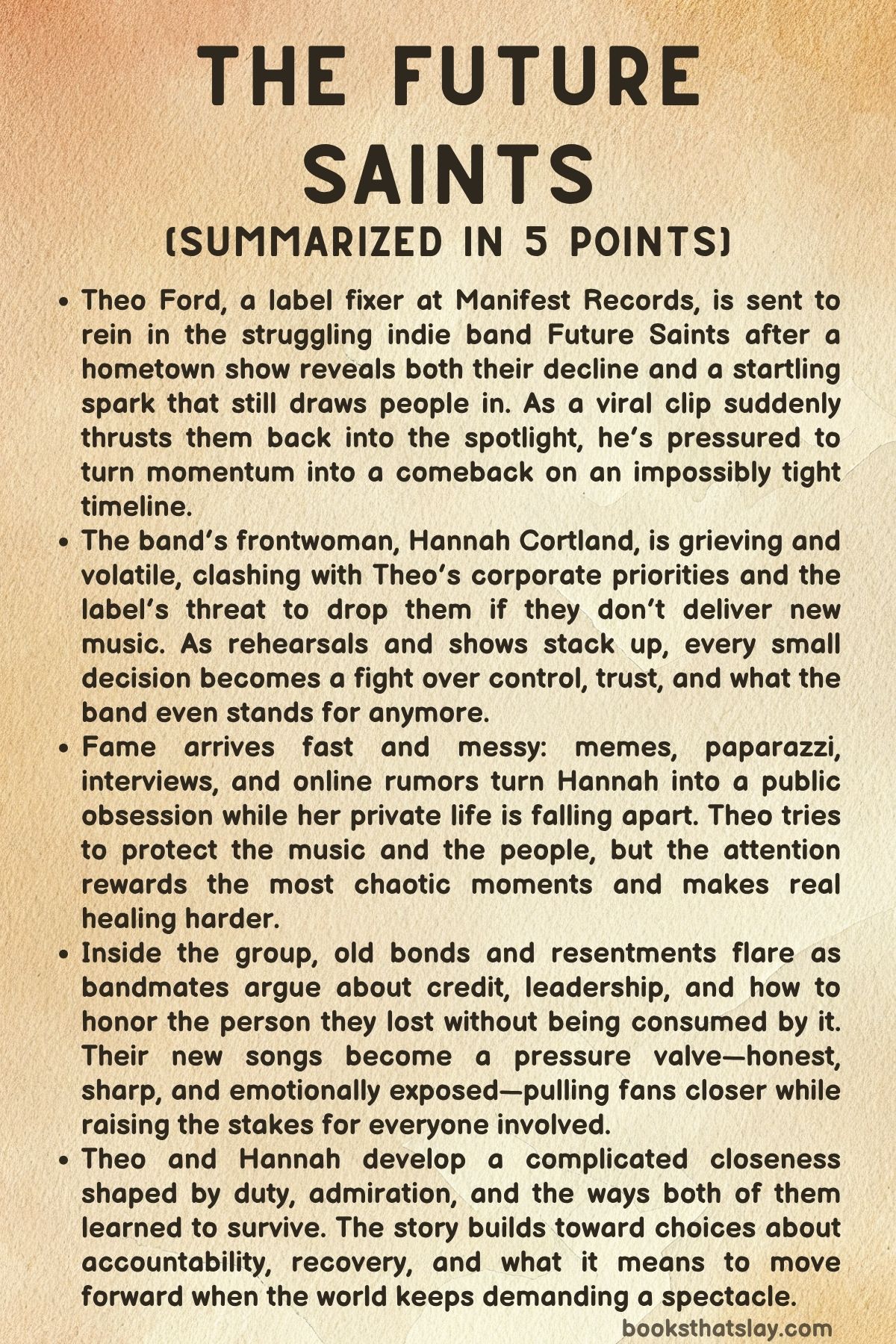
Characters
Theo Ford
Theo begins as a pragmatic fixer inside Manifest Records, the kind of artist-relations manager who’s sent in when an act is failing and the label wants control. In The Future Saints, that professional detachment gets tested almost immediately because the band’s collapse isn’t about laziness or trend-chasing—it’s grief, trauma, and a volatile new fame cycle that keeps rewarding the very behavior that’s destroying them.
Theo’s core tension is that he wants to do the “right” thing, but his definition of “right” has been shaped by scarcity, humiliation, and abandonment: he learned to survive by being useful, agreeable, and excellent, which makes him vulnerable to authority figures like Roger and to relationships where he can earn love through sacrifice.
As he gets closer to Hannah, Theo’s managerial instincts start to blur into emotional caretaking, and that’s where his character becomes most revealing. He doesn’t just want the band to deliver an album; he wants to believe he can prevent another loss, rewrite a story where someone doesn’t disappear, and prove he’s not powerless.
That explains why he keeps returning after being mocked, stranded, and undermined—his persistence is partly integrity and partly compulsion. Even when he earns the promotion and external validation he’s chased, it rings hollow because it’s built on the same machine that exploits Hannah’s pain for profit.
Theo’s eventual pivot toward founding Ford Records is less a victory lap than an attempt at moral self-rescue: he’s trying to build a version of the industry that doesn’t require cruelty as a business model, and to build a selfhood that doesn’t depend on being needed to deserve a place.
Hannah Cortland
Hannah is the novel’s emotional epicenter: a performer whose talent becomes undeniable precisely when she’s most broken, and whose grief becomes content for an audience that doesn’t know the difference between artistry and distress. Her public persona—reckless, defiant, “sad girl” magnetic—functions as armor.
She drinks onstage, picks fights, and rejects management not just because she’s spiraling, but because control feels like betrayal after Ginny’s death; if she accepts a stable narrative, she has to accept the loss as real. Hannah’s sharpest edge is aimed at anyone who tries to reduce her to an asset, yet she also participates in the chaos because part of her believes she no longer deserves a future that’s orderly or safe.
Her inner life is defined by two competing hungers: the need to keep Ginny present and the need to stop being consumed by that need. The ghostly presence of Ginny is not just a “grief device” but a psychological survival strategy—Hannah is fighting existential loneliness by refusing to let the attachment sever.
That refusal fuels her artistic output, especially the notebook songs and the brutal honesty of “Family Fruit,” but it also pushes her toward danger, including the beach incident where the boundary between longing and self-destruction collapses. Importantly, Hannah isn’t written as simply self-destructive; she’s also fiercely protective in her own way, capable of sudden responsibility, such as taking blame at the rooftop party and enduring humiliations partly to ease pressure on Theo, and of deep loyalty that she expresses through action rather than sentiment.
By the end, her decision to enter treatment and finally say goodbye to Ginny is framed as courage rather than redemption: she’s choosing life without bargaining for certainty, and that is the hardest thing she does.
Virginia “Ginny” Cortland
Ginny operates on two levels: she is a real person whose past choices shaped the band’s identity, and she is the internalized companion Hannah uses to survive the present. In life, Ginny was the organizing force—the “glue” who managed logistics, mediated conflicts, and validated Hannah’s worth in a world that labeled Hannah as the problem child.
The gifted-versus-struggling contrast in their upbringing makes Ginny’s loyalty feel revolutionary to Hannah: Ginny didn’t just love her sister, she chose her, again and again, and built a shared universe where Hannah wasn’t defective.
As a ghost, Ginny becomes both comfort and conscience. She appears when Hannah is overwhelmed, warns her about “danger,” and sometimes says the harsh truths Hannah can’t bear from anyone else—clean out the room, stop wearing the clothes, consider rehab, accept the death.
That dual function reveals something crucial: Hannah’s grief isn’t only about missing Ginny; it’s also about needing permission to live without her. The fading of Ginny during therapy and the final imagined beach goodbye show Ginny’s narrative purpose at its most intimate: she is the embodiment of love Hannah trusts, so Hannah can only release her when she believes that love will remain even without the hallucinated presence.
Ginny’s legacy also becomes public property through the fandom’s tributes and the Grammys visuals, which is both honoring and unsettling—she is remembered, but in a way Hannah never fully controls.
Kenny Lovins
Kenny is the band’s drummer and its most visibly “weird” stabilizer: the crystals, sage, and energy rituals are easy to dismiss as comic texture, but they function as his coping strategy and his attempt to impose meaning on disorder. Kenny’s personality reads as playful and chaotic, yet he often serves as a bridge when the others are splitting apart—he can tease Theo as a “Suit” while also recognizing that the band needs structure to survive.
His humor is not shallow; it’s a pressure valve for a group living inside constant volatility.
Kenny’s deeper conflict emerges when the industry starts weaponizing Hannah’s instability as marketing. He may enjoy spectacle, but he doesn’t want to become Roger’s pet project, and he doesn’t want the band’s identity reduced to the label’s preferred “sad girl” narrative.
When the sessions implode and he storms out, it’s not a tantrum so much as a boundary: he refuses to keep participating in a machine that turns grief into content and friendship into competition. By the epilogue, Kenny’s move into a duo with Ripper suggests he still needs music and connection, but on a scale and structure that won’t swallow him.
Tarak “Ripper” Ravishankar
Ripper is ambition with a wound underneath it. He’s charismatic, attention-seeking, and hungry for legitimacy beyond being “the bassist in Hannah’s band,” and that hunger becomes sharper once the band’s virality makes the stakes enormous.
His push to play lead guitar and to be taken seriously is not only ego—it’s also a fear response to a hierarchy he can’t control, where the industry crowns Hannah as the sole star and everyone else as support staff. Ripper’s resentment is fueled by grief too, but unlike Hannah’s inward collapse, his grief externalizes as competition and provocation.
Ripper’s most volatile moments—fights, rumors of leaving, the podcast hints—show how quickly personal pain becomes brand strategy once fame enters the room. He is not simply a villain to Hannah; he’s a mirror for what happens when someone feels invisible next to a tragedy the audience finds poetic.
His loyalty is real, but inconsistent, and often expressed through risky acts that spiral, like defending Hannah physically while also undermining her leadership publicly. The later formation of the Frontmen with Kenny suggests Ripper gets what he wanted—more spotlight—yet the novel leaves a question hanging: will he use that spotlight to become freer, or to repeat the same conflict in a new shape?
Bowie
Bowie, the tour manager, is the adult-in-the-room who has to translate a collapsing band into schedules, venues, and survivable logistics. Unlike Theo, Bowie’s authority isn’t institutional—it’s practical—and that makes him both less powerful and more trusted by the band.
He knows what grief did to them, understands the internal family language, especially “sister magic,” and carries the burden of being the person who must keep the show moving even when the people are falling apart.
Bowie’s guilt around the surprise new song and the secret rehearsals shows the ethical complexity of caretaking in a fame machine. He’s not malicious; he’s choosing between imperfect options, sometimes enabling behavior because the alternative is total collapse.
His loyalty is not to Manifest or to fame, but to the band’s survival in the most literal sense, and he’s one of the few characters who consistently treats Hannah’s life as more important than the album cycle.
Roger Braverman
Roger is the clearest avatar of exploitative power: charming, congratulatory, and relentlessly transactional. He reads people quickly and uses that insight to manipulate them, especially Theo, whose need for approval makes him easy to hook with promotions and praise.
Roger doesn’t just want success; he wants control of the narrative that produces success, which is why he tries to style Hannah into a marketable misery and demands more songs that sound like suffering.
What makes Roger especially corrosive is his ability to frame harm as strategy. He pushes martinis, encourages stunts, and treats scandal as publicity, all while appearing like a savvy executive doing business.
In doing so, he erases personhood—Hannah becomes a product, Theo becomes a tool, and grief becomes a content pipeline. Hannah’s public curse at the Grammys lands because it names what the industry usually disguises: the violence of being profitable while unwell.
Bryan
Bryan functions as Theo’s grounding witness and reality-check, the friend who can say the quiet part out loud when Theo starts romanticizing responsibility. Early on, Bryan’s advice is blunt—take the win, let the label sue, move on—because he sees the situation as career math, not a moral quest.
That contrast highlights Theo’s fatal flaw: Theo can’t stop himself from trying to “save” outcomes that resemble his own childhood losses.
As Theo’s entanglement deepens, Bryan remains a stable reference point, celebrating Theo’s accomplishments while also reflecting the costs back to him. Bryan doesn’t drive the plot, but he sharpens Theo’s characterization by representing a version of adulthood that isn’t addicted to martyrdom.
Dr. Xavier
Dr. Xavier is the story’s institutional voice of mental health—sometimes helpful, sometimes blunt to the point of abrasion. He doesn’t indulge Hannah’s myth-making, and he repeatedly reframes her behaviors as patterns with consequences: substance use, avoidance, self-endangerment, denial.
His insistence on naming reality forces the narrative to confront the difference between honoring grief and being possessed by it.
At the same time, his sessions reveal Hannah’s depth and history, and his exercises—like naming private truths about Ginny—give Hannah tools to anchor memory without turning it into self-erasure. By challenging Hannah to admit the ghost isn’t real and reconsidering her guilt about Ginny’s ambitions, Dr. Xavier becomes the mechanism through which Hannah begins to separate love from punishment.
He is not depicted as magical or perfectly wise; he is depicted as consistent, which is what Hannah’s world lacks.
Matt Sanford
Matt is the media’s appetite in human form: curious, opportunistic, and easily swept into the band’s chaos because it’s good copy and fun in the moment. He arrives as a Rolling Stone reporter but quickly becomes part of the performance ecosystem—drinking onstage, partying, escalating dares—until his own body becomes collateral damage.
That arc illustrates how the boundary between documentation and participation collapses when artists are treated like viral attractions.
Matt is not only a predator; he’s also a casualty of the same spectacle he profits from. His presence shows how fame invites a kind of social irresponsibility where everyone contributes to the spiral while telling themselves it’s just a story.
Sasha Thee Pop Princess
Sasha represents competitive celebrity culture weaponized into conspiracy. Her contempt for Hannah is partly genre snobbery and partly threat response: Hannah’s sudden dominance shifts attention, and Sasha uses her platform to destabilize her by attacking the one truth Hannah cannot tolerate being questioned—Ginny’s existence.
The cruelty of the accusation isn’t accidental; it’s designed to provoke a breakdown that the internet can then consume.
Sasha’s role is pivotal because she demonstrates how public narratives can become violence without any physical contact. By turning grief into a “receipts” hunt, she mirrors the audience’s entitlement and accelerates the paparazzi pressure that pushes Hannah closer to collapse.
Harry Whittles
Harry, the hotel manager, is a minor character who quietly signals how the band’s chaos harms ordinary people. His complaints about the rooftop party aren’t moral panic; they’re workplace consequences—staff getting blamed, liability, guests endangered.
Harry’s presence grounds the story’s glamor in the real-world collateral damage of celebrity antics, and it also sets up Theo’s shifting role: at first he enforces order for the label, later he tries to enforce it for Hannah’s survival.
Minnie
Minnie is a snapshot of devotion: a superfan who knows the band’s past vitality and can feel the difference when grief hollows out performance. She helps establish the stakes by representing the kind of audience that loved the band before virality—the small, loyal crowd that treats the music as intimate rather than as a meme.
Minnie’s conversations with Theo function like an early warning system: something fundamental has changed, and it’s not just “bad behavior,” it’s loss.
Booker Morris
Booker, tied to Dead to Rights, is a reminder that reputations in the industry travel faster than truth. His “Grim Reaper” label for Theo reframes Theo’s self-image: even if Theo believes he’s helping, others see him as an executioner sent to decide who lives or dies commercially.
Booker’s brief appearance deepens the mistrust between Theo and the band by exposing how Theo’s role looks from the outside, especially to artists who assume the label’s interest is never innocent.
Chase Benjamin
Chase is less a character than an instrument of rumor and leverage, a superstar placed near Hannah to generate chatter. His flirtation with Hannah at the party shows how celebrity proximity becomes a currency Roger can spend, and how Hannah’s personal life is repeatedly used as a marketing lever.
Chase’s function is to highlight Hannah’s lack of privacy: even her loneliness can be packaged as a storyline.
Gemma
Gemma is a small but pointed voice of the outside world, reacting to clips and narratives the way normal viewers do—half amused, half concerned, and drawn into the spectacle. Her comments about Theo carrying Hannah underline how quickly real crisis becomes aestheticized and sexualized online.
She adds texture to the social atmosphere around the band’s fame without steering the plot.
Theo’s mother
Theo’s mother embodies the life Theo came from and the emotional truth he keeps trying to outwork. When she appears, she doesn’t care about industry wins; she cares about whether her son is repeating an abandonment pattern by attaching himself to people he thinks he must “earn.” Her worry that he is too entangled with Hannah forces Theo to see that his devotion might not be purely love or loyalty—it might be a coping mechanism that keeps him trapped in the role of rescuer.
Bruce
Bruce is a quiet contrast figure: the stable partner beside Theo’s mother, representing the possibility of a life not ruled by crisis. His presence subtly emphasizes how unusual Theo’s intensity has become; next to Bruce’s steadiness, Theo’s orbit around chaos looks less like passion and more like compulsion.
Andy Quang
Andy is a cameo of comedy-culture cruelty and peer pressure at the SNL after-party. The hair-shaving prank environment he helps create illustrates how humiliation becomes entertainment in elite rooms, and how Hannah’s vulnerability is exploited by crowds who want proof of wildness.
He matters less as an individual and more as a symbol of social momentum that turns “daring” into coercion.
Gavin Dawson
Gavin, the veteran cast member targeted by the prank, represents how little dignity matters once the room decides something is funny. His role reinforces the novel’s theme that public humiliation is currency, and that the same dynamic fueling viral TikTok trends also fuels backstage dares among powerful people.
Adam “Dr. G” Gunther
Dr. G’s party house is the carnival version of celebrity excess—costumes, bouncy castle, petting zoo—where danger is disguised as play. He represents the kind of wealthy enabler who provides the stage for chaos without bearing consequences.
The accident with the robe and the escalating dares show how quickly “fun” becomes harm when everyone is incentivized to push further.
Sharon
Sharon, Hannah’s rehab chaperone, is a boundary made human. She appears when Hannah’s life finally becomes more important than the narrative around her, escorting Hannah away from glamour and back into care.
Sharon’s presence at the end underscores a crucial shift: Hannah is no longer being managed for profit, she is being protected for survival, even when that means separation from Theo and the band’s future.
Themes
Grief as a living presence that reshapes identity
In The Future Saints, Hannah’s relationship with Ginny doesn’t behave like a clean “before and after.” Ginny’s death becomes a force that keeps moving through Hannah’s days, shaping decisions, creativity, and even the way she perceives reality. Hannah doesn’t simply miss her sister; she keeps Ginny close as if closeness can delay finality.
That choice is not presented as a quirky trait but as a survival strategy with a cost. The more Hannah relies on Ginny’s presence to get through performances, interviews, and pressure, the more Hannah’s inner life starts to fracture into two tracks: the public self who must keep functioning and the private self who refuses to accept the loss.
This shows up in small acts—wearing Ginny’s things, writing everything for Ginny, chasing the last place Ginny existed—as well as in the larger drift toward self-destruction that looks like spectacle to outsiders. Grief here isn’t a quiet emotion; it can be loud, defensive, and controlling, especially when other people try to package it into a neat narrative or demand “closure” on a schedule.
The ghost is an especially telling device because it externalizes what Hannah can’t integrate: guilt over feeling like the “lesser” sister, anger at being left behind, and terror of being existentially alone. When therapy finally pushes Hannah to name private truths about Ginny, the point is not sentimental detail; it’s grounding.
Hannah is forced to shift from performing grief for the world to recognizing grief as something personal that must be carried without turning into a stage prop. By the end, the goodbye on the beach matters because it’s not about forgetting Ginny; it’s about accepting that love can remain without requiring a constant hallucinated companion.
That acceptance is portrayed as painful and brave, not uplifting, because it means Hannah must face her own mind without the comfort of a shared voice.
The machinery of fame turning pain into product
The band’s viral rise makes it clear that attention is not the same as understanding. The internet latches onto Hannah’s most destabilized moments because they read as “real,” and the story repeatedly shows how quickly authenticity becomes entertainment.
A performance of despair becomes a TikTok title, a fall becomes a meme format, and a shaved head becomes party currency. None of that requires the audience to care about Hannah as a person; it only requires content that can be repeated, remixed, and consumed.
The industry’s response is even colder because it treats virality as a resource to extract. The label’s priorities are spelled out through Roger’s demands: keep her “in line,” get more songs that sound like suffering, style her into a marketable “sad girl” image, and leverage feuds and rumors to keep the story hot.
Hannah’s grief, substance use, and volatility become promotional fuel, and people around her are pressured to participate, whether they want to or not. Theo is the most complicated figure in this machine because he begins as a professional tool of the system and slowly realizes the system rewards harm.
He can calm venue owners, manage crises, and translate chaos into workable outcomes, but the job also pushes him to treat Hannah’s breakdowns as obstacles to momentum. The story shows how easy it is for “help” to become control: mandatory therapy is framed as support, but it’s also surveillance and risk management; new tour stops are framed as opportunity, but they also keep Hannah in the grinder.
Even the media’s language after the beach incident implies performance, as if a near-death moment must still be interpreted through publicity. What sharpens this theme is how the crowd with phones mirrors the label boardroom: both are watching, both are collecting, and both feel entitled to the story.
Hannah’s eventual decision to enter rehab, and the band’s plan to step away even at the height of acclaim, reads like a refusal to keep selling the worst parts of herself for relevance. The awards and billboards don’t undo what fame did to her; they just prove that the market can reward damage as long as the output is beautiful.
Power, control, and the struggle over who gets to define someone’s story
Control is contested everywhere—inside the band, between the band and the label, and inside Hannah’s own mind. The band’s internal conflicts aren’t just creative differences; they’re battles over direction, credit, and whose suffering sets the agenda.
Ripper wants recognition and autonomy, Kenny wants meaning and harmony but often expresses it through rituals and avoidance, and Hannah is both the center of attention and the person least able to tolerate being managed. When Ginny was alive, she served as a stabilizer who could translate Hannah’s intensity into decisions the group could live with.
After Ginny’s death, every gap in that structure becomes a new site of conflict. Theo arrives believing his job is to take control of a failing act, and early on he tries to force order through contract threats and professional authority.
That approach fails because it treats the band’s crisis like a business problem rather than a human rupture. At the same time, the label’s power is blunt and structural: money, lawsuits, noncompetes, forced therapy, and access to publicity channels.
Hannah can talk back, storm off, or sabotage a show, but she cannot easily escape the system that owns her output and benefits from her instability. The Sasha rumor about Ginny never existing adds another layer: it’s a public attempt to seize Hannah’s narrative and rewrite it as manipulation.
Hannah’s outrage is not just about reputation; it’s about someone trying to erase the person she’s trying to preserve. Theo’s promotion complicates his position because it tempts him with status and approval, pulling him toward Roger’s worldview even when he knows it’s corrosive.
The most revealing moments in this theme happen when “support” is conditional. Roger offers career advancement if Theo prioritizes profit.
The crowd offers love as long as Hannah stays spectacular. Even the band’s loyalty can feel conditional when members question whether Hannah’s grief is ruining their lives.
Hannah’s path toward recovery is therefore also a fight to reclaim authorship over her story: not the label’s version, not the internet’s version, not even the version where she must keep Ginny animated to justify her pain. By choosing rehab and by publicly cursing the label at the Grammys, Hannah asserts a kind of control that isn’t about dominance but about refusing to be edited into a brand.
The cost is high—distance, uncertainty, and the possibility of losing the band—but the theme argues that a life cannot be managed like an image without eventually breaking the person inside it.
Care, boundaries, and love that doesn’t stay purely professional
Theo and Hannah’s connection develops under conditions that almost guarantee confusion: he is assigned to manage her, she is unraveling, and the world keeps rewarding the very behaviors that endanger her. Theo starts with a reputation for ending careers, which makes him threatening even when he tries to help.
Yet he becomes the person most willing to see Hannah as more than a headline or a revenue stream. His care, however, is not automatically pure or wise.
It is entangled with his own history—poverty, bullying, abandonment, a learned urge to be “good,” and an instinct to earn approval from powerful people. That makes him vulnerable to substituting competence for intimacy, believing that if he fixes enough logistics he can stabilize a human being.
The story repeatedly stresses how boundaries blur when crisis becomes routine. Theo breaks into Hannah’s room with a hotel key because urgency makes it feel justified.
He follows her when she asks for space because he cannot tolerate losing control of the situation. He is promoted while still emotionally involved, and that conflict feeds secrecy and guilt.
Hannah also uses the relationship in complicated ways: she tests him, taunts him, dares him to cross lines, and sometimes seems to rely on his steadiness only to resent what it implies—that she needs someone. Their bond becomes most honest when it includes limits: Theo learning he cannot “manage” grief out of her, Hannah recognizing she cannot keep using chaos as armor, and both understanding that desire doesn’t cancel structural harm.
The beach rescue is a turning point because it shows Theo’s care expressed as immediate action, but it also exposes the dangerous edge of that care: he risks his life, then turns violent toward people filming, as if protecting Hannah requires destroying the witnesses. It’s understandable, but it’s also a sign that his identity is sliding into saviorhood.
The later motel scene and the kiss carry weight because they come after Hannah chooses rehab; intimacy appears not as a reward for surviving but as a moment of truth between two people who have been pretending they are only roles. Even then, the ending refuses easy possession.
Hannah leaves to continue treatment, and Theo asks for her happiness rather than her return on a schedule. In that choice, the theme lands on a difficult definition of love: care that does not demand performance, does not insist on access, and accepts that the most responsible act can be letting someone walk back into their own life without you as the centerpiece.