You’ll Never Forget Me Summary, Characters and Themes
You’ll Never Forget Me by Isha Raya is a dark Hollywood thriller about what fame takes, what it hides, and what it turns people into. Actress Dimple Kapoor is watching her career cool down while a younger star, Irene Singh, rises fast.
One terrible moment at a celebrity party leaves Irene dead—and Dimple carrying a secret that could end her life as she knows it. As investigators circle and a blackmailer tightens the screws, Dimple makes choice after choice to protect herself. The story follows the fallout across film sets, mansions, and headlines, where reputation is currency and guilt doesn’t stay quiet.
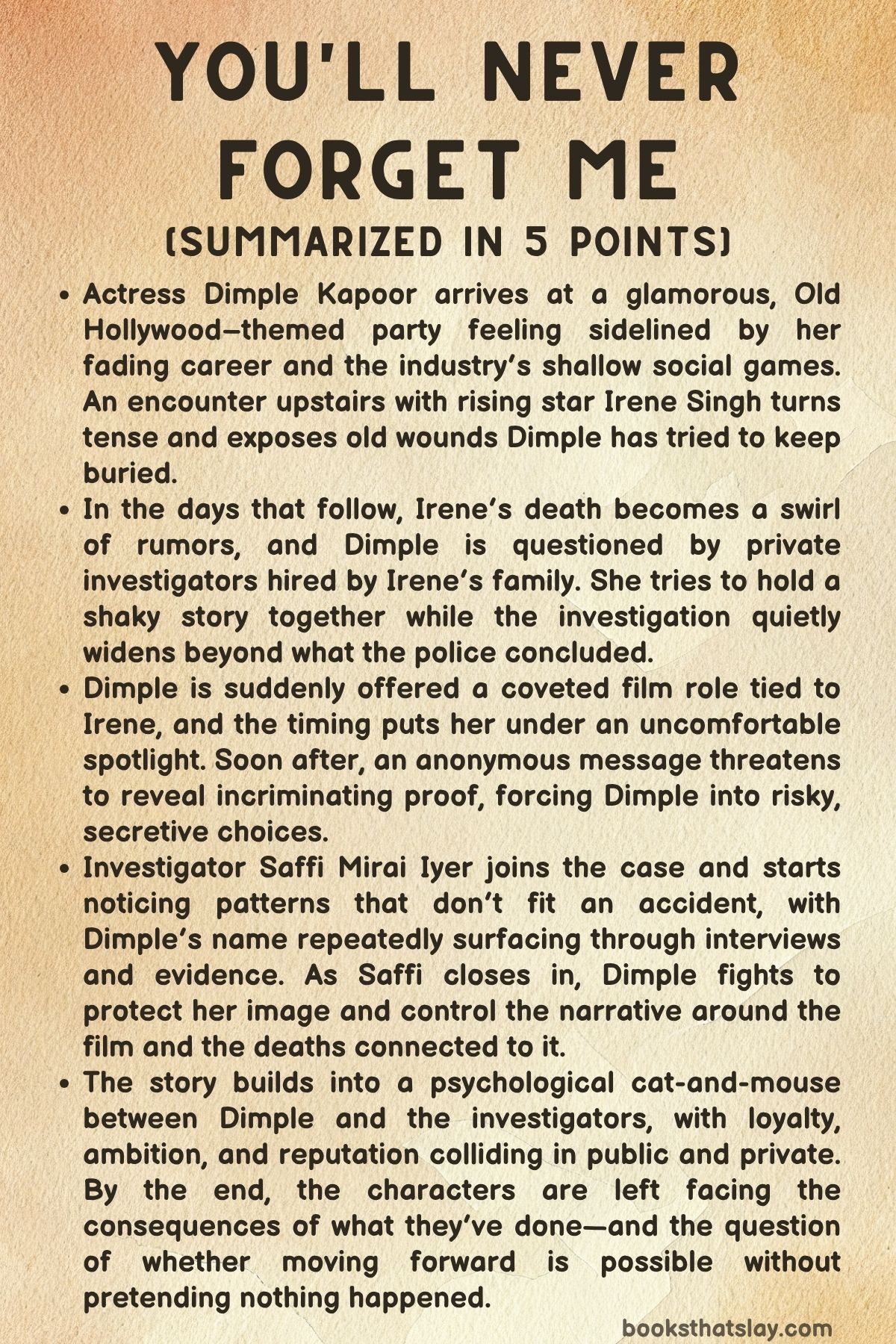
Summary
On January 23, 2026, Dimple Kapoor attends an Old Hollywood–themed party at Irene Singh’s Beverly Hills mansion. Dimple is sober, unhappy, and keenly aware of how quickly the industry has stopped paying attention to her.
The party is packed with people chasing introductions, pouring drinks, and trading pills like party favors. Dimple tries to keep her face composed while feeling dismissed and small.
A waiter named Isaac offers her alcohol; she refuses, tips him, and for a moment believes she’s been recognized—until he mistakes her for staff. Humiliated, she drifts away from the crowd into the quieter hallways, staring at expensive artwork and a stone statue of a young woman.
The statue needles her: beauty can be preserved in stone, but actresses are treated as temporary.
Dimple’s irritation and restless energy pull her toward the mansion’s grand staircase and the upstairs area that guests aren’t meant to enter. She climbs anyway, half imagining what it would be like to command the room again.
At the landing, Irene appears in an elaborate Salomé gown and blocks her path. Irene is sharp, confident, and clearly enjoying the advantage.
She jabs at Dimple’s string of flops, her age, and the fact that Irene has just landed a major lead role—one Dimple wanted and nearly got. Irene frames the party as her victory lap and treats Dimple like a relic hanging around to look relevant.
During their confrontation, Irene notices a dark stain on Dimple’s red dress. That sight yanks Dimple into a brutal memory of childhood abuse by her guardians—an aunt and uncle who drank, screamed, and punished her for any perceived mistake.
The memory carries an ugly truth: those guardians are dead because Dimple, years earlier, set a fire that killed them and made it look like an accident. She has carried a lighter ever since, using it to steady herself when panic rises.
Now, in Irene’s mansion, Irene’s alcohol-scented closeness and a reaching hand blur Dimple’s sense of safety. Dimple’s fear spikes into something instinctive and violent.
She shoves Irene. The push is real, and Irene loses her footing at the top of the stairs.
Dimple tries to catch her, but her long gloves slip, and Irene falls down the staircase. The sound of the impact is unmistakable.
Irene ends at the bottom, still and broken, posed like a dreadful imitation of the statue Dimple had been staring at earlier.
In the days that follow, gossip spreads faster than facts. By January 26, people are already trading rumors about what happened at the party—drugs, fights, ambulances—without fully grasping the outcome.
Dimple, however, knows Irene is dead. She spends the weekend sleepless on her couch, drilling herself on a story she can repeat without hesitation: she stayed among the guests, she never saw Irene, she drank, and her memory is fuzzy.
Two private investigators, Eli Taylor and Atlas Andino, arrive at her apartment to interview her on behalf of Irene’s parents, who don’t trust the official conclusion. Dimple performs anxious innocence while the investigators record the conversation.
They tell her the police ruled the death an accident, but the family wants a deeper look. They ask where she was during the estimated window of death, around 12:30 to 2:30 a.m.
Dimple claims she can’t remember who she spoke to. After they leave, Atlas asks for her autograph, and the request hits Dimple like a drug of its own: attention, proof she still matters.
The investigation expands. On January 27, Eli calls Saffi Mirai Iyer, a former colleague now living abroad, asking for help.
He admits their firm hasn’t handled a case like this, and he wants someone with sharper instincts. Saffi hesitates because of past fallout tied to a case in Arizona and the political risk attached to her family, but she comes to Los Angeles anyway and quietly sets up in the office after hours.
That same day, Dimple’s assistant, Priyal Tiwari, arrives with coffee and startling news: Dimple has been offered the lead role in a film called Insomnia, a role meant for Irene. Dimple immediately understands what it implies—someone in the industry already knows Irene is dead and is moving quickly to prevent delays.
Dimple accepts the role, telling herself it’s an opportunity she can’t lose. Exhausted and scattered, she posts an old behind-the-scenes photo of herself with Irene, their faces pressed together like close friends.
By morning, the news breaks publicly: Irene is dead, and Dimple’s photo makes their relationship look intimate, complicated, and newsworthy.
Dimple throws herself into Insomnia, preparing obsessively and insisting on email confirmation from the director, Jerome Bardoux, about schedules and contracts. Jerome’s message is cold: Irene’s death is “irrelevant” to production, and Dimple should focus on the deal.
On set, Dimple meets her co-star Chris Porter and settles into a luxurious trailer that bears her name. After filming, she finds a blue note on her mirror: someone claims they know she pushed Irene, they have proof, and if she doesn’t want police involvement, she must call a number.
Dimple makes the call from an old phone booth. The blackmailer is Isaac, the waiter from the party.
He says he recorded video of the moment on the stairs. He demands $100,000 and threatens to send the footage to the police and post it online.
Dimple doesn’t beg. She calculates.
Disguised in a wig, scarf, and gloves, she tracks Isaac down by connecting party staffing records and his online footprint to the craft services worker she has seen around the Insomnia set. Isaac lives in a nicer building than his job history suggests.
Dimple avoids camera angles, climbs the stairs, and breaks into his apartment while he sleeps.
Inside, the place is messy except for a pristine workstation with expensive monitors and notes. Dimple cracks his password using personal details and digs through his files.
She finds a collection of celebrity scandals—evidence of a pattern: Isaac profits from secrets. Then she finds the video she feared.
Even muted, it’s clear enough to identify her face and red gown as the one who shoved Irene. Enraged, Dimple deletes the entire folder, but she knows deletion doesn’t erase what Isaac has already seen or shared.
The noise wakes Isaac. He recognizes her and threatens to call the police.
Dimple closes the distance and shoves him over a fourth-floor railing. He dies on the concrete below while she watches, telling herself she has ended a threat.
The relief is immediate—and hollow.
Saffi, meanwhile, reviews the case and finds reasons to doubt an accident. Irene didn’t have much alcohol in her system, and photos show the dress torn in a way that suggests she fell backward while interacting with someone.
Across interviews and gossip, one name keeps surfacing: Dimple Kapoor, described as both rival and close companion. Saffi notes how quickly Dimple’s new casting was announced after Irene’s death and begins to focus on her.
When Isaac dies, he leaves a tip for investigators to check his online drive if anything happens to him. They try, and it’s been wiped.
Saffi studies Isaac’s phone activity and notices a number linked to a phone booth near studios, supporting a theory that the suspect is connected to a nearby production.
As weeks pass, Dimple’s guilt bleeds into her work. During a demanding scene on February 22, she realizes she isn’t pretending—she’s replaying real fear and real consequences.
On March 1, Saffi approaches the case indirectly by targeting Priyal. She engineers a small encounter, wins Priyal’s trust, and learns a key detail: Irene was originally offered the Insomnia lead, and Dimple accepted it on January 27 right as the death became known privately.
Priyal also reveals Dimple tried to back out once she understood why the offer arrived so suddenly, but she couldn’t escape the momentum.
Dimple senses a new pressure closing in and identifies the “Arizona woman” around her as Saffi Mirai Iyer, a respected investigator. Instead of collapsing, Dimple becomes energized by the challenge.
She builds timelines, makes cold calculations, and burns her notes afterward, refusing to leave a paper trail. Soon, Dimple falls from a Beverly Hills balcony and survives, and someone vandalizes an Insomnia poster with the message “Two down,” hinting at a pattern of deaths tied to Irene’s case.
Saffi finally meets Dimple in the hospital. The contact is tense and oddly intimate.
Over time, Dimple pushes Saffi to talk about justice and punishment, and Saffi reveals the personal disaster that haunts her: she once helped convict the wrong person, an innocent mother, whose execution was rushed. When Saffi realized the truth and tried to correct it, she was blocked, punished, and forced to run.
Dimple, in turn, shares her own history of abuse and fear, exposing the private engine behind her panic and violence.
By late summer, the case has tangled with Hollywood power. Dimple begins working “undercover” at industry parties, wearing an earpiece, supposedly to help lure evidence against producer Hector Olsen.
But Dimple takes matters into her own hands. She spikes a drink intended for Olsen, follows him, steals his keys, and sets up a confrontation that ends in chaos and injury to another woman, Shyla Patel.
A witness—Saffi’s intern, Mia Martinez—reports that Dimple spiked the drink. Dimple later breaks into Olsen’s home, disables security, plants evidence using her own stored blood, and sets a fire designed to destroy what can’t be controlled.
The police interpret the scene as Olsen trying to erase proof, and Olsen is arrested while Dimple returns to the investigators acting helpful and grateful.
Then the costs stack up. Dimple wakes in a Toronto hotel to find Saffi gone, Priyal suddenly absent, and signs that someone has been in the room.
In a safe, Dimple finds a message from Saffi challenging her to prove she can stop, that she can move forward without more destruction. Dimple keeps a torn corner of the note like a private token, then makes a call to a major media company, setting a new narrative in motion.
Back in California, Saffi tries to secure testimony from Olsen’s ex-wife, Laila, who describes Olsen’s abuse. Saffi believes Olsen is vile but not Irene’s killer, and she tries to keep the truth from being buried under a convenient scapegoat.
But the story breaks against her. Mia Martinez goes missing, and a burned body recovered from Olsen’s property is identified as Mia by DNA.
At the same time, an article goes viral exposing Saffi’s old Arizona scandal, destroying her credibility. Laila withdraws, the Singhs fire the agency, and Saffi’s own father—an ambitious senator—condemns her for endangering his public image.
Saffi returns to the office to find a red envelope addressed to her with a short apology signed “-D,” a message that looks gentle but lands like a threat.
Atlas Andino takes the bait. He storms into Dimple’s trailer and confronts her at gunpoint, accusing her of killing Irene, killing Isaac, framing Olsen, burning the mansion, and killing Mia.
Priyal refuses to leave Dimple. A struggle breaks out, the gun fires, and Priyal is shot.
Dimple tries desperately to save her, but Priyal dies, and Dimple’s grief turns to fury. Before Dimple can retaliate, Saffi arrives and sees the scene: Priyal dead, Dimple holding the gun, Andino shaken.
Saffi pieces together what happened: Andino fired the shot during the fight. Dimple pressures Saffi to let him go as a way of “moving on,” but the moment fractures into violence when Andino lunges for the gun again.
Saffi reacts and shoots him. Andino dies, and the line between investigator and executioner breaks for good.
In the aftermath, Olsen remains in custody, the planted evidence still warps the truth, and Saffi’s life is in ruins. Dimple survives her injuries and faces the reality that her career may continue even as bodies and lies trail behind her.
On September 13, Dimple meets Saffi on a rooftop. They trade the torn corners of their notes—“-S” and “-D”—returning the tokens that kept their connection alive.
They make a quiet agreement: no more fires, no more running. Dimple drops her lighter off the roof, and together they stand in the wreckage of what they’ve done, choosing to step into whatever comes next without another blaze to hide it.
Characters
Dimple Kapoor
In You’ll Never Forget Me, Dimple Kapoor is built around contradiction: a woman who craves visibility yet is terrified of being truly seen, who performs control while living in constant internal collapse. Her sobriety at Irene Singh’s party is not framed as triumph but as isolation—she watches everyone else dissolve into indulgence while she is trapped inside her own sharp, sober awareness, and that awareness turns every slight into humiliation and every social interaction into a referendum on her fading relevance.
What makes Dimple especially volatile is that her present is never just the present; it is continually invaded by a past defined by abuse and captivity. The stain on her dress and Irene’s alcohol-scented closeness do not simply upset her—they slam open a flashback loop where threat becomes indistinguishable from memory, and her body responds as if she is still the child who had no escape.
That is the psychological engine of her violence: she experiences panic as destiny, and harm as a kind of automatic self-rescue. Yet the novel refuses to let her hide behind trauma as an excuse.
Dimple is also calculating, strategic, and capable of cold follow-through, and the story steadily exposes how easily she can convert fear into planning. Her lighter, first introduced as a grounding object, grows into a symbol of her preferred solution: fire as erasure, fire as control, fire as storytelling—because if the scene is destroyed, so is the version of events she cannot survive.
She repeatedly turns narratives to her advantage, from rehearsing an alibi and weaponizing the public’s nostalgia for her image, to manipulating industry power structures that are already eager to replace Irene with her. As the plot intensifies, Dimple’s relationship to guilt becomes disturbingly functional: guilt does not stop her, it sharpens her.
Even when she is disoriented on set, she recognizes she is no longer “acting” emotions; she is recycling real ones, using performance as both concealment and confession. By the end, her arc lands not on purity or redemption, but on a grim kind of self-awareness—she stops running not because she becomes innocent, but because she finally accepts that survival-by-destruction has made her life unlivable.
Irene Singh
Irene Singh is the story’s spark and its haunting presence: even after her death, she controls the emotional weather of every room she is mentioned in. She is introduced as someone who has successfully climbed the ladder Dimple is sliding down—young, ascendant, celebrated—and she uses that position with a sharp instinct for dominance.
The confrontation on the staircase reveals a person who understands status as performance and cruelty as leverage; she needles Dimple not just to insult her, but to position herself as the future while casting Dimple as a relic. Irene’s Salomé gown and the Old Hollywood theme deepen that irony: she is dressed like spectacle, celebrating herself inside a fantasy of immortal glamour, while the scene quietly underlines how quickly glamour becomes a trap.
Irene’s death is staged with an almost aesthetic stillness—hair fanned, body posed like a statue—which connects directly to Dimple’s earlier obsession with art preserving beauty. Irene becomes the very thing Dimple envies and resents: a frozen image, unaging, preserved by tragedy.
The investigation later suggests Irene likely fell backward while facing someone she knew, which adds a final layer to her characterization: whatever her power in public, her last moment is intimate, relational, and interpersonal—less about Hollywood at large and more about the private violence that can grow between rivals who also mirror each other. Irene’s role in the story is therefore not simply “victim”; she is also a symbol of the industry’s churn and of the brutal intimacy of ambition, where admiration and hatred can occupy the same breath.
Isaac Klossner
Isaac Klossner begins as a seeming nonentity—a waiter offering a drink, a brief misunderstanding, a forgettable face in a mansion full of status seekers—then transforms into a reflection of the same predatory ecosystem that consumes celebrities. He is not just a blackmailer; he is a parasite shaped by proximity to fame, someone who learns that the easiest way to extract wealth from the powerful is to collect their worst moments and hold them hostage.
The discovery of his pristine workstation and his archive of celebrity scandals reframes him as methodical and practiced, not desperate or impulsive. His threat is not only legal but reputational, and he understands that reputational harm travels faster than truth.
That matters because he weaponizes the exact mechanism the story is already dissecting: the public’s hunger for spectacle, scandal, and moral collapse. Isaac also functions as a narrative pivot for Dimple’s moral descent.
With Irene, Dimple can tell herself it was panic and instinct; with Isaac, the sequence is far harder to excuse because it includes planning, infiltration, file deletion, and an escalation that ends with her pushing him over a railing and watching him die. Isaac’s presence therefore forces the story to move Dimple from accident-adjacent catastrophe into deliberate, conscious harm.
He is a villain, but also a mirror: he records, hoards, and sells narratives the way the industry does—he just does it illegally, with less polish and more direct brutality.
Eli Taylor
Eli Taylor serves as the investigator shaped by earnestness and limitation—someone trying to do professional work inside circumstances that keep escalating beyond his experience. He is the one who reaches out to Saffi, admitting the firm has not handled a murder case before, and that admission matters because it positions him as relatively transparent in a world where most characters are constantly curating deception.
Eli’s instinct is to be careful, procedural, and humane, and he often reads like the emotional middle ground between Atlas’s confrontational drive and Saffi’s cold precision. His attempts to comfort Dimple during tense moments show a tendency to respond to vulnerability with softness, which can be both a virtue and a blind spot in a case where vulnerability is frequently performed.
Eli also functions as a stabilizer for the investigative team—he’s the one who can keep working through discomfort, awkwardness, and uncertainty, and he repeatedly tries to keep the focus on evidence rather than personal vendettas. When the situation collapses into betrayals, missing interns, and reputational sabotage, Eli’s role becomes tragic in a quieter way: he represents the kind of straightforward professionalism that is least equipped to survive a story driven by narrative manipulation and moral chaos.
Atlas Andino
Atlas Andino is portrayed as intensity seeking an outlet, and the case becomes the container for all the anger he cannot otherwise metabolize. He is competent and driven, but his instincts lean toward confrontation and moral certainty, which makes him increasingly combustible as the story muddies every clean line between victim and perpetrator.
His clashes with Saffi reveal a deep discomfort with her bluntness and her willingness to speak harsh truths without cushioning them; he reads her as cruel, while she reads him as emotional and obstructive. That dynamic is important because it foreshadows what he becomes later: not merely a colleague who disagrees, but a man who believes righteousness authorizes escalation.
His decision to confront Dimple with a gun is the clearest crystallization of his flaw—he stops being an investigator and becomes an execution of his own conclusions, forcing justice into the shape of his anger. The resulting struggle and Priyal’s death expose the final cost of Atlas’s approach: even when he is “right” about suspicion, his methods produce catastrophe rather than resolution.
His access to Saffi’s computer and the implication of betrayal underline how far he drifts from ethical boundaries, and his end at Saffi’s hand turns the story’s moral knife further—because his death is not treated as clean punishment, but as yet another irreversible act born from panic and reflex, mirroring the very violence he came to stop.
Saffi Mirai Iyer
Saffi Mirai Iyer functions in You’ll Never Forget Me as both investigator and wound: she is brilliant at pattern recognition, relentless in inference, and frighteningly calm about ugly realities, but she is also a person whose identity has been permanently scarred by one catastrophic professional failure. Her backstory—helping convict the wrong person, realizing the error too late, and being blocked when she tried to correct it—explains why she is drawn to this case with such obsessive focus.
She is not just chasing truth; she is chasing a chance to rewrite herself, to prove she can spot the thing others miss before it becomes irreversible. That explains her sharpness with people, including Dimple: Saffi has little patience for performance, perhaps because she once trusted a system of appearances and learned the cost.
Yet the novel complicates her by making her vulnerable to personal entanglement. Her relationship with Dimple evolves into a tense intimacy built on mutual recognition: both women understand what it means to have a past that could annihilate the present, and both are skilled at shaping narratives to survive.
The candle birthday gesture is emblematic of Saffi’s contradictions—she offers softness, then immediately reverts to steel when the moment threatens to become real. As the story progresses, Saffi becomes increasingly trapped between ethics and practicality.
She sees the evidence stacking toward Dimple, yet she is also pulled into a strange alliance where “justice” is no longer a clean outcome but a set of terrible trade-offs. When her credibility is destroyed by the leak of her past and the agency loses the case, the story demonstrates her deepest fear: that she is permanently untrustworthy, permanently dangerous to people who depend on her.
Her final choices are not triumphant; they are compromises made in the rubble. By the end, she and Dimple trading torn paper corners becomes a quiet ritual of mutual containment—an agreement to stop lighting fires, not because either has become virtuous, but because both finally understand the damage their coping mechanisms create.
Priyal Tiwari
Priyal Tiwari is positioned as the closest thing Dimple has to ordinary human connection, which makes Priyal’s role both tender and doomed. As an assistant, Priyal performs the practical labor of holding Dimple’s life together—coffee, messages, schedule triage—but she also serves as emotional ballast, the person who brings reality into Dimple’s insulated, paranoid orbit.
Priyal’s revelations to Saffi show that she is perceptive and deeply embedded in the machinery of Dimple’s career, even when she does not fully understand its darkest undercurrents. What makes Priyal especially poignant is her loyalty: when Atlas arrives with a gun, Priyal refuses to abandon Dimple, stepping into danger without the same appetite for violence that the others carry.
She becomes the clearest casualty of everyone else’s obsession—killed not because she is the target, but because she is in the blast radius of Dimple’s secrets and Atlas’s rage. Her death also punctures whatever fantasy Dimple might still cling to about controlling harm; Priyal is the consequence Dimple cannot frame as necessary, and that loss becomes one of the few moments where Dimple’s composure truly collapses into grief rather than strategy.
Jerome Bardoux
Jerome Bardoux embodies the institutional rot of the film industry: charming, powerful, evasive, and morally flexible in ways that become deadly. His email dismissing Irene’s death as irrelevant and pressing Dimple to focus on production frames him as someone who treats human catastrophe as a scheduling problem.
He is not the one pushing people down stairs, but he benefits from the outcome, and he behaves as if that benefit excuses indifference. Jerome’s behavior later—drunk, unraveling, confessing in fragments—reveals the underside of that arrogance: he is frightened, not remorseful, and his fear is about exposure, not ethics.
When Dimple guides him into writing things down, the scene shows how Jerome can be manipulated because his weaknesses are predictable: he wants absolution without consequence and protection without honesty. Jerome’s function in the story is therefore structural: he illustrates how systems enable monsters and then pretend surprise when the damage surfaces.
Even when he falls apart, it reads less like repentance and more like panic at losing control of the narrative.
Chris Porter
Chris Porter operates as a parallel scandal that demonstrates how fame distorts accountability. As Dimple’s co-lead, he is part of the professional world that keeps moving regardless of death, and his later arrest for gross vehicular manslaughter while intoxicated becomes a media vortex that briefly distracts from the Irene investigation.
The speed with which public opinion polarizes—threats on one side, excuses on the other—highlights the story’s recurring point: the public does not metabolize truth, it metabolizes spectacle. Chris’s quick pivot into rehab and the dismissal of charges shocks Dimple not only because it seems unjust, but because it confirms her deepest belief that consequences are inconsistent and often negotiable if you are protected by the right machine.
Chris is not central to the murder plot in the same way others are, but he is thematically central: he shows the reader, and Dimple, how easily wrongdoing can be softened, rebranded, or erased when the industry decides it is convenient.
Hector Olsen
Hector Olsen functions as an engineered scapegoat and as proof that evil can be both real and strategically useful. He is presented as predatory, with an implied history of violence and drugging, which makes him believable as a villain to the public and to the police.
That believability is exactly why he becomes such an effective target for framing; the story exploits the uncomfortable truth that some people are so obviously harmful that society is eager to assign them any crime that appears nearby. Dimple weaponizes that eagerness—spiking his drink to provoke chaos, stealing his keys, breaking into his mansion, planting blood evidence, and setting the stage for a fire that destroys conflicting proof.
Olsen’s furious insistence that Dimple framed him is dismissed because his reputation has already written the script for everyone else. Later, Saffi’s push to keep him from taking the fall for Irene’s death complicates the moral landscape: Olsen can be vile and still not be guilty of this specific act, and the story insists that accuracy matters even when the suspect is easy to hate.
Olsen’s role ultimately exposes how justice can be redirected by narrative momentum, where plausibility becomes more powerful than fact.
Mia Martinez
Mia Martinez appears as an intern and a tail, someone positioned on the margins of power who nonetheless becomes essential to how the powerful protect themselves. Her observation that Dimple spiked Olsen’s drink is a crucial threat because it is the kind of plain, eyewitness detail that cannot be “spun” as easily as rumors.
That is why her disappearance and death land with such bleak force: she represents the vulnerability of low-status people inside high-stakes games. The discovery of a burned body identified as Mia by DNA ties her fate to the story’s motif of fire as erasure, implying that the same methods used to destroy evidence can also be used to destroy people who carry inconvenient truth.
Mia’s arc underscores that the central conflict is not only about Irene’s death; it is about the widening circle of collateral damage when secrets become a currency worth killing to protect.
Julie
Julie, Dimple’s manager, is a quieter but significant force, representing the professional intimacy that can look like care while still being transactional. She pushes Dimple toward choices that maintain momentum—accepting roles, keeping moving, staying marketable—and her efforts can be read as support or as exploitation depending on where the reader stands.
Her admission that she pushed Dimple to hire Priyal partly because both were lonely reveals a genuinely human motive inside an industry context that usually punishes vulnerability. Julie functions as a reminder that not every manipulator is a cartoon villain; sometimes people make controlling decisions while believing they are helping.
Yet the story also makes clear that this kind of paternalistic steering contributes to the environment where Dimple feels she must keep performing competence even while unraveling. Julie becomes one more layer in the net around Dimple: not an enemy, not a savior, but someone whose care is inseparable from career calculus.
Laila
Laila enters the story as Hector Olsen’s ex-wife, and her presence widens the understanding of harm beyond the headline cases. Her account of being drugged and nearly becoming a murderer reframes victimhood as something that can be weaponized into further violence, even when the original victim never wanted that transformation.
Laila’s potential testimony becomes a strategic chess piece in Saffi’s attempt to stop Olsen from taking blame for Irene’s death, and her role highlights how the legal system can turn personal trauma into leverage. When Laila later withdraws her testimony after Saffi’s credibility is destroyed, it illustrates how fragile justice is when it depends on reputations and public trust; truth is not always what collapses first—sometimes the messenger does.
Laila’s function is therefore both emotional and structural: she shows the ripple effects of predation, and she shows how quickly those ripples can be redirected or silenced when power shifts.
Shyla Patel
Shyla Patel appears as an aspirational figure caught in a trap set by other people’s tactics. When Dimple tries to steer Olsen toward Shyla during the drugged chaos, Shyla becomes a tool within Dimple’s larger plan, and the violence that follows—Olsen breaking her nose—exposes the cruelty of treating real people as movable pieces.
Shyla’s injury is one of the clearest examples of unintended consequence: Dimple intends controlled fallout, but the fallout hits someone who did not consent to be part of the strategy. Shyla matters because her harm is not abstract; it is immediate and physical, and it forces the investigation to confront that even “successful” operations can create victims.
She becomes a living receipt for the cost of manipulation, the kind of cost Dimple keeps trying to deny until it accumulates into catastrophe.
Themes
Fame as a System That Rewards Cruelty and Erasure
From the moment Dimple enters the Beverly Hills party, the social rules are already written in a way that makes her small. The crowd isn’t gathered to celebrate art or community; it’s gathered to rank people, trade access, and decide whose face still matters.
Dimple’s sobriety makes her feel even more exposed because she can’t blur the humiliations the way others do. Being mistaken for staff by Isaac is not just an awkward misunderstanding—it lands as proof that her image no longer “reads” as valuable in the room.
That single moment captures a larger truth about how celebrity works in You’ll Never Forget Me: status is fragile, and once the industry senses you are slipping, it treats you as interchangeable.
Irene’s confrontation on the staircase sharpens the idea that fame isn’t only about talent; it’s also about permission. Irene speaks like someone newly granted that permission, enjoying the authority to judge Dimple’s age, relevance, and failures.
The party becomes a stage where Irene can publicly occupy Dimple’s private fear: that the industry is done with her. The stone statue Dimple fixates on earlier makes the contrast painful—art gets to stay admired, but actresses are assessed as if they’re products with an expiration date.
That comparison exposes how fame sells a promise of being remembered, yet the reality is closer to controlled forgetting, where attention moves on without guilt.
The machinery that replaces Irene with Dimple for the film within days makes the theme even more brutal. Death becomes a scheduling problem, and the director’s email shows how easily human loss is dismissed when money and timelines are involved.
Dimple’s “comeback” arrives not as a triumph but as a transaction facilitated by catastrophe. Even the public narrative is adjustable: when Dimple’s old photo with Irene resurfaces, it instantly turns rivalry into “friendship” because that story is more marketable.
Later, Chris’s legal crisis demonstrates a similar pattern: outrage spikes, then consequences evaporate when image management and rehab headlines provide a socially acceptable exit ramp. Across these events, fame operates as an economy of attention that feeds on scandal, discards people without ceremony, and teaches everyone inside it to treat reputation like a weapon or a shield rather than a reflection of truth.
Trauma, Triggers, and the Fear That Never Fully Leaves
Dimple’s violence is not presented as random; it is tied to a nervous system trained by earlier harm. When Irene notices the stain on Dimple’s dress, that detail functions like a trapdoor: Dimple’s mind is yanked back into a childhood defined by drunken guardians, punishment, and constant threat.
The memory is not a distant story she calmly recalls—it arrives as a bodily reaction that overrides the present. Irene’s alcohol-scented closeness and reaching hand become indistinguishable from earlier danger, and Dimple’s perception collapses into panic logic: there is a threat, there is no escape, and survival requires force.
That is how the story frames trauma—not as a set of sad memories, but as a persistent pattern that can hijack judgment and turn ordinary moments into emergencies.
The lighter Dimple carries as a grounding object speaks to the ongoing management of fear. It is both comfort and warning.
It helps her steady herself, yet it also signals how fire has been woven into her coping—first as an engineered “accident” to kill her abusers, later as a recurring solution when she feels cornered. The fact that she staged a deadly house fire as a teenager reveals how early she learned that the world would not rescue her, and that justice, safety, and control might only come through acts she can orchestrate herself.
That background doesn’t excuse what she does, but it clarifies why she experiences power through irreversible choices.
As the plot escalates, Dimple’s trauma shows up less as flashback and more as repetition. She becomes hyper-vigilant, rehearsing cover stories, calculating timelines, and scanning for signs of exposure.
Her panic episodes are intense not only because she fears prison, but because being seen has always been dangerous for her—seen as a child meant being targeted, and seen as an adult actress now means being judged, discarded, or punished. Acting on the set becomes another trigger: she isn’t pretending to feel guilt; she is living inside it, and the boundary between performance and confession dissolves.
The story also shows trauma morphing into control. Dimple’s methods—erasing evidence, deleting Isaac’s files, planting blood, staging a fire—can be read as attempts to create a world where nothing unpredictable can touch her.
Yet those actions keep reproducing the very terror she is trying to avoid, because each cover-up multiplies the number of people who could expose her and the number of consequences she must prevent. The theme lands in the way she can never fully rest: even her moments of relief are brief, immediately replaced by the next fear that something is closing in.
Trauma becomes a shadow that changes shape but never truly disappears until she confronts, at the end, the cost of constantly choosing survival by destruction.
Moral Injury and the Self-Justifications That Keep Violence Possible
Dimple repeatedly tells herself versions of the same sentence: that what she did was necessary, that the person she harmed was a danger, that stopping them prevents worse harm. The story’s tension comes from how believable those arguments can feel in the moment, especially when the targets are cruel or predatory.
Isaac’s apartment reveals a digital hoard of exploitation—celebrity material gathered for profit, humiliation, and coercion. When Dimple deletes his folder, the act initially resembles a form of justice, almost a rescue of strangers she will never meet.
But the moment Isaac wakes, the moral frame shifts. Dimple moves from erasing evidence to pushing a living person over a railing, then watching him die.
The horror is not only the killing; it’s the way she forces herself to accept it as a kind of cleaning of the world.
That internal logic expands later when she manipulates events around Hector Olsen. She spikes a drink, engineers a situation, steals keys, breaks into a mansion, plants evidence, and sets a fire that destroys proof and leads to a chain of outcomes she can’t fully control.
Each step is a decision to replace legal process with personal judgment. What makes the story unsettling is that Dimple’s reasoning is often framed as strategic rather than impulsive—she is careful, observant, and capable of planning.
That competence makes the ethical drift more frightening because it suggests how easily intelligence can become a tool for rationalizing harm.
Saffi’s backstory mirrors this theme from another angle. Her confession about helping convict the wrong person—an innocent mother whose execution was rushed—shows moral injury on the side of law and procedure.
She didn’t commit physical violence, but she participated in a system that did, and the guilt reshaped her life. She tried to correct the record and was blocked by institutional self-protection, then fled when the truth threatened powerful people.
In Dimple, guilt drives concealment; in Saffi, guilt drives exile and bitterness. Both women carry the knowledge that once you contribute to irreversible harm, “moving on” isn’t a simple choice.
The theme becomes sharper when consequences prove inconsistent. Chris’s charges are dismissed, and the speed of that reversal unsettles Dimple because it suggests morality in their world is negotiable.
If the public can rage today and forget tomorrow, then guilt becomes private rather than communal. That pushes Dimple further toward the belief that only she can enforce outcomes—by force if needed.
The final confrontations show how this mindset infects everyone: Andino arrives with a gun, convinced the truth justifies intimidation, and in the struggle Priyal dies. Then Saffi shoots Andino reflexively, another “necessary” act that cannot be undone.
By the time Dimple and Saffi meet on the rooftop, the theme has matured into a grim recognition: violence doesn’t end when the threat ends, because the memory of what you did keeps demanding payment. Their agreement to stop running and stop setting fires reads as an attempt to interrupt the cycle of self-justification before it claims more lives.
Power, Surveillance, and the War Over Who Controls the Story
Nearly every major turn is driven by someone collecting information, withholding it, or weaponizing it. The party itself is a performance space where visibility is currency, but that visibility is dangerous because it produces witnesses, rumors, and footage.
Isaac embodies modern surveillance as a cottage industry: he records, archives, monitors social media, and turns private moments into leverage. His demand for money is not just blackmail; it is a declaration that reputation is a product he can sell.
Dimple’s response—breaking into his apartment, deleting files—shows how quickly the fight becomes about controlling the record rather than confronting the crime. When the drive is wiped, investigators lose a shared source of truth, and the story becomes vulnerable to whoever can fabricate the most convincing narrative.
Saffi’s investigation method highlights how power works through indirect access. She targets Priyal because assistants are often the soft tissue of celebrity life—close enough to know everything, overlooked enough to approach.
That choice reflects a world where the famous are protected by layers, but those layers can be penetrated through social engineering. The series of traced phone numbers, the phone booth near studios, the intern tailing Dimple, and the staged café encounter all show how the investigation is less about dramatic interrogations and more about mapping networks, timelines, and weak points.
Control comes from knowing what happened before anyone else does.
The film industry’s PR response to Chris’s arrest adds another form of narrative control: coordinated silence, selective visibility, and strategic substitution. They keep him in the film but erase him from promotion, trying to preserve profit while minimizing contamination.
Dimple is positioned as the new face of the project not because truth demands it, but because optics require stability. Even personal relationships become story tools.
The resurfaced photo of Irene and Dimple instantly reshapes public assumptions, and later the viral article exposing Saffi’s past destroys her credibility at the exact moment it matters most. That leak functions as an assassination of trust, proving that in this world, winning doesn’t always mean proving facts—it can mean making the fact-finder untrustworthy.
The most chilling aspect of this theme is how both Dimple and Saffi learn to use narrative the way others do. Dimple considers how to position herself as manipulated rather than complicit when Jerome breaks down, nudging him into writing a confession she can later frame as evidence.
Saffi proposes legal leverage with Laila that treats testimony as strategy rather than pure truth-telling. Each woman, in her own way, is forced to operate inside systems where honesty alone is rarely enough.
By the end, the torn-note exchange between them becomes symbolic not only of connection but of shared custody of the story. Dropping the lighter off the roof is also a surrender of a certain kind of power—the power to erase problems through fire and force.
Yet the ending doesn’t pretend the narrative war is over; it suggests they are choosing, deliberately, to stop trying to control every version of events and accept that living forward will require tolerating uncertainty without defaulting to destruction.