All That’s Left in the World Summary, Characters and Themes
All That’s Left in the World by Erik J. Brown is a young adult post-apocalyptic novel about survival, trust, guilt, and love after a deadly flu wipes out most of humanity. The story follows Andrew and Jamie, two teenage boys who meet by chance when both are nearly alone in a ruined world.
What begins as suspicion and reluctant help grows into companionship, then love, as they travel through danger, loss, and uncertainty. The book balances the harshness of a collapsed society with the hope found in small acts of care, showing how people can still choose kindness when everything familiar has disappeared.
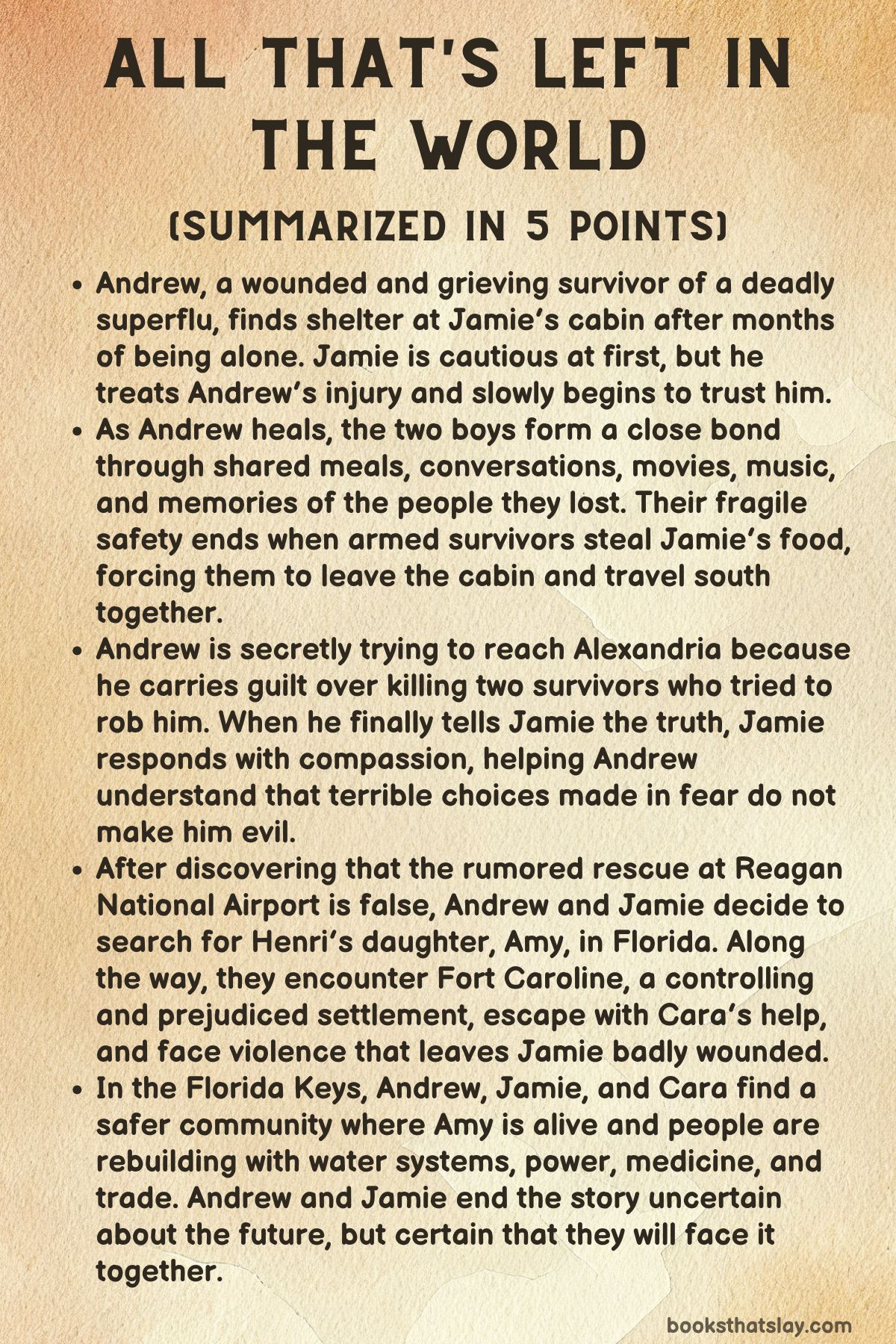
Summary
After a devastating superflu kills most of the world’s population, Andrew has been surviving alone for months. His mother died early in the pandemic, his father left after showing symptoms to protect his children, and his younger sister Elizabeth later died, leaving Andrew with grief he can barely carry.
Injured after stepping into a bear trap, he stumbles through the woods and finds a cabin. Inside lives Jamie, who is also alone after losing his mother.
Jamie has food, running water, electricity, and medical supplies, but he is frightened of strangers and greets Andrew with a rifle.
Andrew is weak, hungry, and in pain, and Jamie eventually chooses to help him. He cleans Andrew’s badly wounded leg, gives him medicine, and lets him stay while he heals.
Though both boys are wary, they begin sharing pieces of their lives. Andrew learns that Jamie was raised by his mother and once had a girlfriend who died early in the pandemic.
Jamie learns that Andrew came from Connecticut and is trying to reach Washington, DC, because of rumors that help from Europe will arrive at Reagan National Airport on June 10. Andrew does not reveal the whole truth: he also carries an address in Alexandria and feels driven to go there for reasons tied to a terrible secret.
During Andrew’s recovery, the boys slowly become friends. They cook together, talk about old movies, books, music, and the world before the flu.
Andrew is drawn to Jamie but assumes Jamie is straight, while Jamie begins to feel a connection he does not fully understand. Their fragile peace is broken when armed people arrive at the cabin.
Led by a man named Howard, they take most of Jamie’s food. Jamie cannot bring himself to shoot them, and Andrew later leaves, believing he is a burden and that he must face his own unfinished business.
Jamie follows him, admitting that the cabin no longer felt safe without him. They decide to travel south together.
Their journey is difficult. They search abandoned towns for food and water, avoid dangerous people, and struggle through exhaustion and fear.
In one town, they find evidence of violence and realize that some survivors have become cruel. Later, they cross the flooded Fort McHenry Tunnel in darkness, narrowly making it through.
As they move closer to DC, Jamie senses that Andrew is hiding something, especially when Andrew wants to pass through Alexandria. Jamie had seen the address in Andrew’s book and quietly tells him that if he needs to look for someone, they should do it.
Before reaching Alexandria, they meet Henri, an older woman living alone near Bethesda. She is guarded but kind, offering them water, food, and advice.
She warns Andrew that secrets can put Jamie in danger and urges him to be honest. Henri also tells them about her daughter Amy, who may still be alive in Florida, and gives them her late husband’s multi-tool.
Soon after, Andrew and Jamie pass through the National Zoo area and are chased by escaped lions. They are separated, and Andrew believes Jamie may have died.
Heartbroken, he still forces himself to continue to Alexandria. When he reaches the street from the address, he finds Jamie alive and waiting for him.
Andrew finally tells Jamie the truth. Earlier in his travels, he met George and Joanne Foster, who were going to Alexandria to find their son Marc and his family.
They invited Andrew to join them, but later tried to rob him. When George threatened him with a gun and Joanne came after him, Andrew killed them both in the struggle.
He has been haunted by guilt ever since and came to Alexandria to tell their family what happened. Jamie comforts him and does not judge him.
Together, they enter the Fosters’ house and find that Marc, his wife, and their children are already dead. Andrew breaks down, and he and Jamie bury the family.
Jamie realizes that his feelings for Andrew have grown into love.
At Reagan National Airport, Andrew and Jamie discover that the rumored rescue is false. A teenage boy named Chris and his younger siblings have been waiting there for help, but documents left by a dead White House intern reveal that Europe suffered a second wave of the flu and communications collapsed.
No rescue is coming. Andrew and Jamie decide to keep moving.
Remembering Henri’s daughter, they choose to go to Florida and try to find Amy.
On the way south, they find a working vehicle and briefly drive before running out of gas. Later, fireworks on the Fourth of July lead them to a settlement called Fort Caroline.
At first, it seems organized and safe, with electricity, food, jobs, and rules. But Andrew and Jamie quickly notice disturbing signs.
The community is controlled, suspicious, and hostile to anyone who does not fit its values. There are few older people, few women, and no people of color.
The questionnaires ask about sexuality, illness, and reproductive history. Harvey, the leader’s son, clearly targets Andrew with homophobic disgust.
Their supplies are taken, and the boys realize they need to escape.
With help from Cara, a teenage girl trapped in the settlement, Andrew and Jamie recover what they can and flee during fireworks. Cara secretly gives them maps showing roads, danger zones, and a route toward the Florida Keys.
Harvey and another man, Walt, follow them. When they confront the boys near a river, Jamie, desperate to protect Andrew, shoots them.
The act shakes him deeply. He had always feared becoming the kind of person who kills, and now he has done exactly that, even though it saved their lives.
Cara later catches up with Andrew and Jamie after escaping Fort Caroline herself. Jamie distrusts her at first, but Andrew sees that she is also afraid and wants freedom.
The three continue toward Florida. Jamie struggles with guilt, and Andrew tries to help him while facing his own past.
Their bond keeps growing, though danger follows them. Fort Caroline men eventually capture Andrew and Jamie, and believing they may die, Jamie kisses Andrew and tells him he loves him.
Andrew says he loves him too. Cara, hidden nearby, fires shots to distract their captors, giving the boys a chance to escape.
During the flight through the woods, Jamie is shot.
Andrew works desperately to stop Jamie’s bleeding. Cara searches for supplies, and together they manage to stitch the wound, but infection sets in as they continue south.
Jamie becomes weaker, and Andrew grows frantic. Near Key Largo, they reach a fortified gate.
Andrew expects rejection or violence, but the people there help them. Jamie is taken to a hospital and survives.
In the Florida Keys, they find a real community, larger and healthier than anything they have seen. People have water systems, power from solar and wind, trade routes, boats, and a sense of shared purpose.
They also find Amy, Henri’s daughter, alive with a baby named after her mother. Andrew and Jamie give Amy Henri’s multi-tool and tell her that Henri is still alive.
Amy explains that babies born after the pandemic seem immune to the superflu, offering a reason to hope for the future.
Jamie, Andrew, and Cara are allowed to stay. Amy assures them that having killed in self-defense does not make them bad people, especially because they take no joy in it.
Jamie reflects on how far they have come and understands that they survived not by being strong alone, but by trusting one another. Later, Andrew and Jamie stand by the ocean, planning a trip north to bring Henri back.
They are unsure whether they will remain in the Keys or eventually return to Jamie’s cabin, and they know the world may still bring danger. What they do know is that they will face whatever comes together.
Characters
Andrew
Andrew is one of the emotional centers of All That’s Left in the World, and his character is shaped by grief, guilt, fear, humor, and a deep need to believe that goodness has not disappeared. When he first appears, he is physically wounded and emotionally exhausted, moving through the woods after months of isolation.
His injury from the bear trap reflects his larger condition: he is trapped by what has happened to him and by what he has done. The loss of his mother, father, and sister has left him with almost no reason to keep going, yet he still carries a sense of responsibility that pushes him forward.
His journey to Alexandria is not only about finding the Foster family; it is about facing the moral weight of killing George and Joanne. Andrew is terrified that if Jamie learns the truth, he will see him as dangerous or ruined.
Andrew’s humor is one of his most important survival tools. He talks about movies, makes jokes, teases Jamie, and uses pop culture as a way to create normalcy in a world where normal life has been destroyed.
His storytelling gives him control over fear, even briefly. It also helps him connect with Jamie, especially when Jamie has become quiet, guarded, or emotionally shut down.
Andrew often uses jokes to avoid pain, but this does not make him shallow. In fact, his humor shows how badly he wants to protect himself and others from despair.
His love for Jamie grows gradually and painfully. At first, Andrew assumes his attraction is hopeless because Jamie had a girlfriend and because the odds of finding another gay boy in a devastated world seem impossible.
This makes his longing quiet and cautious. He does not immediately confess his feelings because he already feels like a burden and a threat.
His fear of rejection is tied not only to romance but also to his history with anti-gay prejudice. Encounters with Harvey bring those fears back sharply, reminding Andrew that even after civilization collapses, old forms of hatred can survive.
Andrew’s greatest conflict is his belief that his past actions may define him forever. He killed in panic and self-defense, but the emotional result is still crushing.
He sees himself through guilt before he allows himself to see the full context of what happened. Jamie’s compassion helps him begin to understand that survival can force impossible choices on people.
By the end, Andrew has not become untouched by pain, but he has become more open, honest, and capable of accepting love. His growth lies in learning that being damaged does not mean being unworthy of care.
Jamie
Jamie begins as a careful, frightened, lonely boy who has built a small refuge out of his mother’s cabin. He has supplies, electricity, water, and medical knowledge from his mother’s notes, but he does not have peace.
His life is defined by absence: his mother is dead, his girlfriend is dead, and the world he knew is gone. When Andrew arrives, Jamie’s first reaction is fear, which is understandable in a world where strangers can mean danger.
Yet his decision to help Andrew shows the central contradiction in his character. Jamie wants to protect himself, but he cannot stop himself from caring.
His relationship with violence is one of the most important parts of his characterization. Jamie owns guns and knows he may need them, but he repeatedly struggles to use them.
He cannot shoot the people who rob the cabin. He cannot kill a deer for food.
He questions whether killing a dangerous person would make him like that person. This hesitation is not cowardice; it comes from a moral seriousness that survives even after the world has become brutal.
Jamie fears becoming cruel more than he fears appearing weak.
Jamie also carries guilt connected to his mother. He had hidden painkillers as part of an agreement that would help ease death if either of them caught the flu, but when his mother became sick, he could not help her die.
This failure haunts him. Later, when he kills Harvey and Walt to protect Andrew, the act devastates him because it seems to reverse everything he believed about himself.
He could not help his mother die, but he could kill someone else. That contrast makes him feel monstrous, even though his actions saved lives.
His love for Andrew changes him slowly. At first, Jamie does not fully understand what he feels.
He is protective, attached, jealous of Andrew’s possible departure, and desperate not to be alone again. Over time, his feelings become clearer.
His love is not presented as a simple escape from trauma; it grows in the middle of fear, hunger, danger, and grief. Jamie’s confession comes when death seems close, which gives it urgency and honesty.
By the end, Jamie has learned that love does not remove fear, but it gives him a reason to continue. In All That’s Left in the World, Jamie represents the struggle to remain gentle without becoming helpless.
Cara
Cara is introduced through Fort Caroline, a settlement that appears orderly but is built on control, exclusion, and fear. At first, she seems like a minor figure behind a desk, but her discomfort quickly reveals that she is not fully aligned with the people around her.
She is young, isolated, and trapped in a society that uses rules and appearances to hide its cruelty. Her decision to help Andrew and Jamie shows courage because she understands the danger of crossing Fort Caroline’s leaders.
Cara’s role grows after she escapes and joins the boys. She is not simply a helper or side character; she is another survivor carrying trauma.
Her quietness, emotional shutdowns, and strong reactions to burned places suggest that she has seen things she cannot easily speak about. Unlike Andrew, who often talks too much to manage fear, Cara often says very little.
Her silence is part of how she survives. She watches, judges, and waits until action is necessary.
Her presence also changes Andrew and Jamie’s relationship. She sees Jamie’s love for Andrew clearly before Jamie fully admits it aloud, and she encourages him to be honest.
This makes her emotionally perceptive, even when she is guarded. She also becomes essential during the escape from Fort Caroline’s men, using gunfire to distract them and help Andrew and Jamie survive.
Later, she risks herself to search for supplies when Jamie is wounded. These choices show that Cara’s trust, once earned, is strong and active.
Cara represents the possibility of chosen family beyond romance. Andrew and Jamie’s bond is central, but Cara becomes part of their survival unit.
She is not absorbed into their relationship; she stands beside it. By the end, her connection with them suggests that rebuilding a life after catastrophe requires more than romantic love.
It requires friendship, loyalty, shared labor, and the willingness to protect one another even after trust has been broken by the world.
Henri
Henri is one of the clearest examples of guarded kindness in the story. When Andrew and Jamie meet her, she is armed and cautious, but she is not cruel.
She has built a small life for herself behind fences, routines, and practical habits. Her husband is dead, and her daughter Amy is missing, yet Henri has not surrendered completely to bitterness.
She understands danger, but she still chooses to offer water, food, shelter, and advice.
Her wisdom comes from experience rather than sentimentality. She does not pretend the world is safe.
She warns Andrew that secrecy can endanger Jamie, and she is direct about the need for trust. This makes her an important moral guide for Andrew.
He has been carrying guilt alone, and Henri recognizes that hidden pain can become dangerous when people are traveling together. Her advice helps push Andrew toward honesty, even though he does not immediately follow it.
Henri’s belief in luck rather than fate is also important. She does not frame survival as something grand or deserved.
Instead, she sees it as uncertain, fragile, and sometimes random. Yet within that uncertainty, she still believes people can choose decency.
Her generosity toward Andrew and Jamie is not naive. It is a deliberate act by someone who knows exactly how bad the world can be.
Her connection to Amy gives the later journey purpose. By giving the boys her husband’s multi-tool, Henri unknowingly sends a piece of herself forward.
When Andrew and Jamie eventually find Amy, Henri’s earlier kindness becomes part of a larger chain of hope. She is not present for much of the plot, but her influence lasts because she reminds the boys that survival should not mean closing themselves off from others forever.
Amy
Amy represents the future that the characters are almost afraid to imagine. For much of the story, she exists only as a possibility: Henri’s missing daughter, someone who may be dead, unreachable, or changed beyond recognition.
Andrew especially needs Amy to be alive because finding her would prove that hope is not foolish. When they finally reach the Keys and discover that she is alive, the emotional meaning of the journey shifts.
Their suffering has not been meaningless.
Amy is practical, compassionate, and grounded in a functioning community. She lives in a place where people have built systems for water, power, trade, defense, and medical care.
Through her, the novel shows that rebuilding is possible without becoming like Fort Caroline. Amy’s world is not perfect or guaranteed to last, but it is built around cooperation rather than domination.
Her response to Andrew and Jamie’s past is especially important. When she learns they have killed people, she does not reduce them to those acts.
Instead, she asks whether those deaths made them happy. Jamie’s immediate answer shows that he still has a conscience, and Amy accepts that as proof of his humanity.
Her judgment gives both boys a kind of release. She does not erase what happened, but she helps them understand that remorse matters.
Amy’s baby also carries symbolic weight. The child’s apparent immunity to the superflu suggests that the world may not be ending after all.
Amy therefore represents both personal hope and biological renewal. Through her, the story moves from mere survival toward the possibility of continuity, community, and a future worth protecting.
Chris
Chris appears at the airport with his younger siblings, and his role is brief but significant. He represents the danger of false hope.
Like Andrew and Jamie, he came to Reagan National Airport because of rumors that help would arrive from Europe. Instead, he has been waiting in an abandoned place with children depending on him, holding documents that prove no rescue is coming.
Chris is a young person forced into adult responsibility. He has to protect his siblings while managing disappointment and fear.
His hope that someone might fly a plane and take them to family in Chicago shows how desperately survivors cling to plans, even when those plans are unlikely. His presence broadens the story by showing that Andrew and Jamie are not the only ones building survival around rumors.
He also helps deliver one of the plot’s major emotional blows. The documents he shares destroy the belief that outside help is on the way.
This moment forces Andrew and Jamie to stop waiting for rescue and choose their own direction. Chris does not travel with them, but his role matters because he helps shift the story from expectation to self-determined survival.
Harvey
Harvey is one of the clearest human threats in the novel. As Danny Rosewood’s son, he reflects the values of Fort Caroline: control, prejudice, entitlement, and violence hidden behind the language of order.
His treatment of Andrew is loaded with homophobic disgust, and his repeated use of the word “friend” as an insult shows how quickly old hatred has adapted to the new world.
Harvey is dangerous not because he is chaotic, but because he belongs to a system that supports him. He can threaten Andrew and Jamie because Fort Caroline gives people like him power.
His pursuit of the boys after their escape reveals both personal cruelty and the settlement’s refusal to let people leave freely. He is not just offended by them; he believes he has the right to punish them.
His death is a turning point for Jamie. Harvey forces Jamie into the very action Jamie has feared: killing another person.
Because Harvey poses an immediate threat, Jamie’s choice is understandable, but it still damages him emotionally. Harvey therefore functions as both antagonist and catalyst.
Through him, the story examines what violence does not only to victims, but also to those who use it in defense.
Danny Rosewood
Danny Rosewood presents himself as a leader, but his authority is rooted in manipulation and control. As head selectman of Fort Caroline, he gives the settlement a civic appearance, making it seem organized and legitimate.
Beneath that surface, however, the community is exclusionary, patriarchal, and authoritarian. Danny’s leadership depends on deciding who is useful, who belongs, and who can be discarded.
His settlement shows how dangerous nostalgia can become after catastrophe. Fort Caroline does not merely want to survive; it wants to rebuild society according to narrow and oppressive rules.
The questionnaires, labor systems, ration controls, and social hierarchy reveal a community obsessed with categorizing people. Danny is responsible for shaping that culture, even if others carry out its violence.
After Harvey’s death, Danny becomes more reckless. His desire for revenge drains resources and creates conflict among his own men.
This exposes the weakness of his leadership: his authority depends on fear and loyalty, but those can collapse when survival is threatened. Danny is a reminder that civilization can return in corrupted forms.
Order alone is not enough; without justice and compassion, it becomes another form of danger.
Grover Denton
Grover Denton initially seems polite and helpful when he guides Andrew and Jamie through Fort Caroline. His background in the Air Force gives him an image of discipline and competence, which makes him appear trustworthy at first.
Yet his role in the settlement reveals a colder kind of danger. He is not as openly hateful as Harvey, but he serves the same system.
Denton’s character shows how ordinary cooperation with harmful authority can be just as frightening as obvious cruelty. He helps enforce Fort Caroline’s rules, participates in the pursuit of Andrew and Jamie, and ties them up when they are captured.
He is part of the machinery that allows Danny’s settlement to function. His calmness makes him unsettling because it suggests that oppression does not always announce itself loudly.
His later resistance to Danny’s revenge is not a sign of moral redemption as much as practical self-interest. He challenges Danny because the pursuit is wasting supplies and risking the group, not because Andrew, Jamie, and Cara deserve freedom.
Denton’s character shows the difference between pragmatism and goodness. He may recognize bad leadership, but he remains shaped by a system that values control over mercy.
Howard
Howard appears earlier in the story as the leader of the group that robs Jamie’s cabin. He is threatening, armed, and willing to take food from two vulnerable boys, but he is not portrayed with the same ideological cruelty as Fort Caroline.
His danger comes from scarcity. He and his people are hungry, and their need has made them willing to intimidate others.
His encounter with Jamie and Andrew is important because it breaks the safety of the cabin. Before Howard arrives, the cabin feels like a fragile shelter where the boys might heal and wait.
After he takes their supplies, that safety is gone. His actions push Andrew into leaving and Jamie into following, which begins the larger journey south.
Howard also tests Jamie’s relationship with violence. Jamie can point a gun, but he cannot fire it.
He chooses to give up food rather than risk Andrew’s life. Howard therefore becomes a force that reveals both the danger of the world and Jamie’s protective feelings.
He is not present for long, but he helps move the story from isolated survival to movement through a much larger, more threatening landscape.
George and Joanne Foster
George and Joanne Foster are central to Andrew’s guilt even though they appear mostly through memory. At first, they seem like possible companions: older survivors heading to Alexandria to find family.
Their invitation gives Andrew a chance not to be alone. That possibility collapses when they try to rob him and force him away.
Their betrayal wounds Andrew deeply because it confirms one of the worst truths of the post-pandemic world: people who seem kind may still become dangerous when fear and scarcity take over. George’s violence and Joanne’s part in the confrontation force Andrew into a moment of panic that ends in both their deaths.
Whether or not Andrew acted in self-defense, the emotional effect is devastating.
The Fosters also represent unfinished moral business. Andrew’s need to reach Alexandria is not practical; it is ethical.
He wants to tell their family what happened because he cannot bear the silence around his actions. When he finds the family already dead, there is no forgiveness waiting for him.
Instead, he must begin forgiving himself with Jamie’s help. George and Joanne therefore remain powerful because they shape Andrew’s inner life long after they are gone.
Marc Foster and His Family
Marc Foster and his family appear only after death, but they carry heavy emotional meaning. Andrew’s journey to their house is driven by the need to confess, explain, and possibly be judged.
Instead, he finds a home untouched by rescue, reunion, or closure. Their deaths make the trip feel, at first, unbearably futile.
Their presence shows the scale of loss caused by the superflu. Behind every address, rumor, and destination may be another silent house.
Marc and his family are not developed as living characters, but their absence matters. They represent the family George and Joanne were trying to reach and the forgiveness Andrew can never receive from them.
Burying them becomes an act of dignity. Andrew and Jamie cannot save them, but they can honor them.
That burial is part of Andrew’s healing because it allows him to do something careful and humane after months of fear and guilt. Marc’s family reminds the reader that even in a ruined world, the dead still deserve tenderness.
Themes
Survival and Moral Compromise
Survival in All That’s Left in the World is never treated as a simple matter of strength, weapons, or endurance. The characters survive by walking long distances, finding food, treating wounds, avoiding dangerous people, and making fast decisions, but the harder struggle is moral.
Andrew and Jamie both kill in situations shaped by fear and self-defense, and neither comes away feeling victorious. Their guilt matters because it proves they have not become numb.
The story repeatedly asks what people are allowed to do when the old rules no longer protect them. Jamie cannot shoot robbers or animals at first because he fears what violence will make of him.
Andrew, already carrying the trauma of killing George and Joanne, believes his actions have stained him permanently. Later, Jamie faces a similar crisis after killing Harvey and Walt.
The novel does not pretend that survival leaves people innocent, but it also refuses to say that terrible choices erase goodness. The difference lies in motive, remorse, and the refusal to enjoy harm.
Characters like Harvey and Danny use power to dominate, while Andrew and Jamie use violence only when cornered. This distinction becomes essential to the book’s moral world.
Surviving is not only about staying alive; it is about deciding what parts of oneself must be protected even when everything else has fallen apart.
Trust, Vulnerability, and Chosen Family
Trust is dangerous in the ruined world of the novel, but life without trust is shown to be almost impossible. Andrew and Jamie begin with fear: Jamie points a gun at Andrew, and Andrew wonders if Jamie might kill him.
Their first bond forms not through instant faith but through small acts that make trust possible. Jamie cleans Andrew’s wound, shares food, fixes his crutch, and lets him stay.
Andrew brings humor, conversation, and companionship into Jamie’s isolated life. Slowly, each boy becomes necessary to the other.
Their relationship shows that trust is not blind optimism; it is a risk taken again and again after watching how someone behaves. The same idea appears through Henri, Cara, and Amy.
Henri helps the boys despite knowing strangers can be dangerous. Cara helps them escape Fort Caroline even though they do not fully trust her at first.
Amy welcomes them after hearing enough to judge their character. These relationships create a chosen family built through care rather than blood.
The world has destroyed many biological families, but it has not destroyed the human need to belong. Andrew, Jamie, and Cara survive because they stop acting as separate wounded people and begin functioning as a unit.
Their loyalty becomes a form of shelter, just as important as food, medicine, or weapons.
Hope After Collapse
Hope in the novel is fragile, practical, and often painful. It does not arrive as a grand rescue.
The rumor about European aid turns out to be false, the airport is empty, and the documents there confirm that the disaster is larger than many survivors imagined. This could destroy Andrew and Jamie’s purpose, but instead it forces them to create a new one.
Their decision to search for Amy shows how hope changes shape. They no longer believe in rescue from distant governments; they look for one living person who might connect them back to Henri’s kindness.
That shift is important because the story presents hope as something people make through action. It appears in Henri’s willingness to help, in Cara’s escape, in Andrew and Jamie’s love, and finally in the Keys community.
The settlement in Florida is not magical safety, but it offers systems, cooperation, trade, medicine, children, and plans for the future. Baby Henri’s immunity gives hope a biological form, suggesting that life is adapting and continuing.
Still, the ending does not promise permanent peace. Andrew and Jamie know danger may return.
The power of hope here is not certainty; it is the decision to keep moving, loving, and helping despite uncertainty. Hope becomes less about expecting the world to be restored and more about believing something worth protecting can still exist.
Prejudice and the Rebuilding of Society
The collapse of civilization does not erase prejudice; in some places, it gives prejudice new room to organize itself. Fort Caroline is the clearest example.
At first, it appears to be a successful settlement with lights, jobs, rules, and leadership, but its order depends on exclusion. The lack of older people, the absence of people of color, the strange treatment of women, and the invasive questionnaires reveal a community trying to rebuild society around narrow ideas of usefulness, purity, gender, and control.
Andrew senses danger quickly because he recognizes Harvey’s homophobia. The old world’s hatred has survived into the new one, and in Fort Caroline it is backed by weapons and authority.
This theme is important because it challenges the idea that any organized community is automatically better than isolation. A settlement can have food, electricity, and structure while still being morally rotten.
Danny and his followers want survival without freedom, order without dignity, and community without difference. By contrast, the Keys settlement suggests another model.
It includes cooperation, protection, shared labor, technology, medicine, and openness to newcomers. The contrast shows that rebuilding is not only a physical task; it is an ethical one.
The question is not simply whether people can create society again, but what kind of society they choose to create.