All the King’s Men Summary, Characters and Themes
All the King’s Men is a political novel by Robert Penn Warren about power, guilt, corruption, and moral responsibility. It follows Jack Burden, a cynical political aide, as he looks back on his years working for Willie Stark, a poor country lawyer who rises to become a powerful governor.
The novel is not only about Willie’s rise and fall, but also about Jack’s struggle to understand the past, his family, his lost love, and his own part in the harm around him. Through politics and personal tragedy, All the King’s Men asks whether anyone can stay innocent in a damaged world.
Summary
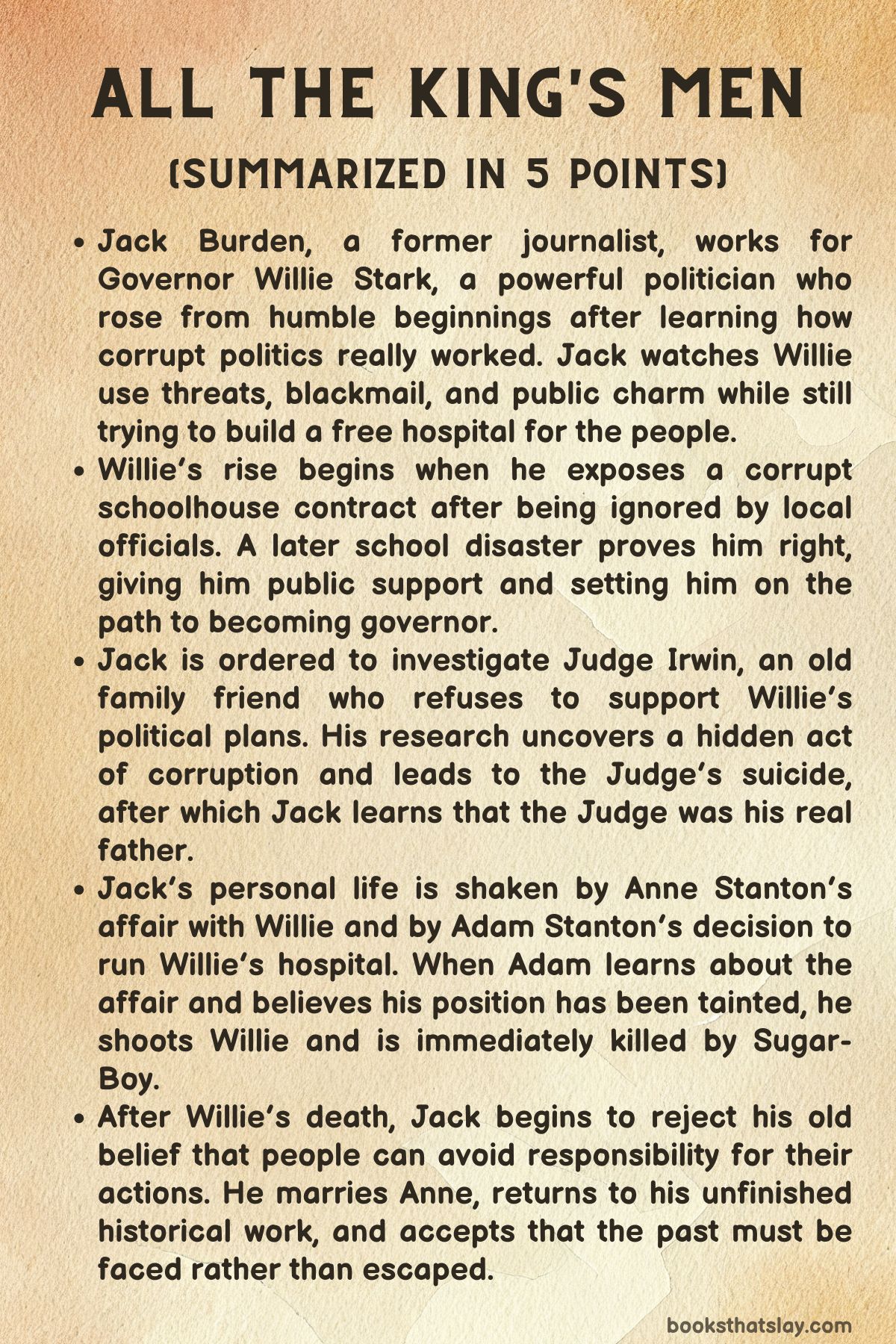
The book is narrated by Jack Burden, a former newspaperman who works for Governor Willie Stark, a commanding and often ruthless political figure known as “the Boss.” Jack begins by recalling a trip to Mason City, Willie’s hometown, with Willie, his wife Lucy, their son Tom, Tiny Duffy, Sugar-Boy, and Sadie Burke. Willie is adored by ordinary people, and even when he claims he is not campaigning, he cannot resist speaking to a crowd.
The trip is partly staged to preserve his image as a humble country man, though Jack understands how carefully that image is managed.
The visit changes direction when Sadie tells Willie that Judge Irwin, an old family friend of Jack’s from Burden’s Landing, has endorsed a political opponent instead of Willie’s preferred candidate. Willie is furious and takes Jack and Sugar-Boy on a late-night drive to confront the Judge.
Judge Irwin refuses to be intimidated and says he acted according to conscience. Willie responds by ordering Jack to investigate the Judge’s past, believing that every man has something hidden.
Jack then looks back to his first meeting with Willie years earlier. At that time, Willie was county treasurer in Mason County, a sincere, awkward, poorly connected local official trying to stop a corrupt schoolhouse contract.
The local officials supported a more expensive contractor because they expected benefits from the deal and used racist fear to turn people against the cheaper bid. Willie warned the town, but he lost his position, and the corrupt contract went through.
Later, the schoolhouse fire escapes collapsed during a drill, killing three children. Willie’s warnings were remembered, and his reputation changed overnight.
This tragedy helped launch Willie’s political career. He first ran for governor without realizing he was being used by one faction to split another candidate’s rural vote.
His speeches were dull and overloaded with facts until he discovered the truth at a campaign event. Drunk and humiliated, he gave a raw speech exposing the scheme and denouncing the men who had used him.
That moment transformed him. He learned how to speak to people’s anger and hope.
He withdrew, later returned on his own terms, and eventually became governor. By then, he understood power better and used it without much hesitation.
Jack, meanwhile, has a pattern of withdrawing from life when faced with failure or emotional difficulty. He calls these retreats the Great Sleep.
He left his doctoral work unfinished, abandoned his marriage to Lois, and drifted until Willie hired him. His job is never clearly defined, but he becomes Willie’s researcher, fixer, and political instrument.
He digs up information, watches people, and helps Willie bend others to his will.
Willie’s administration is marked by both ambition and corruption. When State Auditor Byram B. White is caught misusing funds, Willie protects him from impeachment, not because White is innocent, but because an impeachment would threaten the whole administration.
Willie blackmails legislators to keep them in line. At the same time, he dreams of building a free, modern hospital for the people of the state.
This contradiction defines him: he does ugly things but believes he can use power to create something good.
Jack’s search into Judge Irwin’s past sends him into the kind of historical investigation he once failed to complete as a student. He remembers his unfinished study of Cass Mastern, an ancestor whose affair with Annabelle Trice led to her husband’s suicide and the sale of an enslaved woman named Phebe.
Cass became consumed by guilt and spent the rest of his life trying to atone. Jack had abandoned the project because he could not accept Cass’s belief that one action connects to many lives.
Now, however, Jack’s own life begins to force that lesson on him.
To uncover Judge Irwin’s secret, Jack asks questions around Burden’s Landing and researches old financial records. He learns that the Judge had once been in debt and that his marriage did not solve his money problems.
Jack eventually uncovers a scandal involving the American Electric Power Company. Judge Irwin, while attorney general under Governor Stanton, had acted favorably toward a company and later received stock and a lucrative position.
Mortimer Littlepaugh, the man displaced by the deal, tried to expose the corruption but was ignored and later died by suicide. Jack obtains proof from Littlepaugh’s sister.
During this time, Willie pushes forward with plans for the hospital and wants Adam Stanton, a brilliant surgeon and Jack’s childhood friend, to direct it. Adam despises Willie and sees him as corrupt, but Jack and Anne Stanton, Adam’s sister and Jack’s former love, persuade him to accept.
Jack reveals the truth about Judge Irwin and Governor Stanton’s old corruption to Anne, who shows the evidence to Adam. The revelation damages Adam’s idealized view of his father, but it also makes him more willing to work with Willie, since he can no longer divide the world neatly into pure and corrupt men.
Jack then discovers that Anne is having an affair with Willie. The discovery shakes him deeply because Anne has always represented a lost possibility in his life.
He flees west and reviews their past: their childhood, their young love, their near intimacy, his drifting career, his failed marriage, and the way he and Anne slowly lost each other. In California, Jack tries to protect himself by deciding that human actions do not matter, a belief he calls the Great Twitch.
He imagines people as driven by impulse rather than responsibility.
Events soon destroy that belief. Tom Stark, Willie’s reckless son and a football star, becomes involved in scandals, including a possible pregnancy.
Willie’s enemies try to use the situation against him. Willie sends Jack to pressure Judge Irwin with the evidence he has found.
Jack confronts the Judge, who admits the corruption but refuses to help Willie. Soon afterward, Judge Irwin shoots himself.
Jack’s mother then reveals that Judge Irwin was Jack’s real father. Jack realizes that his investigation has helped cause the death of the man who was both his father and his childhood model of strength.
He also inherits the Judge’s estate, which means he benefits from the corruption he exposed.
Willie’s world begins to collapse. To silence political enemies, he considers giving the hospital contract to Gummy Larson, a corrupt contractor, but Tom’s football injury changes him.
Tom is badly hurt during a game and becomes permanently paralyzed. Willie, shaken by the tragedy, breaks with Larson and seems to turn back toward Lucy, ending his affair with Anne.
This sets off another chain of consequences. Sadie, jealous and angry, tells Tiny Duffy about Anne and Willie.
Tiny calls Adam and tells him that his hospital appointment came through Anne’s affair and that he may lose it because of Tom’s failed surgery.
Adam, enraged and humiliated, goes to the Capitol and shoots Willie. Sugar-Boy immediately shoots Adam.
Willie survives the first surgery but later dies of infection. Before dying, he tells Jack that things might have been different.
Jack attends both Adam’s funeral and Willie’s funeral, surrounded by public grief and private guilt.
After Willie’s death, Tiny Duffy becomes governor and offers Jack a better version of his old job. Jack refuses and accuses Tiny of helping cause Willie’s death.
Sadie admits that she told Tiny to call Adam, though she acted out of pain and jealousy. Jack first wants revenge, but he gradually understands that blame cannot be placed on one person alone.
Sadie, Tiny, Adam, Anne, Willie, and Jack himself are all part of what happened.
In the end, Jack moves away from cynicism. He visits Lucy, who has lost both Willie and Tom but adopts the baby believed to be Tom’s son and names him Willie.
Jack sees in her endurance a kind of moral strength. His mother leaves Burden’s Landing, freeing him from old family lies.
Jack marries Anne, brings the man he once believed was his father to live with them, and returns to his study of Cass Mastern. He no longer believes life is meaningless or disconnected.
All the King’s Men closes with Jack preparing to leave the past behind, not by denying it, but by accepting responsibility for it.
Characters
Jack Burden
Jack Burden is the narrator and moral center of All the King’s Men, though for much of the novel he resists that role. He begins as a detached observer, a man who watches politics, corruption, love, and suffering with a cold intelligence that protects him from feeling responsible.
His work for Willie Stark suits this side of him because it allows him to turn human lives into records, secrets, files, and usable facts. Yet Jack’s detachment is not true strength; it is a defense against disappointment, guilt, and emotional failure.
His repeated retreats into what he calls the Great Sleep show his habit of escaping whenever life demands commitment. He leaves his doctoral research unfinished, walks away from his marriage, and avoids facing his feelings for Anne Stanton.
Jack’s major transformation comes when he realizes that the past is not dead and that actions have consequences beyond the person who performs them. His investigation of Judge Irwin forces him to confront the hidden truth of his own birth and the damage caused by his own political obedience.
By the end, Jack rejects the idea that life is only impulse or accident. He accepts moral connection, personal responsibility, and the need to live with the burden of knowledge.
Willie Stark
Willie Stark is one of the novel’s most complex figures because he is both a corrupt politician and a man with genuine concern for ordinary people. He begins as an honest, awkward local official who tries to prevent a corrupt schoolhouse contract.
His early failure teaches him that truth and good intentions are not enough in politics. When he discovers he has been used as a pawn in a governor’s race, humiliation becomes the turning point in his life.
He learns how to speak to the anger of poor and neglected people, and he rises by turning himself into a forceful populist leader. As governor, Willie uses blackmail, intimidation, patronage, and public performance to control others.
Yet his plan to build a free, modern hospital shows that his ambition is not merely selfish. He wants to do something lasting and useful, even if he believes that good can be created through dirty methods.
His tragedy lies in this contradiction. He thinks power can cleanse itself if the final result is good enough, but the corruption around him eventually reaches his family, his love life, his allies, and his enemies.
His final words suggest that he recognizes, too late, that another path might have been possible.
Anne Stanton
Anne Stanton represents Jack’s lost innocence, but she is not simply a symbol of purity. She is intelligent, emotionally serious, and dissatisfied with the narrow life available to her.
Jack remembers her as part of his idealized youth, yet the adult Anne is more complicated than his memory allows. She works with charities, cares deeply about social good, and tries to help the Children’s Home, but she also feels that her life has lacked direction and purpose.
Her relationship with Willie Stark shocks Jack because he has preserved her in his mind as untouched by the compromises of the adult world. Anne’s affair with Willie shows her hunger for vitality, power, and meaning.
She sees in Willie not only corruption but also energy and commitment. Her decision to help persuade Adam to lead the hospital reveals her belief that something good may still come from Willie’s administration.
When Adam learns of her affair, Anne becomes one of the emotional casualties of the political world around Willie. By the end, her marriage to Jack suggests not a return to their youthful dream, but a more mature bond built after suffering, disillusionment, and truth.
Adam Stanton
Adam Stanton is a gifted surgeon whose moral standards are severe and uncompromising. He believes in professional honor, personal integrity, and the possibility of clean action.
Unlike Jack, who hides behind cynicism, Adam clings to moral certainty. He despises Willie Stark because he sees him as corrupt, vulgar, and dangerous.
This makes his acceptance of the hospital directorship especially important. Adam accepts the role only after his ideal image of his father is broken, and after he is forced to admit that even respected men may have hidden guilt.
His tragedy comes from the collision between his moral absolutism and the messy reality around him. He wants to heal people and serve the public, but he cannot bear the idea that his appointment may be connected to Anne’s affair with Willie.
When Tiny Duffy tells him this, Adam feels that his honor, his sister’s dignity, and his professional purpose have all been stained. His shooting of Willie is not only political revenge; it is an act born from humiliation, betrayal, and a collapsed moral order.
Adam’s death shows the danger of purity when it cannot survive contact with human weakness.
Judge Irwin
Judge Irwin is central to Jack’s understanding of authority, fatherhood, and guilt. To Jack, he has long been a figure of strength, discipline, and old-world honor.
He represents the respectable past of Burden’s Landing, a world that appears more refined and principled than Willie Stark’s rough political machine. Yet Jack’s investigation reveals that Judge Irwin’s public dignity rests on concealed corruption.
As a younger man, he accepted benefits connected to a corporate legal decision, and his actions helped destroy Mortimer Littlepaugh. The Judge’s refusal to help Willie is not simple moral courage, because his own past is compromised.
Still, he is not portrayed as entirely hollow. He has pride, nerve, and a strong sense of personal identity.
When Jack confronts him with proof, he admits the truth but refuses to be controlled. His suicide is both an escape from exposure and a final assertion of control.
The revelation that he is Jack’s biological father gives his death devastating personal meaning. Jack’s search for political leverage becomes an act that destroys his own father, forcing him to understand that knowledge used without moral care can become violence.
Sadie Burke
Sadie Burke is sharp, wounded, intelligent, and deeply aware of political reality. She understands Willie Stark earlier and more clearly than many others because she has watched him change from a naive candidate into a powerful governor.
Sadie is not fooled by political language, romantic illusions, or moral posturing. She knows how power works, and she helps Willie survive within that world.
Her relationship with Willie, however, exposes her emotional vulnerability. She loves him, resents him, depends on him, and hates the humiliation caused by his affairs.
Her anger at Anne is not only jealousy; it is also class resentment and a reaction against being discarded for a woman associated with refinement and social prestige. Sadie’s role in Willie’s death is indirect but serious.
In a moment of rage, she gives Tiny Duffy the information that allows him to push Adam toward violence. Yet Sadie is not cold in the way Tiny is.
Her guilt afterward shows that she understands the horror of what has happened. She is one of the clearest examples of how private pain can become politically destructive when it is attached to powerful people.
Lucy Stark
Lucy Stark is Willie’s wife and moral contrast, but she is more than a simple figure of goodness. She begins as the loyal wife of an ambitious man, but as Willie becomes more corrupt and unfaithful, she increasingly separates herself from him.
Lucy values decency, family, restraint, and moral conduct. She cannot accept Willie’s belief that corruption may be justified by public benefit.
Her distance from Willie is therefore not only personal but ethical. At the same time, Lucy is not politically naive.
She understands enough about Willie’s world to reject it, yet she also recognizes the emotional bond that remains between them. Her suffering intensifies through Tom’s recklessness, his paralysis, Willie’s death, and Tom’s eventual death.
Still, Lucy’s final decision to adopt the child believed to be Tom’s son gives her a renewed purpose. Naming the child Willie suggests that she has chosen to remember the possibility of greatness in her husband rather than only the damage he caused.
Her endurance gives the novel one of its quietest forms of strength.
Tom Stark
Tom Stark is Willie and Lucy’s son, and he reflects the damage caused by power without discipline. He is handsome, athletic, admired, and privileged because of his father’s position.
As a football star, he becomes a public extension of Willie’s pride and ambition. Willie treats Tom’s success almost as proof of his own force, and this pressure helps make Tom arrogant and reckless.
Tom’s behavior with women, his car accident, and his involvement in public scandal show that he has absorbed entitlement without responsibility. Yet Tom is also a victim of the world that celebrates him.
He is valued for performance, masculinity, and public glory, not for maturity. His football injury permanently changes the direction of the plot because it forces Willie to confront the human cost of ambition.
Tom’s paralysis breaks Willie’s confidence and leads him to reject the corrupt hospital contract. Tom’s later death from pneumonia completes Lucy’s suffering and leaves behind the child she adopts.
Through Tom, the novel shows how political power can distort family life and turn a son into a symbol before he has become a responsible person.
Tiny Duffy
Tiny Duffy is opportunism in human form. He lacks Willie Stark’s charisma, vision, and emotional force, but he has a strong instinct for survival.
Early in Willie’s career, Tiny helps manipulate him as a false candidate, and later Willie keeps him close as lieutenant governor partly to remind him of his place. Tiny serves power when it benefits him and waits for chances to profit from weakness.
His pressure to secure the hospital contract for Gummy Larson shows his greed and his willingness to corrupt even Willie’s most idealistic project. Unlike Willie, Tiny does not appear to believe in any larger public good.
His role in Adam’s attack on Willie reveals his coldest quality: he uses Sadie’s jealousy and Adam’s wounded honor as tools while keeping his own hands clean. After Willie’s death, Tiny becomes governor, which shows how political systems often reward patience, calculation, and moral emptiness.
Jack’s refusal to work for him is important because it marks Jack’s rejection of the kind of politics that treats every person as usable material.
Sugar-Boy
Sugar-Boy is Willie Stark’s driver and bodyguard, known for his loyalty, speed, and violent readiness. He speaks with a stutter, but his actions are direct and decisive.
Sugar-Boy’s devotion to Willie is almost absolute. He does not analyze Willie’s politics or question his moral compromises; he loves and serves the man himself.
This loyalty makes him both touching and dangerous. When Adam shoots Willie, Sugar-Boy immediately kills Adam, acting from instinct and devotion rather than judgment.
Later, when Jack considers telling him that Tiny Duffy helped cause Willie’s death, Sugar-Boy’s response makes clear that he would kill Tiny without concern for his own fate. Jack’s decision not to tell him shows Jack’s growing awareness of responsibility.
Sugar-Boy represents a form of loyalty untouched by complexity, but the novel does not present that loyalty as harmless. In a corrupt political world, devotion can become another instrument of violence.
Jack’s Mother
Jack’s mother is beautiful, socially skilled, emotionally guarded, and more loving than Jack initially allows himself to believe. He often views her through resentment, partly because of her marriages to younger men and partly because of the mystery surrounding his father.
To Jack, she seems vain and shallow, but this judgment is incomplete. Her history with Judge Irwin reveals a woman who has lived under the pressure of secrecy for years.
Her emotional collapse after the Judge’s suicide shows how deeply she loved him and how much the hidden past has cost her. She protected Jack from the truth, but that protection also trapped him in confusion.
Her later decision to leave Burden’s Landing and give up the house is a meaningful act. It allows Jack to step away from inherited lies and begin to see her not as a symbol of betrayal, but as a flawed person who suffered and loved.
Through her, Jack learns that his childhood judgments were too simple.
Ellis Burden
Ellis Burden, the man Jack believed to be his father, is a figure of renunciation, weakness, and spiritual retreat. He leaves Jack and Jack’s mother after learning the truth about her relationship with Judge Irwin, but instead of confronting life directly, he withdraws into religion and charity.
Jack often sees him as ineffectual, especially when compared with the strong presence of Judge Irwin. Yet Ellis also represents a kind of goodness that Jack has difficulty respecting.
He cares for the broken, the poor, and the strange, including the man who makes angel figures out of bread. His refusal to discuss Judge Irwin’s past is partly moral disgust and partly a desire to leave sin behind.
When Jack later brings the dying Ellis to live with him and Anne, it signals a change in Jack. He is no longer interested only in strength, success, or worldly power.
He becomes able to accept weakness, dependency, and imperfect goodness as part of human life.
Cass Mastern
Cass Mastern is Jack’s ancestor and one of the novel’s most important moral mirrors. His story teaches the lesson Jack spends most of the novel resisting: no action belongs only to the person who performs it.
Cass’s affair with Annabelle Trice leads to Duncan Trice’s suicide and to the sale of Phebe, an enslaved woman separated from her family because she knows the truth. Cass is horrified when he realizes that his private desire has harmed people beyond himself.
Unlike Jack, who initially hides from responsibility, Cass accepts guilt and tries to reshape his life around repentance. He frees enslaved people, searches for Phebe, turns toward religion, and enters war with a commitment not to kill.
Jack abandons his study of Cass because he cannot understand this moral vision. Only after his own actions lead to Judge Irwin’s death does Jack begin to understand Cass’s belief in connection and consequence.
Cass becomes a guide to the moral meaning of All the King’s Men, even though he belongs to an earlier historical world.
Gilbert Mastern
Gilbert Mastern, Cass’s older brother, represents wealth, social position, and the practical values of the plantation world. He raises Cass into privilege after their poor childhood and prepares him for a life of status, property, and politics.
Gilbert is not presented with the same inner conflict as Cass. He belongs comfortably to a society built on slavery, hierarchy, and masculine honor.
His disapproval of Cass’s moral decisions reflects his inability or unwillingness to question the system that benefits him. Gilbert’s role is important because he shows the social world Cass turns against.
While Cass becomes consumed by guilt and moral responsibility, Gilbert remains connected to order, family pride, and public standing. The contrast between the brothers helps clarify why Cass’s transformation matters.
Cass does not merely regret a private affair; he begins to reject the assumptions of the world that formed him.
Mortimer Littlepaugh
Mortimer Littlepaugh is a dead man whose story exposes the hidden cost of Judge Irwin’s corruption. He loses his position because Judge Irwin benefits from a corporate arrangement, and when he tries to reveal the truth, Governor Stanton refuses to help him.
Mortimer’s suicide shows how corruption destroys people who are not powerful enough to defend themselves. He is not present as an active character in the main action, but his letter and his sister’s testimony make him morally significant.
Through Mortimer, Jack discovers that political crimes are not abstract. A decision made for money and status can ruin a life, silence the truth, and leave grief behind for years.
Mortimer’s story also connects Judge Irwin and Governor Stanton, damaging the ideal image that Jack, Anne, and Adam have held of the past.
Mortimer Littlepaugh’s Sister
Mortimer Littlepaugh’s sister is a minor character, but she plays a crucial role in revealing the truth. She has lived for years with knowledge of her brother’s suicide and the corruption that led to it.
Her decision to lie to the insurance company so she could receive the policy money adds moral complexity to her position. She is both a victim of powerful men and someone who has committed a dishonest act in order to survive.
When Jack pays her for information and documents, their exchange shows how truth itself becomes part of a financial transaction. She helps expose Judge Irwin, but she also reminds Jack that every investigation touches damaged lives.
Her later death prevents Jack from making restitution, reinforcing the idea that some wrongs cannot be neatly repaired.
Tiny Duffy’s Contractor Ally, Gummy Larson
Gummy Larson represents the business side of political corruption. He is not as psychologically developed as Willie, Jack, or Sadie, but his presence is important because he turns public works into private profit.
The hospital is Willie’s dream of public service, but Gummy’s pursuit of the contract threatens to stain it before it can exist. He stands for the contractors, dealmakers, and political financiers who gather around power to extract money from public projects.
Willie’s initial refusal to give him the contract shows that Willie still wants the hospital to be clean. Willie’s later willingness to consider the deal under political pressure shows how vulnerable even his best ambition is to compromise.
Gummy does not need emotional depth to be dangerous; his function is to show how systems of corruption operate through routine deals.
Byram B. White
Byram B. White, the state auditor, is an example of small-scale corruption inside Willie Stark’s administration. His misuse of public funds creates a political crisis, but Willie protects him because exposing him would threaten the whole machine.
White is weak, frightened, and replaceable. Willie sees him less as an individual moral offender than as a part of the larger structure that must be managed.
This is what makes White important. His case reveals how Willie’s politics work: guilt is not punished according to justice, but controlled according to usefulness.
White also helps expose the difference between law and power in the novel. The attorney general wants legal accountability, while Willie wants political survival.
Through White, the novel shows how corruption spreads when leaders treat wrongdoing as a strategic inconvenience rather than a moral failure.
Mr. Miller
Mr. Miller, the attorney general, serves as a contrast to Willie Stark’s flexible view of law. He believes that Byram B. White’s crimes must be handled through legal accountability, not political management.
When Willie refuses, Miller resigns. His decision gives him moral dignity, but it also shows the limits of principle in Willie’s world.
Miller cannot stop Willie, cannot save the administration from corruption, and cannot force justice to operate where power has already taken control. Still, his presence matters because he proves that not everyone in politics accepts Willie’s logic.
He represents the kind of public servant who believes that law must mean something beyond convenience. His resignation is one of the novel’s clearest moments of ethical refusal.
MacMurfee
MacMurfee is one of Willie Stark’s major political rivals and a representative of the older political order that Willie challenges and then partly resembles. He is not portrayed as morally superior to Willie.
His camp uses manipulation, pressure, and scandal when useful, especially in the attempt to exploit Tom Stark’s situation. MacMurfee’s importance lies in the way he reflects the competitive brutality of politics.
Willie may be unusually charismatic and forceful, but he is not operating in a clean world that he alone corrupts. MacMurfee’s methods show that the system already rewards blackmail, leverage, factional loyalty, and personal weakness.
His rivalry with Willie pushes Willie toward further compromise, including the possible deal with Gummy Larson. Through MacMurfee, political conflict becomes less a battle between good and evil than a contest among different forms of ambition.
Joe Harrison
Joe Harrison is the political figure whose supporters first use Willie Stark as a tool. His campaign encourages Willie to run for governor in order to split the rural vote and weaken MacMurfee.
Harrison’s role is important because he helps create the conditions for Willie’s transformation. By treating Willie as a useful fool, Harrison’s camp accidentally awakens Willie’s political genius.
Willie’s drunken speech at the barbecue, where he exposes the scheme, is born from this humiliation. Harrison therefore represents the polished political class that underestimates the anger and intelligence of the rural outsider.
His manipulation fails in the long term because Willie learns from it. Willie becomes powerful partly because men like Harrison teach him how politics really works.
Lois
Lois, Jack’s former wife, appears mainly in Jack’s memory, but she reveals much about his emotional limitations. Jack first describes their marriage in terms of physical compatibility and surface ease.
For a time, he is satisfied because he does not have to face the deeper reality of another person’s inner life. The marriage fails when Jack begins to see Lois as an actual person with habits, desires, flaws, and demands.
Instead of growing into adult intimacy, he becomes irritated and leaves. Lois is important because she shows that Jack’s problem is not only political cynicism; it is also emotional avoidance.
He wants love without vulnerability and companionship without responsibility. His failed marriage prepares the reader to understand why he also failed Anne when they were younger.
Phebe
Phebe, the enslaved maid in Cass Mastern’s story, is one of the most morally important figures in the historical section. She is not given much direct speech or personal development, which reflects the brutal social world that denies her agency.
Yet her fate is the event that awakens Cass’s conscience. Because she discovers the truth about Annabelle and Duncan, Annabelle sells her away from her family to protect herself.
Phebe’s suffering reveals the real cost of private sin within a society built on human ownership. Cass’s guilt becomes serious not simply because Duncan dies, but because Phebe is treated as disposable.
Her story forces attention onto the people most harmed by the choices of the powerful and privileged.
Annabelle Trice
Annabelle Trice is central to Cass Mastern’s moral collapse and awakening. Her affair with Cass leads to Duncan Trice’s suicide, but her most revealing action is selling Phebe.
Annabelle’s fear of exposure matters more to her than Phebe’s humanity. She wants to preserve her secret and her social position, and she treats an enslaved woman’s life as something she can move out of sight.
Annabelle is not merely a romantic temptation in Cass’s story; she represents selfishness protected by social power. Her inability to accept responsibility contrasts sharply with Cass’s later guilt.
Where Cass is transformed by the consequences of their actions, Annabelle tries to erase those consequences by sacrificing someone weaker.
Duncan Trice
Duncan Trice is the betrayed husband in Cass Mastern’s story, and his suicide gives Cass his first direct experience of moral consequence. Duncan is important less for his developed personality than for the effect of his death.
His knowledge of the affair silently exposes the emotional violence behind Cass and Annabelle’s desire. His wedding ring, found under Annabelle’s pillow, becomes a symbol of guilt, betrayal, and the bond Cass has violated.
Duncan’s death begins the chain that leads to Phebe’s sale and Cass’s life of atonement. Through Duncan, the novel shows that hidden actions still leave marks, even when people try to keep them private.
Themes
Power and Moral Compromise
Power in All the King’s Men is never presented as clean, simple, or harmless. Willie Stark begins with a genuine desire to protect ordinary people from corrupt local officials, yet his first political defeat teaches him that honesty alone may not survive in public life.
Once he rises, he adopts the methods of the world that once defeated him: blackmail, threats, deals, public manipulation, and personal loyalty enforced through fear. The unsettling part of Willie’s character is that he does not become corrupt because he has no public purpose.
He becomes corrupt while still wanting to build roads, hospitals, and institutions that help the poor. This creates the novel’s central moral pressure: can good results justify dirty methods?
Willie believes they can, or at least acts as though they can. His hospital project is the clearest test of this belief.
It is meant to be free, modern, and humane, yet it is constantly threatened by the same corrupt political machinery that makes it possible. The novel suggests that compromise may begin as strategy, but it rarely remains under control.
Once people are treated as tools, even noble goals become vulnerable to betrayal, violence, and moral decay.
The Burden of Responsibility
Responsibility in the novel is not limited to direct action. Characters often try to believe that they are responsible only for what they intended, but the story repeatedly proves otherwise.
Jack Burden’s development depends on his slow recognition that every act enters a larger chain of consequence. At first, he hides behind cynicism.
He researches people, exposes secrets, and serves Willie while pretending that facts are neutral and that he is merely doing a job. His unfinished study of Cass Mastern shows that he once rejected the idea that one person’s sin could spread outward and harm others.
Cass understands that his affair with Annabelle leads not only to Duncan’s death but also to Phebe’s sale, and that this makes him responsible beyond his original desire. Jack only understands this later, when his investigation of Judge Irwin leads to the Judge’s suicide and reveals the truth of Jack’s parentage.
The lesson is harsh because Jack cannot undo what he has done. The novel’s moral vision depends on this painful awakening.
Responsibility means accepting that one’s choices affect others, even when the results are unintended, delayed, or hidden.
The Past as a Living Force
The past in the novel is not a closed period behind the characters; it continues to shape identity, politics, family, and guilt. Jack wants to believe that the past can be studied from a distance, filed away, or ignored.
His work as a researcher depends on uncovering old facts, yet he does not initially understand that those facts still carry emotional and moral power. Judge Irwin’s old corruption is not dead simply because it happened years earlier.
It remains capable of destroying his reputation, exposing Governor Stanton’s weakness, breaking Adam and Anne’s faith in their father, and changing Jack’s understanding of himself. Similarly, Jack’s memories of Anne, his mother, Ellis Burden, and Burden’s Landing shape his emotional life long after he leaves home.
The Cass Mastern material deepens this theme by showing that history is not merely background; it is a record of choices whose consequences continue through time. The novel rejects the fantasy that anyone can live free of what came before.
To mature, Jack must stop fleeing the past and learn how to carry it honestly.
Idealism, Cynicism, and the Search for Truth
The novel places idealism and cynicism in constant conflict, but it does not fully endorse either one. Adam Stanton’s idealism gives him moral seriousness, professional honor, and a desire to serve others.
Yet his purity is fragile because it cannot bear contradiction. When he learns that his father was compromised and that his hospital role may be connected to Anne’s affair, his sense of reality collapses.
Jack’s cynicism seems stronger because it expects corruption everywhere. He believes he cannot be shocked if he assumes the worst about people.
Yet cynicism becomes its own form of blindness. It allows him to serve Willie, hurt others, and avoid responsibility while pretending that nothing matters.
Willie Stark stands between these extremes. He has a dream of public good but uses corrupt methods to pursue it.
The novel’s search for truth requires moving beyond both innocence and detachment. Truth is not the belief that people are pure, and it is not the belief that all action is meaningless.
By the end, Jack begins to accept a harder truth: people are flawed, actions matter, and moral life begins when one stops hiding behind either illusion or despair.