All We Have Left Summary, Characters and Themes
All We Have Left by Wendy Mills is a young adult novel about grief, fear, blame, and the difficult work of seeing people beyond inherited hatred. The story moves between two teenage girls: Alia, a Muslim girl trapped inside the World Trade Center on September 11, 2001, and Jesse, a girl in 2016 whose family was broken by her brother’s death that day.
Through their connected stories, the novel examines how trauma can damage families and communities, but also how truth, courage, and empathy can help people begin again.
Summary
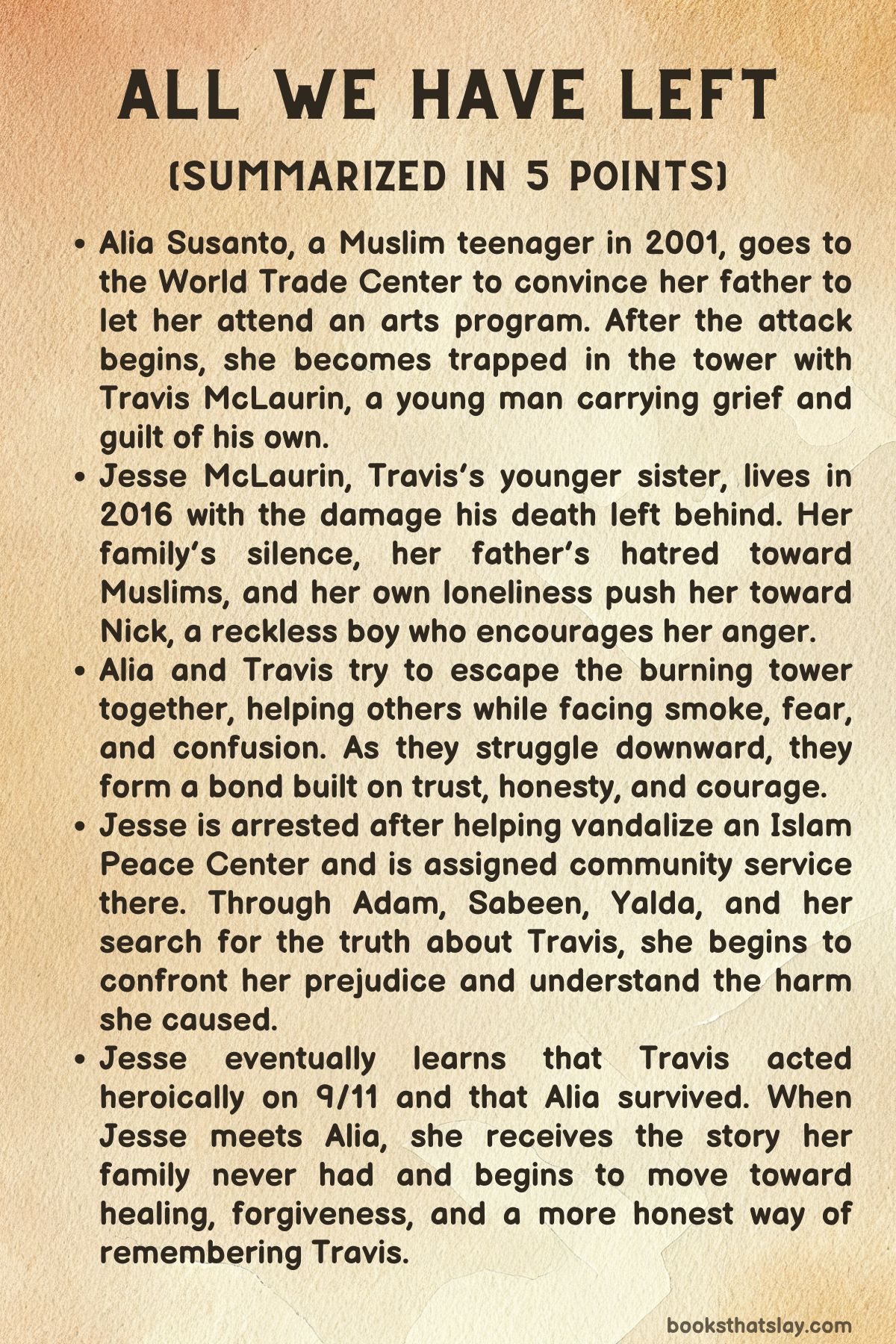
All We Have Left follows two timelines that gradually reveal how the lives of Alia Susanto and Jesse McLaurin are connected through the events of September 11, 2001.
In 2001, Alia is a Muslim teenager living in Brooklyn after her family has moved from California for her mother’s work as an immigration attorney. Alia misses her grandmother and her old life, and she feels misunderstood by her parents.
She dreams of becoming a comic book artist and has created a Muslim superhero named Lia, but her parents want a more traditional future for her. After she is caught holding a marijuana joint that actually belonged to her former friend Carla, her parents punish her by forbidding her from attending a creative film program at New York University.
Angry and desperate, Alia decides to visit her father, Ayah, at his office in the North Tower of the World Trade Center to convince him to change his mind.
That morning, Alia has also chosen to wear the hijab for the first time. For her, the scarf represents faith, discipline, and the hope that she can become a better version of herself.
Her mother misreads the decision as rebellion, and they argue badly before Alia leaves. This makes Alia’s later journey even more painful, because she carries the fear that she may never have the chance to undo the hurtful things she said.
At the World Trade Center, Alia fails to find her father. He has left his office briefly, and she enters an elevator to leave.
There she meets Travis McLaurin, a troubled young man who is also in the building for personal reasons. Alia first thinks he may be trying to steal something, but she soon learns that he is grieving his grandfather, who helped build and maintain the Towers.
Travis has come to the World Trade Center with his grandfather’s ashes, hoping to honor him in the place he loved most.
When the attack happens, the elevator drops and traps Alia and Travis together. They are terrified, confused, and surrounded by smoke, sparks, and darkness.
At first they do not know the scale of what has happened. They wonder whether there has been a bomb, and Travis repeats assumptions he has heard about Muslims because of the earlier World Trade Center bombing.
Alia challenges him, explaining that violent people do not define an entire faith. As they wait and then begin their escape, they move from suspicion to trust.
Their escape becomes a test of endurance and moral courage. They force their way out of the elevator, find a route through offices and stairwells, and join many others trying to get down.
Along the way they help Julia, a young woman with a heart condition who cannot continue alone. Travis and Alia distribute water, support frightened strangers, and witness the bravery of ordinary people and firefighters.
Travis, who has been carrying guilt because he ran for help when his grandfather was attacked and later died, begins to see that courage is not about never being afraid. It is about returning, helping, and doing what is right even when fear is overwhelming.
Alia also struggles with guilt and fear. When she learns that her father may have returned to his office after she left, she tries to go back up the stairs to find him.
Travis follows her, not because it is safe, but because he does not want to live with another regret. Firefighters stop Alia and promise to search for her father, forcing her and Travis to continue downward.
As conditions worsen, they see the other tower collapse, feel the building shake, and understand that their own tower may not stand much longer. Travis protects Alia from smoke and falling debris, and Alia eventually removes her hijab to wrap it around his face so he can breathe.
That act becomes one of the most important symbols in the book: an expression of trust, sacrifice, and shared humanity.
Before the North Tower falls, Travis manages to call home using Julia’s phone. He reaches the family answering machine and leaves a final message saying he loves his mother, his brother Hank, baby Jesse, and even his father, who believes he is a coward.
Alia speaks in the background, trying to send a message to her own family. When the tower collapses, Travis shields Alia with his body.
Alia is torn from him and later wakes on the smoking rubble, injured and confused. She survives, but Travis does not.
In the 2016 timeline, Jesse is Travis’s much younger sister. She was only a baby when he died, but his death has shaped her entire life.
Her father is bitter, angry, and openly hateful toward Muslims. Her mother is emotionally exhausted and tries to cope by staying busy outside the home.
No one talks honestly about Travis, so Jesse grows up surrounded by silence, grief, and resentment. Feeling invisible and unwanted, she becomes drawn to Nick, a reckless boy who shares her anger and sense of emptiness.
Nick introduces Jesse to graffiti. Their tag is “NOTHING,” a word that reflects Jesse’s belief that her life and family have lost meaning.
With Nick, his brother Dave, and Hailey, Jesse takes part in increasingly destructive acts. Nick also encourages anti-Muslim hatred.
When the group targets a new Islam Peace Center, Jesse uses her climbing skills to spray-paint hateful messages on the building. She injures her ankle, is abandoned by Nick, and is arrested.
Instead of being sent to juvenile detention, Jesse is assigned community service at the Islam Peace Center. At first she is ashamed, defensive, and uncomfortable.
But the people there, especially Yalda, Sabeen, and Adam, force her to face what she has done. Adam is Sabeen’s brother and also Jesse’s climbing partner from an earlier trip, someone she had admired before realizing he is Muslim.
Through him and his family, Jesse begins to recognize the damage caused by prejudice. She also starts to see how her father’s anger has shaped her own choices.
Jesse becomes determined to learn the truth about Travis. She finds old news clippings, a hidden answering machine, and clues that her family has kept separate for years.
With help from her friends, especially Emi, she restores Travis’s final voicemail and hears Alia’s name in the background. She learns that Travis was not in the Towers by accident or cowardice.
He had gone there to honor his grandfather. She also learns from Julia, the woman Travis and Alia helped, that Travis acted bravely during the escape.
As Jesse uncovers the truth, her relationships begin to change. She apologizes to the friends she pushed away.
She breaks free from Nick’s influence. She grows closer to Adam, though their relationship is complicated by faith, family expectations, and the pain caused by Jesse’s earlier actions.
Jesse also confronts her father, demanding that he stop defining her and the world through hatred. Their relationship is damaged, but the truth about Travis opens a possible path toward healing.
Jesse eventually discovers that Alia survived. Alia is now a graphic artist, a wife, and a mother, and she has created a comic about 9/11 that honors Travis.
When Jesse meets her, Alia tells her the full story of Travis’s courage and returns meaning to a life Jesse had only known through grief. Jesse gives Alia back the flowered scarf Travis had carried after the attack.
Together, they visit the World Trade Center memorial, where Alia shows Jesse how to touch Travis’s name.
The novel ends with mourning, but also with hope. Jesse cannot undo the past, and Alia cannot explain why she survived when Travis did not.
Yet both characters find a way to carry memory without letting it become hatred. All We Have Left shows that grief can destroy when it is buried or turned against others, but truth and compassion can help people live with loss.
Characters
Alia Susanto
Alia Susanto is one of the emotional centers of All We Have Left, and her character is built around the conflict between who she is, who her parents want her to be, and who she hopes to become. She is a Muslim teenager, an artist, a daughter, and a young person still learning how to make choices with courage and maturity.
At the beginning, Alia is frustrated by her parents’ strictness, especially after being punished for an incident she sees as unfair. Her dream of attending a creative program matters deeply to her because it represents freedom, identity, and the possibility of becoming a comic book artist.
Her fictional superhero, Lia, reflects the stronger self Alia wishes she could be: bold, principled, and unafraid. Yet Alia is not weak; her bravery grows under pressure.
Her decision to wear the hijab is important because it is personal rather than forced. It shows her desire to define her faith on her own terms.
Inside the World Trade Center, Alia changes from a frightened girl carrying regret into someone capable of compassion, endurance, and sacrifice. She helps Julia, challenges Travis’s assumptions about Islam, and ultimately gives Travis her scarf so he can breathe.
Her survival is marked by guilt, but also by purpose. As an adult, she turns memory into art, honoring Travis and preserving the truth of what happened.
Jesse McLaurin
Jesse McLaurin is shaped by a loss she was too young to understand but old enough to inherit. Travis’s death leaves a silence in her family, and that silence becomes the emotional climate of her childhood.
Jesse feels unwanted, invisible, and trapped between a grieving mother and an angry father. Her attraction to Nick comes from that emptiness.
He seems to understand her anger and her need to break rules, but he also encourages the worst parts of her pain. Jesse’s graffiti, especially the hateful message on the Islam Peace Center, is not just an act of rebellion; it is the result of grief without guidance and anger without truth.
Her character arc is one of painful awakening. Through community service, Adam, Sabeen, Yalda, and the search for Travis’s final hours, Jesse is forced to confront her prejudice and her own responsibility.
She does not become better instantly. She has to apologize, listen, investigate, and accept shame before she can grow.
Her courage is different from Alia’s physical survival in the tower, but it is still real: Jesse learns to face the past, challenge her father, reject Nick, and admit that hate has damaged her life. By the end, she becomes someone capable of empathy, accountability, and hope.
Travis McLaurin
Travis McLaurin is dead in Jesse’s timeline, but he becomes one of the most important living presences in the story through memory, testimony, and Alia’s account. At first, Travis is surrounded by mystery.
His father believes he was a coward, his family avoids speaking about him, and Jesse knows him mostly as a source of grief. The truth reveals a far more complicated and humane young man.
Travis is burdened by guilt over his grandfather’s death because he ran for help during an attack instead of staying. His father’s judgment wounds him deeply, and he carries that shame into his final day.
His presence in the World Trade Center is not random; he has gone there to honor his grandfather by bringing his ashes to the place the older man loved. In the tower, Travis proves that he is not defined by one moment of fear.
He protects Alia, helps strangers, returns when he could leave, and shields Alia during the collapse. His final voicemail shows his need to be forgiven and his enduring love for his family.
Travis’s character matters because he exposes the cruelty of fixed judgments. He was not a coward, but a scared, grieving young man who became brave when it mattered.
Adam Ayoub
Adam Ayoub serves as both a moral challenge and a source of healing for Jesse. He is calm, thoughtful, athletic, and quietly strong, but he is not written as an idealized figure without pain.
As a Muslim teenager in post-9/11 America, Adam has grown up with suspicion directed toward his family and community. His father’s experience after the attacks has shaped Adam’s awareness of injustice, and this makes Jesse’s actions especially painful to him.
When he realizes that Jesse was involved in the hateful graffiti and associated with Nick, he feels betrayed because he had seen something better in her. His disappointment is important because it forces Jesse to see the human cost of her actions.
Adam’s connection with climbing also gives him symbolic importance. On the mountain, he and Jesse are away from the noise of prejudice, family damage, and school politics.
Their relationship grows through conversation, patience, and honesty. Adam’s faith shapes his choices, especially around dating, and this adds complexity to his bond with Jesse.
He forgives, but he does not excuse. His role is not simply to rescue Jesse; he helps her become accountable while also allowing himself to trust her again.
Nick Roberts
Nick Roberts represents the dangerous appeal of anger when it is mistaken for freedom. Jesse is drawn to him because he appears fearless, rebellious, and uninterested in ordinary rules.
His “Nothing” tag gives language to Jesse’s emptiness, making her feel seen at a time when she believes her own family barely notices her. Yet Nick’s rebellion is shallow and destructive.
He does not help Jesse understand her pain; he gives her a way to act it out. His treatment of Sabeen, his pressure on Jesse, and his abandonment of her when she is injured reveal his cowardice and cruelty.
Nick likes control more than connection. He pulls Jesse away from her friends, claims her publicly, and uses contempt to keep her emotionally dependent.
His hatred is not principled; it is a pose that becomes harmful because it targets real people. When Jesse finally stands up to him, his power over her collapses.
Nick is important because he shows how grief, loneliness, and resentment can be exploited by someone who offers belonging without responsibility. He is not the cause of Jesse’s prejudice, but he gives it permission to become action.
Jesse’s Father
Jesse’s father is one of the clearest examples of grief turning into bitterness. Travis’s death destroys his ability to function as a husband, father, and business owner.
He drinks too much, neglects his climbing shop, and directs his rage toward Muslims as a group. His hatred is presented as emotionally rooted but morally wrong.
He cannot bear the uncertainty and pain surrounding Travis’s death, so he turns loss into blame. His belief that Travis was a coward also reveals his own inability to process fear, guilt, and helplessness.
Rather than mourn his son openly, he freezes him inside a harsh judgment and forbids the family from speaking honestly. This damages Jesse profoundly.
She grows up feeling that love can be withdrawn and that pain must be hidden or redirected. His cruel rejection of Jesse after learning about Adam shows how deeply prejudice has taken hold of him.
Still, the ending allows for the possibility of change. When Jesse confronts him, he expresses love and regret, suggesting that he is not beyond repair.
His character shows that grief does not excuse hatred, but truth can begin to loosen its hold.
Jesse’s Mother
Jesse’s mother copes with Travis’s death in a very different way from Jesse’s father. Instead of open rage, she turns to activity, community work, and emotional avoidance.
She tries to keep functioning, but her private grief remains intense, as shown by the birthday cake for Travis and her hidden collection of clippings. She loves Jesse, but her grief often prevents her from being fully present as a mother.
Her decision to leave Jesse’s father is not simple abandonment; it is an attempt to stop living inside a house ruled by silence, alcohol, and anger. She also becomes one of the first adults to admit that the family’s refusal to speak about Travis has harmed Jesse.
Her emotional release when she hears Travis’s final message is one of the most important moments in the family’s healing. She represents grief that has been buried rather than transformed.
Unlike Jesse’s father, she is more ready to accept the truth when it arrives. Her relationship with Jesse improves because she begins to speak honestly, apologize, and acknowledge the damage caused by years of silence.
Ayah
Ayah, Alia’s father, is strict, loving, and fearful in ways that Alia does not fully understand at first. His refusal to let Alia attend the creative program feels harsh, especially because she sees herself as wrongly punished.
Yet Ayah’s strictness comes from parental fear, cultural expectations, and a deep desire to protect his daughter from choices that might hurt her future. He wants stability and respectability for Alia, which makes her artistic dreams seem risky to him.
His love is not always expressed in the way Alia needs, and this creates distance between them. On the morning of the attack, Alia goes to his office because she wants to be heard by him.
After the tower is hit, her fear for Ayah becomes one of the strongest forces driving her actions. She tries to go back for him even when it places her in greater danger.
Ayah’s own survival, while helping an injured coworker, mirrors the novel’s larger concern with courage and responsibility. He is not simply an obstacle in Alia’s life; he is a loving parent whose fear sometimes becomes control.
Mama
Alia’s mother is strong, ambitious, protective, and often misunderstood by her daughter. As an immigration attorney, she represents a model of public strength and professional purpose, but at home she struggles to balance discipline with tenderness.
Her conflict with Alia over the hijab and the punishment shows how easily love can be misread when communication breaks down. Mama fears that Alia acts without understanding consequences, especially after the earlier incident when Alia ran away.
Her anger is tied to fear, not lack of love. Alia overhearing her mother cry is important because it reveals the pain beneath Mama’s sternness.
She is also shaped by family history, including political violence and displacement in Indonesia, which helps explain why security and caution matter so much to her. Mama’s role in the story is not large in terms of action, but she is central to Alia’s emotional life.
Alia’s regret over their argument becomes one of the most painful parts of her experience in the tower. Mama represents the complicated nature of parental love: fierce, imperfect, sometimes controlling, but deeply rooted in fear of losing a child.
Nenek
Nenek is Alia’s grandmother and one of the novel’s strongest voices of wisdom. Though she remains physically distant in California, she provides Alia with emotional grounding at a crucial moment.
Her conversation with Alia about the hijab validates Alia’s choice without turning it into a command. Nenek understands faith as something personal and meaningful, not as a performance for others.
She also gives Alia a broader understanding of her parents by explaining the family’s history in Indonesia and the fear that shaped them. Her statement that love carries fear helps Alia begin to see her parents less as enemies and more as people trying, however imperfectly, to protect her.
Nenek is also connected to Alia’s scarf, which later becomes a symbol of sacrifice and survival. Through her, the scarf carries family history, faith, artistry, and love.
Nenek’s character functions as a bridge between generations. She helps Alia understand that identity is not built by rejecting family or obeying it blindly, but by listening, choosing, and growing.
Ridwan
Ridwan, who also goes by Ricky at school, is Alia’s brother and a quieter example of identity conflict. He is affectionate and good-natured with Alia, but he also adapts himself to fit more easily into American teenage life.
By allowing people to think he is Hispanic and hiding his Filipino girlfriend from his parents, he shows how young people may adjust their public identities to avoid judgment or conflict. Ridwan does not carry the same narrative weight as Alia, but his presence helps show that Alia is not the only one negotiating family expectations, culture, and belonging.
He is less confrontational than she is and often advises her to calm down, but that does not mean his life is simple. He represents a more subtle form of compromise: blending in, avoiding difficult conversations, and keeping parts of himself separate.
His warmth toward Alia also gives her family life more dimension. The Susanto household is not merely strict or tense; it contains affection, teasing, loyalty, and unspoken struggle.
Carla Sanchez
Carla Sanchez is important because she represents a painful stage in Alia’s past. Once Alia’s friend, Carla betrays her by becoming involved with Mike and by contributing to the trouble that leads to Alia being grounded.
The bathroom incident with the marijuana joint intensifies the conflict between Alia and her parents, even though Alia was trying to stop Carla from making a bad choice. Carla’s role is brief, but she helps reveal Alia’s vulnerability.
Alia wants independence, but she has already been hurt by people who used that desire against her. Through Carla, the story shows that Alia’s parents are not entirely wrong to worry, even if their punishment is unfair and their communication poor.
Carla also serves as a contrast to Travis. Both are connected to Alia’s bad luck on the day of the attack, but Travis becomes a companion who helps her survive, while Carla belongs to the world of teenage betrayal and impulsive mistakes that Alia is trying to outgrow.
Julia
Julia is the young woman with a heart condition whom Alia and Travis help during their escape. Her character is important because she gives Travis and Alia a chance to choose compassion under extreme pressure.
Both teenagers are frightened and desperate to survive, yet they refuse to abandon her. Julia’s presence shows how disaster can reveal the moral character of ordinary people.
Years later, her testimony becomes crucial to Jesse’s understanding of Travis. Because Julia remembers how Travis and Alia helped her, she is able to correct the false family story that Travis died as a coward.
She also becomes a living witness to Alia and Travis’s courage. Julia’s role connects the two timelines by turning private memory into shared truth.
She survives because others helped her, and later she helps Jesse by telling what she knows. In that sense, Julia represents the lasting responsibility of survivors: to remember accurately, speak honestly, and honor those who acted with kindness.
Hank McLaurin
Hank is Jesse’s older brother, and his distance from the family reflects how deeply Travis’s death fractured the McLaurins. He leaves home and builds a life in Africa, but his departure is also a form of escape from a household where grief is never properly addressed.
Hank knows more than Jesse does, including details about Travis’s troubles before 9/11 and the hidden answering machine, but he has also spent years trying not to remember. His eventual conversation with Jesse helps her piece together the truth.
Hank’s choice to hide the answering machine rather than destroy it shows that some part of him understood the importance of preserving Travis’s final words, even if he could not face them himself. His return near the end suggests the possibility of family repair.
Hank is not presented as a perfect brother; he left Jesse alone with damaged parents. Yet he is also another victim of the family’s silence.
His character shows how trauma can scatter family members, each carrying a different piece of the same wound.
Sabeen
Sabeen is Adam’s sister and one of the clearest examples of dignity under pressure. When Nick and Dave insult her and attack her identity, she refuses to be reduced to their hatred.
Her statement that she is American challenges the false idea that Muslim identity and American identity cannot exist together. The scene in which Nick tears off her scarf is one of the most disturbing acts of personal violation in the story, and Jesse’s decision to retrieve it becomes an early sign that she is not fully lost to cruelty.
Sabeen later treats Jesse with more generosity than Jesse deserves, allowing her presence at the Peace Center and speaking with her about faith, dating, and what it means to be visibly Muslim. Through Sabeen, Jesse begins to understand that the people she targeted have full lives, families, humor, beliefs, and vulnerabilities.
Sabeen is not just a victim of prejudice; she is warm, sharp, and self-possessed. Her character helps humanize the community Jesse has been taught to fear.
Yalda
Yalda, Sabeen and Adam’s mother, runs the Islam Peace Center and becomes an important figure in Jesse’s moral education. She does not humiliate Jesse, though Jesse has harmed her community.
Instead, she holds Jesse accountable by making her participate in the life of the center. Yalda’s approach is firm but humane.
She understands that punishment alone will not change Jesse; Jesse must encounter the people behind the building she defaced. Yalda also represents the labor of Muslim communities after 9/11 and in the years that followed: explaining themselves, creating spaces for dialogue, and enduring suspicion while still choosing openness.
Her Peace Center becomes a place where Jesse hears Muslim teenagers speak about fear, misunderstanding, and frustration. Yalda’s strength lies in her refusal to let hatred define the terms of engagement.
She does not erase Jesse’s wrongdoing, but she creates conditions in which Jesse can learn. Her character shows the difficult generosity required to respond to harm without becoming consumed by it.
Emi
Emi is one of Jesse’s closest friends and an important moral mirror. She is hurt by Jesse’s choices, especially Jesse’s relationship with Nick and her withdrawal from their friendship, but she does not abandon Jesse permanently.
When Jesse asks for help restoring Travis’s voicemail, Emi’s willingness to assist shows the depth of her loyalty. At the same time, Emi does not offer easy forgiveness.
Her reference to her Japanese grandparents’ internment during World War Two challenges Jesse to think about prejudice beyond her own family’s pain. Emi helps Jesse understand that collective blame has a long and dangerous history.
Technically, she helps restore the tape; emotionally, she helps restore Jesse’s connection to a healthier version of herself. Emi’s friendship matters because it is not blind approval.
It is honest, wounded, and ultimately generous. Through her, the story shows that real friendship leaves space for apology and growth, but also requires accountability.
Teeny and Myra
Teeny and Myra, along with Emi, represent the friendships Jesse nearly loses because of Nick. They are more socially cautious than Jesse, and at times they seem unable to fully understand the depth of her anger.
Still, they recognize that Nick is dangerous for her and try to intervene before she falls further into his world. Their concern shows that Jesse is not as alone as she believes, though her pain makes her reject the people who actually care about her.
When Jesse apologizes, their forgiveness helps her return to a more honest and supportive community. Teeny and Myra are not developed as deeply as Jesse or Adam, but their function is important.
They represent ordinary teenage friendship, with teasing, concern, frustration, and loyalty. Their presence reminds readers that Jesse’s recovery does not depend only on romance or family truth; it also depends on repairing the friendships she damaged.
Mr. Laramore
Mr. Laramore begins as Jesse’s Entrepreneurship teacher, but he later becomes a link to Travis’s past. His connection to Travis’s band reveals that Travis had a fuller life than Jesse ever knew.
Mr. Laramore’s silence is understandable, since Travis’s death was painful, but it also reflects the wider pattern of adults avoiding difficult memories. When Jesse confronts him, he provides key information about Travis’s love for music, his guilt over his grandfather, and his reason for going to New York.
Mr. Laramore helps restore Travis as a person rather than a symbol of tragedy. He remembers Travis not only as a victim, but as a friend, musician, and young man carrying pain.
His role shows that truth is often scattered among people who each hold one fragment. Jesse’s growth depends on gathering those fragments and forming a more compassionate picture.
Anne Jonna
Anne Jonna is a 9/11 survivor whose visit to the Peace Center helps Jesse widen her understanding of the attacks. Through Anne, Jesse hears about courage, survival, and the many human stories inside the towers.
Anne also takes Jesse’s search seriously, helping her find Julia and later leading her toward evidence of Alia. Her role is important because she connects public history to private grief.
Jesse has grown up with 9/11 as a family wound, but Anne helps her see it as an event filled with thousands of individual experiences, including Muslim victims and survivors. Anne’s willingness to help Jesse demonstrates the value of witness.
Survivors carry memories that can correct false narratives, comfort the grieving, and give names back to people who have been reduced to symbols.
Mike Stanley
Mike Stanley is part of Alia’s earlier emotional hurt and her parents’ fear. He appears mainly through Alia’s memory, but his behavior at the rooftop party shows why Alia’s desire for freedom has also exposed her to harm.
He pressures her physically, insults her when she refuses him, and then becomes involved with Carla. Mike represents a shallow and selfish form of teenage desire, one that leaves Alia feeling betrayed and ashamed.
His role helps explain the tension between Alia and her parents. They may not know every detail, but their fear that she is making unsafe choices is not baseless.
Mike also contrasts with Travis. Where Mike dismisses Alia’s boundaries, Travis gradually learns to respect and protect her.
This contrast helps reveal Alia’s movement away from false forms of acceptance toward a deeper understanding of trust.
Hailey and Dave
Hailey and Dave are part of Nick’s destructive circle. Dave’s background as a wounded veteran gives him his own pain, but he channels that pain into aggression and prejudice.
He joins Nick in harassing Muslim students and participating in graffiti, making him part of the social force that pulls Jesse toward hate. Hailey, meanwhile, reinforces the group’s cruelty through jealousy, mockery, and loyalty to Nick’s worldview.
Neither character receives the same depth as Jesse, but both are important because they show how harmful behavior becomes normalized inside a group. When Jesse is with them, cruelty feels like belonging.
When she leaves them, she begins to see how empty that belonging was. Dave and Hailey help show that hatred rarely acts alone; it often depends on a small audience willing to laugh, excuse, or participate.
Lia
Lia, Alia’s fictional superhero, is not a real person within the plot, but she is essential to understanding Alia’s inner life. Lia represents the courage, clarity, and confidence that Alia wants but does not always feel.
When Alia is afraid, ashamed, or angry, she imagines what Lia would do. This imaginary figure helps Alia measure the gap between her ideal self and her real actions.
At first, that gap makes Alia feel weak. Over time, however, Alia’s experience in the tower shows that heroism does not require perfection or fearlessness.
Alia becomes brave not by transforming into Lia, but by remaining herself while choosing compassion and endurance. As an adult artist, Alia’s creation of a comic about 9/11 brings Lia’s symbolic purpose full circle.
Art becomes a way to preserve truth, honor Travis, and speak against prejudice. The power of All We Have Left lies partly in showing that imagined heroes can help ordinary people discover real courage.
Themes
Grief, Silence, and the Damage of Unspoken Pain
Grief in the novel is not limited to sadness; it becomes a force that changes homes, identities, and moral choices. Jesse’s family is the clearest example of what happens when mourning is never honestly shared.
Travis’s death leaves behind unanswered questions, but instead of speaking about him, the family turns his memory into a forbidden subject. Jesse’s father converts grief into rage and prejudice, while her mother hides pain behind busyness and private rituals.
Hank escapes physically, and Jesse grows up feeling like the leftover child in a house built around absence. This silence is dangerous because it leaves Jesse to invent meanings on her own.
Without truth, she absorbs her father’s hatred and mistakes anger for loyalty to Travis. The recovered voicemail becomes powerful because it breaks the silence with Travis’s own voice.
It allows the family to hear love where they had imagined shame, courage where they had assumed cowardice, and connection where there had been isolation. The novel suggests that grief must be spoken, not because words erase loss, but because silence lets pain harden into blame.
Healing begins when characters stop protecting themselves from memory and begin facing it together.
Prejudice, Fear, and the Human Cost of Collective Blame
The novel presents prejudice as a response to fear that becomes morally destructive when people stop seeing individuals. After 9/11, Muslim characters are forced to carry the burden of crimes they did not commit.
Alia fears that Muslims will be blamed even while she is trapped in the tower as a victim of the same attack. Years later, Jesse’s father still treats Muslims as enemies, and Jesse repeats that inherited hatred through graffiti and silence.
The harm is not abstract. Sabeen’s scarf is ripped away.
Adam’s family history is marked by suspicion and humiliation. The Peace Center becomes a target simply because it represents a Muslim community.
What makes the theme especially strong is that the novel does not present prejudice as something held only by obvious villains. Jesse is capable of kindness, intelligence, and remorse, yet she still participates in harm because she has grown up inside a distorted story.
All We Have Left challenges collective blame by restoring individuality: Alia is Muslim and a survivor; Adam is Muslim and Jesse’s moral equal; Sabeen is Muslim and American; Yalda is Muslim and generous even toward someone who harmed her community. The novel argues that fear becomes dangerous when it refuses to learn names, stories, and truths.
Courage as Action Despite Fear
Courage in the story is not shown as fearlessness. Nearly every brave character is terrified.
Alia is afraid inside the tower, afraid for her father, afraid of dying, and afraid that her last words to her mother were words of anger. Travis is also afraid, and he carries the shame of believing he failed his grandfather.
Yet both of them act bravely because they continue to help others while afraid. Travis returns when he could leave, protects Alia from smoke and debris, and leaves a final message of love for his family.
Alia helps Julia, challenges hateful assumptions, gives Travis her scarf, and keeps moving even when survival seems almost impossible. In Jesse’s timeline, courage is quieter but still difficult.
She has to admit wrongdoing, apologize to her friends, reject Nick, face Adam’s disappointment, and confront her father’s hatred. These acts require emotional bravery rather than physical endurance.
Climbing also reflects this theme. On the mountain, Jesse understands fear as something that can be managed through trust, balance, and persistence.
The novel’s idea of courage is deeply humane: people become brave through choices, not through purity or certainty. A brave person may hesitate, fail, regret, and tremble, but still choose to do what is right.
Identity, Faith, and the Search for Self
Identity in the novel is personal, cultural, religious, and artistic. Alia’s choice to wear the hijab shows her desire to define her faith for herself.
Her mother misinterprets the decision because of their conflict, but for Alia the scarf is connected to discipline, belonging, and becoming the person she wants to be. Her identity as an artist is equally important.
Through Lia, her superhero, Alia imagines a version of herself who is bold and principled. By surviving and later creating a graphic novel, Alia joins faith and art into one act of memory.
Jesse’s identity is more fractured. She has been shaped by a brother she barely knew, a father’s prejudice, and a family silence that makes her feel invisible.
Nick offers her a false identity based on rebellion and emptiness, but it collapses because it is built on destruction. Adam’s identity adds another layer.
As a Muslim teenager who does not always appear visibly Muslim, he understands that identity can be both seen and hidden, chosen and assigned by others. The novel shows that selfhood is not fixed by family pain, public labels, or other people’s fear.
The characters grow when they claim identities rooted in truth, responsibility, faith, love, and creative expression.