American Dervish Summary, Characters and Themes
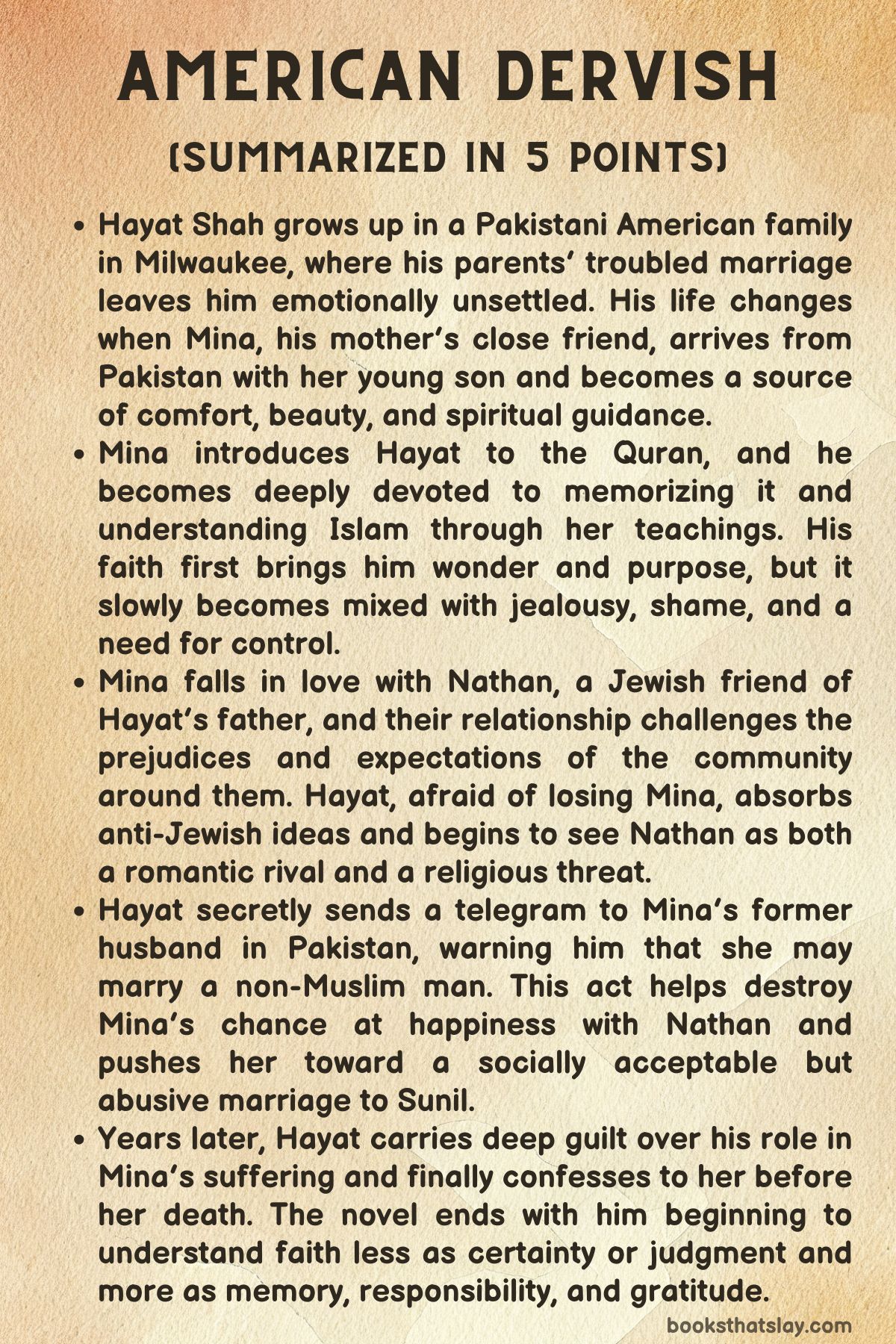
American Dervish by Ayad Akhtar is a coming-of-age novel about Hayat Shah, a Pakistani American boy growing up in Milwaukee in the 1980s. The story follows his deep attachment to Mina, his mother’s elegant, troubled friend, who introduces him to the Quran and a powerful vision of faith.
Through Hayat’s childhood eyes, the novel examines religion, desire, prejudice, family loyalty, and guilt. It is also a story about how a child’s need for love and certainty can lead to damage he cannot fully understand until adulthood.
Summary
American Dervish begins in 1990, when Hayat Shah is a college student attending a basketball game. After accidentally receiving a pork bratwurst, he chooses to eat it, expecting some kind of spiritual consequence but feeling only relief when nothing happens.
The next day, in his Survey of Islamic History class, Professor Edelstein challenges the traditional belief that the Quran is unchanged and divinely perfect by discussing the Sanaa manuscripts, fragments of an older Quranic text with variations from the standard version. Hayat, who once memorized passages of the Quran as a child, feels a complicated release at the idea that the holy book may be historical rather than eternal.
Soon afterward, his mother calls to tell him that Mina, her closest friend, has died of cancer. Hayat had visited Mina before her death and confessed something he had carried for years.
During a date with Rachel, he begins telling her the story.
As a child in Milwaukee, Hayat grows up in a tense Pakistani American household. His father, Naveed, is a brilliant neurologist, charming but unfaithful and often drunk.
His mother, Muneer, is sharp, proud, wounded by her husband’s betrayals, and deeply attached to her friend Mina. Mina has suffered in Pakistan after a painful marriage to Hamed Suhail.
Her husband divorced her and threatened to claim custody of their son, Imran, when the boy became older. Muneer invites Mina and Imran to live with the Shah family in Wisconsin, partly out of love and partly because she believes Naveed owes her after one of his mistresses sets his car on fire.
When Mina arrives, young Hayat is overwhelmed by her beauty, intelligence, and warmth. She quickly becomes the center of his emotional world.
She comforts him, listens to him, teaches him to face sadness rather than hide from it, and gives him a sense of being seen in ways his parents rarely manage. Mina also introduces him to the Quran.
She gives him a green copy, teaches him how to handle it with reverence, and guides him through its opening verses. Hayat begins memorizing the text with unusual speed.
Mina tells him he may become a hafiz, someone who has memorized the entire Quran, and he clings to this possibility as a source of purpose and spiritual importance.
Under Mina’s influence, Hayat’s world changes. Ordinary sensations feel charged with divine meaning.
He learns to pray, studies religious stories, and becomes absorbed in the idea of Allah’s mercy. Mina’s faith, however, is not rigidly traditional.
She values personal interpretation and a direct relationship with God more than strict obedience to religious authorities. This openness makes her a powerful teacher for Hayat, but it also leaves him confused when religious devotion begins mixing with jealousy, shame, and desire.
Hayat’s feelings for Mina become more complicated after he accidentally sees her naked in the bathroom. Mina is angry and cold toward him afterward, and Hayat becomes ashamed of his own body and sexuality.
Though they eventually resume their religious lessons, the emotional bond has changed. Hayat’s possessiveness grows stronger when Mina meets Nathan Wolfsohn, a Jewish colleague and friend of Naveed.
Nathan is gentle, thoughtful, and interested in Mina’s mind. The two begin speaking often and appear to fall in love.
Their relationship unsettles Hayat. He resents Nathan for taking Mina’s attention and fears losing his place in her life.
The situation also brings out tensions in the Pakistani Muslim community surrounding the Shah family. Some of the adults admire Jews, while others express deep anti-Jewish prejudice justified through distorted religious claims.
Hayat remembers his Jewish school friend Jason, who was bullied by Christian boys after criticizing Jesus, and the memory sits beside the ugly things he hears Muslim adults say about Jews. These contradictions shape his growing confusion about faith, loyalty, and hatred.
Mina and Nathan consider marriage, and Nathan agrees to convert to Islam. Naveed takes Nathan and Hayat to a mosque, where Imam Souhef delivers an angry sermon using Quranic verses to attack Jews.
Nathan stands up and denounces the sermon as hatred, not Islam. The congregation turns against him, and Naveed leads him out.
The incident devastates Nathan and shakes Mina’s hopes. Hayat, however, reads the relevant Quranic passages afterward and begins to accept the imam’s hostile interpretation.
His jealousy and religious certainty combine dangerously.
When Imran expresses attachment to Naveed and fear of Nathan becoming his new father, Hayat tells the younger boy that Jews are hated by Allah and destined for hell. Mina discovers what he has said and strikes him in fury.
Muneer attacks Mina in return, and Hayat falls down the stairs, breaking his wrist. In the hospital, Naveed warns him never to speak that way about Jews again and tells him to stop studying the Quran.
Hayat dreams of the Prophet Muhammad and wakes convinced that his spiritual destiny still matters. Mina apologizes for hitting him but tells him he was wrong to speak with such hatred.
Hayat stays silent because he does not fully agree.
Fearing that Mina may still marry Nathan, Hayat commits the act that haunts him for the rest of his life. He finds the address of Mina’s ex-husband in Pakistan and sends a telegram warning that Mina is marrying a kafir named Nathan.
He disguises the return information so no one knows he sent it. The message reaches Mina’s family and former husband.
Hamed threatens to take Imran away, and Mina’s father threatens violence if she marries a non-Muslim. Mina’s relationship with Nathan collapses under the pressure.
Hayat feels guilty but does not confess.
Naveed, angry about Hayat’s religious obsession, rips pages from his Quran and burns them in the backyard. Hayat is horrified.
After Nathan leaves for Boston, Mina is pushed toward marriage with Sunil, a divorced Muslim man connected to the Chatha family. Sunil appears respectable, and the marriage promises to protect Mina from her ex-husband’s threats over Imran.
Yet Mina grows thin and distressed as the wedding approaches. She knows she is giving up love and freedom for safety and social approval.
At Mina’s wedding, Hayat’s illusions suffer a painful collapse. He meets Farhaz, Sunil’s teenage nephew, who is supposed to be a hafiz but turns out to be crude and cynical.
Farhaz and another boy mock Hayat’s innocence about sex. Hayat also sees Naveed kissing Julie, the nurse from his hospital stay, confirming another affair.
During the wedding celebration, Imam Souhef asks Farhaz and Hayat to recite from the Quran. Hayat recites in English, only to be publicly humiliated when Souhef explains that a true hafiz must memorize the Quran in Arabic.
Hayat’s spiritual pride breaks. Soon after, Mina leaves with Sunil and Imran.
Before going, she tells Hayat that true faith matters more than titles.
The years that follow are bleak. Sunil beats Mina and controls her life.
Najat Chatha defends spousal abuse with a Quranic verse, revealing that she too has been abused. Mina moves to Kansas City with Sunil, grows more isolated, and eventually stops speaking to Muneer after Sunil forbids contact.
Muneer falls into depression, and Hayat carries heavy regret. He tries to make amends in small ways, including befriending a Jewish boy, but the damage remains.
Sunil becomes unstable, threatens Mina with a gun, and later blames himself when she develops uterine cancer. Mina, however, sees her suffering through her faith, believing that God is present even in pain.
Before Mina dies, Hayat visits her in the hospital and finally confesses that he sent the telegram. Mina is surprised but refuses to let him take full responsibility for her life.
She says she made her own choices and understands her suffering as part of her path toward God. Hayat challenges this, arguing that she should have chosen what was right instead of surrendering to hardship.
Mina answers through the image of the dervish, who accepts pain as a place where God may be found.
In the epilogue, Hayat is living in Boston with Rachel and working as an intern. He encounters Nathan in a coffee shop and apologizes for the pain he caused between him and Mina, though Nathan stops him before he can confess the telegram.
Nathan reveals that he and Mina secretly exchanged letters after her marriage, aided by a postal worker, and that he never truly recovered from losing her. After Nathan leaves, Hayat walks through the city and sits by the Charles River.
A passage from the Quran returns to him, not as a weapon or badge of purity, but as a sound linked to memory, gratitude, and Mina’s teaching. The novel ends with Hayat listening to the world around him until all he can hear is his own heart.
Characters
Hayat Shah
Hayat Shah is the central consciousness of American Dervish, and his character is built around the painful distance between childhood certainty and adult understanding. As a boy, Hayat is sensitive, lonely, intelligent, and emotionally hungry.
His parents’ unstable marriage leaves him searching for comfort, order, and a dependable source of affection. Mina becomes that source, and through her he discovers the Quran, prayer, and the idea that faith can give shape to his inner life.
At first, religion gives Hayat wonder and discipline, but his devotion slowly becomes mixed with jealousy, shame, and the need to control what he cannot bear to lose. His betrayal of Mina is not presented as simple cruelty; it comes from a child’s wounded possessiveness and a dangerous belief that he is acting on divine truth.
As an adult, Hayat is marked by guilt. His later rejection of rigid belief does not erase the emotional and moral consequences of what he did.
His journey is therefore not just from faith to doubt, but from innocence to responsibility.
Mina Ali
Mina is the emotional and spiritual center of Hayat’s childhood. She is beautiful, intelligent, generous, and deeply wounded by the social rules that restrict her life.
Her first marriage has left her vulnerable, especially because her former husband can threaten her through Imran. In the Shah home, Mina briefly seems to recover a sense of freedom.
She becomes a teacher to Hayat, showing him a version of Islam based on mercy, personal reflection, beauty, and direct experience of God. Yet Mina is also trapped by family expectations, religious pressure, fear of losing her child, and the need for social protection.
Her love for Nathan offers her the possibility of a new life, but she cannot fully escape the weight of communal judgment. Her later marriage to Sunil reveals the tragic cost of choosing safety within a system that harms her.
Mina’s faith remains complex: she does not abandon God, even when suffering, but her acceptance of pain also raises difficult questions about whether spiritual endurance can become self-erasure.
Muneer Shah
Muneer is Hayat’s mother and Mina’s devoted friend. She is sharp-tongued, proud, emotional, and full of contradictions.
Her life with Naveed has left her bitter and suspicious, yet she remains capable of great loyalty and tenderness, especially toward Mina. She often criticizes Muslim men for their treatment of women and admires Jewish men because she associates them with intellectual seriousness and respect.
At the same time, she is still shaped by the customs and social expectations she criticizes. Her home becomes Mina’s refuge, but Muneer cannot ultimately protect her friend from the pressures of family, reputation, and marriage.
As a mother, she loves Hayat intensely but also burdens him with adult pain, especially her anger toward Naveed. Her emotional dependence on Mina makes Mina’s suffering feel like her own failure.
Muneer represents the anguish of women who can see the injustice around them clearly but remain trapped in the very structures they condemn.
Naveed Shah
Naveed is Hayat’s father, a brilliant neurologist whose intelligence does not translate into emotional maturity. He is charming, funny, irreverent, and often perceptive, but he is also selfish, unfaithful, alcoholic, and cruel to Muneer.
His contempt for religious hypocrisy is one of his strongest traits. He rejects the narrowness of men like Souhef and Chatha, and he immediately recognizes the ugliness of anti-Jewish hatred.
Yet his moral clarity in that area does not make him a good husband or a stable father. He repeatedly wounds his family through affairs and drunkenness.
His bond with Nathan reveals his capacity for friendship, loyalty, and affection, while his tenderness toward Imran shows that he is not emotionally empty. His burning of Hayat’s Quran is violent and destructive, but it also comes from fear that religious obsession is deforming his son.
Naveed is one of the novel’s most contradictory figures: morally flawed, often irresponsible, but sometimes more honest than the supposedly devout people around him.
Nathan Wolfsohn
Nathan is a Jewish doctor and Naveed’s close friend. He is gentle, thoughtful, awkward, and emotionally open in ways that contrast with many of the men around Mina.
His love for Mina is sincere, and his willingness to consider conversion shows both devotion and vulnerability. Nathan does not treat Islam as a costume, but neither does he fully understand the depth of the cultural and religious hostility he will face.
The mosque incident becomes a devastating moment for him because he is forced to see how hatred can be given religious authority. His protest against Souhef shows moral courage, while his later grief reveals how deeply he loved Mina.
Nathan’s relationship with Mina also complicates the story’s treatment of identity: even when he is willing to convert, he remains marked by others as Jewish. By the end of American Dervish, Nathan becomes a figure of grace because he accepts Hayat’s apology without demanding a full confession, suggesting a forgiveness Hayat has not yet found within himself.
Imran
Imran is Mina’s young son, and his role in the story is closely tied to insecurity, abandonment, and the need for a father. He is quiet, difficult, emotionally intense, and often unable to express his pain except through tantrums or withdrawal.
His attachment to Naveed comes from the absence of his biological father and his longing for male protection. This attachment makes Hayat jealous, since Hayat already feels neglected by Naveed and possessive of Mina.
Imran is also the innocent listener who receives Hayat’s hateful speech about Jews, making him a victim of Hayat’s confused religious zeal. His love for whoever seems able to become his father, first Naveed and later Sunil, reveals how vulnerable he is to adult decisions made around him.
Imran does not control the plot, but his presence raises the stakes of Mina’s choices. Her fear of losing him is one of the main reasons she gives up Nathan and accepts a marriage that later destroys her happiness.
Sunil
Sunil first appears as a socially acceptable solution to Mina’s crisis. He is Muslim, divorced, connected to the Chatha family, and able to offer the protection that Nathan cannot provide in the eyes of Mina’s family and community.
Beneath that respectable surface, however, he is insecure, controlling, and violent. His politeness in public masks a private need to dominate Mina.
His abuse is not random; it grows from jealousy, wounded masculinity, and a belief that marriage gives him authority over his wife’s body, movements, and speech. Sunil’s character exposes the danger of choosing social approval over genuine goodness.
He is acceptable to the community because he fits the religious and cultural category they demand, but he is morally far worse for Mina than Nathan. His later remorse during Mina’s illness does not erase what he has done.
He becomes a harsh example of how respectability can hide cruelty when communities value appearances more than women’s safety.
Ghaleb Chatha
Ghaleb Chatha represents the religious and social conservatism that the novel criticizes. He is prominent, wealthy, and influential within the local Pakistani Muslim community, but his authority is tied to hypocrisy and prejudice.
He condemns others while benefiting from compromises he excuses for himself. His discussion of Jews reveals a chilling willingness to turn scripture into a justification for hatred.
He also helps arrange Mina’s marriage to Sunil, presenting it as a respectable solution while ignoring the emotional reality of her life. Chatha’s power comes from his ability to control community opinion.
People like him can decide who belongs, who is respectable, and whose suffering can be dismissed. He is not merely an unpleasant individual; he embodies a wider system of male authority, religious arrogance, and social pressure.
Through Chatha, the story shows how cruelty can be made to look righteous when it is supported by status, money, and selective religious interpretation.
Imam Souhef
Imam Souhef is a religious authority whose sermons reveal the destructive force of spiritual leadership without compassion. He speaks with intensity and confidence, but his interpretation of scripture is shaped by anger and prejudice.
His attack on Jews during the mosque service is one of the decisive moments in Hayat’s moral formation. Nathan hears hatred and rejects it; Hayat hears religious certainty and begins absorbing it.
Souhef’s influence is dangerous because it gives a child like Hayat a sacred vocabulary for jealousy and resentment. Later, at Mina’s wedding, Souhef humiliates Hayat by dismissing his English memorization of the Quran as insufficient.
This moment damages Hayat’s pride and exposes the gap between his private devotion and the community’s rules of religious legitimacy. Souhef is not portrayed as a guide toward God but as a man whose authority narrows faith into judgment, exclusion, and shame.
Farhaz
Farhaz is Sunil’s nephew and a recognized hafiz, which makes him important to Hayat’s understanding of religious achievement. Before meeting him, Hayat imagines a hafiz as pure, elevated, and spiritually impressive.
Farhaz destroys that fantasy. He is vulgar, sexually crude, dismissive of his own religious training, and openly contemptuous of the discipline that Hayat has idealized.
His presence forces Hayat to confront the difference between memorization and moral character. Farhaz knows the Quran in the approved language, but this does not make him kind, wise, or spiritually mature.
When he mocks Hayat after the failed recitation, he deepens Hayat’s humiliation. Farhaz is a small but important character because he breaks one of Hayat’s central illusions: that religious accomplishment automatically produces goodness.
Through him, the story separates spiritual status from ethical worth.
Rachel
Rachel appears mainly in the framing sections of the novel, but her role is important because she represents Hayat’s adult life after the collapse of his childhood faith. She is a classmate and later his girlfriend, someone with whom he can discuss doubt, belief, and the burden of the past.
Hayat’s decision to tell Rachel about Mina suggests that he sees her as a listener outside the family and community structures that shaped the original events. Rachel is not deeply developed in the same way as Mina or Muneer, but she helps reveal the adult Hayat’s need to confess and make sense of himself.
Her presence also marks his movement into a wider American world, one in which he can question inherited beliefs more freely. Through Rachel, the story frames memory as something spoken across intimacy, not merely carried alone.
Sonny Buledi
Sonny Buledi is a psychiatrist and an outsider within the Pakistani Muslim community because of his atheism, Westernized family life, and marriage to an Austrian woman. He serves as a contrast to men like Chatha and Souhef.
While others hide prejudice behind tradition, Sonny challenges hateful or irrational claims directly. His horror at anti-Jewish rhetoric shows his moral clarity, even though the community treats him as suspect.
The false use of his name in Hayat’s telegram also reveals how easily outsiders become convenient scapegoats. Sonny is important because he shows that ethical intelligence in the novel is not limited to religious devotion.
In fact, some of the most humane responses come from people whom the conservative community judges as irreligious or improper.
Najat Chatha
Najat Chatha is Ghaleb Chatha’s wife, and her character shows how women can become enforcers of the systems that harm them. She supports the exclusion of Muneer from Mina’s wedding arrangements and later justifies Sunil’s abuse through scripture.
Her defense of wife-beating is especially disturbing because she herself is a victim of abuse. Rather than reject the system that wounds her, she protects it by presenting suffering as religiously acceptable.
Najat’s role is not simply that of a villain; she is also a tragic example of internalized oppression. Her conduct shows how patriarchal authority survives not only through powerful men, but also through women who have been taught to treat endurance as virtue and resistance as shameful disobedience.
Hamed Suhail
Hamed, Mina’s first husband, remains mostly distant from the immediate action, but his power over Mina shapes much of her life. He represents the lingering force of patriarchal control even after divorce.
His threat to take Imran away makes Mina vulnerable to pressure from her family and community. Because of him, Mina’s romantic choice is never simply personal.
Her desire to marry Nathan becomes tied to the risk of losing her child. Hamed’s importance lies in how his authority travels across distance.
He does not need to be physically present in Milwaukee to control Mina’s choices. The telegram sent by Hayat gives Hamed the information he needs to frighten her into submission, making him one of the hidden forces behind the tragedy.
Rafiq and Rabia Ali
Rafiq and Rabia, Mina’s parents, embody the family pressure that limits Mina’s freedom. Rafiq in particular is controlling and concerned with obedience, reputation, and male authority.
His response to Mina’s possible marriage to Nathan is not guided by her happiness but by religious and social acceptability. Rabia is less forceful, yet she remains part of the family structure that expects Mina to comply.
Their arrival in America before Mina’s wedding intensifies her sense of entrapment. Rafiq’s approval of Sunil carries weight because Mina has been trained to understand family blessing as essential to survival and honor.
Together, Mina’s parents show how love within a family can be mixed with control, fear, and the demand that a daughter sacrifice herself for respectability.
Themes
Faith, Interpretation, and Moral Responsibility
Faith in American Dervish is never shown as a single stable force. For Mina, the Quran offers mercy, beauty, silence, and a path toward God that depends on personal reflection.
For Hayat, the same text first opens a world of wonder, then becomes a source of pride, fear, and judgment. For Souhef and Chatha, scripture becomes a tool for exclusion, anti-Jewish hatred, and male authority.
This range of interpretation is central to the novel’s moral tension. The danger does not come from belief alone, but from belief separated from humility and compassion.
Hayat’s tragedy is that he mistakes memorization for wisdom and certainty for righteousness. He is too young to understand that quoting sacred language does not guarantee moral truth.
The novel asks whether faith should lead people toward mercy or toward control, and it repeatedly shows that interpretation carries consequences. When religious language is used to justify hatred, abuse, or social pressure, it can damage lives while still appearing holy.
The story’s deepest religious question is not whether God exists, but how human beings use the idea of God when they are afraid, jealous, wounded, or hungry for power.
Jealousy, Desire, and Childhood Guilt
Hayat’s betrayal of Mina grows from the dangerous confusion of love, desire, jealousy, and religious fear. As a child, he does not have the maturity to understand his attachment to Mina.
She is teacher, mother figure, spiritual guide, and object of fascination all at once. When Nathan enters her life, Hayat experiences his presence as theft.
The boy cannot name the emotional and sexual feelings that disturb him, so he translates them into religious judgment. Nathan becomes not merely a rival, but an unbeliever.
This shift allows Hayat to imagine his jealousy as righteousness. His telegram is therefore both a childish act of possession and a moral crime.
The novel treats childhood seriously because children can cause real harm even when they do not fully understand their motives. Hayat’s adult guilt comes from recognizing that his younger self was not innocent in any simple way.
He was manipulated by fear and religious certainty, but he also chose secrecy, deception, and betrayal. The theme is powerful because it shows guilt as something that matures with the person.
Hayat understands his act more deeply as he grows older, and that understanding becomes part of his identity.
Women, Marriage, and Social Control
Mina’s life reveals how marriage can become a system of control when family honor, religious approval, and male authority matter more than a woman’s freedom. Her first marriage leaves her vulnerable through the threat of losing Imran.
Her love for Nathan offers emotional respect, but it is treated as unacceptable because he is Jewish. Sunil, by contrast, is accepted because he is socially and religiously suitable, even though he later becomes abusive.
This contrast exposes the failure of a community that values the correct category of husband over the actual character of the man. Muneer sees this injustice clearly and often speaks against Muslim men’s treatment of women, yet even she cannot save Mina.
Najat’s defense of abuse shows how deeply the system has shaped some women’s thinking. The novel presents marriage not as automatically sacred, but as dangerous when obedience is demanded without accountability.
Mina’s suffering is not caused by one man alone. It is produced by a network of parents, former husbands, community leaders, religious interpretations, and social expectations that leave her with few safe choices.
Her tragedy lies in being surrounded by people who claim to protect her while steadily reducing her freedom.
Prejudice, Identity, and the Inheritance of Hatred
The treatment of Jewish identity is one of the novel’s most painful concerns. Nathan is kind, loyal, and intellectually open, yet his Jewishness becomes the barrier that many characters cannot see past.
The mosque scene exposes how inherited prejudice can be given religious force, turning old resentment into public doctrine. Hayat’s response to that moment is especially important.
Instead of rejecting the hatred as Nathan does, he absorbs it because it serves his jealousy. Prejudice becomes useful to him, giving him a reason to oppose Nathan while believing himself righteous.
The memory of Jason, Hayat’s Jewish school friend who is attacked by Christian classmates, expands the theme beyond one community. Hatred travels across religious boundaries; different groups justify cruelty in different languages.
The novel also shows that identity is not easily changed by conversion. Nathan may be willing to become Muslim, but others continue to see him as Jewish first.
This reveals the cruelty of communal boundaries that claim to be spiritual but operate socially and politically. The inheritance of hatred is not abstract in the story.
It moves from adults to children, from sermons to private conversations, from sacred texts to family decisions, and finally into Hayat’s own destructive act.