American Prometheus Summary and Analysis
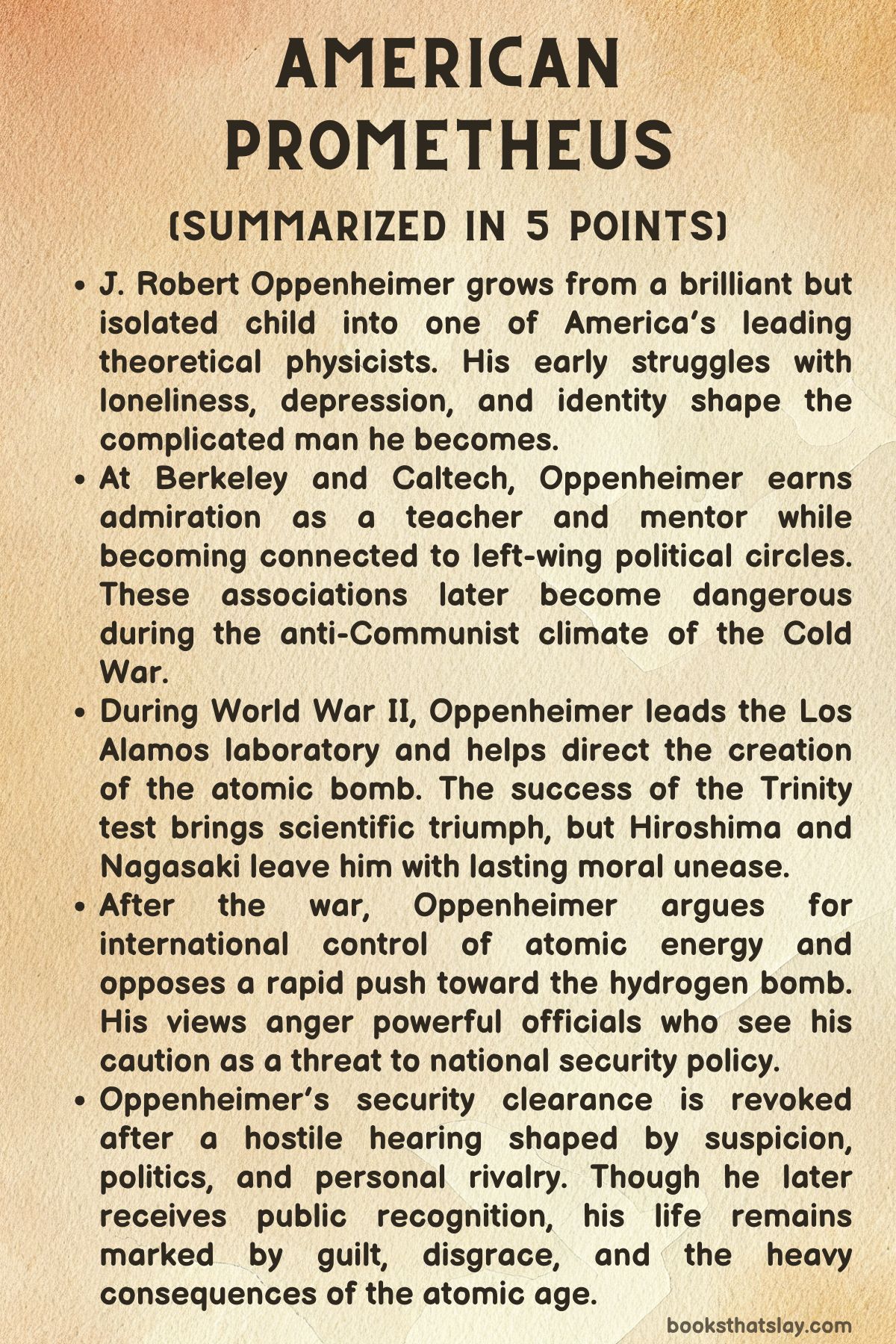
American Prometheus: The Triumph and Tragedy of J. Robert Oppenheimer is a biography of J. Robert Oppenheimer, written by Kai Bird and Martin J. Sherwin. It follows the life of the brilliant physicist who became the scientific director of the Manhattan Project and helped create the atomic bomb.
The book presents him not only as a genius, but as a complicated man shaped by ambition, loneliness, politics, guilt, and public suspicion. It traces his rise from a gifted child to a national figure, then shows how Cold War fear and personal rivalries led to his public disgrace. At its center, the book asks what responsibility means when science changes history.
Summary
American Prometheus tells the story of J. Robert Oppenheimer, one of the most important and controversial scientists of the twentieth century. Born in New York in 1904 to a wealthy German Jewish family, Robert grew up intelligent, sensitive, and socially awkward.
His mother protected him closely, and his early life was marked by solitude, books, poetry, mineral collecting, and a strong hunger for ideas. At the Ethical Culture School, he received a progressive education shaped by secular humanism, moral duty, and social conscience.
Though he excelled academically, he often struggled to connect with classmates and seemed either distant or superior to those around him.
As a young man, Oppenheimer attended Harvard, where he finished his degree in only three years. He began in chemistry but soon found his true passion in theoretical physics.
Even while his intellectual gifts flourished, his emotional life remained unstable. He suffered from depression and loneliness, especially during his graduate studies at Cambridge.
His time there nearly ended in disaster after an incident involving a poisoned apple meant for a teacher he disliked and a later breakdown with his friend Francis Fergusson. Yet after a period of crisis, Oppenheimer recovered enough to continue his work, moving to Göttingen in Germany, then one of the great centers of theoretical physics.
There, he found the kind of demanding intellectual world he needed and began publishing important papers in quantum physics.
Returning to the United States, Oppenheimer built his career at Caltech and the University of California, Berkeley. He became a magnetic teacher, especially for graduate students, who admired his brilliance, intensity, and elegance.
Many called him “Oppie.” He had a gift for seeing the core of difficult scientific problems and for bringing talented people together. At the same time, he could be vain, moody, and hard to understand.
New Mexico became one of his spiritual homes, especially the ranch country near Los Alamos, where he felt a freedom he rarely found elsewhere.
During the 1930s, Oppenheimer’s life changed as politics entered his world more forcefully. The Great Depression, the rise of Hitler, and the Spanish Civil War pushed him toward left-wing causes.
His relationship with Jean Tatlock, a brilliant and troubled woman connected to Communist circles, deepened his political associations. His friends, students, brother Frank, and later his wife Kitty also had ties to Communist or leftist groups.
Oppenheimer himself never clearly joined the Communist Party, and no investigation ever proved that he did. Still, his associations would later become central to the case against him.
As World War II began, Oppenheimer turned away from political activism and toward the urgent scientific problem of nuclear fission. Scientists feared that Nazi Germany might build an atomic bomb first.
The American government created the Manhattan Project, and General Leslie Groves chose Oppenheimer to direct the secret weapons laboratory at Los Alamos. The decision surprised many because Oppenheimer had never managed a large organization.
Yet he proved to be an extraordinary leader. He recruited top scientists, organized the work, encouraged open scientific discussion within the secure laboratory, and helped create a community capable of solving unprecedented technical problems.
Life at Los Alamos was tense and demanding. Security was strict, families felt trapped, and scientists worked under enormous pressure.
Oppenheimer himself was watched by the FBI and Army intelligence because of his past associations. One incident, later called the Chevalier Affair, became especially damaging.
His friend Haakon Chevalier told him that George Eltenton had suggested passing scientific information to the Soviet Union. Oppenheimer rejected the idea, but when questioned later, he gave confused and partly invented accounts, trying to protect his friend and minimize the matter.
These inconsistent statements would haunt him for years.
The atomic bomb project succeeded. On July 16, 1945, the first test explosion took place at Trinity in New Mexico.
Oppenheimer and his colleagues reacted with awe, relief, and excitement. But after the bombs were dropped on Hiroshima and Nagasaki in August 1945, his mood changed.
At first, many at Los Alamos celebrated the end of the war, but reports of the destruction and human suffering soon weighed heavily on them. Oppenheimer became troubled by the moral consequences of what he had helped create.
He later told President Truman that he felt he had blood on his hands, a remark Truman considered weak and self-pitying.
After the war, Oppenheimer became a public figure and an adviser on atomic policy. He argued for international control of nuclear energy and opposed secrecy as the foundation of national security.
He helped shape the Acheson-Lilienthal Report, which proposed international management of atomic power. But the plan was altered before being presented to the United Nations, and the Soviet Union rejected the American version.
The world moved instead toward a nuclear arms race. Oppenheimer, once central to American power, became increasingly uneasy with the direction of policy.
In 1947, he became director of the Institute for Advanced Study in Princeton, where he worked among figures such as Albert Einstein and Niels Bohr. He tried to make the Institute a broader intellectual center, not just a home for mathematics and physics.
Yet his influence in Washington mattered more than his academic post. When the Soviet Union tested its first atomic bomb in 1949, the United States began debating whether to build the hydrogen bomb.
As chair of the Atomic Energy Commission’s General Advisory Committee, Oppenheimer opposed a crash program for the new weapon, fearing it could become an instrument of mass destruction on an even greater scale. His opposition angered powerful figures, including Lewis Strauss, Edward Teller, and others who saw him as an obstacle.
During the Cold War, Oppenheimer’s old left-wing associations became dangerous. The anti-Communist mood in America grew harsher, and officials began to treat doubt, dissent, and past political ties as signs of disloyalty.
Strauss, who had personal and political reasons to resent Oppenheimer, helped build a case against him. In 1953, Oppenheimer was told that his security clearance had been suspended and that he would face a review.
Rather than resign quietly, he chose to fight.
The 1954 security hearing became the central ordeal of his later life. It was not a normal trial, and his lawyers could not see all the classified evidence used against him.
The hearing focused on his Communist associations, the Chevalier Affair, his past relationship with Jean Tatlock, and his opposition to the hydrogen bomb. Many respected witnesses defended him, including George Kennan, Isidor Rabi, Vannevar Bush, and others.
Kitty Oppenheimer also testified strongly. But Edward Teller’s testimony damaged him by suggesting that although Oppenheimer was loyal, his judgment could not be trusted.
The panel voted against him, and the Atomic Energy Commission revoked his security clearance.
Oppenheimer’s fall marked a turning point in the relationship between science and government. He was not imprisoned or formally convicted of disloyalty, but he was publicly shamed and removed from the inner circle of atomic policy.
In later years, public opinion shifted in his favor. Many came to see him as a victim of Cold War fear, political revenge, and official dishonesty.
He continued to lecture, travel, and direct the Institute, but he never regained his former role in government.
Near the end of his life, Oppenheimer received partial public vindication when President Lyndon Johnson awarded him the Enrico Fermi Prize in 1963, an honor President Kennedy had planned before his assassination. Still, the damage could not be undone.
Oppenheimer suffered from throat cancer and died in 1967. Kitty took his ashes to St. John and released them into the sea.
The book closes by following the lives of those he left behind. Frank Oppenheimer rebuilt his life and helped create the Exploratorium in San Francisco.
Peter Oppenheimer settled in New Mexico. Toni Oppenheimer struggled with depression and died by suicide in 1977.
Through Oppenheimer’s life and family, American Prometheus presents a story of brilliance, ambition, moral burden, political fear, and the lasting human cost of the atomic age.
Key People
J. Robert Oppenheimer
J. Robert Oppenheimer stands at the center of American Prometheus as a brilliant, contradictory, and deeply burdened figure. He is introduced as a gifted child whose intelligence sets him apart, but whose emotional fragility and sheltered upbringing make ordinary human connection difficult.
As a young man, he is drawn to beauty, language, landscapes, and abstract thought, yet he often seems unable to live comfortably inside his own mind. His early struggles with depression, his social awkwardness, and his moments of erratic behavior show a man whose genius does not protect him from fear, loneliness, or self-doubt.
His love of New Mexico reveals another side of him: romantic, physical, and attached to places that give him a sense of freedom.
As a scientist, Oppenheimer is less important as a single discoverer than as a mind capable of gathering ideas and people. At Berkeley and Caltech, he becomes a magnetic teacher who inspires younger physicists and creates a school of theoretical physics in the United States.
His students admire him not only for what he knows, but for the way he thinks. He can be generous, demanding, elegant, and cutting.
His charisma helps make him a leader long before he formally becomes one.
His greatest transformation comes at Los Alamos. Before the Manhattan Project, he has never managed anything on such a scale, yet he becomes the ideal director for the atomic bomb laboratory.
He understands the science, recognizes talent, balances strong personalities, and gives the project a shared intellectual purpose. His leadership is not merely administrative; it is almost spiritual for the scientists around him.
Yet the same work that raises him to national importance also creates the moral wound that follows him for the rest of his life. After Hiroshima and Nagasaki, he becomes a man caught between achievement and guilt, patriotism and regret, public honor and private unease.
Oppenheimer’s downfall grows from his own flaws as much as from the cruelty of Cold War politics. His old left-wing associations, his confused handling of the Chevalier Affair, his habit of intellectual ambiguity, and his opposition to the hydrogen bomb all become weapons against him.
He is loyal to the United States, but he is not simple enough for an age that demands simple loyalties. His tragedy lies in the fact that the government first needs his brilliance, then punishes his independence.
By the end, he is a diminished but still dignified figure, publicly honored yet permanently marked by betrayal, guilt, and the knowledge that his work changed the fate of the modern world.
Katherine “Kitty” Oppenheimer
Kitty Oppenheimer is one of the most forceful and difficult people in Robert’s life. She is intelligent, politically aware, emotionally intense, and fiercely loyal, but she is also restless, unhappy, and often harsh.
Her earlier life, shaped by failed marriages, political commitments, and personal losses, gives her a hardened quality. She is not presented as a gentle domestic partner or a passive wife of a famous man.
Instead, she is sharp, proud, and frequently dissatisfied with the roles available to her.
At Los Alamos, Kitty struggles with isolation and the pressure of living under military secrecy. While Robert becomes absorbed in scientific leadership, she experiences the emotional cost of the project from inside the family home.
Her difficulty bonding with her children, especially Peter, and her drinking suggest a woman overwhelmed by confinement, disappointment, and perhaps by the knowledge that her husband belongs more to history than to family life. Yet Kitty is not weak.
During Oppenheimer’s security hearing, she shows remarkable strength. Under hostile questioning, she remains controlled and loyal, often appearing tougher than Robert himself.
Kitty’s role is important because she exposes the private cost of public greatness. Robert’s fame does not create a stable family; in many ways, it makes intimacy harder.
She loves him, defends him, resents him, and suffers beside him. Her loyalty after his disgrace is real, but so is her bitterness.
She understands the injustice done to him and never fully forgives those who helped destroy his standing. Kitty’s complexity makes her more than a supporting figure.
She represents the emotional damage that surrounds Oppenheimer’s public life, and she reminds the reader that genius often leaves wreckage at home.
Jean Tatlock
Jean Tatlock is one of the most haunting figures in Oppenheimer’s life. She is intelligent, beautiful, politically committed, and emotionally troubled.
Her relationship with Oppenheimer is intense because both of them carry inner instability and a fascination with ideas larger than ordinary life. Jean draws him closer to left-wing political circles, but her importance is not only political.
She seems to touch a part of him that is romantic, wounded, and searching for emotional recognition.
Her depression gives her story a tragic weight. She becomes a symbol of the emotional darkness that also shadows Oppenheimer, especially in his younger years.
Their relationship does not survive, and he later marries Kitty, but Jean remains important to him. His wartime meeting with her, while he is under surveillance and directing the bomb project, becomes dangerous not because of romance alone, but because her Communist associations make the visit suspicious to security officials.
Jean’s death by suicide deepens the sense of loss surrounding Oppenheimer’s private life. For him, she is not simply a former lover; she is a reminder of an earlier self, one tied to passion, politics, and vulnerability.
For the government investigators, however, she becomes evidence in a security file. That contrast is central to her role.
Jean is a human being in pain, but Cold War suspicion reduces her to a political risk. Her character shows how private grief can be distorted when fear and surveillance dominate public life.
General Leslie R. Groves
General Leslie Groves is the military force behind the Manhattan Project and one of the few powerful figures who recognizes Oppenheimer’s usefulness despite his political liabilities. Groves is conservative, blunt, practical, security-minded, and deeply committed to winning the war.
On paper, he and Oppenheimer should not work well together. Groves represents military order; Oppenheimer represents intellectual freedom.
Yet their partnership becomes one of the most important relationships in the project.
Groves’s great strength is his ability to judge talent. He sees that Oppenheimer, despite his lack of administrative experience and his troubling political background, has the rare combination of scientific understanding, charisma, and urgency needed to lead Los Alamos.
Groves protects him when Army intelligence and the FBI raise suspicions. His support is not sentimental.
He backs Oppenheimer because the bomb project needs him.
At the same time, Groves never fully escapes the assumptions of his military world. During the later security hearing, his testimony is mixed.
He praises Oppenheimer’s wartime service and loyalty, yet he also accepts the logic of revoking his clearance. This contradiction makes Groves a revealing character.
He can admire and defend Oppenheimer when victory requires it, but after the war, under the pressure of security culture, even he becomes unable or unwilling to reject the suspicions surrounding him. Groves shows how wartime necessity can temporarily override ideology, but not permanently defeat it.
Lewis Strauss
Lewis Strauss is one of Oppenheimer’s chief antagonists and a key figure in his public destruction. Ambitious, proud, conservative, and deeply sensitive to slights, Strauss represents the political and institutional forces that come to resent Oppenheimer’s influence.
His conflict with Oppenheimer is partly ideological, especially over nuclear policy and secrecy, but it is also personal. Strauss dislikes Oppenheimer’s manner, his prestige, his opposition to the hydrogen bomb program, and his ability to command respect in circles Strauss wants to control.
As chair of the Atomic Energy Commission, Strauss uses his authority to reopen and intensify suspicions that had long existed in Oppenheimer’s security file. He does not merely respond to concerns; he actively helps shape the case.
His actions suggest a man who sees Oppenheimer as both a political danger and a personal rival. In Strauss’s mind, Oppenheimer’s opposition to the hydrogen bomb is not a legitimate policy position but evidence of questionable loyalty or judgment.
Strauss is important because he shows how personal resentment can hide behind national security language. The machinery used against Oppenheimer appears official and procedural, but Strauss’s role reveals how much of it is driven by anger, ambition, and revenge.
He is not portrayed as a simple villain without motives; rather, he is dangerous because he believes his own suspicions and has the power to act on them. Through Strauss, the book shows how bureaucratic power can turn private hostility into public punishment.
Edward Teller
Edward Teller is a brilliant physicist whose obsession with the hydrogen bomb places him in direct conflict with Oppenheimer. At Los Alamos, Teller is restless because he is more interested in the possibility of a thermonuclear superbomb than in the immediate work of building a fission weapon.
His imagination reaches toward greater destructive power, and this ambition separates him from scientists who become increasingly worried about the moral and political consequences of nuclear arms.
Teller’s importance grows after the war, when the hydrogen bomb becomes a national policy issue. Oppenheimer and the General Advisory Committee oppose a crash program, fearing the weapon’s genocidal potential.
Teller, by contrast, believes development should proceed. Their disagreement is not merely technical; it reflects different views of responsibility.
Oppenheimer begins to think in terms of restraint, while Teller thinks in terms of possibility, security, and scientific advance.
His testimony at Oppenheimer’s hearing becomes one of the most damaging moments in the case. Teller does not call Oppenheimer disloyal, but he questions his judgment and says he would feel safer if public matters were in other hands.
This statement wounds Oppenheimer’s defenders and isolates Teller from many scientists afterward. Teller’s character embodies the moral division within the scientific community: whether the scientist’s duty is to create what can be created, or to resist what should not be used.
Haakon Chevalier
Haakon Chevalier is Oppenheimer’s friend, a literature professor, and a committed Marxist whose connection to Oppenheimer becomes disastrous. He is not a major political actor in the usual sense, but his role in the Chevalier Affair gives him enormous significance.
At a dinner with the Oppenheimers, he tells Robert that George Eltenton has suggested passing information to the Soviet Union. Oppenheimer rejects the idea, but the incident later becomes one of the central charges used to question his loyalty.
Chevalier’s role is tragic because friendship becomes evidence. His political commitments and casual approach to a dangerous suggestion place Oppenheimer in a terrible position.
Oppenheimer’s later attempts to protect Chevalier by hiding his name and altering details only make the situation worse. Chevalier is therefore less important as a spy figure than as a catalyst for Oppenheimer’s most damaging mistake.
He also represents the world Oppenheimer once inhabited: left-wing intellectual circles filled with anti-fascist passion, ideological debate, and sympathy for social justice causes. In the 1930s, such associations may seem morally urgent to Oppenheimer; in the Cold War, they become liabilities.
Chevalier’s character shows how the meaning of political friendship changes when the state begins reading past associations as signs of betrayal.
Frank Oppenheimer
Frank Oppenheimer, Robert’s younger brother, mirrors and contrasts with him. Like Robert, he becomes a physicist, but he is more drawn to experimental work.
Frank is also more openly connected to Communist politics, joining the Communist Party with his wife Jackie. His political choices have severe consequences.
During the anti-Communist investigations, Frank loses his academic career and is forced to leave mainstream scientific life for a time.
Frank’s relationship to Robert is important because it shows how family loyalty and political danger overlap. Robert worries about Frank, but he also distances himself from certain left-wing associations as pressure builds.
Frank’s suffering reveals the broader damage caused by Cold War suspicion. He is not only a side character in Robert’s story; he is another example of a scientist whose life is reshaped by political fear.
Yet Frank’s later recovery gives his character a different arc from Robert’s. After losing his academic position, he eventually helps create the Exploratorium in San Francisco, a science museum built around curiosity, public learning, and hands-on discovery.
This later achievement suggests resilience. While Robert remains tied to secrecy, weapons, and government power, Frank’s later work returns science to openness and education.
In that sense, Frank offers a quieter counterpoint to the tragedy of his brother’s fame.
Ernest Lawrence
Ernest Lawrence is Oppenheimer’s Berkeley colleague and a major figure in American experimental physics. He is energetic, practical, and institutionally powerful, bringing money, machinery, and prestige to the Berkeley Radiation Laboratory.
His scientific style differs sharply from Oppenheimer’s. Lawrence builds devices and systems; Oppenheimer thinks in theories and abstractions.
Their relationship shows the productive tension between experimental and theoretical science.
Lawrence is also more conservative in temperament, especially when it comes to politics. He finds Oppenheimer’s left-wing associations and support for unions irritating and counterproductive.
As the political climate changes, this difference becomes more significant. Lawrence’s world is one of funding, laboratories, government connections, and patriotic research.
Oppenheimer’s earlier world includes intellectual radicalism and moral questioning.
Although Lawrence is not presented as Oppenheimer’s central enemy, he helps define the scientific environment that Oppenheimer moves through. He represents the rise of large-scale, government-backed science in the United States.
His success shows that modern physics is no longer only a matter of chalkboards and equations; it requires machines, money, institutions, and political alliances. Against Lawrence, Oppenheimer appears both brilliant and vulnerable, powerful in thought but less secure in the practical politics of science.
Isidor Rabi
Isidor Rabi is one of Oppenheimer’s close friends and one of the scientists who understands him most clearly. Like Oppenheimer, Rabi is a Jewish physicist from New York, but he has a stronger connection to his Jewish identity.
This contrast helps reveal Oppenheimer’s discomfort with parts of his own background and his desire to fashion himself as something more elegant, universal, and detached.
Rabi respects Oppenheimer’s brilliance but is not blinded by it. He sees his charm, his affectations, his gifts, and his weaknesses.
During the Manhattan Project, Rabi refuses to become a full participant, though he serves as a consultant. His refusal gives him moral independence.
He is close enough to the project to understand its importance, but distant enough to avoid being consumed by it.
At the security hearing, Rabi becomes one of Oppenheimer’s strongest defenders. His famous objection to the proceedings captures the absurdity of the case: if the government no longer wants Oppenheimer’s advice, it can simply stop consulting him.
Rabi’s role is that of the loyal friend with common sense. He cuts through the inflated language of loyalty and security and sees the hearing as needless cruelty.
His presence reminds the reader that many scientists viewed Oppenheimer’s punishment not as justice, but as a national embarrassment.
Niels Bohr
Niels Bohr appears as a moral and intellectual guide. By the time he arrives at Los Alamos, he is already one of the great figures of modern physics.
To Oppenheimer and many others, Bohr carries unusual authority, not just because of his scientific achievements but because of his philosophical seriousness. He thinks about the bomb not only as a weapon but as a force that will alter world politics.
Bohr’s central concern is secrecy. He believes that the atomic age requires openness between nations, especially if a future arms race is to be prevented.
His influence helps turn Oppenheimer’s mind toward the postwar consequences of nuclear weapons. During the war, Oppenheimer is focused on defeating Hitler and completing the project.
Bohr widens the frame, asking what will happen after success.
Bohr’s character represents scientific wisdom joined to moral imagination. He understands that discovery cannot be separated from politics.
His warnings are not fully heeded, and the world moves toward exactly the kind of arms race he fears. In this way, Bohr becomes a prophetic figure.
He is not central in terms of action, but his ideas shape the book’s deepest questions about knowledge, secrecy, and responsibility.
George Kennan
George Kennan is a diplomat, intellectual, and friend of Oppenheimer whose presence connects nuclear policy to broader Cold War strategy. Known for shaping the idea of containment, Kennan is not naïve about the Soviet Union.
Yet he also worries about the United States building its security around nuclear terror. His friendship with Oppenheimer is based on shared seriousness, restraint, and concern about the moral direction of American power.
Kennan’s role becomes especially important during the hydrogen bomb debate and the security hearing. He opposes making nuclear weapons the center of national defense and supports Oppenheimer’s loyalty and honesty.
Unlike more reactionary figures, Kennan can recognize Soviet danger without surrendering to panic. This makes him an important counterweight to the anti-Communist hysteria surrounding Oppenheimer.
As a character, Kennan represents the possibility of sober political judgment. He is neither a radical nor a weapons enthusiast.
His tragedy is that his caution is ignored by a government increasingly committed to secrecy, military buildup, and ideological certainty. Through Kennan, American Prometheus shows that opposition to nuclear escalation did not come only from dreamers or political outsiders; it also came from some of the most serious minds inside the American establishment.
David Lilienthal
David Lilienthal is a public servant who shares Oppenheimer’s hope for international control of atomic energy. As the head of the board that helps produce the Acheson-Lilienthal Report, he works closely with Oppenheimer and comes to admire his intelligence and passion.
Lilienthal represents a version of government that is still open to idealism, planning, and public responsibility.
His importance lies in the postwar struggle over atomic policy. He and Oppenheimer help create a serious proposal for international control, but that proposal is altered by Bernard Baruch and reshaped in a way that protects American advantage.
Lilienthal’s disappointment reflects the collapse of a more cooperative vision for the atomic age. Once the Baruch Plan fails, the possibility of international control recedes, and the arms race gains momentum.
Lilienthal also appears as a defender of Oppenheimer during the security hearing, though the proceedings frustrate and unsettle him. His character shows how people of conscience inside government can be outmaneuvered by fear, ambition, and political calculation.
He is not powerless, but he is not powerful enough to stop the direction of events.
Edward R. Murrow
Edward R. Murrow plays a smaller but meaningful role as a public voice during the years after Oppenheimer’s disgrace. As a journalist and television figure, Murrow helps bring Oppenheimer before the public again at a time when opinion is beginning to turn against McCarthyite excess.
His interview allows Oppenheimer to speak about secrecy and public life after the security hearing.
Murrow’s significance lies in his connection to public accountability. Where the security hearing occurs behind closed doors and under unfair conditions, Murrow’s medium belongs to a broader audience.
He represents the changing mood of the country, as some Americans begin to question the fear-driven politics that damaged Oppenheimer and others. His role is not to rescue Oppenheimer fully, but to help make him visible as a wronged public figure rather than merely a suspected security risk.
Toni Oppenheimer
Toni Oppenheimer, Robert and Kitty’s daughter, is one of the saddest figures in the family’s later story. As a child, she is remembered as comparatively stable, especially beside the emotional difficulties of her parents and brother.
She grows attached to St. John, the Caribbean island where the family spends time after Robert’s disgrace. The island gives her a sense of refuge, much as New Mexico gave Robert a sense of freedom.
Yet Toni’s life is shaped by the shadow of her father’s past. Her attempt to work for the United Nations is blocked when she cannot obtain security clearance because of Robert’s history.
This moment shows how the punishment of Oppenheimer extends beyond him. His daughter inherits the consequences of suspicions and political judgments she did not create.
Toni’s later depression and death by suicide give the family story a painful ending. Her character reveals the long afterlife of public disgrace inside private lives.
She is not a public actor like her father, but her suffering shows that history’s damage is not limited to famous names. The Oppenheimer family pays for Robert’s choices, his enemies’ actions, and the emotional instability that runs through their home.
Peter Oppenheimer
Peter Oppenheimer, Robert and Kitty’s son, grows up under difficult emotional conditions. His parents are intense, distracted, and often unable to provide a stable family atmosphere.
Kitty struggles to bond with him, while Robert is frequently distant and absorbed in work, ideas, or his own burdens. Peter’s childhood reflects the cost of having parents who are brilliant and forceful but not consistently nurturing.
Peter’s later life in New Mexico connects him to one of the places that mattered most to his father. Yet his story does not carry the same public drama as Robert’s or the same tragic focus as Toni’s.
Instead, he represents the quieter consequences of family strain: distance, instability, and the effort to build a life outside the shadow of a famous parent. His character helps complete the domestic portrait of the Oppenheimers, showing that Robert’s greatness did not translate into emotional security for his children.
Themes
Science, Power, and Moral Responsibility
The creation of the atomic bomb forces science out of the protected space of theory and into the center of political power. Oppenheimer begins as a man devoted to abstract physics, beauty, and intellectual difficulty, but his work at Los Alamos places him in charge of a weapon capable of mass destruction.
The book presents this shift as one of the defining moral crises of the modern age. Scientific knowledge is not treated as neutral once it becomes usable by armies and governments.
The bomb’s success brings victory, fame, and national pride, but it also creates guilt, fear, and an irreversible change in human history. Oppenheimer’s later discomfort comes from realizing that achievement and responsibility cannot be separated.
He helps build the weapon because he fears Nazi Germany may build one first, yet after Hiroshima and Nagasaki he must face what American use of the bomb means. His famous sense of blood on his hands captures the moral burden of a scientist whose work has escaped the laboratory and entered civilian life as destruction.
The theme asks whether scientists are responsible only for discovery, or also for the political and human consequences of what their discoveries make possible.
The Destructive Force of Suspicion
Cold War suspicion turns Oppenheimer’s past into a permanent accusation. His friendships, romances, political donations, union sympathies, and family connections are gathered into files and read as signs of possible betrayal.
The danger is not that evidence proves him disloyal, but that the culture of fear no longer requires clear proof. Ambiguity becomes guilt.
Complexity becomes danger. The security hearing shows how institutions can use procedure to create the appearance of fairness while denying basic protections.
Oppenheimer’s old mistakes, especially his confused handling of the Chevalier Affair, give his enemies material to use, but the larger issue is the political climate that makes such use possible. The same government that trusted him to lead the Manhattan Project later treats him as unfit to advise it.
This reversal exposes the instability of public honor in a fearful age. Suspicion also spreads beyond Robert himself, damaging Frank, Toni, former students, friends, and colleagues.
In American Prometheus, loyalty is not measured by service alone. It is measured by ideological purity, personal associations, and willingness to support official policy.
The result is a society where independent judgment becomes risky and public service offers no protection against political revenge.
Genius and Emotional Isolation
Oppenheimer’s intelligence gives him distinction, but it does not give him peace. From childhood onward, he is set apart by his gifts, yet that separateness often becomes loneliness.
He can master difficult ideas, attract brilliant students, and command the respect of world-class scientists, but he struggles with intimacy, stability, and ordinary emotional life. His early depression, his awkwardness at school, and his breakdowns during his Cambridge years show that brilliance can exist beside severe inner distress.
Even later, when he becomes admired and famous, he remains difficult to know. His students imitate him, his colleagues admire him, and government officials seek his advice, but he often appears emotionally remote from those closest to him.
This is especially clear in his family life. Kitty, Peter, and Toni live with the consequences of his distance, while Robert himself seems unable to offer simple affection without strain.
His relationships with Jean Tatlock, Kitty, Ruth Tolman, and others suggest a man searching for connection while repeatedly failing to sustain it in healthy ways. The theme does not reduce genius to suffering, but it shows that public brilliance can hide private damage.
Oppenheimer’s mind helps shape history, yet his emotional isolation leaves wounds that neither fame nor achievement can repair.
Secrecy and the Failure of Public Judgment
Secrecy begins as a wartime necessity but grows into a permanent habit of government. At Los Alamos, secrecy protects the bomb project from enemy knowledge, yet it also creates tension between military authority and scientific openness.
After the war, Oppenheimer and figures such as Niels Bohr understand that secrecy cannot solve the nuclear problem. A world of hidden arsenals, classified plans, and mistrust will only make the arms race worse.
Their warnings are ignored because secrecy serves political power. It allows officials to control information, silence dissent, and present policy choices as security requirements rather than moral decisions.
The hydrogen bomb debate makes this especially clear. Oppenheimer’s opposition to a crash program should be treated as a serious policy judgment, but his enemies recast it as evidence of poor loyalty or dangerous influence.
Once public debate is restricted, the nation cannot honestly confront what nuclear weapons mean. The security hearing itself becomes another expression of secrecy’s corruption: evidence is hidden, illegal surveillance shapes the case, and the accused cannot fully answer what he cannot fully see.
This theme shows that democratic judgment fails when citizens, scientists, and even defendants are denied access to truth. Secrecy may protect states in moments of danger, but when it becomes a governing principle, it damages justice, policy, and conscience.