American Royals Summary, Characters and Themes
American Royals by Katharine McGee is a young adult alternate-history novel that imagines the United States as a monarchy founded by King George Washington instead of a presidency. The story follows the modern Washington royal family as duty, ambition, romance, and public image shape their private lives.
At its center are Princess Beatrice, the future queen; her rebellious sister Samantha; their charming brother Jefferson; Nina, the commoner pulled into royal scrutiny; and Daphne, Jefferson’s ambitious ex-girlfriend. The book explores how power can limit choice, how love becomes political, and how young people struggle to define themselves under constant attention.
Summary
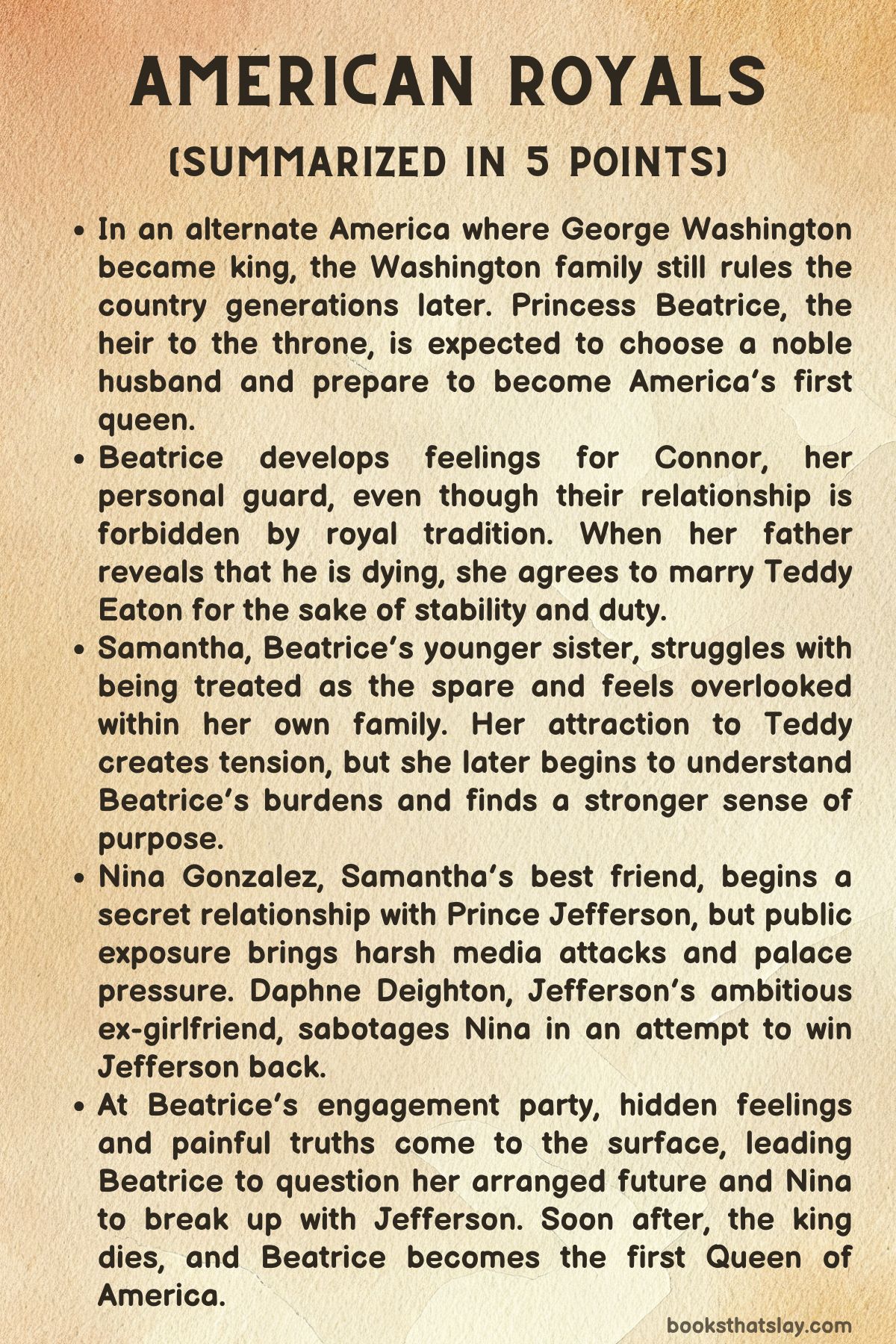
American Royals opens in an alternate America where George Washington accepted a crown, creating a royal family that still rules the country generations later. The Washingtons are now the most famous family in America, admired by the public but surrounded by secrecy, duty, and scandal.
The story follows four young women whose lives are tied to the palace: Princess Beatrice, Princess Samantha, Nina Gonzalez, and Daphne Deighton.
Beatrice Washington is the eldest child of the king and queen and is preparing to become America’s first queen in her own right. She has spent her whole life being trained for responsibility, sacrifice, and public service.
Her parents decide that she must begin looking for a husband, not because she is ready for love, but because the crown needs stability. Beatrice is expected to choose from a short list of eligible noblemen, and she understands that whoever marries her will not simply be her partner but the future king consort.
The pressure weighs heavily on her because she knows most people see her as a symbol rather than a person.
At the Queen’s Ball, Beatrice meets Lord Theodore Eaton, known as Teddy. He is kind, respectful, and far more genuine than the other suitors.
Beatrice likes him, but her real feelings are for Connor, her personal guard. Connor has become her confidant, someone who treats her like a person rather than a future monarch.
Their bond grows into love, even though both know it is forbidden by royal expectations. Beatrice’s position makes a future with Connor almost impossible, and this conflict becomes the deepest struggle of her life.
Samantha, Beatrice’s younger sister, lives in the shadow of the crown. As the spare, she is constantly compared with Beatrice but given no clear purpose.
She is lively, impulsive, and often criticized for not behaving like a proper princess. At the Queen’s Ball, Sam meets Teddy and kisses him in secret before realizing that he is one of Beatrice’s approved suitors.
When Beatrice begins dating Teddy, Sam feels pushed aside again, as though even the man she liked naturally belongs to her more perfect sister.
Nina Gonzalez, Sam’s best friend, has known the Washingtons since childhood because her mother works as the king’s chamberlain. Nina is close to Sam and Jefferson, but she is not royal, and she has always felt caught between palace life and ordinary life.
Six months before the main events, Nina and Prince Jefferson slept together at a graduation party, after which Jefferson left on a royal tour without properly speaking to her. Nina was hurt, especially because Jefferson had recently ended things with his longtime girlfriend, Daphne Deighton.
When Jefferson returns, he tries to reconnect with Nina. He apologizes for how he handled the past and asks for a chance to start over.
Nina is hesitant because she knows dating a prince would expose her to public judgment, but she still cares for him. Their relationship begins quietly, with small private moments away from the palace spotlight.
Jefferson wants to be open about them, but Nina fears the media and the class divide between them.
Daphne Deighton is Jefferson’s ex-girlfriend and the daughter of an ambitious noble family. Daphne has spent years shaping herself into the perfect future princess.
Her mother has encouraged her to climb socially, and Daphne believes she is meant to marry Jefferson. When Jefferson breaks up with her, Daphne refuses to accept defeat.
She learns that Nina may be the girl Jefferson is seeing and begins plotting to remove her as competition. Daphne presents herself as polished and charitable in public, but privately she is ruthless.
Her past also contains a dark secret involving her friend Himari, who fell into a coma after the graduation party.
During the Washington family’s New Year’s trip to Telluride, several relationships shift. Nina and Jefferson continue their romance in secret, though Daphne notices their closeness and begins planning against Nina.
Samantha spends more time with Teddy and learns that he is under pressure too. His family needs the financial and social security that a royal marriage would bring, and he feels unable to refuse Beatrice.
Sam and Teddy kiss again, confirming that their attraction is real even though he is being pushed toward her sister.
Beatrice and Connor are delayed by bad weather and forced to spend a night away from the rest of the family. Their feelings finally come into the open.
Connor admits he loves her but fears their relationship can only end badly. Beatrice asks him not to leave, and for a short time she allows herself to imagine a future based on love instead of duty.
That hope is crushed when Beatrice’s father tells her he has stage-four lung cancer and only a short time to live. He has kept the illness mostly hidden, but now he needs Beatrice to prepare for the throne sooner than expected.
He urges her to marry Teddy, believing a king consort will make her transition easier and reassure the country. Beatrice is devastated.
Although she loves Connor, she agrees to marry Teddy because she has been raised to put America before herself.
The engagement wounds everyone around her. Connor is heartbroken when he learns the news during the public announcement.
Beatrice tries to explain, but he resigns as her guard. Samantha is furious when Teddy tells her about the engagement, then confronts Beatrice and admits she has feelings for him.
Beatrice cannot reveal the full truth at first, but eventually she tells Sam about their father’s illness. The sisters finally speak honestly about their jealousy, loneliness, and pain.
For the first time, they begin to understand each other.
Meanwhile, Nina’s relationship with Jefferson becomes public after Daphne tips off the press. Nina is attacked online and in gossip columns, mocked as a commoner trying to rise above her place.
Paparazzi surround her home, and palace officials warn her about the expectations that come with dating a prince. Nina feels overwhelmed and betrayed, especially because she did not choose the spotlight.
Her friendship with Sam also suffers because Nina had hidden the relationship, and the two argue about years of imbalance in their friendship. Later, they reconcile when Nina turns to Sam for help after Daphne sabotages her dress for Beatrice’s engagement party.
At the engagement party, several truths come out. Beatrice sees Connor again and realizes she cannot continue pretending.
She decides to call off the wedding and tell her father she loves Connor. Sam offers to tell Teddy, and when she does, Teddy admits he has feelings for her too.
They kiss, choosing honesty even though their situation is complicated.
Nina confronts Daphne in the bathroom and learns that Daphne leaked the story, supplied damaging photos, and canceled her dress order. Daphne warns Nina that the royal world will never accept her.
Nina tells Jefferson, but he refuses to believe Daphne could be so cruel. Realizing that Jefferson still does not fully understand what his world costs her, Nina breaks up with him.
Beatrice tells her father she cannot marry Teddy because she loves Connor. The king is sympathetic but insists she cannot marry a commoner and remain queen.
Beatrice argues that old rules can change, but her father refuses. Their argument ends suddenly when he collapses.
He is taken to the hospital, and the royal family gathers in fear.
At the hospital, Daphne uses the crisis to move closer to Jefferson again, while Nina arrives and sees Daphne comforting him. Daphne also visits Himari and remembers the truth: she drugged Himari at the graduation party to stop her from revealing Daphne’s affair with Ethan, and Himari’s fall led to the coma.
Daphne feels guilt, but she still cannot give up her ambition.
The king briefly wakes and speaks to Beatrice. He tells her he loves her, is proud of her, and has spent his life preparing her for the throne.
Soon after, he dies. Outside the hospital, the crowd begins bowing and curtsying to Beatrice.
In that moment, she is no longer only a princess facing impossible choices. She has become the first Queen of America.
Characters
Beatrice Washington
Beatrice is the emotional and political center of American Royals, because her life is shaped almost entirely by the crown she is expected to inherit. She has been trained since childhood to think of duty before desire, and that training has made her disciplined, careful, and deeply lonely.
She is not rebellious in an obvious way; instead, her conflict is quieter and more painful. She wants to be a good queen, but she also wants to be seen as a woman with private feelings, not only as the future ruler of America.
Her relationship with Connor reveals the part of her that longs for honesty, tenderness, and personal freedom. With him, she can briefly step outside the rigid expectations of monarchy.
Yet when her father’s illness becomes known to her, Beatrice’s old conditioning returns with force. She agrees to marry Teddy not because she loves him, but because she believes the country needs stability and her family needs strength.
Her arc is about the cost of leadership, especially for a young woman who has been told that sacrifice is the highest form of love. By the end, Beatrice is still conflicted, but she has begun to question whether tradition should always control her future.
Her rise to queenship comes at a moment of grief, making her new power feel less like triumph and more like a heavy inheritance.
Samantha Washington
Samantha is defined by her position as the spare, but her story shows how painful that label can be. She is royal, privileged, and admired, yet she often feels useless beside Beatrice, whose role has always been clear.
Sam’s wildness is not just immaturity; it is also a reaction to being underestimated. She acts out because she does not know where she belongs in a family that praises discipline, duty, and public control.
Her attraction to Teddy intensifies this insecurity because he first appears to choose Beatrice, reinforcing Sam’s belief that her sister always receives what Sam wants. However, Sam is not simply jealous.
She is observant, emotionally direct, and capable of real loyalty once she begins to understand others better. Her friendship with Nina exposes her flaws, especially her tendency to treat Nina as a permanent companion without fully noticing Nina’s own struggles.
Her conversation with Beatrice about their father’s illness marks an important turning point, because she begins to see her sister not as a rival but as someone carrying an impossible burden. Sam matures by learning that she does not need to compete for the crown’s attention.
Her value lies in her warmth, honesty, and ability to connect with people in ways Beatrice often cannot.
Nina Gonzalez
Nina represents the outsider’s view of palace life. She has grown up near the Washingtons, but she has never truly belonged to their world.
This makes her one of the clearest judges of the monarchy’s emotional cost. She loves Sam and Jefferson, yet she understands that royal life can absorb people and make ordinary boundaries disappear.
Her romance with Jefferson is sincere, but it also exposes how unequal their lives are. For Jefferson, love feels like something that should be enough.
For Nina, love is constantly challenged by paparazzi, class prejudice, public cruelty, palace rules, and the assumption that she is not worthy of him. Nina’s insecurity does not come from weakness; it comes from seeing clearly how society treats commoners who enter elite spaces.
Her conflict with Sam is equally important because it forces both girls to confront the imbalance in their friendship. Nina has often been expected to orbit Sam’s life, provide support, and accept royal chaos without complaint.
When she finally speaks up, she claims her own identity. Her breakup with Jefferson is painful because it shows that love cannot survive if one person must carry all the public damage alone.
Nina’s strength lies in her refusal to become someone else just to fit beside a prince.
Daphne Deighton
Daphne is one of the most complex characters because she is both villainous and deeply shaped by the world that rewards her behavior. She has been raised to see marriage to Jefferson as the highest possible achievement, and her mother’s ambition has sharpened her into someone who treats social life like a battlefield.
Daphne is polished, beautiful, strategic, and frighteningly controlled. She understands image better than almost anyone else in the story, which allows her to manipulate the press, the public, and even Jefferson.
Her cruelty toward Nina reveals how far she will go to protect the future she believes she deserves. Yet Daphne is not motivated only by romance.
In many ways, Jefferson matters less to her than the crown he represents. Her history with Himari shows the darkest side of her ambition.
She does not intend for Himari to end up in a coma, but her decision to drug her friend proves that she is willing to harm people when they threaten her plans. Ethan sees the real Daphne more clearly than Jefferson does, which unsettles her because it challenges the perfect role she has built.
Daphne’s tragedy is that she knows she is lonely, but she keeps choosing status over truth.
Jefferson Washington
Jefferson is charming, affectionate, and far less burdened by duty than Beatrice, but his privilege often prevents him from understanding the consequences of his actions. He cares for Nina, and his feelings for her are genuine, yet he repeatedly underestimates how harsh his world can be to someone outside it.
He assumes that love can solve the problem, while Nina has to face the reality of gossip columns, social judgment, and palace pressure. His failure to believe Nina when she exposes Daphne is one of his most revealing moments.
It shows that Jefferson is still influenced by the comfort of familiarity and by the polished image Daphne has maintained for years. He is not malicious, but he is sheltered.
His relationship with Daphne also shows his weakness for avoiding uncomfortable truths. He wants peace, reassurance, and emotional simplicity, even when the situation demands sharper judgment.
Jefferson’s arc is less complete than Beatrice’s or Sam’s, but his role is important because he shows how privilege can make a decent person careless. He loves Nina, but he does not yet fully understand what loving her requires.
Teddy Eaton
Teddy is kind, diplomatic, and aware of the pressure placed on him by family expectations. At first, he appears to be a suitable match for Beatrice because he is noble, charming, and respectful.
Unlike many of her other suitors, he treats her with real consideration. However, Teddy is also trapped by duty.
His family’s financial problems make marriage to Beatrice not just romantic or political, but practical. This gives him a quiet sadness because he knows he is participating in a match that neither he nor Beatrice truly wants.
His connection with Sam reveals his more natural self. With Sam, he is less formal and more emotionally open.
Their attraction grows from shared frustration: both feel secondary to Beatrice’s destiny, and both understand what it means to be used by systems larger than themselves. Teddy’s decency appears most clearly when Beatrice breaks the engagement.
He does not punish her or expose her secret. Instead, he handles the situation with grace.
He is not a passive character, but he is a constrained one, shaped by family duty, class expectation, and the hope that he might still find real affection within those limits.
Connor
Connor represents the life Beatrice might have had if she were free to choose love without political consequences. As her guard, he is physically close to her but socially separated from her by rank, law, and tradition.
This tension defines their relationship. Connor respects Beatrice’s position, but he also sees the private person beneath the title.
He offers her companionship without calculation, which is rare in her world. His love for her is sincere, but he is not naive about the danger of their relationship.
He understands that being with Beatrice could damage her public standing and place him in an impossible role. His decision to resign after her engagement is both an act of pain and self-preservation.
When he later asks to return as her guard, it shows the depth of his attachment and the difficulty of leaving someone he loves. Connor’s importance lies in what he awakens in Beatrice: the belief that she might deserve a personal life, not only a national role.
He is also the clearest challenge to the monarchy’s class rules, because his love exposes how unfair those rules are.
Daphne’s Mother
Daphne’s mother is a major force behind Daphne’s ambition. She treats social climbing as both strategy and survival, training her daughter to view marriage as a route to power.
Her influence helps explain why Daphne thinks in terms of rank, reputation, and competition. She does not encourage emotional honesty; she encourages control.
Her advice teaches Daphne that friendship, romance, and public image are tools to be managed. This makes her partly responsible for the person Daphne becomes, though Daphne still makes her own choices.
Daphne’s mother also reflects the wider culture of the aristocracy in American Royals, where titles and proximity to the crown can matter more than morality. Through her, the story shows how ambition can be inherited, refined, and passed down like a family duty.
Ethan
Ethan is one of the few people who sees Daphne without fully believing her performance. He is sharp, cynical, and honest in a way that makes him dangerous to her plans.
Unlike Jefferson, Ethan recognizes Daphne’s intelligence, ambition, and cruelty. Their relationship is charged because he is drawn to the very parts of her that she hides from the royal world.
Ethan repeatedly tells Daphne that Jefferson will never truly know her, and he is right. His attraction to her is not based on the princess-like image she has created but on her real, complicated self.
However, Ethan is not simply a moral guide. He has his own flaws and has participated in Daphne’s secrets.
His role is to expose the emptiness of Daphne’s dream. He offers her the possibility of being known, but choosing him would mean giving up the crown she has spent her life chasing.
King George
King George is loving, dutiful, and deeply committed to the monarchy’s traditions. As a father, he cares for his children, but as king, he often places the crown above their personal happiness.
His relationship with Beatrice is especially important because he has trained her to become queen while also asking her to accept the sacrifices that come with power. His illness changes the emotional direction of the story.
Once Beatrice learns he is dying, her choices become urgent and painful. The king’s advice about marrying Teddy comes from concern, but it also shows his limits.
He believes stability matters more than romantic freedom, and he cannot fully accept Beatrice’s desire to marry Connor. His own past love for a commoner helps explain his thinking, but it does not make his decision less painful for Beatrice.
In his final moments, he gives Beatrice love, pride, and responsibility all at once. His death transforms her from heir into queen before she is emotionally ready.
Queen Adelaide
Queen Adelaide represents the polished discipline of royal life. She is composed, formal, and deeply aware of how every action reflects on the monarchy.
Her expectations for Beatrice and Samantha are shaped by public duty, and she often appears stricter with Sam because Sam resists royal rules more openly. Yet the queen is not cruel.
She believes in the structure that has governed her family and country, and she tries to prepare her children for the scrutiny they will face. Her role in the marriage discussions shows how royal motherhood is complicated by political responsibility.
She cannot simply ask what Beatrice wants; she must think about what America expects. This makes her emotionally distant at times, but it also reveals the pressures placed on women inside the monarchy.
Queen Adelaide has learned to survive by obeying the system, and she expects her daughters to do the same.
Himari Mariko
Himari’s role is mostly silent in the present, but her presence is powerful because she represents the human cost of Daphne’s ambition. Before her coma, Himari was Daphne’s friend and also a possible rival for Jefferson’s attention.
Daphne’s decision to drug her shows how competition within aristocratic circles can turn brutal when status is treated as the highest goal. Himari is important not because of what she says, but because of what her condition reveals about Daphne.
Every hospital visit forces Daphne to confront the truth she tries to bury. Himari’s coma is a reminder that Daphne’s schemes are not harmless social games.
They have real consequences, and innocent people can be destroyed by them.
Robert Standish
Robert Standish, the king’s chamberlain, represents the palace as an institution rather than a family. His interaction with Nina after her relationship with Jefferson becomes public is cold and revealing.
He does not focus on Nina’s feelings or safety; he focuses on rules, appearance, and control. He expects her to sign documents, improve her image, and adjust to royal expectations.
Through him, the story shows how the monarchy protects itself. Individuals may be kind, but the institution can still be harsh.
Robert’s role is brief but important because he makes Nina understand that dating Jefferson means entering a system that will monitor and judge her constantly.
Themes
Duty Versus Personal Freedom
In American Royals, duty often demands that characters give up the lives they privately want. Beatrice carries this burden most clearly.
She has been raised to believe that the crown must come before every personal desire, including love. Her relationship with Connor gives her a glimpse of emotional freedom, but her father’s illness pushes her back toward the role she was trained to accept.
Her engagement to Teddy is not a romantic decision; it is an act of public responsibility. This theme also affects Teddy, who feels pressured to accept a royal match because his family’s future depends on it.
Samantha experiences duty differently. She has fewer official responsibilities, but that lack of purpose leaves her feeling useless and overlooked.
Nina, as a commoner, sees duty from outside the palace and recognizes how much royal life demands from everyone near it. The story asks whether sacrifice is noble when it is chosen freely, and whether it becomes damaging when tradition leaves no real choice.
By the end, Beatrice’s decision to question the rules suggests that leadership may require more than obedience. It may also require the courage to challenge inherited expectations.
The Cost of Public Image
Public image controls nearly every relationship in the story. The royals are treated as national symbols, which means their private choices are constantly judged as public events.
Beatrice cannot simply date; she must select someone suitable for the future of the monarchy. Jefferson cannot have an ordinary relationship with Nina because the press turns their romance into a public debate about class, beauty, worth, and ambition.
Nina suffers the most direct harm from this culture. Once her relationship with Jefferson becomes public, she is insulted, photographed, compared to Daphne, and treated as if she has committed a crime by loving someone above her social rank.
Daphne understands this system better than anyone and uses it as a weapon. She knows which photos will damage Nina, which stories the press will print, and how to maintain her own polished reputation.
The theme shows that image is not shallow in this world; it has power. It can protect, punish, elevate, or destroy.
The characters who survive best are not always the kindest, but the ones who understand how to control the story told about them. This creates a society where truth matters less than presentation, and emotional honesty becomes dangerous.
Class, Rank, and Belonging
Class shapes who is considered worthy of love, power, and respect. Beatrice is expected to marry someone noble because the monarchy treats bloodline as political security.
Connor may be honorable, loyal, and loving, but his common status makes him unacceptable as Beatrice’s partner. Nina faces a similar barrier with Jefferson.
She has known the royal family for years, yet the public and the palace still see her as an outsider when she becomes romantically linked to the prince. Her commoner status makes people assume she is ambitious, manipulative, or unworthy, while Daphne’s noble background protects her despite her cruelty.
Daphne herself is obsessed with rank because she has been taught that proximity to the crown determines value. Her family’s title is not high enough for her satisfaction, so she views marriage to Jefferson as the final step in proving herself.
This theme shows how social hierarchy distorts relationships. Love becomes a question of permission.
Friendship becomes unequal. Marriage becomes strategy.
The characters are constantly measured by where they stand in relation to the throne, and those lower in rank must work harder to be believed, accepted, or respected.
Ambition and Moral Compromise
Ambition drives several characters, but the story is especially interested in what people are willing to sacrifice to get what they want. Daphne is the clearest example of ambition becoming morally corrupt.
She wants the crown so badly that she sabotages Nina, manipulates the press, lies to Jefferson, and hides her role in Himari’s accident. Her actions are extreme, but they are not random.
She has been trained to see life as a contest in which losing means becoming invisible. Her ambition gives her discipline and intelligence, but it also destroys her ability to form honest relationships.
Beatrice’s ambition is different because it is tied to duty rather than personal gain. She wants to be a good queen, yet even that honorable goal pressures her to make choices that hurt herself and Connor.
Samantha’s growth involves finding ambition beyond rebellion. She begins to understand that she can serve the monarchy in her own way, not by copying Beatrice but by using her natural ability to connect with people.
The theme shows that ambition is not automatically wrong. It becomes dangerous when status matters more than truth, love, or conscience.
The book contrasts ambition rooted in service with ambition rooted in possession.